
Your Modern Product Led Growth Strategy Playbook for 2026
Discover a modern product led growth strategy with our 2026 playbook. Learn to drive acquisition, activation, and revenue with real-world examples for SaaS.
A product led growth strategy is a business model where the product itself drives user acquisition, activation, and retention.
What Product-Led Growth Means for Your Business
Product-Led Growth (PLG) isn't just a buzzword; it's a completely different way to think about how SaaS companies grow. Instead of making sales and marketing teams the gatekeepers of value—hiding your product behind demos and long discovery calls—PLG puts the product front and center.
The idea is to let users experience your product's value directly through freemium plans or free trials. It creates a powerful, self-service engine where the product itself becomes the main driver for acquiring, activating, and retaining customers.
Essentially, you stop telling people how great your product is and start showing them. When potential customers can find value on their own terms, you build real trust and generate organic demand from the ground up.
Why PLG Is a Game-Changer for Modern SaaS
This model is a direct response to how B2B buyers operate today. They expect to do their own research and try things out before committing to a purchase. A product-led approach meets them exactly where they are, offering instant access and a smooth path to seeing what your product can do for them.
A successful PLG model transforms the entire customer journey. It stops being a linear sales funnel and becomes a continuous loop where acquisition, engagement, and expansion all happen within the product itself.
The financial upside is hard to ignore. PLG motions are proving to be a massive advantage in SaaS. In fact, every single company on Brex's list of the 50 fastest-growing software companies uses them. These businesses often see a 50-80% reduction in customer acquisition costs (CAC) compared to old-school sales-led models, where CAC can easily hit $500-$5,000 per customer. The email and lifecycle side of that motion is covered in our marketing automation for SaaS guide.
For growth teams, this changes everything. Think about it: instead of pouring budget into outbound sales, you can focus on building an experience that proves its own ROI. It’s similar to how Slack hooked users by showing them the product's value through in-app analytics, making the decision to upgrade a no-brainer.
To give you a clearer picture, here’s a quick rundown of how the two models stack up.
PLG vs Sales-Led Growth at a Glance
This table breaks down the core differences between a Product-Led Growth model and a traditional Sales-Led Growth model.
Attribute
Product-Led Growth (PLG)
Sales-Led Growth (SLG)
Primary Growth Driver
The product experience itself
Sales and marketing teams
Customer Acquisition
Freemium, free trials, self-service sign-ups
Demos, discovery calls, outbound sales
Key Metric
Product-Qualified Leads (PQLs)
Marketing-Qualified Leads (MQLs)
Sales Cycle
Short, often automated
Long, high-touch, and complex
Cost to Acquire
Low
High
User Onboarding
Automated, in-product guides
Manual, led by sales or customer success
Pricing Model
Self-service, transparent tiers
Custom quotes, requires negotiation
Ideal Customer
Users who prefer to self-educate and try before they buy
Buyers who need guided purchasing and complex solutions
As you can see, the PLG approach is built around user empowerment and efficiency, while SLG relies on human-led processes.
Reshaping Your Internal Teams
Adopting PLG isn’t just a marketing initiative—it forces a fundamental shift in how your entire company operates. It breaks down the classic silos between marketing, sales, and product, forcing them to collaborate around a single source of truth: user behavior data.
Here’s how roles typically evolve:
- Marketing stops chasing MQLs and starts focusing on driving product sign-ups and helping new users get activated. The goal becomes product usage, not just lead volume.
- Sales moves away from cold outreach and instead engages with Product-Qualified Leads (PQLs). These are users who have already hit key value milestones in the product and are showing clear buying signals.
- Product is no longer just about building features. It’s about designing an experience that smoothly guides users to their "Aha!" moment and makes upgrading feel like the natural next step.
This cross-functional alignment is absolutely essential for PLG to work. To get a deeper look at the nuts and bolts, this practical guide to Product-Led Growth offers a great breakdown of how to build, measure, and scale a PLG strategy from the ground up.
Finding Your 'Aha' Moment and Ideal Customer

Everyone thinks a great product-led growth strategy starts with the product. They're wrong. It starts with your customer.
Before you touch a line of code or design a single growth loop, you need an almost obsessive understanding of who your best user is and the one problem they need you to solve. Everything else you do is built on top of this foundation. Get this wrong, and nothing else matters.
This goes way beyond basic demographics. Company size and job titles give you some context, but a real Ideal Customer Profile (ICP) for PLG is all about behavior and intent. What do your power users do that others don't? What separates the people who stick around forever from those who churn in a week?
A newsletter platform like Breaker, for instance, might discover its true ICP isn't just "B2B marketers." It's more specific: "B2B marketers at companies with a dedicated content team who have already tried and failed with other email platforms." That behavioral detail is gold. You can dive deeper into this in our guide on what an ideal customer profile truly is.
Defining the Core Problem with Jobs to be Done
Once you have a sharper picture of your ICP, you can map it to the Jobs to be Done (JTBD) framework. It’s a deceptively simple idea that changes everything. It forces you to stop thinking about what your product is and start focusing on what your customer hires it to do.
People don’t buy a drill because they want a drill. They buy it because they want a hole in the wall.
So, what's the "hole in the wall" for your users?
- For Slack, the job wasn't to "send messages." It was to "cut down on internal email and actually feel connected to my team."
- For Dropbox, the job wasn't to "store files." It was to "get to my important documents from anywhere without carrying a USB stick."
The JTBD framework is a gut check. It forces you to focus on the user's desired outcome, not your product's feature list. A crystal-clear understanding of this core job is the first real step toward finding your product's unique value.
This empathy helps you speak your customers' language. As you work to find your 'Aha' Moment and ideal customer, you can see how this understanding shapes great content, like in these standout LinkedIn newsletter examples.
Pinpointing and Instrumenting the 'Aha' Moment
The 'Aha!' moment is that click—the breakthrough when a user finally gets it. It’s the second they understand exactly how your product solves their specific JTBD. Your single most important job in PLG onboarding is getting users to this moment as fast as humanly possible.
This isn't a fuzzy feeling. It's a specific, measurable event.
Company
The 'Aha' Moment
Slack
Sending and receiving 2,000 team messages
Breaker
Seeing the first 10 qualified subscribers automatically added to a list
Canva
Creating and downloading their first design in under 5 minutes
Once you have a hypothesis for your 'Aha!' moment, you have to prove it with data. Instrument your product analytics to track the user journey from the second they sign up to the moment they complete this key action.
Look at the cohorts of users who hit that milestone versus those who don't. You'll almost always see a massive difference in retention and conversion rates.
With that data, you can finally work backward to design your activation flow. Every single tooltip, checklist, email, and product tour should have one relentless focus: pushing the user to perform that critical action. Kill any friction that gets in the way—unnecessary form fields, confusing buttons, distracting pop-ups. Your entire product-led growth strategy depends on making that moment of clarity inevitable.
Building Your Product for Activation and Viral Growth
Alright, you know who you’re building for and what job they need done. Now for the fun part: designing a product experience that actually delivers.
In a product-led growth strategy, your product does the heavy lifting. It's your top marketer, your best salesperson, and your most patient onboarding specialist, all in one. This means growth can’t be a feature you bolt on later—it has to be baked into the user experience from day one.
The whole game is about creating growth loops. These are self-sustaining systems where your current users naturally bring in new ones. Forget the old-school funnel that just ends. A loop feeds back into itself, sparking compounding growth that feels almost automatic.
Your product is the engine. And it all starts with a killer first impression.
Designing a Frictionless Activation Flow
Activation is that magic window between a user signing up and finally getting it—the "Aha!" moment. Your mission is to make that journey as short and painless as humanly possible. Every extra click, confusing pop-up, or unnecessary field is another reason for them to bounce and never come back.
A truly great activation flow is laser-focused on one thing: delivering value, fast. It steers new users straight toward the key actions that prove your product's worth.
- Onboarding Checklists: Don't just throw a to-do list at them. Frame it as a guided path to a quick win. For a tool like Breaker, a checklist might be: "Define your first target audience," "Draft a test campaign," and "See your first 10 potential subscribers." Each step is a milestone that builds momentum.
- Contextual Tooltips: Skip the long, boring product tour nobody remembers. Instead, use smart tooltips that pop up exactly when a user needs guidance. The first time they open the email editor? A small tip can point out the AI content assistant. Simple.
- Welcome Emails and Nudges: Onboarding isn't confined to your app. Use automated emails to pull users back in if they drop off, or to celebrate small victories like completing their first task. For a deeper dive, our guide on product-led growth email tips to boost engagement is packed with actionable ideas.
This obsession with minimizing time-to-value is what separates a good product from a great growth engine. You're not just teaching features; you're engineering success.
Building Inherent Virality with Growth Loops
While a smooth activation flow keeps users around, viral growth loops bring new ones through the door. This is how you turn happy users into your most powerful acquisition channel. It works because the product itself becomes more valuable or useful when others join in.
True virality isn't a fluke marketing stunt. It’s when using your product is an act of marketing in itself. Each new user creates the conditions for the next wave of sign-ups.
You can build several types of these loops right into your product.
Three Core Growth Loops to Consider
Loop Type
How It Works
Real-World Example
Viral Loop
Users invite others directly because collaboration makes the product better.
Slack: The tool is basically useless on your own. Inviting teammates is a core step, creating exponential growth.
Content Loop
Users create public content (reports, designs) that gets found by new users via search.
Canva: Users make resumes and social posts, which get shared. This content ranks on Google, attracting new users.
Paid Loop
Revenue from one user is reinvested into paid ads to acquire the next user.
HubSpot: Customer LTV is higher than acquisition cost (CAC), letting them profitably scale their ad spend.
Canva's meteoric rise is a masterclass in combining these loops. With 260 million monthly active users and a $3.5 billion ARR, their growth is fueled by brilliant product-led execution. They built a content loop by creating templates for high-volume searches like "build an Instagram post," funneling millions of people straight into their free tool. Then, their viral loop activates when users share designs or invite team members to collaborate.
To build your own loops, think about where sharing feels natural. Can users create a shareable report? Can they embed a branded widget on their site? Does inviting a colleague unlock a feature?
By weaving these mechanics into your product, it stops being just a tool and transforms into a self-perpetuating growth machine.
Aligning Your Pricing with Product Value
Getting monetization right in a product-led growth model is a delicate dance. Gatekeep too many features, and users will never experience that critical "Aha!" moment. But if you give away too much for free, you'll end up with a large, happy user base that never converts to paying customers.
The sweet spot is aligning your pricing tiers directly with the value a user gets from your product. The upgrade should feel like the next logical step in their journey, not an arbitrary roadblock. Generic tiers like "Basic," "Pro," and "Enterprise" often miss the mark in PLG because they’re based on feature bundles, not on the job the user hired your product to do.
When a user is succeeding with your product, paying for more of it should feel like a fair trade. For a platform like Breaker, this meant moving away from a simple "per subscriber" fee. A much better, value-aligned approach is to charge per engaged subscriber. This model directly ties Breaker's revenue to its customer's success—they only pay more when their newsletter is actually growing with an active, interested audience. It’s a powerful way to build trust because your financial goals are perfectly in sync.
Choosing Your PLG Monetization Model
The right pricing model depends entirely on your product, your market, and how quickly users can find your core value. There are several proven models that work well for PLG companies, and it's crucial to understand what each one is built for.
Picking a monetization model is a foundational decision. Here's a look at the most common options and where they fit best.
Choosing Your PLG Monetization Model
This table breaks down the common PLG pricing models, their ideal use cases, and what you need to keep in mind before you commit.
Model
Best For
Key Consideration
Freemium
Products with broad appeal and network effects, like collaboration or communication tools (e.g., Slack, Trello).
You need a massive top-of-funnel to make this work. Free-to-paid conversion rates are often low (2-5% is typical), so you must have a clear, compelling reason for users to upgrade.
Free Trial
Complex B2B products where users need the full feature set to understand the value (e.g., HubSpot).
Your trial period must be long enough for users to hit their "Aha!" moment. A clunky onboarding flow can easily kill your conversion rates before the trial even ends.
Usage-Based
Infrastructure or API products where value scales directly with consumption (e.g., AWS, Twilio).
Pricing has to be predictable. Surprise bills are the fastest way to lose a customer, so clear dashboards and usage alerts are non-negotiable.
Per-User Seat
Tools designed for team collaboration where adding more members makes the product more valuable (e.g., Figma, Asana).
This can create friction. A single champion might love your tool but struggle to get budget approval to add their whole team, stalling adoption.
Each model has its trade-offs. Freemium is fantastic for capturing a huge user base, while a free trial is perfect for showing off a sophisticated product's full power. Usage-based pricing aligns cost perfectly with consumption, but per-user models can sometimes slow down viral growth inside big companies.
Designing a Seamless Upgrade Path
Once you’ve settled on a model, the next challenge is designing a frictionless path from free to paid. This is where Product-Qualified Leads (PQLs) become your North Star. A PQL isn't just someone who signed up; they're a user whose behavior shows they’re getting real value and are about to need more.
A PQL is a signal that a user has outgrown the free plan and is ready for a conversation or a self-serve upgrade. Their product usage is a better buying signal than any form-fill or lead score.
For a tool like Breaker, a PQL might be a user who has:
- Imported over 500 of their own contacts.
- Achieved a 30% open rate on three consecutive campaigns.
- Gotten close to hitting their engaged subscriber limit.
These are triggers that signal success. The user is serious, and their newsletter is working. The upgrade prompt shouldn't be an aggressive, full-screen pop-up. Instead, it should appear contextually, offering a solution at the exact moment of need.
For example, when a user tries to access a paid feature, a small, helpful modal can explain the benefit and offer a one-click upgrade. The goal is to make the transition feel like a helpful suggestion, not a frustrating dead end.
Using a Hybrid Model for Enterprise Growth
A pure product-led growth strategy is powerful, but for many SaaS companies, it’s only half the story. The most successful businesses don’t choose between product-led and sales-led; they blend them. This hybrid approach, often called product-led sales, uses a self-serve motion to build a massive user base and then layers on a targeted sales team to capture high-value enterprise accounts.
It really is the best of both worlds. You get to capture the entire market, from individual users who sign up for free to large corporations willing to sign six-figure contracts. Your self-serve product becomes a massive, low-cost lead generation engine, feeding your sales team a steady stream of highly qualified prospects who already know and love what you do.
The Product-Led Sales Flywheel
This model creates an incredibly powerful flywheel. Instead of cold calling, your sales team engages with users who are already showing strong buying signals through their product usage. This is a complete game-changer for sales efficiency.
The process usually looks something like this:
- Users sign up for your freemium or free trial product on their own.
- They activate by experiencing the product's core value—that "Aha!" moment.
- Product usage data is tracked to identify accounts hitting key engagement thresholds.
- These accounts become Product-Qualified Leads (PQLs) and are automatically flagged for the sales team.
- Sales reps reach out with a hyper-relevant, value-driven message based on the user's actual product activity.
This approach flips the traditional sales model on its head. The conversation starts with, "I saw your team just invited 20 new users and are hitting your data limit. Can I help you get more value?" instead of the classic, "Hi, have you heard of us?" For an even more targeted approach, you can learn more about how to refine your outreach with our guide on how ABM email targeting boosts lead quality.
Defining Your PQL Triggers
The core of a product-led sales strategy is defining what a PQL actually is for your business. These are the specific, measurable in-product actions that signal an account is ripe for a sales conversation. Your triggers should go beyond individual user activity and focus on account-level engagement, which is a much stronger indicator of enterprise potential.
A PQL isn't just an active user; it's an active account showing signs of organizational adoption. It’s the moment an individual's love for your product starts spreading across their company.
Here are a few examples of powerful account-level PQL triggers:
- Team Adoption: An account surpasses 5 or more active users from the same company domain.
- Feature Usage: Users from an account have started using advanced features typically associated with team or enterprise plans.
- Approaching Limits: The account is nearing its usage limits on the free or lower-tier plan (e.g., hitting 90% of their subscriber cap).
- Integration Use: An account connects your product to a key business system like a CRM, signaling it's becoming embedded in their workflow.
These triggers should automatically alert your sales reps, arming them with the context they need to have a meaningful, well-timed conversation.
The recent explosive growth of companies in the AI space really highlights the power of this hybrid model. For instance, the AI-native code editor Cursor hit $500 million ARR in under two years by first building a massive self-serve user base before even hiring a sales team. Predictions show this hybrid approach—self-serve first, then enterprise sales—is becoming the new standard, with companies seeing customer acquisition costs plummet by 50-80% as product usage data fuels expansion. You can discover more insights about these PLG predictions for 2026 on productled.com.
Your Product Led Growth Implementation Checklist
Moving a product-led growth strategy from a great idea on a slide deck to a real, working growth engine takes a methodical approach. It's not something you can just flip a switch on.
To help you get there, I’ve broken the whole process down into a simple, three-part checklist: Pre-Launch, Launch, and Post-Launch. Think of this as your playbook for getting PLG off the ground without missing any of the critical pieces.
The Pre-Launch Foundation
Before you even think about driving traffic, you need to make sure your house is in order. This first phase is all about getting your hands dirty with research, nailing down your definitions, and getting the technical bits right. Honestly, this is where most PLG initiatives fail—by skipping the homework.
- Define Your ICP and JTBD
- Why it's a big deal: If you don't know exactly who you're building for and what specific problem they're "hiring" your product to solve, you’re just guessing.
- How to nail it: Get on calls with early users. Dig into behavioral data. You need to build a data-driven Ideal Customer Profile (ICP) and crystallize their core "Job to be Done" (JTBD).
- Instrument Your 'Aha!' Moment
- Why it's a big deal: This is that magic moment when a new user truly gets the value of your product. If you can't measure it, you can't optimize for it.
- How to nail it: Use your analytics tools to find the exact sequence of actions that correlates with long-term retention. That becomes your North Star for the entire onboarding experience.
- Design a Frictionless Onboarding Flow
- Why it's a big deal: Every extra click, confusing instruction, or unnecessary form field between sign-up and the "Aha!" moment is a leak in your funnel. Friction is the sworn enemy of activation.
- How to nail it: Map out the user journey from sign-up to that first moment of value. Be ruthless. Cut every step that isn't absolutely essential. Use tooltips and an in-app checklist to guide users to a single quick win.
Launch and Activation
Once the foundation is solid, it's time to open the doors. The launch phase is all about driving that first wave of users and making sure they have a smooth path to activation. This is where all your prep work gets tested in the real world.
A successful PLG launch isn't a one-day traffic spike. It's about starting the flywheel. You want a steady stream of new users who successfully find value and begin the first turn of your growth loop.
This is especially true in a hybrid model where self-serve sign-ups eventually feed your sales team.
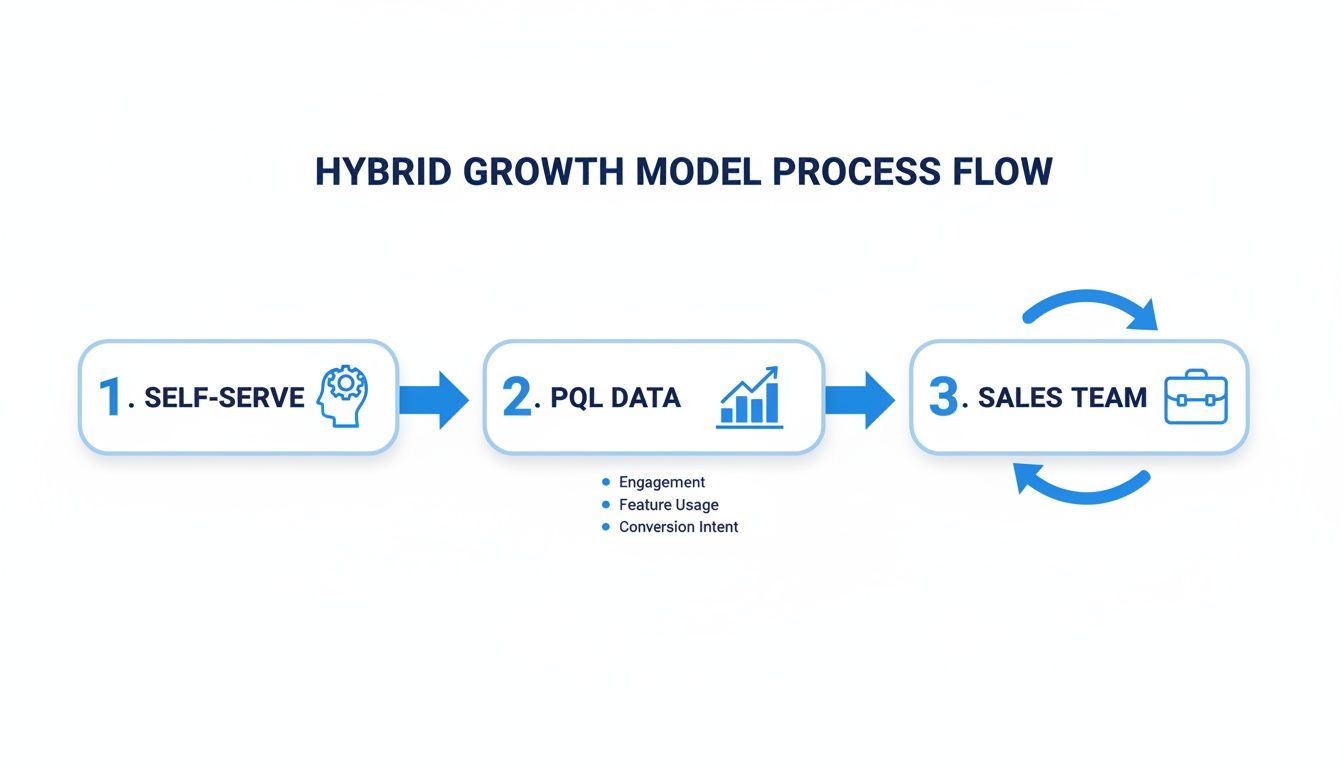
As you can see, the product usage data from your free or self-serve users is the critical signal that tells your sales team which accounts are ready for a conversation. These are your Product-Qualified Leads (PQLs).
Post-Launch: The Optimization Loop
Getting users in the door is just the beginning. The real work of growth happens after launch. This final phase is a continuous cycle of analyzing, iterating, and scaling what works.
Set PQL Triggers for Sales
- Why it's a big deal: In a hybrid model, your sales team can't just call everyone who signs up. They need clear, data-backed signals to focus their energy on accounts that are actually showing buying intent.
- How to nail it: Dig into your product analytics. Look for usage patterns that signal a team or company is getting serious. For example, a great PQL trigger could be when an account hits 5+ active users from the same corporate domain.
Monitor Key PLG Metrics
- Why it's a big deal: You simply cannot improve what you don't measure. Gut feelings don't scale.
- How to nail it: Build a dashboard that you and your team live in. At a minimum, you need to be tracking Time-to-Value (TTV), activation rate, free-to-paid conversion rate, and expansion revenue. Review these numbers weekly to spot trends and find your next big opportunity.
Iterate and Refine Growth Loops
- Why it's a big deal: Your first attempt at a referral program or a collaboration feature won't be perfect. The best growth loops are the result of constant tinkering and improvement.
- How to nail it: Use A/B testing and user feedback to obsessively optimize your growth mechanisms. Can you make sharing content easier? Can you improve the incentive for inviting a colleague? Small tweaks here can have a massive impact on your viral coefficient over time.
Got Questions About PLG? You're Not Alone.
As you start pulling the levers of a product-led growth strategy, a few questions inevitably surface. It's a sign you're on the right track—digging into the details is what separates a successful transition from a frustrating one.
Here are the honest answers to the most common questions we hear from teams just like yours.
What Metrics Actually Matter in a PLG Model?
Forget vanity metrics. In a product-led world, your focus shifts from traditional marketing analytics to user behavior and the value they get from your product.
While every business is unique, there are a few core metrics that are completely non-negotiable for any PLG playbook.
- Activation Rate: What percentage of new sign-ups actually reach that "Aha!" moment? This is your make-or-break, top-of-funnel metric. If users aren't activating, nothing else matters.
- Time-to-Value (TTV): How fast can you get a new user to that "Aha!" moment? The goal here is to shrink this number as close to zero as humanly possible.
- Free-to-Paid Conversion Rate: This is where the rubber meets the road. What percentage of your free users are pulling out their credit cards to upgrade? It’s a direct measure of how well your monetization strategy is working.
- Expansion Revenue: How much new revenue are you generating from existing customers through upgrades, add-ons, or seat expansions? This is the hallmark of a healthy, scalable PLG engine.
Tracking these numbers tells you a simple story: is your product creating real value, and are you successfully turning happy users into paying customers?
How Do We Realistically Shift from Sales-Led to PLG?
Pivoting from a traditional, sales-heavy organization doesn't happen with a flip of a switch. It's a gradual cultural shift that demands buy-in from marketing, sales, and product. The secret is to start small, prove the value, and build from there.
The biggest mistake we see? Teams treating PLG like it's just another marketing channel. It’s not. It’s a fundamental change in your entire business strategy that requires product adjustments, new team goals, and a relentless focus on the self-serve user experience.
A smart transition usually begins by introducing a freemium plan or free trial. Think of it as a lead generation engine for your sales team.
From there, you define what a Product-Qualified Lead (PQL) looks like—these are users whose in-product actions scream, "I'm ready for a sales conversation." This simple change lets your sales team stop cold calling and start talking to warm, high-intent leads who already get what your product does. The entire sales process becomes radically more efficient and effective.
Ready to turn your newsletter into a growth engine? Breaker combines an intuitive email builder with automatic list expansion to deliver engaged, exact-match subscribers. Start your 7-day trial and see real ROI today.
Keep reading
All articlesNewsletter Segmentation Strategy: Increase Engagement in 2026
Build a data-driven newsletter segmentation strategy using behavior, intent score, and topic affinity to lift opens and clicks. Step-by-step guide.
How to Grow Newsletter Subscribers with Qualified Leads in 2026
Discover 8 channels to grow engaged newsletter subscribers in 2026, with real cost-per-engaged-subscriber data to focus your list-building strategy.
B2B Lead Generation via Newsletter: What Actually Works
Cold outbound is losing steam. See 7 proven newsletter tactics for B2B lead generation, from gated content to sponsorship swaps, that beat cold outreach.