
Ultimate Guide to Retargeting for Newsletter Growth
Turn website visitors into newsletter subscribers with retargeting: tracking pixels, audience segmentation, platform selection, ad creatives, A/B tests, and KPIs.
Retargeting is a powerful way to turn website visitors into newsletter subscribers. Most visitors - 96-98% - leave without subscribing, but retargeting helps bring them back. It uses tracking pixels to show targeted ads to people who’ve interacted with your content but didn’t sign up. This strategy is especially effective in B2B marketing, where decisions involve multiple stakeholders and longer timelines.
Key takeaways:
- 70% of retargeted visitors are more likely to convert compared to non-retargeted ones.
- Retargeting ads have click-through rates 10x higher than standard display ads.
- Platforms like LinkedIn, Meta, and Google offer tools for precise audience targeting.
- Cost-effective: Retargeted clicks are 8 times cheaper than new audience clicks.
To succeed, focus on:
- Installing tracking pixels to build retargeting audiences.
- Segmenting visitors by engagement level (e.g., 0–30 days, 31–90 days).
- Choosing the right platform for your audience (LinkedIn for B2B, Meta for broader reach).
- Crafting tailored ads with clear calls-to-action and fresh visuals.
- Monitoring key metrics like CTR, CVR, and CPA to optimize performance.
Retargeting works best when aligned with the buyer's journey, offering value at every stage. Tools like Breaker can automate and simplify these campaigns, helping you grow your subscriber base efficiently.
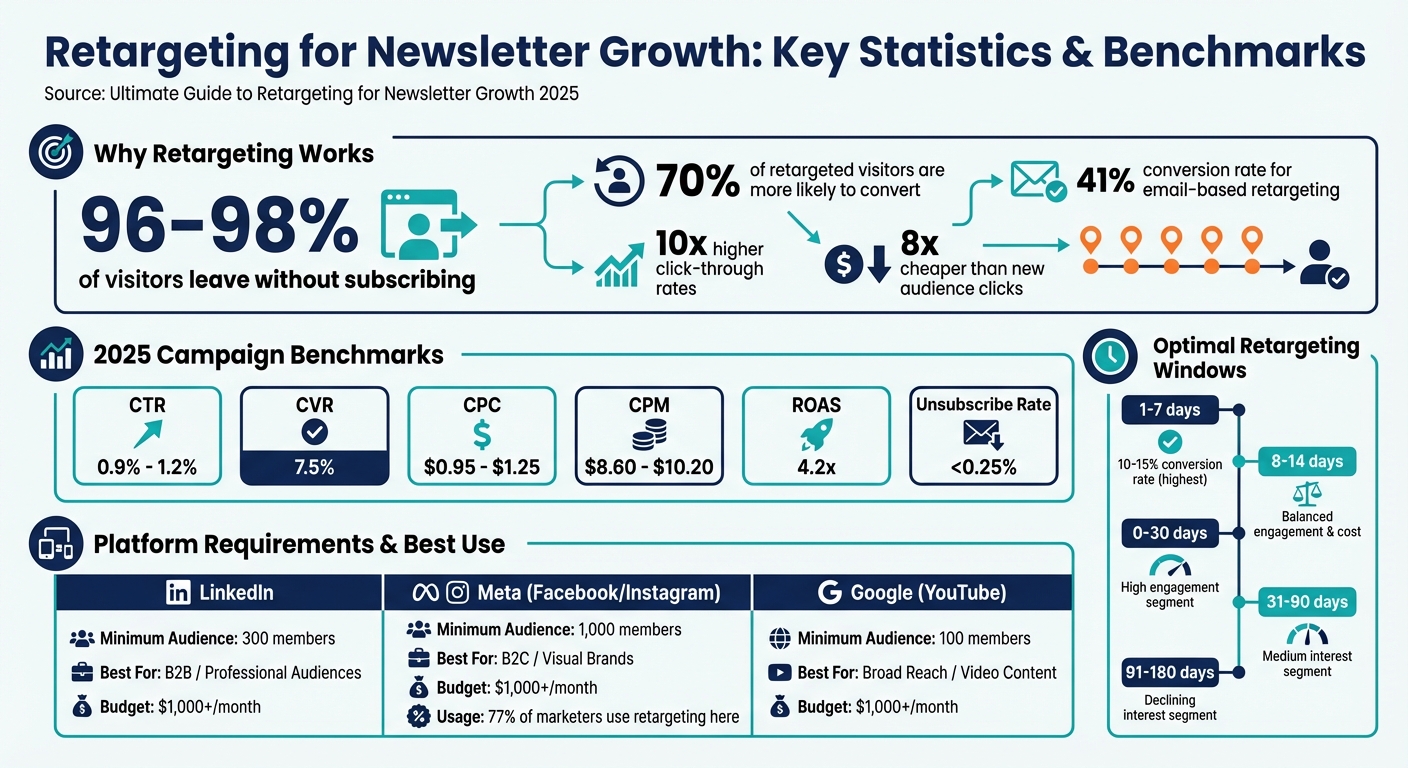
Retargeting Statistics for Newsletter Growth: Key Performance Metrics and Benchmarks
The Retargeting Strategy That Keeps Prospects Coming Back
What is Retargeting and How Does It Grow Newsletters?
This section dives into how retargeting helps re-engage lost visitors and convert them into newsletter subscribers.
Retargeting Basics
Retargeting is a method used to reconnect with visitors - those who have interacted with your website, clicked on a link, or consumed your content - but didn’t take the next step, like subscribing to your newsletter. It works by using a tracking pixel embedded in your site or links, allowing you to display targeted ads to these visitors as they navigate platforms like LinkedIn, Google, or Meta.
In the B2B space, retargeting takes on a slightly different form compared to B2C. Instead of focusing on individual consumers, B2B marketers often use account-based retargeting. This approach targets multiple stakeholders within a specific company - such as the CFO, CTO, or marketing director - to ensure your brand stays visible throughout what is often a lengthy buying process. Since B2B decisions typically involve multiple decision-makers over extended periods, retargeting plays a crucial role in keeping your brand top of mind during evaluations.
"B2B retargeting differs from B2C in the fact that the buying decisions aren't made by a single person... B2B marketers are targeting entire accounts."
- Leadfeeder
Another effective strategy is link retargeting, which attaches a tracking pixel to branded links shared on third-party platforms. This allows you to expand your retargeting efforts beyond just your website visitors.
These tools work together to create opportunities for turning interest into newsletter signups.
How Retargeting Drives Newsletter Signups
Retargeting ads serve as timely reminders for visitors already familiar with your brand - like those who have read your blog, browsed your resources, or visited high-intent pages. These ads encourage them to subscribe, effectively converting warm leads into engaged newsletter readers.
The numbers speak for themselves: retargeted visitors are 70% more likely to convert than those who aren’t retargeted. Retargeting ads also boast click-through rates approximately 10 times higher than standard display ads, and email-based retargeting can achieve conversion rates as high as 41%. Considering that it often takes 6 to 8 touchpoints to turn a lead into a viable prospect, retargeting proves to be an efficient and cost-effective way to grow your newsletter audience.
The key to success lies in aligning your retargeting campaigns with the buyer's journey. For example, during the Awareness stage, you might target blog readers with ads promoting a free industry report that requires signing up for your newsletter. As prospects move into the Consideration stage, you could offer resources like case studies or webinars to further nurture their interest.
"Retargeting isn't just about re-engaging lost leads. For B2B marketers, it's about creating meaningful touchpoints across the buyer's journey."
- Adobe Experience Cloud Team
How to Set Up Retargeting Campaigns
Retargeting campaigns are a powerful way to re-engage potential subscribers and drive newsletter signups. Here's a step-by-step guide to getting started.
Installing Tracking Pixels
The first step in setting up a retargeting campaign is adding tracking pixels to your website. These small pieces of code - like Google Tag, Meta Pixel, or LinkedIn Insight Tag - track visitor activity and build your retargeting audience. Install these as soon as possible to start collecting data on your website traffic.
Identifying Your Retargeting Audience
To make your campaign effective, segment your audience based on their behavior and engagement timeframe. Focus on users who’ve shown high intent, such as visiting your newsletter signup page, downloading a lead magnet, or watching at least 50% of a video. Divide your audience into time-based groups:
- 0–30 days: High engagement
- 31–90 days: Medium interest
- 91–180 days: Declining interest
These segments help you prioritize recent visitors, who are much more likely to convert. For instance, retargeted users are 70% more likely to convert than those who aren't retargeted.
To avoid wasting ad spend or annoying your audience, use exclusion lists. Remove users who’ve already subscribed or reached your "Thank You" page. Also, set the membership duration for your audience based on your typical conversion cycle. If most signups occur within 15 days, a 30-day retargeting window is more efficient than the default 540-day maximum.
If your audience is too small to meet platform minimums - 1,000 for Meta, 300 for LinkedIn, or 100 for YouTube - you can combine segments using "OR" logic. For example, target website visitors OR video viewers within the same timeframe to meet the required size.
Selecting Retargeting Platforms
Choosing the right platform is key to reaching your audience effectively:
- LinkedIn: Ideal for B2B campaigns, offering precise targeting options like job title, industry, and company size through Matched Audiences.
- Google Ads: Provides the largest reach, spanning Search, YouTube, Gmail, and the Display Network. This makes it a great choice for campaigns focused on volume.
- Meta (Facebook & Instagram): Perfect for visual storytelling and supports Lead Form Ads, which allow users to sign up without leaving the platform.
For effective B2B retargeting, a budget of at least $1,000 per month per channel is recommended. For smaller segments, such as form abandoners, daily budgets between $20 and $60 can work well. Notably, 77% of marketers use retargeting as part of their strategy on Facebook and Instagram, while LinkedIn remains the top choice for professional audiences.
Platform
Minimum Audience Size
Best For
Meta (Facebook/Instagram)
1,000 members
B2C / Visual Brands
300 members
B2B / Professional Audiences
Google (YouTube)
100 members
Broad Reach / Video Content
X (Twitter)
100 members
Real-Time Engagement
For the full Meta playbook, from audience targeting to creative and funnels, see our Facebook ads newsletter growth guide.
Building Newsletter Signup Campaigns
When setting up your campaign, choose a "Lead Generation" or "Conversion" objective on your platform. This ensures the algorithm focuses on driving newsletter signups rather than just clicks or impressions. Create separate ad sets for different audience segments, tailoring your messaging to match their familiarity with your brand.
To avoid overwhelming users, set frequency caps at 4 to 5 impressions per day per user. Use UTM codes in your URLs to track performance accurately. Split your budget evenly between educational content and direct signup offers - this prevents your audience from feeling bombarded with constant asks.
Keep your ads fresh by updating creatives monthly. For more personalized campaigns, upload your CRM data for list-based retargeting. This allows you to target known contacts with customized messages. Alternatively, pixel-based retargeting captures anonymous visitors as they browse, automatically adding them to your audience pool. These tactics help turn warm leads into loyal subscribers.
Creating Ad Creatives and Messaging
Ad creatives and messaging play a key role in turning visitors into subscribers. When it comes to retargeting for newsletter growth, crafting engaging visuals and targeted messages is essential for converting re-engaged leads. Once your campaign is set up, the right combination of creative content and tailored messaging can transform interest into action.
Designing Ads That Get Attention
Visual storytelling is your secret weapon against ad fatigue. Static banners often fall victim to "banner blindness", where users simply ignore them. To stand out, consider using formats like video, carousel, or collection ads, which are more dynamic and engaging. Incorporating humor, puzzles, or interactive elements into your visuals can keep your ads feeling fresh and memorable.
Dynamic ads are particularly effective. Brands like Nespresso and Monday.com have seen significant boosts in impressions and conversions by using these formats.
To combat ad fatigue, refresh your creatives monthly. Research indicates that 61% of consumers are less likely to engage when they repeatedly see the same ad. Regularly updating visuals and copy ensures your messaging stays relevant and engaging.
When it comes to balancing your creative strategy, aim for a mix of content that adds value and direct conversion offers. For B2B campaigns, splitting your budget 50/50 works well: allocate half to promoting thought leadership or educational content, and the other half to driving newsletter signups. This approach positions your brand as helpful rather than overly aggressive.
Writing Personalized Messages for Different Audiences
Once you've captured attention with compelling visuals, your messaging needs to speak directly to your audience's needs. Personalized ads are 42% more likely to convert. Tailor your copy to match the user's stage in the customer journey and their specific interests. By segmenting your audience based on behavior and timing, you can craft messages that resonate.
For users in the 0–30 day window, focus on high-intent offers with clear calls-to-action like "Subscribe for weekly insights" or "Get your free guide." These users are warm leads and ready to act. Meanwhile, for those in the 90–180 day range, shift gears to thought leadership content that keeps your brand top-of-mind. Messaging like "Learn how top marketers grow their lists" or "Discover the latest B2B trends" works well here.
Be cautious with how you reference past user behavior. Avoid phrases like "We know you saw" or "Since you looked at", as these can feel intrusive. Instead, use subtle language to address unfinished actions. For example, if someone abandoned a signup form, try messages like "Did you forget something?" or "Your free guide is waiting".
Role-based personalization is another key tactic, especially in B2B campaigns. For instance, CFOs are likely to respond to messaging focused on ROI and cost savings, while CTOs might prioritize system integration and scalability. Adjust your headlines and value propositions to align with these priorities, helping decision-makers progress through the funnel.
Audience Segment
Timeframe
Messaging Focus
High Intent
0–30 Days
Direct signup offers with clear benefits
Medium Interest
31–90 Days
Product capabilities and social proof
Declining Interest
91–180 Days
Thought leadership and educational content
Social proof is a powerful tool for building trust with warm prospects. In fact, 85% of consumers trust online reviews as much as personal recommendations. Incorporate elements like testimonials, case studies, or subscriber counts into your ad copy. For example, use phrases like "Join 50,000+ marketers who trust our weekly newsletter" or "See why industry leaders subscribe."
Testing is crucial to refine your messaging. Start with 3–5 variations of headlines, visuals, and calls-to-action, and analyze performance. If your conversion volume supports it, scale up to 10–20 variations. For instance, in December 2023, Peak Design ran a retargeting campaign for abandoned carts using a two-email sequence. The first email, sent 30 minutes after cart abandonment, achieved a 66% open rate, while the second email, sent 30 hours later, had a 59% open rate. This campaign recovered 12% of abandoned carts. Adam Saraceno, Head of Marketing, explained:
"It ends up being recovered revenue you probably wouldn't have made at all... when you consider how much you earn back compared to how much it costs to do email remarketing, it ends up being a no-brainer."
Finally, focus on benefit-driven copy. Instead of generic calls-to-action like "Sign up now", highlight the value users will gain. Try phrases like "Get your free ebook" or "Start receiving weekly insights".
Tracking and Improving Campaign Performance
Once your retargeting ads are live, it’s time to focus on metrics that genuinely reflect subscriber growth. Forget vanity stats - what matters are numbers like Click-Through Rate (CTR), Conversion Rate (CVR), Cost Per Acquisition (CPA), and Return on Ad Spend (ROAS). For 2025, the average CTR for retargeting campaigns falls between 0.9% and 1.2%, while conversion rates hover around 7.5%. These benchmarks provide a solid foundation for evaluating your campaign’s effectiveness.
For the bigger picture on compounding these gains, see our 1 million subscribers newsletter growth playbook.
Metrics to Monitor
Keep an eye on Cost Per Click (CPC), which typically ranges from $0.95 to $1.25, and Cost Per Mille (CPM), averaging between $8.60 and $10.20. For newsletter growth, pay close attention to your Unsubscribe Rate - keeping it under 0.25% signals you’re attracting subscribers who genuinely value your content.
Metric
2025 Benchmark
What It Tells You
CTR
0.9% – 1.2%
How engaging your ads are
CVR
7.5%
How many clicks convert to signups
CPC
$0.95 – $1.25
Cost efficiency per click
CPM
$8.60 – $10.20
Cost to reach 1,000 people
ROAS
4.2x
Revenue generated per dollar spent
Timing also plays a big role in performance. Visitors who see your retargeting ads within 1–7 days of visiting your site tend to convert at a 10–15% rate, while engagement and cost balance out in the 8–14 day window. As Sean Lau, a Marketing Specialist, explains:
"The faster you follow up, the more likely a visitor becomes a buyer".
You should also track engagement velocity, which measures how quickly new subscribers interact with your first newsletter. Combine this with retention curves to pinpoint any leaks in your funnel. If subscribers aren’t engaging within the first week, your retargeting ads might be pulling in the wrong audience.
By monitoring these metrics, you’ll gain actionable insights into what’s working - and where A/B testing could help fine-tune your campaigns.
Using A/B Testing to Improve Results
When your metrics don’t hit the mark, A/B testing can help you figure out what’s going wrong. This method removes guesswork and often results in a 10–25% improvement in key performance indicators. However, it’s crucial to test only one element at a time - whether it’s your headline or your image - so you know exactly what’s driving the change.
For reliable results, aim for at least 95% confidence, which usually requires a minimum of 100 conversions and 1,000 impressions per variant. Run your tests for 7–14 days to account for daily traffic patterns and differences between weekdays and weekends.
Focus your testing efforts on areas that directly influence conversions. Examples include:
- Ad creatives: Compare user-generated content (UGC) videos with static images.
- Messaging: Test role-specific copy versus broader, generic appeals.
- Audience segments: Evaluate performance in the 1–7 day window versus the 15–30 day window.
In 2025, UGC-style videos and testimonials are outperforming standard ads, delivering 2.3x higher CTR.
Start every test with a clear hypothesis. For instance: "Switching our CTA from ‘Sign Up’ to ‘Get Weekly Insights’ will boost our conversion rate because it highlights the value subscribers receive."
Another key step is setting up exclusion audiences to avoid wasting budget on people who’ve already subscribed or aren’t a good fit. During testing, refresh your creatives every 2–3 weeks, as performance tends to drop after users see the same ad more than six times.
To strike a balance, divide your budget evenly - allocate 50% to content that adds value (like thought leadership articles) and the other 50% to direct signup offers. This approach avoids overwhelming your audience with constant pitches while building trust that turns casual browsers into loyal subscribers.
Using Breaker for Retargeting and Subscriber Growth
When it comes to growing a newsletter audience, precision is everything. Breaker takes the guesswork out of retargeting by automating workflows that are often tedious and time-consuming. If you've ever manually run retargeting campaigns, you know how challenging it is to pinpoint the right audience, validate email addresses, and monitor performance across platforms. Breaker streamlines these tasks, giving you more time to focus on building a subscriber base filled with people who align with your ideal customer profile.
Automating Retargeting with Breaker
Breaker's TruSend™ algorithm simplifies audience targeting by analyzing your ideal customer profile, newsletter content, and engagement data to find B2B leads that are a perfect match. Manual segmentation can be riddled with errors - studies show that 62% of businesses face data inaccuracies of up to 40%. By using AI enrichment and proprietary data sources, Breaker identifies subscribers who are genuinely interested in your content.
In 2025, Josh Durham, CEO of Aligned Growth Media, adopted Breaker as his agency's go-to lead generation tool. Thanks to its automation capabilities, Breaker became the "#1 source of booked calls" for his company. Similarly, Peter Lohmann, CEO of RL Property Management, used Breaker to triple sponsor revenue and double community memberships, achieving over a 10X ROI.
Breaker doesn't just stop at targeting - it ensures every lead moves seamlessly from initial interest to becoming a newsletter subscriber. With a 99% deliverability rate powered by unique sending logic, the platform integrates with popular CRMs for lead nurturing to convert leads automatically. Plus, unlimited email validations are included, keeping your list clean without adding extra costs.
Optimizing Campaigns with Breaker's Analytics
Breaker offers real-time analytics to help you fine-tune your retargeting campaigns. Instead of waiting days for reports, you get instant insights into metrics like open rates, click-through rates, and engagement trends. This allows you to make mid-campaign adjustments, whether that means updating ad creatives, refining audience segments, or reallocating your budget to better-performing channels.
Metrics tracking goes beyond the basics. Breaker monitors the entire subscriber journey, including call booking rates, call attendance, and final conversion rates within B2B sales funnels. The platform boasts an average open rate of 30% and a 4% CTR - both surpassing industry standards.
Before scaling your campaigns, Breaker's B2B Newsletter ROI Calculator can help you assess your list's earning potential. By plugging in your average customer value and conversion rates, you can determine the best investment level for your next retargeting effort. With a 4.8/5 satisfaction rating from B2B marketers, Breaker has proven to be a reliable tool for turning retargeting campaigns into steady growth engines. As Davis Richardson, Advisor to Jordan Belfort, shares:
"Breaker subscribers are our best growth channel".
These automation and analytics tools make it easier to integrate sustained newsletter growth into your broader strategy.
Conclusion
Retargeting is a game-changer when it comes to converting existing traffic into a thriving newsletter audience. By re-engaging visitors who didn’t convert the first time around, this strategy can drive impressive results. Just look at the stats: retargeting can increase conversion rates by up to 70%, and its click-through rates are 76% higher than those of standard display ads.
The secret to making retargeting work lies in behavior-based segmentation and multi-touch reinforcement. These tactics ensure your brand remains visible and relevant throughout the customer journey. Whether it’s through pixel-based campaigns targeting anonymous visitors or list-based strategies aimed at reactivating cold leads, the goal is clear: send the right message at the right time - without overwhelming your audience. Automated tools make this process smoother and more efficient.
"Retargeting isn't a fallback plan. It's a powerful strategy that helps you make the most of your marketing spend." - admin, Head of Product, Yournotify
Automation takes this strategy to the next level. Tasks like managing audience segments and frequency caps can be time-consuming and resource-heavy. That’s where tools like Breaker come in, handling these processes for you. This allows you to focus on crafting messages that truly connect with your audience, all while enjoying the benefits of real-time analytics.
FAQs
What are tracking pixels, and how do they help with newsletter retargeting?
Tracking pixels are tiny, invisible bits of code tucked into emails or webpages that quietly gather data about user activity. When someone opens an email or visits a webpage with a tracking pixel, it sends information back to the marketer. This might include whether the email was opened or which links were clicked.
In the context of newsletter retargeting, tracking pixels are especially handy for observing subscriber behavior without requiring direct interaction. For instance, if a subscriber opens an email but skips clicking on any links, marketers can use that insight to follow up with emails or ads specifically tailored to their preferences. However, recent privacy updates from email providers and browsers are starting to limit the amount of data these tools can collect. As a result, marketers now face the challenge of balancing effective campaign strategies with privacy-compliant practices.
What are the best platforms for running B2B retargeting campaigns?
The best platforms for B2B retargeting campaigns are those that excel in precise audience targeting, automation, and detailed analytics. These features are key to reconnecting with prospects and guiding them through the sales funnel. Many of these platforms are specifically designed for B2B marketers, offering tools like real-time performance tracking, personalized strategies, and cross-channel integrations to boost campaign results.
Take Breaker, for instance. It’s built with B2B marketers in mind, providing features like automated lead generation, precise targeting capabilities, and high email deliverability. These tools make it easier to grow engaged subscriber lists and fine-tune retargeting campaigns.
Ultimately, the right platform will depend on your goals, but prioritize those that combine advanced targeting features with user-friendly interfaces and actionable insights.
What’s the best way to track the success of my retargeting campaigns?
To gauge how well your retargeting campaigns are performing, keep an eye on key performance metrics like engagement rates, conversion rates, and the quality of leads your efforts bring in. These numbers give you a clear picture of whether your campaigns are hitting their goals.
Leverage tools with real-time analytics to dig into user behavior. This kind of insight lets you tweak your strategy on the fly to improve results. Also, track how your campaigns are contributing to growing your newsletter subscriber list and attracting engaged, high-quality leads.
Related Blog Posts
Keep reading
All articlesGDPR Consent Requirements for Purchased Email Lists
Purchased email lists rarely meet GDPR's consent bar. Learn the legal basis rules, PECR overlap, and safer alternatives before you hit send.
7 Email Platforms With Inbox Placement Testing & Suppression
Compare 7 email platforms that combine inbox placement testing with suppression management, scored on features, pricing, and best-fit sender size.
Email Automation Workflow & Drip Campaign Data Structure
Learn the database schema behind email drip campaigns—tables, workflow states, and event logs that power reliable marketing automation.