
Multi-Channel Nurturing in Long Sales Cycles
Engage B2B buyers via email, LinkedIn, retargeting and webinars with behavioral signals, lead scoring and automation to move prospects through long sales cycles.
Most B2B leads aren’t ready to buy right away. In fact, 95% of them need time, stretching sales cycles to 6–18 months. This is where multi-channel nurturing comes in - using email, LinkedIn, retargeting ads, and webinars to stay relevant throughout the buyer's journey. Companies that master this process generate 50% more sales-ready leads at 33% lower costs, while nurtured leads make 47% larger purchases.
Key Takeaways:
Before diving into specific channels, ensure your foundation is solid with a comprehensive B2B lead generation checklist.
- Challenges: Long sales cycles with 6.8 stakeholders per deal, decision fatigue, and shifting priorities.
- Main Channels:
- Email: Automated drip campaigns and segmentation boost revenue by 760%.
- Social Media: LinkedIn drives engagement and thought leadership.
- Retargeting Ads: Re-engage the 96% of visitors who don’t buy on their first visit.
- Webinars/Content Offers: Educate prospects and signal buying intent.
- Tactics: Use behavioral triggers, lead scoring, and progressive profiling for real-time, personalized outreach.
Why It Works:
Multi-channel nurturing meets prospects where they already spend time, keeping your brand visible and trustworthy. With automation and data-driven strategies, you can deliver relevant content at the right moment, ensuring higher engagement and conversion rates.
Want to optimize your strategy? Focus on consistent touchpoints, align sales and marketing, and use tools like Breaker for automated lead generation and newsletter delivery.
Main Channels for Multi-Channel Nurturing
Email Marketing Workflows
Email continues to be the cornerstone of B2B nurturing strategies, with 73% of B2B marketers identifying it as their most effective channel. Instead of relying on generic email blasts, businesses can leverage automated drip sequences to deliver timely and relevant content. For example, if a lead downloads a whitepaper, they might receive a follow-up email with a case study a few days later, and later an invitation to a webinar.
Segmented email campaigns have been shown to boost revenue by at least 760%. Drip campaigns are designed to guide prospects through a gradual process, starting with educational content like blog posts or industry reports and moving toward more targeted offers such as product comparisons or ROI calculators. By using progressive profiling - gathering small amounts of data with each interaction - forms stay short and user-friendly while still collecting valuable insights. Plus, personalized calls-to-action perform 202% better than generic ones. These advanced drip campaign template examples show how to structure sequences for longer cycles.
While email is essential, integrating it with social media engagement can deepen connections and broaden your reach.
Social Media Engagement
When it comes to B2B social selling, LinkedIn reigns supreme. This platform allows sales teams and marketers to build genuine relationships before making a pitch. Social selling on LinkedIn focuses on fostering thought leadership by sharing industry insights, engaging with prospects’ posts, and participating in meaningful conversations. It meets buyers where they’re already researching solutions.
"LinkedIn gives us the unique opportunity to target exactly who we want. And the lead quality from Sponsored Content is higher than other social platforms we advertise on." - James Carroll, Team Lead, Paid Social, Tableau
LinkedIn’s advanced targeting capabilities make it a perfect complement to email workflows, helping you reach decision-makers within their professional network. 47% of B2B marketers report social media as an effective nurturing tool, especially during the middle stages of a long sales cycle when maintaining visibility and engagement is critical.
Paid Ads and Retargeting
Did you know that 96% of website visitors aren’t ready to buy on their first visit? That’s where retargeting steps in. By placing tracking pixels on your site, you can show tailored ads to visitors who’ve already expressed interest but haven’t yet converted. Platforms like LinkedIn and Google allow you to serve these ads in a way that keeps your brand front and center - without being overbearing. Ads aligned with user behavior can generate 10x higher click-through rates compared to standard display ads. And with LinkedIn ads starting at just $10 per day, retargeting can fit a variety of budgets.
Interactive formats like webinars and gated content can further enhance your nurturing efforts.
Paid social can also feed the top of the funnel directly. Our guide to Facebook ads for newsletter growth covers targeting and lead forms for B2B.
Webinars and Content Offers
Webinars are a powerful way to combine education with real-time interaction. They provide prospects with an opportunity to ask questions, see your product in action, and hear directly from experts - all in a low-pressure environment. For businesses with long sales cycles, webinars are especially effective during the consideration stage, when buyers are comparing options and seeking detailed validation.
Gated content - such as whitepapers, ebooks, and ROI calculators - offers value while capturing key intent signals. For instance, when a prospect downloads a technical integration guide, it’s a strong indication they’re seriously evaluating your solution. The key is to align content with each stage of the funnel: educational blog posts for awareness, case studies for consideration, and product demos for decision-making. To maximize your efforts, you can repurpose a single webinar into blog posts, social media clips, and downloadable checklists, ensuring consistent messaging across all channels.
Together, these channels create a cohesive nurturing framework that works seamlessly with automation tools to deliver results.
INBOUND 2016: Sahil Jain - "Multi-Channel Lead Nurturing"
How to Build Multi-Channel Nurturing Strategies
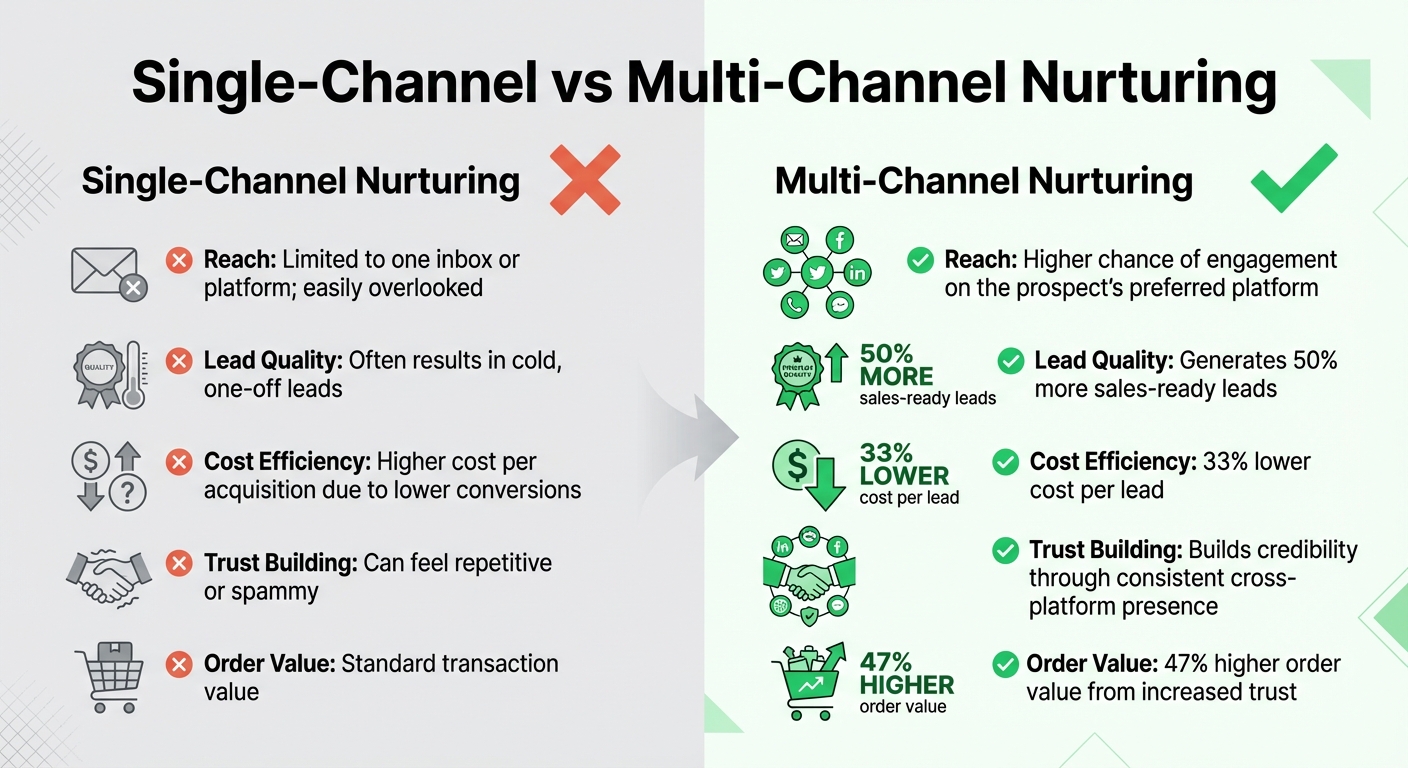
Single-Channel vs Multi-Channel Nurturing: Performance Comparison
Mapping Touchpoints Across Channels
To create an effective multi-channel strategy, you need to align your touchpoints with the prospect's journey. With nearly 70% of the buying journey happening before a prospect even contacts sales, it’s critical to ensure your touchpoints work seamlessly together across all platforms.
One approach to streamline this process is the 3-3-3 Framework: three time periods (ramp-up, active promotion, follow-up), three key messages, and three primary platforms. For example, you could combine email workflows with LinkedIn engagement and retargeting ads - a mix that complements each channel without overwhelming your team or prospects.
Consistency is key. Whether it’s a LinkedIn post, an email, or a retargeting ad, your messaging should feel like a natural continuation of the conversation, not disjointed pitches from different sources [21, 23].
Here’s a quick comparison between single-channel and multi-channel approaches:
Feature
Single-Channel Nurturing
Multi-Channel Nurturing
Reach
Limited to one inbox or platform; easily overlooked
Higher chance of engagement on the prospect's preferred platform
Lead Quality
Often results in cold, one-off leads
Generates 50% more sales-ready leads
Cost Efficiency
Higher cost per acquisition due to lower conversions
33% lower cost per lead
Trust Building
Can feel repetitive or spammy
Builds credibility through consistent cross-platform presence
Order Value
Standard transaction value
47% higher order value from increased trust
A great way to start is with a 30-day sequence. For instance, send a welcome email on Day 1, follow it up with a LinkedIn connection request on Day 5, launch retargeting ads on Day 14, and send a personalized direct mail piece by Day 18. Considering it takes an average of 13 to 18 touchpoints to schedule a meeting with a new prospect, this cadence ensures your outreach feels steady but not overwhelming.
"You wouldn't toss a bag of kernels into the microwave and expect them all to pop at the exact same time... Leads work the same way. Some will pop early, but most take time."
– Laura Johns, CEO, The Business Growers
Static segments won’t cut it for long B2B sales cycles. Prospects’ interests and behaviors shift over time, so it’s crucial to adjust your segmentation monthly. For instance, someone who downloaded an awareness-stage whitepaper in January might be actively comparing vendors by March. Your touchpoints need to evolve with them.
Next, let’s explore how automation and behavioral triggers can make your strategy even more effective.
Using Automation and Behavioral Triggers
Relying solely on time-based sequences is outdated. Instead, behavioral triggers allow you to respond in real time, based on what prospects actually do. This approach ensures your outreach is relevant and timely. For example, if someone visits your pricing page, downloads a case study, or opens multiple emails within a short period, these actions can trigger an immediate and tailored response [3, 24].
Behavioral trigger emails achieve open rates of 42.36%, far surpassing the 14.5%–26.9% range for standard broadcast emails. Why? Because they address what the prospect is actively considering. If a lead visits your integration documentation page, an automated system could send them a technical guide or prompt a LinkedIn message from your solutions engineer - delivering exactly what they need.
Take HubSpot as an example. By using behavioral triggers, they monitor actions like ebook downloads and then activate follow-up sequences with related tips and templates. This approach has led to response rates 4–10 times higher than generic emails. Similarly, Cleverly combined LinkedIn outreach with tailored email sequences for over 10,000 clients, generating $312 million in pipeline revenue.
The secret lies in branching logic. Design workflows that adapt based on engagement. For instance, if a lead goes quiet after two emails, shift to lighter educational content like a blog post or industry report. On the other hand, if they show high activity - like multiple website visits in a week - accelerate to product offers or trigger a sales handoff [4, 5].
Set clear criteria for when automation should pass a lead to sales. Many companies use a point system, such as 70 points, based on behaviors like webinar attendance, pricing page visits, or email clicks. In fact, 62% of B2B revenue teams now use AI-powered intent signals to prioritize these handoffs and tailor content dynamically.
"83% of those customers only want to hear from you if you are able to be relevant and contextual."
– Salesforce/IDC Study
Another powerful tactic is progressive profiling. Instead of asking for all details upfront, collect information gradually. Start with basics like name and email, then gather more specifics - like company size or job role - through subsequent interactions. This keeps forms short and user-friendly while building a more complete profile over time. Unsurprisingly, 78% of marketers report improved lead quality with this method.
Automation doesn’t replace human interaction; it ensures that your team engages at the right moment with the right message. Companies using automated nurturing see 50% more sales-ready leads at a 33% lower cost [1, 24, 5]. Plus, nurtured leads tend to make 47% larger purchases [1, 24]. It’s the difference between guessing when to connect and knowing exactly when to reach out.
Measuring and Improving Multi-Channel Strategies
Key Metrics for Tracking Success
If you want to truly measure the effectiveness of your multi-channel strategy, focus on metrics that show progression. In long B2B sales cycles, relying on vanity metrics like email open rates won’t give you the full picture. Instead, track how leads move through your pipeline and get closer to making a purchase.
"Lead nurturing success should be reframed around progression, not just conversion."
– Carly Miller, Madison Logic
Start by aligning your metrics with the buyer's journey. During the Awareness stage, monitor impressions, website visits, and email opens to measure how far your reach extends. In the Consideration stage, track click-through rates (CTR), webinar attendance, and time spent on product pages to assess genuine interest. When leads reach the Decision stage, key metrics include opportunities created, MQL-to-SQL conversion rates, and time-to-conversion - these help you evaluate your pipeline's health.
Here are some benchmarks to keep in mind: open rates of 20–25%, click-through rates of 2–5%, and Lead-to-MQL conversion rates of 10–15%. If your numbers fall short, it’s time to dig into your strategy and identify what needs adjusting.
Another critical tool for long sales cycles is multi-touch attribution. This approach ensures you’re not just crediting the final interaction but understanding how various channels - like email, LinkedIn, webinars, and retargeting ads - work together to close deals. Multi-touch attribution helps you pinpoint the most effective combinations.
Engagement scoring is another way to prioritize leads. Assign points based on behaviors that indicate intent. For example, visiting a pricing page might earn 15 points, while reading a blog post might be worth 3 points. Many companies use a scoring threshold (e.g., 70 points) to determine when a lead is ready for a sales handoff, allowing the team to focus on the most promising prospects while continuing automated nurturing for others.
Buying Stage
Key Metrics to Track
Purpose
Awareness
Impressions, Website Visits, Email Opens, Ad Engagement
Measure brand visibility and reach.
Consideration
CTR, Webinar Attendance, Time on Product Pages, Engagement Score
Assess interest and intent.
Decision
Opportunities Created, MQL-to-SQL Rate, Time-to-Conversion
Evaluate pipeline impact and sales velocity.
Post-Sale
Retention Rate, Upsell/Cross-sell Revenue, Churn Rate
Measure long-term customer value.
To stay on top of your strategy, establish a review schedule that matches your sales cycle. Check early-stage metrics like opens and clicks weekly, mid-funnel metrics like webinar attendance monthly, and bottom-funnel metrics like deal velocity quarterly. This regular analysis allows you to fine-tune your efforts as you go.
Refine Your Strategy
Once you’ve nailed down your key metrics, focus on identifying where leads tend to stall. Marketing automation platforms often provide drip reports that highlight drop-off points. For instance, if engagement drops sharply after the third email in your sequence, it’s a sign to test new content, adjust timing, or rethink your call-to-action (CTA).
When testing, change one variable at a time - like subject lines, CTA wording, or content format. For example, if your current CTA, "Learn More", only yields a 2% click rate, try alternatives like "See How It Works" or "Get the Guide" to see if a more specific prompt resonates better.
"53% of buyers stop engaging as soon as content becomes irrelevant."
– Cone Consumer New Media Study
Revisit your audience segments monthly and adjust your approach based on their evolving engagement. A lead who downloaded an introductory whitepaper in January might be ready for more advanced content by March. If you’re still sending them beginner-level materials, you risk losing their attention. Multi-touch attribution data can help you identify which channel combinations perform best, so you can focus your resources where they’ll have the most impact.
Maintaining a clean database is also essential. On average, 25% of email subscribers are lost each year due to attrition. For leads that have been inactive for 90 days, consider triggering a re-engagement campaign or removing them to ensure your metrics remain accurate and your deliverability stays intact.
Finally, establish a strong feedback loop with your sales team. Regularly review which leads are converting and which are being rejected. If sales frequently pushes back on your MQLs, it may be time to adjust your scoring criteria or the handoff threshold. When marketing and sales are aligned on what qualifies as "sales-ready", companies can generate 50% more sales-ready leads while reducing acquisition costs by 33%.
Don’t forget to keep an eye on your LTV:CAC ratio (Lifetime Value to Customer Acquisition Cost). A healthy ratio is 3:1, meaning each customer should generate three times what you spent to acquire them. If your ratio dips below this, it’s a signal to optimize underperforming channels or refine your targeting efforts.
Using Breaker for Newsletter Automation in Multi-Channel Nurturing
Automating Lead Generation
Breaker simplifies subscriber acquisition by automating the process of finding and engaging leads that perfectly match your target audience. These highly relevant subscribers seamlessly integrate into your nurture programs, ensuring a steady flow of qualified leads while keeping existing prospects engaged. The platform works effortlessly with email, LinkedIn, and retargeting strategies, creating a cohesive lead generation system.
To keep your campaigns running smoothly, Breaker offers unlimited email validation, which keeps your subscriber list clean and improves deliverability. This is especially important during 30–90 day drip campaigns, where maintaining a strong sender reputation ensures your messages land in inboxes instead of spam folders.
"Lead nurturing is about playing the long game. Stop expecting every lead to convert immediately and start building a system that keeps you top of mind until they're ready to buy."
– Laura Johns, CEO, The Business Growers
Breaker’s CRM integrations take the hassle out of data management by automatically syncing lead data across systems. This ensures every touchpoint is tracked without manual input, making it easier to coordinate multi-channel outreach. By automating lead acquisition and data flow, you’re also set up for seamless real-time performance tracking.
Real-Time Performance Analytics
Once your leads are in the pipeline, understanding how they interact with your campaigns becomes crucial. Breaker’s analytics dashboard gives you instant access to performance data, helping you track drip program progression in real time. Metrics like bounce rates, click-through rates, and prospect movement through nurture stages are all available at a glance. This makes it easy to adjust and optimize your strategy across all channels to maintain consistent engagement.
The platform also highlights high-intent behaviors, such as multiple email opens in a short period or interaction with specific content. For instance, if a lead downloads a case study or visits your pricing page after receiving a newsletter, you’ll know immediately. These insights allow you to trigger timely sales alerts or tweak your nurture sequences to keep the momentum going.
With Breaker’s analytics naturally integrating into your existing measurement tools, you can quickly identify weak points in your campaigns. Whether it’s fine-tuning subject lines, adjusting send times, or refining your content, the real-time data lets you make impactful changes without waiting weeks to see results.
Building and Delivering Personalized Newsletters
Breaker’s user-friendly newsletter builder empowers you to create tailored content that aligns with your prospects’ stage in the buying journey. Considering that 72% of B2B buyers expect personalized engagement, generic newsletters just won’t cut it. The platform makes it easy to use CRM segmentation for lead nurturing emails and deliver messages that resonate.
With support for unlimited users, Breaker encourages seamless collaboration. Your team can work together on different nurture tracks, crafting educational content for early-stage leads while focusing on ROI-driven messaging for those closer to making a decision. This flexibility ensures every segment of your audience receives content that speaks directly to their needs.
Breaker’s plans, which include options for up to 50,000 or 250,000 monthly sends, allow you to maintain consistent communication throughout long sales cycles without worrying about volume limits. Plus, the platform’s deliverability management ensures your messages reach their intended audience, keeping your nurture efforts effective over time. Combined with real-time analytics, these personalized newsletters round out a well-integrated multi-channel nurturing strategy.
Conclusion and Key Takeaways
Summary of Best Practices
Multi-channel nurturing is a powerful way to boost engagement and improve results over long sales cycles. For B2B companies dealing with extended sales processes, creating coordinated touchpoints across platforms like email, LinkedIn, retargeting ads, and content offers ensures you stay relevant. Behavioral triggers play a key role in this, helping you deliver the right message at the right time. Here's a compelling stat: companies that excel in lead nurturing see 50% more sales-ready leads while cutting costs by 33%, and nurtured leads tend to make purchases that are 47% larger than those from non-nurtured leads.
To succeed, it's crucial to align your sales and marketing teams on what defines a qualified lead. Tailor your content to meet the needs of prospects at different stages of their journey. Lead scoring can help you identify when a prospect moves from passive research to active consideration. When it comes to email campaigns, timing matters - space them out between six and 30 days to stay visible without overwhelming inboxes. Use automation thoughtfully, incorporating branching logic that adjusts messaging based on how prospects interact with your content. For instance, direct engaged users to product details and guide less responsive leads to educational resources. Given that sales cycles often stretch between six and 12 months, it's essential to regularly review and refine your audience segments to adapt to changing priorities. These practices lay a solid foundation for implementing an effective multi-channel nurturing strategy.
Next Steps for Implementing Multi-Channel Nurturing
Start simple. Launch an automated workflow like a welcome email series or a campaign designed to keep your brand top of mind, and then build on that foundation. Audit your existing content to identify gaps at each stage of the buyer's journey, from initial awareness to final validation. Remember, half of your leads won't be ready to make a purchase right away, so planning and creating content that aligns with their timeline is crucial.
To put these strategies into action, consider tools like Breaker's automated newsletter platform. Specifically designed for B2B marketers, Breaker offers features like automated lead generation, precise audience targeting, and real-time performance analytics. Its intuitive newsletter builder makes it easy to craft personalized emails that adapt to prospect behavior. This ensures you engage the right audience while maintaining high deliverability rates - even throughout long and complex sales cycles. Learn more about how Breaker can enhance your multi-channel approach at Breaker.
FAQs
How does multi-channel nurturing help reduce sales cycle costs?
Multi-channel nurturing can significantly cut down sales cycle costs. It achieves this by generating 50% more sales-ready leads and trimming overall expenses by around 33%. By connecting with prospects across various platforms, it reduces inefficient outreach and accelerates conversions, making your sales approach both smarter and more budget-friendly.
How does LinkedIn contribute to B2B multi-channel nurturing?
LinkedIn plays a key role in B2B multi-channel nurturing by connecting marketers with decision-makers in a professional environment. With tools like Sponsored Content, Sponsored Messaging, and Dynamic Ads, LinkedIn allows businesses to deliver personalized and highly targeted messages directly to prospects' feeds or inboxes. These interactions help keep your brand visible throughout longer sales cycles.
Its advanced targeting options - like filtering by industry, job title, or company size - make LinkedIn a powerful platform for segmenting audiences in long-cycle deals. The platform works seamlessly alongside email campaigns, supports retargeting for prospects who’ve already engaged with your content, and facilitates direct conversations through messaging. By integrating LinkedIn into your strategy, you can maintain consistent engagement and add a professional, social layer to your outreach, nurturing leads effectively until they’re ready to move forward.
How can behavioral triggers improve lead nurturing strategies?
Behavioral triggers are automated responses that kick into action based on specific activities a prospect takes - like checking out a pricing page or clicking a link in a newsletter. These triggers turn static outreach into a dynamic, tailored experience by delivering the right content precisely when a prospect shows interest. This real-time responsiveness is especially valuable in long B2B sales cycles, helping to keep leads engaged and moving forward by addressing their needs as they arise.
By tying messaging to observable actions, behavioral triggers make segmentation and scoring more precise. For instance, if a lead frequently views case studies, they can be categorized in the "consideration" phase, while someone engaging with blog posts might stay in the "awareness" stage. This targeted approach not only improves engagement and conversion rates but also ensures that prospects get relevant content without overwhelming or losing their interest.
Platforms like Breaker take full advantage of behavioral triggers to streamline lead generation and targeting. For example, when a subscriber interacts with a Breaker newsletter, the platform can instantly adjust their score and send follow-ups through the best channel - whether that’s email or social ads. This creates consistent, timely touchpoints that keep prospects engaged and help generate high-quality leads throughout lengthy sales cycles.
Related Blog Posts
Keep reading
All articlesHow to Write a Newsletter with AI: Step-by-Step Guide 2026
Learn how to write a newsletter with AI the right way: a 7-step process to train, calibrate, and edit AI drafts that still sound like you.
How to Boost Conversions With Your Email Newsletter
Turn your newsletter into a conversion engine. See 2026 benchmarks, CTR vs CVR explained, and the fixes most email guides skip.
Drip Campaign Template: Ready-to-Use Email Sequences
Get 6 ready-to-paste drip campaign templates with subject lines, body copy, and send timing—plus a step-by-step guide to building your own.