
5 Audience Segmentation Strategies for B2B Email
Target B2B prospects with industry, journey-stage, engagement, firmographic, and behavior-based email segments to boost opens, clicks, and conversions.
Audience segmentation in B2B email marketing helps you deliver the right message to the right people, improving engagement and driving better results. Here’s a quick summary of the five key strategies:
- Segment by Industry: Tailor content to address specific challenges and priorities of industries like healthcare or finance.
- Segment by Buyer Journey Stage: Match your messaging to where prospects are - whether they’re problem-aware or ready to buy.
- Segment by Engagement Level: Group contacts by activity (active, moderate, dormant) to refine your campaigns and boost results.
- Segment by Company Size and Role: Customize emails based on company size and decision-maker roles to address unique concerns.
- Segment by Behavioral Actions: Use real-time actions (e.g., downloads, page visits) to deliver timely, relevant content.
These strategies ensure your B2B email personalization efforts resonate with your audience, increasing open rates, click-throughs, and conversions. Tools like Breaker simplify the process by automating segmentation and tracking engagement, saving you time while optimizing results.
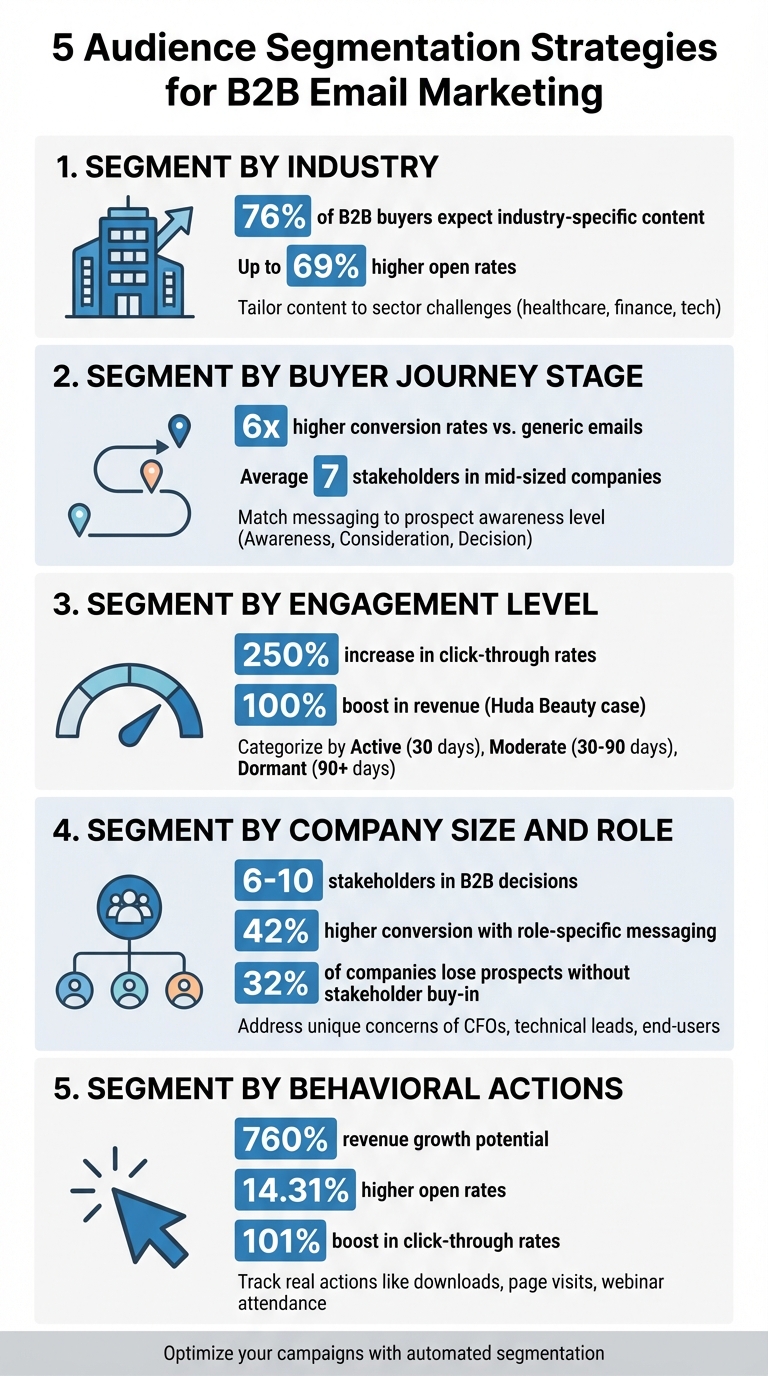
5 B2B Email Audience Segmentation Strategies with Key Statistics
Master B2B/B2C Email Marketing by Segmenting, Targeting, and Measuring Success | Make Sales not Spam
1. Segment by Industry
Organizing your contacts by industry - such as healthcare, finance, manufacturing, or technology - allows you to address the specific challenges each sector faces. This approach, often guided by firmographics, ensures your messaging resonates with the unique priorities of each industry. Regulated sectors need their own playbook, which is why we cover email marketing for healthcare separately, including HIPAA-safe segmentation.
Take healthcare, for instance. Organizations in this sector are deeply focused on HIPAA compliance and securing patient data. On the other hand, financial services prioritize regulatory reporting and combating fraud. By tailoring your content to these pain points and using industry-specific language and benchmarks, you can create material that truly connects. In fact, 76% of B2B buyers expect content to address their industry's specific needs, and 73% want companies to demonstrate an understanding of their unique business expectations.
To gather this industry-specific data, use tools like sign-up forms, LinkedIn profiles, or CRM integrations. Platforms like Breaker make this process easier by using real-time analytics and precision targeting to automatically assign new subscribers to the right industry segments. As your campaigns grow, you can start with broad categories like "Healthcare" or "Finance" and later refine these into smaller sub-segments based on engagement metrics.
This kind of segmentation pays off. Campaigns tailored to specific industries can achieve up to 69% higher open rates. Moreover, industry-focused emails can help you predict buying behaviors and system preferences. By addressing regulatory concerns and leveraging industry benchmarks, your content becomes not only relevant but also a valuable tool for moving prospects through the B2B lead generation funnel.
It’s also crucial to align your messaging with decision-makers. For example, finance teams may respond well to content that demonstrates ROI, while technical leads might prioritize ease of implementation. With 32% of B2B companies losing prospects due to a lack of buy-in from all decision-makers, targeted industry messaging can help bridge this gap and ensure your message resonates across the board.
Once you've segmented by industry, the next step is to refine your strategy further by focusing on the buyer's journey stage.
2. Segment by Buyer Journey Stage
Every contact is at a different point in their buying journey - some are just starting to recognize a problem, while others are ready to make a purchase. By segmenting your audience based on their journey stage, you can ensure your message resonates with where they are. For instance, early-stage prospects may benefit from educational content, while those closer to buying might find ROI calculators or case studies more useful.
You can track behaviors like website visits, form submissions, email opens, and resource downloads to understand intent. For example, if someone downloads a beginner's guide, they’re likely aware they have a problem but haven’t identified a solution yet. On the other hand, a contact repeatedly visiting your pricing page is product-aware and may just need a little encouragement to convert. Tools like lead scoring can simplify this process by assigning numerical values to these actions, automating their categorization.
Tailored campaigns based on these stages are highly effective - delivering conversion rates up to six times higher than generic email blasts. This is especially critical for B2B businesses, where buying cycles are often lengthy and involve an average of seven stakeholders for mid-sized companies. Sending the same message to a CFO focused on ROI and a technical lead evaluating implementation isn’t just ineffective - it’s a missed opportunity. Each role and stage demands content that speaks directly to their needs.
Breaker streamlines this process by integrating with CRMs and using real-time tracking to automatically move contacts into the right segment. This ensures timely follow-ups and makes it easier to manage large-scale B2B campaigns with thousands of contacts spread across different journey stages.
To align your content with these stages:
- Problem-aware prospects: Share educational resources like blogs, guides, or explainer videos.
- Solution-aware prospects: Provide product overviews, webinars, or comparison sheets.
- Product-aware prospects: Offer case studies, testimonials, or ROI calculators.
- Most-aware prospects: Focus on trials, demos, or personalized consultations.
3. Segment by Engagement Level
Not all email subscribers interact with your content in the same way. Engagement segmentation helps you categorize your audience based on behaviors like open rates, click-through rates, and how often they respond. This allows you to fine-tune your messaging to match each group's level of activity.
Start by creating clear engagement tiers: Active (engaged in the last 30 days), Moderate (engaged 30–90 days ago), and Dormant (no activity for over 90 days). Why does this matter? Engagement-based segmentation can increase click-through rates by as much as 250%. These tiers give you a solid foundation for making targeted and measurable changes to your campaigns.
Take Huda Beauty as an example. In July 2024, the company faced a decline in year-over-year performance. To address this, CRM and Loyalty Manager Phuong Ngo limited regular email campaigns to subscribers who had interacted within the past 120 days. Full-list emails were reserved for major annual sales. The result? A 100% boost in year-to-date revenue from their marketing platform. This approach also helped improve email deliverability since Internet Service Providers (ISPs) favor emails with higher engagement rates.
Tools like Breaker make this process easier by automatically syncing real-time behavioral data and adjusting segments dynamically. Here’s how you can tailor your efforts for each group:
- Active subscribers: Keep them engaged with frequent updates and clear calls-to-action.
- Moderately engaged contacts: Share valuable content or surveys to rekindle interest.
- Dormant users: Launch re-engagement campaigns with irresistible offers. If they remain unresponsive, consider removing them to maintain a healthy email list and reduce bounce rates.
A tiered strategy works best. Devote 70% of your campaigns to your most engaged profiles, 20% to a broader audience, and just 10% to your entire list for major announcements. This ensures your efforts are focused where they’ll have the most impact.
4. Segment by Company Size and Role
B2B buying decisions are rarely made by just one person - they often involve 6 to 10 stakeholders, each with their own priorities and concerns. For instance, while a CFO might focus on ROI and overall financial impact, a technical lead will likely prioritize ease of implementation and integration capabilities. To effectively engage all stakeholders, it's crucial to tailor your messaging to address their specific needs.
Segmenting your audience by company size (like employee count or annual revenue) and job role allows you to craft messages that resonate with each decision-maker. For example, enterprise buyers often look for solutions that are scalable, secure, and easy to integrate, whereas SMBs tend to prioritize affordability, quick implementation, and immediate ROI. Research shows that 75% of enterprise buyers prefer content tailored to their business size and complexity, and role-specific messaging can boost conversion rates by 42%.
Engaging all key decision-makers has a direct impact on revenue. According to marketers, 32% of B2B companies lose prospects from their pipeline when not all stakeholders are actively involved. Addressing the unique concerns of every stakeholder not only keeps deals on track but also strengthens your overall approach. This firmographic segmentation enhances earlier strategies and ensures your outreach remains targeted and effective.
Building on journey and engagement segmentation, refining your messaging by company size and role adds another layer of precision. For instance, tools like Breaker can sync firmographic data from your CRM and use dynamic tags to adapt content based on updated role or company information. Collecting job titles and company details through sign-up forms lets you create tailored content tracks. For executives, you might deliver summaries and business cases; for mid-level managers, detailed feature guides; and for end-users, practical tutorials. Exclusion strategies can also help you filter out contacts who aren’t decision-makers.
Dynamic segmentation eliminates the need for manual list updates. This is especially important since 56% of people unsubscribe when content feels irrelevant. Keeping your data accurate and your content relevant not only improves engagement but also safeguards your sender reputation. Email providers tend to reward emails that generate positive interactions, ensuring better deliverability and long-term success.
5. Segment by Behavioral Actions
Behavioral segmentation focuses on actual actions rather than assumptions about who your audience is. For example, when someone downloads a whitepaper, attends a webinar, or repeatedly visits your pricing page, these behaviors reveal their stage in the buying process and what they care about most. Unlike demographic guesses, this approach relies on real, measurable actions, making it far more reliable.
The results speak for themselves: segmented campaigns can drive up to 760% revenue growth, achieve 14.31% higher open rates, and boost click-through rates by 101%.
"Marketers rely mostly on permanent data like age and sources, while behavioral data is often more accurate and less biased",
explains Rui Nunes, Founder of SendXmail.
With the right tools, implementing behavioral segmentation becomes straightforward. For instance, Breaker automatically tracks user interactions across emails, landing pages, and websites. Using tags and triggers, it groups audiences based on their actions - like downloading content or attending a webinar - removing the need for manual updates. Imagine this: if someone visits your pricing page three times in one week, they automatically receive a "Book a Demo" invitation. Or, if they download an SEO guide, they’re added to an educational nurture series. This kind of real-time automation ensures your message reaches the right person at the perfect moment.
Behavioral segmentation is particularly powerful for B2B campaigns, where buying decisions often involve 6 to 10 stakeholders with varying priorities. Tracking specific content engagement helps pinpoint where the group stands in the decision-making process. Breaker’s CRM integration keeps customer data synced in real time, updating segments automatically. This allows you to layer strategies - such as combining behavioral data with lifecycle stages (e.g., "New Lead" + "Downloaded Whitepaper") - to create highly tailored nurture tracks that drive conversions. By refining your targeting with this approach, you enhance precision across other segmentation methods like industry, journey stage, and engagement.
Here’s a practical tip: set up a "sunset flow" for inactive contacts. If someone hasn’t engaged for nine months, send them a re-engagement email asking if they’d like to stay subscribed. If they don’t respond, remove them from your list. This keeps your sender reputation intact and improves deliverability. By focusing on what your audience actually does, you ensure every message is timely, relevant, and aligned with their current needs.
Conclusion
The segmentation strategies we've discussed take your B2B email marketing from broad and generic to highly targeted and effective. These techniques allow you to tailor your messaging - whether it's addressing a CFO's concerns about ROI versus an IT manager's technical questions, or offering educational content to early-stage leads while presenting demos to those exploring your pricing page. The key is meeting your audience where they are in their journey.
However, manually managing these strategies across hundreds or even thousands of contacts can quickly become overwhelming. That’s where tools like Breaker step in. By seamlessly syncing CRM data, monitoring behavior, and dynamically adjusting segments, Breaker eliminates the guesswork and heavy lifting. Plus, with features like email validation, authentication checks, and engagement tracking, it ensures your emails land in the inbox - not the spam folder.
This level of automation doesn’t just save time - it helps you build trust and credibility with your audience.
"Email works when it feels personal, useful, and respectful of the reader's time",
says Corina Leslie, PR Manager at ZeroBounce.
FAQs
How can I segment my B2B email audience by industry effectively?
Segmenting your B2B email audience by industry allows you to craft content that speaks directly to the needs and priorities of each sector. Start by gathering firmographic data - details like industry type or codes (e.g., NAICS or SIC) - when prospects sign up or through your CRM system. Once you’ve cleaned and standardized the data, you can create industry-specific segments for sectors like healthcare, software, manufacturing, finance, or energy.
From there, customize your email campaigns for each segment. Adjust subject lines, messaging, case studies, and offers to address the unique challenges and goals of each industry. This approach often leads to better open and click-through rates because recipients are more likely to engage with content that feels tailored to their specific needs.
To make this process more efficient, consider using tools that automate audience segmentation and maintain data accuracy. Platforms like Breaker can help you filter contacts by industry, monitor performance metrics in real time, and ensure your emails maintain high deliverability. Don’t forget to regularly test and tweak your messaging to ensure it continues to resonate with each industry’s evolving priorities.
How does segmenting email audiences by engagement level improve marketing results?
Segmenting your email audience based on their engagement levels - like how often they open, click, or respond - lets you fine-tune your messaging to fit their behavior. For example, highly engaged contacts might appreciate sales-driven or in-depth content, while less active subscribers are better suited for re-engagement efforts or informational content. This keeps your emails relevant and helps avoid overwhelming your audience.
By tailoring content to match each group’s activity, you can build stronger relationships, improve open and click-through rates, and lower unsubscribe rates. This strategy not only enhances the overall subscriber experience but also boosts conversions and maximizes your campaign's return on investment.
How can behavioral segmentation improve B2B email campaigns?
Behavioral segmentation takes B2B email campaigns to the next level by grouping contacts based on their actions - like browsing your website, opening emails, or downloading content - instead of relying on static details like job titles or industries. This approach helps marketers deliver targeted messages that match a prospect's current interests and intent, which can lead to higher open rates, click-throughs, and conversions.
By monitoring real-time behaviors, you can act quickly on signals like a visit to your pricing page or an abandoned cart. These timely follow-ups keep prospects engaged while their interest is still fresh. Tools like Breaker make this even easier by automating audience segmentation and offering actionable insights, helping you craft campaigns that feel more personalized and impactful.
Related Blog Posts
Keep reading
All articlesGDPR Consent Requirements for Purchased Email Lists
Purchased email lists rarely meet GDPR's consent bar. Learn the legal basis rules, PECR overlap, and safer alternatives before you hit send.
7 Email Platforms With Inbox Placement Testing & Suppression
Compare 7 email platforms that combine inbox placement testing with suppression management, scored on features, pricing, and best-fit sender size.
Email Automation Workflow & Drip Campaign Data Structure
Learn the database schema behind email drip campaigns—tables, workflow states, and event logs that power reliable marketing automation.