
Ultimate Guide to Segmentation for Lead Nurturing
Segment B2B leads with firmographic, behavioral, and technographic data to boost engagement, speed conversions, and increase nurture ROI.

Stop sending generic emails. Segmentation - the process of dividing leads into smaller, targeted groups - can improve engagement, increase conversions, and reduce costs. Here’s why it works and how to do it:
- Why It Matters: 95% of B2B leads aren’t ready to buy upfront, and 80% won’t convert without proper nurturing. Segmented campaigns see 14.31% higher open rates and up to 760% more revenue.
- Types of Segmentation: Use firmographic (company size, industry), behavioral (actions like email clicks or site visits), and technographic (tools and tech used) data to tailor your messaging.
- Benefits: Nurtured leads close deals 23% faster, spend 47% more, and generate 50% more sales-ready opportunities.
- Tools & Tips: Platforms like Breaker automate segmentation, track real-time data, and keep your campaigns relevant. Progressive profiling and lead scoring refine your approach over time.
Stop wasting time on one-size-fits-all emails. Segmentation creates personalized experiences that drive results.
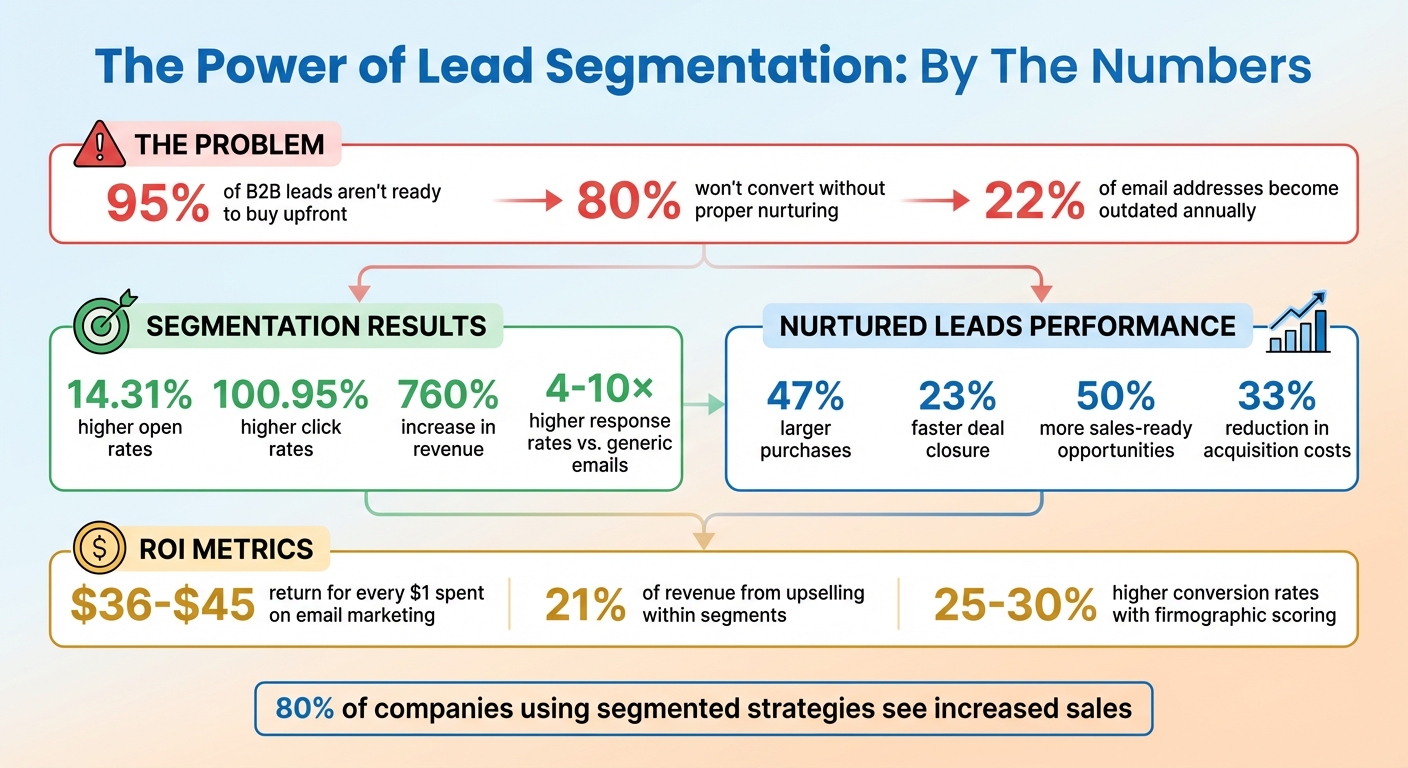
Lead Segmentation Impact: Key Statistics and ROI Metrics for B2B Marketing
A Guide to B2B Customer Segmentation
Why Segmentation Matters for Lead Nurturing
Segmentation allows you to address the specific needs and challenges of different groups, making it easier to connect with your audience on a meaningful level. This approach is crucial for B2B marketing, where decisions often involve multiple stakeholders. For example, while C-suite executives prioritize strategic ROI, managers are more focused on operational improvements. Trying to appeal to both with a single, generic email rarely works. Instead, segmentation creates the foundation for more impactful and measurable results.
The numbers back this up: segmented email campaigns see 14.31% higher open rates and an impressive 100.95% higher click rates compared to non-segmented campaigns. Even more striking, segmentation can lead to a 760% boost in revenue[7, 14]. Why? Because targeted messages resonate better, delivering content that speaks directly to each group's priorities.
Segmentation also helps maintain your sender reputation. Sending relevant content reduces spam complaints, ensuring your emails land in inboxes instead of junk folders. Plus, it makes better use of your resources by focusing your efforts on leads that are genuinely interested, rather than wasting time and budget on those unlikely to convert.
Benefits of Segmentation in B2B Marketing
In B2B marketing, segmentation allows you to personalize your approach without creating individual campaigns for every lead. By grouping similar prospects, you can tailor your messaging to address shared concerns. This is critical, as 56% of marketers believe that targeted content is the most important part of a lead nurturing program. And the payoff is clear: email marketing delivers an average ROI of $36 to $45 for every $1 spent[14, 8], with segmentation amplifying those returns. Nurtured leads tend to make 47% larger purchases, and businesses that focus on nurturing generate 50% more sales-ready leads while reducing acquisition costs by 33%.
Behavioral segmentation takes things a step further by scoring leads based on their actions, such as visiting pricing pages or downloading case studies. This approach helps you identify prospects with real intent, not just demographic alignment. Unsurprisingly, 69% of top-performing marketers rate themselves as "very good" or "excellent" at lead nurturing when they use these methods.
Problems with Generic Email Campaigns
Generic email campaigns fail because they treat every lead the same. Imagine sending the same email to a startup founder and an enterprise VP - neither recipient will feel their unique needs are being addressed. This lack of relevance leads to disengagement[16, 8].
"If your current B2B lead nurturing strategy is little more than a few automated emails and a monthly newsletter, you're not nurturing, you're ghosting." - Matt Hummel, Pipeline-360
Generic campaigns often result in high unsubscribe rates and poor deliverability. When engagement drops, email service providers interpret this as a sign of low-quality content, pushing your emails into spam folders[16, 8]. These campaigns also waste resources on leads that aren’t ready to convert, taking time away from more qualified prospects.
Another issue is email list decay - about 22% of email addresses become outdated each year as people change jobs or abandon accounts. Generic emails accelerate this problem by sending irrelevant content. In contrast, lead nurturing emails generate 4 to 10 times the response rate of generic blasts. The difference between segmented and generic campaigns can determine whether you build strong connections or fade into the background.
Challenge
Generic Campaigns
Segmented Approach
Engagement
Low opens/clicks; high unsubscribes
4–10× higher response rates
Revenue Impact
Lower order values
47% higher order value
Deliverability
High spam risk
Improved sender reputation
Resource Use
Wasted on unqualified leads
Focused on sales-ready prospects
Customer Experience
Impersonal and frustrating
Relevant to specific pain points
These challenges highlight why segmentation is a cornerstone of any successful lead nurturing strategy. By delivering tailored content, you can foster stronger relationships, improve engagement, and ultimately drive better results.
Main Types of Segmentation for Lead Nurturing
Segmentation helps you understand your leads from different angles, breaking them into groups based on specific criteria. Demographic and firmographic segmentation focuses on who your leads are, such as their job titles, company size, industry, and revenue. Behavioral segmentation looks at what they do - actions like opening emails, visiting your website, or attending webinars. Finally, technographic segmentation examines the tools and technologies your leads use, like CRM systems or cloud providers. Each type of data serves a unique purpose: demographic and firmographic data remain stable, behavioral data changes with activity, and technographic data focuses on tech infrastructure.
B2B marketers often combine these segmentation methods to create a complete profile of their leads. For example, firmographic data can establish relevance, behavioral data can highlight engagement, and technographic data can guide technical solutions. This layered strategy helps craft messaging that resonates on multiple levels. Let’s dive deeper into each segmentation type.
Demographic and Firmographic Segmentation
Firmographic segmentation groups leads based on company attributes like industry, number of employees, revenue, location, and ownership type. Think of it as the B2B version of demographic data. For instance, a 500-employee manufacturing company will have very different needs compared to a 20-person SaaS startup, even if both show interest in your product. Factors like company size affect sales cycles and decision-making processes - large enterprises with over 1,000 employees often involve 10 to 15 decision-makers and sales cycles lasting 6 to 9 months.
Key firmographic data points include:
- Company size: (1–50, 51–200, 201–1,000, 1,001+ employees)
- Revenue ranges: (under $1M, $1M–$10M, $10M–$100M, $100M+)
- Ownership type: (public, private, PE-backed, or VC-funded)
Ownership structure also plays a role. For example, venture-funded startups may move quickly, while public companies might have complex approval processes tied to quarterly budgets. Companies using firmographic-based lead scoring see 25% to 30% higher conversion rates, and 80% of B2B organizations report better sales outcomes through segmentation.
To collect this data, use lead forms with dropdown menus. However, keep forms concise - each additional field beyond five to seven can reduce conversion rates by 8% to 12%. Progressive profiling can help capture details over time, starting with three to five fields and gathering more data through follow-ups. Third-party enrichment services can also pre-fill 15 to 25 fields using an email or domain, costing around $0.10 to $0.50 per record. Update your data quarterly, especially in fast-changing industries where up to 30% of information can become outdated annually.
Behavioral and Engagement-Based Segmentation
Behavioral segmentation focuses on what your leads do, like opening emails, downloading content, or attending webinars. These actions reveal intent. For instance, a lead who visits your pricing page multiple times in a week is likely closer to making a purchase than someone who just opens an occasional email. Behavioral-triggered emails tend to perform better, with 38% open rates and 6.8% click-through rates.
Assigning scores to behaviors can help prioritize leads. For example:
- +25 points for visiting the pricing page
- +5 points for opening an email
This scoring system allows your sales team to focus on leads with the highest potential. Targeted content based on specific behaviors can generate 20% more sales opportunities. Behavioral data is also useful for identifying inactive leads. For example, if a lead hasn’t engaged in 90+ days, you can trigger re-engagement campaigns. Keep in mind that 75% of North American customers feel they don’t receive relevant email content, and over 70% of visitors who leave a website never return. Companies using behavioral segmentation often see a 20% to 30% boost in conversions and a 15% to 25% drop in acquisition costs.
Technographic Segmentation
Technographic segmentation looks at the technology your leads use or plan to adopt. This includes tools like CRM systems, cloud providers, and collaboration software. For B2B SaaS companies, these insights are especially valuable, as they reveal compatibility opportunities and potential challenges. For example, if you’re offering a CRM integration, knowing whether a lead uses Salesforce or HubSpot can shape your messaging and technical approach.
Technographic data answers questions that firmographic and behavioral data might not. A lead might seem like a great fit but could be locked into a long-term contract with a competitor, making your outreach poorly timed. On the other hand, a company using outdated tools might have an immediate need for your solution. Upselling within these segments can account for 21% of revenue, according to 91% of sales professionals.
Gathering technographic data often requires more advanced methods. Marketers might use third-party providers that track technology adoption or analyze job postings and company websites for insights. However, avoid creating segments that are too small - over-segmentation wastes resources. Instead, combine technographic data with firmographic and behavioral insights for a well-rounded view. Use firmographic data to set the tone, behavioral data to time your outreach, and technographic data to refine your technical offering. Tools like Breaker can help automate and optimize this process.
How to Use Breaker for Segmentation
Breaker makes segmentation easier by combining precision targeting, real-time analytics, and automated lead collection - all without the hassle of juggling multiple tools or spreadsheets. As your leads engage with your content, the platform helps you build and refine segments automatically. By taking care of data collection, organization, and analysis, Breaker frees you up to focus on creating messages that truly connect with your audience. Using the segmentation strategies mentioned earlier, Breaker automates the process, making it a smoother experience for nurturing leads effectively. This approach ensures targeted messaging and dynamic segmentation throughout the buyer's journey.
Precision Audience Targeting with Breaker
Breaker’s targeting tools let you pinpoint audiences using firmographic, behavioral, and technographic filters. For instance, if your goal is to reach SaaS companies with 50 to 200 employees that recently visited your pricing page, Breaker makes it easy to isolate that exact group - no need for exporting data or writing complicated queries. When your content aligns with a lead’s profile and behavior, engagement naturally improves. Plus, Breaker includes unlimited email validations to make sure your segments consist of active, deliverable addresses, helping to safeguard your sender reputation and boost overall results.
Using Breaker's Real-Time Analytics for Dynamic Segments
After identifying your audience, Breaker’s real-time analytics keep your segments dynamic. As leads interact with your emails or website, the platform updates segment memberships automatically. For example, if a lead visits your pricing page twice within 48 hours, they can instantly be moved into a high-intent segment without you lifting a finger. This ensures your messaging stays relevant and timely as leads move through the buyer's journey.
Trigger-based emails driven by real-time data deliver results that outperform standard batch emails by an impressive 497%. When a lead exhibits strong buying signals, Breaker can notify your sales team within minutes - critical, as responding within five minutes increases the chance of qualification by 21 times. The analytics dashboard also provides insights into which segments are driving the most engagement, helping you fine-tune your strategy based on actual performance.
Automated Lead Generation and Signup Forms
Breaker’s customizable signup forms make it easy for leads to self-segment from the start. You can include dropdowns for industry, radio buttons for company size, or checkboxes for specific pain points. The platform automatically maps this data to your CRM or email fields, eliminating the need for manual data entry.
"Mapping form data to CRM fields ensures your leads are accurately transferred, organized, and ready for action."
– Malay Gupta, B2B Growth Strategist
Progressive profiling allows you to gather additional details over time. Start with three to five fields on your initial form, then collect more information during future interactions. With Breaker’s form mapping and progressive profiling, your data stays consistent, organized, and free of duplicates - making segmentation even more efficient.
Best Practices for Segmentation in Lead Nurturing
Effective segmentation follows the MASA criteria - Measurable, Accessible, Substantial, and Actionable. To refine your approach, consider lead scoring, which assigns numerical values to interactions like email opens, website visits, or content downloads. This helps you prioritize leads that are closer to making a purchase decision. Another useful tactic is creating suppression lists to avoid over-contacting prospects. For instance, excluding anyone who has received more than seven emails in two weeks can prevent fatigue and safeguard your sender reputation.
Segmentation works best when it's dynamic. Leads evolve - they change jobs, companies grow, and budgets shift. Regularly updating your segments ensures you're working with accurate, current data instead of outdated assumptions. Alongside this, data cleansing removes incomplete or incorrect information that could skew your results. A great example comes from Social Media Examiner, which used exit-intent popups to capture and segment visitors leaving their site. In just seven months, they grew their email list by 95,654 names. Neil Patel also reported impressive results, noting that exit-intent popups doubled his opt-in rate and boosted sales by 12%.
"Exit-intent popups have doubled my email opt-in rate. When done right, you can see an instant 12% lift on driving sales."
– Neil Patel, Founder, QuickSprout
Additionally, mapping content to lifecycle stages is key. Share educational blog posts during the Awareness stage, case studies and webinars during Consideration, and pricing or testimonials during Decision. This approach can significantly boost engagement, with segmented campaigns driving up to a 760% increase in revenue.
Progressive Profiling for Better Segmentation
Long forms often discourage engagement. Progressive profiling solves this by collecting information gradually over time. Start with basic details like a name and email address. Then, as leads interact further - attending webinars or downloading resources - you can gather more specific data, such as company size, budget, or current technology stack.
This method reduces form abandonment and allows leads to self-segment. For example, using checkboxes or dropdown menus, they can indicate their interests or challenges. Over time, as you collect more data, your segments become increasingly precise - shifting from broad categories like location or industry to highly detailed groups based on behavior or specific needs.
Tools like conditional logic can streamline this process. For returning visitors, previously completed fields are hidden, and new questions appear instead. Automation can then move leads into more relevant segments as new information comes in, such as a job title change or a specific challenge. Leads who provide detailed information often signal higher buying intent, making them ideal candidates for direct sales conversations.
"Lead nurturing is the process of building and maintaining relationships with prospects at every stage of the buyer's journey by providing relevant information, personalized communication, and timely engagement until they are ready to make a purchase decision."
– Carlos Correa, Ringy
Since only about 2% of leads are ready to buy immediately, progressive profiling ensures you're building relationships with the remaining 98% until they're ready.
Personalizing Content Based on Segments
Once you've segmented your audience, personalization turns that data into meaningful engagement. Relevance is key - generic messages often get ignored, but content tailored to specific pain points or interests captures attention. This is especially true for B2B customers, who expect a higher degree of personalization compared to B2C buyers.
Use real-time behavioral triggers to guide your messaging. For example, if a lead visits your pricing page twice in 48 hours, follow up with a case study or demo offer. If they download a whitepaper on a specific topic, send related content to build on their interest. Messaging that reflects a lead's values or concerns creates a connection that numbers alone can't achieve.
Keeping your data up-to-date is equally important. Outdated information leads to irrelevant messages, damaging your credibility and wasting resources. Regularly validate and refresh your segments to ensure accuracy. Also, consider channel preferences - some leads prefer email, others LinkedIn, or even SMS. Syncing your data across channels creates a consistent experience, no matter where the interaction happens.
Personalization isn't just about engagement - it drives revenue. Upselling and cross-selling account for an average of 21% of total revenue, and 91% of sales professionals say upselling is a major revenue driver. By tailoring offers based on transactional data, like purchase history or spending habits, you can uncover opportunities to strengthen customer relationships and boost sales.
Segmentation Types Comparison Table
A well-rounded segmentation strategy combines various approaches to address different objectives. Knowing when to apply each type ensures your efforts are effective - from identifying potential customers to predicting intent and delivering timely content.
Segmentation Type
Data Points
Primary Benefit
Ideal For
Firmographic
Company size, industry, revenue, location
Identifies businesses that can afford and need the product
Targeting enterprises vs. SMBs with tailored pricing or features
Behavioral
Website visits, email clicks, content downloads
Predicts intent based on actual engagement patterns
Triggering follow-ups when leads show high-intent signals
Psychographic
Values, interests, pain points, motivations
Builds emotional connections through shared values
Crafting campaigns that resonate on a deeper level
Demographic
Age, gender, job title, education level
Personalizes tone and strategy for decision-makers
Tailoring outreach to C-suite vs. mid-level managers
Technographic
Current tech stack, future software needs
Helps SaaS companies offer compatible solutions
Positioning integrations or alternatives effectively
Lifecycle Stage
Awareness, Consideration, Decision
Delivers the right content at the right time
Guiding leads through educational, evaluative, and conversion content
Transactional
Purchase frequency, recency, total spend
Optimizes upselling and retention strategies
Identifying customers ready for upgrades or add-ons
The most effective strategies combine these segmentation types. For instance, you might start with firmographic data to identify target companies, layer on behavioral insights to spot engaged leads, and use lifecycle stage segmentation to deliver tailored content. This multi-layered approach ensures your messaging stays relevant and impactful throughout the buyer's journey.
Measuring and Improving Segmentation Performance
Choosing the right metrics is key to understanding how well your segmentation efforts are working. Engagement metrics like open rates, click-through rates (CTR), and unsubscribe rates can reveal whether your content connects with specific groups. For example, unsubscribe rates should stay below 1%. If they climb higher, it’s a warning sign that your content isn’t aligned with your audience. Conversion metrics track actions taken by recipients, while funnel velocity measures how quickly leads progress to become marketing-qualified leads (MQLs) or customers. Financial metrics, such as cost per customer and revenue generated from segmented campaigns, ensure that your efforts are delivering a return on investment.
"The effectiveness of your lead nurturing is dependent on how well you've segmented your leads."
– Corey Wainwright, HubSpot
Keeping an eye on segment size and engagement trends is equally important. If a segment shows a high unsubscribe rate or declining engagement, it might be time to tweak your messaging. Behavioral signals - like website visits, email replies, or Net Promoter Score (NPS) survey responses - offer real-time feedback to refine dynamic segments. Regularly reviewing cost-per-customer metrics also ensures your campaigns remain cost-effective.
Key Metrics for Segmentation Success
Different metrics provide insights into various aspects of your segmentation strategy:
- Engagement metrics (e.g., CTR and unsubscribe rates) reflect how relevant your content is to your audience.
- Conversion metrics, such as the lead-to-MQL ratio, show how effectively your segments are progressing through the funnel.
- Efficiency metrics like time-to-conversion help identify delays or bottlenecks.
- Financial metrics, including cost per customer and customer lifetime value (CLV), measure the long-term impact of your segmentation efforts.
Advanced analytics tools can compare multiple segments at once, helping you identify which characteristics drive the best engagement. Testing different calls-to-action (CTAs) within specific groups can also fine-tune your campaigns. If you notice an increase in MQLs that aren’t converting to sales-accepted leads, it’s worth revisiting your lead scoring criteria. Closed-loop analytics, which track leads all the way to a sale, are essential for understanding your true ROI. For instance, segmented B2B campaigns have been shown to achieve 14.31% higher open rates and 100.95% higher click rates compared to non-segmented campaigns.
Refining Segments Using Breaker Analytics
Breaker’s real-time analytics can pinpoint underperforming segments and suggest improvements. Dynamic segments automatically update based on recent behaviors, such as visits to your pricing page or clicks on emails, ensuring your data stays relevant. Analytics tools can also flag issues like unexpected changes in segment size or engagement, helping you catch problems such as overly broad criteria or data sync errors early.
Predictive analytics take it a step further by using historical data to forecast future actions, like the likelihood of churn or a purchase. This allows you to target retention or expansion efforts more effectively. For example, in 2023, Twilio Segment used CustomerAI Predictions to identify leads likely to request a demo within 60 days. By focusing on the top 20% of high-intent leads, they increased nurture email engagement by 10%. Similarly, from 2024 to 2025, Stonewall Kitchen used Attentive’s AI Pro solutions to identify 11% more website visitors, generating over $128,000 in additional revenue within six months. They also saw a 35% improvement in open rates and an 11% boost in conversion rates.
To keep your segmentation strategy on track, perform weekly checks on enrollment triggers and segment counts. This helps ensure your logic stays accurate as your business evolves. Watch for segment volatility, such as groups with zero members or sudden growth, which might signal data issues. Automated re-engagement triggers can help revive inactive leads by moving them into "win-back" segments. Additionally, overlap reports can identify contacts appearing in multiple segments (like "high-risk" and "upcoming renewal"), allowing you to streamline messaging and prioritize relevant content effectively.
Conclusion
Segmentation is at the heart of successful B2B lead nurturing. The stats don’t lie: segmented campaigns can boost revenue by up to 760%, and nurtured leads generate 47% higher average order values. On the flip side, without segmentation, around 80% of new leads fail to convert into sales. That’s a staggering loss of potential that no business can afford to overlook. These numbers make it clear - generic outreach is no longer an option. Targeted messaging is the way forward.
To make this shift, businesses need to go beyond cookie-cutter emails. The goal is hyper-personalized communication that pinpoints a lead’s specific challenges at just the right moment. By combining firmographic, behavioral, and technographic data, you can build a complete profile for each lead. This 360-degree perspective allows for more precise and effective nurturing.
"Segmentation fuels meaningful connections in B2B lead nurturing. Precision in data, criteria, and messaging fosters engagement, guiding prospects toward enduring partnerships."
– B2B Rocket
Platforms like Breaker simplify this process with AI-driven targeting, real-time analytics tracking over 40 metrics, and automated lead generation to attract ideal subscribers. Their deliverability tools ensure your segmented campaigns land in the primary inbox, while CRM integrations make it easy to push qualified leads down the sales funnel.
To accelerate your segmentation strategy, focus on clear objectives, implement lead scoring, use dynamic active lists, and regularly audit your data. It’s worth noting that 80% of companies using segmented strategies see a boost in overall sales. The real question isn’t whether to segment - it’s how fast you can get started.
FAQs
How does segmentation help improve lead nurturing?
Segmentation enhances lead nurturing by allowing businesses to deliver tailored and meaningful communication to distinct groups of leads. By organizing leads based on factors like age, interests, behaviors, or their position in the sales funnel, marketers can craft messages that align more closely with what each group cares about. The result? More engagement, stronger trust, and better conversion rates.
Take demographics, for instance. Messaging aimed at specific age groups or income levels can feel more relatable, while segmenting by industry or location helps address challenges unique to those groups. Beyond improving relevance, segmentation also makes marketing efforts more efficient. By focusing on high-potential prospects, businesses can reduce the time and resources spent on one-size-fits-all campaigns. This approach not only improves the experience for leads but also helps guide them through the sales funnel more effectively, ultimately driving better outcomes for your business.
What types of data work best for segmenting leads in B2B marketing?
When it comes to segmenting leads in B2B marketing, some data types stand out: firmographics, behavioral data, geographic information, and contextual factors.
- Firmographics: Think of details like company size, industry, location, and the technology they use. These elements help you understand your audience better and align your sales strategies to meet their specific needs.
- Behavioral Data: This includes insights like website activity, purchase history, and email engagement. It’s all about tracking what your prospects are doing so you can create campaigns that feel timely and personalized.
- Geographic Information: Whether it’s regional preferences or logistical considerations, knowing where your audience is can help you craft messages that resonate on a local level.
- Contextual Factors: This focuses on the unique situations or conditions your prospects might be facing, allowing you to address their specific challenges or opportunities.
By blending these data types, you can build campaigns that are not just targeted but also drive higher engagement, better conversions, and ultimately a stronger ROI.
How does Breaker simplify and improve my lead segmentation process?
Breaker simplifies lead segmentation with advanced AI tools and real-time analytics, helping you create highly targeted audience groups. Its AI-powered lead enrichment classifies subscribers based on factors like behavior, demographics, and firmographics, ensuring your messages resonate with the right people.
With features like automated list growth and dynamic segmentation, Breaker minimizes manual effort while making personalized outreach scalable. Plus, it integrates seamlessly with your CRM and delivers in-depth performance insights, allowing you to fine-tune your segmentation strategy over time. The result? More engagement and stronger outcomes for your lead nurturing efforts.
Related Blog Posts
Keep reading
All articlesGDPR Consent Requirements for Purchased Email Lists
Purchased email lists rarely meet GDPR's consent bar. Learn the legal basis rules, PECR overlap, and safer alternatives before you hit send.
7 Email Platforms With Inbox Placement Testing & Suppression
Compare 7 email platforms that combine inbox placement testing with suppression management, scored on features, pricing, and best-fit sender size.
Email Automation Workflow & Drip Campaign Data Structure
Learn the database schema behind email drip campaigns—tables, workflow states, and event logs that power reliable marketing automation.