
B2B Email Deliverability Case Study Examples
Case studies on B2B email deliverability: practical fixes for sender reputation, SPF/DKIM/DMARC, list hygiene and dedicated infrastructure that cut bounces and boost inbox placement.

If your emails aren’t landing in inboxes, your marketing efforts are wasted. For B2B companies, poor email deliverability can lead to lost revenue, damaged sender reputation, and missed opportunities to connect with decision-makers. Key factors like sender reputation, email authentication, and list hygiene play a huge role in ensuring your emails reach their destination.
Key Takeaways:
- Sender Reputation: A score below 70 significantly increases the chances of emails being flagged as spam.
- Common Issues: Poor list hygiene, missing email authentication (SPF, DKIM, DMARC), and shared infrastructure often lead to deliverability problems.
- Proven Solutions:
- Real-time email validation to reduce bounce rates.
- Proper DNS setup (SPF, DKIM, DMARC) to build trust with mailbox providers.
- Gradual IP warming and segmentation to improve inbox placement.
- Results from Case Studies:
- SaaS company improved sender reputation from 65 to 98.
- Fintech company boosted inbox placement by 30% after switching to dedicated infrastructure.
- Lead generation agency reduced bounce rates from 19.09% to 0.4%.
- Enterprise company maintained a 99%+ delivery rate while sending 6 million emails daily.
Quick Fixes:
- Regularly clean your email list to remove invalid contacts.
- Monitor sender reputation and email metrics like bounce rates and spam complaints.
- Use dedicated IPs for high-volume emails and separate marketing from transactional emails.
Email deliverability isn’t just a technical issue - it directly impacts revenue and customer trust. The case studies below demonstrate how addressing these challenges can lead to measurable business improvements.
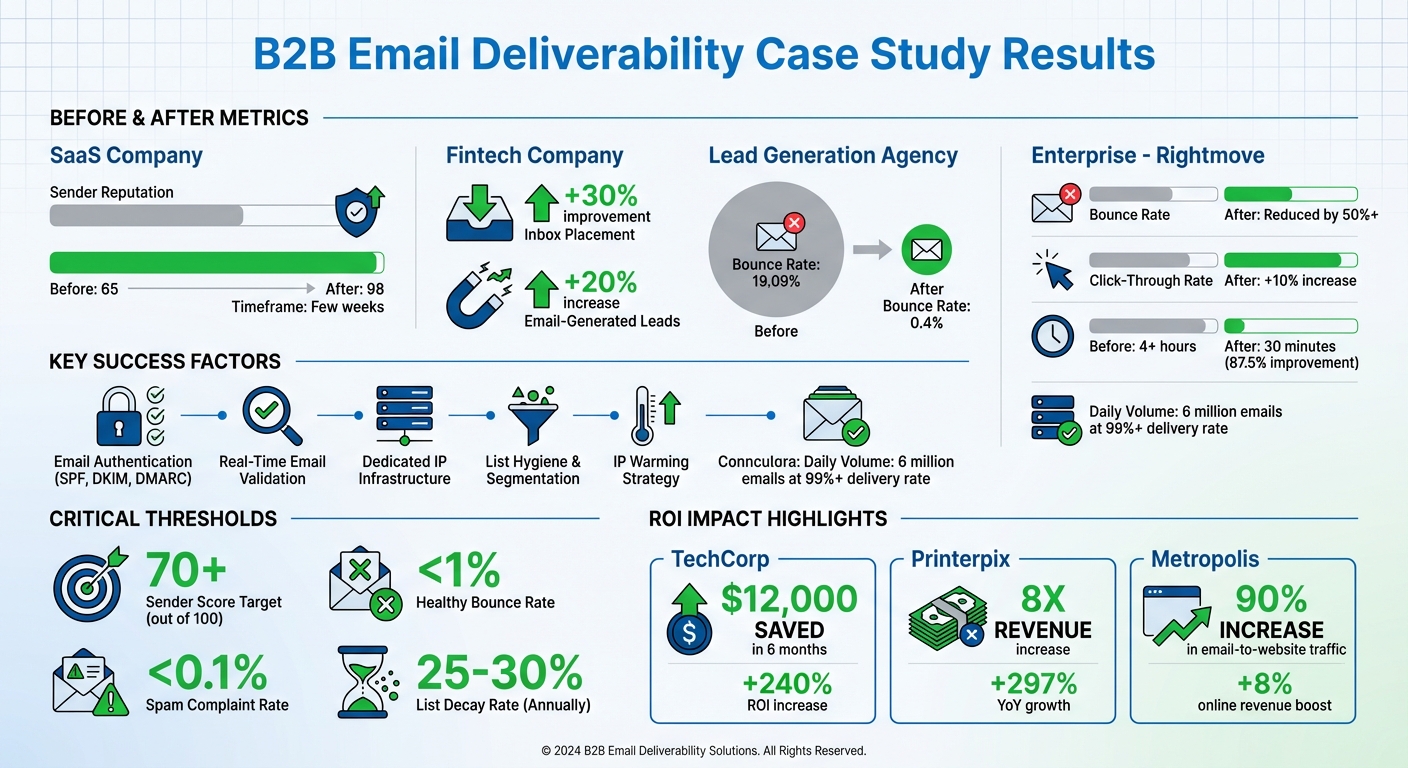
B2B Email Deliverability Case Study Results: Key Metrics and Improvements
Case Study 1: SaaS Company Improved Deliverability During Rapid Growth
Challenge
In April 2025, a Fortune 500 company collaborating with Growleads encountered a major email deliverability issue. Their sender reputation had plummeted to 65 out of 100. The root cause? DNS verification errors in their Microsoft 365 setup, which went unnoticed during their rapid expansion. Without proper configuration of SPF, DKIM, and DMARC protocols, their emails were flagged as suspicious by mailbox providers. On top of that, their aggressive growth strategy involved sending emails to outdated, inactive contacts, further damaging their reputation. These issues made it clear that their email practices needed a complete overhaul.
(Source: Growleads Case Study, 2025)
Solution
To tackle the problem, the team implemented a three-step plan. First, they addressed the DNS verification issues, ensuring SPF, DKIM, and DMARC were correctly set up to confirm the legitimacy of their emails. Next, they introduced an automated suppression system to instantly remove hard-bounced email addresses and those flagged as spam reporters. Finally, they launched a domain warming strategy, gradually increasing email volume by 15% every few days while focusing on their most engaged subscribers.
(Source: Growleads Case Study, 2025)
Results
In just a few weeks, the company’s sender reputation soared from 65 to 98, leading to much better performance for their email campaigns. This case highlights how precise technical adjustments and improved contact list management can effectively restore sender reputation - an essential factor for B2B marketers.
(Source: Growleads Case Study, 2025)
Case Study 2: Fintech Company Switched to Dedicated Email Infrastructure
Challenge
This fintech company ran into a common B2B email marketing hurdle: shared infrastructure. The main problem? The "noisy neighbor" effect. On shared email platforms, one sender's overly aggressive campaigns can drag down the sender reputation for everyone else. For this company, that meant emails often ended up in spam folders, with inbox placement all over the map. To make things worse, as email volumes grew, major providers throttled delivery, causing delays in critical communications. These disruptions not only hurt customer trust but also impacted revenue. It became clear they needed their own isolated infrastructure to regain control.
Solution
The company made a strategic move to a dedicated email infrastructure, complete with its own IP and domain reputation. They took extra precautions by setting up separate subdomains for transactional and marketing emails, ensuring vital communications were always protected. On the technical side, they implemented SPF, DKIM, and DMARC protocols with proper alignment for all sending domains. Email content was fine-tuned to avoid spam filters, and they carefully managed IP warmup schedules to build a strong sending reputation with major mailbox providers.
Results
The switch paid off. Inbox placement improved by 30%, and email-generated leads jumped by 20%. With the shared sender reputation issues behind them, the company achieved consistent, reliable email delivery. Email became a dependable revenue driver once again, strengthening both customer trust and business performance.
Case Study 3: B2B Lead Generation Agency Cut Bounce Rates
Challenge
Belkins, a B2B lead generation agency, ran into a big problem during a period of rapid growth: their bounce rate shot up to 19.09%, putting their sender reputation in serious jeopardy. The main culprit? Outdated contact lists, which naturally lose over 25% of their accuracy each year. On top of that, their reliance on third-party data introduced invalid email addresses into their database. Spam traps and toxic addresses were piling up, threatening their ability to reach prospects and putting their entire email strategy at risk.
Solution
To tackle the issue, Belkins knew they needed a swift and strategic fix. Under the leadership of CMO Margot Kashuba and Co-founder Michael Maximoff, the agency integrated ZeroBounce's API for real-time email validation. This tool allowed them to clean their email lists on the fly. They took a systematic approach, identifying and removing invalid syntax, non-existent domains, spam traps, and disposable email addresses. Additionally, they implemented provider-based segmentation, ensuring Gmail senders targeted Gmail recipients and Outlook senders reached Outlook users, improving inbox placement.
"Email validation became the first step in ensuring bounce rates went down and our emails were going to valid and active subscribers." – Michael Maximoff
Results
Belkins achieved a dramatic turnaround, slashing their bounce rate from 19.09% to just 0.4%. With emails now reaching active contacts, engagement rates surged.
"Maintaining a healthy email list helped us build and maintain trust with our audience. With fewer spam complaints and higher engagement, our sender reputation improved." – Margot Kashuba
Case Study 4: Enterprise Company Reached Near-Zero Bounce Rates
Challenge
Rightmove, the UK's largest property platform, faced a daunting task during a critical migration. Under the leadership of Chloe O'Malley, Head of CRM, the team needed to maintain a stellar 99%+ delivery rate while sending out an incredible 6 million emails daily. Any hiccup in the process could seriously harm their sender reputation and disrupt communications with millions of users. On top of that, high bounce rates were dragging down engagement metrics, and their large-scale email sends were taking more than 4 hours to complete. It was clear that their email infrastructure needed a complete makeover.
Solution
To tackle these challenges, Rightmove implemented a well-thought-out strategy. Over a three-month period, from September to December, they introduced 11 new IPs and 4 domains to properly segment their email infrastructure. They carefully phased the warming of these IPs, prioritizing highly engaged segments, and created separate subdomains for transactional and marketing emails. This separation ensured critical system messages weren’t impacted by any marketing-related issues. To further enhance credibility, they adopted advanced protocols like BIMI and Apple Branded Mail.
"The Email Deliverability Services team at Braze helped us to achieve a very challenging deadline for IP warming and end-to-end platform migration... without compromising on engagement." – Chloe O'Malley, Head of CRM, Rightmove
Results
The results were nothing short of transformative. Rightmove slashed bounce rates by over 50% while maintaining their impressive 99%+ delivery rate for 6 million daily emails. Click-through rates saw a 10% increase, and operational efficiency skyrocketed - email send times plummeted from over 4 hours to just 30 minutes, an 87.5% improvement. By achieving a near-zero bounce rate, they safeguarded their sender reputation and saved thousands of dollars in ESP costs by avoiding emails sent to invalid addresses. This case underscores how technical precision and systematic improvements can drive massive gains in email deliverability.
Common Patterns and Best Practices from These Case Studies
Main Deliverability Problems
The case studies highlight three recurring issues that consistently harm email deliverability. First, poor list hygiene stood out as a major problem. Companies were sending emails to outdated addresses, typo-ridden entries, and disposable emails, causing bounce rates to soar as high as 18%. For instance, TechCorp discovered that 17% of their email database was invalid, costing the company $2,000 every month in ESP fees. Second, missing or broken email authentication left companies exposed to security risks. Philips, for example, saw their Sender Score plummet to 7 out of 100 due to improperly configured SPF and DKIM records. Third, shared infrastructure caused reputation issues beyond their control, as the bad practices of other senders on the same infrastructure dragged down deliverability rates.
Another critical issue was the lack of real-time monitoring. MeritB2B admitted they had no insight into their sender reputation or inbox placement rates, leaving them unaware of problems until significant damage had already occurred. Additionally, mailing disengaged subscribers sent a signal to ISPs that the content was irrelevant, further eroding sender reputation.
Addressing these challenges required focused, actionable solutions.
Solutions That Work
The solutions implemented in these case studies directly tackled the core issues of list hygiene, authentication, and infrastructure. One of the most effective strategies was real-time email validation at the point of entry. TechCorp integrated an API into their lead capture forms to instantly reject invalid email addresses, preventing bad data from entering their system. This change reduced their bounce rate from 18% to just 0.8% within six months. Another impactful tactic was IP segmentation. TBC Corporation separated engaged subscribers (those active within six months) from inactive ones, assigning them to different dedicated IP addresses. This adjustment increased their active list delivery rate from 60% to 99%.
Automated email authentication also delivered significant improvements. By implementing automated SPF, DKIM, and DMARC management, companies saw immediate gains in inbox placement. Philips, for instance, used Validity's Certification process with three new IP addresses and achieved inbox placement rates between 91-98%. Additionally, engagement-based filtering proved highly effective. DonorsChoose.org filtered out disengaged subscribers, achieving 100% inbox placement with Microsoft and 99% with Yahoo. Metropolis International went a step further by cleansing 50,000 invalid contacts and redesigning their email templates to be mobile-friendly, which led to a 380% increase in mobile opens.
"We actually look at our sender reputation as a corporate asset. That's become very powerful to us because we now have a much better understanding of email as a channel." – Karie Burt, SVP/CPO, MeritB2B
Business Impact and ROI
The implementation of these solutions led to measurable financial and operational benefits. TechCorp, for example, saved $12,000 in ESP costs over six months and increased their ROI per subscriber from $2.50 to $8.50 - a 240% improvement. Printerpix saw even more dramatic results, resolving their Gmail deliverability issues and achieving an 8X revenue increase, along with a 297% year-over-year revenue boost during their peak November-December period. Metropolis International also saw substantial gains, increasing email-to-website traffic by 90% and boosting online revenue by 8% within 10 months of their deliverability overhaul.
Beyond revenue, these improvements enhanced operational efficiency and protected brand reputation. MeritB2B improved their average inbox placement rates by over 60%, enabling their sales team to trust that prospects were actually receiving their outreach. Philips’ Digital and CRM Specialist Charlie Wijen emphasized the direct link between deliverability and revenue:
"We are clear there's a straight-line relationship between better inbox placement performance and Philips' program revenue"
These case studies demonstrate that email deliverability isn't just a technical concern - it directly drives revenue and impacts the bottom line in meaningful ways.
How To Never Run Into Email Deliverability Issues AGAIN (NO SPAM PROTOCOL)
How to Maintain High Deliverability Over Time
To keep your email deliverability rates consistently high, it's essential to follow a combination of technical best practices, list maintenance strategies, and continuous monitoring.
Technical Setup
Start with the basics: implement SPF, DKIM, and DMARC protocols. These are crucial for ensuring your emails land in inboxes rather than getting lost in spam folders. Without these measures, around 17% of cold B2B emails fail to reach their destination.
Take it a step further by updating your DMARC policy from "p=none" to "p=quarantine" or "p=reject." This signals to internet service providers (ISPs) that your domain is secure and actively blocks unauthorized senders. Conduct quarterly DNS audits - especially after switching email service providers - to catch any errors that could disrupt delivery.
For high email volumes (over 50,000 emails per month), use dedicated IPs. For smaller volumes, high-quality shared IPs work well. If you're working with a new domain or IP, start small - send 20–30 emails daily to your most engaged recipients. Gradually increase your sending volume by about 15% every few days to properly "warm up" your email infrastructure.
Once your technical setup is solid, focus on keeping your email list clean and up-to-date.
List Hygiene
Email lists naturally decay over time - B2B lists can lose over 30% of their accuracy annually. To combat this, use real-time validation during lead capture to filter out invalid, disposable, or role-based email addresses.
Automate the suppression of hard bounces immediately and soft bounces after 3–5 consecutive failures. Define clear inactivity windows for different email campaigns - typically 60–90 days for outbound emails and 90–180 days for newsletters. Use these windows to trigger re-engagement campaigns or suppress inactive contacts. Before removing inactive subscribers, send a final email offering them a chance to opt for fewer emails or confirm their interest.
Plan a deep-clean of your database at least once every quarter to address data decay. Double opt-ins are another effective way to ensure your recipients genuinely want your content. Keep an eye on your spam complaint rate - anything above 0.1% (1 in 1,000 emails) could raise red flags with mailbox providers.
Beyond hygiene, staying on top of metrics and monitoring tools is key to long-term success.
Tracking and Monitoring
Your domain reputation plays a huge role in deliverability. This reputation is shaped by your brand's email history and how recipients interact with your messages. Tools like Google Postmaster Tools can help you monitor domain reputation and delivery errors. Set up real-time alerts for blacklist events using services like Spamhaus or MXToolbox so you can act quickly if issues arise.
Keep an eye on your sender score, which ranges from 0 to 100 - aim for at least 70. Also, track inbox placement rates, which show whether your emails are landing in inboxes or being filtered out. A healthy bounce rate should stay below 1%, and spam complaint rates should remain under 0.1%.
Encourage positive engagement, like replies, as they boost your domain reputation in B2B marketing. Monitor key metrics such as open rates, click-through rates, and "not spam" feedback. Use feedback loops provided by your email service provider to identify and remove complainers quickly. Automated tracking systems can help you spot potential problems early and prevent them from escalating.
Using a platform like Breaker can streamline these tasks. Breaker offers tools for real-time analytics, automated lead generation, and precise audience targeting, making it easier to maintain high deliverability rates.
Conclusion: What B2B Marketers Should Remember
The examples above make it clear: improving email deliverability isn't just possible - it's crucial. It directly affects your revenue. For instance, when one AI sales platform saw its placement drop from 78% to 43%, it put $840,000 in Annual Recurring Revenue (ARR) at risk.
The formula for success is straightforward: strict list hygiene, engagement-based segmentation, and technical authentication. Removing hard bounces and building quality B2B email lists can lead to significant gains, such as achieving 100% Gmail inbox placement within just four weeks.
To stay ahead, keep a close eye on your deliverability metrics, audit your SPF, DKIM, and DMARC records every quarter, and make unsubscribing simple to avoid being flagged as spam. These practices, combined with regular list maintenance and strong authentication, are key to maintaining and improving deliverability over time.
For those seeking a solution to streamline these efforts, Breaker offers tools like real-time analytics, automated lead generation, and precise audience targeting. These features are designed to help B2B marketers secure high inbox placement rates. Remember, your sender reputation is a valuable corporate asset - protect it, and you'll set the foundation for consistent campaign success.
FAQs
What are the best ways for B2B companies to improve their email sender reputation?
To boost email sender reputation, B2B companies should focus on a few essential practices. First, prioritize keeping your email list clean and current. Regularly scrub your database to remove invalid or inactive addresses - this reduces bounce rates and minimizes spam complaints. Using email validation tools is a smart way to ensure only legitimate contacts make it onto your list.
Next, fine-tune your email content and sending habits. Share relevant, personalized messages that resonate with your audience, and avoid overwhelming recipients with excessive emails. It’s also critical to use proper email authentication protocols like SPF, DKIM, and DMARC. These not only enhance trust with mailbox providers but also improve your chances of landing in the inbox instead of the spam folder.
Lastly, keep a close watch on engagement metrics like open rates, click-through rates, and spam complaints. Tracking these indicators allows you to spot and fix problems early, safeguarding your sender reputation and ensuring your emails reach their intended audience.
What are the advantages of using dedicated email infrastructure for B2B marketing?
Using a dedicated email infrastructure brings several advantages for B2B marketers, especially when it comes to optimizing email campaigns. For starters, it enhances email deliverability by enabling critical authentication protocols like SPF, DKIM, and DMARC. These protocols play a vital role in ensuring your emails land in recipients' inboxes instead of being flagged as spam. Plus, this setup helps safeguard your sender reputation and minimizes risks like domain distrust, which can be especially problematic during high-volume campaigns.
Another key benefit is the control and visibility it provides over email performance. With dedicated infrastructure, marketers can closely monitor campaigns, quickly address deliverability challenges, and implement strategies such as IP warming to maintain strong engagement rates. This level of control ensures faster email delivery and smoother execution, making it an ideal choice for large-scale campaigns that demand reliability and precision.
What is the impact of real-time email validation on bounce rates?
Real-time email validation is a game-changer when it comes to keeping bounce rates low. By identifying and filtering out invalid or high-risk email addresses before they even make it into your database, you ensure your emails reach the right people. This not only keeps your email list cleaner but also boosts deliverability.
Take this for example: Companies that have embraced real-time validation have seen dramatic results. Some have slashed their bounce rates from double digits to under 1%. That’s not just a number - it translates to saving thousands of dollars in wasted resources and seeing a noticeable lift in ROI. Plus, by proactively catching invalid addresses, you protect your sender reputation, which means better inbox placement and stronger email performance overall.
For B2B marketers aiming to fine-tune their campaigns and see consistent success, real-time email validation isn’t just a nice-to-have - it’s a must.
Related Blog Posts
Keep reading
All articlesGDPR Consent Requirements for Purchased Email Lists
Purchased email lists rarely meet GDPR's consent bar. Learn the legal basis rules, PECR overlap, and safer alternatives before you hit send.
7 Email Platforms With Inbox Placement Testing & Suppression
Compare 7 email platforms that combine inbox placement testing with suppression management, scored on features, pricing, and best-fit sender size.
Email Automation Workflow & Drip Campaign Data Structure
Learn the database schema behind email drip campaigns—tables, workflow states, and event logs that power reliable marketing automation.