
How Analytics Predicts High-Value Leads in Real Time
Explore how real-time analytics revolutionizes lead generation, boosting conversion rates and enhancing engagement with high-value prospects.
Real-time analytics is changing how businesses find and engage high-value leads. By analyzing live data, companies can prioritize prospects and respond instantly, increasing conversion rates by 51%. Traditional methods, which rely on outdated or static scoring, fall short in today’s fast-paced environment. Here’s what you need to know:
- Speed matters: Responding to leads within five minutes makes you 100x more likely to convert them.
- AI-driven insights: Machine learning uses behavioral, demographic, and intent data to score leads dynamically.
- Data accuracy: First-party data reduces errors from outdated or fake third-party sources (up to 40% of leads can be misclassified).
- Automation: Predictive tools automate 50% of decisions, saving time and improving lead quality.
Businesses adopting these tools report higher productivity and ROI. The market for predictive analytics is growing fast, expected to hit $5.6 billion by 2025. If you’re still relying on static scoring, it’s time to rethink your approach.
Lead Generation Timing Analysis with GA4 and AI
Research Findings on Predictive Analytics Performance
Recent research highlights how predictive analytics is reshaping lead generation strategies. Data confirms that AI-powered predictive systems are boosting lead generation outcomes. These findings open the door for a deeper dive into how these tools impact lead conversion rates and their growing adoption across industries.
Lead Quality and Conversion Rate Improvements
Studies reveal a 25% increase in conversion rates for companies that incorporate predictive analytics and intent data into their sales workflows. This approach not only enhances the quality of leads but also maximizes sales productivity.
Fortune 1000 companies offer compelling evidence of the value predictive analytics brings. Case studies from these organizations report impressive returns on investment after adopting AI-driven lead targeting tools. Many have seen a dramatic improvement in identifying and engaging high-value prospects.
Real-world success stories illustrate these benefits. Peter Lohmann, CEO of RL Property Management, shared the impact of predictive tools on his business:
"We tripled our sponsor revenue and doubled our community memberships with breaker. Well over a 10X ROI."
Similarly, Brennan Haelig, CEO of Jumpstart ROI, emphasized the central role predictive analytics now plays in their sales process:
"Breaker is our #1 source of booked calls."
These examples highlight how predictive analytics has evolved from a supplementary tool to a key driver of pipeline growth.
Automation is another critical advantage of predictive systems. With real-time data analytics, businesses can now automate 50% of decisions, improving efficiency and the accuracy of lead qualification. By reducing manual intervention, these systems streamline processes while maintaining - or even enhancing - the quality of lead scoring.
Growing Use of Predictive Analytics Tools
Beyond boosting conversion rates, the rapid adoption of predictive analytics reflects a broader industry transformation. By 2025, 73% of companies plan to invest in AI-powered sales tools. This surge underscores the growing importance of real-time insights in staying competitive in fast-changing markets.
Several factors are fueling this trend. Advances in AI and cloud infrastructure have made predictive analytics more accessible and cost-effective. The explosion of IoT and connected devices has created a wealth of real-time data streams for predictive models to analyze. At the same time, rising customer expectations for personalized interactions have made real-time analytics essential for meeting these demands.
The automation potential of these tools is remarkable. By 2025, experts predict that up to half of all business decisions in data-driven enterprises will be automated through real-time analytics. This level of automation minimizes delays in lead qualification and dramatically improves response times.
Market growth projections further reflect this momentum. The predictive analytics market in marketing is expected to grow from $5.29 billion in 2020 to $41.5 billion by 2028 - an almost eightfold increase. Similarly, the broader predictive analytics market is projected to expand from $1.1 billion in 2020 to $5.6 billion by 2025, with a compound annual growth rate of 38.3%.
Stricter privacy regulations are also pushing companies toward predictive analytics. As third-party data becomes less reliable, businesses are turning to first-party data and real-time behavioral insights. Platforms that effectively utilize this data offer a competitive edge in today’s privacy-focused landscape.
Finally, the demand for hyper-personalization is another driving force. Buyers now expect tailored, timely communication. Predictive analytics makes this possible at scale, enabling businesses to deliver the right message to the right prospect at the perfect moment.
How Real-Time Predictive Models Function
Real-time predictive models work by processing data instantly from multiple sources. They rely on event-driven architectures and streaming platforms like Apache Kafka or Apache Flink, which allow them to analyze information as soon as it's generated. This enables businesses to qualify and prioritize leads immediately, without delays.
The system's design is built around real-time data integration, machine learning for pattern recognition, and dynamic scoring that updates lead rankings on the fly. These capabilities make it possible to incorporate a wide range of data signals to refine lead predictions continuously.
Data Types and Signals Used in Predictions
Different data types feed into these models to enhance predictions:
- Behavioral data: Tracks user actions such as website visits, email opens, content downloads, and webinar attendance to gauge engagement.
- Firmographic data: Includes details like company size, industry, revenue, employee count, and location to confirm whether a lead fits the target profile.
- Intent signals: Captures activities like search queries, topic engagements, and interactions with competitor content, which can indicate a prospect’s readiness to buy.
For instance, Breaker’s matching algorithm combines custom targeting, AI-powered data enrichment, proprietary datasets, and rigorous data hygiene practices to identify the perfect newsletter subscribers.
Machine Learning and Dynamic Scoring Systems
Machine learning algorithms are at the heart of these models, analyzing both historical and real-time data to assign lead scores based on their likelihood to convert. These algorithms adapt dynamically, updating scoring criteria as new data comes in and learning from outcomes like closed deals or lost opportunities.
Take this example: If a prospect from a target industry downloads a high-value whitepaper and requests a demo, the system can instantly identify them as a high-priority lead. This dynamic scoring approach has proven results - companies using predictive analytics for lead scoring have reported a 51% boost in lead-to-deal conversion rates.
"Our algorithm delivers engaged, exact-match B2B subscribers - so you grow without guesswork or wasted spend."
First-Party Data Collection and Management
A steady flow of first-party data is critical for effective real-time lead qualification and personalization. As privacy regulations tighten and third-party data becomes less reliable, first-party data - gathered directly from user interactions on websites, emails, and other digital platforms - has become the gold standard for accurate predictive modeling.
Consent management plays a key role here, ensuring that only authorized and current data is used. This not only maintains regulatory compliance but also ensures data quality. Incorporating strong data hygiene practices into the collection process further boosts model performance by keeping information clean and trustworthy from the start.
To keep up with the demands of real-time processing, businesses need scalable infrastructure capable of handling large data volumes without lag. When combined with robust data collection, real-time analysis, and continuous model updates, this creates a strong competitive edge that grows more valuable over time.
Real-World Applications in B2B Lead Generation
Real-time analytics is reshaping B2B marketing by automating processes and delivering instant insights. Businesses across various sectors are adopting these systems to simplify their lead generation efforts and achieve tangible outcomes. Let’s dive into how automated tracking and dynamic segmentation use these analytics to enhance lead generation.
Automated Lead Tracking and Scoring
Tracking leads manually across multiple channels can be time-consuming and inefficient. Automated lead tracking solves this problem by using machine learning to instantly score leads based on behavioral and demographic data. This automation allows marketing teams to skip manual qualification tasks and dedicate their energy to high-priority prospects.
Leading CRM platforms now embed real-time data processing into their lead management tools, making these features a standard in the industry. Companies using such automated systems report higher conversion rates thanks to quicker and more precise lead qualification.
Dynamic Segmentation and Personalization
Traditional segmentation methods often rely on fixed criteria that can quickly become irrelevant. Real-time analytics introduces dynamic segmentation, which adjusts instantly to changes in lead behavior and preferences. This method organizes prospects based on live behavioral cues, updated demographic data, and contextual factors like timing and device usage.
Dynamic segmentation enables highly personalized messaging that connects with prospects when they’re most engaged. For example, if a lead downloads a whitepaper or attends a webinar, the system immediately updates their segment and triggers follow-up content tailored to their interests. By analyzing multiple data points - such as website visits, email interactions, content downloads, search activity, and social media engagement - marketers can deliver messages that are perfectly timed and relevant. This strategy is particularly effective in complex B2B sales cycles, where timing and relevance are crucial. Platforms like Breaker bring this concept to life in practical applications.
How Breaker Supports Real-Time Lead Generation
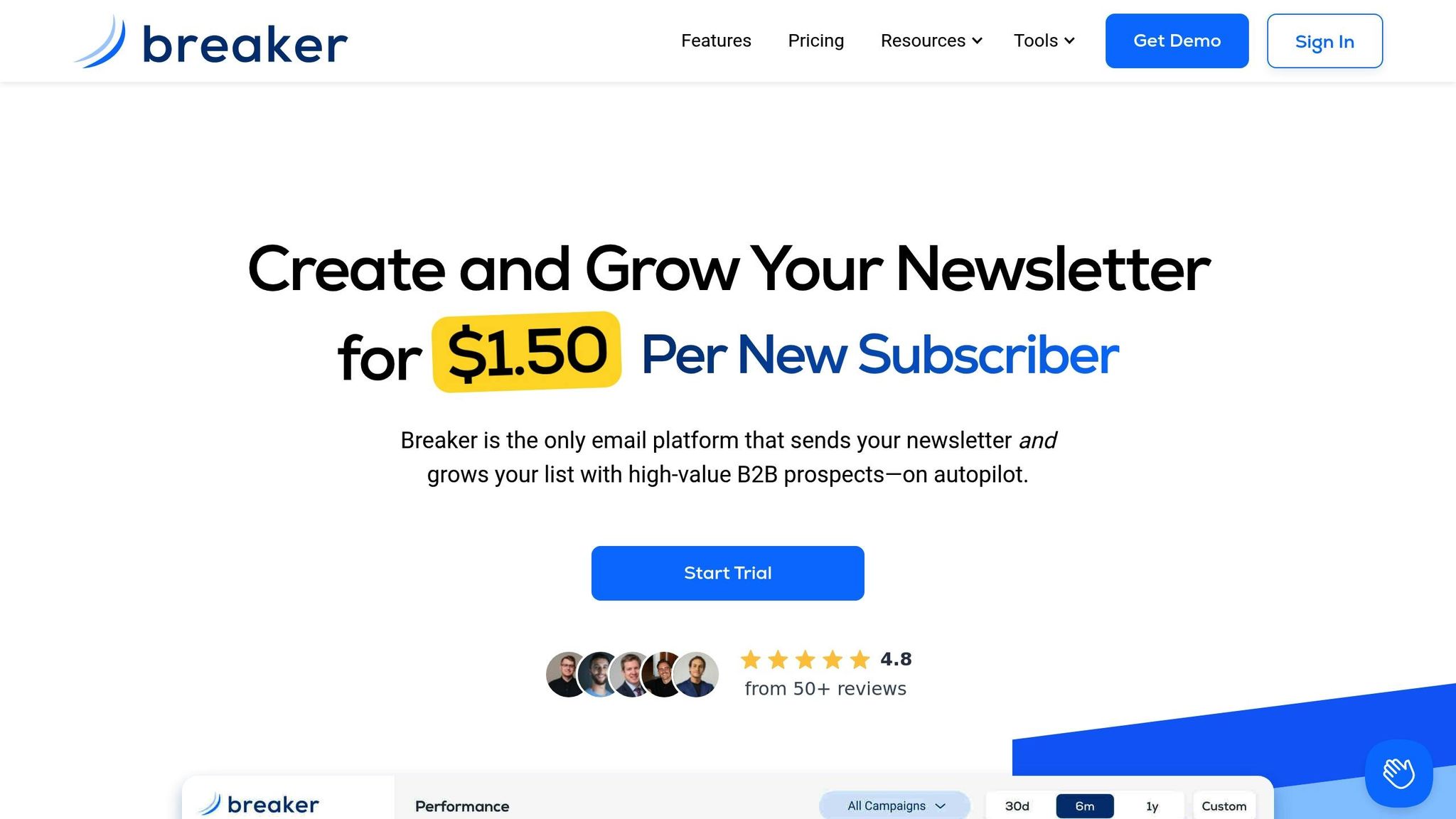
Breaker exemplifies how real-time analytics can be seamlessly integrated into B2B marketing workflows. The platform combines automated lead generation, precise audience targeting, and real-time performance analytics to help marketers quickly identify and act on high-value opportunities.
Using a custom matching algorithm, Breaker employs AI-driven data enrichment and proprietary datasets to pinpoint exact-match subscribers. This eliminates the guesswork in building audiences and ensures marketing efforts are directed toward prospects who align with the ideal customer profile.
Real-time performance analytics offer instant insights into key metrics like open rates, click-through rates, and subscriber growth. These features allow marketers to fine-tune their campaigns on the spot, without waiting for periodic reports. The results speak for themselves: RL Property Management added 5,000 new subscribers each month, Aligned Growth Media identified Breaker as their top source for booked calls, and Davis Richardson - collaborating with Jordan Belfort - achieved outstanding results, tripling sponsor revenue, doubling community memberships, and generating an over 10X ROI.
Breaker also tackles a common B2B marketing issue: the reliability of lead data. Research shows that 40% of leads sourced from third-party data are outdated, inaccurate, or fake. By focusing on first-party data collection and real-time validation, Breaker ensures that marketers target genuine, engaged prospects, significantly boosting the likelihood of conversions.
Implementation Challenges and Best Practices
Real-time predictive analytics holds immense promise for lead generation, but putting it into action isn’t without its obstacles. Knowing the common challenges and adopting effective strategies can be the difference between success and falling short.
Common Implementation Challenges
One of the biggest hurdles is data quality issues. Predictive analytics relies on accurate, well-integrated data. But when data from tools like web analytics, email platforms, or CRM systems is incomplete or siloed, models can miss critical behavioral signals. This weakens their ability to identify high-value prospects.
Another challenge is over-reliance on historical data. In fast-moving markets, models built primarily on past behaviors may fail to adapt to shifting buyer preferences or new competitors. This backward focus can cause businesses to miss emerging trends, leading to wasted marketing efforts and missed opportunities.
Data privacy and compliance requirements also add complexity. Regulations like the California Consumer Privacy Act (CCPA) require transparency about how data is used and give consumers the right to opt out. To stay compliant and maintain trust, companies need clear consent processes, anonymization practices, and thorough audit trails.
Lastly, technical integration challenges can overwhelm IT teams. Connecting diverse data sources in real time demands robust APIs and infrastructure to ensure secure, seamless data flow.
By addressing these challenges head-on, organizations can set the stage for successful integration of real-time analytics.
Proven Best Practices for Success
To get the most out of predictive analytics, follow these best practices:
- Prioritize data governance: Use automated validation tools and regular data cleaning routines to maintain high-quality, reliable data. Clean data leads to better-performing models.
- Align sales and marketing teams: Foster collaboration by setting shared goals and implementing service-level agreements (SLAs) for lead handoffs. Regular cross-team meetings to review model performance and gather feedback also help refine strategies.
- Leverage first-party data: As privacy regulations tighten and third-party data becomes less reliable, focus on consent-based data collection. Centralized repositories and regular purging of outdated records can improve data quality and collection rates.
- Start small with pilot projects: Before committing to large-scale investments, test the waters with scalable platforms that integrate well with existing marketing tools. Define clear KPIs, such as lead conversion rates or time-to-close metrics, to measure success.
One standout insight? Businesses that respond to leads within five minutes are 100 times more likely to convert them into customers.
Static Scoring vs. Real-Time Analytics Comparison
To better understand the impact of real-time analytics, here’s a side-by-side comparison with static scoring:
Feature
Static Scoring
Real-Time Analytics
Data Freshness
Periodic updates; often lags behind market changes
Continuously updates with live data for quick adaptation
Personalization
Limited by batch processing and preset rules
Enables hyper-personalization based on live behavior
Response Speed
Slower; may miss time-sensitive opportunities
Instant lead qualification and engagement
Implementation Complexity
Easier setup with fewer infrastructure needs
Requires advanced data pipelines and integration
Scalability
Better suited for smaller datasets and simple cases
Demands scalable infrastructure and ongoing support
Cost
Lower initial and operational expenses
Higher investment for technology and maintenance
Conversion Impact
Limited due to delayed responses
Boosts conversions with timely, relevant engagement
Real-time analytics shines in fast-paced, competitive environments where timing and relevance are critical. While it demands a greater investment in technology and expertise, the payoff in conversion rates and customer engagement can be substantial. The choice between static scoring and real-time analytics ultimately depends on your business goals, resources, and market priorities.
Conclusion: Getting Started with Predictive Analytics
Real-time predictive analytics is reshaping the way B2B marketers identify and prioritize their most valuable leads. With the market expected to grow from $1.1 billion in 2020 to $5.6 billion by 2025 - an impressive 39% annual growth rate - the impact is clear. Companies using predictive analytics have reported a 51% boost in lead-to-deal conversion rates, directly translating into higher revenue. These numbers highlight why swift adoption can make a big difference.
Getting started is easier than it might seem. The key to success begins with defining your Ideal Customer Profile (ICP). This step ensures predictive tools can zero in on the leads that align with your business goals. Once that's in place, look for platforms that combine AI-driven targeting with real-time performance tracking and robust matching algorithms.
"Define your ideal customer, and Breaker handles the rest. Our algorithm delivers engaged, exact-match B2B subscribers - so you grow without guesswork or wasted spend."
– Breaker
Switching from static to dynamic scoring is no longer optional for staying competitive. Traditional systems rely on outdated batch processing, while real-time analytics continuously adapts to live data, enabling hyper-personalized and instant lead qualification.
The clock is ticking. Real-time analytics is among the fastest-growing technology sectors, with an annual growth rate of 22.63%. Hesitating could mean falling behind competitors who are already leveraging this advantage.
For B2B marketers ready to make the leap, the focus should be on data quality and first-party data collection. Opt for platforms that integrate smoothly with your CRM and provide instant insights into key metrics like open rates, click-through rates, and subscriber growth. Remember, the goal isn’t just to gather more data - it’s to turn that data into actionable insights that fuel revenue growth. Prioritizing high-quality data and seamless integration will position your business to thrive in this new era.
The future of lead generation belongs to those who can predict, adapt, and respond in real time. The tools are proven, the market is ready, and the advantages are too significant to ignore. The real question is: how soon can you get started?
FAQs
How is real-time predictive analytics more accurate and faster than traditional lead scoring?
Real-time predictive analytics offers a sharper, faster alternative to traditional lead scoring methods. While older approaches depend on static data and occasional updates, real-time analytics works with live data, providing instant insights to identify high-value leads as they emerge.
This dynamic process allows marketers to respond immediately, fine-tuning campaigns and targeting strategies on the fly. Tools like Breaker's real-time performance analytics make this possible by delivering instant metrics - like open rates and click-throughs - giving marketers the ability to make smarter decisions in less time.
What key data sources improve the accuracy of predictive analytics for lead generation?
To make predictive analytics more precise in lead generation, zeroing in on the right data is key. Customer behavior data - things like website visits, email clicks, and social media engagement - offers a window into what potential leads are interested in and what they might need. Demographic and firmographic data, such as industry type, company size, and job roles, helps narrow down the focus to prospects with the highest potential. On top of that, historical performance data, like past campaign results and sales records, provides a solid foundation for building accurate predictive models and spotting trends.
By tapping into these data sources in real time, businesses can better identify and prioritize leads that are worth pursuing, leading to smarter resource use and a stronger return on investment (ROI).
What challenges do businesses face with real-time predictive analytics, and how can they address them?
Implementing real-time predictive analytics isn't always smooth sailing. Challenges like data quality, system integration, and a shortage of skilled professionals can make the process tricky.
For starters, poor data quality - think incomplete or inconsistent data - can throw off predictions. The fix? Businesses should focus on strong data governance practices, along with regular cleaning and validation of their datasets to ensure accuracy.
Then there's the issue of integrating predictive analytics tools into existing workflows and platforms. The key here is to choose tools that align well with current systems and allow for easy integration, minimizing disruptions.
Lastly, finding skilled data professionals can be a tough hurdle. Companies can tackle this by investing in training programs for their teams or collaborating with external experts. Both approaches can help fill the skills gap and set the stage for a successful rollout.
Related Blog Posts
Keep reading
All articlesGDPR Consent Requirements for Purchased Email Lists
Purchased email lists rarely meet GDPR's consent bar. Learn the legal basis rules, PECR overlap, and safer alternatives before you hit send.
7 Email Platforms With Inbox Placement Testing & Suppression
Compare 7 email platforms that combine inbox placement testing with suppression management, scored on features, pricing, and best-fit sender size.
Email Automation Workflow & Drip Campaign Data Structure
Learn the database schema behind email drip campaigns—tables, workflow states, and event logs that power reliable marketing automation.