
IP Reputation Tracking vs Domain Reputation Monitoring
Compare IP and domain reputations for email deliverability—differences, recovery timelines, shared vs dedicated IPs, and core best practices.

When it comes to email deliverability, two key factors determine whether your emails land in inboxes or spam folders: IP reputation and domain reputation. Both play unique roles in ensuring successful email campaigns, but understanding their differences is crucial for improving your email performance.
- IP reputation evaluates the trustworthiness of the server sending your emails. It’s like your email server’s “credit score,” influenced by consistent sending habits, engagement rates, and low bounce rates. Shared IPs are cost-effective but risk reputation damage from other senders. Dedicated IPs offer full control but require high volumes (100,000+ emails/month) to maintain stability.
- Domain reputation focuses on the credibility of your sending domain. It’s tied to your brand and evaluated based on authentication protocols (SPF, DKIM, DMARC) and user engagement (opens, clicks, replies). Unlike IPs, domain reputation is portable and long-lasting, making it a priority for modern email providers.
Quick Comparison
Factor
IP Reputation
Domain Reputation
Focus
Server infrastructure ("Where")
Brand identity ("Who")
Scope
Specific IP address
All IPs tied to the domain
Persistence
Temporary, tied to servers
Long-term, tied to the brand
Recovery Time
2–4 weeks
6–12 weeks
Primary Drivers
Sending habits, IP blocklists
Authentication, engagement metrics
Importance
Medium
High
Key Takeaways:
- IP reputation is critical for getting emails accepted by servers, but its importance is declining due to the rise of IPv6.
- Domain reputation determines inbox placement and is prioritized by email providers like Gmail and Outlook.
- Both reputations must be managed together for optimal deliverability. Focus on strong authentication, clean email lists, and consistent sending practices.
By balancing both strategies, you can ensure better inbox placement and protect your email campaigns from deliverability issues.
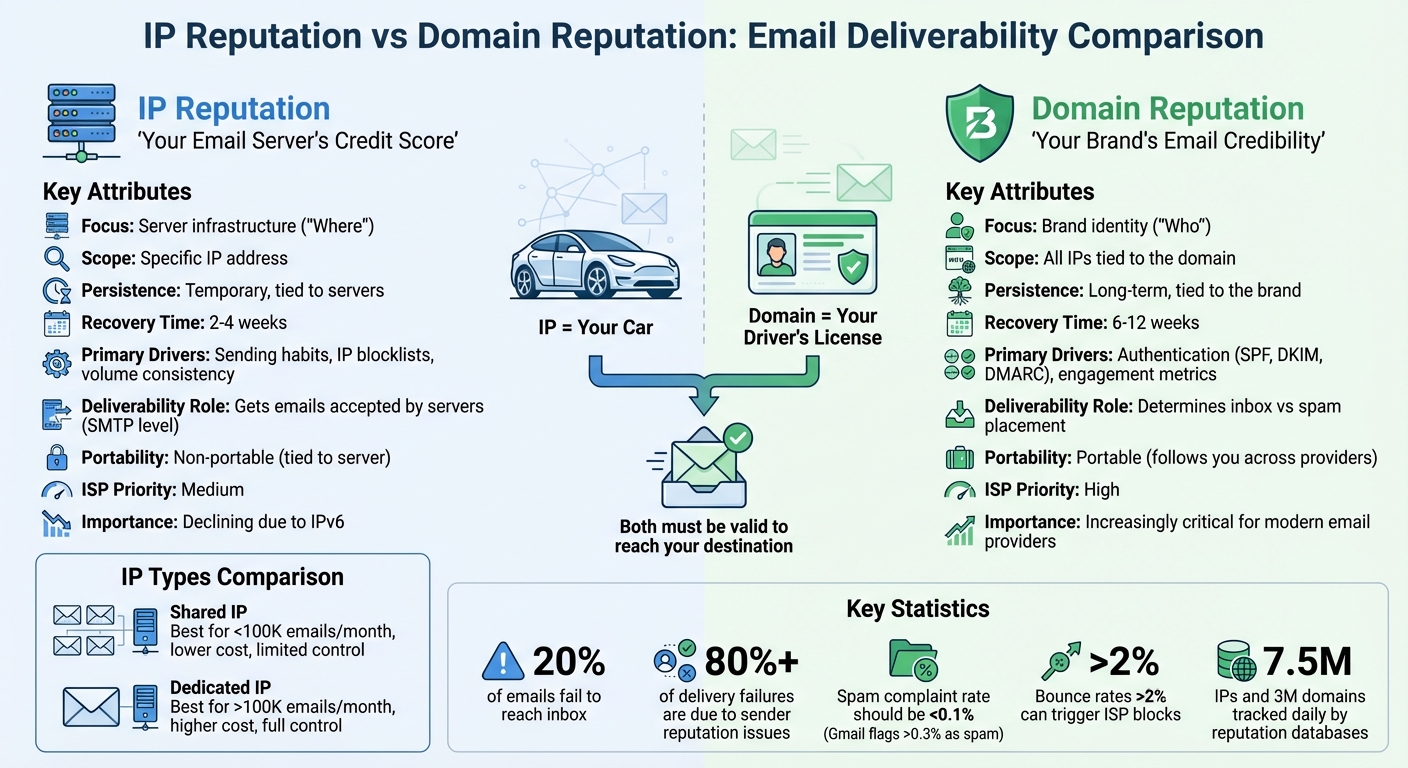
IP Reputation vs Domain Reputation: Key Differences for Email Deliverability
IP Reputation Tracking: Features and Limitations
How IP Reputation Works
Think of IP reputation as your email server's credit score. Internet Service Providers (ISPs) assign a trust score - usually between 0 and 100 - based on your sending habits. To build a strong reputation, you need consistent sending volumes, high engagement rates (like opens and clicks), and minimal bounce rates. But here's the tricky part: IP reputation is highly sensitive to sudden changes. For example, if your email volume jumps from 10,000 to 100,000 overnight, it might raise red flags for ISPs, who could interpret it as suspicious or bot-like behavior.
Nicolas Rios, Head of Product at Abstract API, explains it well:
"IP reputation - often described as the credit score of an email sender".
Just like a financial credit score, you can’t buy a solid reputation; it has to be earned through steady, reliable actions. On top of that, whether you're using a shared or dedicated IP can significantly affect your deliverability.
Shared vs. Dedicated IPs
The type of IP you choose plays a big role in how much control you have over your reputation. With shared IPs, multiple senders share the same address. This means your reputation is tied to the behavior of everyone using that IP. If another sender starts spamming, everyone’s reputation takes a hit. Shared IPs are generally a good option for lower-volume senders (under 100,000 emails per month) because the combined traffic helps ISPs assess the IP more easily.
On the other hand, dedicated IPs give you complete control over your reputation. This is particularly useful for high-volume senders, like B2B marketers, who rely on IP whitelisting for corporate communications. However, there’s a catch: to keep a dedicated IP “warm” and maintain your reputation, you need to send at least 100,000 emails per month. Sending fewer emails from a dedicated IP can appear irregular to ISPs and hurt your reputation.
Feature
Shared IP
Dedicated IP
Control
Limited; shared with others
Full; only your actions matter
Cost
Lower; included in basic plans
Higher; usually a premium option
Volume Needs
Best for under 100K emails/month
Requires over 100K emails/month
Best For
Small businesses, occasional senders
High-volume B2B marketers
These differences highlight the trade-offs between shared and dedicated IPs, particularly in terms of control and volume requirements.
Limitations of IP Reputation
While IP reputation is still relevant, its importance is fading. Modern mailbox providers now place more emphasis on domain reputation and user engagement.
Another challenge is that IP reputation is temporary and tied to infrastructure. Unlike domains, which are closely associated with your brand, IPs can be quickly swapped out and exploited. This makes them less reliable indicators for email providers. With the vast number of IPv6 addresses available - 340 undecillion, to be exact - bad actors can rotate through IPs faster than ISPs can block them. As a result, email providers increasingly focus on lasting signals like domain authentication and engagement metrics.
For B2B marketers, this means relying solely on IP reputation isn’t enough. Even with a perfect IP score, poor domain authentication or low engagement can still land your emails in spam folders. This is why balancing both IP and domain reputation is critical for effective email deliverability.
IP & Domain Reputation Myths, Truths, and the Basics You're Still Overlooking
Domain Reputation Monitoring: Benefits and Drawbacks
Understanding the unique strengths and challenges of domain reputation is key to refining your email deliverability strategy, especially when compared to IP reputation tracking.
How Domain Reputation Works
Domain reputation acts as a lasting record of your brand's credibility with email providers. It's shaped by factors like authentication protocols, engagement metrics, and your historical sending patterns. Providers like Gmail, Yahoo, and Outlook evaluate your domain using tools such as SPF, DKIM, and DMARC, alongside engagement signals like email opens, clicks, replies, and even how long recipients spend reading your messages.
The Spamhaus Team simplifies it:
"IP reputation is less important than the reputation of domains and content for inbox placement."
Why the shift? The rise of IPv6 introduced an astronomical number of IP addresses - 340 undecillion, to be exact - making IP-based blocking less practical. Malicious senders can easily rotate through IPs, so email providers now rely more heavily on domains, which are far less transient. This approach not only protects against bad actors but also offers long-term benefits for brands that prioritize their domain reputation.
The Long-Term Value of Domain Reputation
One of the standout benefits of domain reputation is its portability. Unlike IP reputation, which is tied to specific servers, your domain reputation stays with you even if you switch email service providers or IPs. This stability acts as a trust anchor, ensuring consistent email performance across your campaigns.
Major providers now prioritize domain reputation over IP reputation when deciding whether your emails land in the inbox. For brands, this means your domain reputation supports multiple IPs, providing a more reliable foundation for deliverability. For B2B marketers especially, maintaining a strong domain reputation is critical for ensuring emails reach their intended audience.
Using subdomains strategically can also help. For instance, separating transactional emails (like password resets) from promotional campaigns can shield your primary domain from potential issues with one email stream. While the benefits of domain reputation are clear, it’s not without its challenges.
Challenges of Domain Reputation Monitoring
If your domain reputation takes a hit, recovery isn’t quick - it can take anywhere from 6 to 12 weeks of consistent, high-quality sending to rebuild trust. There’s no fast track to fixing it; major ISPs don’t offer whitelists or manual overrides.
Benjamin Franklin’s timeless words ring true here:
"It takes many good deeds to build a good reputation, and only one bad one to lose it."
Monitoring domain reputation can be tricky because mailbox providers don’t share the specifics of their evaluation processes. By the time you notice delivery issues, significant damage may already have occurred. To protect your domain, you need to focus on strong authentication, diligent list hygiene (like removing subscribers who haven’t engaged in 3–6 months), avoiding spam traps from purchased lists, and maintaining steady sending volumes.
Interestingly, over 80% of email delivery failures stem from sender reputation issues rather than problems with the actual content. This underscores the importance of prioritizing your domain’s reputation to keep your emails reaching inboxes.
IP Reputation vs. Domain Reputation: Side-by-Side Comparison
Now that we've broken down how IP and domain reputations function individually, let's put them head-to-head. This comparison will help clarify their differences and guide you in managing email deliverability effectively.
Comparison Table
Factor
IP Reputation
Domain Reputation
Primary Focus
Sending server/relay infrastructure ("Where")
Brand identity and "From" domain ("Who")
Scope
Limited to a specific IP address
Covers all IPs tied to the domain
Persistence
Low; can change with new servers
High; remains with the brand over time
Recovery Time
2–4 weeks
6–12 weeks
Primary Drivers
Volume consistency, IP neighborhood, blocklists
Authentication (SPF, DKIM, DMARC), engagement, TLD
Deliverability Role
Decides if the connection is accepted (e.g., SMTP errors)
Influences inbox placement (primary inbox vs. spam)
Portability
Non-portable; tied to the server
Portable; follows you across providers
ISP Priority
Medium (used for safety limits)
High (critical for filtering decisions)
Here’s how MailChannels explains it:
"Think of IP as your car, and domain as your driver's license. Both need to be valid to reach your destination."
This analogy captures how both reputation types impact email delivery, from initial processing to final inbox placement.
Key Takeaways from the Comparison
Let’s distill the main points from the table and earlier discussions:
- IP reputation acts as the gatekeeper. If your IP reputation is poor, emails may be blocked outright or rejected during the SMTP handshake. Since it’s tied to specific server infrastructure, it’s easier to improve compared to domain reputation.
- Domain reputation determines inbox placement. Even if the IP successfully delivers the email, domain reputation decides whether it lands in the inbox or spam folder. Providers like Gmail and Microsoft increasingly rely on domain-level signals because domains are harder to manipulate. As Allegrow points out, mailbox providers now "overwhelmingly prioritize domain reputation... over IP reputation."
- Short-term vs. long-term focus. IP reputation is something you can address relatively quickly, while domain reputation requires consistent effort over time. Even a small spam complaint rate - just 0.1% - can harm your domain’s standing with major providers.
- Monitoring scale matters. Reputation databases like Spamhaus track around 7,500,000 IPs and 3,000,000 domains daily.
- When to focus on each:
- Prioritize IP tracking when setting up a new dedicated IP, troubleshooting bounce-backs, or managing shared IP environments.
- Prioritize domain monitoring when switching email providers, addressing spam folder issues, or managing multiple subdomains.
Understanding when and how to focus on each reputation type can make a big difference in your email deliverability strategy. Balancing both ensures your messages reach their intended audience effectively.
How B2B Marketers Can Use Both Methods
To get the best email deliverability results, B2B marketers need to manage both IP and domain reputations effectively. As email deliverability expert Daniyal Dehleh explains:
"Email deliverability is now a trust issue, instead of a server issue".
Think of IP reputation as the technical backbone and domain reputation as the face of your brand. Both need attention to ensure your emails land in inboxes.
Maintaining Both Reputations
First, make sure your SPF, DKIM, and DMARC protocols are fully authenticated with a 100% pass rate. By 2025, bulk senders who fail any of these protocols (sending over 5,000 messages daily to Gmail) risk immediate rejection. These settings are critical for protecting both your IP and domain reputations.
Regular list maintenance is another must. Clean your email lists every 60–90 days and remove hard bounces immediately. To avoid triggering alarms with ISPs, keep daily email volume changes under 20% - sudden spikes can raise red flags. Using double opt-in is also key to reducing spam complaints, keeping your complaint rate below 0.1%. Gmail considers rates above 0.3% as spammy behavior.
Here’s a real-life example: A mid-size SaaS company in late 2025 boosted their inbox placement rate from 30% to 90% in just two months. How? By cleaning their lists, segmenting inactive users, warming up their IP over 21 days, and ensuring proper authentication protocols were in place. This success came from addressing both IP and domain reputations at the same time.
Once your reputations are solid, it’s time to decide whether a dedicated or shared IP is the right fit for your email strategy.
When to Use Dedicated IPs
Dedicated IPs are ideal if you’re sending over 100,000 emails per month or if you operate in industries with strict compliance requirements, where corporate filters often require whitelisting. With a dedicated IP, you have full control over your sending reputation, but this also means you need to maintain a steady, predictable email schedule.
If you’re sending fewer than 100,000 emails monthly or your volume fluctuates, shared IPs are generally a better option. On shared IPs, you can’t control the IP’s behavior, so your focus should shift to building a strong domain reputation through proper authentication and engagement strategies.
For high-volume senders, keep in mind that bounce rates above 2% can lead to temporary blocks from major ISPs like Gmail. With a dedicated IP, you’re solely responsible for keeping these metrics in check.
While IP selection is important, engagement metrics are just as critical for maintaining a strong domain reputation.
The Role of Engagement Metrics
ISPs like Gmail and Outlook rely heavily on user engagement signals to evaluate domain reputation. Positive signals include open rates, click-through rates, replies, and how much time users spend reading your emails. On the flip side, actions like deleting emails without reading or marking them as spam can quickly harm your domain reputation.
To improve engagement, segment your list by activity level and prioritize subscribers who’ve engaged in the past 30–90 days. This approach strengthens your engagement signals while limiting exposure to inactive users. For subscribers who haven’t engaged in six months or more, it’s best to remove them - they’re likely dragging down your deliverability metrics.
It’s worth noting that more than 80% of undelivered emails fail because of sender reputation issues, not content problems. Your engagement strategy plays a direct role in determining whether your emails make it to the inbox. To protect your primary domain, consider using subdomains to separate different types of email traffic, such as transactional and marketing emails.
Conclusion: Choosing the Right Approach
IP and domain reputations work together to ensure successful email delivery. While IP reputation focuses on getting emails delivered, domain reputation plays a key role in determining whether those emails land in the inbox or get filtered out. Together, they form the backbone of email deliverability.
The email industry has evolved. In the past, IP reputation was the primary factor mailbox providers considered. But today, platforms like Gmail and Outlook rely more on domain reputation and engagement metrics. This shift is largely due to the abundance of IPv6 addresses, which made IP-based blocking less effective. As Harvey Mackay once said:
"You can't buy a good reputation; you must earn it".
The numbers speak volumes: 20% of emails fail to reach the inbox, and over 80% of these failures are tied to sender reputation issues. Even a pristine IP reputation cannot offset a poor domain reputation, highlighting the importance of managing both.
To navigate this complex landscape, having the right tools is essential. Platforms like Breaker simplify the process by offering built-in deliverability management. With features like unlimited email validations and real-time analytics, Breaker helps you maintain strong IP and domain reputations without needing advanced technical expertise. By focusing on delivering highly engaged, relevant subscribers, the platform naturally boosts engagement metrics, which are critical for modern email filtering.
Think of IP reputation as your short-term safety net and domain reputation as a long-term investment in your brand. To succeed, implement strict authentication protocols, maintain clean email lists, monitor engagement, and leverage tools designed to optimize deliverability. The effort you put in will be reflected in your inbox placement rates.
FAQs
What steps can I take to repair my damaged domain reputation?
To fix a damaged domain reputation, the first step is to clean and verify your email list. This reduces bounces and ensures you're not sending emails to outdated or poor-quality contacts. Stick to sending emails that are targeted and relevant, focusing on recipients who are actively engaged. This approach builds trust and lowers the chances of spam complaints.
It's also crucial to monitor your email practices. Make sure you're following best practices, like avoiding spam-like content and not overwhelming your audience with too many emails. By consistently practicing good email hygiene and refining your targeting, you can gradually rebuild and improve your domain's reputation.
What are the advantages of using a dedicated IP instead of a shared IP?
Using a dedicated IP comes with clear advantages, particularly in terms of control and managing your sender reputation. With a dedicated IP, your email activity is the sole factor influencing its reputation. This means you won’t have to worry about being penalized for poor practices by other senders sharing the same IP. The result? A more stable and predictable email performance.
This setup is especially useful for businesses running high-volume email campaigns or those that depend on maintaining a strong reputation to ensure their emails reach inboxes. By isolating your email traffic, you minimize the chances of deliverability issues caused by others and gain better oversight of your email performance.
For companies focused on reliable and consistent email delivery, a dedicated IP can make all the difference, ensuring your messages land where they’re meant to - without outside interference.
Why is domain reputation now more important than IP reputation?
Domain reputation has taken center stage over IP reputation as email providers now prioritize the trustworthiness of a sender's domain rather than focusing solely on the IP address. Here's the difference: IP reputation measures the activity of a specific IP, like spam complaints or whether it's been blacklisted. On the other hand, domain reputation evaluates the sender's overall credibility. This includes factors like email authentication protocols (SPF, DKIM, DMARC), consistent sending habits, and how recipients interact with the emails.
Why the shift? Domains are more stable and can function across multiple IP addresses, making them a better indicator of trust. A strong domain reputation ensures dependable email deliverability, no matter which IP is used. Focusing on domain reputation has become a smarter, long-term approach to improving email performance.
Related Blog Posts
Keep reading
All articlesGDPR Consent Requirements for Purchased Email Lists
Purchased email lists rarely meet GDPR's consent bar. Learn the legal basis rules, PECR overlap, and safer alternatives before you hit send.
7 Email Platforms With Inbox Placement Testing & Suppression
Compare 7 email platforms that combine inbox placement testing with suppression management, scored on features, pricing, and best-fit sender size.
Email Automation Workflow & Drip Campaign Data Structure
Learn the database schema behind email drip campaigns—tables, workflow states, and event logs that power reliable marketing automation.