
Best Email Platforms With Real-Time Analytics in 2026
Compare email platforms with true real-time analytics—webhooks, live deliverability signals, and lead scoring that beat daily batch reporting.
Marketers lose deals every day because they find out an email failed 24 hours too late. By the time the daily report arrives, the A/B test is over, the prospect has moved on, and the deliverability problem has already harmed the next three sends. That's the cost of waiting for batch reports instead of acting on live data - and it's driving teams to search for email platforms with real-time email analytics dashboard capabilities rather than yesterday's dashboard shipped with their ESP.
Real-time email analytics means opens, clicks, bounces, and engagement signals appear in your dashboard within seconds or minutes, not hours later. The fastest platforms push data through webhooks and live dashboards so you can adjust course while a send is still unfolding. Slower ones force you to wait until morning. This guide breaks down what real-time actually means technically, compares platforms that deliver on that promise, and provides a framework for choosing the right one.
What Real-Time Email Analytics Actually Means
Real-time email analytics is the ability to see subscriber behavior - opens, clicks, bounces, unsubscribes - reflected in your dashboard within seconds to a few minutes of each event, typically through webhook-driven or event-streaming architecture rather than scheduled batch jobs.
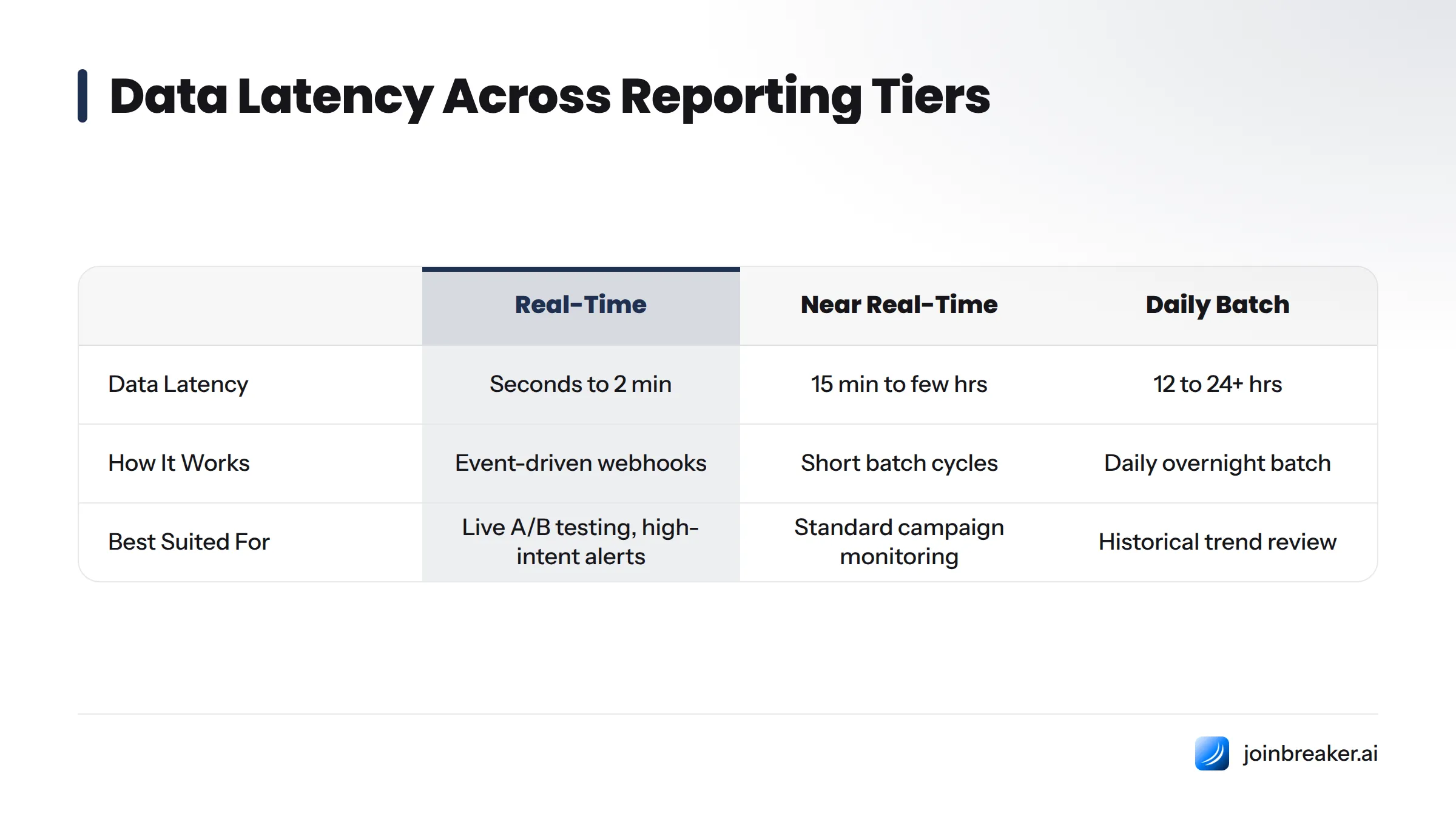
"Real-time" gets used as a marketing word far more often than accurately, and that gap matters once you're relying on the data to make decisions. A genuinely real-time platform uses event-driven architecture: the moment a subscriber opens an email or clicks a link, that event fires a webhook or streams into an analytics layer, and your dashboard updates almost instantly. A "near real-time" platform batches events every 15 to 60 minutes. Legacy ESPs running daily batch reporting - still common - refresh numbers once every 24 hours, usually overnight.
Real-Time vs. Near Real-Time vs. Daily Batch Reporting
Here's how the three tiers compare in practice:
| Reporting Tier | Data Latency | How It Works | Best Suited For |
|---|---|---|---|
| Real-time | Seconds to 2 minutes | Event-driven webhooks stream opens and clicks directly into a live dashboard | Live A/B testing, high-intent lead alerts, breaking-news sends |
| Near real-time | 15 minutes to a few hours | Data collected continuously but refreshed in short batch cycles | Standard campaign monitoring, mid-size list management |
| Daily batch | 12 to 24+ hours | Reports compiled once per day, usually overnight | Historical trend review, low-frequency senders |
If you've ever refreshed a dashboard five times waiting for yesterday's send to finish counting, you've experienced daily batch reporting. It's not broken, just built for a slower decision cycle than modern teams operate on.
Why Data Latency Changes What You Can Do
Speed determines what actions are still possible. If this morning's open rates appear tomorrow, you've lost the window to adjust follow-up subject lines, catch a deliverability drop before it spreads to your next sends, or flag a high-intent click to sales while the lead is still warm. Real-time visibility transforms analytics from a postmortem into a steering wheel.
This is what Breaker calls narrative infrastructure: the connective layer between "what just happened" and "what to do next." A dashboard showing yesterday's results cannot inform today's decision. For a deeper look at how this plays out, Breaker's guide on how analytics improve email journey flows walks through the mechanics.
Real-Time Analytics Checklist:
- Dashboard refresh rate measured in seconds or minutes, not hours
- Webhook or API access to pipe events into your own systems
- Live deliverability and inbox placement signals, not weekly digests
- Engagement scoring that updates as subscribers interact
- Clear documentation of vendor latency (ask for the actual number)
Key Metrics a Real-Time Email Platform Should Track
Not every metric needs to be instant. Historical trends work fine on delay. But several metrics lose most of their value without live access, and those deserve scrutiny before you commit.
Opens, Clicks, and Engagement Scoring
Open rate and click-through rate remain the backbone of email performance tracking, even with Apple's privacy changes complicating open-rate accuracy. What matters in real time is less the raw number and more the trend: is engagement climbing or falling within the first hour after send, when typically 60-80% of opens occur. Engagement scoring, which weighs opens, clicks, and reply behavior into a single subscriber number, delivers the most value when updated live - that's the signal telling you who to contact today.
Deliverability and Inbox Placement Signals
A real-time email performance tracking tools platform should flag bounce spikes, spam complaints, and inbox placement drops as they happen, not after sender reputation has taken damage. Deliverability monitoring in near real time is one of the underrated features in this category, covered in depth in Breaker's breakdown of inbox placement testing and suppression.
Subscriber Intent and Lead Scoring
This is where real-time analytics stops being reporting and becomes a sales tool. Predictive lead scoring built from live click and engagement data can flag a subscriber who just clicked your pricing link three times in ten minutes - a very different prospect than someone who opened an email once a week ago. Breaker's piece on how analytics predicts high-value leads in real time explores the mechanics of audience graph-based scoring.
Revenue Attribution Metrics
For ecommerce and subscription newsletters, tying opens and clicks to actual revenue is the metric that justifies analytics investment to finance and leadership. Platforms connecting live engagement data to purchase or conversion events - usually via UTM tracking and CRM integrations - give you a faster read on which campaigns generate actual revenue versus vanity opens. Breaker's newsletter analytics guide covers metrics most closely correlated with revenue for newsletter operators.
The Best Email Platforms With Real-Time Email Analytics (2026 Comparison)
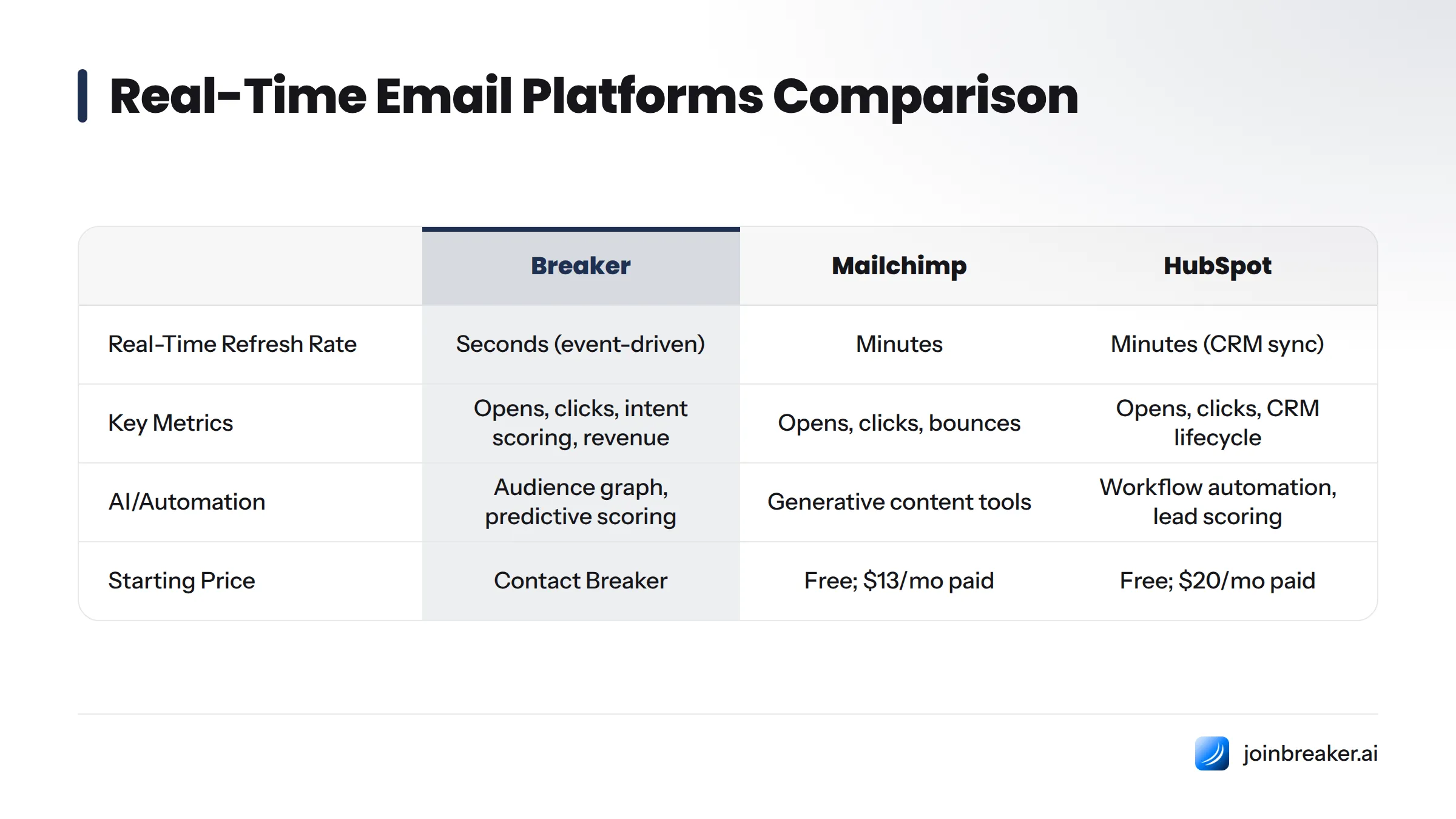
I evaluated each platform on five criteria: actual dashboard refresh speed, depth of metrics tracked, AI or automation features built on that data, deliverability tooling strength, and pricing clarity. Here's how leading platforms compare:
| Platform | Real-Time Refresh Rate | Metrics Tracked | AI/Automation Features | Deliverability Tools | Starting Price | Best For |
|---|---|---|---|---|---|---|
| Breaker | Seconds (event-driven via RealClick™ + audience graph) | Opens, clicks, intent scoring, revenue attribution, engagement decay | Audience graph, predictive lead scoring, TruSend send-time optimization | Built-in inbox placement monitoring, reputation alerts | Contact Breaker for pricing | B2B newsletters, AI-powered audience intelligence |
| Mailchimp | Near real-time (minutes) | Opens, clicks, bounces, basic segmentation | Generative content tools, basic send-time recommendations | Standard spam-complaint monitoring | Free tier; paid plans from roughly $13/month | General small business email marketing |
| HubSpot | Near real-time, tied to CRM sync cycles | Opens, clicks, CRM-linked lifecycle data | Workflow automation, lead scoring tied to CRM stages | Deliverability insights within Marketing Hub | Free tier; paid Marketing Hub plans from around $20/month | CRM-integrated analytics |
| ConvertKit | Near real-time | Opens, clicks, subscriber tagging | Visual automation builder | Basic deliverability reporting | Free tier; paid plans from around $25/month | Solo creators and small newsletters |
| beehiiv | Near real-time | Opens, clicks, growth and referral metrics | Boosts network for list growth, A/B subject line testing | Built-in deliverability dashboard | Free tier; paid plans from around $34/month | Creator newsletters and monetization |
| Klaviyo | Near real-time, strong on event triggers | Opens, clicks, purchase behavior, flow performance | Predictive analytics (CLV, churn), flow automation | Deliverability monitoring tied to ecommerce sends | Free tier; paid plans from around $20/month | Ecommerce analytics |
| ActiveCampaign | Near real-time | Opens, clicks, automation-triggered events | Extensive automation builder with conditional logic | Deliverability tracking within automation reports | Paid plans from around $15/month | Marketing automation analytics |
| Customer.io | Real-time (event-stream architecture) | Behavioral events, opens, clicks, custom event triggers | Event-triggered journeys, API-first data model | Deliverability data via integrations | Usage-based pricing, contact for quote | Event-triggered real-time data at scale |
Breaker: B2B Newsletters and AI-Powered Audience Intelligence
Breaker is built on the principle that analytics should drive the next action, not just describe the previous one. Its RealClick™ tracking and audience graph feed engagement data into a live email platform with live open rate tracking that updates as subscribers interact. The platform reports a 63% average open rate and 2.7% average click-through rate across its customer base, attributed to TruSend send-time optimization and deliverability-first infrastructure. For B2B lead generation off newsletters, Breaker's predictive lead scoring surfaces high-intent clicks as they happen rather than in a next-day digest, making it positioned at the top of this list. See Breaker's own AI-native ESP review for deeper platform details.
Mailchimp: General Small Business Email Marketing
Mailchimp remains one of the most recognizable names in the category, with an analytics dashboard covering fundamentals well: opens, clicks, bounce tracking, and basic audience segmentation. Its reporting refreshes quickly but isn't built on event-streaming architecture like more specialized platforms, so it falls into near real-time rather than true real-time. For a small business sending a weekly newsletter or product update, that speed is usually adequate.
HubSpot: CRM-Integrated Analytics
HubSpot's strength lies less in raw speed and more in context. Email analytics sync directly with the CRM, so a marketer sees not just that a contact opened an email but where that contact sits in the sales pipeline. That CRM integration is especially valuable for B2B teams already practicing CRM best practices alongside email, since the lead-to-close loop stays in one system.
ConvertKit and beehiiv: Creator Newsletters
Both platforms built their reputation serving independent creators and small publishers, offering solid near real-time dashboards covering opens, clicks, and subscriber growth. beehiiv emphasizes monetization and referral-based growth analytics, while ConvertKit focuses on simplicity and automation for solo operators. Neither markets itself as offering second-by-second event streaming, but for most newsletter operators the refresh speed catches problems same-day.
Klaviyo: Ecommerce Analytics
Klaviyo's analytics engine is purpose-built around commerce events: purchases, cart abandonment, and browse behavior feed into flow performance reporting. Its predictive analytics for customer lifetime value and churn risk make it strong for any brand where email revenue attribution is the primary scorecard.
ActiveCampaign: Marketing Automation Analytics
ActiveCampaign's conditional automation builder is deep, and reporting reflects that complexity by tracking engagement at nearly every automation touchpoint. It suits teams running complex nurture sequences who want analytics woven into every journey branch, a topic covered further in the B2B marketing automation platform guide.
Customer.io: Event-Triggered Real-Time Data
Customer.io is one of few platforms built on genuinely event-driven, API-first architecture from the ground up, making it a favorite among engineering-led growth teams piping behavioral events into email, push, and in-app messaging simultaneously. Its real-time credentials are strong, though it requires more technical setup than traditional ESPs.
How to Choose the Right Real-Time Email Platform
The best platform depends on what you're doing with the data. Here's a framework broken down by four common use cases:
| Use Case | Priority Features | Platforms Worth Shortlisting |
|---|---|---|
| B2B lead generation | Predictive lead scoring, CRM integration, intent-based alerts | Breaker, HubSpot |
| Media/newsletter publishing | Audience growth analytics, monetization tracking, send-time optimization | Breaker, beehiiv |
| Ecommerce | Revenue attribution, purchase-event triggers, flow performance | Klaviyo |
| Agency reporting | Multi-client dashboards, white-label reporting, API access | ActiveCampaign, Customer.io |
Questions to Ask Before You Buy:
- What's the actual latency between an event happening and appearing in the dashboard? Ask for a number, not an adjective.
- Is real-time data available via webhook or API, or only inside the vendor's dashboard?
- How does the platform handle Apple Mail Privacy Protection's effect on open-rate accuracy?
- What happens to historical analytics data if you migrate away? Can you export it?
- Does pricing charge extra for API access or real-time features, or is it bundled?
- Can the platform connect to your CRM or data warehouse without a third-party integration tool?
If you're coming from a legacy ESP and worried about losing historical performance data, review a B2B email marketing tools comparison before committing, since migration support varies widely between vendors.
Common Pitfalls That Undermine Real-Time Accuracy
Even the fastest dashboard can show technically real-time numbers that are practically misleading. Here are three issues tripping up marketers most often.
Apple Mail Privacy Protection and Open Rate Inflation
Apple's Mail Privacy Protection, documented in Apple's developer materials, pre-fetches images in emails opened through Apple Mail apps, registering an "open" even if the subscriber never actually viewed the message. Available since iOS 15, and now widely adopted across consumer inboxes, this has meaningfully inflated open-rate data industry-wide. The practical fix is to weight click-through rate and downstream engagement more heavily than raw opens, since clicks require actual action and aren't affected by this pre-fetching.
Webhook and API Reliability Issues
A platform can have a technically real-time architecture yet deliver spotty data if webhooks fail silently or your receiving endpoint drops events during high traffic. Before trusting real-time claims, ask what retry logic exists for failed webhook deliveries and whether the platform offers fallback batch sync to catch missed events. Most vendors won't volunteer this technical detail unless you ask.
GDPR and Consent Impacts on Tracking Data
Under the EU's General Data Protection Regulation, tracking pixels and click data generally require a lawful basis, usually consent, before collection. This means subscribers who haven't consented to tracking may not generate the open or click events your dashboard expects. The official EU GDPR portal outlines these consent requirements in detail, and any platform serving EU subscribers needs to handle consent-gated tracking gracefully rather than dropping or guessing at missing data. Teams building lists touching EU subscribers should also review GDPR rules around purchased email lists.
How Real-Time Analytics Drives Revenue
The business case for real-time data comes down to decision speed. A marketing team running an A/B test on subject lines doesn't need to wait a full day to see which variant wins if the platform shows statistically meaningful open and click differences within the first hour or two, often enough data to call a winner and resend to the remaining list same-day. That single change turns one send into effectively two optimized sends.
Deliverability is the other place speed pays off. A bounce-rate spike caught within minutes can be paused and diagnosed before it damages sender reputation. The same spike caught the next morning might already require a multi-week deliverability recovery process to repair. For B2B teams, a high-intent click - someone opening the pricing page link three times in one sitting - is a lead sales should know about today, not in next week's report. Breaker's case study on send-time optimization walks through a concrete example of how reducing reporting lag translated into faster follow-up and more closed deals.
This video rounds out the comparison with a look at how several current platforms, including creator tools like beehiiv, stack up on broader feature sets beyond analytics:
Frequently Asked Questions
What is real-time email analytics? Real-time email analytics tracks subscriber behavior like opens, clicks, and bounces as events happen, with dashboard updates occurring within seconds to minutes rather than daily reports.
How is real-time email analytics different from standard email reporting? Standard reporting typically compiles data in daily or weekly batches, while real-time analytics streams events continuously through webhooks or event-driven architecture, so the gap between an action and its appearance in your dashboard shrinks from hours to minutes or seconds.
Which email platform has the best real-time analytics in 2026? Breaker and Customer.io currently offer the fastest, most technically real-time architectures, with Breaker emphasizing AI-driven audience intelligence and lead scoring, and Customer.io emphasizing event-triggered, API-first data pipelines for engineering-led teams.
Does Apple's Mail Privacy Protection affect real-time open tracking? Yes. Apple Mail Privacy Protection can register false opens by pre-fetching email content before a subscriber actually views it, inflating open-rate data for subscribers using Apple Mail clients. Click-through rate is a more reliable real-time signal.
Can I get real-time analytics with free email marketing tools? Some free tiers, like Mailchimp's, offer near real-time reporting on basic metrics, but true event-driven, webhook-level real-time access is typically reserved for paid plans across most platforms.
How do real-time analytics improve email deliverability? Real-time deliverability monitoring flags bounce spikes, spam complaints, and inbox placement drops as they occur, allowing senders to pause campaigns or adjust list hygiene before reputation problems compound across multiple sends.
What metrics should I monitor in real time? Prioritize open rate trends in the first hour after sending, click-through rate, bounce rate, spam complaint rate, and any subscriber-level engagement or intent scoring your platform offers, since these are metrics where speed changes what action you can take.
Is real-time analytics worth paying extra for? For teams running frequent sends, B2B lead generation, or revenue-driving campaigns, catching a deliverability issue or qualifying a hot lead within minutes rather than a day typically justifies the cost difference between real-time and batch-reporting platforms.
Final Verdict: Choosing an Email Platform Built for Real-Time Analytics
Which platform is best depends on what decision you need to make faster. If you're a B2B marketer catching high-intent leads the moment they click, Breaker's combination of live audience graph scoring and a reported 63% average open rate with 2.7% CTR makes it the strongest option on this list - built specifically to turn engagement data into next-step decisions rather than static reports. If you're running heavy ecommerce automation, Klaviyo's commerce-native event tracking is hard to beat. If you need pure engineering-grade event streaming across multiple channels, Customer.io delivers that architecture.
What matters most is that you stop accepting "real-time" as a marketing claim and start asking vendors for the actual latency number, the webhook documentation, and a clear answer on how they handle Apple Mail Privacy Protection and consent-based tracking gaps. A platform that can answer those three questions clearly has usually earned the label. One that can't is probably still running on yesterday's data, dressed up as today's.
Sources
Keep reading
All articlesWhat Is an Email Drip Campaign
Learn what an email drip campaign is, how triggers and sequences work, and how it differs from nurture campaigns, newsletters, and sequences.
8 Drip Campaign Examples That Convert Subscribers
See 8 real drip campaign examples with subject lines, triggers, and timing that turn subscribers into customers across ecommerce, B2B, and SaaS.
What Is a Heat Map (Email Marketing Definition)
Learn what a heat map is, how the color scale works, and explore 6 types—from website click maps to email marketing heat maps—with real examples.