
What Is Ideal Customer Profile A Guide to B2B Growth
Learn what is ideal customer profile and how to build one. This guide covers how to define, create, and leverage your ICP for targeted B2B marketing.
An Ideal Customer Profile (ICP) is a detailed description of a fictional company that gets the most value from your product and provides the most value back to you. It's the blueprint for the perfect B2B account, not an individual person.
The Strategic Blueprint for Your Growth
Think of an Ideal Customer Profile as a strategic compass for your entire go-to-market motion. Many marketing efforts feel like casting a wide net and just hoping for the best. An ICP, on the other hand, is like having a high-powered sonar system. It helps you ignore the vast, empty ocean and focus your energy only on the areas teeming with the exact fish you want to catch.
This targeted approach is what separates high-growth B2B companies from the rest. Instead of guessing who might benefit from your solution, you use data to build a clear, specific picture of the organization that is most likely to buy, succeed, and become a long-term advocate. This isn't just a marketing exercise; it's a foundational business strategy.
ICP vs. Buyer Persona: What Is the Difference?
It’s easy to get these two mixed up, but it's crucial to understand that an ICP and a buyer persona are not the same thing. They work together, but they answer two fundamentally different questions:
- Ideal Customer Profile (ICP): Focuses on the company level. It answers the question, “What kind of organization is the perfect fit for our product?”
- Buyer Persona: Focuses on the individual level. It answers the question, “Who are the people we need to convince within that organization?”
Simply put, an ICP defines the playground, while buyer personas identify the key players on the field. You first use your ICP to find the right companies and then use your buyer personas to tailor your messaging to the decision-makers, champions, and influencers within them.
To make it even clearer, let's break down how they differ side-by-side.
Ideal Customer Profile vs Buyer Persona Key Differences
Attribute
Ideal Customer Profile (ICP)
Buyer Persona
Focus
The company or account
The individual or person
Scope
Macro-level (the "where")
Micro-level (the "who")
Data Points
Firmographics: Industry, company size, revenue, location, tech stack, funding stage.
Demographics & Psychographics: Job title, role, responsibilities, pain points, motivations, goals.
Purpose
To identify the best-fit companies to target.
To craft messaging that resonates with specific people inside those companies.
Example
A mid-market SaaS company with 50-250 employees in the FinTech space.
"Victoria, the VP of Marketing" who needs to prove ROI on her marketing spend.
Both are essential for an effective B2B strategy, but they serve very different roles.
An ICP is your macro-level filter for account selection, defining firmographics like industry, company size, and revenue. A buyer persona is your micro-level lens for communication, focusing on job titles, pain points, and motivations. You absolutely need both.
For instance, your ICP might be "US-based SaaS companies with 50-200 employees that have raised a Series A funding round."
Within that company, you might have several buyer personas, like "Victoria the VP of Marketing," who cares about ROI and lead generation, and "Sam the Sales Director," who needs better tools for his team. You can't effectively reach Victoria and Sam without first identifying their company as an ideal fit.
This guide will give you a step-by-step framework for building a data-driven ICP that attracts these high-value, long-term customers.
Why an ICP Is Your Most Powerful Growth Lever
A well-defined Ideal Customer Profile fundamentally changes the game. It shifts your strategy from asking, “Who could we sell to?” to confidently declaring, “Who should we sell to?” This isn't just a minor tweak in perspective; it's the engine for predictable B2B growth. When you focus every ounce of effort on accounts that are a perfect fit, you directly improve your most critical business metrics.
Think of it like a team of archers. Without an ICP, they're just shooting arrows randomly into a vast forest, hoping one eventually hits something. But with a clear ICP, they're all aiming at a single, well-lit target. Every arrow is more likely to hit the bullseye, and no energy is wasted on impossible shots. This focused approach is the key to unlocking efficient, scalable growth.
Reduce Customer Acquisition Costs
One of the first things you'll notice with a precise ICP is a dramatic drop in your Customer Acquisition Cost (CAC). When you know exactly which companies to target—their industry, size, revenue, and even the tech they use—you stop burning money on marketing and sales efforts aimed at poor-fit leads.
Your ad spend becomes laser-focused because you're targeting narrower, more relevant audiences. Your sales team’s productivity skyrockets because they spend their time talking to qualified accounts that actually need your solution, instead of chasing dead ends. This kind of efficiency means every dollar and every hour invested yields a much higher return, directly lowering the cost to acquire each new customer.
An ICP acts as a filter for your entire go-to-market motion. It ensures that only the highest-potential accounts enter your pipeline, saving invaluable resources and accelerating your sales cycle.
This focus allows you to move beyond generic campaigns and adopt more targeted tactics. You can read more about how this works in our guide on ABM email targeting, a strategy that absolutely depends on a rock-solid ICP to succeed.
Increase Customer Lifetime Value
Slashing costs is only half the story. A great ICP also significantly boosts Customer Lifetime Value (LTV). Companies that fit your ideal profile aren't just more likely to buy; they're far more likely to stick around and succeed with your product.
Because your solution is built to solve their specific problems, they get value faster, run into fewer support issues, and see a clearer return on their investment. This success leads directly to higher satisfaction and loyalty.
Happy customers are much more likely to:
- Renew their subscriptions without a second thought.
- Expand their usage, upgrading to higher tiers or adding more seats.
- Become brand advocates, providing powerful testimonials and referrals.
This creates a virtuous cycle where the customers you bring in aren't just short-term wins. They become long-term partners who contribute compounding value to your business over time. When your LTV is way higher than your CAC, you have the foundation for sustainable, profitable growth.
Align Your Entire Organization
Finally, an ICP serves as the single source of truth that aligns every single department in your company. It creates a seamless and consistent customer experience, from the first marketing touchpoint to the final sales call and all the support that follows.
- Marketing knows what message will resonate and which channels to use to deliver it.
- Sales can prioritize the right leads and tailor their outreach to be incredibly effective.
- Product gets clear feedback to build features that serve your most valuable users.
- Customer Success can proactively support accounts, driving adoption and heading off problems.
This kind of alignment across the organization eliminates internal friction and makes sure everyone is pulling in the same direction. Organizations with high-quality audience data are way ahead of the game here, with research showing that 66% use it for sophisticated prospect segmentation. Investing in data hygiene and enrichment is no longer optional for competitive B2B teams.
A well-defined ICP is more than just a targeting document; it’s a critical component of broader business expansion and helps you implement actionable growth strategies. It's the strategic foundation upon which all your other growth activities should be built.
How to Build Your Ideal Customer Profile from Data
The best Ideal Customer Profiles aren't dreamed up in a boardroom meeting; they're discovered in your own data. Building an ICP on assumptions is like trying to navigate a new city with a map you drew from memory. A data-driven approach, on the other hand, gives you a reliable guide that leads you straight to your best-fit accounts.
The whole process starts by looking at who you already serve successfully. This is about moving past guesswork and building a profile you can trust to steer your entire go-to-market strategy. A crucial first step here is understanding how to identify your target audience in the first place.
This flow chart nails down why a clear ICP is so powerful. It shows how focusing your efforts directly leads to lower acquisition costs and much higher lifetime value.
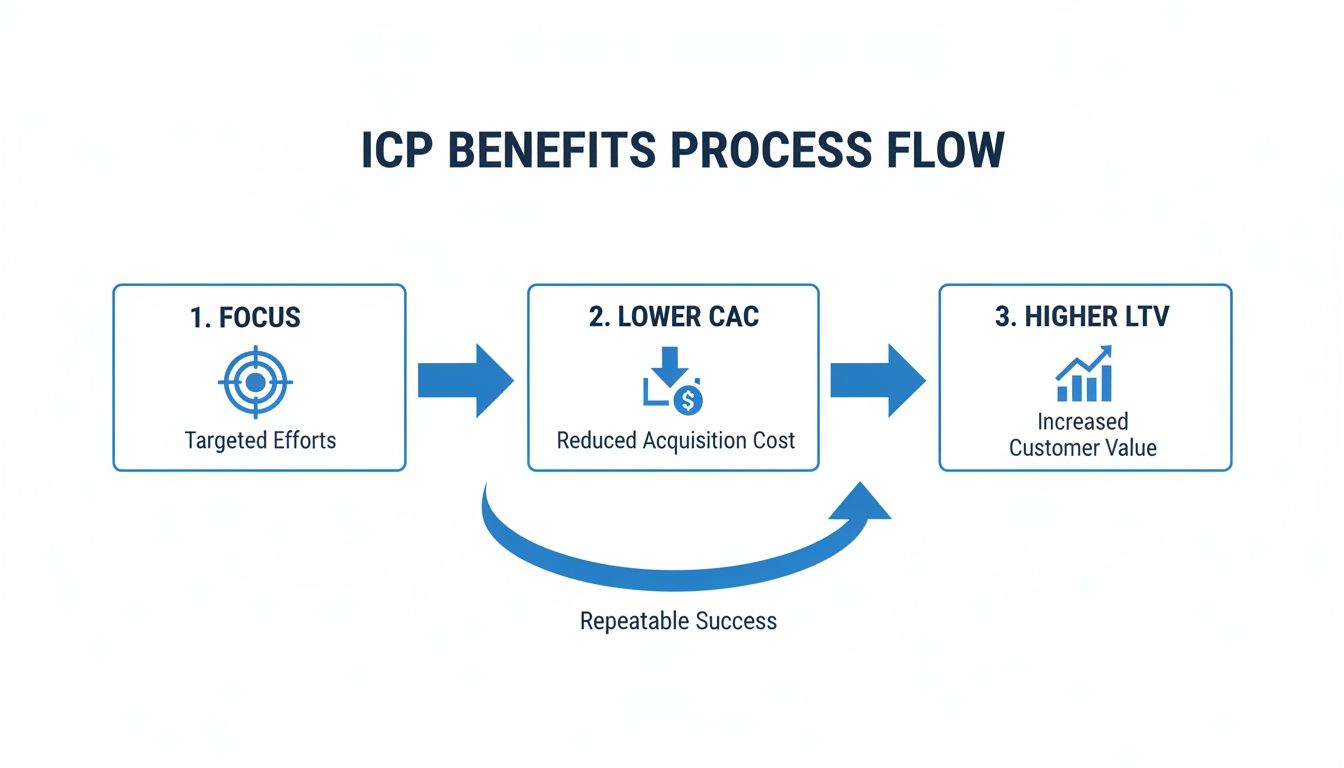
It’s a simple chain reaction: strategic focus drives efficiency, and efficiency drives profitability.
Start with Your Best Customers
Your first job is to find your "champions"—the customers who not only love your product but are also the most profitable. Don't just pick your favorite company logos. Instead, make a list based on cold, hard success metrics.
Look for customers who check these boxes:
- High Lifetime Value (LTV): They have a high contract value, have renewed multiple times, or have significantly expanded their account with you.
- Strong Product Adoption: They are active users who really lean on your solution's key features and are getting real, tangible results.
- Low Support Costs: They don’t need a ton of hand-holding and aren’t constantly flooding your support team with tickets.
- Brand Advocacy: They're the ones willing to give you a testimonial, participate in a case study, or refer new business.
Once you have a list of 10-15 of these top-tier customers, you’ve got the raw material you need to reverse-engineer your ICP.
Gather Quantitative Data
With your list of best customers ready, it’s time to get into the numbers. Your CRM and analytics platforms are goldmines of quantitative data that will form the skeleton of your profile. The goal is to spot the common threads—the firmographics—that tie all these great accounts together.
Look for patterns across data points like these:
- Industry or Vertical: Do they all operate in a specific sector like FinTech or Healthcare?
- Company Size: What's their average employee count?
- Annual Revenue: Do they fall within a particular revenue bracket?
- Geographic Location: Are they clustered in a certain country, region, or city?
- Technology Stack: What other tools or platforms do they all seem to be using?
By analyzing the firmographic data of your most successful customers, you can build a quantitative foundation for your ICP. This data transforms your definition of an "ideal customer" from a vague concept into a set of measurable, actionable criteria.
These hard numbers give you an objective, data-backed framework to build upon.
Uncover Qualitative Insights
Data tells you what your ideal customers look like, but qualitative insights tell you why they're such a great fit. This is where you step away from the spreadsheets and have actual conversations. Talk to your sales team, your customer success managers, and most importantly, your customers.
To build a truly effective B2B profile, you should aim to interview 8-15 real customers. This is what separates a generic, flimsy profile from one that truly gets the nuanced needs of your target accounts.
When you talk to them, ask open-ended questions to dig into their motivations and challenges:
- What critical business problem were you trying to solve when you found us? This uncovers the original pain point and what triggered their search.
- What specific outcomes or results have you achieved with our solution? This reveals the tangible value your product delivers from their perspective.
- What alternatives did you consider before choosing us? This clarifies your competitive landscape and what makes you different.
- How was the buying process for you? Who was involved in the decision? This informs your sales strategy and helps flesh out your buyer personas.
These conversations add color and context to the data, helping you understand the human story behind the numbers.
Using Your ICP to Fuel B2B Marketing
Creating a detailed Ideal Customer Profile is a huge step, but it’s only the beginning. The real value comes when you put that profile into action, turning it from a static document into a day-to-day guide for your entire marketing engine. A well-used ICP bridges the gap between theory and execution, making sure every campaign, piece of content, and dollar of ad spend is aimed squarely at your most valuable potential customers.

Think of your ICP as the targeting system for a rocket. Without it, you’re just launching expensive metal into the sky hoping it lands somewhere useful. With it, you can hit a precise destination on the other side of the world. This is how you move from hopeful marketing to predictable revenue.
Refine Your Messaging and Content
Your ICP is a cheat sheet for creating messaging that actually connects. You know their industry, their challenges, and the results they're chasing. This knowledge lets you stop writing generic copy and start speaking directly to their specific pain points.
For example, instead of a vague headline like "Our Software Boosts Efficiency," you can get hyper-specific: "How Series B FinTechs Cut Customer Onboarding Time by 40%." This kind of messaging instantly signals to your ideal customers that you understand their world and have a solution built for them.
An ICP is your ultimate content filter. It tells you what to create, who to create it for, and what language to use. Every blog post, ad, and landing page should be written as if you're speaking directly to a company that fits your profile.
This focus ensures your content library becomes a powerful magnet for high-fit accounts.
Power Hyper-Targeted ABM Campaigns
Account-Based Marketing (ABM) is nearly impossible to pull off without a crystal-clear ICP. Your profile gives you the exact criteria needed to build a target account list filled with high-potential companies, not just random businesses in a broad industry.
Here’s how you can use your ICP to sharpen your ABM efforts:
- Build Your Target List: Filter databases and platforms to find companies that match your firmographic criteria like employee count, industry, or tech stack.
- Personalize Your Outreach: Craft campaigns that reference industry-specific challenges or company-specific news, showing you’ve done your homework.
- Align Sales and Marketing: Give both teams a shared list of named accounts to focus on, ensuring a coordinated and seamless buyer experience.
This approach stops you from wasting resources on companies that will never buy and concentrates your best efforts on the accounts that truly matter.
Sharpen Lead Scoring and Prioritization
Not all leads are created equal. An ICP helps your marketing and sales teams instantly separate the high-potential leads from the noise. By building your ICP criteria directly into your lead scoring model, you can automatically assign higher scores to inbound leads from companies that match your profile.
This means a lead from a 200-person SaaS company (your ICP) gets prioritized over one from a 5,000-person manufacturing firm (not your ICP), even if they downloaded the same ebook. This ensures your sales team spends their time on opportunities most likely to close, dramatically shortening the sales cycle and boosting win rates. You can find more details in this B2B marketer's guide to audience targeting, which explains how refined targeting impacts every stage of the funnel.
Build a Must-Read B2B Newsletter
For B2B newsletter creators, an ICP is the key to building an audience that converts. It lets you transform your newsletter from a simple content roundup into an indispensable resource for a very specific group of professionals. When you know your ideal subscriber works at a company that fits your ICP, your content strategy becomes laser-focused.
Instead of covering broad topics, you can dive deep into the niche challenges and opportunities that your ideal customers face every single day. This creates a publication that isn't just "nice to read" but "need to read." As a result, your newsletter becomes a powerful engine for generating highly qualified, ICP-fit leads who already know your expertise and are primed for a sales conversation.
Validating and Refining Your ICP Over Time
Your market doesn't stand still, and neither should your Ideal Customer Profile. The moment you finalize your first ICP, it begins to age. An ICP isn't a "set it and forget it" document; it's a living guide that needs regular check-ups to stay sharp in a changing business world.
Think of your ICP as the calibration for a high-precision instrument. When you first set it, everything is perfectly aligned. But over time, market shifts, new competitors, and evolving customer needs cause it to drift. Regularly validating and refining your ICP is how you keep your entire go-to-market engine perfectly tuned to your most profitable customers. A market analysis template that you revisit each quarter is the simplest way to catch that drift early.
This proactive approach stops your strategy from becoming obsolete. It’s the difference between navigating with a live GPS and trying to find your way with a paper map from five years ago.
Establishing Feedback Loops
Your best ICP insights come straight from the front lines. Your sales and marketing teams are in constant contact with the market, generating a continuous stream of real-world data about what’s working and what isn’t. The trick is to build a formal system for capturing all that intelligence.
Set up regular, structured meetings—monthly or quarterly—where both teams can share what they're seeing.
- Sales Insights: What objections are they hearing most often? Which types of companies are flying through the pipeline?
- Marketing Insights: Which ad campaigns are bringing in the highest quality leads? What content is really hitting home with ICP-fit accounts?
This kind of collaborative feedback loop turns anecdotes and gut feelings into actionable data. It helps you spot emerging trends and see when your definition of "ideal" might be changing, long before it shows up in your annual revenue reports.
Tracking Performance Metrics by Segment
Data is your ultimate source of truth for ICP validation. But don't just look at your overall numbers. You need to slice and dice your performance metrics by the criteria you defined in your ICP. This is how you see with total clarity if your targeting is actually hitting the mark.
Key metrics to monitor include:
- Lead-to-Opportunity Conversion Rate: Are leads from companies that match your ICP converting at a higher rate than those that don't? If not, there's a disconnect somewhere.
- Sales Cycle Length: Is the sales process noticeably shorter for your target accounts? A faster cycle is a powerful signal of a good fit.
- Win Rate: Your win rate for ICP-fit deals should be significantly higher. This metric directly validates the accuracy of your profile.
- Average Contract Value (ACV): Ideal customers should, on average, have a higher ACV, confirming they bring more value back to your business.
By analyzing these metrics, you move beyond theory and into evidence-based optimization. If a particular segment consistently underperforms, it’s a clear signal that it’s time to refine that part of your ICP.
This data-driven approach allows for precise adjustments. Maybe you discover your ideal company size is actually 50-150 employees, not 50-250. Or perhaps a new, fast-growing industry vertical is outperforming your traditional targets. Tracking these details is essential for continuous improvement. If you're using lead scoring, it's also critical to check out our guide on lead scoring automation to ensure your model reflects these ICP adjustments.
Ultimately, refining your ICP is an ongoing cycle of analysis, feedback, and iteration. This disciplined process ensures your company stays agile, efficient, and always focused on the customers who will drive sustainable growth.
Common Questions About Ideal Customer Profiles
Once you start putting your ICP into practice, a few questions always seem to pop up. Here are some straightforward answers to the most common ones we hear, designed to help you sidestep common pitfalls and get the most out of your work.
How Often Should I Update My Ideal Customer Profile?
Your ICP isn't a "set it and forget it" document. Think of it as a living guide that needs to adapt as your business and the market change. A good rule of thumb is to give it a formal review at least once a year.
That said, you don't always have to wait. A major event is the perfect trigger for a refresh. This could be launching a new product, expanding into a different market, or even just noticing a big shift in how your customers are behaving.
Keep an eye on your campaign data and CRM. If you see a steady drop in lead quality or conversion rates from your target accounts, that’s a clear signal that your ICP might need a tune-up much sooner.
Can a Business Have More Than One ICP?
Absolutely. It’s actually pretty common for a business to have multiple ICPs, especially if you sell different products, serve a few distinct industries, or go after different market segments.
For example, a software company might have one ICP for mid-market tech startups and a totally separate one for enterprise financial services firms. Their pain points, buying cycles, and decision-makers are worlds apart, so each one deserves its own focused profile. The second profile also needs its own playbook, which our guide to email marketing for financial services lays out.
The trick is to create a unique, detailed ICP for each segment you’re actively targeting. Just be careful not to create too many—that can dilute your focus and stretch your resources thin. Always start with the profile for your most profitable segment first, nail it, and then expand.
What Is the Biggest Mistake Companies Make When Creating an ICP?
The single most damaging mistake is building an ICP on assumptions and gut feelings instead of hard data. It’s a classic trap: the team gets in a room and brainstorms who they think their ideal customer should be, creating a profile that’s more about internal wishful thinking than market reality.
This "aspirational ICP" leads to a ton of wasted time and money. Sales and marketing teams end up chasing companies that look good on paper but get almost no real value from the product.
The best Ideal Customer Profiles are built from the ground up with a mix of quantitative data from your CRM (like company size and revenue) and qualitative insights from real customer interviews. Data, not guesswork, has to be the foundation.
How Does an ICP Help with B2B Newsletter Content?
An ICP is a total game-changer for your content strategy, especially for a B2B newsletter. Once you know the specific industry, job titles, daily frustrations, and long-term goals of your ideal customer, you can stop guessing and start creating content that speaks directly to their world.
Instead of writing generic, forgettable articles, you can tailor your newsletter to solve the exact problems your ICP faces. This is how your newsletter goes from being a simple marketing email to an indispensable resource they actually look forward to reading.
Let's make this real with a couple of examples:
- Your ICP is Series B SaaS companies: Your content could tackle topics like scaling a go-to-market team, optimizing a PLG funnel, or prepping for the next funding round.
- Your ICP is enterprise manufacturing firms: You could write about supply chain automation, implementing IoT on the factory floor, or navigating new industry regulations.
This level of focus makes your newsletter a must-read for the exact companies you want as customers. It skyrockets engagement, builds your authority, and turns subscribers into a reliable stream of qualified leads. By answering the question "what is an ideal customer profile," you're also creating a content roadmap for the future.
Ready to turn your ideal customer profile into a powerful growth engine for your newsletter? Breaker combines an intuitive email platform with an automated audience acquisition engine, delivering engaged, ICP-fit subscribers directly to your list. Stop guessing and start growing. Discover how Breaker can build your perfect B2B audience.
Keep reading
All articlesHow to Boost Conversions With Your Email Newsletter
Turn your newsletter into a conversion engine. See 2026 benchmarks, CTR vs CVR explained, and the fixes most email guides skip.
Drip Campaign Template: Ready-to-Use Email Sequences
Get 6 ready-to-paste drip campaign templates with subject lines, body copy, and send timing—plus a step-by-step guide to building your own.
Post-Webinar Survey Questions Template (2026)
30+ post-webinar survey questions with NPS, CSAT, and CES templates, plus timing and length tips to boost completion and qualify leads faster.