
B2B Email Marketing Strategy: Goal Alignment Guide
Align B2B email campaigns to revenue by setting SMART goals, tracking KPIs from engagement to pipeline, and optimizing segmentation and deliverability.

Email marketing is more than just opens and clicks - it’s about driving real business results like pipeline growth, retention, and revenue. This guide explains how to align your B2B email campaigns with core business objectives and measure their impact effectively. Here’s what you’ll learn:
- How email supports business goals: From generating leads to accelerating sales cycles and expanding accounts, email plays a key role at every stage of the B2B funnel.
- Common mistakes to avoid: Focusing on vanity metrics, sending generic campaigns, and poor system integration can undermine your efforts.
- Steps to align email campaigns with business goals: Use a clear framework to map email objectives to revenue targets, set SMART goals, and track KPIs that matter.
- Optimizing and scaling your strategy: Segment your audience, tailor campaigns to lifecycle stages, and collaborate with sales and customer success teams for better results.
B2B Email Marketing Benchmarks and How to Use Them–Chad S. White
Mapping Business Goals to Email Marketing Objectives
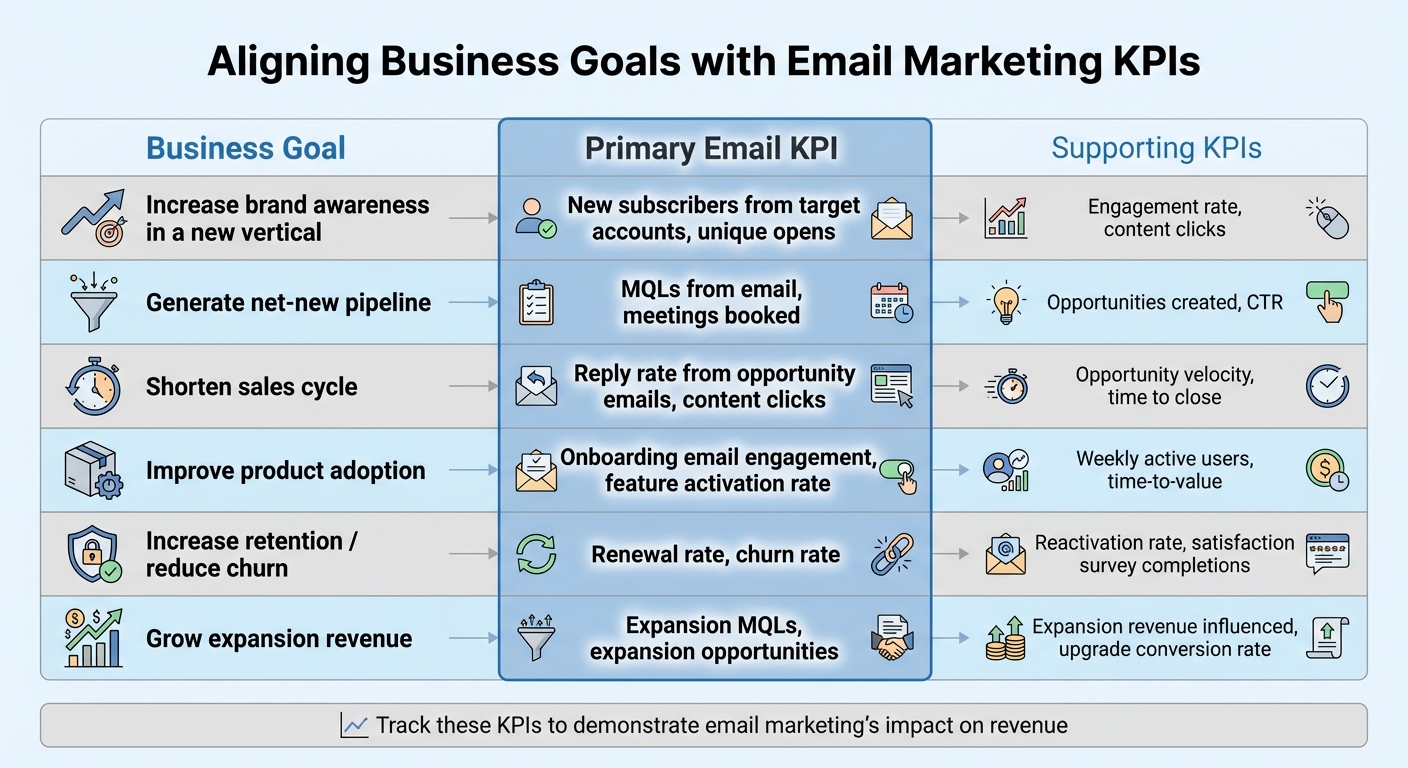
B2B Email Marketing KPIs by Business Goal
Goal Mapping Framework
To align email marketing efforts with your company's broader goals, start by identifying your top three to five strategic objectives. These are typically expressed as targets like "increase net-new ARR by 25%" or "improve gross logo retention to 92%." Once you’ve pinpointed these goals, break them down into actionable areas where email campaigns can make a measurable impact.
The process for mapping goals to email objectives involves four key steps:
- Clearly define the business objective. For example, "Increase net-new pipeline by $3 million in H1."
- Identify how email contributes to achieving this goal. This might include converting inbound leads into marketing-qualified leads (MQLs) or accelerating the transition from MQL to sales-qualified leads (SQLs).
- Develop targeted email strategies, such as lead nurture sequences, account-based marketing (ABM) campaigns, or re-engagement programs. Assign key performance indicators (KPIs) like MQL volume, meeting bookings, open rates, and clicks to each stage.
- Attach KPIs to both program-level metrics (e.g., MQL volume, meeting bookings) and email-specific metrics (e.g., opens, clicks, and opportunity influence).
By creating a clear connection between executive-level goals and campaign execution, it becomes easier to demonstrate email marketing's value to leadership. Tools like Breaker can help streamline this process by offering real-time analytics that show which audiences and email campaigns are driving pipeline and revenue growth. This structured approach ensures your email objectives are both focused and measurable.
Setting SMART Goals for Email Campaigns
Effective B2B email marketing goals should follow the SMART framework - Specific, Measurable, Achievable, Relevant, and Time-bound. This helps tie email performance directly to business outcomes rather than relying on vanity metrics. Here’s an example of a SMART goal:
"By June 30, increase marketing-qualified leads generated from product-education nurture emails from 150 to 225 per month while maintaining at least a 30% MQL-to-SQL conversion rate."
When setting these goals, use historical data to establish realistic targets. For instance, if your current demo-request conversion rate from email clicks is 3%, aiming for 5% is reasonable, while expecting a jump to 15% overnight isn’t. The time-bound element should also align with typical U.S. business planning cycles, such as quarterly or annual milestones.
To set SMART goals effectively, gather key data upfront. This includes historical email performance metrics (open rates, click-through rates, and click-to-lead conversions), funnel benchmarks from your CRM (e.g., MQL-to-SQL rates, average deal sizes, and win rates), and sales insights on cycle length and critical conversion events. For example, if you need $3 million in pipeline, and your average deal size is $50,000 with a 20% win rate, you’ll need around 300 opportunities influenced or sourced by email.
Email Marketing KPIs for Tracking Goals
Once your objectives are defined, success should be measured using targeted KPIs. These can be grouped into three categories: engagement, funnel movement, and revenue impact.
- Engagement-level KPIs: These provide early indicators of email performance and include open rates, click-through rates (CTR), click-to-open rates (CTOR), reply rates (for sales-aligned emails), as well as unsubscribe or spam complaint rates. While these metrics are helpful diagnostics, they’re not the ultimate goal.
- Funnel-level KPIs: These measure how well email campaigns move prospects through the buyer journey. Examples include form fills, content downloads, webinar registrations, new MQLs and SQLs, and demo or meeting bookings. They also track progression rates between lifecycle stages, such as lead to MQL or MQL to SQL.
- Revenue-level KPIs: These focus on bottom-line impact, tracking metrics like marketing-sourced pipeline, closed-won revenue from email, and marketing-influenced pipeline through multi-touch attribution. Additional revenue metrics might include changes in customer lifetime value (CLV) among email-engaged users and churn or renewal rates.
Here’s an example of how business goals align with email KPIs:
Business Goal
Primary Email KPI
Supporting KPIs
Increase brand awareness in a new vertical
New subscribers from target accounts, unique opens
Engagement rate, content clicks
Generate net-new pipeline
MQLs from email, meetings booked
Opportunities created, CTR
Shorten sales cycle
Reply rate from opportunity emails, content clicks
Opportunity velocity, time to close
Improve product adoption
Onboarding email engagement, feature activation rate
Weekly active users, time-to-value
Increase retention / reduce churn
Renewal rate, churn rate
Reactivation rate, satisfaction survey completions
Grow expansion revenue
Expansion MQLs, expansion opportunities
Expansion revenue influenced, upgrade conversion rate
Using Breaker’s real-time analytics, you can connect engagement metrics directly to pipeline and revenue outcomes, providing actionable insights for optimizing your email campaigns.
Building an Aligned B2B Email Marketing Strategy
Audience Segmentation for Goal Alignment
Start by defining your ideal customer profile (ICP) in collaboration with your sales team. This step goes deeper than just knowing demographics - it’s about understanding your audience’s pain points, motivations, decision-making processes, and buyer journeys. Once you have a clear ICP, segment your audience using behavioral and firmographic data, such as website activity, email interactions, content downloads, and purchase histories.
Effective segmentation should group your contacts by lifecycle stage (awareness, consideration, decision), engagement levels (like frequent openers versus non-openers), and ICP alignment. For instance, high-value ICP matches can benefit from personalized nurturing sequences, while disengaged contacts may respond better to retargeted content that addresses their specific challenges. Research from the CDP Institute shows that companies leveraging unified customer data platforms for segmentation achieve 2.5x higher email engagement rates and 3x faster campaign deployment.
Breaker's approach to precision audience targeting combines custom targeting with AI enrichment, ensuring you connect with the right subscribers from the start. This method makes your campaigns more relevant and impactful right out of the gate.
Once you’ve segmented your audience effectively, the next step is to craft email sequences tailored to each lifecycle stage.
Lifecycle-Based Email Programs
Your email campaigns should align with where your prospects and customers are in their journey. For the awareness stage, focus on weekly newsletters that deliver industry insights and educational content addressing key pain points. As they move into the consideration stage, set up drip campaigns featuring resources like webinars, ebooks, and case studies. When prospects reach the decision stage, use intent data - such as page visits or content downloads - to trigger personalized demos.
For existing customers, focus on retention and expansion with quarterly check-ins that include loyalty offers, NPS surveys, or updates on new features. Make sure every email has a single, clear goal and one call-to-action (CTA). High-performing teams often use engagement triggers, like clicks or downloads, to prompt immediate sales follow-ups, which can significantly boost pipeline activity. To enhance results, align these email sequences with your sales cadence, enabling deeper account engagement and faster deal progression.
Once your email sequences are in place, it’s crucial to collaborate across teams to maximize their effectiveness.
Working with Sales and Customer Success Teams
Teamwork with sales and customer success is essential to ensure consistent messaging and shared accountability for results. Marketing can provide sales with nurtured leads scored by engagement, allowing sales teams to prioritize hot prospects and accelerate the pipeline. Joint workshops are a great way to align on buyer personas and messaging, while shared dashboards can track email activity and trigger timely sales follow-ups.
Customer success teams play a pivotal role by offering insights into customer health metrics. For instance, accounts showing reduced usage can prompt re-engagement emails. Marketing can support these efforts by building workflows that include personalized content hubs or advocacy programs. Regular cadence meetings with shared KPIs - like MQL-to-SQL conversion rates and pipeline growth - help ensure everyone stays on the same page. This collaborative approach not only improves your email marketing strategy but also drives measurable business outcomes.
Measuring Performance and Revenue Alignment
Setting Up Analytics and Tracking
To show how email campaigns contribute to business revenue, having precise analytics and tracking systems in place is non-negotiable. Start by adding UTM parameters (like utm_source=email, utm_medium=newsletter, or utm_campaign=q4_promo) to every email link. These help you identify traffic sources in your analytics tools and CRM. Consistency is key - apply UTM codes to every call-to-action (CTA) and ensure seamless integration with your CRM. B2B teams that excel in this area often attribute 15–20% of closed-won deals to specific email campaigns.
Take it a step further by integrating your email platform with your CRM using APIs. This setup allows you to map email activity to custom fields and apply lead scoring. Attribution models, whether first-touch or multi-touch, are essential for calculating the revenue tied to email campaigns. For example, if your $1 million pipeline shows that 40% of opportunities involved email touches (tracked through UTM and CRM tags), you can confidently attribute $400,000 in pipeline influence to email efforts. This level of insight highlights email's impact and helps you focus on campaigns that yield the best results.
Reports for Goal Alignment
To stay on track, create three essential reports to measure and align your efforts:
- Campaign Performance Reports: Track key metrics like open rates (20–30% is a good benchmark), click-through rates (2–5%), and conversion rates to MQL or SQL (5–10%). Break these metrics down by audience segment for deeper insights.
- Lifecycle Metrics: Monitor how contacts move through the funnel stages. Aim for less than a 30% drop-off between stages and a minimum of 25% progression from awareness to consideration.
- Pipeline Impact Analysis: Quantify how email campaigns contribute to opportunities by calculating the percentage of deals influenced by email touchpoints.
Schedule monthly reviews with sales and leadership teams using shared dashboards in tools like Tableau or Google Data Studio. Focus on metrics that link email efforts to tangible business outcomes, such as MQL generation, pipeline growth, and revenue increases. These collaborative sessions ensure everyone is aligned on strategy and can make adjustments as needed. With these reports, you'll have a solid foundation for diving into more advanced tools and insights.
Using Breaker for Data-Driven Insights
Once your goals and KPIs are clear, tools like Breaker can take your strategy to the next level. Breaker’s real-time dashboard tracks key metrics - such as opens, clicks, and lead generation - helping you identify which campaigns resonate most with your audience. By leveraging its precision targeting features, you can refine your audience segments for even better results. In fact, users often report a 30% boost in click-through rates when using Breaker’s exact-match targeting capabilities.
"Breaker is our #1 source of booked calls." - Josh Durham, CEO, Aligned Growth Media
Breaker also ensures your tracking data stays accurate with its deliverability monitoring, which keeps rates above 98%. Its CRM integrations make it easy to push leads into your sales funnel for proper attribution. Armed with these insights, you can fine-tune your messaging, sharpen your targeting, and confidently present ROI to stakeholders.
Optimizing and Scaling Your Email Marketing Strategy
Governance and Process Documentation
Expanding your email marketing efforts without clear ownership can quickly become unmanageable. To keep things organized, establish a RACI model (Responsible, Accountable, Consulted, Informed) to ensure every task - whether it's strategy, deployment, or reporting - has a designated owner. A common approach is to assign marketing operations to oversee infrastructure and governance, demand generation to focus on strategy and performance, content teams to handle messaging, and sales or customer success teams to provide input on offer relevance and timing. As your program grows, centralize key rules like branding guidelines, data usage policies, compliance standards, and frequency caps. At the same time, allow regional or product marketers to request campaigns using standardized brief templates.
Create a living playbook that documents every step of your workflow, from intake briefs and audience selection to content creation, design, QA processes, approvals, scheduling, and post-send analysis. Campaign briefs should be outcome-driven, linking each initiative to a clear business goal, a defined target audience, and measurable KPIs. For U.S.-based teams, ensure consistency by applying standard time zones, holiday schedules, and formatting conventions (e.g., $1,200.50, 01/31/2025). To keep everything aligned, set up a monthly email council to review performance metrics, prioritize campaigns, and adjust the roadmap as needed to stay on track with business objectives.
Deliverability and List Quality Management
Once governance is in place, focus on maintaining strong email deliverability to ensure your messages actually reach your audience. Even the most compelling content is useless if it doesn't land in inboxes. Protect your sender reputation by authenticating your domain with SPF, DKIM, and DMARC protocols, and monitor DMARC reports to catch potential spoofing issues. Use double opt-in for new subscribers to minimize spam complaints and block fake email addresses - this is especially critical for high-value B2B lists. Automate list hygiene by removing hard bounces, suppressing inactive addresses (after 120–180 days), and re-engaging dormant contacts before removing them entirely. Aim for a bounce rate under 2% and a spam complaint rate below 0.1% (about 1 complaint per 1,000 emails) to maintain good standing with major providers like Gmail and Outlook.
To further safeguard deliverability, segment your email streams by purpose - keeping transactional emails separate from marketing messages - so that issues in one area don’t impact essential communications. If you're targeting new audience segments or significantly increasing email volume, warm up your IPs and domains gradually. Start with your most engaged U.S. subscribers to build positive engagement signals. Platforms like Breaker can simplify this process by offering preconfigured authentication, detailed engagement tracking by list source, and expert management of mail streams. Their approach combines sending logic, continuous list maintenance, and proactive reputation monitoring to help ensure your emails consistently land in inboxes.
Test-and-Learn Framework for Optimization
With governance and list quality under control, the next step is to focus on continuous testing and refinement to boost performance. Design tests around specific business questions. For instance, instead of debating button colors, ask, "Will a shorter form in our webinar email increase MQLs by 15% for U.S. mid-market accounts?". Prioritize experiments that could drive meaningful results, like refining audience segmentation, testing different value propositions, experimenting with email formats (plain-text vs. designed), or optimizing timing and frequency. Use A/B testing to isolate one variable at a time, and allow tests to run for 5–10 business days - typical for U.S. B2B buying cycles - to ensure reliable results. Research shows that marketers who consistently A/B test achieve higher conversion rates and grow their lists up to 49% faster.
Maintain a central log to track each experiment, including the hypothesis, setup, testing dates, metrics, results, and future implications. Report outcomes in terms of downstream impact - such as additional MQLs, new opportunities, or closed-won revenue - rather than just surface metrics like click-through rates. Incorporate successful test results into your playbook so your team can build on past learnings. Regularly review campaign performance (weekly or monthly) with marketing, sales, and customer success teams to share insights. Tools like Breaker make it easier to identify high-performing segments and content. With an average open rate of 67% and a click-through rate of 44%, Breaker provides a strong foundation for optimizing future campaigns.
Conclusion
Aligning B2B email marketing with your business goals isn’t a one-and-done task - it’s an ongoing effort that delivers measurable results. By starting with clear business objectives instead of focusing solely on tactics, every campaign can connect directly to outcomes like pipeline growth and revenue expansion. For instance, companies using unified customer data platforms see email engagement rates that are 2.5 times higher and campaign deployment speeds three times faster, highlighting how the right infrastructure boosts strategic alignment.
Collaboration across teams is equally critical. Marketing, sales, and customer success need to share a common understanding - agreeing on what defines a Marketing Qualified Lead (MQL), when a lead becomes an opportunity, and how email programs support each stage of the buyer’s journey. Without clear metrics, campaigns can overlap with sales efforts, creating confusion and missed opportunities. Shared planning and unified dashboards keep everyone focused on the same revenue goals.
Refining your strategy is just as important as initial alignment. Data-driven testing ensures your approach evolves over time. Linking email metrics to key outcomes - like MQL-to-SQL conversion rates, opportunity influence, and closed-won revenue - helps pinpoint gaps and prioritize resources. A structured test-and-learn process, complete with clear hypotheses and criteria for success, allows you to fine-tune everything from audience targeting to messaging, timing, and offers.
Platforms like Breaker demonstrate how precise targeting and real-time analytics can simplify campaign optimization. Breaker connects you with exact-match B2B decision-makers, provides real-time performance insights that link campaign results to pipeline and revenue, and takes care of deliverability management to ensure your emails consistently hit inboxes. With an impressive average open rate of 73% and a click-through rate of 47%, Breaker not only optimizes current campaigns but also supports automated lead generation that aligns seamlessly with sales and customer success workflows.
FAQs
How do you align B2B email marketing with your business goals?
To make your B2B email marketing efforts work in harmony with your business goals, start by pinpointing exactly what you want to achieve. Are you aiming to generate more leads, drive sales, or strengthen customer loyalty? Having a clear objective will guide your strategy.
Next, focus on reaching the right people. Segment your email lists so you can deliver messages tailored to specific groups. Personalized content is key - it should address your audience's unique needs and interests to keep them engaged.
Keep a close eye on performance metrics like open rates, click-through rates, and conversions. These numbers will show how well your emails are performing and where you might need to tweak your approach. By regularly analyzing the data and making adjustments, you'll be able to fine-tune your campaigns to better support your business goals.
What key metrics should I track to measure the success of my B2B email marketing campaigns?
To gauge how well your B2B email marketing campaigns are performing, keep an eye on these essential metrics:
- Open rate: This tells you how many recipients actually opened your email, offering a glimpse into how compelling your subject lines are.
- Click-through rate (CTR): Tracks the number of recipients clicking on links in your email, reflecting how engaging and relevant your content is.
- Conversion rate: Measures the percentage of recipients who take the desired action, like signing up for a webinar or making a purchase.
- Subscriber growth: Helps you understand how your email list is evolving - whether you're reaching more people or seeing a decline.
- Unsubscribe rate: A high number here could mean your content isn’t hitting the mark or that you’re emailing too often.
Regularly analyzing these metrics gives you the chance to adjust your strategy, ensuring your campaigns are more aligned with your goals and resonate better with your audience.
How can teamwork between marketing, sales, and customer success boost email marketing results?
Collaboration among your marketing, sales, and customer success teams is key to ensuring your email campaigns align with business objectives and deliver a consistent message. When these teams share insights and feedback, they can fine-tune audience targeting, create more engaging content, and time emails for maximum impact.
This teamwork doesn’t just boost engagement and conversions - it also helps build stronger customer relationships, increasing retention and paving the way for sustained growth.
Related Blog Posts
Keep reading
All articlesGDPR Consent Requirements for Purchased Email Lists
Purchased email lists rarely meet GDPR's consent bar. Learn the legal basis rules, PECR overlap, and safer alternatives before you hit send.
7 Email Platforms With Inbox Placement Testing & Suppression
Compare 7 email platforms that combine inbox placement testing with suppression management, scored on features, pricing, and best-fit sender size.
Email Automation Workflow & Drip Campaign Data Structure
Learn the database schema behind email drip campaigns—tables, workflow states, and event logs that power reliable marketing automation.