
GDPR vs. CAN-SPAM: Email Compliance Rules
Understand the key differences between GDPR and CAN-SPAM regulations to ensure email compliance and avoid heavy fines in international marketing.
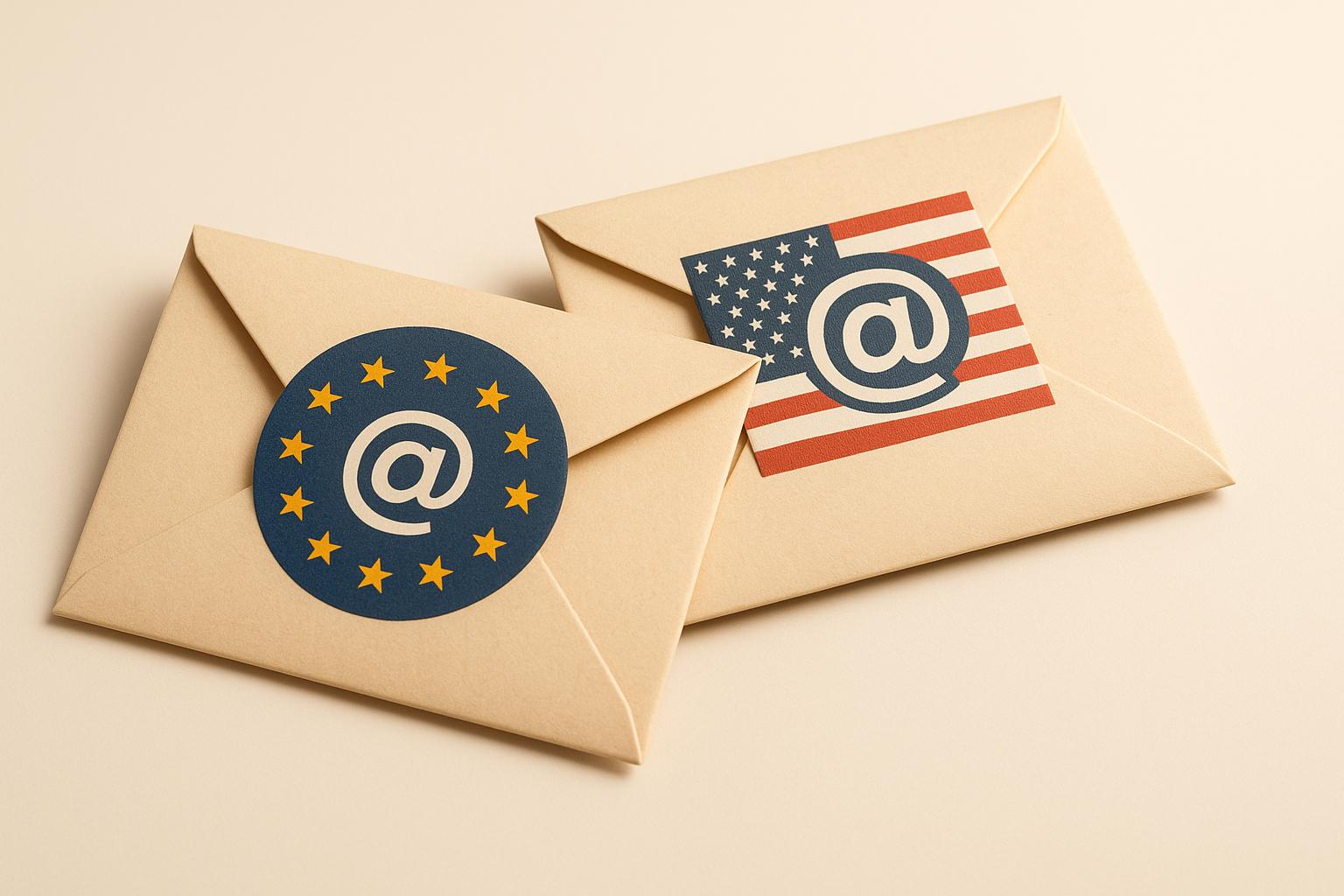
GDPR and CAN-SPAM are two key email compliance laws, and understanding their differences is essential for marketers handling international campaigns.
Here’s what you need to know:
- GDPR (EU): Requires explicit opt-in consent before sending marketing emails. It applies to any organization processing the personal data of EU residents, no matter where the company is based. Non-compliance can result in fines up to €20 million (≈ $21.8 million) or 4% of global revenue.
- CAN-SPAM (US): Operates on an opt-out model, meaning you can send marketing emails until a recipient unsubscribes. Violations can lead to fines of $43,792 per email. It applies to all commercial emails sent to or from the U.S.
Key Differences:
- Consent: GDPR requires opt-in; CAN-SPAM allows opt-out.
- Unsubscribing: GDPR mandates immediate withdrawal; CAN-SPAM allows up to 10 business days.
- Penalties: GDPR fines are significantly higher and based on revenue; CAN-SPAM fines are per email violation.
For global marketers, following GDPR’s stricter standards often ensures compliance across both regions. Prioritize transparency, maintain clear opt-out options, and document consent to avoid penalties.
Mastering Email Compliance: Navigating CAN-SPAM & GDPR for Cold Email Marketing
Main Differences Between GDPR and CAN-SPAM
Both GDPR and CAN-SPAM aim to protect email recipients, but their approaches to consent, transparency, and user rights are fundamentally different. For B2B marketers working across borders, understanding these differences is key. Let’s break down how these regulations compare in terms of consent, unsubscribing, and transparency.
Consent Requirements: Opt-In vs. Opt-Out
The biggest distinction lies in how consent is handled. GDPR requires explicit opt-in consent before sending marketing emails to EU residents. In practical terms, this means recipients must actively agree to receive emails - passive consent, like pre-checked boxes, doesn’t cut it. To comply, marketers often use double opt-in, where subscribers confirm their email address and explicitly agree to terms.
On the other hand, CAN-SPAM follows an opt-out model. You can send commercial emails to U.S. recipients without prior consent, as long as you provide a clear way to unsubscribe. This difference has major implications for list management: with EU contacts, you must secure documented consent before adding them to your list, while for U.S. contacts, you can take a more proactive approach as long as opt-out requests are handled promptly.
For the GDPR side, our breakdown of purchased email list consent requirements under GDPR explains why broker lists rarely qualify.
Unsubscribe Requirements
When it comes to unsubscribing, GDPR insists that it should be just as easy to withdraw consent as it was to give it. If signing up takes one click, unsubscribing should be just as simple - no fees, no delays.
Under CAN-SPAM, every commercial email must include an obvious opt-out mechanism, and unsubscribe requests must be processed within 10 business days.
Sender Information and Transparency Rules
Both regulations prioritize transparency, but GDPR demands more detailed disclosures. While CAN-SPAM focuses on accurate sender identification, such as a valid physical address and truthful subject lines, GDPR goes further. It requires you to provide comprehensive company details and a clear privacy notice explaining how you collect, use, and retain data. Recipients need to fully understand who you are and why their data is being processed.
Requirement
GDPR
CAN-SPAM
Consent Model
Explicit opt-in required
Opt-out (no prior consent needed)
Unsubscribe Timeline
Immediate withdrawal
Within 10 business days
Sender Information
Detailed company info and privacy notice
Valid physical address and accurate headers
Individual Rights
Access, correction, deletion, data portability
Opt-out only
Age Restrictions
Parental consent required for minors
None
GDPR’s transparency rules extend beyond email marketing to cover all data processing activities. Marketers must explain their legal basis for processing data, specify how long it will be retained, and inform individuals of their rights.
For companies targeting both EU and U.S. audiences, adopting GDPR’s stricter standards across the board is often the safest way to ensure compliance in all regions.
Compliance Best Practices for B2B Marketers
Staying compliant is crucial for maintaining strong email deliverability and protecting your business from legal risks. By following structured processes that align with GDPR's opt-in requirements and CAN-SPAM's transparency rules, you can achieve efficient and effective compliance.
How to Collect and Manage Consent
Make sure to collect explicit consent through clear, unchecked opt-in boxes. These should clearly outline the type of communication being offered, whether it's newsletters, product updates, or event invitations. To ensure accuracy and accountability, use a double opt-in process that verifies consent and records timestamps along with subscriber preferences.
Keep detailed, time-stamped records for every opt-in. Document the exact wording used during sign-up and track any changes to subscriber preferences over time. This evidence is critical for audits and demonstrates your commitment to compliance.
Equally important is tracking opt-outs. Log the dates and actions associated with unsubscribe requests to show adherence to regulations. Using a centralized system to manage all consent and opt-out data helps you stay organized and prepared for any regulatory review.
Lastly, confirm that all third-party providers handling subscriber data adhere to these same compliance standards.
Checking Third-Party Provider Compliance
Your compliance obligations don’t stop with your own processes - they extend to any vendors managing your subscriber data. This includes email service providers, lead generation platforms, and analytics tools. Before working with a provider, review their privacy policies, data processing agreements, and compliance certifications to ensure they align with GDPR and CAN-SPAM requirements.
Look for features like automated consent tracking, quick opt-out processing, detailed activity logs, and strong audit trails. Request documentation, such as SOC 2 reports or third-party attestations, to verify their compliance. Also, make sure your contracts include clear terms about compliance responsibilities and liability, so you’re protected if the vendor mishandles data or fails to honor opt-out requests.
Using technology designed for compliance, like Breaker, can simplify these processes even further.
Using Breaker for Email Compliance
Breaker offers tools that automate compliance, integrating explicit consent collection, email validations, and deliverability management. These features help you connect with engaged B2B subscribers who have willingly opted in to receive your communications.
Maintaining clean subscriber lists is essential. Breaker provides unlimited email validation to remove invalid or inactive addresses, ensuring you're only reaching people who have consented. This reduces bounce rates, minimizes spam risks, and aligns with GDPR and CAN-SPAM requirements.
Breaker also manages deliverability, mailing logic, and reputation monitoring, reducing the chances of your emails being flagged as spam. By avoiding co-registration networks - which often deliver poorly targeted leads - Breaker focuses on high-quality contacts. Its real-time analytics let you track compliance metrics like opt-in rates, unsubscribe rates, and response times for opt-out requests.
With precision audience targeting and advanced AI tools, Breaker helps you minimize the risk of sending unwanted emails, keeping your marketing efforts compliant and efficient over the long term.
Penalties for Breaking Email Laws
Failing to comply with GDPR and CAN-SPAM regulations can lead to hefty financial consequences. While both laws impose serious fines, their methods for calculating and enforcing penalties differ significantly.
GDPR Fines and Enforcement
Under GDPR, organizations may face fines as high as €20 million (around $21.8 million) or 4% of their global annual revenue - whichever is greater. For example, a company generating $1 billion in revenue could be fined up to $40 million. GDPR uses a tiered penalty system, meaning the fine depends on factors like the severity of the violation, how many individuals were affected, and the company’s cooperation during investigations.
Enforcement is handled by national data protection authorities across the EU, and the regulation applies globally to any organization processing the personal data of EU residents, regardless of its location. GDPR also grants individuals the ability to seek damages directly if a company breaches compliance.
Some notable fines include €22 million against British Airways and €20.4 million against Marriott International for issues related to data protection and consent. The largest fine to date was €1.2 billion (approximately $1.3 billion), imposed on Meta (Facebook) in May 2023 for data transfer violations. These penalties highlight GDPR’s strict enforcement compared to U.S. laws like CAN-SPAM.
CAN-SPAM Fines and Enforcement
Under the CAN-SPAM Act, fines can reach up to $43,792 per violation. Since each non-compliant email counts as a separate offense, a single campaign targeting thousands of recipients could result in fines totaling millions. For instance, sending 1,000 non-compliant emails could lead to penalties exceeding $43 million.
The Federal Trade Commission (FTC), state attorneys general, and Internet Service Providers (ISPs) are responsible for enforcing CAN-SPAM. Unlike GDPR, this law does not allow individuals to take legal action; only government agencies and ISPs can pursue violators.
The FTC has secured significant settlements for deceptive email practices, with some cases exceeding $3 million. These enforcement actions emphasize the financial risks of ignoring compliance.
Total Cost of Non-Compliance
The consequences of non-compliance extend beyond fines. Businesses may also face legal fees, remediation expenses, reputational harm, and operational challenges like audits, data restrictions, and increased oversight. These disruptions can severely impact marketing efforts. Among these, reputational damage often has the longest-lasting effects, as it erodes customer trust and damages business relationships.
For B2B marketers with international audiences, the stakes are even higher. U.S.-based companies targeting EU residents must meet GDPR’s stringent requirements while also adhering to CAN-SPAM for their domestic campaigns. This dual compliance obligation highlights the need for thorough, well-documented email marketing strategies.
GDPR vs. CAN-SPAM Comparison Table
Understanding the differences between GDPR and CAN-SPAM is essential for B2B marketers navigating email compliance. Below is a side-by-side comparison that outlines the key aspects of each regulation, helping marketers identify which rules apply to their campaigns.
Feature
GDPR (EU)
CAN-SPAM (US)
Consent Model
Requires opt-in: explicit, affirmative consent must be given before sending marketing emails. Pre-checked boxes are prohibited.
Operates on an opt-out system: marketing emails can be sent until the recipient opts out.
Geographic Scope
Applies to any organization handling the personal data of EU/EEA residents, regardless of where the organization is based.
Applies to commercial emails sent to or from the United States.
Unsubscribe Requirements
Consent withdrawal must be as simple as granting it, and requests must be addressed promptly.
Emails must include a clear opt-out mechanism, with requests processed within 10 business days.
Sender Information
Requires detailed company details, including name, registration, and address, in every message.
Requires a valid postal address and accurate sender information, along with truthful subject lines.
Individual Rights
Grants rights like access to data, erasure (right to be forgotten), data portability, and objection to processing.
Does not provide equivalent rights to individuals.
Maximum Penalties
Fines can reach up to €20 million (≈ $21.8 million) or 4% of annual global turnover, whichever is higher.
Penalties can go up to $43,792 per non-compliant email.
Enforcement Authority
Enforced by national data protection authorities; individuals can also sue for damages.
Enforced by the Federal Trade Commission (FTC), state attorneys general, and ISPs - individuals cannot sue directly.
Age Restrictions
Requires parental consent for processing data of children under 16 (some member states allow this to be lowered to 13).
Does not impose specific age-related requirements.
Data Breach Notification
Breach notifications are mandatory within 72 hours of discovery.
No requirement to notify about data breaches.
Third-Party Provider Responsibility
Data processors must comply with strict protection standards.
Senders are responsible for compliance, even when using third-party email services.
This comparison highlights GDPR's stringent opt-in rules and higher penalties, while CAN-SPAM focuses on transparency and opt-out simplicity. For U.S. companies targeting EU residents, obtaining explicit opt-in consent is non-negotiable. This dual regulatory landscape demands systems that can handle both frameworks efficiently.
The financial risks of non-compliance under both regulations are substantial. Tools like Breaker simplify the process by automating consent management, record-keeping, and sender identification, making compliance less daunting.
Email Compliance Summary
Navigating GDPR and CAN-SPAM regulations doesn’t have to be overwhelming. Here’s the key difference: GDPR demands explicit opt-in consent before sending marketing emails to residents of the EU, while CAN-SPAM allows emailing U.S. recipients until they opt out. Regardless of the regulation, two things are non-negotiable: transparency and a simple unsubscribe option.
The stakes for non-compliance are high. GDPR penalties can reach up to €20 million (about $21.8 million) or 4% of global revenue, whichever is greater. Meanwhile, CAN-SPAM violations can cost $43,792 per email.
But compliance isn’t just about avoiding fines - it’s a smart strategy. Following these rules can strengthen customer relationships, improve deliverability rates, and protect your brand’s reputation from spam complaints. The best way forward? Get explicit consent when required, keep sender details accurate, and always include a clear opt-out option in your emails.
Breaker’s matching algorithm is designed to make compliance easier. It uses automation and data hygiene to identify the right subscribers while adhering to regulatory standards.
"We use a robust matching algorithm that leverages custom targeting, AI enrichment, proprietary data sources, data hygiene, and compliance systems to identify ideal subscribers for your newsletter."
- Breaker FAQ
Breaker users see impressive results, with an average open rate of 60% and a click-through rate of 40%. This highlights how focusing on compliance can actually boost marketing performance.
To stay ahead, adopt compliance best practices: audit your email lists regularly, train your team on the latest regulations, and keep an eye on updates. For EU contacts, use double opt-in and maintain detailed consent records. Also, ensure any third-party providers you work with meet the same standards, as you’re responsible for their compliance too.
FAQs
How can businesses comply with both GDPR and CAN-SPAM when emailing international audiences?
To meet the requirements of both GDPR and CAN-SPAM when reaching out to international audiences, it's wise to align with the stricter standards of the two. Under GDPR, businesses must secure clear and explicit consent from EU residents before collecting their data or sending them marketing emails. Meanwhile, CAN-SPAM rules require every email to include an opt-out option, accurate sender details, and a valid physical postal address.
Leveraging tools designed for compliance can make this process smoother. Platforms that specialize in precise audience targeting and ensure high email deliverability can help you stay within legal boundaries while ensuring your messages land in the inboxes of interested recipients.
How do you collect explicit opt-in consent under GDPR, and how is this different from CAN-SPAM requirements?
Under GDPR, obtaining explicit opt-in consent means the individual must take a clear, affirmative action - like checking an empty box or filling out a signup form. This consent has to meet specific criteria: it must be freely given, specific, informed, and unambiguous. In other words, the person giving consent should fully understand what they are agreeing to.
On the other hand, CAN-SPAM takes a different approach. It doesn’t require explicit opt-in consent. Instead, it emphasizes giving recipients a straightforward way to opt out, such as including an unsubscribe link in your email. It also requires clear identification of the sender and a valid physical postal address in every message.
What are the risks of not complying with GDPR and CAN-SPAM, and how can businesses protect themselves?
Failing to follow GDPR and CAN-SPAM regulations isn’t just a legal misstep - it can cost businesses a fortune. GDPR violations can result in fines as high as €20 million or 4% of a company’s global annual revenue, whichever is greater. Meanwhile, breaking CAN-SPAM rules can lead to penalties of up to $50,279 per violation.
To minimize these risks, businesses need to make data protection a top priority. This includes securing clear, explicit consent for email marketing and offering recipients simple, user-friendly opt-out options. Regularly reviewing email practices and staying informed about compliance updates are also critical. Tools like Breaker can make this process smoother by helping businesses meet compliance standards while boosting email deliverability and audience engagement.
Related Blog Posts
Keep reading
All articlesPost-Webinar Survey Questions Template (2026)
30+ post-webinar survey questions with NPS, CSAT, and CES templates, plus timing and length tips to boost completion and qualify leads faster.
GDPR Consent Requirements for Purchased Email Lists
Purchased email lists rarely meet GDPR's consent bar. Learn the legal basis rules, PECR overlap, and safer alternatives before you hit send.
7 Email Platforms With Inbox Placement Testing & Suppression
Compare 7 email platforms that combine inbox placement testing with suppression management, scored on features, pricing, and best-fit sender size.