
What Is a Bounced Email and How Do You Fix It
Learn what is a bounced email, the difference between hard and soft bounces, and how to fix them to protect your sender reputation and improve deliverability.
You’ve crafted the perfect email, hit send, and waited for the magic to happen… only to get a frustrating "delivery failed" notification. What gives?
That's a bounced email, and it's essentially the digital equivalent of a "return to sender" stamp on a physical piece of mail.
Understanding a Bounced Email

When you send an email, your server tries to hand it off to your recipient's mail server. If the receiving server can't or won't accept the message, it sends back a failure notice. That notice is the bounce, and it contains clues about what went wrong.
Getting a handle on bounced emails is the first step toward better deliverability. These aren't just minor hiccups; they're vital signs for the health of your email list and your entire sending strategy.
The Two Core Types of Email Bounces
Every bounced email falls into one of two categories: hard bounces or soft bounces. It’s crucial to know the difference because each one signals a completely different problem and requires a unique response.
- Hard Bounces: These are permanent delivery failures. Think of them as a dead end. The email address is invalid, doesn't exist anymore, or was typed incorrectly from the start.
- Soft Bounces: These are temporary hiccups. The email address is valid, but something got in the way of the delivery right now. The server might be down, the recipient's inbox could be full, or the email file might be too large.
A hard bounce is like sending a letter to a building that’s been torn down—it’s never going to get there. A soft bounce, on the other hand, is like trying to deliver a package when the recipient's mailbox is temporarily stuffed full. You can probably try again later. For a deeper dive, check out our newsletter glossary about bounces.
A bounced email is essentially an email that gets rejected by the recipient's server and 'bounces' back to the sender, often due to invalid addresses or temporary server glitches.
Email Bounce Quick Reference
To make it even clearer, here’s a quick side-by-side comparison of the two bounce types.
Characteristic
Hard Bounce (Permanent)
Soft Bounce (Temporary)
Nature of Failure
The email address is invalid or non-existent.
A temporary issue prevented delivery to a valid address.
Common Causes
Typos, deleted accounts, fake emails.
Full inbox, server timeout, oversized email.
Action Required
Remove the address from your list immediately.
Monitor; if it persists, then remove the address.
Impact on Sender
High rates severely damage sender reputation.
Minimal impact if resolved quickly; problematic if chronic.
Understanding this distinction is the key to managing your email list health effectively.
Keeping your bounce rate low is non-negotiable for protecting your sender reputation. While a few bounces here and there are normal, a high rate tells email providers like Gmail and Outlook that your list might be old, unmanaged, or low-quality.
According to industry data, a healthy hard bounce rate should stay well below 2%. For instance, one report showed that senders practicing good list hygiene achieved an average hard bounce rate of just 1.7% (read the full research on Apsis.com). This shows what's possible when you stay on top of your data.
Now, let's dig into the specific causes behind both hard and soft bounces so you know exactly what to look for.
Hard Bounces vs Soft Bounces
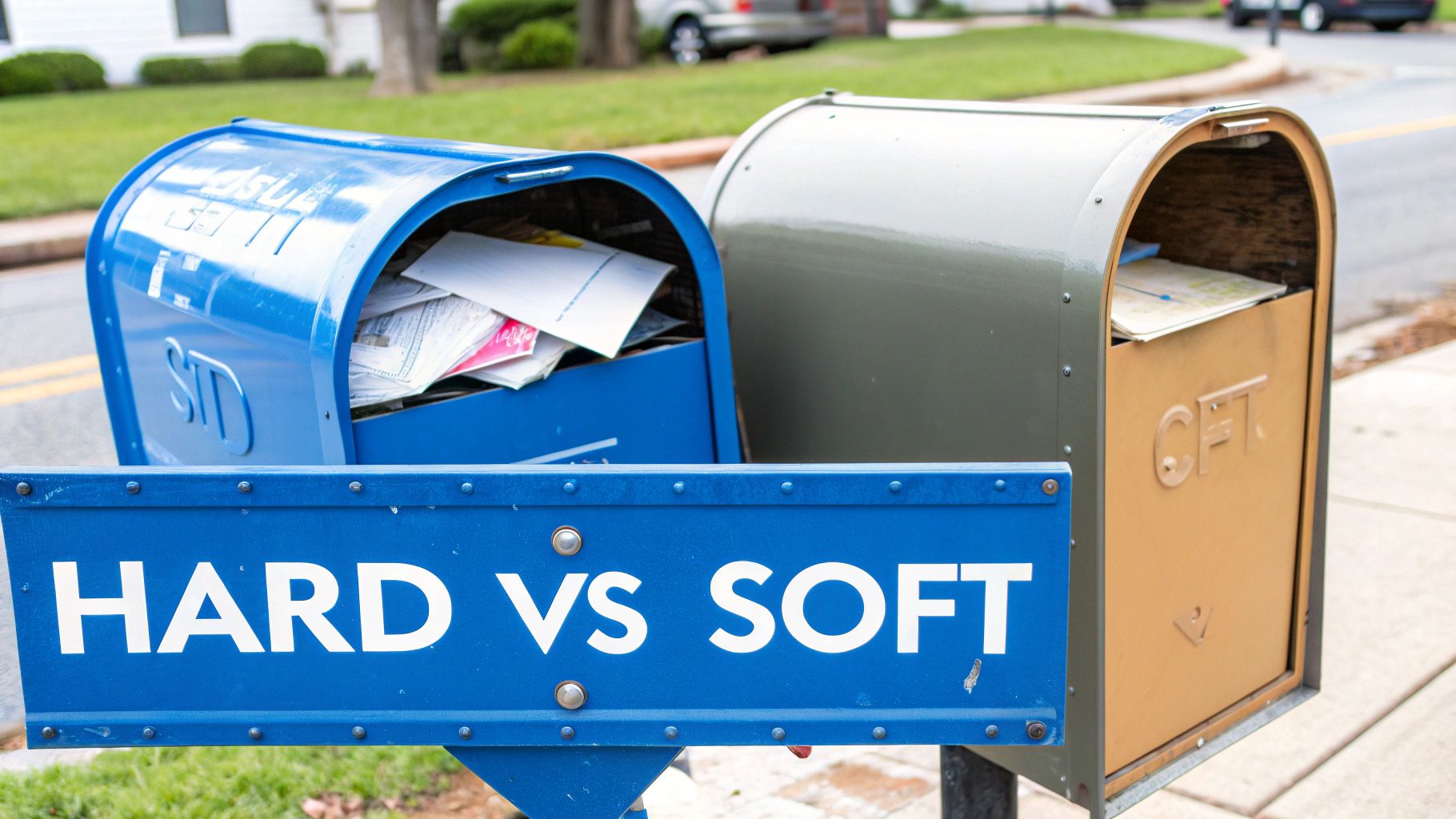
Not all bounces are created equal. Far from it. Getting a handle on the critical difference between a hard bounce and a soft bounce is absolutely fundamental to protecting your sender reputation and making sure your messages actually land in the inbox.
Think of them as two completely different kinds of roadblocks on the path to your subscriber.
A hard bounce is a permanent, dead-end delivery failure. It’s like sending a letter to a building that’s been torn down—the address is gone forever, and trying again won't change a thing. This is the most serious kind of bounce because it signals to Internet Service Providers (ISPs) that your list might be old, stale, or low-quality.
On the flip side, a soft bounce is just a temporary hiccup. The email address is totally valid, but some short-term problem got in the way of delivery. It's the equivalent of a courier finding the recipient's mailbox is crammed full; the address is right, you just need to try delivering your package again a bit later.
Decoding the Reasons Behind Hard Bounces
Hard bounces are the big red flags you can't afford to ignore. If you keep sending emails to addresses that hard bounce, you're taking one of the fastest routes to destroying your sender score. Before you know it, your legitimate emails could start getting flagged as spam.
Here are the usual suspects behind hard bounces:
- Invalid Email Address: The address flat-out doesn't exist. This is often just a simple typo, like
jane.doe@gamil.cominstead ofgmail.com. - Domain Name Doesn't Exist: The part after the "@" symbol isn't a real, registered domain.
- Recipient's Server Blocked Delivery: The server on the other end has decided to block you, which can happen if your domain or IP has been flagged for spammy behavior.
- Account Closed: The user shut down their email account, making the address permanently inactive.
A hard bounce is a definitive signal that the email address is no longer viable. For the health of your list and your sender reputation, you must remove these addresses immediately.
Understanding Temporary Soft Bounce Issues
A soft bounce isn't nearly as alarming as a hard bounce, but it's still something you need to keep an eye on. While a single soft bounce isn't a big deal, if the same address keeps having issues campaign after campaign, it can eventually point to a more permanent problem.
The most common reasons for a soft bounce include:
- Mailbox is Full: The recipient has let their inbox overflow and can't receive anything new until they clear some space.
- Server is Down or Offline: The recipient's email server was temporarily unavailable right when your email tried to arrive. Bad timing, that's all.
- Email is Too Large: Your message, usually because of a hefty attachment, is bigger than the size limit set by the recipient's inbox.
Most email service providers will automatically try to resend an email that soft bounces a few times. But if an address consistently soft bounces over several campaigns, it’s a good practice to treat it like a hard bounce and remove it from your list. For a deeper dive, you can learn more about the key differences between soft vs hard bounces in our detailed guide.
Why High Bounce Rates Damage Your Email Marketing
A bounced email is more than just a failed delivery—it's a red flag for Internet Service Providers (ISPs) like Gmail and Outlook. When they see you repeatedly sending emails to addresses that don't exist, they start to wonder about the quality of your list and the legitimacy of your whole operation.
Think of it like the postal service. If someone keeps sending hundreds of letters to fake addresses, they'll get flagged as suspicious pretty quickly. ISPs do the exact same thing in the digital world, constantly monitoring sender behavior to keep spam out of their users' inboxes.
This directly hammers your sender reputation, an invisible score that dictates whether your emails land in the inbox, get diverted to spam, or are blocked completely. Once your reputation is damaged, it's a tough climb back, and it can stall your entire email marketing strategy.
The Snowball Effect on Deliverability
Once your sender reputation takes a hit, things start to go downhill fast. Your overall deliverability—the percentage of emails that actually make it to subscribers' inboxes—begins to tank.
This means even your most loyal, engaged followers might suddenly stop seeing your emails. Why? Because the ISP's filters now see you as potential junk mail.
When your sender reputation drops, even perfectly crafted campaigns sent to valid email addresses have a much higher chance of landing in the spam folder. This directly hurts your open rates, click-through rates, and ultimately, your ROI.
What begins with a few bounces can quickly snowball. Soon, a huge chunk of your audience never even sees the content you worked so hard to create. This slow erosion of trust with ISPs undermines every bit of effort you put into your newsletter.
The chart below shows the razor-thin line between a healthy bounce rate and a full-blown deliverability crisis.
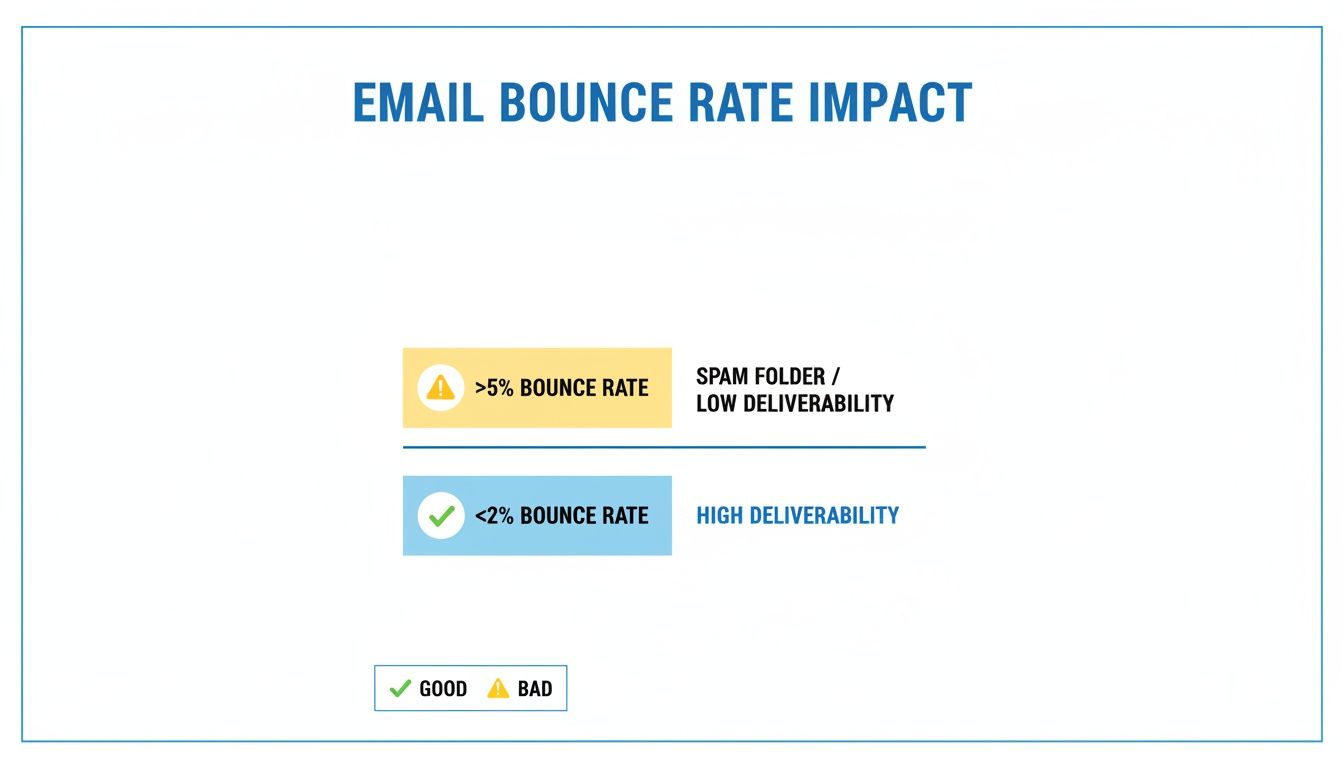
As you can see, keeping your bounce rate under 2% is crucial for good deliverability. Once you creep above 5%, you're in the danger zone and at high risk of being flagged as a spammer.
The Financial and Growth Impact
The damage isn't just technical; it hits your growth and revenue right where it hurts. The data doesn't lie: even small, temporary spikes in bounce rates often lead to bigger deliverability problems down the road. Most pros aim for delivery rates of 97-99%; anything below 95% is a clear sign that something is wrong.
Poor list hygiene, like clinging to old or fake addresses, is the main culprit here, contributing to a whopping 70% of all hard bounces. You can dig deeper into how these email statistics connect to real-world campaign performance.
Ultimately, a high bounce rate means you are:
- Wasting Resources: You're paying to send emails that have zero chance of ever being seen.
- Losing Potential Customers: Real, interested subscribers are missing your offers and updates.
- Undermining Growth: Your newsletter's ability to drive leads and sales is severely compromised.
Ignoring what a bounced email is telling you is like ignoring a small leak in a boat. It might not seem like a big deal at first, but if you don't fix it, it will eventually sink your entire operation.
Understanding Email Bounce Rate Benchmarks

So you know your bounce rate. But how do you know if it’s actually a problem? Context is everything. While every marketer dreams of a 0% bounce rate, that’s just not realistic. A few clear, data-driven benchmarks are what you really need to gauge the health of your email list and sender reputation.
As a general rule, the industry has some simple thresholds that give you a quick snapshot of where you stand.
- Good: Under 2%. This is the gold standard. It tells internet service providers (ISPs) you have a clean, healthy list and solid sending practices.
- Warning: Between 2-5%. This isn’t a disaster, but it’s a clear signal that something needs a closer look. Time to investigate your list hygiene.
- Critical: Over 5%. This is a major red flag for ISPs. It requires immediate action to prevent serious damage to your sender reputation and deliverability.
How Benchmarks Change With Email Type
But those numbers aren't a one-size-fits-all solution. The type of email you're sending has a massive impact on what’s considered an acceptable bounce rate. The context of your campaign completely changes the game.
For instance, a transactional email—like an order confirmation or a password reset—should have a bounce rate near zero. Think about it: the recipient just gave you their address and is actively waiting for your message. Anything higher than 0.5% for these emails points to a technical problem.
On the other hand, a cold outreach campaign will naturally have a higher bounce rate. These lists are often less verified, and a rate between 5-10% might be expected, though you still don't want to see it. The key is to clean that list aggressively after the first send.
When you’re checking your performance, always compare apples to apples. A weekly newsletter to your loyal, opted-in subscribers should have a much lower bounce rate than a one-off promotional blast to a less-engaged segment.
Email Bounce Rate Industry Benchmarks
To help put your numbers in perspective, here’s a quick breakdown of bounce rate expectations for common email campaign types. As you can see, what’s considered "good" for one can be a major warning sign for another.
Email Type
Good Rate
Warning Rate
Critical Rate
Transactional Emails
Below 0.5%
0.5% - 1%
Over 1%
Newsletters (Opt-in)
Below 2%
2% - 5%
Over 5%
Marketing Promotions
Below 3%
3% - 7%
Over 7%
Cold Outreach
Below 5%
5% - 10%
Over 10%
Tracking your rates against these benchmarks helps you spot trouble before it hurts your sender score. If your transactional emails are creeping into the warning zone, it’s a signal to investigate your sending infrastructure. If your cold outreach is hitting critical levels, your list source needs serious reevaluation.
Putting Your Numbers Into Perspective
Diving deeper into the data shows just how much these benchmarks can fluctuate in the real world. Cold email funnels, for example, average around a 7.5% bounce rate, while newsletters often sit closer to a much healthier 2.06%.
Autoresponders perform even better, with an average bounce rate of just 1.21%. Ultimately, your goal should be to hit a 97%+ delivery rate, which translates directly to a bounce rate of 3% or less. You can find more insights on cold email benchmarks on LevelUpLeads.io. By understanding these nuances, you can set realistic goals for your campaigns and know exactly when it’s time to act.
How to Reduce and Prevent Bounced Emails
Knowing what a bounced email is and how it hurts your marketing is the first step. The next is taking decisive action. Being proactive about the health of your email list is always going to be more effective than scrambling to fix a deliverability crisis down the line.
Fortunately, keeping bounces at bay really comes down to a few core best practices. These strategies protect your sender reputation, make sure your messages actually land in front of your audience, and help you get the most impact out of every single campaign you send.
Start With Proactive List Hygiene
The single most powerful way to prevent bounced emails is to build and maintain a clean email list from day one. Good hygiene isn't a one-and-done task; it's an ongoing commitment to the quality of your data.
Here are the foundational strategies for keeping your list in pristine condition:
- Implement Double Opt-In: When a new user subscribes, send them a confirmation email with a link they have to click. This simple step confirms the email address is valid, free of typos, and actually owned by someone who wants to hear from you.
- Never Use Purchased Lists: Buying email lists is a surefire way to skyrocket your bounce rate. These lists are almost always packed with old, invalid, or fake addresses that will instantly trigger hard bounces and tank your sender score.
- Regularly Validate Your List: Use an email verification service to scrub your list for invalid addresses, typos, and potential spam traps. Exploring free email verification tools can be a great starting point for cleaning your lists and keeping them healthy.
Proactive list hygiene isn't just about deleting bad contacts. It’s about building a solid foundation of engaged, valid subscribers who are genuinely interested in what you have to say. This is the cornerstone of any successful email program.
React Swiftly to Bounce Signals
Even with the best preventive measures in place, some bounces are just inevitable. How you respond to them is what separates the successful senders from those who end up in the spam folder. Your email service provider gives you all the data you need to act quickly.
Here’s a simple, reactive workflow:
- Identify and Purge Hard Bounces Immediately: After every campaign, pull a list of all the contacts that resulted in a hard bounce. Remove them from your active sending list without a second thought. There is zero reason to ever email a hard-bounced address again.
- Monitor Soft Bounces: Keep a close eye on addresses that soft bounce repeatedly. Most platforms will automatically suppress an address after it soft bounces three to five consecutive times, but it’s smart to monitor this yourself. If an address is consistently having temporary issues, it may be abandoned and should be removed.
Platforms like Breaker automate a lot of this heavy lifting. Our list hygiene feature automatically cleanses your list, while our TruSend deliverability management protects your sender reputation by handling bounces the right way.
This screenshot from a deliverability dashboard shows exactly how these metrics are tracked, giving you a crystal-clear view of bounce activity.
The dashboard provides an at-a-glance overview of hard and soft bounces, letting you quickly diagnose issues after each send. For more on this, check out our complete guide on how to validate email addresses to keep your list in top shape.
Frequently Asked Questions About Bounced Emails
Even after you get the hang of bounces, a few tricky questions always pop up when you start applying that knowledge to your own campaigns. This section is here to clear up some of the most common ones and give you straight answers for real-world situations.
Think of it as your go-to guide for those "what if" moments that every email marketer runs into.
How Often Should I Clean My Email List?
As a rule of thumb, you should give your entire email list a deep clean at least twice a year. This means running it through a verification service to scrub out any invalid, dormant, or sketchy addresses that have crept in.
If you’re sending high volumes or your list is growing fast, bumping that up to a quarterly check is even better. The real goal is to consistently weed out bad addresses before they have a chance to become hard bounces. Think of regular list hygiene as the single best proactive step you can take to protect your sender reputation and make sure your emails actually land in the inbox.
The core idea behind list cleaning is simple: prevention is always better than repair. A clean list is the bedrock of good deliverability, protecting your sender reputation from the damage that hard bounces inflict.
Can a Soft Bounce Turn Into a Hard Bounce?
Yes, it absolutely can. While a one-off soft bounce usually just means something temporary is going on (like a full inbox), repeated soft bounces from the same address are a major red flag. It often signals a more permanent problem, like an abandoned mailbox that no one checks anymore.
Most professional email service providers (ESPs) are smart about this. If an address soft bounces over several campaigns in a row, the system will automatically reclassify it as a hard bounce. This is a built-in safety measure. The ESP then adds that address to your suppression list, which stops you from sending to it again and protects your sender score from taking more hits. It's an automated way to stop you from repeatedly knocking on a door that will never open.
Does Using Double Opt-In Really Reduce Bounces?
Yes, putting a double opt-in process in place is one of the most powerful ways to stop bounces before they even start. It’s a simple but incredibly effective way to guarantee list quality right from the moment someone subscribes.
When you require new subscribers to click a verification link in their email, you achieve two critical things at once:
- You prove the address is valid and doesn't have any typos that would have caused an immediate hard bounce.
- You confirm the owner is genuinely interested in your content and has actively agreed to receive it.
This extra step acts as a filter, catching invalid addresses, potential spam traps, and low-effort sign-ups. The payoff is a highly engaged list built on a foundation of confirmed interest and accurate data, which naturally leads to a very low bounce rate.
My Bounce Rate Is High—What Is the First Thing I Should Do?
If you see a sudden spike in your bounce rate, the very first thing you need to do is pause all sending to that specific email list or segment. Pushing ahead and sending more emails will only make the damage to your sender reputation worse.
Once you’ve stopped sending, you need to play detective. Start by digging into your most recent campaign report to see exactly which addresses bounced.
From there, be methodical:
- Export All Hard Bounces: Pull a list of every single address that hard bounced.
- Permanently Remove Them: Delete these addresses from your active lists for good. Don't even think about sending to them again.
- Analyze the Soft Bounces: Look for patterns. Are a bunch of them from the same domain (like
company-name.com)? That could point to a temporary server issue or block on their end, not a problem with your list itself. - Verify the Entire List: Before you resume sending to that segment, run the whole list through a trusted email verification service. This will catch any other risky addresses you might have missed and help prevent the same problem from happening all over again.
Ready to stop worrying about bounced emails and focus on growth? Breaker combines powerful email sending with automated list hygiene and deliverability management. Our platform ensures your emails land in the inbox while our targeting engine delivers a steady stream of engaged, exact-match subscribers. Start your free 7-day trial and see how easy it is to grow a healthy, high-performing newsletter.
Keep reading
All articlesGDPR Consent Requirements for Purchased Email Lists
Purchased email lists rarely meet GDPR's consent bar. Learn the legal basis rules, PECR overlap, and safer alternatives before you hit send.
7 Email Platforms With Inbox Placement Testing & Suppression
Compare 7 email platforms that combine inbox placement testing with suppression management, scored on features, pricing, and best-fit sender size.
Email Automation Workflow & Drip Campaign Data Structure
Learn the database schema behind email drip campaigns—tables, workflow states, and event logs that power reliable marketing automation.