
CAN-SPAM Act Requirements: What B2B Marketers Must Know
Clear CAN-SPAM guidance for B2B email marketers: accurate sender headers, honest subject lines, a postal address, working unsubscribe links, and third-party accountability.
The CAN-SPAM Act is a federal law regulating all commercial emails in the U.S. Its goal? To prevent spam, misleading content, and intrusive practices while ensuring transparency in email marketing. If you're a B2B marketer, this law applies to every email promoting products or services - whether it's a cold email, newsletter, or promotional message. Violations can cost up to $46,517 per email, so compliance is non-negotiable.
Here’s what you need to know to stay compliant:
- Sender Details: Clearly identify who’s sending the email (e.g., accurate "From" and "Reply-To" fields).
- Subject Lines: Avoid misleading or deceptive language.
- Physical Address: Include a valid postal address in the email footer.
- Unsubscribe Option: Provide a clear, functional opt-out link and honor requests within 10 business days.
- Third-Party Accountability: You're responsible for compliance, even if a third party sends the emails.
Compliance isn't just about avoiding fines - it protects your sender reputation and improves email performance. Regular audits, list hygiene, and clear policies ensure your campaigns are effective and within the law.
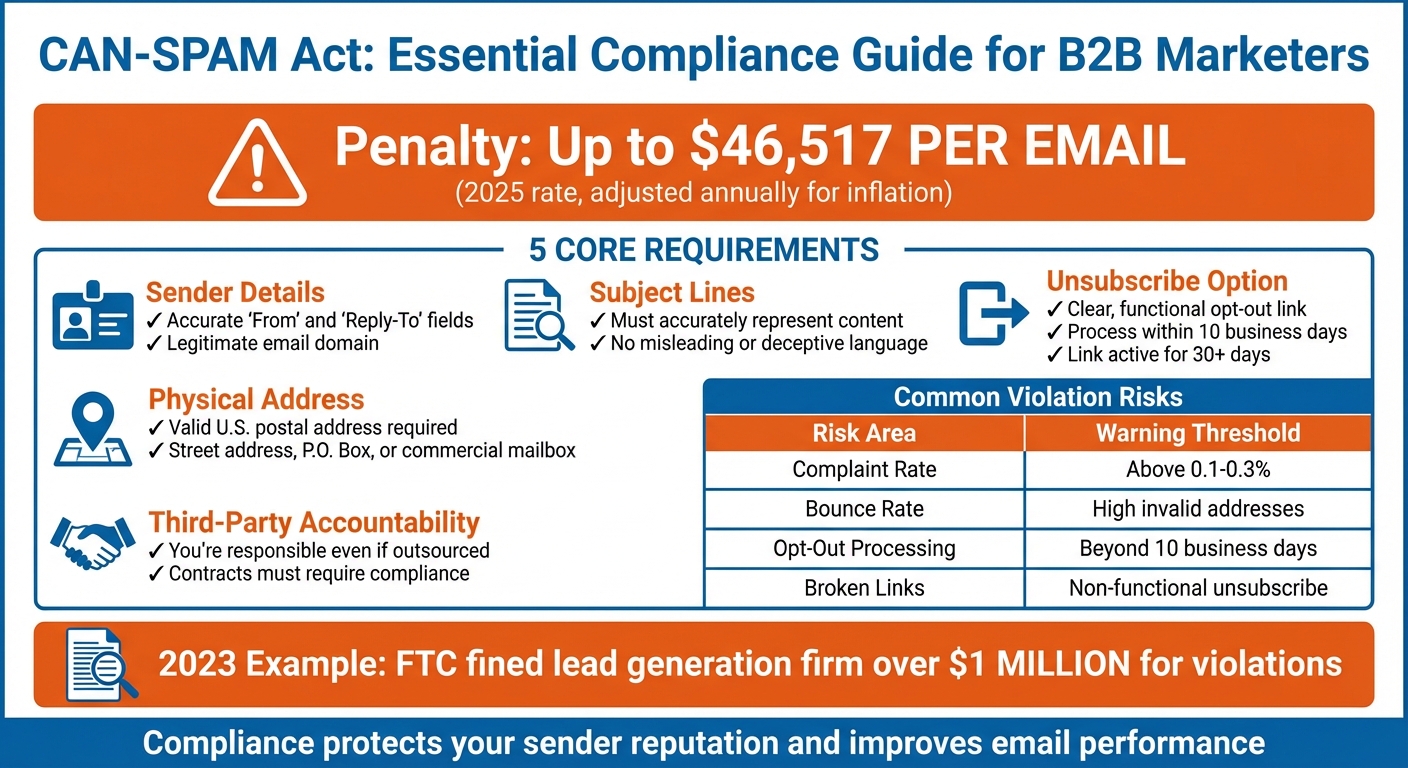
CAN-SPAM Act Compliance Requirements and Penalties for B2B Email Marketing
Complying with the CAN SPAM Act - Business Tips | Federal Trade Commission
Core CAN-SPAM Requirements for B2B Email Marketing
Staying compliant with the CAN-SPAM Act is critical for any B2B email marketing campaign. These rules not only keep you on the right side of the law but also help maintain strong deliverability rates and trust with your audience.
Accurate Sender and Header Information
The "From", "To", "Reply-To", and routing details in your emails must clearly identify the sender. For example, use names like "Acme Software, Inc." or "Jordan Lee, Acme Software", instead of vague terms like "Support Team." Your email domain should be legitimate (e.g., sales@acme.com) and not mimic or misrepresent another entity. The Reply-To address must direct to a monitored inbox capable of handling responses and opt-out requests. To ensure consistency, standardize sender identities across all email campaigns, whether it’s newsletters, product updates, or sales outreach. Tools like Breaker can help by enforcing brand-aligned sender identities and authenticating domains for better deliverability.
Clear and Honest Subject Lines
Subject lines should accurately represent the email's content and avoid misleading language. For instance, "Q4 Benchmark Report for Manufacturing CFOs" is compliant, whereas deceptive lines like "Re: Your invoice" (if no invoice exists) or "Account suspended" (for a sales pitch) are not. If you mention a "free trial" in the subject, make sure the email delivers on that promise. When testing subject lines, focus on clarity and relevance rather than using ambiguous or clickbait tactics.
Physical Address Requirement
Every commercial email must include a valid physical postal address in the footer. This can be your company’s current street address, a business-registered P.O. Box, or a private mailbox from a commercial mail receiving agency that complies with USPS regulations. For remote-first or virtual companies, a compliant P.O. Box or commercial mailbox is acceptable, but it’s essential to keep the address up to date. If your address changes, revise your email templates immediately.
Unsubscribe Mechanisms and Opt-Out Requirements
Your emails must provide a clear and easy-to-use opt-out option, typically through an unsubscribe link in the footer. This link must remain functional for at least 30 days after the email is sent, and opt-out requests must be processed within 10 business days. Recipients shouldn’t have to pay a fee, provide unnecessary information, or go through complex steps to unsubscribe. Automating this process with your email service provider can ensure compliance. While preference centers can allow users to customize their email subscriptions (e.g., opting out of newsletters but keeping product updates), a global opt-out request must fully suppress all future emails.
CAN-SPAM Opt-Out Requirement
Details
Visibility
The unsubscribe link should be easy to locate
Duration
Must remain functional for at least 30 days after sending the email
Processing
Opt-out requests must be honored within 10 business days
Barriers
No fees or excessive steps - just one simple action required
Liability for Third-Party Email Senders
The CAN-SPAM Act holds both the promoting company and the third-party email sender (e.g., an agency, ESP, or affiliate) accountable for any violations. Outsourcing email campaigns doesn’t exempt you from responsibility. Contracts with third-party providers should explicitly require compliance with CAN-SPAM regulations, including accurate sender details, truthful subject lines, a valid physical address, and functional unsubscribe mechanisms. Be sure these providers use your suppression lists and conduct regular compliance checks. Platforms like Breaker can assist by offering features such as verified footer addresses, automated unsubscribe links, suppression list management, and audit logs to document compliance practices effectively.
Penalties and Risk Management
Financial Penalties for Violations
Violating the CAN-SPAM Act can result in hefty financial penalties. The Federal Trade Commission (FTC) has the authority to impose civil fines of up to $46,517 per non-compliant email as of 2025, with adjustments made annually for inflation. For comparison, the penalty stood at $43,792 in 2023. A notable example occurred in 2023 when the FTC fined a lead generation firm over $1 million for violations, including failing to honor opt-out requests. This serves as a stark warning for B2B marketers, especially those using cold outreach or purchased email lists. These substantial fines highlight the importance of proactive compliance measures.
Common Compliance Risks for B2B Marketers
Certain practices frequently attract FTC scrutiny, particularly in B2B email marketing. One major issue is outdated email lists. High bounce rates from invalid addresses not only reflect poor list hygiene but also draw attention from Internet Service Providers (ISPs) and regulators. Similarly, high complaint rates - typically above 0.1% to 0.3% - can signal problems like misleading subject lines or irrelevant content. For example, if you send an email campaign to 50,000 recipients and 0.5% file complaints, you’re looking at 250 spam reports - a red flag for enforcement.
Another common compliance pitfall is non-functional opt-out links. If unsubscribe mechanisms fail or don’t process requests promptly, the risk of penalties increases significantly. Poorly targeted cold outreach also raises the likelihood of complaints, further increasing regulatory scrutiny.
CAN-SPAM Violation Risk Area
Description
Potential Trigger for Enforcement
Outdated Email Lists
High bounce rates from invalid addresses
FTC monitoring via ISPs
High Complaint Rates
Spam reports exceeding acceptable thresholds
Automated flags by email providers
Broken Opt-Out Links
Unsubscribe mechanisms that don’t work properly
Per-email fines up to $46,517
Misleading Headers/Subjects
False sender details or deceptive subject lines
Civil penalties and possible lawsuits
To minimize these risks, take proactive steps like:
- Regular email validation to remove invalid addresses.
- Keeping suppression lists updated across all platforms.
- Monitoring complaint rates to ensure they stay well below the 0.3% threshold.
Additionally, conducting quarterly audits of sender data, opt-out processing, and third-party compliance can help identify and resolve potential issues early. By addressing these risks head-on, you can maintain a clean and compliant email list while steering clear of costly penalties. These strategies are critical for successful B2B email campaigns and will tie into the next section’s discussion on maintaining compliance.
Maintaining Email List Quality and Compliance
Email Validation and List Hygiene
Keeping your email list clean is a critical part of staying compliant with CAN-SPAM regulations. Using email validation tools can help you catch issues like syntax errors, non-existent domains, and disposable email addresses before they cause trouble. To stay ahead, implement real-time validation during sign-up to block invalid addresses and correct typos, especially in corporate domains. For your existing lists, schedule batch validations every quarter - or monthly if you're sending a high volume of emails.
When managing your list, remove hard bounces immediately and suppress contacts that repeatedly soft bounce. It's also a good idea to phase out addresses that haven’t shown activity - like opening or clicking emails - in the past 6–12 months. These inactive contacts can hurt your engagement rates and increase the risk of spam complaints. And remember, avoid using purchased, scraped, or harvested lists, as they often lead to bounce issues and complaints that can damage your sender reputation.
Managing Suppression Lists and Opt-Out Data
Your suppression list is a vital tool for compliance. This database tracks contacts who should never receive your commercial emails - whether they’ve opted out, bounced, or filed complaints. It’s important to store key details like the email address, opt-out reason, date and time of the request, and the system where it originated. Under CAN-SPAM rules, you’re prohibited from using opt-out addresses for anything other than honoring the unsubscribe request.
To minimize risk, consolidate suppression data into a single system of record - typically your CRM or customer data platform. This system should be integrated with all your email service providers (ESPs), marketing automation tools, and sales platforms via APIs or scheduled syncs. Any unsubscribe link or "remove me" reply should update the central suppression table within minutes. Regularly audit your suppression data across all systems to identify gaps before they become compliance issues. Keep in mind, you have 10 business days to process opt-out requests, and your unsubscribe mechanism must remain functional for at least 30 days after an email is sent. A well-maintained suppression list not only ensures compliance but also supports better cold outreach practices.
Cold Outreach and Consent Management Best Practices
Under CAN-SPAM, B2B cold outreach is allowed as long as you adhere to the rules. This includes using truthful headers and subject lines, providing a physical address, and including a functional opt-out mechanism. However, meeting legal requirements doesn’t guarantee your emails will land in the inbox. Sending cold emails to irrelevant contacts can lead to spam complaints, which harm your sender reputation and deliverability.
To improve your results, personalize cold emails based on the recipient's role, company, and industry. These practices align with earlier compliance steps, such as validating senders and processing opt-outs accurately. Start with low send volumes, especially from new domains, and gradually increase to warm up your sending patterns. Always include a clear and easy way to opt out in every cold email, and immediately suppress anyone who replies with "no thanks" or "stop".
For newsletters and nurture campaigns, focus on explicit opt-in methods like forms, gated content, or event registrations. This reduces complaints and boosts engagement. Tools like Breaker can simplify this process by using advanced algorithms, AI enrichment, and proprietary data to identify ideal subscribers. They also offer unlimited email validations and deliverability management to help you maintain a clean, compliant list. Following these practices ensures CAN-SPAM compliance becomes a seamless part of your daily operations.
Implementing CAN-SPAM Compliance in Daily Operations
Policy and Process Documentation
To align with CAN-SPAM requirements, clearly distinguish between commercial and non-commercial emails using decision trees that outline mandatory elements like a physical address, unsubscribe link, and accurate headers. Your policy should also define who is authorized to send commercial emails and through which systems, ensuring every email includes the necessary elements. This should tie into your ongoing email list maintenance and opt-out management practices discussed earlier.
Centralize the handling of opt-out requests to comply with the 10-business-day rule. Establish clear procedures for processing opt-outs, whether they come via an unsubscribe link, email reply, or even a phone call. All requests should be logged in a centralized system, not left in individual inboxes. Include guidelines for how long to retain campaign logs, consent records, and email archives to prepare for potential audits. These policies form the backbone for enforcing compliance through technology.
Using Technology for Compliance
Leverage your ESP, CRM, or automation platform by configuring locked templates that automatically include your verified "From" name, U.S. postal address, and unsubscribe link. Implement role-based access controls and pre-send validations to ensure no campaign is sent without these essential elements.
Platforms like Breaker can streamline compliance by automatically adding compliant footers, syncing suppression and opt-out lists, and offering unlimited email validations to maintain list quality. Use these systems to enforce compliance automatically and monitor performance through dashboards that track bounce rates, spam complaints, and unsubscribe rates in real time. Regularly review campaigns - weekly or monthly - that exceed complaint thresholds, and investigate areas like subject-line accuracy, audience targeting, and opt-out clarity. While technology ensures compliance at a baseline level, team training reinforces operational consistency.
Training and Cross-Team Coordination
Train your marketing, sales, and customer success teams to recognize and process messages regulated under CAN-SPAM. Conduct hands-on exercises to reinforce these practices. A simple rule for all team members: any request to stop receiving promotional emails must be recorded and processed through the central opt-out system.
Create a governance structure where marketing operations oversees standards and tools, while sales, customer success, and external partners follow the same suppression lists, templates, and approval workflows. Training complements your technological measures by ensuring everyone adheres to compliance standards. Hold quarterly coordination meetings to address issues such as outdated contact information, overlapping campaigns, or partners who fail to honor opt-outs - common risks under CAN-SPAM. Additionally, schedule annual refresher training and brief sessions whenever tools or policies are updated to maintain alignment.
Conclusion
Following CAN-SPAM regulations isn't optional for B2B marketers - it's a legal necessity that shields your business from hefty fines (up to $46,517 per violation) and helps establish effective email marketing practices. The rules are straightforward: ensure your headers have accurate sender details, craft truthful subject lines, include your physical U.S. postal address, and offer a functional unsubscribe link.
Staying compliant does more than just avoid penalties; it also improves your email marketing results. Handling opt-outs quickly and maintaining clean mailing lists can lead to better deliverability, fewer spam complaints, and a higher return on investment by keeping your messages out of spam folders.
With regulatory updates expected in 2025 as federal and state standards evolve, compliance should be treated as an ongoing responsibility rather than a one-time task. Regular audits, clear documentation of policies, and the use of automated tools are key steps to staying ahead. Platforms like Breaker make this process easier by offering tools such as unlimited email validations and integrated list hygiene management.
In short, CAN-SPAM compliance isn't just about avoiding fines - it’s about building a stronger, more effective email marketing strategy. By embedding compliance into your daily operations through well-documented policies, reliable technology, and thorough team training, you create a system that not only minimizes risks but also enhances performance. This blend of preparation and automation ensures your marketing efforts remain both compliant and impactful.
FAQs
What are the consequences of not complying with the CAN-SPAM Act in B2B marketing?
Failing to follow the CAN-SPAM Act can lead to hefty fines - up to $43,792 per violation. And here's the kicker: each non-compliant email counts as a separate offense. For businesses sending out multiple emails, those penalties can stack up fast.
To steer clear of these fines, B2B marketers need to ensure their email campaigns check all the boxes. This includes providing a clear way for recipients to opt out, using accurate sender details, and sticking to honest subject lines.
What steps can B2B marketers take to stay compliant with the CAN-SPAM Act?
To ensure compliance with the CAN-SPAM Act, B2B marketers should keep these practices in mind:
- Get clear permission: Only send emails to individuals who have explicitly opted in to receive them.
- Provide an easy opt-out: Every email must include a straightforward way for recipients to unsubscribe.
- Be honest and transparent: Use accurate sender details and avoid misleading subject lines or deceptive content.
- Keep your email list updated: Regularly remove invalid or inactive addresses to maintain a healthy list.
Following these principles not only helps you comply with the law but also strengthens trust with your audience.
What should I do if a third-party email sender violates the CAN-SPAM Act?
If a third-party email sender breaches the CAN-SPAM Act, the first step is to halt the sending of non-compliant emails right away. Take time to thoroughly review your email practices to confirm they align with legal standards. Make sure to document every action you take to resolve the issue and implement measures to prevent future violations. If you're unsure about any legal obligations, reaching out to a legal professional can provide clarity and help minimize potential risks.
Acting quickly is essential - not just to maintain compliance but also to safeguard your reputation and the trust you've built with your audience.
Related Blog Posts
Keep reading
All articlesGDPR Consent Requirements for Purchased Email Lists
Purchased email lists rarely meet GDPR's consent bar. Learn the legal basis rules, PECR overlap, and safer alternatives before you hit send.
7 Email Platforms With Inbox Placement Testing & Suppression
Compare 7 email platforms that combine inbox placement testing with suppression management, scored on features, pricing, and best-fit sender size.
Email Automation Workflow & Drip Campaign Data Structure
Learn the database schema behind email drip campaigns—tables, workflow states, and event logs that power reliable marketing automation.