
A/B Testing Tools for B2B Email Marketers
Compare six A/B testing platforms for B2B email: features, pricing, test limits, and best use cases to boost opens and clicks.
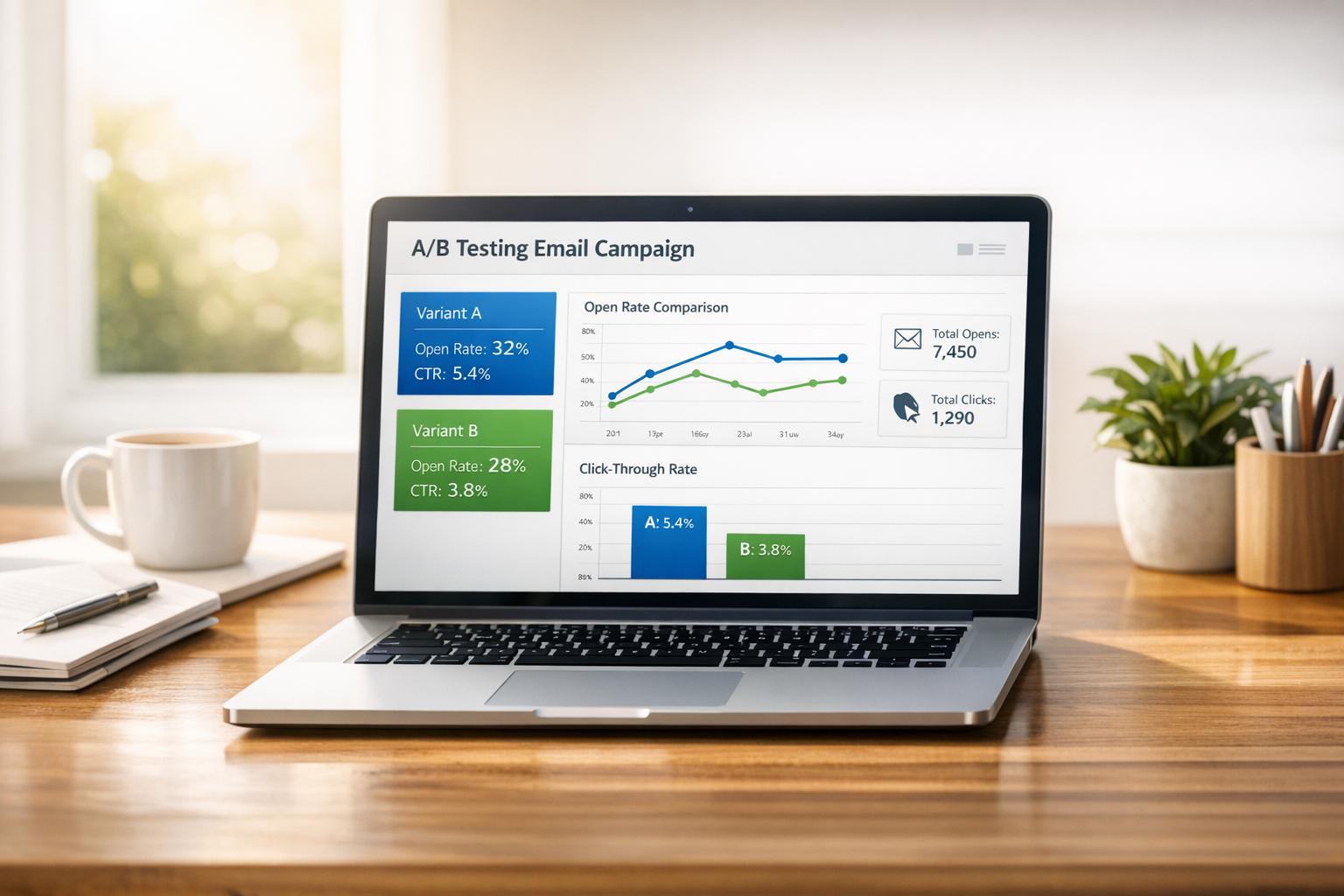
A/B testing helps B2B marketers make data-backed email decisions by comparing different versions of emails to determine what works best. Key elements to test include subject lines, CTAs, and send times. This article reviews six tools - ActiveCampaign, GetResponse, Brevo, MailerLite, Optimizely, and Breaker - detailing their features, pricing, and use cases for improving email performance. Here’s a quick overview:
- ActiveCampaign: Test up to 5 variations, automate workflows, starts at $29/month.
- GetResponse: Offers 5 variations, AI tools, starts at $15.58/month.
- Brevo: Includes CRM, limits tests to 2 variations, starts at $16.17/month.
- MailerLite: Supports up to 8 variations (multivariate), free plan available.
- Optimizely: Enterprise-grade experimentation, custom pricing.
- Breaker: Real-time analytics, precise targeting, starts at $200/month.
Quick Comparison
Tool
Max Variations
Key Feature
Starting Price
ActiveCampaign
5
Automation branch testing
$29/month
GetResponse
5
AI writing assistant
$15.58/month
Brevo
2
Built-in CRM
$16.17/month
MailerLite
8 (Multivariate)
Multivariate testing
Free plan
Optimizely
Multiple
Enterprise-level optimization
Custom pricing
Breaker
N/A
Real-time performance analytics to improve email journey flows
$200/month
Each tool fits different needs, from budget-friendly options to advanced enterprise solutions. Choose based on your testing complexity, automation needs, and team size.
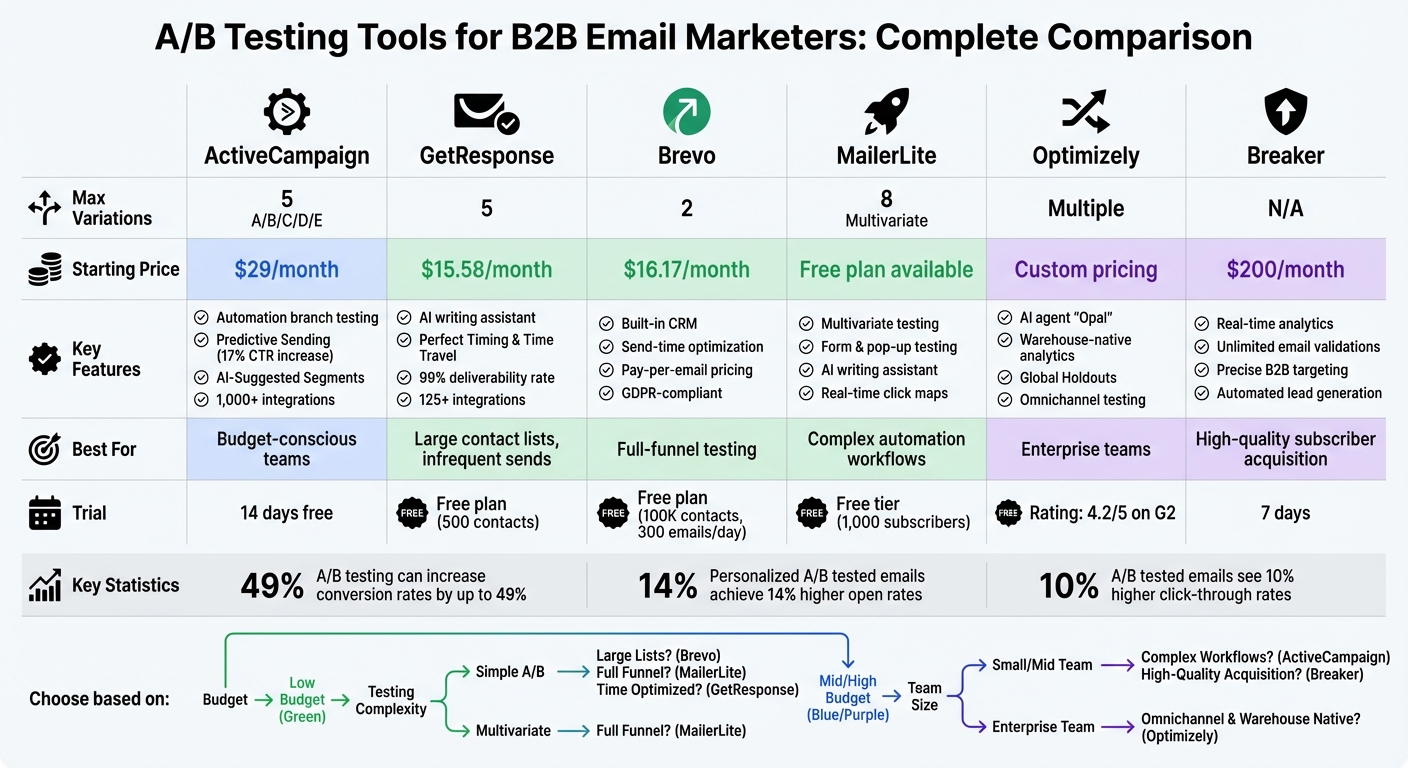
A/B Testing Tools Comparison: Features, Pricing, and Capabilities for B2B Email Marketers
1. ActiveCampaign
A/B Testing Features
ActiveCampaign allows you to test up to five variations simultaneously (A/B/C/D/E), making it easier to pinpoint the most effective version. You can experiment with subject lines, preheaders, content blocks, images, videos, and CTAs. The platform’s "Active Intelligence" feature automatically determines the best-performing version based on your selected success metrics - such as opens, clicks, or site activity - and sends it to the rest of your audience. Additionally, you can test customer journeys by creating split test branches within automated workflows. This feature lets you compare different paths and refine your processes. For B2B teams, testing follow-up wait times can help maximize engagement.
"ActiveCampaign stands out with the number of parallel tests and metrics customizations. The learning curve is pretty flat so you won't struggle integrating the app in your existing flow".
These tools lay the groundwork for more advanced features tailored to B2B needs, as outlined below.
B2B-Specific Capabilities
ActiveCampaign includes Predictive Sending, which schedules emails to land in inboxes when recipients are most likely to engage - resulting in a 17% increase in click-through rates. Its AI-Suggested Segments analyze customer data to identify key audiences, such as at-risk subscribers or potential repeat buyers, making them ideal for targeted testing. You can also use dynamic content to personalize variations based on behavior, preferences, or lifecycle stages, ensuring your test versions are highly relevant to individual recipients.
Pricing and Scalability
ActiveCampaign’s pricing begins at $29 per month, with some plans starting as low as $15 depending on contact volume. Split automation testing becomes available with the Professional plan. There’s also a 14-day free trial that doesn’t require a credit card. The platform is designed to grow with your needs, supporting everything from simple email campaigns to complex, multi-branch automation tests. However, it’s worth noting that native geolocation testing isn’t currently offered.
Integration and Analytics
ActiveCampaign shines when it comes to integration and analytics. It connects with over 1,000 tools - including Salesforce, Microsoft Dynamics, and other CRMs - making it a powerful addition to your marketing stack. On the analytics side, the platform goes beyond basic metrics like open and click rates. You can customize metrics to gain deeper insights into what drives engagement, helping you fine-tune your email strategies for better results.
2. GetResponse
A/B Testing Features
GetResponse allows you to test up to five variations of subject lines and message content. This includes experimenting with elements like images, layouts, and CTAs. Using a simple slider, you can control the size of your test group. Once the test runs, the platform automatically sends the best-performing version to the rest of your audience. The winner is determined based on open or click-through rates within a timeframe you set. You can even test landing pages to refine your lead generation funnel.
"I love the GetResponse AI Email Generator. It creates excellent copy and gives me ideas that I can edit and add to my email marketing. It has increased my open rates on the tested emails." – David Jones, CMO, Thundering Herd Marketing
These features are part of a broader suite designed to enhance B2B campaigns.
B2B-Specific Capabilities
GetResponse MAX offers advanced tools tailored for B2B marketers. These include dedicated IP addresses, custom mailing domains, and seamless integration with Microsoft Dynamics. A/B tests are built into automation workflows, complete with lead scoring and tagging to refine targeting. The platform’s AI writing assistant helps craft precise email copy and subject lines. Features like "Perfect Timing" and "Time Travel" ensure your emails land in inboxes at the most effective times for global audiences, all while maintaining an impressive 99% deliverability rate.
Pricing and Scalability
Pricing for GetResponse starts at $15.58 per month for the Email Marketing plan when billed annually, and A/B testing is available across all plans. There’s also a free plan for up to 500 contacts and 2,500 newsletters per month. Paid plans include unlimited email sends, which is crucial for businesses running frequent campaigns.
The platform scales easily, with pricing tiers based on list sizes (e.g., 1,000; 2,500; 5,000; 10,000; up to 100,000 contacts). For large-scale operations, the Enterprise (MAX) tier offers custom pricing and additional features. On average, users see their list grow by 100% in the first 30 days of a paid plan, and regular A/B testing often boosts open and click-through rates by 10–25%.
Integration and Analytics
GetResponse integrates with over 125 tools, including Salesforce, Microsoft Dynamics 365, Zapier, and Google Analytics, making it easier to align your marketing efforts across platforms. The MAX plan also provides robust API access and priority support for more complex integrations.
Detailed analytics, like real-time click maps, revenue attribution, and device-specific trends, help pinpoint which email strategies are driving results. Additionally, GetResponse supports email authentication standards like DKIM and DMARC, ensuring compliance with providers such as Gmail, Yahoo, and Microsoft.
3. Brevo
A/B Testing Features
Brevo allows you to test subject lines, "From" names, and even entire email content, such as images, headlines, and CTA buttons. Here's how it works: two email variations are sent to 10% of your audience. Brevo then tracks performance and automatically sends the better-performing version to the remaining 80%. You can decide whether the winner is determined by open rates or click-through rates.
However, there’s a catch - Brevo limits tests to just two variations. This means no multivariate testing, and you can only test individual emails in automated sequences. That said, testing "From" names, like using a sales rep’s name versus the company name, can make a big difference in open rates, particularly for professional audiences.
"Brevo provides all the functionality that 99% of marketers will ever need to make smarter, data-driven decisions." – Alpha Design Global
Beyond its testing tools, Brevo offers features designed specifically for B2B workflows.
B2B-Specific Capabilities
Brevo comes with a built-in CRM that helps you track deals through customizable pipelines while organizing contact data for more targeted communication. You can create automated workflows triggered by user actions - think follow-up emails after a meeting or a series of educational emails after someone downloads a whitepaper. Advanced segmentation tools let you tailor your messaging based on demographics, behavior, or web activity, ensuring your emails resonate with specific professional groups.
Collaboration is also made easier with tools like a shared inbox, keeping sales and marketing teams in sync. On top of that, Brevo uses AI-powered send-time optimization to ensure your emails land in inboxes when recipients are most likely to engage.
Pricing and Scalability
Brevo’s pricing model is based on email volume, not contact count, which makes it a cost-efficient option for B2B companies managing large databases but sending emails less frequently. However, A/B testing is only available starting with the Standard plan, priced at $16.17 per month. The Free plan supports up to 100,000 contacts and includes 300 emails per day, along with CRM access.
Plan
Monthly Price
Email Limit
A/B Testing
Free
$0
300/day
No
Starter
$8.08+
5,000+
No
Standard
$16.17+
5,000+
Yes
Professional
$449+
150,000+
Yes
Enterprise
Custom
1M+
Yes
For businesses with sporadic email campaigns, there’s a pay-as-you-go option that uses prepaid credits with no expiration date. The Professional plan adds perks like 10 user seats and contact scoring, while the Enterprise plan offers unlimited contacts and dedicated IP addresses.
Integration and Analytics
Brevo integrates seamlessly with popular B2B tools like Salesforce, HubSpot, Zoho CRM, and Google Analytics 4. It provides real-time reports on open rates, click-through rates, bounce rates, and unsubscribes. AI-powered insights help identify what’s driving engagement. Plus, the platform is fully GDPR-compliant, offering features like data deletion, rectification, and portability - important for businesses in regulated industries.
The drag-and-drop editor makes designing emails simple, though advanced marketers might find the analytics lacking in deeper statistical insights. Still, for most B2B teams, Brevo’s multichannel support (email, SMS, WhatsApp, push notifications) and straightforward interface strike the right balance between functionality and ease of use.
4. MailerLite
A/B Testing Features
MailerLite takes A/B testing to the next level with multivariate testing, allowing you to experiment with up to 8 campaign versions. This includes tweaking subject lines, email content, sender names, and send times simultaneously. Unlike basic A/B testing, which limits you to 5 versions of a single variable, MailerLite’s approach gives B2B marketers the flexibility to test combinations. For example, you can see if "John from TechCorp" resonates better than just "TechCorp" as the sender name while also testing various subject lines and delivery times.
The platform also supports automation workflow testing, letting you A/B test specific steps in a sequence - perfect for refining lead nurturing strategies. For instance, you can test different time delays between follow-up emails to determine the most effective interval. Additionally, you can test up to 5 variations of embedded forms and pop-ups to identify which offers, like whitepapers or consultation requests, yield better results.
"The A/B testing capabilities have been great. We can see exactly what kind of messaging resonates with our audience and what doesn't, which helps us refine our strategy and make our communication more effective." – Claire Fitzsimmons, Founder, Salty
Real-world examples highlight the effectiveness of MailerLite’s testing tools. For instance, KC Tool, a German hand tool distributor, boosted click rates by about 1% by testing subject lines and product images, leading to hundreds of extra clicks per campaign. Similarly, The Remote Company achieved an average 10% increase in open rates by testing subject lines.
Pricing and Scalability
MailerLite’s pricing structure is designed to accommodate B2B campaigns of varying scales. Costs are based on subscriber count, starting with the Growing Business plan at around $9 per month, which includes multivariate testing and unlimited emails. For more advanced needs, the Advanced plan begins at approximately $18 per month and adds features like promotional pop-up testing and an AI writing assistant.
Plan
Monthly Price
A/B Testing
Multivariate Testing
Free
$0
Up to 5 versions
No
Growing Business
$9+
Up to 5 versions
Up to 8 versions
Advanced
$18+
Up to 5 versions
Up to 8 versions
For larger subscriber lists, MailerLite recommends the 80/20 rule: send 10% of your audience Version A, another 10% Version B, and then the winning version to the remaining 80%. This method is particularly effective for B2B campaigns with varying audience sizes.
Integration and Analytics
MailerLite offers built-in analytics to track essential metrics like opens, clicks, and conversions directly from its dashboard, often eliminating the need for external tools. Features like real-time click maps provide insights into which parts of your email content are engaging readers the most. For e-commerce businesses, integrations with Shopify and WooCommerce make it easy to measure how different test variations impact sales. Additionally, MailerLite connects with external CRM tools via Zapier, ensuring that your testing data aligns seamlessly with your overall marketing stack.
To ensure accurate results, MailerLite recommends using external tools like the Evan Miller statistical calculator to verify test significance. Serving a community of approximately 800,000 users, the platform has earned perfect 5/5 star ratings on WittySparks, Trustpilot, G2, and Capterra. However, some users have noted that its automation features might feel too basic for professional agencies with more complex needs.
5. Optimizely
A/B Testing Features
Optimizely delivers enterprise-level A/B testing through its AI-driven experimentation platform. At the heart of this platform is "Opal", an AI agent designed to simplify and enhance the testing process. Opal analyzes your website data to generate impactful test ideas, creates ready-to-use variations, and turns complex results into actionable business insights. With omnichannel consistency and a user-friendly visual editor, even non-technical users can independently launch tests. These features make Optimizely a strong contender for B2B applications.
B2B-Specific Capabilities
For B2B teams, Optimizely offers warehouse-native analytics, enabling precise tracking of metrics like customer lifetime value, retention, and churn. It integrates seamlessly with platforms like Snowflake, BigQuery, Databricks, and Redshift, consolidating all data into a single, reliable source. A real-world example: In 2024, Cox Automotive boosted its experimentation program's health score by 27% in just one quarter. They also slashed analysis time from weeks to minutes. Additionally, the platform's Global Holdouts feature allows businesses to measure the long-term cumulative effects of their testing efforts.
Pricing and Scalability
Optimizely provides custom pricing based on your needs. However, it’s worth budgeting 2–3 times the base fee to cover integration, setup, and training. Users frequently report faster test launches and improved engagement metrics, such as a 35% increase in test impact and a 37% boost in website engagement. Built for scalability, the platform enables engineering, marketing, and product teams to conduct experiments independently while maintaining statistical accuracy. Data from 127,000 experiments shows that personalization can deliver a 41% higher impact.
With a 4.2/5 rating on G2 and recognition as a Leader in the 2025 Forrester Wave for Digital Experience Platforms, Optimizely continues to be a trusted choice for enterprise B2B marketers seeking impactful experimentation tools.
6. Breaker
A/B Testing Features
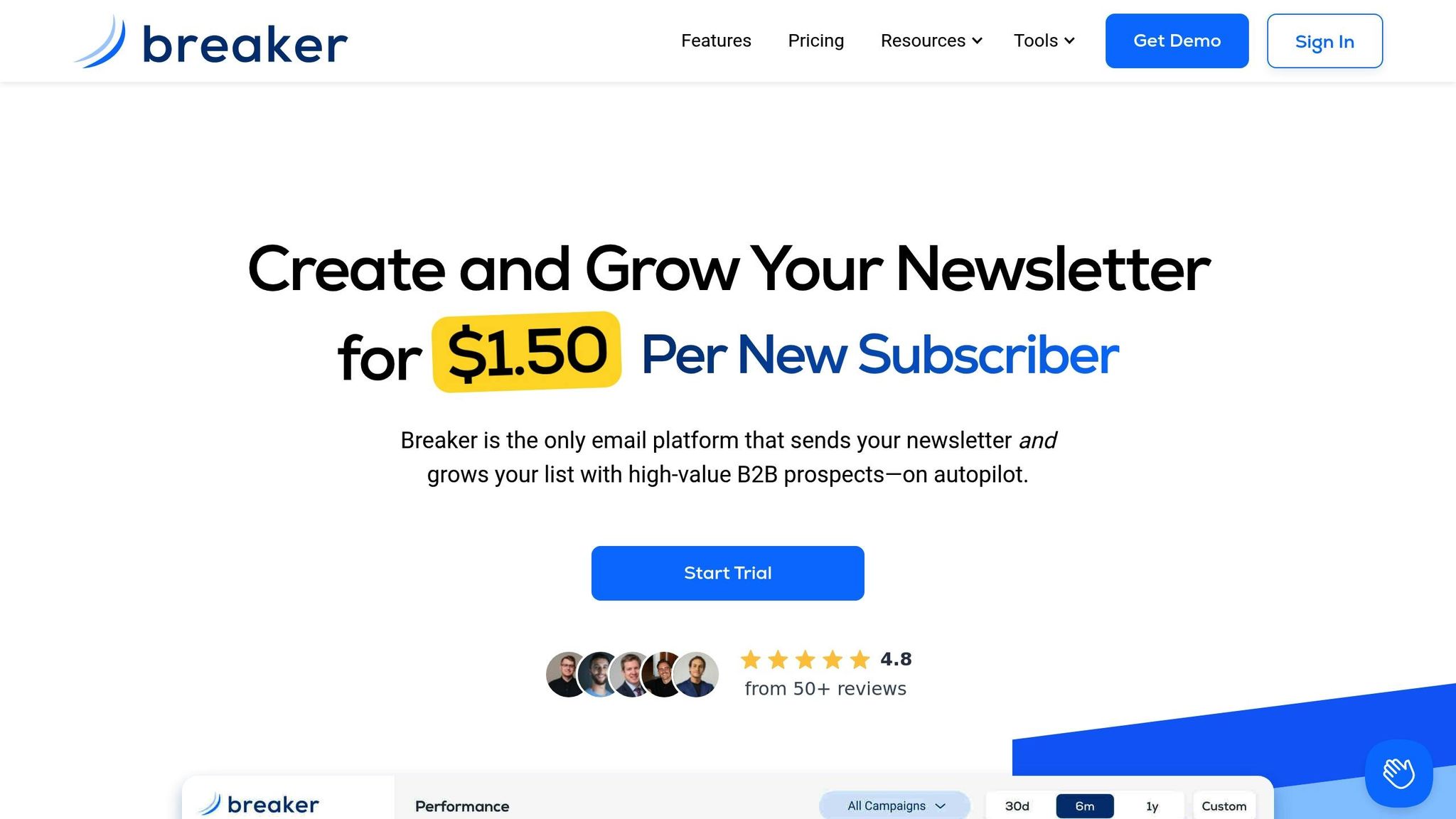
Breaker combines real-time performance analytics with an easy-to-use newsletter builder to fine-tune your email campaigns. With access to live insights, you can quickly tweak your messaging and improve campaign outcomes, making it a powerful complement to traditional A/B testing methods. These tools are designed to enhance the platform's focus on B2B marketing.
B2B-Specific Capabilities
Breaker is tailored for B2B marketers, offering precise audience targeting and automated lead generation to connect with key decision-makers. The platform ensures your emails land in the inboxes of subscribers who align with your ideal customer profile. Features like unlimited email validations and built-in deliverability management ensure your messages are reliably delivered. Additional tools, including CRM integrations, customizable signup forms, and dedicated support, help you maintain top-quality data throughout your campaigns.
Pricing and Scalability
Breaker keeps its pricing simple.
- Starter Plan: $200/month, includes 100 engaged subscribers per month, up to 50,000 email sends, and a 7-day trial.
- Custom Plan: $1,750/month, includes 1,000 engaged subscribers per month and up to 250,000 email sends.
Both plans allow unlimited users, making them suitable for teams of any size.
A/B testing and optimization for B2B emails
Advantages and Disadvantages
Here’s a breakdown of the key strengths and limitations of each tool for B2B email testing, based on their features and pricing:
ActiveCampaign allows testing up to five variations, including entire automation branches, which is great for optimizing nurture sequences. However, its 14-day trial might feel too short for teams that need more time to evaluate its capabilities.
MailerLite supports testing across landing pages, forms, pop-ups, and automation steps. It also includes an AI email generator to speed up the creation of variants. The downside? Multivariate testing (up to eight variations) is only available on the "Growing Business" and "Advanced" plans.
GetResponse offers a user-friendly sample size selector and detailed stats, all starting at an affordable $14 per month.
Brevo integrates a unified CRM for both sales and marketing efforts, but its A/B testing features are limited to higher-tier plans.
Optimizely delivers enterprise-level optimization tools, which might be overkill for smaller teams with simpler needs.
Breaker stands out with real-time analytics and precise targeting to boost deliverability and engagement. At $200 per month for the Starter Plan, it also includes unlimited email validations, making it a solid choice for teams focused on acquiring high-quality subscribers.
The table below provides a quick comparison to help you decide which tool aligns with your requirements.
Tool
Max Variations
Key Strength
Primary Limitation
Starting Price
ActiveCampaign
5
Tests entire automation journey branches
14-day trial period
Varies
GetResponse
5
Intuitive sample size selector & detailed statistics
-
~$14/month
Brevo
Not specified
Unified CRM and sales platform
A/B testing features on higher tiers
Varies
MailerLite
8 (Multivariate)
Full-funnel testing across emails and forms
Multivariate testing on higher plans
Free tier available
Optimizely
Multiple
Enterprise-grade optimization
May be too complex for smaller teams
Enterprise pricing
Breaker
N/A
Real-time analytics and precise B2B targeting
-
$200/month
Conclusion
Choosing the right A/B testing tool comes down to your specific goals - whether you're prioritizing budget, testing capabilities, or automation. For example, GetResponse delivers dependable A/B testing for around $14/month, while MailerLite includes a free plan for up to 1,000 subscribers and strong testing features. If you’re looking for advanced automation, ActiveCampaign starts at $29/month and offers robust options.
A/B testing can drive conversion rates up by as much as 49%, making it a key tactic for B2B marketers. For those managing large contact lists, Brevo's pay-per-email pricing might be attractive, though its A/B testing tools are only available with higher-tier plans. On the other hand, Optimizely is a great fit for enterprise teams needing multi-channel optimization, though it may feel overwhelming for smaller teams.
For B2B marketers focused on engagement and deliverability, Breaker stands out. At $200 per month, it includes unlimited email validations, real-time analytics, and role-based segmentation - tools that are perfect for maintaining high-quality subscriber interactions. Personalized, A/B tested emails can achieve 14% higher open rates and 10% higher click-through rates, making these tools invaluable when building and nurturing high-value B2B relationships.
FAQs
What should B2B email marketers look for in an A/B testing tool?
When selecting an A/B testing tool for your B2B email campaigns, focus on tools that offer robust testing features. These should include options to test subject lines, send times, CTAs, sender names, and even complete email designs. A tool like this can help you identify what boosts open rates, click-throughs, and conversions - key metrics for the extended sales cycles typical in B2B marketing.
It’s also important to choose a tool that seamlessly integrates with your current CRM or email platform. Look for an intuitive interface that simplifies test setup and result analysis. Features such as audience segmentation, real-time analytics, and clear performance metrics can make managing campaigns much more efficient.
Don’t overlook critical considerations like statistical reliability, compliance with data privacy laws, and transparent pricing. Opt for tools with built-in significance calculators, guidance on sample sizes, and adherence to U.S. regulations like CAN-SPAM. Platforms like Breaker stand out by combining these capabilities with automated lead generation, accurate targeting, and strong deliverability - catering specifically to the needs of B2B marketers.
How does A/B testing help improve open and click-through rates in B2B email marketing?
A/B testing is a powerful tool for B2B email marketers, allowing them to compare different versions of an email to determine which one delivers better results. By testing components such as subject lines, sender names, delivery times, layouts, or calls-to-action (CTAs), you can pinpoint what truly connects with your audience. Once you've identified the top-performing version, sending it to your entire list can lead to higher open rates, as the content better matches your recipients' preferences. Plus, a stronger CTA or improved design can significantly boost click-through rates.
Tools like Breaker simplify this process by providing real-time analytics, making it easy to tweak and test various elements on the fly. Regularly experimenting with features like personalized subject lines, segmented audiences, and ideal send times ensures a steady cycle of improvement. This approach not only increases engagement but also generates more qualified leads and drives revenue growth for your B2B email campaigns.
What’s the difference between A/B testing and multivariate testing in B2B email marketing?
When it comes to improving email performance, A/B testing and multivariate testing are two popular methods, each serving different needs and levels of complexity.
A/B testing is straightforward: it compares two or more email versions, but only changes one key element - like the subject line or a call-to-action. This simplicity means you can use a smaller audience and still get quick, actionable insights about what resonates most with your readers.
Multivariate testing, however, dives deeper. It examines multiple variables at once by testing combinations of different elements, such as subject lines, images, and send times. While this approach provides a better understanding of how these elements interact, it demands a much larger audience and more time to gather meaningful data.
For B2B email marketers, the choice often comes down to goals and resources. If you're looking for fast, targeted improvements, A/B testing is the way to go. But if you have a bigger subscriber list and want to tackle more complex questions, multivariate testing can offer a clearer picture of what drives engagement.
Related Blog Posts
Keep reading
All articlesGDPR Consent Requirements for Purchased Email Lists
Purchased email lists rarely meet GDPR's consent bar. Learn the legal basis rules, PECR overlap, and safer alternatives before you hit send.
7 Email Platforms With Inbox Placement Testing & Suppression
Compare 7 email platforms that combine inbox placement testing with suppression management, scored on features, pricing, and best-fit sender size.
Email Automation Workflow & Drip Campaign Data Structure
Learn the database schema behind email drip campaigns—tables, workflow states, and event logs that power reliable marketing automation.