
Top 5 Metrics for B2B Email Campaign Success
Track deliverability, opens, CTR, conversions, and list health to turn B2B email engagement into pipeline and revenue.

Want better results from your B2B email campaigns? Start tracking the right metrics. Here’s the deal: open rates alone don’t tell the full story. A 45% open rate is meaningless if it doesn’t generate leads or revenue. Instead, focus on these five metrics to measure success:
- Open Rate: Shows if your subject lines grab attention.
- Click-Through Rate (CTR): Measures how engaging your content and CTAs are.
- Conversion Rate: Tracks meaningful actions like demo requests or webinar sign-ups.
- Deliverability Rate: Ensures your emails actually reach inboxes.
- Unsubscribe/List Growth Rate: Indicates audience retention and growth quality.
Each metric plays a role in driving revenue. For example, improving conversion rates can turn clicks into closed deals. Tools like Breaker can help track and optimize these metrics, ensuring your campaigns deliver measurable business outcomes.
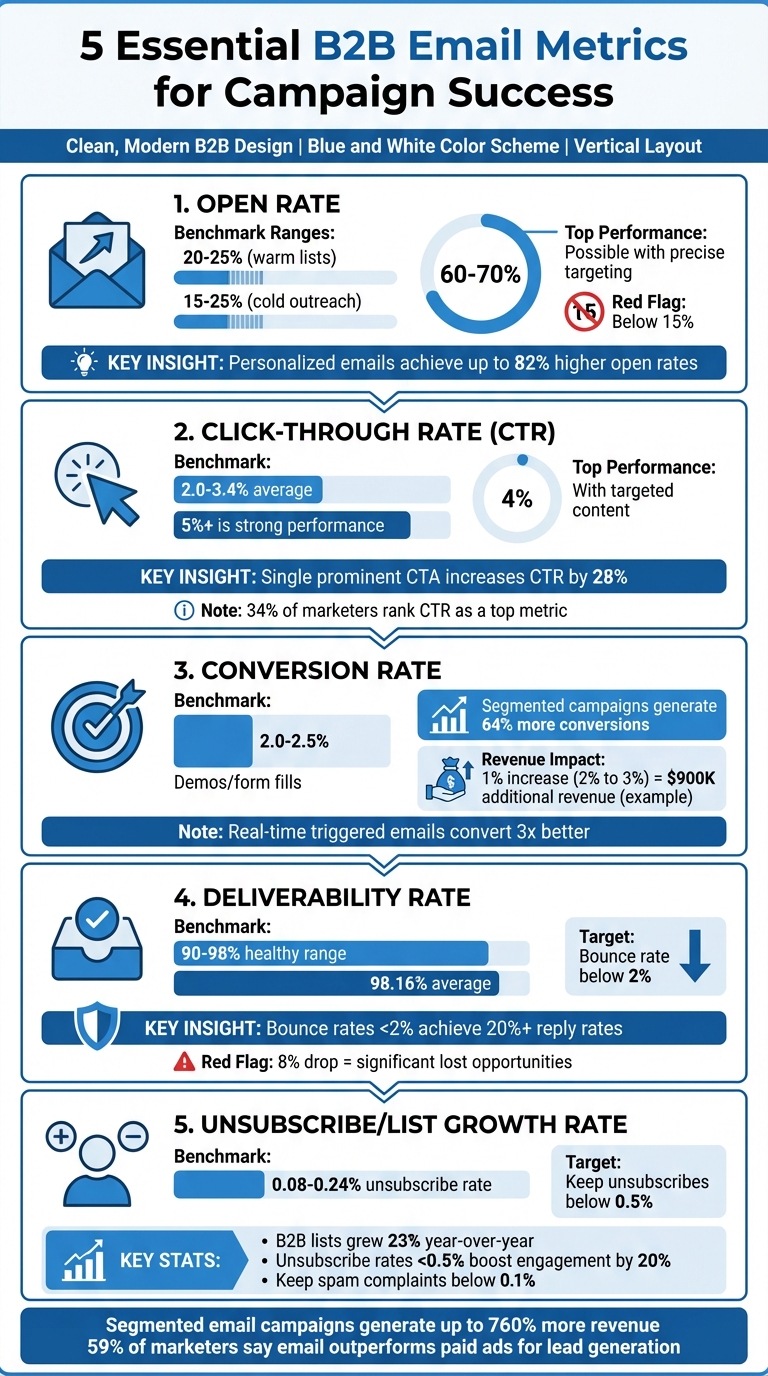
5 Essential B2B Email Metrics: Benchmarks and Performance Standards
1. Open Rate
Why Open Rate Matters in B2B Email Campaigns
The open rate - measuring the percentage of delivered emails that are opened - gives you a glimpse into whether your subject line, sender name, and timing can stand out in a packed B2B inbox. In the B2B world, grabbing that initial attention is crucial for driving engagement and, ultimately, conversions. While tools like Apple’s Mail Privacy Protection have made tracking less precise, open rate remains a useful metric for A/B testing. For example, comparing two subject lines or different send times can reveal what resonates better with your audience, helping you refine your strategy for stronger engagement.
What Open Rate Tells You
If your open rate dips below 15%, it’s a red flag. This could point to issues like outdated contact lists, unappealing subject lines, or emails getting caught in spam filters. Fixing these problems often starts with A/B testing and segmenting your audience.
For example, Breaker reports an impressive 60–70% open rate across active campaigns, showing what’s possible with precise targeting and strong email deliverability. On the other hand, typical B2B open rates hover around 20–25% for warm lists and 15–25% for cold outreach. These benchmarks provide a starting point for identifying areas where you can improve.
How to Optimize Your Open Rate
For warm B2B lists, aim to exceed the 20–25% range, while cold campaigns usually fall between 15–25%. However, with a highly targeted list, you could see open rates soar to 50% or higher.
To boost your results, try these strategies:
- A/B Test Subject Lines: Experiment with different tones, lengths, or offers to see what gets more clicks.
- Segment Your Audience: Tailor your emails to specific groups for more relevance.
- Personalize Your Emails: Adding details like company names or job-specific insights can make a big difference - personalized emails can achieve up to 82% higher open rates.
- Time Your Sends: Target peak U.S. work hours for better visibility.
Tools like Breaker simplify this process by offering real-time analytics and automated targeting, ensuring your emails land in the inboxes of engaged recipients.
2. Click-Through Rate (CTR)
Why CTR Matters in B2B Email Campaigns
While the open rate shows whether your subject line grabbed attention, the click-through rate (CTR) tells you if your email content hit the mark. In B2B marketing, CTR measures the percentage of delivered emails that lead recipients to click on a link. With privacy features making open rates less dependable, CTR has become a key indicator of how well your content connects with your audience and how effective your calls-to-action (CTAs) are.
For B2B teams, CTR is especially useful because most emails are designed to drive specific actions - like signing up for a webinar, downloading a resource, requesting a demo, or visiting a website. In fact, 34% of marketers now rank CTR as one of their top metrics, right alongside open rate. This makes CTR a crucial follow-up metric to measure after open rates.
What CTR Can Teach You
CTR offers a clear window into what’s working in your emails - and what isn’t. For example, if your open rate is strong but clicks are low, it’s a sign that your subject line and targeting are effective, but your email body, offer, or CTA might not be hitting the right notes. On the other hand, if a specific link gets most of the clicks, it shows what your audience values most, giving you a roadmap for future content and messaging.
Segmenting CTR based on factors like job titles, industries, or account tiers can reveal which groups are most engaged with your messaging. This allows for more precise targeting and personalization. Testing different CTAs - such as "Schedule a 15-minute consultation" versus "Download the guide" - can also show which approach resonates better with your audience. Platforms like Breaker provide detailed analytics that help you identify these trends quickly, allowing you to refine your strategy without wasting time on lengthy testing cycles.
Connecting CTR to Pipeline and Revenue
CTR isn’t just about clicks - it’s about what those clicks lead to. It’s the bridge between email engagement and actual revenue. For example, clicks on bottom-of-funnel CTAs like "Request a demo" often result in more form submissions, meetings, and Marketing Qualified Leads (MQLs). By tracking how many clicks convert into opportunities, you can calculate the revenue impact of each click.
Let’s break it down: If 100 demo clicks lead to 10 meetings, 4 opportunities, and 1 closed deal worth $20,000, that’s an average of $200 per click. This kind of insight helps you focus on email campaigns and audience segments that not only drive engagement but also deliver tangible business results.
Benchmarks and How to Improve CTR
In recent B2B email benchmarks, average CTRs range from 2.0% to 3.4%, with anything above 5% signaling strong list quality and highly relevant offers. If your CTR is under 2%, it could point to issues like weak value propositions, generic content, or lackluster CTAs - even if your open rates look good. Breaker reports an average CTR of 4% across active campaigns, showing what’s possible with well-targeted and engaging content.
To boost your CTR, align your email copy and CTA with the promise of your subject line. Stick to a single, prominent CTA - this alone can increase CTR by up to 28%. Tailor your messaging to specific roles or industries to address their unique challenges. Segmentation often leads to higher CTR compared to generic campaigns, and optimizing for mobile can drive a 14% increase in clicks. Finally, run A/B tests on CTA wording, button placement, and content formats, using CTR as your primary success metric. With tools like Breaker, analyzing and acting on these tests becomes much easier and faster.
3. Conversion Rate
Relevance to B2B Email Performance
When it comes to driving revenue, the conversion rate is a key metric that goes beyond just tracking opens and clicks. It measures whether recipients are taking the desired actions, like booking a demo or starting a trial, which are crucial for B2B sales. In this context, a conversion typically involves actions such as registering for a webinar, downloading a whitepaper, requesting pricing, or initiating a trial. To calculate it, you can use two approaches: divide the number of conversions by the total emails sent (to evaluate campaign effectiveness) or divide conversions by clicks (to focus on landing-page performance). Unlike metrics like opens or clicks, the conversion rate reveals how well your targeting, messaging, and offers are turning prospects into marketing-qualified leads and pipeline opportunities.
Actionable Insights Provided by the Metric
Breaking down conversion rates by different segments can uncover which audiences are most responsive to specific offers. For instance, segmenting by industry, company size, or job title helps identify which ideal customer profile (ICP) groups are delivering the best results, allowing you to fine-tune your targeting. Similarly, comparing conversion rates across different offers - like webinars, demos, or content downloads - can reveal which calls-to-action are most effective at advancing prospects through the sales funnel. Analyzing conversion rates at various funnel stages, such as early lead capture versus late-stage demos, can also highlight whether your strategy needs more focus on generating leads or accelerating deals. These insights directly impact revenue by spotlighting the most effective audience segments and offer types.
Impact on Pipeline and Revenue
The conversion rate acts as a bridge between email engagement and revenue outcomes. Each conversion represents a step closer to a marketing-qualified lead, an opportunity, or even a closed deal. For example, imagine a U.S.-based B2B SaaS company sends an email campaign to 50,000 targeted contacts promoting a product demo. With a 2% conversion rate, 1,000 recipients book demos. If 30% of those demos turn into opportunities and 20% of those opportunities close at an average deal size of $30,000, the campaign generates 60 deals and $1.8 million in revenue. Now, improving the conversion rate to 3% increases demos to 1,500, resulting in 90 deals and $2.7 million - an additional $900,000 in revenue from just a one-point increase.
Benchmarks and Optimization Potential
For B2B email campaigns, conversion rates for actions like demo bookings or form fills typically range from 2.0% to 2.5%, with warmer lists and lower-friction offers, such as webinar registrations, often performing better. However, instead of relying solely on global averages, marketers should compare their results to historical data and similar campaigns. To improve conversion rates, focus on targeting only ICP-aligned contacts, craft email copy and design around a single, benefit-driven call-to-action, and ensure seamless alignment between the email and the landing page. Additional strategies include simplifying forms by reducing required fields, personalizing content by industry or role, and A/B testing CTA wording and placement. Segmented campaigns, for instance, generate 64% more conversions, while real-time triggered emails convert three times better than standard campaigns. Tools like Breaker, with its real-time analytics and precise targeting, empower marketers to systematically test and scale campaigns, starting with the most engaged and relevant subscribers.
4. Deliverability Rate
Why It Matters for B2B Email Performance
Deliverability rate is the percentage of emails that successfully land in recipients' inboxes. It’s calculated using the formula: (Emails Delivered ÷ Emails Sent) × 100. This metric is crucial because no other performance indicators - like opens, clicks, or conversions - matter if your email doesn’t make it to the inbox. In B2B email campaigns, where you’re often targeting specific decision-makers over extended sales cycles, even small deliverability issues can significantly reduce your pipeline opportunities. Common causes of poor deliverability include outdated contact lists, email authentication problems, or Internet Service Provider (ISP) blocks. Understanding this metric helps pinpoint areas for improvement and ensures your emails reach the right audience.
What This Metric Tells You
Tracking deliverability can uncover key problems. For example, a rising bounce rate might indicate invalid email addresses, which often result from list decay due to job changes or domain updates. Similarly, issues like missing email authentication protocols (SPF, DKIM, or DMARC) or spam-triggering content can also negatively impact deliverability. By monitoring these data points, you can identify whether your lists need cleaning or if technical fixes are required.
How It Affects Your Pipeline and Revenue
Poor deliverability has a direct impact on your ability to generate leads. If your deliverability rate drops from 98% to 90%, that 8% difference represents missed opportunities before your message even reaches the recipient. In high-stakes B2B environments, where deals can be worth tens of thousands of dollars, these losses quickly add up. Research from QuickMail, which analyzed millions of emails, shows that campaigns with bounce rates below 2% tend to achieve reply rates of over 20%. This illustrates how maintaining strong deliverability directly supports your pipeline and revenue goals.
Benchmarks and How to Improve
The average deliverability rate for B2B campaigns is about 98.16%, with healthy campaigns typically falling between 90% and 98%. Ideally, bounce rates should remain below 2% for opted-in campaigns. To improve deliverability, focus on these key strategies:
- Regularly remove hard bounces and inactive contacts.
- Ensure proper email authentication with SPF, DKIM, and DMARC.
- Avoid using purchased lists, as they often lead to higher bounce rates.
- Segment your lists by engagement and target only those who fit your ideal customer profile.
ISPs often evaluate engagement signals to decide whether an email should land in the inbox or the spam folder. Tools like Breaker can help by automating list hygiene, validating email addresses, and managing sending practices to maximize inbox placement. A strong deliverability rate lays the groundwork for the success of all other email metrics, ensuring your campaigns reach their full potential.
5. Unsubscribe Rate and List Growth Rate
Relevance to B2B Email Performance
The unsubscribe rate - the percentage of recipients who opt out of your emails - can be a clear indicator that your messaging isn’t hitting the mark. Meanwhile, the list growth rate measures how quickly your email database is expanding, factoring in new sign-ups, unsubscribes, and bounces. Unlike metrics like open or click-through rates that focus on individual campaigns, these two metrics provide a broader view of how well your overall strategy is connecting with B2B buyers. In industries with long decision cycles and multiple stakeholders involved, keeping a growing, engaged email list is critical for sustaining a strong sales pipeline. These metrics not only measure current engagement but also help predict the long-term health of your pipeline.
Actionable Insights Provided by the Metric
If your unsubscribe rate is climbing, it’s often a red flag that your content isn’t meeting subscriber expectations. This could happen for several reasons: sending irrelevant content, being overly promotional, or overwhelming your audience with too many emails. In a B2B setting, high unsubscribe rates might also suggest that your targeting is off or that your audience segmentation is too broad. For example, if your emails are reaching the wrong personas, you’re likely wasting opportunities to connect with key decision-makers.
On the flip side, healthy list growth paired with a low unsubscribe rate is a sign that your lead-generation efforts - like improved forms and better capture mechanisms - are working. Recent data shows that B2B email lists grew by 23% year-over-year, thanks to these kinds of refinements in acquisition strategies. This combination of growth and retention indicates that your onboarding and targeting are effectively attracting and engaging the right audience.
Impact on Pipeline and Revenue
A shrinking or stagnant email list can directly limit your ability to generate marketing-qualified leads (MQLs), which are essential for fueling the top of your sales funnel. If your best-fit prospects are unsubscribing at high rates, you miss out on crucial nurturing opportunities during the extended B2B buying process. This results in fewer touchpoints, weaker pipeline influence, and ultimately, lost revenue. Research shows that keeping unsubscribe rates below 0.5% can boost engagement by up to 20%, which strengthens conversion pathways and speeds up deal cycles.
It’s not just about growing your list - it’s about growing it with the right people. For example, Breaker uses precision targeting and AI tools to attract high-quality leads that align with their ideal customer profile (ICP), ensuring their subscribers are both engaged and primed to convert. These insights can help set clear benchmarks and refine your acquisition strategy for better results.
Benchmarks and Optimization Potential
For B2B campaigns, average unsubscribe rates typically fall between 0.08% and 0.24% per send, depending on the industry and type of campaign. If your rates consistently exceed 0.5%, it’s time to dig into potential issues like content relevance, email frequency, or audience targeting. Additionally, keeping spam complaint rates below 0.1% is crucial for maintaining good deliverability.
To optimize engagement and list growth, consider these strategies:
- Segment your audience by role, industry, or stage in the sales funnel.
- Offer a preference center so subscribers can control how often they hear from you.
- Regularly clean your list by removing inactive contacts and hard bounces.
- Focus on acquiring high-intent leads through channels like demo requests, webinar sign-ups, and gated content downloads.
B2B Email Marketing Benchmarks and How to Use Them–Chad S. White
How to Use These Metrics Together
Think of email metrics as a funnel - starting with deliverability, moving through open rates, CTR, and conversion rates, and finally ending with unsubscribe rates and list growth. Each metric highlights a specific stage of your campaign’s performance, helping you pinpoint where things might be going off track.
Here’s how these metrics work together: Patterns across them reveal where your funnel might be breaking down. For example, high open rates paired with low CTR could mean your subject lines are doing their job, but the email content or call-to-action (CTA) isn’t compelling enough. On the other hand, strong CTR but poor conversions might point to a disconnect between your email's promises and the landing page experience - maybe the form is too complicated, or the offer isn’t clear. If all metrics look solid but unsubscribe rates are climbing and list growth is stagnant, you might be dealing with a sustainability issue. This could stem from over-emailing, targeting the wrong audience, or casting too wide a net.
To get the full picture, it’s essential to track trends over time - both at the campaign level and across audience segments. Monitor all five key metrics (deliverability, open rate, CTR, conversions, and list growth) alongside deeper KPIs like marketing-qualified leads (MQLs), opportunities created, and revenue per email. Analyze performance by segment (such as industry, job title, or account tier) and connect email behavior to broader business outcomes. Use metrics like rolling 30- or 90-day averages to spot patterns and fine-tune your strategy.
Breaker makes this process easier by offering precise audience targeting, automated lead generation, and real-time analytics. Its dashboard gives you instant insights into key metrics - like deliverability, open rates, and CTR - while tying them back to specific audience segments and acquisition sources.
To stay on track with your revenue goals, establish a regular review process. Check campaigns weekly for drops in deliverability or CTR, test improvements with A/B testing, and conduct monthly performance reviews to refine your segmentation and content strategies. This rhythm will help you decide which audience segments to scale, which acquisition sources to prioritize or eliminate, and what content themes to focus on for the next quarter.
Conclusion
Each of the five metrics - open rate, click-through rate, conversion rate, deliverability rate, and unsubscribe/list growth rate - offers a unique lens into your B2B email campaign's performance. Together, they cover everything from how compelling your subject lines are to how well your emails convert leads, ensuring every aspect of your strategy is accounted for. These metrics don't just provide insight; they directly influence your ability to build a strong pipeline, attract high-quality leads, and ultimately drive revenue.
Consider this: segmented email campaigns can generate up to 760% more revenue, and 59% of marketers believe email outperforms paid ads for lead generation. By aligning your campaigns with proven benchmarks, you set the foundation for scalable growth. These metrics are more than just numbers - they're tools for refining your strategy and improving results.
But tracking metrics isn’t enough. You need to act on what the data tells you. That’s where Breaker steps in. With features like automated lead generation, real-time analytics, and precise audience targeting, Breaker provides everything you need to optimize your campaigns. Its intuitive dashboard highlights exactly where you’re excelling or falling short, whether it’s crafting better subject lines, improving CTAs, or keeping your email list healthy.
Breaker also ensures you’re building a quality subscriber base from the start. With unlimited validations, strong deliverability, and precise targeting, you’re equipped to hit top-tier benchmarks: open rates over 60%, click-through rates above 40%, and conversions that lead to booked calls and closed deals.
Think of these metrics as more than just indicators - they’re the foundation of a dynamic, ever-improving strategy. With consistent monitoring, A/B testing, and the right tools, you can turn your email campaigns into a reliable revenue engine, ensuring every email you send contributes directly to your business goals.
FAQs
What are the best ways to boost open rates for B2B email campaigns?
To improve open rates for your B2B email campaigns, focus on crafting clear, attention-grabbing subject lines that spark curiosity or interest. Make your emails feel personal by tailoring them to each recipient, and use audience segmentation to send content that resonates with specific groups. Timing is another key factor - study your audience's habits to determine when they’re most likely to check their inbox.
Using real-time analytics can give you valuable insights into what’s working and what’s not. By monitoring performance, you can tweak your approach - whether it’s testing new subject lines or adjusting send times - to steadily boost engagement. Small changes can lead to noticeable improvements.
How can I boost the conversion rate of my B2B email campaigns?
To boost the success of your B2B email campaigns, focus on creating attention-grabbing subject lines that entice recipients to open your emails. Ensure your content feels personalized and relevant, speaking directly to the needs and interests of your audience. Don’t forget to include clear and actionable calls-to-action that make it easy for readers to take the next step.
Take the time to segment your audience, so you can tailor your messaging to specific groups for greater impact. Keep an eye on performance metrics to uncover patterns and adjust your strategy as needed. Experimenting with different approaches - like A/B testing subject lines or tweaking email layouts - can reveal what resonates most with your audience.
Why is email deliverability important for B2B marketing campaigns?
Email deliverability plays a key role in the success of your campaigns. It’s all about ensuring your messages make it to your audience’s inboxes instead of getting trapped in spam filters. The better your deliverability, the higher the chances your emails will be seen and acted upon.
Consistently reaching your audience not only improves open rates but also drives engagement and boosts your return on investment (ROI). In short, deliverability is the backbone of any strong email marketing strategy, turning your efforts into tangible outcomes.
Related Blog Posts
Keep reading
All articlesPost-Webinar Survey Questions Template (2026)
30+ post-webinar survey questions with NPS, CSAT, and CES templates, plus timing and length tips to boost completion and qualify leads faster.
GDPR Consent Requirements for Purchased Email Lists
Purchased email lists rarely meet GDPR's consent bar. Learn the legal basis rules, PECR overlap, and safer alternatives before you hit send.
7 Email Platforms With Inbox Placement Testing & Suppression
Compare 7 email platforms that combine inbox placement testing with suppression management, scored on features, pricing, and best-fit sender size.