
Email Campaign Benchmarks for B2B Marketers
B2B email benchmarks, open/click targets, and proven tactics - segmentation, personalization, automation, and AI - to raise engagement and ROI.
Looking to improve your email marketing results? Here’s what you need to know:
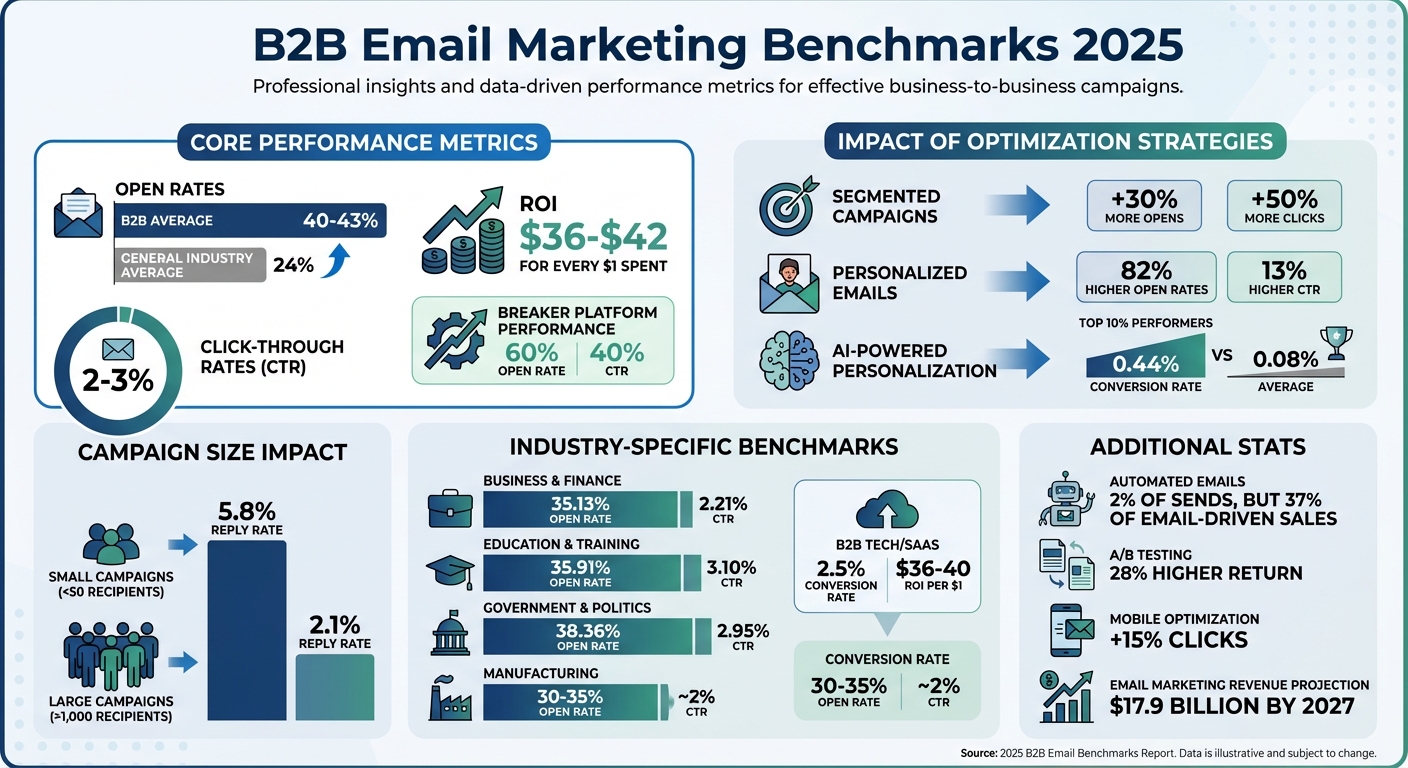
- Open rates for B2B emails in 2025 average between 40–43%, higher than the general industry average of 24%.
- Click-through rates (CTR) typically range from 2–3%, emphasizing the importance of relevant content.
- Email marketing remains a powerhouse, delivering an ROI of $36–$42 for every $1 spent.
- Segmented campaigns generate 30% more opens and 50% more clicks, while personalized emails achieve 82% higher open rates.
To stay competitive, focus on strategies like segmentation, personalization, and automation. Tools like Breaker can help you track performance in real-time, refine targeting, and boost deliverability for stronger results.
Whether you're aiming to increase engagement or maximize ROI, leveraging these benchmarks and strategies can make a measurable difference.
B2B Email Marketing Benchmarks 2025: Key Performance Metrics
Core B2B Email Marketing Benchmarks for 2025
Performance Metrics Overview
According to recent data from Breaker, targeted B2B email campaigns can achieve impressive results, with an average open rate of 74% and a click-through rate of 4%. These figures highlight just how important it is to focus on reaching the right audience.
When emails are sent to poorly matched leads, engagement drops, and sender reputation can take a hit. This, in turn, can reduce the chances of your emails landing in inboxes in the future. While specific benchmarks for bounce and unsubscribe rates aren't available, keeping a close eye on these metrics is critical for maintaining a clean and effective email list.
These performance indicators are the baseline for improving B2B email strategies, as we'll explore further. The table below summarizes these benchmarks for easy reference.
Metrics Comparison Table
Here’s a quick look at the available data from Breaker:
Metric
Performance
Average Open Rate
74%
Average Click-Through Rate
4%
Bounce Rate
Not available
Unsubscribe Rate
Not available
Email Performance Differences by Industry and Segment
Benchmarks by Industry
Email performance in the B2B space varies widely depending on the industry. For instance, business and finance campaigns tend to achieve open rates of about 35.13% and click-through rates of 2.21%. This reflects the more research-driven nature of these audiences, who often take a measured approach to engagement. On the other hand, education and training campaigns see slightly better results, with open rates around 35.91% and click-through rates at 3.10%. Meanwhile, government and politics campaigns lead the pack with open rates of 38.36% and click-through rates of 2.95%, likely due to the appeal of mission-focused, informational content.
When it comes to B2B tech and SaaS campaigns, conversion rates hover around 2.5%, while ROI benchmarks range between $36 and $40 for every $1 spent. These audiences are particularly responsive to content like product updates, integration news, and feature highlights, which often drive click-through rates above 3%.
In contrast, the manufacturing and industrial sectors report open rates between 30% and 35% and click-through rates near 2%. While these numbers may seem modest, targeted campaigns that deliver highly technical content to procurement, engineering, or operations decision-makers can still generate impressive ROI.
Regional and Demographic Differences
Geography and audience demographics add another layer of complexity to email performance.
In North America, including the United States, open rates generally align with or slightly exceed global averages. However, click-through rates may be tempered by features like streamlined unsubscribe processes in major email clients. U.S. marketers, in particular, contend with higher unsubscribe rates due to stricter inbox standards and more accessible unsubscribe options.
Audience demographics are equally influential. Senior executives - such as C-suite leaders and VPs - receive a high volume of emails but engage less frequently. However, when they do engage, the potential deal value is often much greater. On the flip side, mid-level managers and practitioners tend to respond more actively to educational content, like how-to guides or actionable templates, resulting in higher open and click rates.
Company size also plays a critical role. For example, SMBs often show higher engagement rates due to shorter sales cycles and smaller average contract values. In contrast, enterprise audiences may have lower engagement metrics overall but involve more stakeholders in each deal, leading to significantly higher annual contract values. Even a modest click-through rate in an enterprise campaign can translate into substantial revenue per 1,000 emails sent.
Understanding these nuances allows marketers to craft strategies that go beyond industry averages and achieve stronger results.
Proven Methods to Beat Benchmark Performance
Segmentation and Personalization
When it comes to outperforming benchmarks, advanced segmentation and personalization are game-changers for campaign success. By zeroing in on specific audience groups, you can significantly improve engagement - targeted emails consistently outperform bulk sends in both open and click rates.
Start by using firmographic data like company size, industry, revenue, and job roles to define your audience. For instance, campaigns targeting fewer than 50 recipients see an impressive 5.8% reply rate, compared to just 2.1% for campaigns sent to over 1,000 recipients. The takeaway? Quality over quantity. Focus on smaller, well-defined segments, such as mid-market IT managers, enterprise procurement teams, or SMB marketing directors. Each group has unique pain points and triggers, and addressing these directly not only drives engagement but also improves the overall health of your email list.
Personalization goes far beyond adding a recipient’s first name. True personalization taps into contextual details, such as industry-specific challenges, past interactions, or product preferences. Emails tailored in this way achieve 82% higher open rates than generic bulk messages. When you align your message with your audience’s real needs and stage in the buyer journey, engagement becomes almost effortless. Incorporating dynamic content - like behavior-based recommendations - can even double your ROI.
Automation and Optimization
Refining your targeting is just the first step. Automation ensures your messages are delivered at the perfect moment, based on real-time behavior. Trigger-based emails, such as those sent after a prospect visits a pricing page or downloads a whitepaper, perform 8x better in open and click rates than traditional batch campaigns.
Design workflows around critical points in the customer journey. For example, create automated welcome emails for new subscribers, follow-ups for leads engaging with key content, or nurture sequences tailored to specific actions. Though automated emails make up only 2% of total sends, they account for a whopping 37% of email-driven sales. Their relevance and timing make them incredibly effective.
The best-performing B2B campaigns - those in the top 10% - achieve conversion rates that are five times higher than average: 0.44% compared to 0.08%. To reach this level, systematic testing is essential. A/B test one variable at a time - whether it’s subject lines, send times, CTAs, or email length. Testing pays off, with companies seeing a 28% higher return when they conduct A/B split tests and spam checks before sending. Additionally, optimizing for mobile devices can increase clicks by 15%. Combining automation with smart segmentation gives your campaigns the edge needed to exceed standard benchmarks.
B2B Email Marketing Benchmarks and How to Use Them–Chad S. White
New Trends in B2B Email Marketing for 2025
B2B email marketing continues to evolve, blending tried-and-true strategies with new approaches to deliver better results.
AI-Powered Personalization
Artificial intelligence is no longer just a buzzword in B2B email marketing - it's now a core tool. A whopping 95% of marketers believe generative AI improves email content creation. But AI's impact goes far beyond adding a recipient's name to an email. It fine-tunes subject lines, customizes messages based on behavioral and firmographic data, and ensures relevance on a whole new level. For instance, emails personalized with AI see a 13% higher click-through rate compared to traditional methods. Segmentation powered by AI is another game-changer, driving 30% more opens and 50% more clicks than generic campaigns. By leveraging AI, marketers can now deliver hyper-relevant content at scale, paving the way for even smarter strategies like optimizing send times.
Best Send Times and Days
When it comes to email performance, timing is everything. Research shows that Tuesday and Wednesday are the sweet spots for B2B campaigns, as these midweek days align with peak inbox activity among decision-makers. However, frequency is just as important as timing. Overloading subscribers with too many emails can backfire - 44% of consumers say they’ll unsubscribe if they feel overwhelmed. Keeping emails well-timed and spaced out is key to maintaining engagement without fatigue.
Budget Growth and Resource Planning
Email marketing budgets are on the rise, with 38% of marketers planning to allocate more funds in the coming year. And for good reason - email remains a powerhouse channel, delivering an average ROI of $36 for every $1 spent. As third-party tracking becomes less reliable, companies are doubling down on owned channels like email. This shift has sparked investment in specialized teams, advanced AI tools, and stronger data systems to support scalable campaigns. The numbers back up this confidence: email marketing revenue is expected to reach $17.9 billion by 2027, growing at a 13.3% annual rate since 2020. With bigger budgets, B2B marketers can focus on more sophisticated automation, deeper personalization, and rigorous testing to consistently exceed performance benchmarks.
How Breaker Helps Marketers Meet and Beat Benchmarks
Real-Time Performance Tracking
Breaker’s analytics dashboard offers real-time updates on key metrics like opens, clicks, replies, conversions, unsubscribes, and bounces. This means you can assess performance almost immediately after sending an email. For example, if a U.S. marketer notices open rates dropping below 20% within 30 minutes, they can quickly tweak subject lines or resend emails to non-openers. The platform also dives deep into segment-level insights. It might show that software directors have a 30% open rate, while manufacturing VPs are at 12%, allowing you to adjust your targeting and messaging mid-campaign instead of waiting for a final report. Automated alerts are another handy feature - if bounce rates exceed ~2% or unsubscribe rates climb past ~0.2–0.3%, you’ll be notified, giving you the chance to fix list quality or relevance issues before they hurt your overall performance. These tools make it easier to fine-tune your campaigns on the fly.
Precision Targeting and Deliverability
Breaker combines advanced algorithms with AI enrichment to create highly specific subscriber lists. By segmenting audiences based on firmographics (like industry or company size), roles, seniority, tech stack, and behaviors (such as previous opens or clicks), you can deliver content that resonates - think tailored case studies or specific calls to action. The results speak for themselves: Breaker reports an average open rate of 60% and a click-through rate of 40% for active campaigns, far surpassing the typical B2B benchmarks of around 35–40% for opens and 2% for clicks. On top of that, Breaker ensures your emails reach the inbox by automatically filtering out invalid or bouncing addresses, supporting domain authentication (SPF, DKIM, DMARC), and monitoring spam complaints. This focus on deliverability helps maintain a strong sender reputation, setting the foundation for successful campaigns.
Scalable Campaigns with Breaker’s Custom Plan
Breaker’s Custom Plan, priced at $1,750 per month, supports up to 250,000 email sends and 1,000 new engaged subscribers each month. This makes it easier for B2B teams to scale campaigns without worrying about per-send fees. The plan includes tools for running multi-touch sequences, segmenting newsletters, and managing automated lifecycle flows, all while avoiding volume limits. To keep campaigns performing well as they grow, Breaker offers features like send throttling, frequency caps per contact, and built-in recommendations. For instance, the system might alert you if a segment is receiving too many emails in a short period, helping you stay within acceptable unsubscribe and complaint rates. With unlimited email validations and users included in every plan, Breaker ensures teams can manage resources efficiently while collaborating seamlessly.
Conclusion
B2B email benchmarks provide valuable insights into campaign performance. According to 2025 data, average B2B email open rates range between 40–43%, which is notably higher than the cross-industry average of about 24%. Click-through rates typically fall between 2–3%, highlighting the importance of delivering targeted and relevant messages to drive engagement. Healthy email lists are reflected in unsubscribe rates staying below 0.2–0.3% and bounce rates under 2%. Additionally, email marketing continues to deliver strong returns, with an ROI of $36–$42 for every $1 spent, proving that even small improvements can lead to measurable revenue growth.
However, performance can differ significantly depending on the industry and audience segment, making it less helpful to rely solely on broad averages. Instead, focusing on strategies like segmentation, personalization, and automation can lead to better outcomes. For example, segmented campaigns generate 30% more opens and 50% more clicks, while personalized emails see 82% higher open rates. Tools driven by AI and send-time optimization further enhance performance by ensuring recipients get the right content at the right time.
These benchmarks underline the importance of advanced tools in achieving better results. Breaker is a platform designed to help B2B marketers surpass these averages. By offering precision audience targeting to reach ideal subscribers, real-time analytics for mid-campaign adjustments, and reliable deliverability to ensure emails hit the inbox, Breaker addresses the key factors that separate average campaigns from exceptional ones. On average, Breaker users report 60% open rates and 40% click-through rates, showcasing the potential of aligning targeting, messaging, and infrastructure.
Whether your goal is to improve open rates from the low 30s or push click-through rates past 4%, success hinges on maintaining clean email lists, implementing effective segmentation, running continuous tests, and using the right tools. Breaker’s Custom Plan, priced at $1,750 per month, supports 250,000 sends and 1,000 new engaged subscribers, offering the scalability B2B marketing teams need. By combining proven strategies with Breaker’s capabilities, you can turn benchmark data into actionable growth.
FAQs
How do segmentation and personalization improve the success of B2B email campaigns?
Segmentation and personalization are key to boosting the effectiveness of B2B email campaigns. By breaking your audience into smaller, well-defined groups and crafting messages that address their specific needs, you can deliver content that feels relevant and engaging.
This strategy leads to higher open rates, improved click-through rates, and stronger overall engagement. Plus, it helps build deeper customer relationships and ensures your emails reach the right people at the right time - ultimately driving a better return on investment.
How does AI improve B2B email marketing strategies?
AI is reshaping B2B email marketing by making audience targeting more precise, streamlining lead generation, and providing instant performance feedback. These tools allow marketers to fine-tune their campaigns and improve engagement without heavy lifting.
By processing large datasets, AI ensures emails land in the inboxes of the right people at just the right moment, boosting open rates and driving conversions. It also enhances messaging and design, helping create campaigns that are both impactful and efficient.
Why does timing matter for B2B email campaigns, and which days are best for sending them?
Timing is everything when it comes to successful B2B email campaigns. The right timing can make all the difference in whether your email gets opened, clicked, or ignored entirely. Catching your audience at the right moment ensures your message gets the attention it deserves.
Studies suggest that the best days to send B2B emails are Tuesday, Wednesday, and Thursday. These midweek days tend to align with when professionals are most focused and actively engaged with their work. On the other hand, Mondays are usually a no-go since inboxes are flooded after the weekend, and Fridays are tricky because people’s minds are already drifting toward their weekend plans.
Related Blog Posts
Keep reading
All articlesGDPR Consent Requirements for Purchased Email Lists
Purchased email lists rarely meet GDPR's consent bar. Learn the legal basis rules, PECR overlap, and safer alternatives before you hit send.
7 Email Platforms With Inbox Placement Testing & Suppression
Compare 7 email platforms that combine inbox placement testing with suppression management, scored on features, pricing, and best-fit sender size.
Email Automation Workflow & Drip Campaign Data Structure
Learn the database schema behind email drip campaigns—tables, workflow states, and event logs that power reliable marketing automation.