
B2B Subject Line Trends: Insights from 2025 Data
Short, personalized subject lines plus AI-powered testing are the fastest way to boost B2B open and reply rates in 2025.
Email subject lines matter more than ever in 2025. Why? Because they directly impact open rates, reply rates, and even whether your email lands in the inbox or spam. Here’s what the data says:
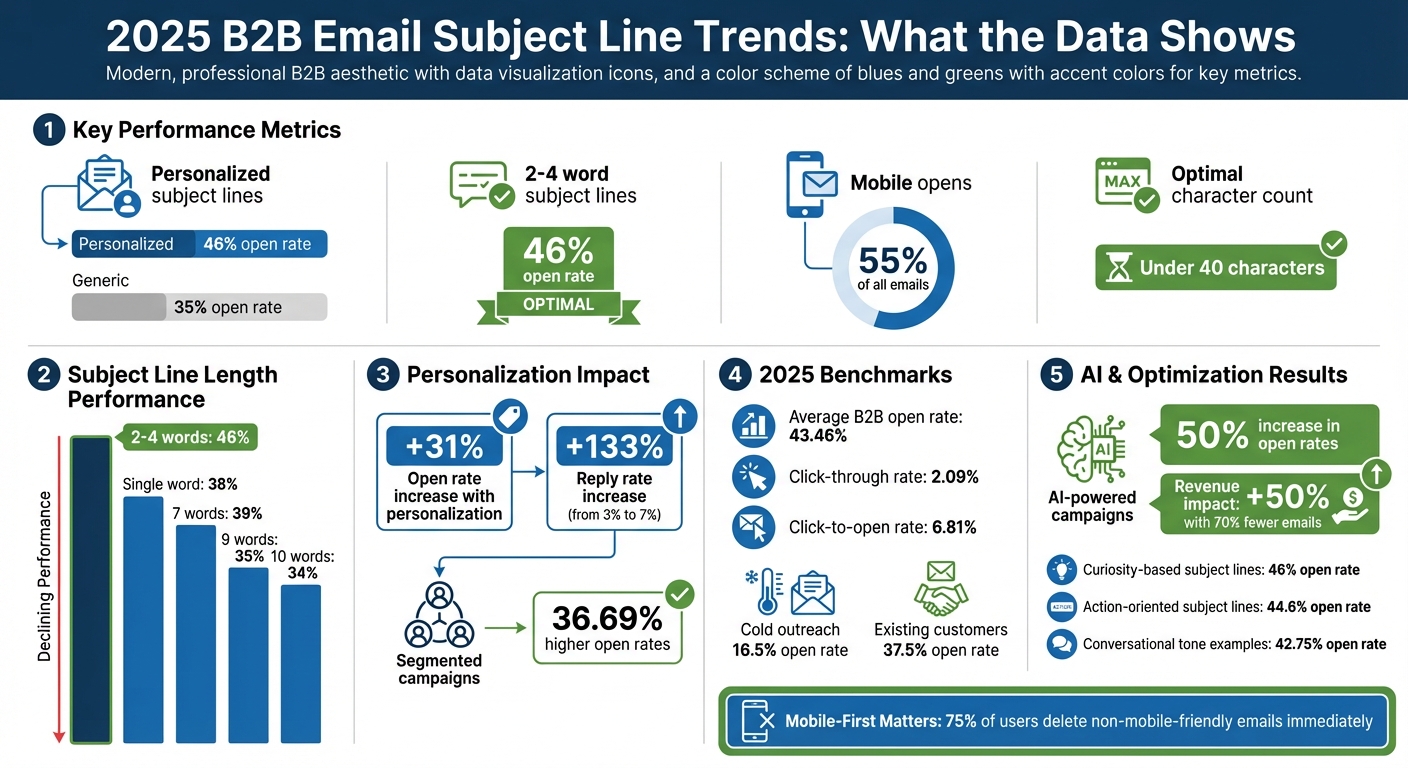
- Personalization works: Subject lines with a recipient’s name or tailored content saw a 46% open rate, compared to 35% for generic ones.
- Shorter is better: Subject lines with 2–4 words performed best, achieving a 46% open rate. Longer ones saw engagement drop significantly.
- Mobile-first matters: With over 55% of emails opened on mobile, subject lines under 40 characters are crucial.
- Segmentation boosts results: Emails sent to targeted lists saw a 36.69% higher open rate than broad campaigns.
- AI tools are game-changers: Predictive testing and multivariate analysis helped increase open rates by 50% in some campaigns.
Want better results? Keep subject lines concise, personalize them, and test with AI tools. These strategies helped brands increase engagement while reducing email volume by up to 70% - and still grow revenue by 50%.
2025 B2B Email Subject Line Performance Statistics and Best Practices
2025 B2B Email Campaign Data and Metrics
Open Rate and Click-Through Rate Benchmarks
In 2025, the average B2B email open rate climbed to 43.46%, a slight increase from 42.35% in 2024. However, this figure is influenced by Apple's Mail Privacy Protection (MPP), which preloads email content for about 46% of email clients. As a result, nearly half of these "opens" may not represent genuine user engagement.
The click-through rate (CTR) for B2B emails in 2025 reached 2.09%, edging up from 2% in 2024. Meanwhile, the click-to-open rate (CTOR) rose to 6.81%, compared to 5.63% the previous year. Breaking it down further, B2B sales emails had an average open rate of 21.3%. Cold outreach emails saw a lower open rate of 16.5%, while emails sent to existing customers performed much better at 37.5%.
Interestingly, unsubscribe rates doubled, jumping from 0.08% in 2024 to 0.22% in 2025. This uptick is partly due to Gmail's one-click unsubscribe feature, which allows users to opt out more easily if the content doesn’t feel immediately relevant.
Now, let’s dive into how subject line length can impact these engagement metrics.
Best Subject Line Length
When it comes to subject lines, shorter is better. Subject lines with 2–4 words achieved the highest open rate at 46%. On the other hand, single-word subject lines fell behind with a 38% open rate due to their lack of context. Engagement steadily drops as subject lines grow longer: 7 words yield a 39% open rate, 9 words drop to 35%, and 10-word subject lines see only 34%.
This trend is largely driven by mobile optimization. Many email clients on mobile devices truncate subject lines after 35–50 characters, making brevity essential. Sophie Kompaniiets, Content Writer and Strategist at Belkins, highlights this point:
"Email subject lines hitting the 2–4 word sweet spot consistently reel in the highest open rates, reaching 46%"
Adding personalization can also make a big difference. Short, customized phrases like "Hi [Name]" can boost open rates by as much as 50%. These findings emphasize the importance of concise, tailored subject lines in achieving better engagement rates.
Industry-Specific Performance Differences
Email performance varies widely across industries. In 2025, Energy Management Systems led the pack with a 46.31% open rate, followed by Investment Firms at 45.47% and Oil and Gas Services at 44.99%. On the other end, SaaS (Software as a Service) emails struggled with an open rate of just 25.71%, and Insurance Companies weren’t far behind at 26.07%.
Industry
2025 Open Rate
Energy Management Systems
46.31%
Investment Firms
45.47%
Oil and Gas Services
44.99%
Wholesale Suppliers
40.67%
SaaS (Software as a Service)
25.71%
Insurance Companies
26.07%
Cybersecurity
27.32%
This table highlights the wide range of open rates across sectors. Industries like SaaS face unique challenges, such as higher spam filter sensitivity and a flood of competing emails. In contrast, traditional industries with longer sales cycles, such as energy and investment, see higher engagement since email remains a key tool for vendor discovery.
For industries with open rates below 30%, success hinges on hyper-personalization and precise targeting. These tactics help cut through the noise and establish stronger connections with the intended audience.
Personalization and Segmentation for Better Engagement
Personalization Methods That Deliver Results
In 2025, personalized subject lines achieved a 46% open rate, compared to just 35% for non-personalized ones. That’s a 31% increase in visibility simply by adding a personal touch.
The most effective strategies make emails feel like a genuine conversation. For example, subject lines like "Hi {{first_name}}" achieved a 45.36% open rate. Adding company-specific context performed even better - formulas such as "How {{company_name}} can {{desired-result}}" reached a 43.49% open rate. Question-based subject lines also stood out. Examples like "{{first_name}}, can I get your feedback here?" hit 43.45%, while "Thoughts, {{first_name}}?" landed at 42.75%.
But personalization doesn’t just increase open rates - it drives action. Reply rates jumped 133%, going from 3% to 7% when subject lines included personal details. Even small tweaks, like using "Name @ Company" instead of a generic business name, can boost open rates by nearly 4%.
For automated emails such as welcome series, product names are especially effective, followed by first names. The trick is to align personalization with context - behavioral triggers require a different approach than cold outreach.
Personalization naturally ties into audience segmentation, which takes targeting to the next level.
How Audience Segmentation Improves Results
Segmentation builds on personalization by ensuring messages reach the right people. In 2025, emails using subscriber filters were 36.69% more likely to be opened than those sent to a broad, unfiltered list. Segmentation typically focuses on four main categories:
- Lifecycle stage (subscriber, lead, customer)
- Behavioral signals (engagement frequency, content interactions)
- Demographic details (industry, company size, job role)
- Intent indicators (pricing page visits, trial sign-ups)
The revenue impact is hard to ignore. Brands that segmented by engagement recency and removed inactive subscribers saw a 50% increase in revenue while sending 70% fewer campaigns. This approach also helps maintain sender reputation, as platforms like Gmail penalize senders who email subscribers inactive for six months.
AI-powered segmentation is becoming the norm. These tools analyze vast amounts of data to predict which emotional triggers - like urgency, curiosity, or social proof - will resonate most with specific groups. For instance, AI can pull data from CRMs to craft subject lines referencing recent support tickets, upcoming renewals, or browsing activity.
To make segmentation effective, you’ll need at least 1,000 contacts to generate statistically reliable AI insights. Clean data is essential too - ensure at least 80% of key CRM fields (like name, lifecycle stage, or industry) are filled before launching personalization campaigns.
Subject Line Strategies That Performed Best in 2025
Curiosity-Based Subject Lines
In 2025, subject lines designed to spark curiosity led the pack, boasting an impressive 46% open rate by tapping into the reader's natural desire to uncover answers. The key? Create a curiosity gap - tease valuable insights without giving away the full story.
"There's a clear shift toward clarity and curiosity over hype. Personalized subject lines that pose a question seem to spark interest and invite interaction, likely because they are authentic and suggest the email contains an answer or insight the reader may find valuable." – Taisia Mendel, Senior Content Strategist, Belkins
Simple yet thought-provoking questions like "Are you the right person to talk with?" or "Is [Challenge] holding your business back?" grab attention and encourage engagement. Adding a touch of social proof can further pique curiosity. For example, referencing a competitor’s success - "[Competitor] saved 20 hours weekly - interested?" - leverages peer relevance to draw in readers.
Next, let’s look at how action-driven language takes subject lines to the next level.
Action Words and Time-Sensitive Language
Actionable subject lines with clear calls-to-action stood out in 2025, achieving a 44.6% open rate. These lines set specific expectations and focus on delivering value. However, urgency-driven phrases like "ASAP", "Now", or "Limited Time Offer" fell flat, with open rates dipping below 36%. This reflects a growing trend - B2B audiences are increasingly wary of false urgency, which often triggers spam filters and inbox fatigue.
When using action words, authenticity is key. A subject line like "Register for Thursday's webinar" feels direct and helpful, while "ACT NOW - Last Chance!" risks being dismissed as spam. Avoid overused terms like "urgent", "free", or "guarantee", which can hurt performance by signaling automated marketing. If urgency is necessary, tie it to a real event or deadline for credibility.
Conversational and Relatable Tone
Subject lines that mimic natural conversation continued to perform strongly in 2025, fostering a sense of genuine connection. These colleague-like lines help emails feel more like personal messages than marketing pitches.
Using casual, low-pressure language proved especially effective. For instance, subject lines like "Thoughts, {{first_name}}?" achieved a 42.75% open rate, and "Quick question" reached 36.45%. Personal sender names also made a difference. An A/B test by MailerLite in 2025 revealed that including a real name - "Kerry @ MailerLite" - resulted in a 3.81% higher open rate and over 1,000 additional opens compared to using just the company name.
"Subject lines... work because they mimic real human conversation. They don't look like marketing automation; they look like a message from a colleague or friend." – Chase McGee, Focus Digital
To apply this strategy, avoid overly formal styles like Title Case. Instead, use sentence case (capitalize only the first word) for a more casual feel. Keep subject lines short - 2 to 4 words often see the best results, with open rates as high as 46%. Lastly, steer clear of buzzwords like "synergy" or "game-changing", which can disrupt the conversational tone and reduce effectiveness.
Mobile Optimization and AI Testing Tools
Mobile-First Subject Line Design
Did you know that over 55% of email opens happen on mobile devices? That means your subject line needs to shine on a small screen. Mobile displays typically cut off subject lines after 35–50 characters, so it’s crucial to get your most important message across within that range. Essentially, the first few words carry the weight of your value proposition.
Here’s another staggering fact: 75% of users will delete an email on the spot if it isn’t mobile-friendly. With mobile users giving you only about 10 seconds to grab their attention, every single character matters.
To maximize visibility on smartphone lock screens, aim for subject lines under 40 characters. Using sentence case (capitalizing just the first word) not only looks more natural but also helps avoid triggering spam filters. And personalization? It’s a game-changer. Adding a personal touch to your subject line can increase open rates by 26% - but make sure the personalized element shows up before the text gets cut off.
By adopting these mobile-first strategies, you’re setting the stage for more advanced techniques like A/B testing and AI-driven optimization.
A/B Testing and AI-Powered Optimization
Once your subject lines are mobile-ready, AI tools can take things to the next level. In 2025, AI has become much more than a content generator - it now offers predictive performance scoring. These tools can evaluate subject lines before you even hit “send,” analyzing historical data, identifying potential spam triggers, and forecasting open rates based on audience behavior. The results? Campaigns powered by AI have seen open rates jump by 50% and click-through rates rise by 41%.
For example, JP Morgan Chase teamed up with Persado to incorporate AI-generated subject lines into their marketing efforts. According to Kristin Lemkau, the company’s Chief Marketing Officer, the results were eye-opening:
"The AI created compelling copy that human marketers didn't think would work. That's the key insight most people miss. AI doesn't just write faster; it tests hypotheses humans wouldn't consider."
A smart approach involves multivariate testing, where AI evaluates multiple combinations of tone, structure, and personalization at once. If your email list has more than 1,000 recipients, you can test 3–5 AI-generated subject line variations on a small segment first. Then, roll out the best-performing version to the rest of your audience. This iterative process, combined with earlier personalization and segmentation efforts, ensures that each campaign not only delivers results but also improves your strategy for the future.
B2B Subject Lines Review: Best to Worst
Conclusion
The data from 2025 paints a clear picture: personalization isn't just a nice-to-have anymore - it’s a must. Personalized subject lines alone can increase open rates by more than 30%. And when those subject lines are kept under 40 characters and framed as questions, the results are even better.
The numbers don’t lie. Segmented campaigns see 28% higher open rates, and removing inactive subscribers can protect your deliverability. A standout example? In May 2025, one brand reduced its email volume by 70% through segmentation. The result? Their revenue shot up 50%, jumping from $10,000 to $18,000.
What’s the takeaway? Prioritize clarity and curiosity over flashy, hype-filled messaging. This approach consistently leads to higher engagement.
Looking ahead to 2026, make these insights work for you by incorporating AI tools and A/B testing into your strategy. Start small: test different variations on smaller segments before expanding to your full audience. Platforms like Breaker can help you with precise targeting, real-time analytics, and managing deliverability - turning insights into measurable results.
Want to start making changes today? Try crafting your next subject line with personalization in mind. Keep it short, under 40 characters, and pose it as a question. Then, track the performance, tweak as needed, and repeat the process. The data shows it works - now it’s your turn to put it into action.
FAQs
How does AI improve B2B email subject lines?
AI tools are transforming how B2B email subject lines are crafted. By analyzing massive datasets, these tools predict what grabs attention from specific audiences. They evaluate elements like phrasing, length, and keywords to recommend subject lines that are more likely to boost open rates. Even better, they learn from past campaign results, improving their suggestions to match the latest engagement patterns.
AI also takes personalization to the next level. It can seamlessly add details like the recipient's name, job title, or recent interactions into subject lines, making emails feel more tailored. Plus, it helps marketers sidestep spam triggers, ensures subject lines stay within mobile-friendly limits (typically 20–40 characters), and delivers real-time performance metrics. For B2B marketers using Breaker, these features streamline the process and deliver consistently impactful results heading into 2025.
Why is personalization important for boosting email open rates?
Personalization adds a human touch to your emails, making them feel more relevant and appealing to the recipient. This approach can greatly boost the likelihood of your emails being opened. When content aligns with someone's specific needs or interests, they’re far more inclined to engage with it.
Simple strategies like using personalized subject lines, addressing recipients by their name, or referencing their past preferences can create a stronger connection. These small touches help your emails stand out in crowded inboxes. In the fast-paced world of B2B communication, where attention spans are fleeting, personalization is a powerful way to grab interest quickly and leave a lasting impression.
What are the best practices for writing mobile-friendly email subject lines?
To craft subject lines that work well on mobile devices, focus on keeping them short and impactful. Research from 2025 reveals that subject lines between 20-40 characters or 2-4 words perform the best. This length fits neatly within the limited screen space of most smartphones, ensuring your message is fully visible. Staying under 50 characters is crucial to prevent key details - like personalization or value propositions - from being cut off.
Start with the most important information to grab attention right away. Avoid using all caps or excessive punctuation, as these can not only appear unprofessional but may also trigger spam filters. Instead, opt for clear, concise language that piques curiosity or highlights value. Testing different versions through A/B splits can make a big difference, as even minor tweaks can boost open rates.
With privacy updates, such as Apple’s iOS 15, affecting open-rate tracking, it’s more important than ever to create subject lines that immediately capture interest. When it fits the tone, adding a single, thoughtfully chosen emoji can help your message stand out - just be careful not to overdo it in such limited space.
Related Blog Posts
Keep reading
All articlesGDPR Consent Requirements for Purchased Email Lists
Purchased email lists rarely meet GDPR's consent bar. Learn the legal basis rules, PECR overlap, and safer alternatives before you hit send.
7 Email Platforms With Inbox Placement Testing & Suppression
Compare 7 email platforms that combine inbox placement testing with suppression management, scored on features, pricing, and best-fit sender size.
Email Automation Workflow & Drip Campaign Data Structure
Learn the database schema behind email drip campaigns—tables, workflow states, and event logs that power reliable marketing automation.