
Checklist for Using Social Proof in Email Campaigns
A practical checklist showing how to use authentic social proof in emails to build trust, boost clicks, and increase conversions through placement, personalization, and testing.
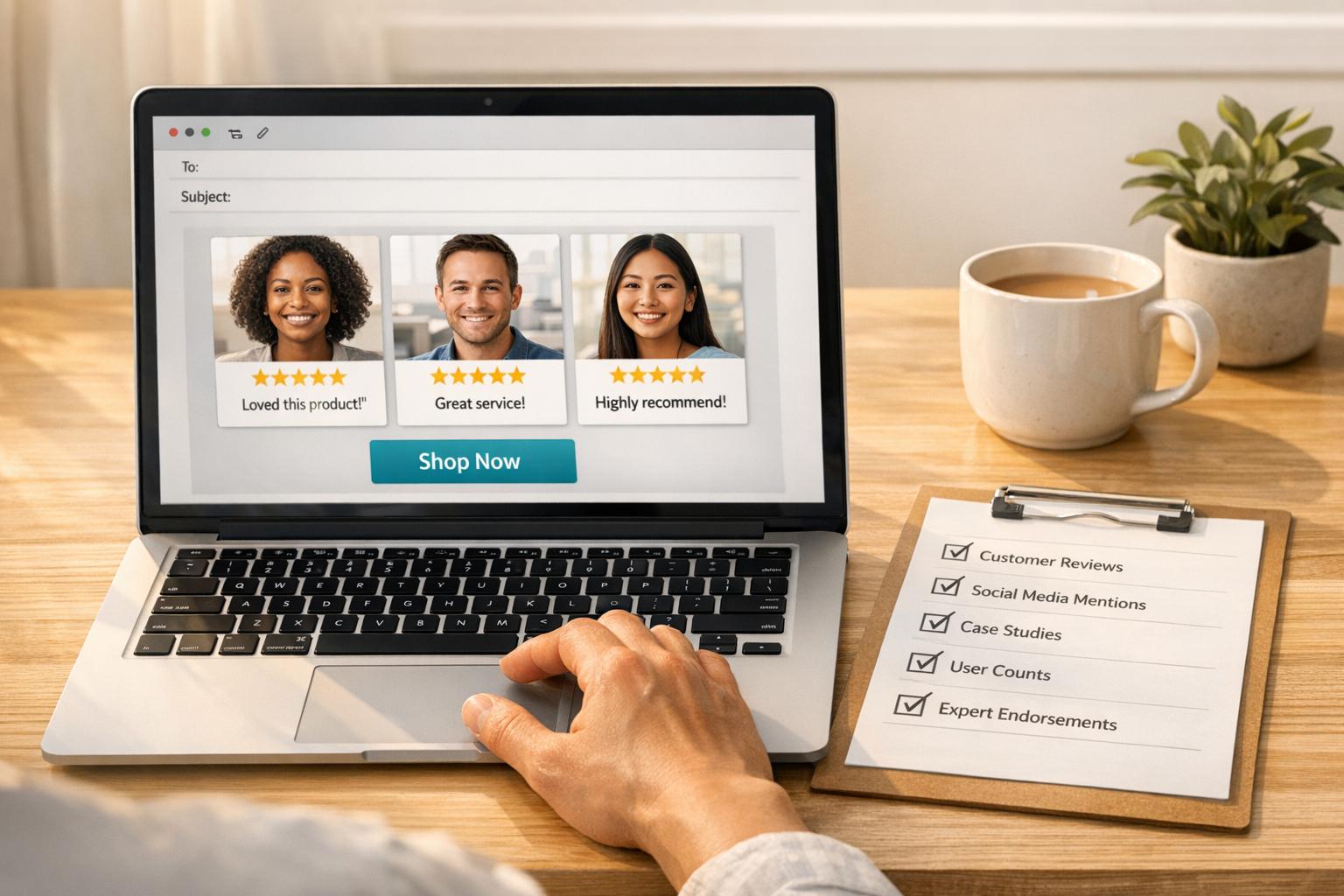
Social proof is a powerful way to build trust and increase conversions in email marketing. By showcasing what others think or do, you can help subscribers feel confident about taking action. Here’s a quick breakdown of how to use it effectively:
- Set Clear Goals: Align social proof with your campaign objectives, like boosting sales or click-through rates.
- Choose the Right Type: Use testimonials, reviews, user-generated content, or expert endorsements based on your audience.
- Verify Credibility: Ensure all proof is genuine, detailed, and permissioned to maintain trust.
- Strategic Placement: Position social proof near CTAs or in headers to maximize impact.
- Leverage Data: Highlight numbers like customer counts or milestones to showcase popularity.
- Segment Your Audience: Tailor social proof to specific groups for better engagement.
- Test and Track: A/B test different formats and placements to optimize performance.
- Stay Transparent: Follow FTC guidelines for endorsements and disclose incentives.
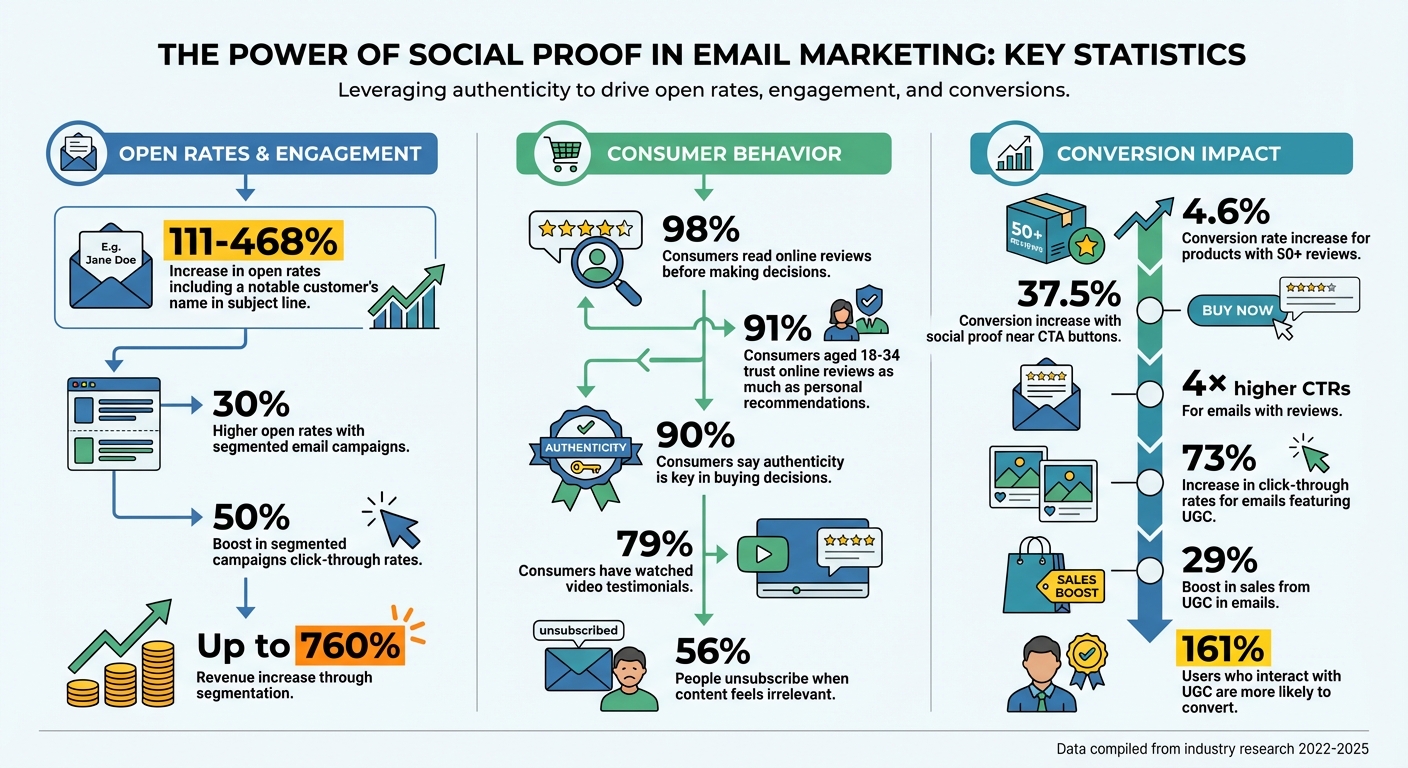
Social Proof Email Marketing Statistics and Impact Metrics
How to Use Social Proof and Live Polls in Email Marketing
Pre-Campaign Planning
Plan ahead to strategically place social proof in your email campaigns for maximum impact.
Set Clear Campaign Goals
Before diving in, define what you want your email to achieve. Are you aiming to boost conversions, increase click-through rates, or simply grab attention with higher open rates? Different goals call for different types of social proof.
For example, if you're focused on driving sales, customer testimonials and case studies are your go-to tools. They provide the reassurance buyers need to make that final decision. On the other hand, if your priority is improving click-through rates, try incorporating product reviews or user-generated content - these encourage readers to click through to your website.
Including a notable customer's name in your subject line can work wonders. Studies show it can boost open rates by anywhere between 111% and 468%. That’s the power of a well-placed name-drop.
"Use social proof to answer major objections. For instance, if you sell protein powder, then taste is going to be a big objection. This is when you use social proof that directly answers that objection." – Danavir Sarria, Supply Drop
Tailor your social proof to match where your customers are in their journey. At the top of the funnel, expert endorsements and influencer mentions are great for building awareness. As customers move closer to making a purchase, detailed testimonials or case studies that address specific concerns become essential.
Once your goals are clear, you can choose the type of social proof that aligns best with your objectives.
Select the Right Type of Social Proof
The type of social proof you use should align with both your audience and your campaign goals.
For B2B campaigns, case studies are particularly effective because they showcase how your product or service solves complex challenges. On the other hand, B2C audiences are more likely to engage with visual user-generated content or star ratings. If you’re addressing specific concerns - like whether your product tastes good or is easy to use - look for testimonials that tackle those objections head-on.
The numbers back this up: 98% of consumers read online reviews before making decisions about businesses. Products with 50 or more reviews can see conversion rates increase by 4.6%. However, avoid displaying small numbers like "5 customers bought this", as it can backfire and make your product seem unpopular.
Psychology plays a big role here. Highlighting large customer bases (e.g., "300,000 designers use this tool") taps into FOMO - fear of missing out. Similarly, industry awards or mentions in respected publications take advantage of the halo effect, borrowing credibility from those sources to strengthen your brand.
Once you've chosen the right type of social proof, ensure it’s credible and trustworthy.
Verify Authenticity
Nothing destroys trust faster than fake testimonials. Today’s consumers are quick to spot inauthentic reviews, and the damage to your reputation can be irreversible.
To establish trust, include specific details like the person’s name, job title, company, and even their photo. Whenever possible, link back to the original review so readers can verify it themselves. Avoid vague statements like "This product is amazing!" Instead, use measurable results - something like "increased ROI by 22%" carries much more weight.
Video testimonials are another excellent option. Seeing and hearing someone share their experience makes the proof feel more genuine. In fact, 79% of consumers have watched video testimonials to learn about a company or product. On landing pages, host them on YouTube and follow our guide to embedding a YouTube video on your site to keep the page fast.
Don’t forget to get explicit permission before using someone’s name, story, or image in your campaigns. Also, keep your numbers up to date - outdated stats or milestones can give the impression that your business isn’t growing.
Creating and Collecting Social Proof Content
Once you've mapped out your strategy, the next step is to gather the social proof that will give your email campaigns an extra edge.
Gather Quality Testimonials and Reviews
Timing is everything when it comes to collecting feedback. Ask for testimonials right after a positive milestone - like completing a project or delivering strong results - when emotions are high and enthusiasm is fresh.
To get detailed, meaningful testimonials, guide your customers with a simple "Problem-Solution-Result" framework. Instead of vague praise like "Great product!", you'll receive responses like:
"Since the Denver Post took over management of our digital marketing, we have double-digit revenue growth." – Anthony Nicosia, EVP, Doctor Fix It.
Why does this matter? Because 91% of consumers aged 18 to 34 trust online reviews as much as personal recommendations, and most people read about 10 reviews before making a purchase decision. To make the process easy, keep your feedback forms short, mobile-friendly, and straightforward. Personalize your request emails by including the customer's name and even a photo of the product they purchased. Using casual subject lines like "How did we do?" can also encourage more honest responses.
Don't overlook informal feedback from emails, calls, or meetings. With permission, turn these into formal testimonials. LinkedIn is another goldmine for recommendations - it adds credibility and is easy to showcase in your campaigns.
The best time to ask for feedback depends on your product. For example:
- Food delivery: 2–3 hours after delivery.
- Apparel: Around 5 days after purchase.
- Electronics or supplements: Wait 2–3 weeks so customers have time to fully experience the product.
Once you've collected testimonials, expand your efforts by tapping into user-generated content (UGC) for even more compelling social proof.
Use User-Generated Content
UGC allows potential customers to see your product in action through the eyes of real users. And it works - 90% of consumers say authenticity is a key factor in their buying decisions.
Emails featuring UGC can increase click-through rates by 73% and boost sales by 29%. Even more impressive, people who interact with UGC are 161% more likely to convert.
"Include photos or actual screenshots of user-generated content and reviews to inspire higher confidence and increase click-through. Images are not only more enticing, but they are also harder to fake than text quotes." – Stacey Kane, EasyMerchant
UGC can take many forms: customer photos, video testimonials, screenshots of social media mentions, or spotlight stories. Social media screenshots, in particular, feel authentic and are tough to fake.
Encourage your customers to share their experiences by using a branded hashtag, making it easier to collect content for future campaigns. You can even run contests to reward customers who share photos or videos of your product. Just make sure you have their explicit permission before using their content.
While personal stories are powerful, pairing them with hard data can make your social proof even more compelling.
Display Key Numbers and Milestones
Combine personal testimonials with solid metrics to paint a complete picture of your brand's impact.
Showcase numbers that highlight your success - like customer counts, active users, or completed transactions. For example, mention "over 10,000 satisfied clients" or the number of email subscribers and social media followers to underline your popularity.
Metrics related to business activity, such as the number of projects completed, products sold, or successful transactions in a specific timeframe, can reinforce your credibility. If your numbers aren’t quite there yet, focus on other forms of social proof until they grow. Above all, make sure any figures you share are accurate and up to date.
Email Design and Placement
Where you place social proof in your emails can make or break your campaign. A well-thought-out design can turn hesitant readers into buyers, while poor positioning might leave even your best testimonials unnoticed. Aligning placement with your campaign goals ensures your social proof delivers maximum impact.
Position Social Proof Effectively
To boost conversions, place social proof near call-to-action (CTA) buttons. For instance, reviews or star ratings positioned just above "Buy Now" buttons can reassure readers at the critical decision-making moment, increasing conversions by 37.5%.
Another prime location is the email header. Including social proof here immediately builds trust before readers dive into your pitch. For promotional emails highlighting specific products, try pairing social proof - like testimonials or ratings - directly with product images or descriptions to validate your offering.
Some brands have taken creative approaches to integrating social proof. In 2022, Litmus, a B2B email platform, tested "Interest Signals" in their resource announcement emails. They showcased a live count of "interested email geeks" based on real-time clicks, resulting in a 4.5% increase in click-through rates. Similarly, DFS, a furniture retailer, added purple banners to product images in their emails, displaying the exact number of live “loves” each item had received.
Don’t overlook the email footer or signature. These areas are perfect for displaying awards, certifications, or customer counts without distracting from your main message. For example, Boux Avenue used a live Instagram "like" counter in their email footer to encourage readers to follow them on Instagram.
Once you’ve nailed placement, the next step is to focus on how your social proof looks.
Format Visual Elements
Visuals like star ratings, customer photos, and media logos often feel more credible and engaging than plain text.
"Images are not only more enticing, but they are also harder to fake than text quotes. Thus, customers will find them more convincing." – Stacey Kane, EasyMerchant
Whenever possible, use actual screenshots of social media mentions or embed social posts. These feel more authentic and trustworthy compared to formatted quotes. If you’re showcasing awards or media mentions, include recognizable logos in your footer or signature. This approach builds authority without cluttering your main content. For example, Olay, the skincare brand, included an award logo in their welcome email template to establish credibility with new subscribers right away.
Consistency in design is key. Star-rating icons are a great way to highlight top products without taking up too much space. Carousels can also be effective for showing off multiple reviews or media mentions in an eye-catching way. If you’re highlighting numerical milestones, make them stand out - something like "10,000 Happy Customers" grabs attention instantly.
While visuals can enhance your message, it’s important to avoid overwhelming your readers with too much content.
Balance Content Volume
Overloading your email with social proof can dilute its impact. Stick to showcasing up to three awards and one or two strong testimonials per email.
Tailor your social proof to fit the email’s purpose. For example, include a customer service testimonial in a shipping update email rather than a product-focused one. And if your numbers aren’t impressive yet - like a small subscriber count - it’s better to leave them out until you’ve built more momentum.
Keep your campaigns fresh by rotating different types of social proof. Alternate between expert reviews, user-generated content, and bold data points to keep your audience engaged.
If you’re using Breaker’s newsletter builder, testing these placement and design strategies is simple. Experiment to find what resonates best with your audience while building trust and driving engagement.
Personalization and Audience Segmentation
Customizing social proof for specific audience segments can significantly enhance your marketing efforts. For instance, segmented email campaigns boast 30% higher open rates and a 50% boost in click-through rates, with marketers reporting up to a 760% increase in revenue through segmentation.
Align Social Proof with Audience Preferences
The type of social proof you use should resonate with the preferences of each audience segment. For example, B2B audiences and professional buyers are more likely to trust expert endorsements and industry authority. Meanwhile, consumer and lifestyle brands thrive on celebrity or influencer endorsements that appeal to social aspirations and identity.
Make sure your social proof ties directly to the product or service you’re promoting. If you’re marketing skincare products, highlight reviews or testimonials specifically about those products - not just general brand praise. Address potential objections by using testimonials that counter specific concerns your audience might have.
By combining these tailored endorsements with precise segmentation, you can amplify the effectiveness of your campaigns.
Segment by Behavior and Demographics
To create effective audience segments, start by collecting data from your CRM, website analytics, purchase histories, and customer surveys. Use this information to define criteria like demographics (age, income, occupation) and behaviors (purchase frequency, cart abandonment, engagement levels).
Establish clear rules for each segment. For instance, you might create a group for "customers who purchased in the last 30 days" or "users who abandoned their cart twice". Then, align the right social proof with each group. For professional buyers, technical case studies might be most effective, while younger audiences might respond better to user-generated content. High-value customers, identified through RFM modeling (Recency, Frequency, Monetary value), can be targeted with premium social proof that highlights exclusive benefits.
To ensure meaningful insights, keep your segments large enough - aim for at least 100–200 subscribers per group. A/B test different types of social proof to see what resonates, as 56% of people unsubscribe when content feels irrelevant.
If you’re using tools like Breaker’s real-time analytics and audience targeting, you can monitor which social proof strategies perform best for each segment. This allows you to refine your approach continuously for even better results.
Testing and Performance Measurement
After adding social proof to your emails, the next step is figuring out if it’s actually making an impact. Testing and tracking are essential to uncover what connects with your audience.
When you’ve customized your social proof for specific audience segments, measuring its effectiveness will help you fine-tune your approach.
Run A/B Tests
Start by comparing emails that include social proof with those that don’t to establish a baseline for performance. Then, experiment with different types of social proof. For example, one email might feature customer testimonials, while another highlights expert endorsements - see which one gets more clicks.
Placement matters too. Try positioning testimonials in different parts of your email - above the call-to-action (CTA), in the header, or in the footer - to find out what grabs the most attention. You can also test formats, like a simple text-based review versus one that includes a customer photo and full name.
Monitor Performance Metrics
Keep an eye on key metrics like open rates, click-through rates (CTR), and conversions to gauge the effectiveness of your efforts. Open rates can reveal if the social proof in your subject line is enticing enough to get recipients to open your email. For instance, mentioning a high-profile customer by name in the subject line can boost open rates by anywhere from 111% to 468%.
Click-through rates tell you how many people are engaging with links near your testimonials or reviews. Emails that include reviews can achieve up to 4× higher CTRs compared to those without. And when it comes to conversions, emails featuring product reviews can increase conversion rates by 37.5%. Plus, users who interact with user-generated content are 161% more likely to convert.
Don’t stop there - also track any broader engagement your emails generate, like website visits or social media follows. If you’re using tools like Breaker’s real-time analytics, you can monitor these metrics as they happen and tweak your strategy on the fly based on what’s working.
This testing phase helps validate the smart placements and tailored content you’ve already put in place.
Compliance and Transparency
Once you've tested your campaigns and confirmed they're performing well, it's time to focus on meeting legal and ethical standards. Specifically, make sure your use of social proof aligns with regulations. For example, the Federal Trade Commission (FTC) has strict guidelines regarding testimonials and endorsements in marketing emails. Violating these rules can lead to hefty fines - up to $53,088 per email.
Confirm Content Authenticity
Every testimonial or piece of user-generated content you include in your campaigns must be genuine and verifiable. Whenever possible, include details like the customer's full name, job title, company, and even a real photograph. These elements not only add credibility but also make it harder for anyone to question the authenticity of the testimonial.
Visual elements, such as screenshots or original user-generated photos, can significantly enhance trust. Unlike plain text quotes, these are much harder to fake. You can also link directly to third-party review sites where the testimonials were originally posted. This gives readers the opportunity to verify the content themselves.
Before featuring any customer feedback, make sure you have explicit permission. A simple direct message, email, or tweet asking for consent is sufficient. Just because a review is publicly available doesn’t mean you can automatically use it in your campaigns.
Once you've verified the authenticity of your content, the next step is to clearly disclose any endorsements that involve incentives.
Disclose Paid Endorsements
Being transparent isn’t just ethical - it’s also a legal requirement. If you've paid for an endorsement, provided free products, or offered any kind of incentive for a review, you need to disclose it. The FTC’s updated 2025 guidelines broaden the scope of what qualifies as a paid endorsement. This now includes promo codes, affiliate links, brand tags, and even user-generated recommendations.
Disclosures must be clear and easy to spot. In email campaigns, place them in the first one or two lines of your message, ensuring they appear above any "See More" fold or truncation point. Use simple language like "#ad", "Sponsored by [Brand Name]", or "Paid partnership with [Brand Name]". If your email includes video testimonials, make sure on-screen disclosures are in at least 24-point font, use high-contrast colors, and remain visible for at least three seconds.
Conclusion
This checklist highlights just how important social proof is at every stage of your email campaign. To use it effectively, you’ll need a clear strategy from the start. Pair the right type of social proof with the appropriate stage of your sales funnel - whether it’s expert endorsements to raise awareness, customer testimonials to establish trust, or impressive stats to build credibility.
Make sure your social proof is authentic and easy to verify. Include details like full names, job titles, company logos, or real photos. Generic or unattributed quotes can come across as fake and hurt your credibility. In fact, showcasing real customer feedback on a product page has been shown to significantly improve conversions.
Where you place social proof matters just as much as the proof itself. Position it strategically to back up your call-to-action - like right above a "Buy Now" button or inside an abandoned cart email. This helps reassure hesitant subscribers at the exact moment they’re deciding whether to take action. If you’re sharing numbers, make sure they’re impressive enough to create urgency. Weak stats can do more harm than good by signaling low interest or popularity.
Lastly, don’t skip testing. The best campaigns are built on continuous A/B testing - experimenting with different formats, placements, and types of social proof to see what clicks with your audience. Let the data guide your decisions. Maybe video testimonials work better than text quotes, or expert endorsements drive more clicks than peer reviews. By applying these tested tactics, you’ll be well on your way to making your email campaigns more effective and impactful.
FAQs
How can I make sure the social proof in my email campaigns is authentic?
To make sure the social proof in your email campaigns feels genuine, stick to verified reviews, authentic customer testimonials, and endorsements from trustworthy sources. Using real feedback from actual customers or respected organizations helps establish trust and credibility.
Steer clear of inflating claims or using fake content - it can seriously harm your brand’s reputation. Instead, focus on adding specific details like names, dates, or measurable results. This approach makes your social proof more relatable and convincing.
What types of social proof work best for different audiences?
The best kind of social proof varies depending on what your audience values and where they are in their buying journey. For people who are just discovering your brand, media mentions or celebrity endorsements can quickly establish trust by leaning on recognizable names or authority figures. Meanwhile, more seasoned or cautious shoppers often look for customer reviews and testimonials, which feel more relatable and authentic.
If your audience places a high value on expertise, showcasing industry awards or expert opinions can make a strong impression. For budget-conscious buyers, bestseller labels or product rankings might be the most persuasive. And when it comes to loyal customers, sharing case studies or success stories that align with their needs can strengthen trust and deepen engagement. Choosing the right type of social proof ensures it connects with your audience and motivates them to take the next step.
How can I test and measure the impact of social proof in my email campaigns?
To gauge the effectiveness of adding social proof to your email campaigns, start with A/B testing. Craft two versions of your email: one that includes elements like testimonials, reviews, or case studies, and another without them. Then, compare performance metrics such as open rates, click-through rates, and conversions to determine which approach connects more with your audience.
Dive deeper by examining metrics like bounce rates, overall engagement, and conversion trends over time. These insights can reveal patterns that help you adjust your strategy. For a more personal touch, gather qualitative feedback through surveys or direct replies to understand how recipients feel about the social proof you're using.
Using these methods together allows you to fine-tune your emails, build trust, and encourage stronger engagement.
Related Blog Posts
Keep reading
All articlesGDPR Consent Requirements for Purchased Email Lists
Purchased email lists rarely meet GDPR's consent bar. Learn the legal basis rules, PECR overlap, and safer alternatives before you hit send.
7 Email Platforms With Inbox Placement Testing & Suppression
Compare 7 email platforms that combine inbox placement testing with suppression management, scored on features, pricing, and best-fit sender size.
Email Automation Workflow & Drip Campaign Data Structure
Learn the database schema behind email drip campaigns—tables, workflow states, and event logs that power reliable marketing automation.