
A/B Testing Metrics: What to Track and Why
Use open rate, CTR, and conversion rate together to diagnose your email funnel and improve subject lines, CTAs, and landing-page performance.
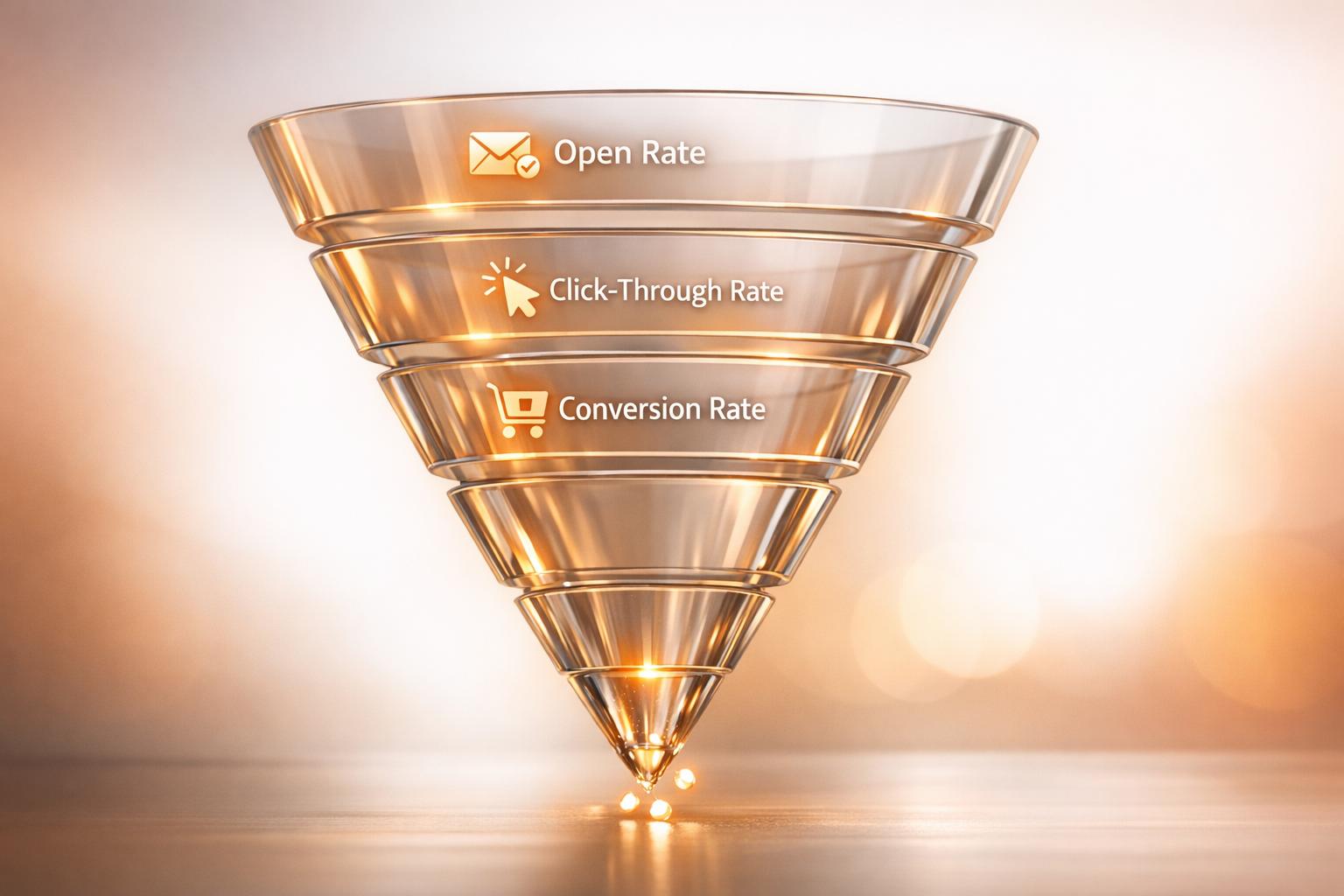
Want better email results? Focus on these three metrics: open rate, click-through rate (CTR), and conversion rate. These metrics work together to show how well your emails engage readers and drive actions. Here's the breakdown:
- Open Rate: Measures how many people open your email. Best for testing subject lines and sender names. However, privacy features (like Apple’s Mail Privacy Protection) can skew this data.
- Click-Through Rate (CTR): Tracks how many recipients click links in your email. Great for testing content, CTAs, and layout. It’s more reliable than open rates but doesn’t show if clicks lead to meaningful actions.
- Conversion Rate: The ultimate measure - tracks actions like sign-ups or purchases. Ties email performance directly to business results but requires integration with landing pages and tracking systems.
Key takeaway: Use all three metrics together. Open rates gauge attention, CTR shows engagement, and conversion rates measure success. This layered approach helps refine your strategy and boost results.
How To Analyze A/B Test Results? - TheEmailToolbox.com
1. Open Rate
Open rate measures the percentage of recipients who open your email, tracked using a 1x1 pixel that loads when the email is viewed. It’s a straightforward way to gauge if your subject lines, sender names, and preheader text are catching attention.
Primary Use Case
This metric is ideal for testing elements that shape a recipient's first impression, such as subject lines, sender names, and the best times to send emails for your audience. Nick Donaldson, Senior Director of Growth at Knak, highlights its importance:
"Open rate measures the percentage of recipients who open your email. It's a key indicator of how effectively your subject lines and sender names grab attention."
Strengths
Open rate is easy to work with since you only need to adjust one element - like a subject line - to run a test. It provides quick feedback on whether your emails are reaching the intended audience and avoiding spam filters. In 2025, a strong unique open rate generally ranges between 30% and 40%. Personalization can make a big difference: subject lines tailored to the recipient can increase opens by 26%, and adding a subscriber's name can boost them by over 14%.
Limitations
Privacy features are making open rates less reliable. For instance, Apple’s Mail Privacy Protection preloads images automatically, inflating open rates without reflecting actual engagement. In fact, 22% of marketers report that this feature has reduced the accuracy of their open rate data. As Team Braze puts it:
"The days of measuring email performance by open rate alone are over. With privacy updates reshaping how marketers access and interpret engagement data... relying on superficial stats can lead teams in the wrong direction."
Additionally, if images are blocked, the tracking pixel won’t load, leading to underreported opens.
B2B Relevance
For B2B marketers, a strong open rate shows that your emails are successfully reaching decision-makers and that your sender reputation is good enough to bypass corporate spam filters. Testing often focuses on whether a professional, direct tone works better than a casual one, as B2B audiences tend to prefer an information-first approach. To get the most accurate insights, track unique open rates instead of total opens to filter out repeat views. Also, monitor performance by domain (e.g., Gmail versus Outlook) to identify deliverability issues early.
Up next, we’ll dive into click-through rates to explore deeper engagement metrics.
2. Click-Through Rate (CTR)
Click-Through Rate (CTR) measures the percentage of recipients who click on one or more links in your email. To calculate it, divide the total number of clicks by the number of delivered emails and multiply by 100. This metric offers a clear picture of engagement, showing whether recipients find your content compelling enough to act.
Primary Use Case
CTR is an essential tool for A/B testing in email campaigns. Marketers often experiment with elements like call-to-action (CTA) text, link placement, or content layout to see what resonates best.
Erica Santiago from HubSpot highlights its importance:
"CTR is a crucial metric for all email marketers to track, as it gives direct insight into how many people on an email list are engaging with the content and interested in learning more about a brand or offer."
Industry benchmarks show average CTRs vary by sector. For example, B2B services hover around 2.21%, Business and Finance averages 2.59%, and Hobbies can climb to about 4.78% .
CTR’s focus on actionable user behavior makes it an invaluable measure of audience engagement.
Strengths
CTR is a more dependable metric than open rates, particularly since Apple's Mail Privacy Protection has impacted open data accuracy. It directly measures interest and intent. In fact, 33% of marketers consider CTR a top email performance metric. It provides clear, actionable feedback on how well your content connects with your audience. Even small tweaks, like using a single, focused CTA or personalizing it, can lead to impressive results. Some tests have shown click increases of up to 371% and conversion boosts of 202%.
Limitations
While CTR is powerful, it does have its limits. It doesn’t explain why someone clicked or whether they found value after landing on your page. It also doesn’t capture sentiment or satisfaction. Overloading emails with too many links can inflate CTR artificially, without reflecting genuine interest. Additionally, mobile users often click less due to navigation challenges on smaller screens.
B2B Relevance
In B2B marketing, where sales cycles are often lengthy, CTR plays a crucial role as a mid-funnel metric. It helps gauge how well your content nudges prospects toward lead-generation goals . A/B testing often zeroes in on CTAs like "Get a demo" or "Start a free trial" to refine messaging that drives qualified leads.
To optimize CTR in B2B campaigns, consider segmenting your audience based on past click behavior to deliver more targeted emails. Stick to one clear CTA per email to avoid overwhelming recipients with too many choices. For businesses with extended sales cycles, CTR helps identify which early-stage content keeps prospects engaged long enough to convert. Alongside open rates, it provides valuable insights for refining strategies in complex, multi-step sales processes.
3. Conversion Rate
When it comes to measuring the success of your email campaign, the conversion rate stands as the ultimate indicator.
This metric tracks the percentage of recipients who take a specific action - whether it’s requesting a demo, signing up for a webinar, downloading a whitepaper, or making a purchase - after clicking a link in your email. To calculate it, divide the number of conversions by the total number of recipients, then multiply by 100. Across industries, the median conversion rate is 4.3%.
As Wilson Lau, Sr. SEO Marketing Manager at AdRoll, puts it:
"Conversion rate is the fundamental measure of how effectively your emails push customers to do what you want them to do."
Unlike open and click-through rates, the conversion rate provides a direct connection between your email efforts and tangible business outcomes.
Primary Use Case
Conversion rate highlights how well your campaigns translate into meaningful results. It’s a powerful way to see if your A/B testing efforts are driving actual business outcomes, not just higher engagement metrics. Through A/B testing, you can experiment with elements like CTA wording, offer types, and layouts, ensuring your email aligns perfectly with your landing page.
For instance, HubSpot ran an A/B test comparing emails sent with a personalized sender name versus a generic company name. The personalized approach led to a 0.53% higher open rate and a 0.23% higher click-through rate, ultimately generating 131 additional leads. This example underscores how small adjustments can significantly impact conversions.
Strengths
The conversion rate is a reliable metric that ties marketing experiments directly to business growth. It reveals which variations genuinely deliver value, rather than just increasing clicks or opens. Importantly, this metric remains accurate even in the face of privacy features that may skew open rate data.
For example, replacing a text link with a button for your CTA can boost click-through rates by 27%, while using positive language in your email copy has been shown to increase conversion rates by 22%.
Limitations
While conversion rates offer critical insights, they don’t explain why users behave the way they do. To uncover the full story, you’ll often need qualitative data like surveys or session replays.
Technical challenges can also affect accuracy. For instance, device switching or cookie rejections may lead to underreported conversions. Additionally, if your landing page fails to deliver on the email’s promise, recipients might leave out of frustration or confusion.
B2B Relevance
For B2B marketers, where sales cycles are often longer, conversion tracking focuses on key lead-generation milestones rather than immediate purchases. These milestones could include webinar sign-ups, whitepaper downloads, or free trial registrations.
To improve B2B conversion rates, ensure your email offer aligns seamlessly with your landing page to avoid confusion. Experiment with action-focused CTAs, such as testing “Get the formulas” versus “Read more”. Adding trust signals - like customer reviews or security badges - near your CTA can also build confidence. Finally, streamline your forms by testing shorter versions and prioritizing mobile responsiveness, as a poor mobile experience can significantly hurt conversions.
These insights into conversion rates provide a clear picture of how this metric drives impactful email marketing campaigns.
Comparing the Metrics: Strengths and Weaknesses
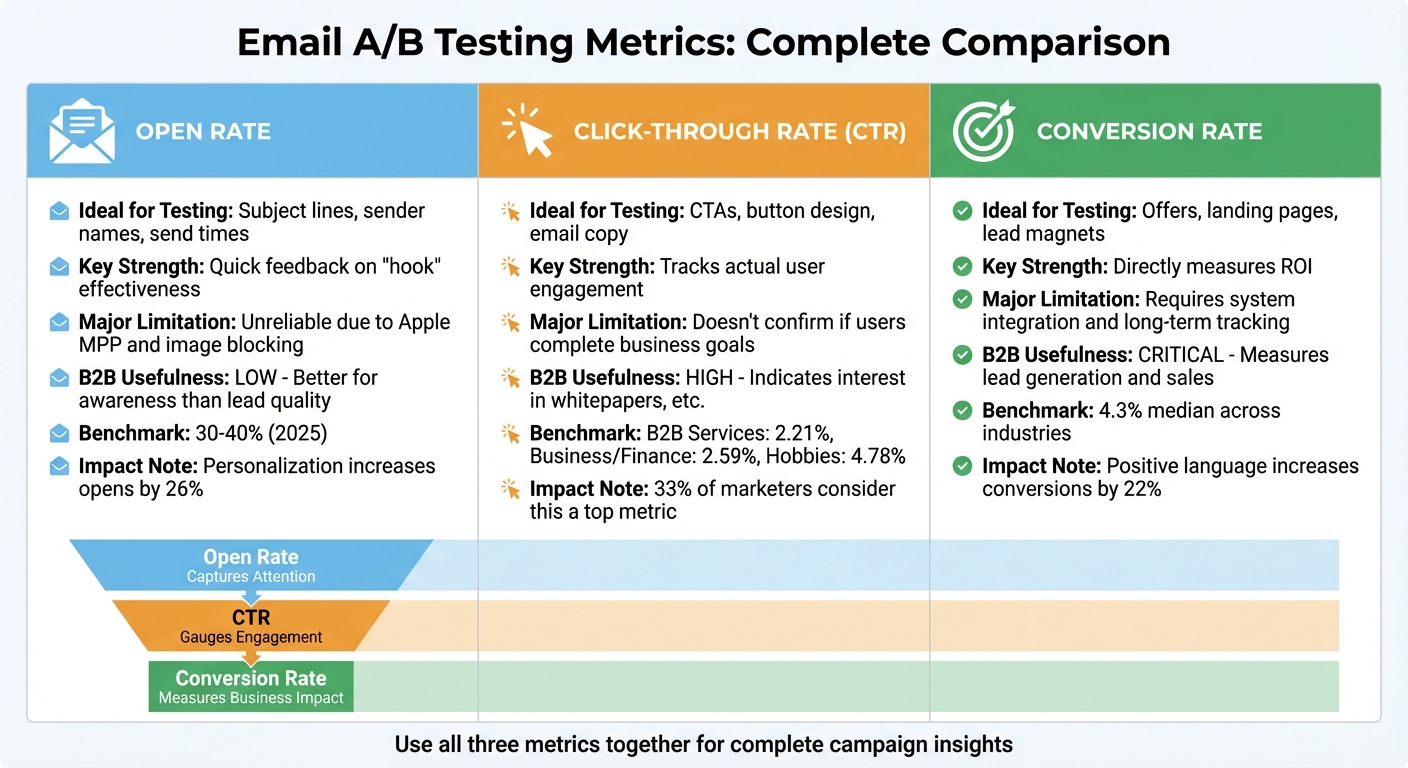
A/B Testing Email Metrics Comparison: Open Rate vs CTR vs Conversion Rate
Building on the analysis of each metric, here’s a closer look at how they stack up in terms of strengths and challenges, and how they fit into your overall email strategy.
Open rate is particularly useful when testing subject lines or sender names. However, its reliability has taken a hit due to factors like Apple's Mail Privacy Protection and corporate firewalls, which can skew tracking data. As Team Braze aptly notes:
"The days of measuring email performance by open rate alone are over. With privacy updates reshaping how marketers access and interpret engagement data... relying on superficial stats can lead teams in the wrong direction".
Click-through rate (CTR) offers a more direct measure of how well your email content connects with recipients. Erica Santiago, a Marketing Specialist at HubSpot, refers to it as the "day-to-day" email marketing metric. Still, CTR has its limitations - high clicks don’t always equate to meaningful engagement. A recipient might click out of curiosity without any intention of taking further action.
Conversion rate, on the other hand, provides an outcome-focused view by tracking the actual ROI of your campaigns. While it's arguably the most critical metric, it does require an integrated approach, combining email data with web analytics and CRM systems. Plus, meaningful insights often demand longer tracking periods.
To simplify the comparison, here’s how these metrics break down side by side:
Metric
Ideal for Testing
Key Strength
Major Limitation
B2B Usefulness
Open Rate
Subject lines, sender names, send times
Quick feedback on "hook" effectiveness
Unreliable due to Apple MPP and image blocking
Low; better for awareness than lead quality
CTR
CTAs, button design, email copy
Tracks actual user engagement
Doesn’t confirm if users complete business goals
High; indicates interest in whitepapers, etc.
Conversion Rate
Offers, landing pages, lead magnets
Directly measures ROI
Requires system integration and long-term tracking
Critical; measures lead generation and sales
The best approach? Use these metrics as a funnel: open rate tells you if the email captures attention, CTR gauges how engaging the content is, and conversion rate reveals its actual impact on your business goals.
Conclusion
To truly understand the success of your email campaigns, tracking open rate, CTR (click-through rate), and conversion rate together is essential. Each metric tells a different part of the story: open rate shows how well your subject lines grab attention, CTR highlights how engaging your content is, and conversion rate ties everything back to your business goals. Together, they provide a complete picture of your campaign’s effectiveness.
When these metrics don’t align, it’s a clear sign that something in your funnel isn’t working as it should. By analyzing them side by side, you can pinpoint where engagement drops off and make targeted improvements. This kind of holistic view ensures your A/B tests deliver actionable insights that lead to better results. For test ideas tied to revenue rather than opens, see our A/B testing tips for better email ROI.
Real-time tracking is non-negotiable. Without up-to-date data, you could be making decisions based on outdated or incomplete information. It’s critical to have a system that monitors performance across the entire customer journey - not just isolated metrics that look good on paper.
That’s where Breaker comes in. It provides real-time analytics for open rate, CTR, and conversion rate, all in one place. With its automated tracking tools, you can quickly identify what’s working, adjust on the fly, and make smarter, data-driven decisions that directly impact revenue.
Instead of relying on a single metric, use all three to guide your strategy. They work together as a funnel, helping you see what’s effective and where there’s room for improvement. With this approach, you’ll not only optimize your campaigns but also drive meaningful business results.
FAQs
How do privacy features impact the accuracy of email open rates?
Privacy tools that block or hide image loading can throw off open-rate accuracy. These tools stop tracking pixels from logging when an email gets opened, which can lead to incomplete or inconsistent open-rate data.
Although open rates can still provide a general sense of engagement, they shouldn't be relied on alone. Pair them with metrics like click-through rates or conversions to get a fuller understanding of how your emails are performing.
Why is click-through rate (CTR) a better metric than open rate?
Click-through rate (CTR) stands out as a dependable metric because it tracks real engagement - specifically, when someone clicks a link in your email. This action shows they not only interacted with your content but also found it engaging enough to take further action.
On the other hand, open rates can be deceptive. These rely on images loading to register an "open", which doesn’t always happen. Plus, just because an email is opened doesn’t mean it was read or understood. CTR, however, gives a much clearer sense of how well your email is driving meaningful actions.
What challenges do marketers face when tracking email conversion rates?
Tracking email conversion rates during A/B testing comes with its fair share of challenges. One major hurdle is making sense of raw data without a structured framework. Numbers alone can be misleading, leaving teams scratching their heads about what’s really driving results. Compounding this, many teams lack access to more detailed diagnostic metrics that could explain why conversion rates fluctuate.
Another common pitfall is relying too heavily on basic metrics like raw click counts. While they might seem useful at first glance, these numbers often fail to uncover the deeper factors influencing conversions. On top of that, privacy regulations and data restrictions have made it increasingly difficult to track detailed engagement, limiting insights into how audiences interact with emails. And when primary conversion goals don’t align with secondary metrics - like bounce rates or add-to-cart actions - it can lead to incomplete or ineffective optimization efforts.
To navigate these challenges, marketers must adopt a well-rounded approach to data analysis. Focusing on metrics that offer deeper context and actionable insights is key to improving email performance.
Related Blog Posts
Keep reading
All articlesPost-Webinar Survey Questions Template (2026)
30+ post-webinar survey questions with NPS, CSAT, and CES templates, plus timing and length tips to boost completion and qualify leads faster.
GDPR Consent Requirements for Purchased Email Lists
Purchased email lists rarely meet GDPR's consent bar. Learn the legal basis rules, PECR overlap, and safer alternatives before you hit send.
7 Email Platforms With Inbox Placement Testing & Suppression
Compare 7 email platforms that combine inbox placement testing with suppression management, scored on features, pricing, and best-fit sender size.