
Segmentation Strategies for Personalized Email Outreach
Learn demographic, behavioral and funnel-based email segmentation tactics, plus AI tools and metrics to boost open rates, CTR, and revenue.
In email marketing, segmentation is key to boosting engagement and ROI. Sending targeted emails to specific groups, rather than generic blasts, improves open rates by 50% and click-through rates by 100.95%. Plus, 71% of consumers expect personalized interactions, and 74% feel frustrated by irrelevant content.
For B2B marketers, segmentation ensures tailored messaging for different decision-makers (e.g., CFOs vs. IT Directors) and sales funnel stages. This guide explains how to use demographic, behavioral, and funnel-based segmentation to make your emails more effective, along with tools like Breaker that automate and refine these processes.
Key Takeaways:
- Demographic Segmentation: Target by job title, company size, or industry for more relevant communication.
- Behavioral Segmentation: Use actions like page visits or downloads to identify high-intent leads.
- Sales Funnel Segmentation: Align content with where leads are in their buying journey - awareness, consideration, or decision.
- Dynamic Segmentation: Automate updates based on real-time behavior to keep messaging relevant.
- Tools Like Breaker: AI-driven features like predictive engagement scoring and real-time analytics maximize campaign performance.
Effective segmentation not only improves engagement but also drives higher revenue, with segmented campaigns generating 760% more revenue than non-segmented ones. Start simple, refine as you go, and leverage automation tools to scale personalization efficiently.
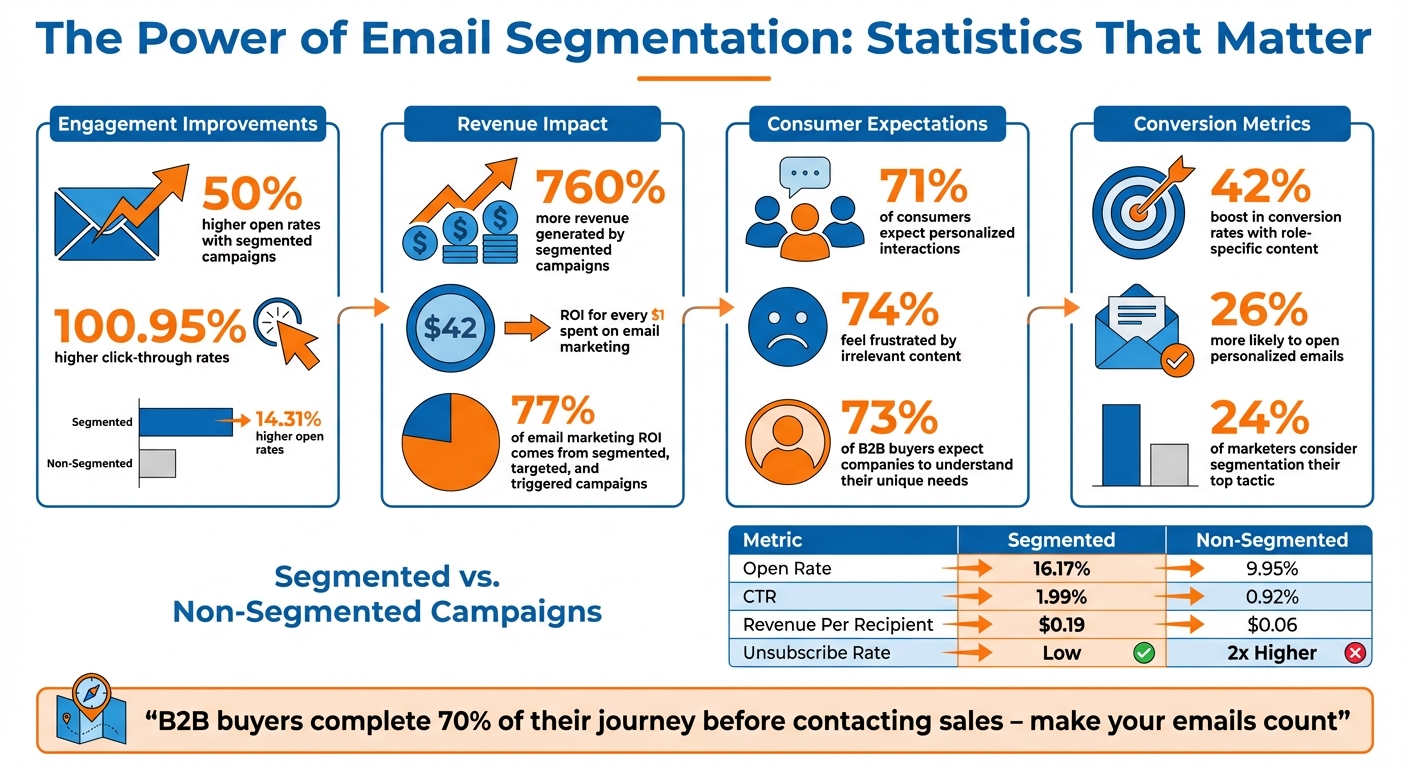
Email Segmentation Impact: Key Statistics and ROI Metrics for B2B Marketers
Understanding Audience Segmentation Basics
What is Email Segmentation?
Email segmentation is all about breaking down your email list into smaller, more targeted groups based on shared traits like demographics, behaviors, interests, or even where someone is in the sales funnel. Instead of sending out a one-size-fits-all message, marketers can craft tailored emails that resonate with each group.
Here’s the key difference between segmentation and personalization: segmentation focuses on defining groups (e.g., healthcare CTOs), while personalization hones in on customizing content for individuals (e.g., addressing someone by name or referencing their past activity). Think of segmentation as setting the stage, making it possible to scale personalization across thousands of contacts.
For B2B marketers, segmentation opens up opportunities to target based on firmographics like company size or industry, job roles (e.g., CFOs versus junior managers), and even the buyer’s journey stage - whether they’re a Marketing Qualified Lead or a Sales Qualified Lead. This ensures that each group gets messages that speak directly to their specific needs and priorities.
Understanding these fundamentals lays the groundwork for diving into more advanced segmentation strategies later.
"Email segmentation is the simplest way to ensure you're sending the right message to the right person at the right time. You don't need any technical skills to create segments of your audience, either."
- Jaina Mistry, Director, Brand and Content Marketing, Litmus
Why Segmentation Matters for B2B Email Campaigns
Segmented email campaigns deliver results. They see click-through rates that are 50% higher than generic email blasts, and 24% of marketers consider segmentation their go-to tactic for improving email performance. On top of that, 74% of customers express frustration when they receive irrelevant email content. These stats highlight just how critical tailored communication has become.
B2B sales cycles are often long and involve multiple decision-makers, which makes segmentation even more essential. By aligning content with where a prospect is in their journey - whether they’re just learning about your solution, weighing their options, or ready to make a decision - you can keep them engaged. For instance, early-stage prospects might appreciate educational content, while those comparing solutions may find detailed case studies or pricing breakdowns more useful. A generic approach, on the other hand, risks losing their interest.
Segmentation also plays a role in maintaining your sender reputation. When you send relevant, engaging emails, Internet Service Providers take notice, increasing the likelihood that your messages land in inboxes instead of spam folders. Additionally, dynamic, real-time segmentation can make a big difference. By using automated rules to adjust segments based on behaviors - like opening an email, visiting a pricing page, or downloading a whitepaper - you ensure your messaging stays relevant without constant manual updates.
Up next, we’ll explore key strategies to put these segmentation principles into action effectively.
Core Segmentation Strategies for B2B Marketers
Demographic Segmentation
Demographic segmentation forms the backbone of personalized B2B email marketing. Start with the basics: job title and seniority level. A CFO is laser-focused on ROI and the bottom line, while a marketing manager is more interested in features and how they fit into campaigns. The same product can mean entirely different conversations depending on who’s reading your email.
Company size is another critical factor. Small and medium-sized businesses often prioritize quick ROI and ease of use. On the other hand, enterprise-level organizations are more focused on scalability and seamless integration. In fact, 75% of enterprise buyers prefer content tailored specifically to their business size and operational complexity. Segmenting by industry or vertical also allows you to use relevant terminology and address specific needs. For example, healthcare companies require details about HIPAA compliance, while financial services firms care about SOC 2 certifications.
Geographic segmentation helps you fine-tune send times and stay compliant with regional regulations like GDPR or CCPA. Some marketers also segment by technology stack to highlight compatibility with the tools a company already uses, reducing perceived risks around implementation.
The results speak for themselves: segmented email campaigns achieve 14.31% higher open rates and 100.95% higher click-through rates compared to generic email blasts. Role-specific content alone can boost conversion rates by 42%. Start with a few impactful segments, such as industry or company size, before adding more layers. A practical tip? Keep one master list with multiple segments to avoid sending duplicates to the same contact.
B2B Segment Category
Key Criteria
Messaging Focus
Firmographics
Industry, Company Size, Revenue
Scalability, ROI, Industry Compliance
Demographics
Job Title, Seniority, Education
Strategic Impact vs. Tactical Usage
Geographics
Time Zone, Region, Language
Local Events, Regional Regulations
Technographics
Current Tech Stack, Integrations
Compatibility, Migration Ease
Next, let’s explore how user behavior can refine these segmentation strategies even further.
Behavioral Segmentation
Building on audience characteristics, behavioral segmentation zeroes in on what leads actually do - offering insights into their intent. Actions like visiting pricing pages, downloading case studies, or attending webinars identify high-intent prospects ready for a sales follow-up. For instance, if someone visits your pricing page three times in one week, that’s a clear signal they’re considering a purchase.
You can also segment leads by usage rate - grouping them into heavy, medium, or light users to prioritize high-value accounts. For SaaS companies, tracking feature usage can reveal which customers need help and which are ready for upgrades. Similarly, understanding content preferences helps you tailor follow-ups. For example, if a lead frequently clicks on SEO-related resources but skips lead generation content, your emails should focus on SEO topics.
Behavioral segmentation drives results. Abandoned cart emails, a common example of behavior-based triggers, boast an average open rate of 50.50%.
Start simple by separating "active" subscribers from "inactive" ones - those who haven’t opened an email in 60 to 90 days. Use re-engagement workflows to win back these leads with targeted campaigns. Map specific behaviors to lifecycle stages: a demo request or multiple visits to a pricing page should transition a lead to Marketing Qualified Lead (MQL) status. Also, use suppression lists to avoid sending promotional emails to active customers or leads currently in onboarding sequences.
By analyzing behaviors, you can align messaging with a lead’s position in the sales funnel for even greater precision.
Sales Funnel Segmentation
Combining demographic and behavioral data with sales funnel stages creates a well-rounded segmentation strategy. A lead’s position in the funnel determines what type of messaging they need. At the awareness stage, they’re researching solutions and need educational content like blogs, whitepapers, or industry insights. In the consideration stage, they’re evaluating vendors and want case studies, product comparisons, and webinars. By the decision stage, they’re ready for demos, testimonials, trial offers, or direct sales conversations.
Interestingly, B2B buyers complete 70% of their journey before ever reaching out to a sales rep. That means your email content must guide them through each stage without overwhelming or rushing them. Define clear categories like Lead, MQL, SQL, and Customer. Then, identify specific actions that trigger movement between stages - a form submission might mark someone as a Lead, while a demo request could signal an MQL.
Dynamic segments are essential for keeping everything up-to-date. Automation can instantly update a lead’s segment when their status changes, ensuring your messaging stays relevant. For example, configure exit triggers to remove contacts from nurture campaigns as soon as they convert, like requesting a demo.
The impact is clear: segmented campaigns deliver a 100.95% higher click-through rate than non-segmented ones. Instead of creating separate emails for every stage, use dynamic content blocks to customize calls-to-action or featured resources based on the recipient’s funnel position. This approach allows you to scale personalization without significantly increasing workload.
"73% of B2B buyers expect companies to understand their unique needs and expectations."
- Salesforce
Advanced Segmentation with Breaker
Using AI for Predictive Segmentation
Breaker takes segmentation to the next level by using AI to predict future behaviors, going beyond the limits of traditional methods. While standard segmentation focuses on what you already know about your leads, predictive segmentation uses AI to analyze vast datasets and uncover patterns you might miss. It examines behaviors like email engagement, content preferences, and website activity to identify signals that guide smarter targeting decisions.
This approach allows for true 1:1 personalization at scale, replacing generic groupings with highly specific audience segments.
"The future lies in moving beyond segmentation to true 1:1 personalization at scale - where each recipient receives content that feels crafted specifically for them."
- Nick Donaldson, Senior Director of Growth, Knak
One practical example is predictive engagement scoring. Breaker assigns each subscriber a score based on their past actions, such as opening emails, clicking links, or replying. High scorers are prioritized for outreach, while low scorers might enter re-engagement campaigns or be temporarily paused to protect your sender reputation. This method works - personalized emails are 26% more likely to be opened than generic ones.
Breaker also simplifies content personalization by using AI to populate email templates with tailored messaging. For instance, a CFO might receive ROI-focused content, while an operations manager gets messaging about ease of use - all within the same campaign.
These predictive tools, paired with Breaker's advanced targeting features, can refine your email strategy even further.
How to Use Breaker's Audience Targeting Tools
Breaker combines CRM integration, lead scoring, and real-time analytics to automate and enhance audience targeting. By syncing your CRM with Breaker, you can automate lead scoring using a "fit vs. behavior" model. This system assigns points to actions like attending webinars or repeatedly visiting your pricing page, helping you prioritize high-intent prospects.
With over 40 live metrics tracked - such as opens, clicks, and bounces - you can make mid-campaign adjustments to protect deliverability. For example, if bounce rates spike or open rates drop suddenly, you can pause the campaign, investigate issues like SPF or DKIM errors, and fix them before they harm your sender reputation.
Breaker also optimizes email delivery by staggering sends based on each recipient's time zone and engagement history, ensuring your emails land at the most effective time.
Engagement scores are updated instantly, helping you identify active leads and create dynamic sub-segments. For example, highly engaged contacts can be moved into "VIP" groups for exclusive offers, while less active ones are routed into re-engagement sequences. Considering email marketing can yield up to $42 for every $1 spent, fine-tuning your targeting with these tools is a smart investment.
Feature
Application
Benefit
40+ Live Metrics
Track opens, clicks, and bounces in real time
Make adjustments mid-send to protect deliverability
AI Send-Time Optimization
Stagger emails by time zone and engagement history
Boost open rates by sending at the ideal time
Lead Scoring Automation
Assign scores based on CRM data and behavior
Prioritize high-intent leads for follow-up
Engagement Scoring
Provide instant performance insights
Identify segments needing fresh content
Measuring Segmentation Impact on Email Performance
Tracking Key Performance Indicators (KPIs)
When it comes to measuring the success of segmentation, the numbers tell the story. Unique Open Rates help you understand if your subject lines resonate with specific groups, while Click-Through Rates (CTR) reveal whether your content inspires action. But if you want to cut through surface-level metrics, Revenue Per Recipient (RPR) shows which segments are actually driving revenue.
Consider this: campaigns sent to highly segmented groups (less than 20% of your list) achieve an average open rate of 16.17%, compared to just 9.95% for broad, unsegmented emails. CTR jumps from 0.92% to 1.99%, and RPR sees a massive increase from $0.06 to $0.19. In fact, segmented campaigns can generate 760% more revenue than generic email blasts.
Another metric to watch is the unsubscribe rate. If your unsubscribe rate is high, it might mean you're overloading your audience or missing the mark with your messaging. Unsegmented campaigns, for example, have unsubscribe rates that are double those of segmented ones. Comparing conversion rates between segmented and unsegmented campaigns can also help you calculate the ROI of your segmentation efforts.
Deliverability metrics are equally important. Internet Service Providers (ISPs) rely on engagement signals - like opens and clicks - to decide whether your emails land in the inbox or the spam folder. Keep an eye on spam complaints and your sender reputation. If a segment consistently shows low engagement (less than 20%), it’s time to either move those contacts into a re-engagement sequence or remove them altogether to protect your reputation.
By tracking these performance indicators, you can validate your segmentation strategy and fine-tune it over time. These metrics also pave the way for leveraging tools like Breaker’s real-time analytics to take your campaigns to the next level.
Using Breaker's Real-Time Analytics to Optimize Campaigns
Once you’ve identified trends in your KPIs, Breaker’s live analytics can help you make real-time adjustments. With over 40 live metrics at your fingertips, you can quickly spot and address issues mid-campaign. For instance, if bounce rates suddenly spike or open rates drop, you can pause the campaign, investigate potential SPF or DKIM issues, and fix them before your deliverability takes a hit.
Breaker also supports dynamic segmentation, automatically updating groups based on subscriber behavior. Let’s say someone makes a purchase - they’re immediately moved from a sales nurture sequence to a customer welcome series. Weekly tracking of segment trends can help you identify potential problems, like "exploding segments" (unexpected growth) or "empty segments", which often point to data issues.
Engagement scoring is another way to refine your approach. Use these scores to create sub-segments: prioritize high scorers for exclusive VIP offers, while directing low scorers into re-engagement campaigns. Monitoring Revenue Per Email (RPE) at the segment level can also highlight which audiences deliver the best returns. To avoid audience fatigue, set frequency caps based on engagement data - for example, limit emails to 3–4 per week for segments showing signs of burnout.
Breaker’s AI-driven send-time optimization takes things a step further by staggering emails based on time zones and engagement history. This ensures your message lands when each recipient is most likely to open it. Combined with predictive engagement scores, you can forecast which subscribers are likely to interact with your next campaign, allowing you to refine your targeting even further.
Common Segmentation Mistakes and How to Avoid Them
Over-Segmentation and Insufficient Data
Mastering segmentation is essential, but it’s just as important to avoid common mistakes that can derail your email campaigns.
One such pitfall is over-segmentation. When your segments become so narrow that they only include a handful of subscribers, the data loses reliability and effectiveness.
"The smaller the segments are, the more targeted and direct your marketing emails should be... avoid segmenting so much that you're left with just a handful of people in each segment." - Adobe Experience Cloud Team
Over-segmentation also makes campaign management unnecessarily complex. If you’re juggling 40 or more active segments, you’re likely to face overlapping workflows and conflicting messages. Start with broader categories - like new versus existing customers - and only add layers of complexity when it meaningfully changes the message, offer, or timing.
Another issue is poor data quality. Inconsistent or incomplete information, such as missing job titles, can fragment your segments and disrupt your automation efforts. To combat this, use dropdown menus during sign-ups instead of free-text fields to standardize data collection. You can also gather zero-party data - like preferences or purchase feedback - through quizzes, surveys, or preference centers to improve segmentation accuracy.
Finally, ensure your segments are dynamic, so they adapt as your audience evolves.
Failing to Update Segments Regularly
Static segments can quickly become outdated. For example, a prospect who made a purchase last month shouldn’t still receive “first-time buyer” promotions. This often happens when marketers rely on manual updates instead of dynamic segmentation. With dynamic segments, contacts automatically shift between groups based on real-time behaviors. For instance, someone completing a purchase can immediately move from a nurture sequence to a customer onboarding flow.
Regular segment reviews are crucial. Adjust your segments to reflect current customer behavior and business goals. Weekly quality assurance checks can help you spot issues early, such as sudden spikes or overly restrictive filters that leave segments empty.
Additionally, set clear exclusion rules. For example, exclude recent buyers (within the last 7 days), subscribers with active customer service tickets, and those who have soft-bounced three or more times.
"Your success with email marketing is dictated by who you send messages to and who you don't." - Ben Zettler, Founder of Zettler Digital
Consistently updating and refining your segments ensures your campaigns stay relevant and effective.
Email Mapping and Segmentation for B2B Success–Stephanie Ristow
Conclusion
Segmentation takes email outreach from being one-size-fits-all to delivering tailored messages that drive real results. By customizing content for specific industries, job roles, or stages of the buyer's journey, you can do more than just improve open rates - you can build trust and guide prospects through your sales funnel with pinpoint accuracy. The numbers speak for themselves: segmented campaigns generate 760% more email revenue and increase click-through rates by 50%.
The key to successful segmentation lies in balancing simplicity with strategic depth. Start with basic categories and gradually layer in behavioral and firmographic data for more refined targeting. Dynamic segmentation keeps your lists fresh as subscriber behaviors evolve, while periodic audits help you avoid the risks of over-segmentation or outdated information.
Breaker simplifies and enhances this process with its AI-powered tools. It automates segmentation and optimizes campaigns in real time. Using predictive timing, Breaker identifies the best moments to send emails to each recipient. Behavioral triggers handle outreach based on real-time actions, while in-depth analytics provide instant feedback on campaign performance. Instead of manually building static lists, Breaker allows you to create detailed segments - like identifying users who opened several emails but haven’t made a purchase - without the hassle. This combination of smart segmentation and advanced targeting empowers email campaigns to deliver consistently high ROI.
"Scaling personalization doesn't require more headcount - it requires smarter systems." - Alan Cassinelli, Marketing Manager, Blaze.ai
Considering that 77% of email marketing ROI comes from segmented, targeted, and triggered campaigns, it’s clear: segmentation is essential for driving engagement and revenue growth. By leveraging Breaker’s precision tools, B2B marketers can turn email outreach into a powerful strategy for building connections and fueling business success.
FAQs
How can demographic segmentation make email campaigns more effective?
Demographic segmentation makes email campaigns more impactful by delivering messages that feel personal and relevant. By categorizing your audience based on factors like age, gender, income, or location, you can craft content that speaks directly to their interests and needs.
This kind of precision helps grab attention, encourages interaction, and ultimately improves conversion rates since people are more inclined to engage with content that aligns with their lives.
How does behavioral segmentation help identify leads most likely to convert?
Behavioral segmentation zeroes in on high-intent leads by examining actions like browsing your website, interacting with emails, or past purchases. By diving into these patterns, you can direct your efforts toward people who are more likely to take meaningful actions, like completing a purchase or signing up for a service.
This method sharpens the focus of your email campaigns, making them more relevant. The result? Increased engagement and higher conversion rates, as your messages connect with the audience that matters most.
How does Breaker use AI to improve email segmentation?
AI tools like Breaker are changing the game when it comes to email segmentation. By tapping into real-time data and analyzing user behavior, Breaker automatically groups your audience based on factors like their interests, engagement levels, or where they are in the customer journey. This not only saves you hours of manual work but also ensures your emails hit the mark with content that feels tailor-made for each recipient.
What sets Breaker apart is its ability to combine advanced targeting with real-time analytics. This means your campaigns can adapt on the fly as customer behaviors shift, keeping your strategy agile and effective. For B2B marketers, integrating AI-driven segmentation means more personalized emails, higher engagement rates, and better ROI - all while simplifying the entire process.
Related Blog Posts
Keep reading
All articlesGDPR Consent Requirements for Purchased Email Lists
Purchased email lists rarely meet GDPR's consent bar. Learn the legal basis rules, PECR overlap, and safer alternatives before you hit send.
7 Email Platforms With Inbox Placement Testing & Suppression
Compare 7 email platforms that combine inbox placement testing with suppression management, scored on features, pricing, and best-fit sender size.
Email Automation Workflow & Drip Campaign Data Structure
Learn the database schema behind email drip campaigns—tables, workflow states, and event logs that power reliable marketing automation.