
10 B2B Email Campaign Best Practices for Growth Teams in 2026
Discover the top 10 email campaign best practices for B2B marketers. Drive growth with tips on segmentation, deliverability, design, and automation.
Email remains the undisputed champion of B2B marketing, but simply sending campaigns is no longer enough. In a crowded inbox, success hinges on a strategic, data-driven approach. Generic blasts and uninspired subject lines lead to unsubscribes, damaged sender reputations, and missed revenue opportunities. True growth comes from mastering the fundamentals and leveraging technology to deliver the right message to the right person at the precisely the right time.
This guide moves beyond the obvious, offering a comprehensive roundup of 10 essential email campaign best practices specifically designed for B2B growth teams. From advanced segmentation and bulletproof deliverability to creating high-value content that converts, these actionable insights will help you turn your newsletter into a predictable engine for lead generation and customer acquisition. To move beyond basic email tactics and unlock significant revenue, understanding essential Marketing Automation Best Practices is key, as it provides the framework for scaling personalization and efficiency.
We'll provide specific examples, mini-checklists, and implementation details to help you build, scale, and optimize every send for maximum ROI. We will cover critical areas including:
- Segmentation and Personalization
- Subject Line Optimization
- List Hygiene and Compliance
- Mobile-Responsive Email Design
- Clear Call-to-Action (CTA) Strategy
- Deliverability and Sender Reputation Management
- Timing and Frequency Optimization
- Data-Driven Analytics and Performance Measurement
- Content Quality and Value Delivery
- List Growth and Audience Expansion Strategy
By implementing these strategies, you can transform your email program from a simple communication channel into a powerful revenue-generating asset. Let's dive into the practices that separate high-performing campaigns from the ones that get ignored.
1. Segmentation and Personalization
Effective email marketing is no longer about batch-and-blast campaigns. The cornerstone of modern email campaign best practices is treating subscribers as individuals, not a monolithic list. Segmentation is the process of dividing your email list into smaller, more focused groups based on specific criteria. For B2B audiences, this means moving beyond simple demographics and using rich firmographic and behavioral data to create meaningful cohorts.

Personalization is the action you take based on those segments. It's about tailoring the content, messaging, and offers to the unique needs and context of each group. This goes far beyond inserting a {{first_name}} tag. It means delivering the right message, to the right persona, at the right stage of their journey. For example, Slack personalizes its onboarding sequence based on a user's stated team (e.g., engineering, marketing, sales), showcasing relevant features and integrations for their specific use case. This relevance is what drives engagement, builds trust, and ultimately converts subscribers into customers.
How to Implement Segmentation and Personalization
To get started without getting overwhelmed, focus on creating a few high-impact segments first. You can expand your strategy as you gather more data and insights.
- Start with Core Segments: Begin by identifying 3-5 key groups. Common B2B segments include company size (SMB vs. Enterprise), industry (SaaS, Healthcare, Finance), job role (Marketer, Engineer, Founder), and engagement level (active vs. inactive subscribers).
- Leverage Enrichment Data: Use tools that provide AI-powered data enrichment to automatically enhance your subscriber profiles with firmographic details. This allows for more sophisticated targeting without requiring users to fill out lengthy forms.
- Test Your Assumptions: Before building out complex, content-heavy campaigns for a new segment, run a small-scale test. Send a targeted email to a sample of that segment to validate that your messaging resonates and achieves the desired engagement.
- Refine and Iterate: Segmentation is not a set-it-and-forget-it task. Regularly review the performance of your segments. If a group is consistently underperforming, it may be time to adjust your criteria or messaging strategy. To dive deeper into specific tactics, you can explore these advanced segmentation strategies for personalized email outreach.
2. Subject Line Optimization
Your subject line is the single most important element in getting your email opened. It serves as the first impression and the primary gatekeeper to your content, making it a critical component of email campaign best practices. A compelling subject line piques curiosity, communicates value, and stands out in a crowded inbox, directly influencing your open rates and overall campaign success. It's the difference between being read and being archived.

Crafting the perfect subject line is both an art and a science, requiring continuous A/B testing to understand what truly resonates with your audience. For example, Grammarly often uses a curiosity gap with subject lines like, "This word appears in your writing 47 times," compelling users to open the email to find the answer. In contrast, Notion focuses on clear benefits with subjects like, "Your all-in-one workspace is ready." Both are effective because they are tailored to their audience's motivations. Mastering this initial touchpoint is key, and it sets the stage for everything that follows.
How to Implement Subject Line Optimization
To move beyond guesswork and start writing subject lines that convert, adopt a systematic, test-driven approach. Start with a few core strategies and refine them based on performance data.
- Keep it Concise and Mobile-First: Aim for subject lines under 50 characters. This ensures the full message is visible on most mobile devices, where a significant portion of emails are read. Get straight to the point and deliver the core value upfront.
- A/B Test Key Variables: Don't just test random ideas. Systematically test different approaches, such as personalization (e.g., using a contact's name or company) versus a benefit-driven statement. This will reveal which psychological triggers work best for your specific segments.
- Avoid Spam Trigger Words: Be cautious with words like "free," "guarantee," "act now," or excessive punctuation. These can land your email in the spam folder, tanking your deliverability. Use them only when completely authentic and necessary.
- Analyze and Iterate: Consistently track open rates to identify winning patterns. Create templates or formulas based on your top-performing subject lines and test variations. Beyond just opens, understanding broader strategies for boosting email click-through rates is critical for converting that initial interest into meaningful action.
3. List Hygiene and Compliance
A large email list is a vanity metric; an engaged list is an asset. The foundation of successful email campaign best practices is maintaining a clean, healthy, and compliant subscriber base. List hygiene is the ongoing process of removing inactive subscribers, invalid email addresses, and unengaged contacts to protect your sender reputation. It ensures your messages reach the inboxes of people who actually want to hear from you.
Compliance involves adhering to global data privacy and anti-spam regulations like GDPR, CAN-SPAM, and CASL. It’s not just about avoiding legal trouble; it's about building trust and respecting subscriber consent. A meticulously maintained list leads to higher deliverability, better engagement rates, and more accurate campaign metrics. For example, Mailchimp automatically identifies and segments low-engagement subscribers, prompting marketers to either re-engage or remove them to maintain list health.
How to Implement List Hygiene and Compliance
Proactive list management is far more effective than reactive cleanup. Integrate these practices into your regular email marketing workflow to ensure your list remains a high-performing asset.
- Implement Double Opt-In: Make double opt-in the standard for all new subscriber acquisitions. This confirms user intent, reduces the number of invalid or misspelled email addresses on your list, and provides a clear record of consent, which is crucial for compliance.
- Automate Bounce and Unsubscribe Management: Ensure your email service provider immediately removes hard bounces and unsubscribes after every campaign. This is a fundamental step in preventing damage to your sender reputation.
- Run Quarterly Re-engagement Campaigns: Target subscribers who haven't opened or clicked an email in the last 90-180 days with a "win-back" campaign. Offer a compelling reason to stay subscribed, and for those who don't respond, have a clear process for moving them to a suppression list.
- Regularly Validate Your List: Before a major campaign or when importing new contacts, use validation tools to identify and remove invalid, risky, or temporary email addresses. This preemptively cleans your list and safeguards your deliverability.
- Maintain Detailed Consent Records: Keep meticulous records of how and when each subscriber opted in. This documentation is your best defense in a compliance audit and reinforces a transparent relationship with your audience.
4. Mobile-Responsive Email Design
With a significant portion of emails now being opened on mobile devices, responsive design is no longer an option; it's a fundamental requirement. This practice ensures your emails render perfectly and are easily readable across all screen sizes, from a large desktop monitor to a small smartphone. A core component of modern email campaign best practices is providing a seamless user experience, regardless of the device. If your email requires pinching and zooming, you’ve already lost the reader's attention.
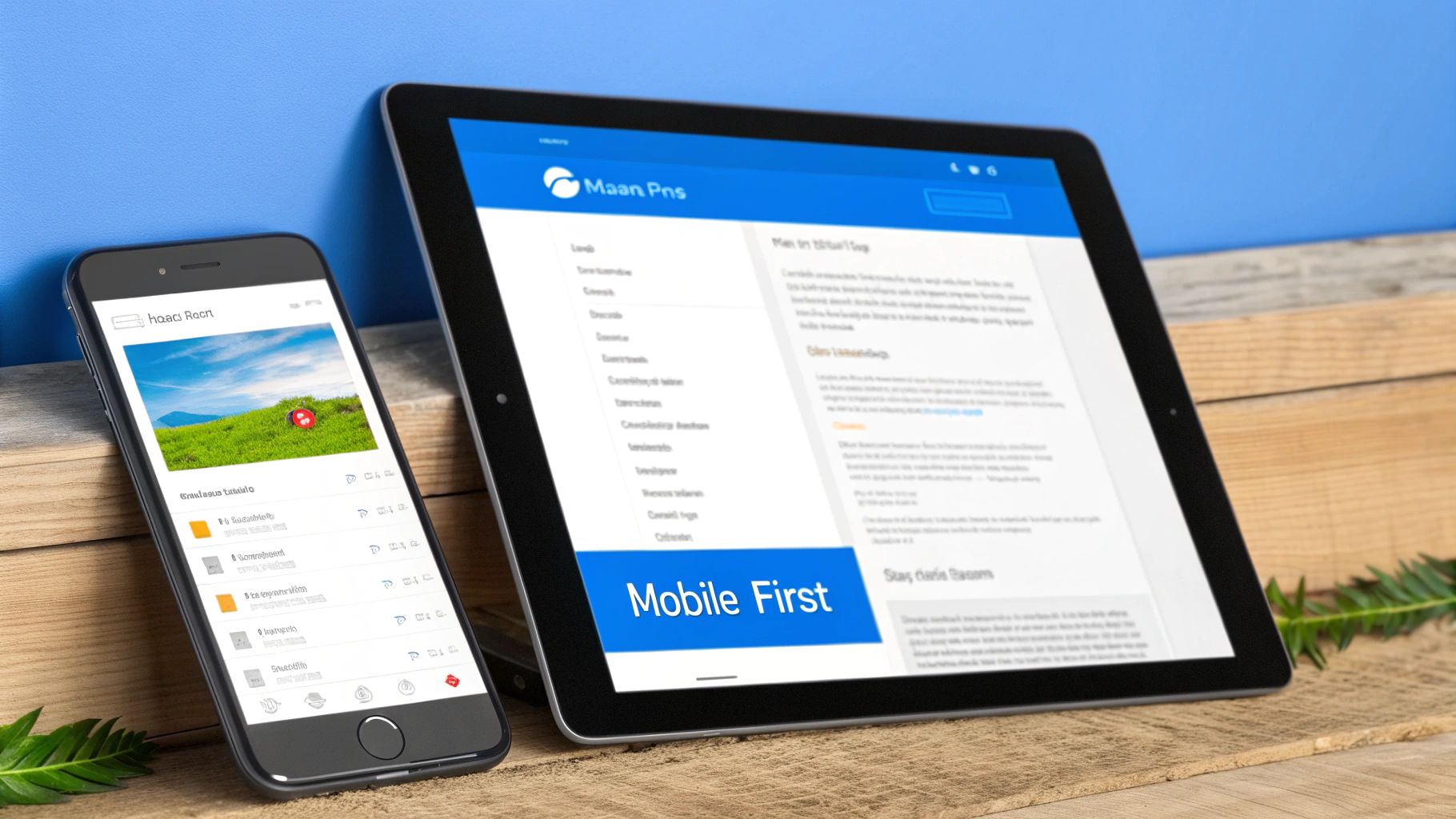
The goal is to eliminate friction. This means implementing single-column layouts that stack content vertically for effortless scrolling, using readable font sizes, and designing thumb-friendly call-to-action (CTA) buttons. Companies like Stripe excel at this by creating newsletters where content blocks stack neatly on mobile, ensuring a smooth reading experience. Similarly, Airbnb’s mobile-first design features centered content and prominent booking buttons that are easy to tap, driving user action without frustration. This focus on mobile usability directly impacts engagement and conversion rates.
How to Implement Mobile-Responsive Email Design
A mobile-first approach is the most effective way to ensure your emails look great everywhere. Start by designing for the smallest screen and then scale up.
- Adopt a Mobile-First Mindset: Design your email for a mobile view first, then adapt it for larger screens like tablets and desktops. This approach prioritizes clarity and forces you to focus on the most critical content.
- Create Thumb-Friendly CTAs: Make your primary call-to-action buttons at least 44x44 pixels. This provides a large enough target for users to tap easily with their thumb on a mobile screen, reducing accidental clicks and frustration.
- Optimize Images and Load Times: Large, unoptimized images can drastically slow down email load times on mobile networks. Compress image file sizes without sacrificing quality and always use descriptive alt text for accessibility and in case images fail to load.
- Test Across Multiple Clients: Before hitting send, preview your email across major clients like Gmail, Apple Mail, and Outlook on both desktop and mobile. This ensures a consistent and professional appearance for every subscriber.
5. Clear Call-to-Action (CTA) Strategy
Every email you send should have a purpose, and the call-to-action (CTA) is the bridge between that purpose and subscriber action. A core component of email campaign best practices is designing obvious, compelling, and well-positioned CTAs that guide recipients toward a desired outcome. Whether you want them to book a demo, download a resource, or read a blog post, a strong CTA removes friction and makes the next step crystal clear.

The best CTAs are more than just a button; they are the culmination of your email's message. They use action-oriented language, stand out visually, and directly align with the primary goal of the campaign. For instance, Calendly often uses a single, high-contrast purple button with the direct text 'Schedule a Demo'. Similarly, Mixpanel uses benefit-driven copy like 'See Analytics in Action' to entice clicks by focusing on the value proposition. This strategic approach transforms a passive email read into an active engagement, directly impacting conversion rates and campaign ROI.
How to Implement a Strong CTA Strategy
Effective CTAs are built through a combination of intentional design, persuasive copy, and continuous testing. Start with a clear hypothesis and refine your approach based on performance data.
- Use Action-Oriented Language: Begin your CTA with a powerful verb that clearly states the action. Instead of "Learn More," try "Discover the Strategy," "Download Your Guide," or "Claim Your Free Audit." This creates a sense of urgency and clarity.
- Prioritize Visual Hierarchy: Your primary CTA should be impossible to miss. Use a contrasting color that stands out from the email's background and ensure the button is large enough for easy tapping on mobile devices (at least 44x44 pixels is a good rule of thumb).
- Optimize Placement: Place your most important CTA "above the fold" so it's visible without scrolling. It's also effective to repeat the CTA at the end of the email for recipients who read the entire message before deciding to act.
- Test and Measure Everything: Don't assume you know what works best. A/B test different elements like button text, color, size, and placement to identify what drives the most clicks. For a deeper look into this process, explore this ultimate guide to CTA testing in email marketing.
6. Deliverability and Sender Reputation Management
Even the most brilliantly crafted email is useless if it never reaches the inbox. Deliverability, the measure of your ability to land in a subscriber's primary inbox instead of the spam folder, is a critical component of successful email campaign best practices. It’s governed by your sender reputation, a score that inbox providers like Gmail and Outlook assign based on your sending history, authentication, and engagement metrics.
Managing your sender reputation involves a combination of technical setup and consistent, responsible sending habits. This includes properly authenticating your domain to prove you are who you say you are and actively monitoring how recipients interact with your emails. For example, Amazon SES enforces strict authentication and warm-up protocols for new domains to build a positive reputation from the start. Neglecting deliverability means your entire email strategy is built on a shaky foundation, directly impacting open rates and ROI.
How to Implement Deliverability and Reputation Management
Proactively managing your sender reputation ensures your messages are seen by your target audience. Start with the technical fundamentals and maintain good sending hygiene over time.
- Configure Email Authentication: Before launching any campaigns, set up SPF, DKIM, and DMARC records in your DNS settings. These protocols act as your email's digital passport, verifying your identity to inbox providers and significantly reducing the risk of being flagged as spam.
- Warm-Up New Domains/IPs: If you're using a new sending domain or a dedicated IP, implement a warm-up schedule. Start by sending to a small, highly engaged segment and gradually increase your volume over several weeks. This process demonstrates positive sending patterns to providers.
- Monitor Key Metrics: Keep a close eye on your bounce and complaint rates. Aim for a bounce rate under 2% and a complaint rate below 0.1%. A sudden spike in either is a clear signal that something is wrong with your list health or content.
- Avoid Spam Triggers: Steer clear of common spam trigger words (e.g., "free," "act now"), excessive use of capital letters, and misleading subject lines. Clean, professional formatting and valuable content are key to staying out of the spam folder.
- Regularly Check Blacklists: Use tools to check if your domain or IP has been placed on any major blacklists. If you find an issue, address the root cause immediately and follow the delisting process provided by the blacklist operator.
7. Timing and Frequency Optimization
Sending the right message to the right person is only half the battle; sending it at the right time is what gets it opened. Timing and frequency optimization is the process of strategically determining the best days, times, and cadence for your emails based on your audience's behavior. This practice is crucial among email campaign best practices because send timing directly impacts open rates, while frequency management is a delicate balance between maintaining engagement and avoiding list fatigue.
Neglecting this element means your perfectly crafted email could be buried in an inbox by the time your subscriber starts their day. Conversely, sending too often can lead to a spike in unsubscribes, damaging your sender reputation. B2B audiences, for example, often show peak engagement mid-week during business hours. LinkedIn has found that Tuesday through Thursday mornings are prime engagement windows, while a company like Slack might see better performance in the mid-afternoon when teams are wrapping up projects. The goal is to align your sending schedule with your subscribers' digital habits.
How to Implement Timing and Frequency Optimization
Start with educated hypotheses based on industry benchmarks, but let your own data be the ultimate guide. A systematic testing approach will reveal the unique preferences of your audience.
- Establish a Testing Cadence: Begin by testing three distinct time slots across your list for a period of 4-6 weeks to gather significant data. For example, test sends at 9 AM, 1 PM, and 4 PM on a Tuesday to identify which slot generates the highest open and click-through rates.
- Segment Frequency by Engagement: Not all subscribers are equal. Your most active and engaged users may tolerate (and welcome) more frequent communication, while less active subscribers should be contacted more sparingly to avoid unsubscribes.
- Monitor Unsubscribe Rates: Keep a close watch on your unsubscribe rate after each send. A sudden increase is a clear indicator that your frequency is too high or your content is not meeting expectations for that cadence.
- Implement a Preference Center: Empower your subscribers by allowing them to choose their preferred email frequency (e.g., daily, weekly, monthly). This simple act respects their inbox and can significantly reduce your churn rate. You can learn more about building effective email strategies, including preference centers, through these go-to-market email templates.
8. Data-Driven Analytics and Performance Measurement
Launching an email campaign without tracking its performance is like navigating without a map. Data-driven analytics are the foundation of all email campaign best practices, transforming guesswork into a strategic, repeatable process for improvement. This involves systematically tracking, analyzing, and acting on key performance indicators (KPIs) to understand what resonates with your audience and what drives results. Without measurement, meaningful optimization is impossible.
The goal is to move beyond surface-level "vanity metrics" like open rates and focus on data that directly impacts business objectives, such as conversion rates, pipeline generated, and return on investment (ROI). For instance, HubSpot connects its email marketing tool directly to its CRM, allowing marketers to attribute closed deals back to specific email campaigns. This provides a clear, revenue-focused picture of what's working, enabling teams to double down on successful strategies and refine underperforming ones.
How to Implement Analytics and Performance Measurement
Establishing a regular cadence for reviewing analytics and making data-informed decisions is crucial for long-term growth. Start by defining what success looks like and building a system to track it consistently.
- Establish Key Metrics: Focus on a handful of critical KPIs. Key metrics for B2B include click-through rate (CTR), conversion rate (e.g., demo requests, content downloads), unsubscribe rate, and ultimately, email-attributed revenue.
- Utilize UTM Parameters: Consistently use UTM parameters on all links within your emails. This ensures that you can accurately track traffic and conversions back to specific campaigns and even specific links within an email in your analytics platform.
- Create a Performance Dashboard: Build a simple dashboard to track your primary KPIs over time (weekly, monthly, quarterly). This provides an at-a-glance view of performance trends and helps you quickly spot anomalies or opportunities for improvement.
- Review and Iterate Regularly: Schedule a weekly or bi-weekly review of your email analytics. Use these sessions to identify patterns, form hypotheses, and plan A/B tests to continuously enhance your campaigns. To understand which metrics are most important for testing, you can review this guide on essential A/B testing metrics and what to track.
9. Content Quality and Value Delivery
The most sophisticated segmentation and automation will fail if the content inside your emails is weak. A core component of modern email campaign best practices is shifting focus from selling to serving. Instead of a constant stream of promotional messages, your primary goal should be to provide genuine value by educating, informing, or solving a specific problem for your audience. For B2B subscribers, this means delivering professional, well-researched content that respects their expertise and busy schedules.
This value-first approach is what transforms an email list from a simple marketing channel into a trusted resource. When subscribers know your emails will help them do their jobs better, they are more likely to open, read, and engage with your messages, including the occasional promotional one. For example, HubSpot’s marketing emails often feature actionable guides and templates rather than direct product pitches, building authority and keeping their audience engaged long-term. This strategy builds brand equity and keeps you top-of-mind when a purchasing need arises.
How to Implement a Value-Driven Content Strategy
To consistently deliver high-quality content, build a system that prioritizes your audience's needs over your own promotional calendar.
- Follow the 80/20 Rule: A well-established guideline is to make 80% of your content educational and valuable, with only 20% being promotional. This ratio ensures you build goodwill and earn the right to sell.
- Address Specific Pain Points: Conduct research through surveys, customer interviews, and sales team feedback to understand the primary challenges your subscribers face. Create content, such as checklists, frameworks, or tutorials, that directly addresses and solves these problems.
- Repurpose High-Performing Assets: You don't always need to create content from scratch. Adapt your most successful blog posts, webinars, case studies, and reports into digestible email formats. This maximizes the reach of your best content.
- Establish Authority with Data: Incorporate original research, compelling statistics, and data-backed insights into your emails. This positions your brand as a credible authority in your industry and makes your content more shareable and memorable.
10. List Growth and Audience Expansion Strategy
A sophisticated email campaign strategy is only as effective as the audience it reaches. Systematically growing your email list with high-quality, engaged subscribers who match your ideal customer profile (ICP) is a foundational email campaign best practice. A healthy, growing list is an appreciating asset that fuels every other marketing and sales initiative, providing a direct and owned channel for communication.
Effective list growth is not about accumulating the largest number of contacts possible; it's about attracting the right contacts. This involves a balanced approach, combining organic methods that attract subscribers through value and paid channels that provide predictable, scalable growth. For example, Lenny's Newsletter grew its influential B2B audience by consistently delivering deep, valuable product insights, which naturally encouraged word-of-mouth referrals and social sharing. This focus on quality over sheer quantity ensures higher engagement, better deliverability, and a greater return on investment from your email efforts.
How to Implement a List Growth Strategy
Building a sustainable growth engine requires a multi-channel approach focused on value exchange. Offer compelling reasons for your target audience to subscribe and stay engaged.
- Optimize High-Value Lead Magnets: Create and promote resources that solve a specific problem for your ICP. This could be a comprehensive industry report, an exclusive template, a free tool, or an in-depth webinar. Test different offers to see which one resonates most with key segments like job role or industry.
- Implement Referral Programs: Leverage your existing subscriber base by incentivizing them to invite their peers. Offer rewards like exclusive content, early access to features, or even gift cards for successful referrals. This taps into trusted networks and brings in highly qualified leads.
- Explore Paid Acquisition Channels: For more predictable growth, allocate a budget to channels where your audience is active. This includes sponsoring relevant industry newsletters, running targeted ads on platforms like LinkedIn, or partnering with complementary brands for co-marketing initiatives.
- Track Channel Performance: Don't just focus on the number of new subscribers. Monitor key metrics like engagement rate, conversion rate to customer, and customer acquisition cost (CAC) for each channel. This data will allow you to double down on what works and optimize your budget for maximum ROI.
10-Point Email Campaign Best Practices Comparison
Practice
🔄 Implementation Complexity
⚡ Resource Requirements
⭐ Expected Outcomes
📊 Ideal Use Cases
💡 Key Advantages / Tips
Segmentation and Personalization
Medium–High: initial setup of segments and dynamic content, ongoing maintenance
Data enrichment, CRM integration, automation tools, content variants
High ⭐⭐⭐⭐ — higher opens, CTRs, conversions
ICP-driven B2B outreach, account-based campaigns, lifecycle nurture
Start with 3–5 core segments; use ICP/AI enrichment; monitor segment size
Subject Line Optimization
Low–Medium: iterative A/B testing and copy refinement
Copywriters, A/B testing tools, analytics
Moderate–High ⭐⭐⭐ — meaningful open-rate uplift
Any campaign needing improved open rates (promos, newsletters)
Keep <50 chars for mobile; test personalization vs curiosity; avoid overpromise
List Hygiene and Compliance
Medium: routine cleanup and legal/process controls
Validation tools, compliance workflows, legal oversight
High ⭐⭐⭐⭐ — improved deliverability and lower risk
Large lists, multi-jurisdiction sends, high-volume campaigns
Enforce double opt-in; remove hard bounces immediately; document opt-ins
Mobile-Responsive Email Design
Medium: responsive templates + cross-client QA
Designers/devs, responsive builder, device testing tools
High ⭐⭐⭐⭐ — better mobile CTR and UX
Mobile-first audiences, newsletters, transactional emails
Design mobile-first; 44x44 CTAs; optimize images and test major clients
Clear Call-to-Action (CTA) Strategy
Low–Medium: copy + design alignment and testing
Design assets, analytics/UTM tracking, simple A/B tests
High ⭐⭐⭐⭐ — increases clicks and conversions
Demo signups, downloads, event registration, product CTAs
Use single primary CTA; power verbs; place above fold and repeat; add UTMs
Deliverability & Sender Reputation Management
High: technical DNS, monitoring, and remediation
Dev/IT, deliverability tools, warm-up schedules, monitoring
High ⭐⭐⭐⭐ — consistent inbox placement and sending scale
New sending domains, high-volume senders, regulated industries
Configure SPF/DKIM/DMARC; warm up IPs; monitor bounces and blacklists
Timing and Frequency Optimization
Medium: testing cadence and automation per recipient
Send-time optimization tools, analytics, timezone logic
Moderate ⭐⭐⭐ — improved opens and reduced churn
Recurring campaigns, segmented audiences, international lists
Test multiple time slots for 4–6 weeks; offer frequency prefs; cap sends
Data-Driven Analytics & Performance Measurement
Medium: integrate data sources and dashboards
Analytics platform, CRM integration, UTM discipline
High ⭐⭐⭐⭐ — enables continuous optimization and ROI tracking
All programs requiring measurement and attribution
Track conversions/ROI, not just opens; set baselines and review weekly
Content Quality and Value Delivery
High: content strategy, creation, and curation effort
Writers, researchers, designers, editorial calendar
High ⭐⭐⭐⭐ — builds trust, retention, and organic engagement
Thought leadership, nurture sequences, long-term retention
Follow 80/20 value/promo; repurpose top content; solicit feedback
List Growth and Audience Expansion Strategy
Medium–High: multi-channel acquisition & optimization
Lead magnets, paid channels, partnerships, forms
High ⭐⭐⭐⭐ — increases addressable market and revenue potential
Scaling acquisition, sponsorships, enter new verticals
Test lead magnets by segment; track CAC by channel; prioritize quality over size
From Best Practices to Business Growth
We've explored the ten fundamental pillars of exceptional email marketing, from the granular details of subject line optimization to the strategic oversight of list hygiene and compliance. It's easy to view this comprehensive list as a daunting series of tasks to be checked off. However, the true power of these email campaign best practices lies not in isolated execution, but in their integration into a cohesive, flywheel-like system that propels sustainable business growth. Adopting these principles transforms your email program from a simple broadcast channel into a sophisticated engine for building relationships, nurturing leads, and driving revenue.
The journey from a decent email strategy to a world-class one is iterative. It's about shifting your mindset from "sending emails" to "solving problems" for your audience, one targeted campaign at a time. The principles discussed are not just theoretical; they are the practical levers that B2B growth teams, enterprise sales leaders, and newsletter creators pull every day to achieve remarkable results.
The Interconnected Pillars of Email Excellence
The most successful marketers understand that these best practices are deeply interconnected. Think of it this way:
- Powerful segmentation and personalization are ineffective if poor deliverability prevents your messages from ever reaching the inbox.
- A perfectly crafted, mobile-responsive design is wasted if the content inside fails to deliver tangible value or is sent at the wrong time.
- An aggressive list growth strategy will backfire spectacularly without rigorous list hygiene, damaging your sender reputation and leading to diminishing returns.
Your goal is to create a virtuous cycle. A clean, engaged list improves deliverability, which ensures your valuable content is seen. Compelling content with clear calls-to-action drives higher engagement, which further signals to inbox providers that your emails are wanted. This positive feedback loop is the hallmark of a mature email marketing program.
Key Takeaway: Mastering email marketing isn't about perfecting one area; it's about raising the baseline across all ten pillars simultaneously. Incremental improvements in several areas yield a greater cumulative impact than a singular focus on just one.
Your Actionable Roadmap to Implementation
Reading about best practices is the first step; implementation is what separates high-performers from the rest. To avoid getting overwhelmed, start with a strategic audit and prioritize your efforts. Here’s a simple framework to get you started:
- Conduct a Quick Audit: Score your current email program from 1-10 on each of the ten practices covered in this article. Where are your biggest gaps? Are you flying blind without proper analytics, or is your list hygiene long overdue for attention?
- Identify Low-Hanging Fruit: Pinpoint 1-2 areas where you can make a meaningful impact with minimal effort. This could be as simple as establishing a consistent A/B testing schedule for subject lines or implementing a basic welcome automation series for new subscribers.
- Commit to a Keystone Habit: Choose one practice to focus on deeply for the next quarter. For instance, you might commit to building out three new audience segments based on user behavior data or launching a dedicated re-engagement campaign to win back inactive subscribers.
- Measure, Iterate, and Expand: Track the results of your initial changes. Did improving your CTA design increase click-through rates? Did cleaning your list boost your open rates? Use these small wins to build momentum and gain buy-in for tackling the more complex areas of your strategy.
By systematically applying these email campaign best practices, you move beyond guesswork and into the realm of data-driven, predictable growth. You stop just sending campaigns and start building a resilient, high-performance marketing asset that consistently delivers measurable business value and fosters deeper connections with your most important audiences.
Ready to elevate your email strategy without the manual grind? Breaker automates the most challenging aspects of these best practices, from intelligent list expansion and deliverability management to providing the real-time analytics you need to optimize effectively. See how top B2B teams are using Breaker to turn their email programs into powerful growth engines.
Generated with the Outrank tool
Keep reading
All articlesGDPR Consent Requirements for Purchased Email Lists
Purchased email lists rarely meet GDPR's consent bar. Learn the legal basis rules, PECR overlap, and safer alternatives before you hit send.
7 Email Platforms With Inbox Placement Testing & Suppression
Compare 7 email platforms that combine inbox placement testing with suppression management, scored on features, pricing, and best-fit sender size.
Email Automation Workflow & Drip Campaign Data Structure
Learn the database schema behind email drip campaigns—tables, workflow states, and event logs that power reliable marketing automation.