
Ultimate Guide to Storytelling in B2B Newsletters
Stop sending feature lists—use customer-led storytelling in B2B newsletters to boost opens, clicks, and pipeline with clear frameworks, proof, and scalable processes.

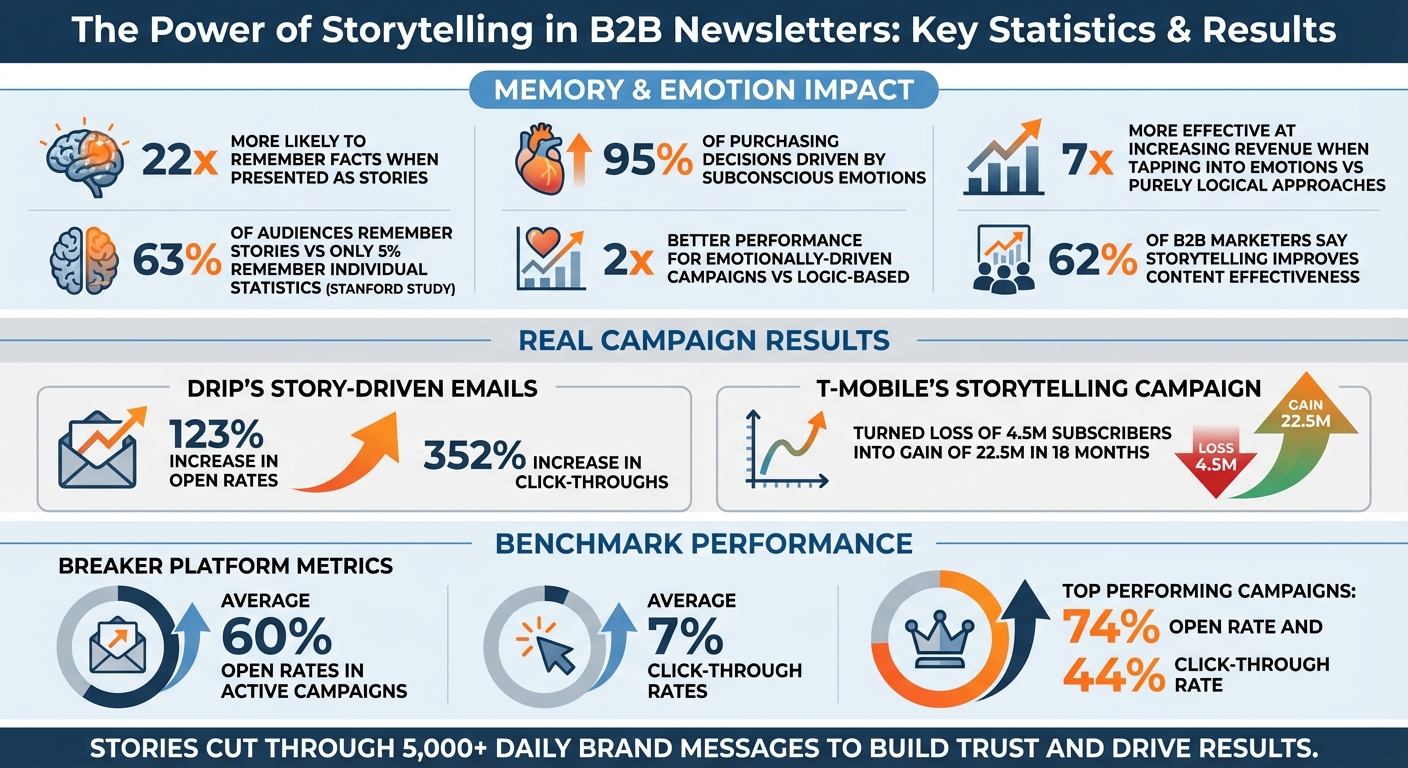
Storytelling transforms B2B newsletters from dull, product-heavy emails into engaging content that builds connections and drives results. Why does it work? People are 22 times more likely to remember facts when presented as stories, and emotionally-driven campaigns perform 2x better than logic-based ones. Instead of focusing on features, storytelling makes your customer the hero, showcasing real challenges and solutions.
Key Takeaways:
- Why It Matters: Storytelling cuts through the noise of 5,000+ daily brand messages, fostering trust and loyalty.
- Proven Results: Example: Drip increased open rates by 123% and click-throughs by 352% with story-driven emails.
- Core Elements: Build stories with five essentials: character, conflict, stakes, resolution, and takeaway.
- Frameworks That Work: Use structures like Hero’s Journey or Problem-Agitate-Solution to craft relatable narratives.
- Practical Tips: Write concise emails with clear subject lines, bolded stats, and one call-to-action for maximum impact.
Storytelling isn’t fluff - it’s a proven method to engage readers and boost results in B2B email marketing.
B2B Newsletter Storytelling Statistics and Key Performance Metrics
BOOST Your Sales with the Power of STORYTELLING in Emails
Core Principles of B2B Newsletter Storytelling
At the heart of every compelling B2B story lies the same foundational structure. Whether it’s a customer success narrative or an industry insight, the difference between a forgettable email and one that sparks action boils down to five key elements: character, conflict, stakes, resolution, and takeaway. In this dynamic, the character is always your customer - not your brand. They are the hero, grappling with challenges like operational inefficiencies, compliance hurdles, or competitive pressures. Your brand? You’re the mentor, offering the tools and guidance they need to succeed.
The conflict is what keeps readers hooked. It’s the looming challenge - an industry shake-up, a technical roadblock, or an internal inefficiency standing in the way of success. The stakes explain why solving this matters, whether it’s about avoiding revenue loss, protecting a reputation, or seizing new opportunities. The resolution highlights the transformation your product or service made possible, supported by real results. And the takeaway? That’s the practical insight or lesson your reader can use, even if they’re not ready to make a purchase just yet.
Key Elements of a B2B Story
Here’s how these elements come to life:
- Character: A relatable figure, like a CFO, IT director, or operations manager, facing tangible professional challenges.
- Conflict: The obstacle creating tension - outdated systems, regulatory shifts, or inefficiencies causing delays.
- Stakes: The quantifiable risks, whether in time, money, or competitive positioning.
- Resolution: A clear transformation, with measurable results that highlight the impact of your solution.
- Takeaway: A valuable insight or actionable lesson the reader can apply right away.
Why does storytelling matter so much in B2B? A Stanford study found that only 5% of an audience remembered individual statistics, but 63% remembered the stories they heard. This is because stories evoke emotional responses - even in B2B buyers who often claim to make purely rational decisions. In reality, 95% of purchasing decisions are driven by subconscious emotions. Campaigns that tap into these emotions are seven times more effective at increasing revenue and profit compared to purely logical approaches.
Story Frameworks for B2B Newsletters
To craft these stories, proven frameworks can help you structure the narrative. For example:
- The Hero’s Journey simplifies into five steps for newsletters: The Ordinary World (the problem), Call to Adventure (the need for change), The Mentor (your brand), The Transformation (the result), and The Return (the broader lesson).
- Problem-Agitate-Solution (PAS) works well when emphasizing the cost of inaction. It identifies the pain point, intensifies it by illustrating worst-case scenarios, and then offers your solution as the way forward.
- Before-After-Bridge (BAB) uses contrast to show where the customer started, where they could be, and how your product bridges the gap.
- Overcoming the Monster is perfect for stories about major disruptions, where your customer faces a daunting challenge and your brand equips them to overcome it.
Framework
Core Structure
Best Use Case
Hero's Journey
Hero → Conflict → Mentor → Transformation
Customer success stories and case studies
Problem-Agitate-Solution (PAS)
Identify pain → Paint worst-case → Offer solution
Highlighting inaction costs or industry shifts
Before-After-Bridge (BAB)
Ordinary world → Desired future → Your product
Product launches and feature updates
Overcoming the Monster
Hero faces insurmountable threat → Brand empowers hero
Market disruptions or major challenges
Humanizing B2B Storytelling
B2B buyers aren’t just professionals - they’re people with careers, reputations, and personal stakes in their decisions. To connect, your stories need to tap into what researchers call “rational emotions,” like trust, fear of risks, status concerns, and the aspiration to leave a legacy. A great example comes from The Turmeric Co.’s founder, Thomas Robson-Kanu. In a welcome email, instead of listing product benefits, he shared the story of a career-threatening football injury that inspired him to start the company. That emotional hook drew readers into the brand’s story before any mention of a sale.
"B2B marketing too often flattens audiences into one-dimensional robots trying to solve a business goal... Stories that work in the B2B space do need to be clear on their facts and figures... But they should also connect on the level of values." – Jonah Sachs, CEO, Free Range Studios
Make your stories personal. Use real people - don’t sign off as “The Team.” Let specific team members narrate emails to build a genuine connection. Write conversationally, throwing in phrases like “Yay!” or “Ugh…” to make the tone feel natural. Add micro-conflicts, like a late-night fix or a tense meeting, to make the story relatable. And don’t shy away from humor. As GE’s Beth Comstock put it: “You have to be true to who you are... At GE, we know we’re not Facebook or Apple – we embrace our geeky side”. Authenticity wins over perfection every time.
Types of Stories for B2B Newsletters
Crafting compelling stories for B2B newsletters requires a solid grasp of storytelling principles tailored to professional audiences. Each type of story serves a distinct role - whether it's building trust, showcasing values, or positioning your brand as an expert in the field. By weaving narratives that connect with readers, you can boost engagement and establish lasting credibility.
Customer Success and Case Stories
Customer success stories are among the most impactful tools in B2B storytelling. Why? Because they highlight real-world challenges and the tangible benefits of your solutions. These stories follow a simple yet powerful structure: Before (The Problem) → During (Your Solution) → After (The Results).
For example, T-Mobile's "Uncarrier" campaign didn't just announce new pricing plans - it told a story about an industry riddled with restrictive contracts and excessive roaming fees. By positioning itself as the disruptor, T-Mobile turned a loss of 4.5 million subscribers into a gain of 22.5 million over just 18 months.
When crafting these stories for newsletters, focus on real scenarios. Instead of listing product features, illustrate how a CFO solved a budget crisis or how an IT director tackled a security breach. Use specific metrics - like percentage increases, time saved, or revenue growth - to make the transformation feel concrete. After all, stories are 22 times more memorable than plain data.
Brand and Mission Stories
Origin stories and mission-driven narratives help set your brand apart in competitive markets while fostering trust. They answer key questions: Who are you? Why does your company exist? What values guide your decisions? These stories resonate because they go beyond products, focusing on shared beliefs and values.
Consider Salesforce's "1-1-1 program." Back in 1999, founder Marc Benioff pledged 1% of equity, 1% of employee time, and 1% of products to social causes. This wasn't just a marketing move - it became a core part of Salesforce's identity, inspiring over 70 other companies to adopt the same model. It’s a prime example of how mission-driven stories can create a lasting emotional connection with customers.
To craft your own brand story, highlight the people behind your company. Share how it all started, the hurdles your team overcame, or the values that shape your decisions. As Dan Martell puts it:
"Authority isn't bestowed to the entrepreneur with the best message but the entrepreneur most willing to express it."
Authenticity is key here - getting personal helps build trust faster.
Industry Insights and Trend Narratives
Data-driven stories are powerful for establishing expertise while offering real value to your audience. But raw numbers alone won’t create a connection. To truly engage, combine data with context, analysis, and actionable takeaways. The goal? Not just to inform, but to help readers make smarter decisions.
Unlike mission stories that focus on values, data-driven narratives position your brand as a thought leader. Start with a clear structure: introduce the challenge, explain the shift, and provide practical advice. For instance, instead of simply stating that "62% of newsletter professionals think web-based distribution will be more effective", explain what this means for content strategy and how your audience can adapt.
A great example comes from Canadian Tire, which used data storytelling to improve inventory planning. By implementing AI dashboards, they didn’t just present supply chain numbers - they explored the root causes of stockouts, like sudden demand spikes or supplier delays. This approach helped teams address problems more effectively and strengthened the story’s impact.
To make these insights digestible, use bold text, headings, and bullet points to create quick, skimmable takeaways. Remember, what sets your story apart isn’t just the data itself - it’s your unique perspective and expertise that make it truly valuable.
How to Write Stories in B2B Newsletters
When crafting stories for B2B newsletters, it's essential to make every word count. Decision-makers often skim emails quickly, often on their phones, between meetings. Your challenge? Deliver a compelling narrative in a compact, easy-to-read format.
Writing Subject Lines and Preheaders That Get Opens
Your subject line and preheader are like the opening scene of a movie - they need to grab attention and set the stage. Instead of generic topics like "Our latest case study", focus on creating intrigue or showcasing a result. For instance, a subject line like "How a SaaS CFO cut churn 27% in 90 days" teases both a problem and a solution, sparking curiosity. Pair that with a preheader that adds context or hints at the resolution, such as "Discover the 3 changes that made it happen."
Specific details make your message stand out. Use numbers or relatable scenarios to build trust and interest. Examples include:
- "How Acme reduced support tickets by 42% in 90 days"
- "The workflow problem your CRM isn’t solving yet"
- "What one ops director did to save 10 hours a week"
However, don’t fall into the trap of clickbait. If you promise a "3-step playbook" in your subject line, ensure the email delivers those steps clearly and concisely. Testing different approaches - whether focusing on challenges, outcomes, or specific roles - can help you identify what resonates most with your audience.
Structuring Stories for Email Format
Emails need a streamlined narrative that works on small screens. A simple three-part structure works best:
- Context & Conflict: Start with 1–3 sentences introducing the problem or challenge.
- Action: Briefly explain the steps taken, emphasizing your solution’s role without making it sound like a sales pitch.
- Outcome & Takeaway: Highlight measurable results and provide a clear lesson or next step.
Keep your story between 250–400 words to avoid overwhelming readers. Use short paragraphs, bold key figures, and subheadings like "The Challenge", "What Changed", and "The Result" to make the content skimmable. This format ensures busy professionals can grasp the core value quickly, even if they’re just scanning.
Position your strongest story at the top of the email. Use secondary sections - like "Quick Win", "Customer Spotlight", or "Industry Snapshot" - to share shorter, supporting stories. Design for mobile-first reading: keep copy concise, make buttons easy to tap, and ensure key information is visible without scrolling. Stick to one main call-to-action per story, such as "See the full playbook" or "Schedule a 15-minute consultation", and reinforce it with a clear button.
Adding Data and Proof to Stories
Data and testimonials lend credibility to your narrative. Focus on one or two powerful metrics - like time saved, revenue impact, or risk reduction - and present them in a way that’s easy to spot, such as bolded text or simple visuals. For example:
"Within 60 days, new-user activation rose from 43% to 71%, while support tickets dropped by 35%."
Use before-and-after comparisons or specific timeframes to make the results feel tangible. For instance, "12 days to close versus 7 days after rollout" or "in just one quarter." Avoid overwhelming readers with too many stats; instead, highlight the ones that matter most to your audience, like cost per lead or resolution time.
Incorporate testimonials strategically. Don’t just add a block quote at the end - place it where it reinforces a key point. For example:
"As Jenna, Director of Operations at Northstar, explains, 'We cut monthly reporting time from 3 days to a few hours - and my team finally stopped working weekends.'"
Including the customer’s name, role, and company adds authenticity and builds trust. Focus on testimonials that highlight specific outcomes rather than vague praise.
Tools like Breaker can help B2B marketers refine their storytelling by analyzing which formats and proof points drive the most engagement. With average open rates of 60% and click-through rates of 7% in active campaigns, you can test subject lines, story structures, and data placements to see what works best for your target audience.
Scaling and Measuring Storytelling in B2B Newsletters
Building a Story Pipeline
To scale your storytelling efforts, start by creating a structured process for gathering stories. One way to do this is by setting up a Slack channel or a form where teams like sales, customer success, and product can share weekly updates. These might include customer wins, challenges overcome, standout support tickets, or those game-changing "aha" moments during demos. Regular check-ins with these teams can help ensure a steady flow of fresh ideas.
Once you have stories coming in, organize them in a tool like a spreadsheet or Airtable. Tag each story by buyer persona, funnel stage, and theme to keep things easy to track. Establish a monthly goal - such as collecting five stories per channel - to ensure a consistent output. Use a simple, repeatable template (e.g., challenge → approach → measurable result) with one or two quotes and a clear call-to-action. This framework keeps your narratives focused and aligned with your marketing objectives.
Using Analytics to Improve Storytelling
Analytics can help you fine-tune your storytelling. Start by tracking open rates to see what types of subject lines grab attention - whether they spark curiosity or highlight outcomes. If open rates are high but clicks are low, it might mean the story content or call-to-action isn’t connecting with readers. To dig deeper, monitor metrics like click-through rates (CTR) and click-to-open rates (CTOR) to ensure your subject line matches the story being told. And if you notice a spike in unsubscribes after a particular story, it could signal a mismatch with audience expectations.
Segment your analytics by factors like industry, role, or company size to pinpoint which stories perform best. Go a step further by tying email engagement to outcomes like demo bookings or trial signups. This helps identify which types of narratives actually drive results. A/B testing different angles - such as focusing on the problem versus the solution - can also reveal what resonates most. Research shows that 62% of B2B marketers say storytelling improves content effectiveness. These insights can guide you in creating more impactful, scalable storytelling strategies.
Using Breaker for Storytelling at Scale
Breaker takes these insights and helps you scale your efforts seamlessly. Its precise targeting ensures that customer success stories reach prospects facing similar challenges, making your narratives more relevant without requiring manual segmentation. With real-time analytics, you can quickly identify high-performing stories and replicate their success in future campaigns. On average, Breaker campaigns boast an impressive 74% open rate and a 44% click-through rate, offering a strong benchmark for storytelling success.
The platform’s newsletter builder simplifies design and scheduling, allowing your team to focus on crafting engaging content. Plus, its automated lead generation tools bring in subscribers who fit your ideal customer profile, ensuring a steady stream of engaged readers. This makes it easier to test and refine your storytelling approach. As Josh Durham, CEO of Aligned Growth Media, puts it:
"Breaker is our #1 source of booked calls."
Conclusion
Storytelling plays a crucial role in B2B newsletters - it’s a proven method to spark engagement, earn trust, and drive pipeline growth. Unlike product-focused emails that merely list features, story-driven messages bring solutions to life by showcasing real people overcoming real challenges. This makes abstract ideas tangible and memorable. Research consistently shows that storytelling enhances content performance, leading to better open rates, higher click-throughs, and more qualified leads.
To craft compelling newsletters, start by identifying three key elements: the hero, the challenge, and the transformation. Use customer success stories to provide relatable examples. Combine emotional narrative hooks with solid data to appeal to both the heart and the mind. And don’t forget to test and refine your approach based on what resonates most with your audience.
This shift from feature-heavy content to human-centered storytelling requires a structured process. Build a steady pipeline of stories by gathering customer wins, team highlights, and market insights from your sales and support teams. Organize these stories based on audience personas and where they fall in the sales funnel. A simple format - challenge, approach, result - can help you stay consistent and even shorten sales cycles by educating prospects early on and helping them build internal cases for your solution.
Breaker simplifies this transition. By aligning storytelling with strategy, it ensures your customer stories reach the right prospects at the right time. Its real-time analytics reveal which narratives are working best, while its easy-to-use newsletter builder handles design and scheduling. Automated lead generation tools attract engaged subscribers, giving your team more time to focus on crafting stories that convert. As Peter Lohmann, CEO of RL Property Management, shared:
"We tripled our sponsor revenue and doubled our community memberships with breaker. Well over a 10X ROI."
Ready to get started? Try reframing your next newsletter as a story. Give it a clear beginning, middle, and end. Add one relatable human detail, and craft a subject line that teases the narrative. Track the impact on open and click rates. That single experiment will show you how storytelling can transform your newsletters into a powerful growth engine.
FAQs
How does storytelling boost engagement in B2B newsletters?
Storytelling has the power to turn an ordinary B2B newsletter into something readers actually look forward to. By weaving content into relatable narratives, you can replace bland feature lists or updates with something that captures attention and sticks in the mind. A good story - complete with a protagonist, a challenge, and a resolution - doesn’t just entertain; it creates an emotional connection. And that connection? It’s what drives readers to click, share, or take the next step.
When aligned with the buyer’s journey, storytelling becomes even more effective. Imagine this: the buyer is the hero, their pain point is the obstacle, and your solution steps in as the trusted guide. Suddenly, your call-to-action feels less like a sales pitch and more like a natural next step in their story. Over time, this approach does more than just boost engagement - it builds trust and loyalty, making your newsletters feel personal rather than promotional.
What makes a B2B story effective in newsletters?
An engaging B2B story grabs attention and connects with its audience by focusing on a few essential elements. It starts with a hero - usually a customer or an industry persona - facing a challenge that reflects the audience’s own struggles or concerns. Then, your product or service steps in as the solution, helping the hero overcome the obstacle and achieve measurable results, like cutting costs or boosting productivity.
For a story to truly resonate, it needs to feel genuine and relevant, aligning seamlessly with your brand’s values while addressing the realities of decision-makers. Incorporating an emotional angle - like a surprising revelation or a relatable human touch - keeps readers hooked and ensures your message sticks. When these elements come together, they create a narrative that not only informs but also persuades and motivates action in a B2B newsletter.
What are the best storytelling frameworks for B2B newsletters?
The best storytelling frameworks for B2B newsletters are those that craft a compelling narrative while aligning seamlessly with the buyer’s journey. Some tried-and-true options include the Hero’s Journey, Problem-Agitate-Solution (PAS), and the Three-Act Structure. These approaches make it easier to break down complex ideas, build emotional connections, and keep readers engaged.
The Hero’s Journey is particularly effective for B2B newsletters because it positions the reader as the hero and the brand as their trusted guide. This framework connects with readers by addressing their challenges and ambitions in a relatable way. On the other hand, the PAS model is great for grabbing attention by spotlighting a problem, stirring urgency, and presenting a clear solution. The Three-Act Structure keeps things straightforward with a classic beginning, middle, and end, making the story flow naturally and leaving a lasting impression.
Leveraging these storytelling techniques helps marketers craft newsletters that not only capture attention but also drive better open rates, clicks, and conversions.
Related Blog Posts
Keep reading
All articlesGDPR Consent Requirements for Purchased Email Lists
Purchased email lists rarely meet GDPR's consent bar. Learn the legal basis rules, PECR overlap, and safer alternatives before you hit send.
7 Email Platforms With Inbox Placement Testing & Suppression
Compare 7 email platforms that combine inbox placement testing with suppression management, scored on features, pricing, and best-fit sender size.
Email Automation Workflow & Drip Campaign Data Structure
Learn the database schema behind email drip campaigns—tables, workflow states, and event logs that power reliable marketing automation.