
Ultimate Guide To Engagement-Based Segmentation
Engagement-based segmentation protects deliverability, boosts opens and clicks, and turns B2B emails into consistent revenue drivers.

Want better email results? Engagement-based segmentation is the key. It’s all about dividing your email list into smaller groups based on how subscribers interact with your messages - like opening emails, clicking links, or making purchases. This strategy helps you send the right content to the right people at the right time, boosting open rates, click-through rates, and revenue.
Here’s what you’ll learn:
- What it is: Group subscribers by activity levels (e.g., "Highly Engaged" or "At-Risk").
- Why it matters: Segmented campaigns can increase revenue by 760% and open rates by 203%.
- How to use it: Track metrics like open rates, clicks, and conversions. Adjust email frequency and content based on engagement tiers.
- Tools to simplify: Platforms like Breaker automate segmentation and track real-time engagement.
Engagement-based segmentation isn’t just about better metrics - it ensures your emails land in inboxes, not spam folders. Ready to refine your email strategy? Let’s dive in.
Key Metrics for Measuring Subscriber Engagement
Core Metrics to Track
To fine-tune your email strategy, tracking specific engagement metrics is essential. Start with the basics: open rates measure how effective your subject lines are at grabbing attention, while click-through rates (CTR) show whether your email content delivers on that initial promise. To dig deeper, monitor click-to-open rates (CTOR) - this metric helps you determine if the content inside your email aligns with the expectations set by its subject line.
For a more detailed look at engagement, focus on conversion actions. These include behaviors like webinar sign-ups, whitepaper downloads, form submissions, or demo requests. These actions go beyond passive engagement, signaling a subscriber's active interest. Additionally, tracking website engagement - such as time spent on your site and pages viewed - provides a broader picture of their interest level.
It's equally important to pay attention to negative engagement signals. High unsubscribe rates or spam complaints can damage your sender reputation and email deliverability. Tonya Gordon, Manager of Deliverability Strategy at Klaviyo, emphasizes this point:
"Sending frequently to subscribers who aren't engaging does far more harm than good".
To protect your sender reputation, aim to keep your unsubscribe rate below 1%.
Once you've established these metrics, you can take engagement tracking a step further with lead scoring.
Using Lead Scoring to Prioritize Subscribers
Lead scoring assigns numerical values to subscriber actions, helping you separate casual browsers from high-intent prospects. For instance, you might assign +20 points for a demo request and +5 points for an email open. This system gives sales teams a clearer picture of who’s ready to buy.
Combine implicit scoring (actions like email clicks and website visits) with explicit scoring (self-reported details such as job title or company size) for a well-rounded evaluation. Many marketers use two separate scores: one for "Fit" (how closely a lead matches your ideal customer profile) and another for "Interest" (how actively they engage with your content). This dual approach helps prioritize outreach efforts effectively.
You can also apply negative scoring to account for behaviors that suggest low intent. For example, deduct points for using a generic Gmail address in a B2B context or for visiting only your "Careers" page. With 53% of salespeople reporting that selling has become more challenging over the past year, lead scoring is a powerful tool to focus your efforts on the prospects most likely to convert.
Never land in SPAM again with this STRATEGY
How to Define Engagement Tiers in B2B Campaigns
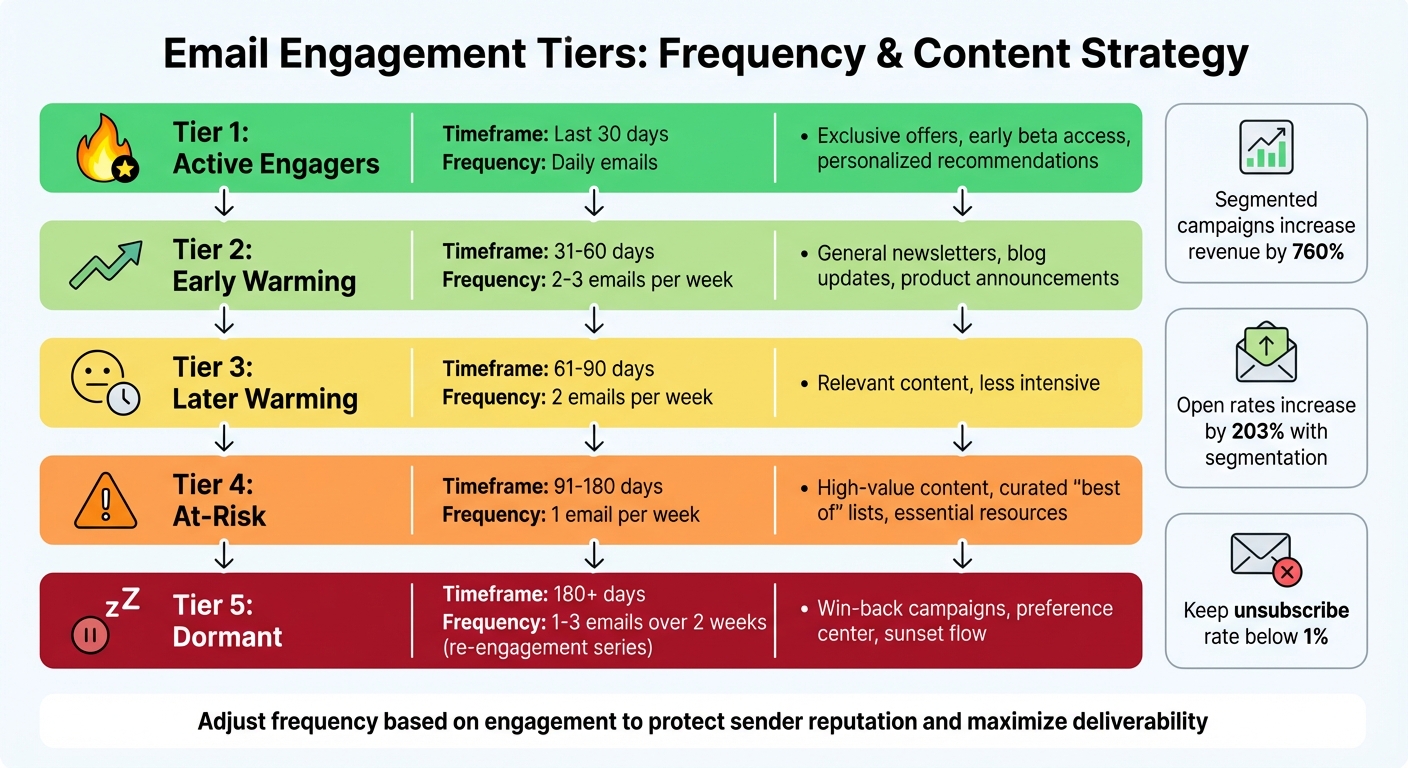
Engagement-Based Email Segmentation Tiers and Frequency Guide
Standard Engagement Tiers
To create effective engagement tiers, start by segmenting your subscribers based on how recently they've interacted with your emails - think thresholds like 30, 60, 90, and 180 days. Here’s how these tiers typically break down:
- Active Engagers (last 30 days): These are your most responsive subscribers. They frequently open emails and click on your content.
- Warming Subscribers (31–90 days): This group shows moderate engagement. Many businesses further divide them into two subgroups - Early-Stage Warming (31–60 days) and Later-Stage Warming (61–90 days) - for more precise targeting.
- At-Risk Subscribers (91–180 days): These users interact less often and need special attention to avoid deliverability issues.
- Dormant Subscribers (over 180 days): These individuals haven’t engaged in six months or more. A re-engagement campaign is essential before deciding whether to suppress them from your list.
While time-based criteria are a great starting point, don’t overlook behavioral signals unique to B2B interactions. Actions like visiting a demo request page, downloading detailed technical resources, or checking out pricing information can indicate high intent and might be more telling than simple recency.
"By taking email segmentation a step further - i.e., pruning nonengagers by using sunset policies, and signal-boosting to your most engaged recipients - you can maintain a strong engagement rate even as you increase email frequency or volume".
Next, let’s explore how to fine-tune email frequency and content for each engagement tier.
Adjusting Content Frequency and Type by Tier
Each engagement tier needs its own approach when it comes to email frequency and the type of content you send. Here’s a breakdown:
- Active Engagers: Send daily emails featuring exclusive offers, early access to beta programs, and highly personalized recommendations.
- Early Warming Subscribers (31–60 days): Reduce frequency to 2–3 emails per week, focusing on general newsletters, blog updates, and product announcements.
- Later Warming Subscribers (61–90 days): Stick to 2 emails per week, keeping the content relevant but less intensive.
- At-Risk Subscribers (91–180 days): Send just one email per week, emphasizing high-value content like curated "best of" lists or essential resources.
- Dormant Subscribers: Use a short re-engagement series - 1 to 3 emails over two weeks - before deciding whether to move them to a suppression list.
This tiered strategy isn’t just about keeping your emails out of spam folders; it also improves overall engagement. For example, reducing email frequency for a 180-day segment - from 180 messages to 106 - can significantly lower spam risks. These adjustments lay the groundwork for more detailed engagement analysis, helping you refine your strategies even further.
Setting Up Engagement Segmentation with Breaker
Breaker provides tools to simplify and automate segmentation by leveraging engagement metrics and tier classifications.
Using Real-Time Analytics for Segmentation
Breaker’s real-time analytics monitor activities like email opens, clicks, and website visits, updating segments instantly. This immediate feedback helps identify changes in engagement tiers without waiting for daily reports. The platform categorizes subscribers into five tiers: Not Engaged, At Risk, Neutral, Engaged, and Highly Engaged. By continuously tracking engagement, Breaker can adjust email frequency or pause campaigns for unengaged segments, protecting sender reputation. With 63% of businesses already reducing email frequency based on engagement, having automated tools that respond in real time can streamline operations significantly.
These insights also allow Breaker to automate how subscribers move between tiers.
Creating Automated Engagement Tiers
Dynamic segments in Breaker update automatically as subscriber behavior changes. By integrating with CRM systems, it pulls in unified customer data - such as lifecycle stages, product usage, and purchase history - to refine segmentation. For instance, subscribers who visit pricing pages or download technical resources are shifted to higher engagement tiers. Behavioral triggers ensure timely responses, like sending a personalized demo invitation when someone reaches the Highly Engaged tier. Additionally, global suppression lists help manage messaging frequency, ensuring that contacts in onboarding or re-engagement workflows aren’t overwhelmed.
This automated segmentation lays the groundwork for detailed performance tracking.
Tracking Performance Metrics by Tier
Breaker’s dashboards allow you to monitor key metrics - open rates, click-through rates (CTR), and conversions - by tier. For example, you can assess whether highly engaged segments consistently maintain open rates above 10%, while less engaged groups might fall below that benchmark. Metrics like recent engagement dates, form submissions, and website visits help refine these segments further. As subscribers engage more often, tools like progressive profiling (e.g., interactive quizzes or gated content) can collect additional first-party data, enabling even more detailed segmentation. This method focuses on granular behavioral patterns rather than just recent activity, allowing for highly targeted content delivery.
Advanced Techniques for Improving Engagement
Once you've nailed down your segmentation strategy, it's time to take things up a notch. By focusing on user behavior and real-time feedback, you can fine-tune your efforts to keep your audience engaged and coming back for more.
Behavioral Triggers and Engagement Scores
Behavioral triggers are automated messages sent based on specific user actions. These could include high-intent behaviors like visiting a pricing page multiple times in a week or downloading a pricing guide. They can also mark onboarding achievements, like completing a key feature setup, or help recover lost opportunities, such as cart or browse abandonment.
Pairing these triggers with engagement scores can create even more precise segmentation. For example, tracking actions like email opens, clicks, or support tickets can help you identify "Champions" versus "At-Risk" users. Here's a real-world example: in 2025, Userpilot used this approach to send an in-app survey to users who had interacted with a specific feature. The result? A response rate four times higher than expected, with 19 participants recruited in just a few days. Similarly, Kontentino replaced a one-size-fits-all product tour with an interactive walkthrough tailored to individual user tasks, such as scheduling or analytics, boosting user activation by 10%.
AI also steps in here, uncovering complex patterns - like a mix of blog reads and webinar attendance - that signal a higher likelihood of conversion. This matters because 71% of U.S. consumers now expect personalized experiences, and 76% feel frustrated when brands fail to deliver. Companies that effectively use behavioral data often outperform their competitors in sales by as much as 85%. Clearly, combining behavioral triggers with engagement scoring isn't just a nice-to-have; it's what modern audiences demand.
These techniques naturally lead into strategies for re-engaging users who may have drifted away.
Re-Engagement Strategies for Dormant Subscribers
Instead of cutting ties with inactive subscribers right away, try a gradual approach. For instance, if someone stops engaging, reduce their email frequency - from daily to three times a week after 30–60 days, and then to weekly after 90 days. For medium-term inactivity (90–180 days), "we miss you" campaigns with special offers or discounts can work wonders. For those in the early stages of disengagement, interactive content like quizzes, surveys, or videos can help reignite interest by lowering the effort needed to re-engage.
For subscribers who’ve been dormant for nine months or more, consider a three-message "sunset flow" before removing them from your list. Research shows it often takes four follow-ups to get a response from a prospect, so a structured workflow is key. For example: send a gentle email reminder after 7–10 days of silence, follow up with a casual phone call two weeks later, an empathetic SMS two weeks after that, and finally, a handwritten letter three to six months later.
"By taking email segmentation a step further - i.e., pruning nonengagers by using sunset policies, and signal-boosting to your most engaged recipients - you can maintain a strong engagement rate even as you increase email frequency or volume." – Kate Nowrouzi, VP of Deliverability and Product Strategy, Sinch
For high-value dormant accounts, go beyond email. Retarget them with ads on platforms like Facebook or LinkedIn, or even reach out via direct sales. And don’t underestimate SMS - its open rates can hit an impressive 98%, compared to just 14.5% for email. Segmentation alone can boost email open rates by up to 203%, proving that targeted re-engagement is worth the effort to maintain your sender reputation.
Testing and tweaking these strategies over time will help you refine your approach and maximize results.
A/B Testing for Specific Engagement Segments
A/B testing is a great way to fine-tune your automated segmentation strategies. By testing specific variables - like subject lines, calls-to-action, or layouts - you can figure out what resonates most with each segment. Just make sure to test one variable at a time to get clear, actionable results. For example, you could test daily emails for subscribers who’ve engaged in the past 30 days versus weekly emails for those inactive for 91–180 days.
When testing across different engagement levels, focus on your most responsive segments first while using separate strategies for less active groups. For dormant subscribers, consider using distinct IP pools - one for active users and another for inactive ones - to protect your sender reputation. Segmented emails have been shown to generate 760% more revenue than non-segmented campaigns, with open rates exceeding 40% and click-through rates three times higher.
AI tools can also help by generating tailored copy and subject line suggestions for different engagement levels. You might even test dynamic content blocks, which allow you to display personalized offers or product recommendations within a single email template. For "Not Engaged" segments, try reactivation campaigns and implement a sunset flow after nine months of inactivity to keep your list clean. Brands that segment their lists often achieve open rates 14.31% higher and click-through rates 101% higher. Clearly, segment-specific A/B testing is a smart investment for optimizing engagement.
Tracking and Refining Engagement Segments
Breaker’s automated segmentation lays the groundwork for effective email marketing, but keeping those segments relevant requires ongoing effort. Subscriber behavior can change quickly, and your strategies need to keep pace. Regularly checking in on segment performance helps you catch issues early - like noticing a shrinking "Highly Engaged" group, which could point to content fatigue or the need to attract fresh subscribers.
Monitoring Segment Performance with Analytics
It’s essential to track segment sizes alongside deliverability metrics to spot trends. For example, if your "Highly Engaged" group starts shrinking while your "Not Engaged" group grows, it’s a red flag. Comparing up to five segments side-by-side can help you assess performance metrics like open rates, click-through rates, and conversions. This type of analysis makes it clear which segments are thriving and which ones need attention.
Adjustments are key to keeping your sender reputation intact. If you over-email disengaged users, your reputation could take a hit. In some cases, it might take up to 90 days of exclusive sending to your most engaged subscribers to repair it. Regularly review recent subscriber actions - such as email clicks, website visits, or survey responses - to ensure your segment criteria are still relevant.
"If your emails aren't landing in the inbox, they aren't being read, and you're leaving money on the table." – Kate Nowrouzi, VP of Deliverability and Product Strategy, Sinch
Keep an eye on unsubscribe rates for each segment. If one group is opting out faster than others, it’s a sign your content isn’t meeting their expectations. This matters because 74% of customers report frustration when email content doesn’t match their interests. Breaker’s real-time analytics can help you catch these patterns early, giving you a chance to adjust before losing more subscribers.
When you’ve established clear performance metrics, managing segment complexity becomes the next challenge.
Avoiding Over-Segmentation
While segmentation is powerful, overdoing it can backfire. Too many segments can lead to conflicting workflows, overlapping audiences, and what’s known as "segment creep", where managing everything becomes overwhelming. If a single contact qualifies for multiple segments, they might get bombarded with emails, leading to fatigue and higher unsubscribe rates.
Start with 2–3 broad segments based on clear differences in your audience, and only add more granular tiers when your data supports it. Conduct a weekly quality check on segment membership. Look for "empty segments", which may indicate overly restrictive criteria, or fast-growing ones that could signal data issues. To avoid overwhelming your audience, limit email sends to 3–4 per week.
Use global suppression lists to prevent over-messaging contacts who are already in high-priority workflows, like active sales or onboarding. The key is finding a balance: enough segmentation to deliver relevant content, but not so much that it becomes unmanageable. Done right, segmentation can boost email open rates by up to 203%, but only if you can handle the complexity.
Segment Sizes: Pros and Cons
Striking the right balance between large and small segments is critical. Here’s a breakdown of the trade-offs:
Segment Size
Pros
Cons
Large Segments
Easier to manage; provides statistically strong A/B testing data.
Less personalized; higher risk of audience fatigue and spam complaints.
Small Segments
Delivers highly personalized content; better click-through and conversion rates.
Requires more resources; can lead to over-segmentation and complex workflows.
Large segments are ideal for general announcements and provide reliable data for testing but sacrifice personalization. Smaller segments, on the other hand, allow for hyper-targeted messaging. In fact, segmented campaigns can see click-through rates that are 50% higher than unsegmented ones. However, they demand more time and careful management. Considering that 77% of email marketing ROI comes from segmented and targeted campaigns, finding the right balance is well worth the effort.
Key Takeaways for Engagement-Based Segmentation
Main Points Recap
Engagement-based segmentation plays a central role in successful B2B email marketing. By monitoring subscriber interactions and adjusting email frequency, it helps safeguard sender reputation, boost return on investment (ROI), and ensure emails land in the primary inbox. The numbers speak for themselves: email segmentation can increase open rates by as much as 203% and deliver an average ROI of $36 for every $1 spent.
The strategy revolves around creating engagement tiers. For example, highly engaged subscribers might receive daily emails, while those inactive for 90+ days might get weekly communications. A sunset policy for disengaged subscribers keeps your email list fresh and focused, while offering exclusive deals to your most engaged contacts amplifies their value.
"Segmentation alone can increase email open rates by up to 203%." – Kate Nowrouzi, VP of Deliverability and Product Strategy, Sinch
Breaker simplifies this process with real-time analytics that automatically sort subscribers into engagement tiers. With a 4.8/5 satisfaction rating from B2B marketers, the platform is praised as a top tool for generating booked calls and delivering a 10X ROI.
Armed with these insights, it’s time to dive into actionable strategies for B2B marketers.
Next Steps for B2B Marketers
Now that you understand the fundamentals of engagement segmentation, it’s time to put it into practice. Start by defining your engagement tiers based on recent subscriber activity, such as email opens, clicks, or website visits within specific timeframes. This step sets the foundation for a more tailored and effective email strategy.
Develop a tiered sending schedule that aligns email frequency with each engagement level, and establish clear guidelines for a sunset policy to manage inactive subscribers. Breaker’s Starter Plan, priced at $200/month, offers an easy way to get started. Use its real-time analytics to monitor segment health, track subscriber movement between tiers, and identify ways to optimize your conversion funnel. Begin with just 2–3 broad segments and refine them as your database grows and provides more insights.
FAQs
How does segmenting by engagement improve email deliverability?
Segmenting your email list based on engagement helps you zero in on the subscribers who are actively engaging with your content. By tailoring your strategy - sending frequent, relevant emails to engaged users while scaling back or pausing messages to inactive ones - you can reduce the risk of spam complaints and protect your sender reputation. A strong sender reputation increases the likelihood of your emails landing in inboxes instead of spam folders, ultimately improving your deliverability rates.
This method also ensures your messages are reaching the right audience, which can lead to better campaign performance and more satisfied subscribers.
What metrics should B2B marketers track for successful engagement-based segmentation?
To segment your audience based on engagement, start by keeping an eye on key metrics like open rates, click-through rates, and conversion rates. These numbers reveal how actively your subscribers are engaging with your emails. It's also important to track subscriber growth or churn to spot trends in your audience, and revenue per email to gauge the financial success of your campaigns.
Regularly reviewing these metrics allows you to fine-tune your segmentation strategies, ensuring your content connects with the right people.
How does lead scoring improve engagement-based segmentation?
Lead scoring assigns a numerical value to each contact based on criteria like their job title, industry, or company size, as well as their actions - think email opens, link clicks, or content downloads. By evaluating both how well a contact fits your target profile and how engaged they are, you can quickly spot your most interested subscribers and identify those who may be slipping away.
When combined with an engagement-based segmentation strategy, lead scoring creates dynamic audience groups. For instance, high-scoring leads are automatically placed into "hot" or "active" categories, while lower-scoring ones move into "cold" or "re-engagement" groups. This setup lets you fine-tune how often you reach out, the type of content you share, and the tone of your calls-to-action. The result? Better open rates, fewer unsubscribes, and a stronger sender reputation.
A tool like Breaker can make this process seamless for B2B marketers. It automates lead scoring, syncs scores with real-time analytics, and triggers tailored newsletters based on engagement levels. For example, a lead with a score of 80 or higher might receive a series of product-focused emails, while a lead scoring below 30 might get a re-engagement campaign. This automation keeps your segments current and ensures you’re spending time on the leads most likely to convert, turning raw engagement data into actionable strategies.
Related Blog Posts
Keep reading
All articlesGDPR Consent Requirements for Purchased Email Lists
Purchased email lists rarely meet GDPR's consent bar. Learn the legal basis rules, PECR overlap, and safer alternatives before you hit send.
7 Email Platforms With Inbox Placement Testing & Suppression
Compare 7 email platforms that combine inbox placement testing with suppression management, scored on features, pricing, and best-fit sender size.
Email Automation Workflow & Drip Campaign Data Structure
Learn the database schema behind email drip campaigns—tables, workflow states, and event logs that power reliable marketing automation.