
Lifecycle Emails: Retention Stage Strategies
Practical retention email strategies: segmentation, post-purchase sequences, re-engagement tactics, automation, and metrics to boost customer lifetime value.
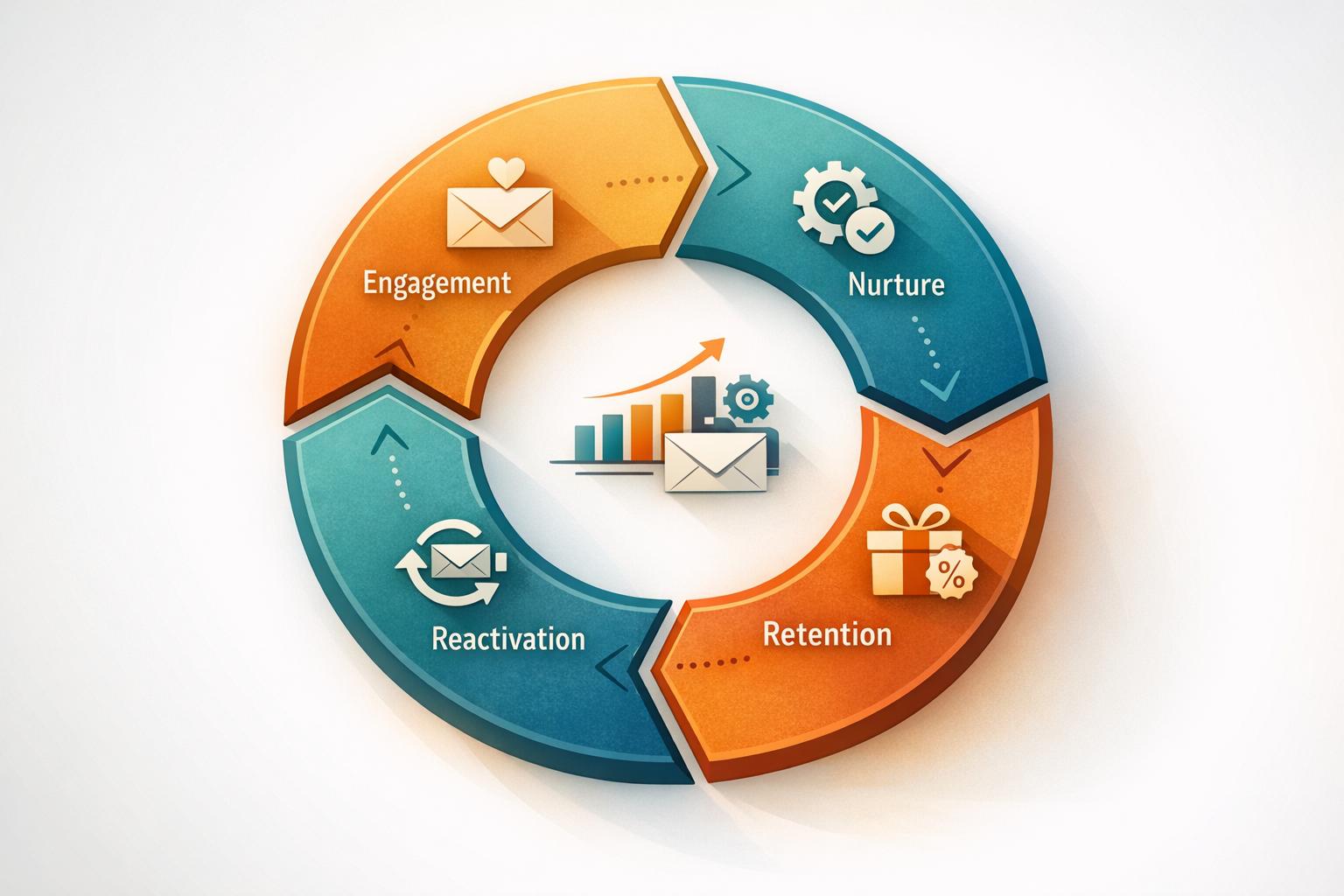
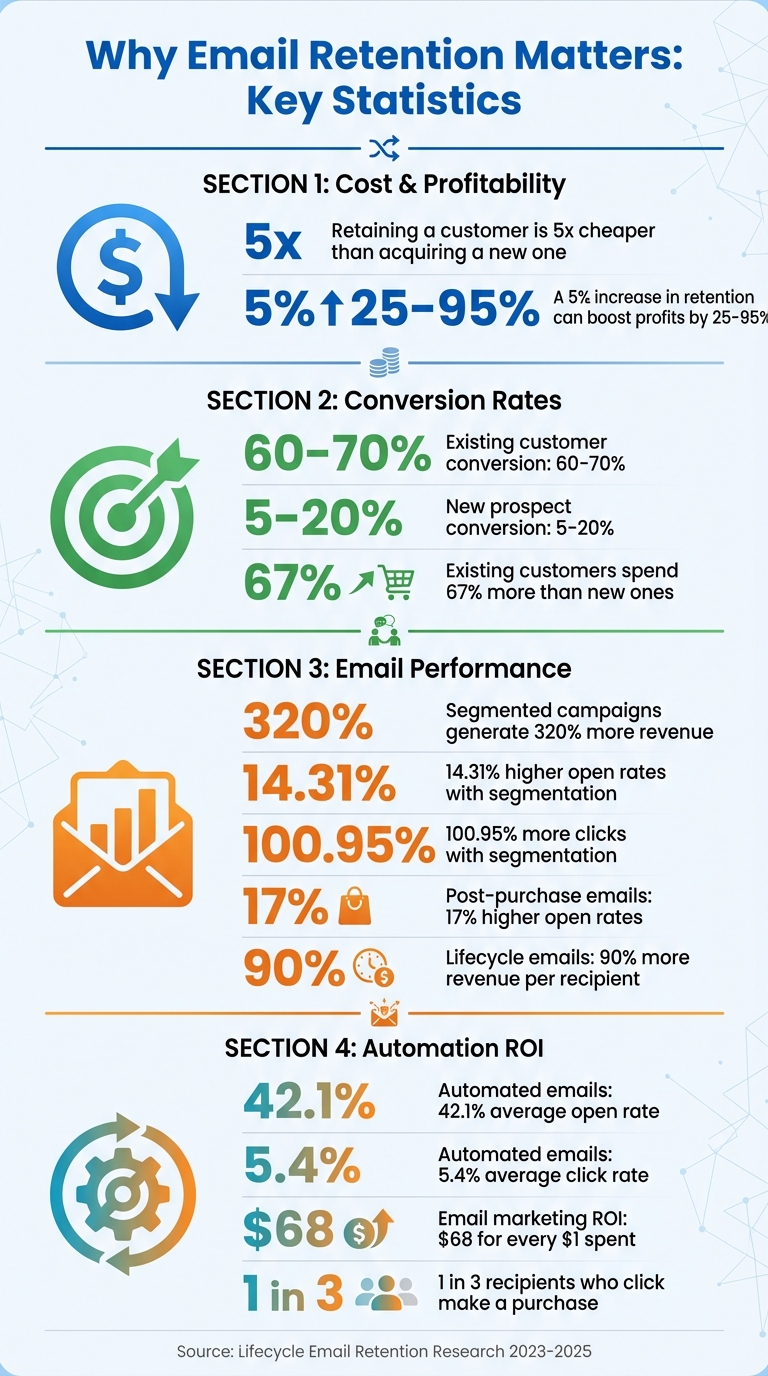
Retention emails are key to keeping customers engaged and boosting their lifetime value. Unlike acquisition emails, these focus on existing customers by encouraging repeat purchases, upsells, cross-sells, and referrals. Why does this matter? Because retaining a customer is 5x cheaper than acquiring a new one, and even a 5% increase in retention can boost profits by 25–95%.
Key Takeaways:
- Segment your audience: Tailored emails based on behavior (e.g., purchase history, engagement) generate 320% more revenue than generic campaigns.
- Post-purchase emails: Thank-you messages, product guides, and timely recommendations can increase repeat purchases and reduce churn.
- Re-engagement tactics: Win-back campaigns with personalized offers or feedback surveys can revive inactive customers.
- Automation tools: Platforms like Breaker use behavioral triggers and CRM data to send timely, relevant emails that improve retention.
Retention efforts start immediately after a purchase and require consistent, personalized communication. By focusing on customer needs and leveraging automation, you can drive loyalty and long-term growth.
Email Retention Marketing Statistics: ROI, Conversion Rates, and Customer Value
105% Increase In Retention Rate - How We Did It
How to Segment Customers for Retention Campaigns
Sending the same email to everyone? That’s a quick way to lose interest. Segmented email campaigns generate 320% more revenue than non-segmented ones. They also boast 14.31% higher open rates and 100.95% more clicks. Why? Because when you tailor messages to fit customers' behavior and preferences, they feel more personal - and people respond to that.
Segmentation turns a generic retention strategy into a customized experience. This approach doesn’t just improve engagement; it helps maintain a strong sender reputation, ensuring your emails actually reach inboxes. And here’s the kicker: existing customers spend 67% more than new ones. But to keep them spending, you’ve got to stay relevant. By figuring out who’s ready to buy again, who needs a little push, and who might be slipping away, you can step in with the perfect message at the right time. Let’s dive into how purchase history and engagement can help you create actionable customer segments.
Segmenting by Purchase History and Engagement
A great starting point for segmentation is RFM analysis - short for recency, frequency, and monetary value. This method ranks customers into categories like "Champions", "At Risk", and "Lost" based on their buying behavior. For instance, someone who’s made three purchases totaling $500 in the past month shouldn’t get the same email as someone who bought once six months ago for $50.
Real-world examples show how effective this can be. In 2023, Chewy used AI to predict when customers would need to reorder pet supplies, based on their purchase patterns. These timely reminders boosted email-driven sales by 40% and increased retention by 25%.
"Our new email approach has transformed how we connect with pet parents. We're not just selling products; we're supporting them throughout their pet's life".
Beyond purchase data, engagement metrics reveal who’s paying attention and who’s not. You can also segment by product preferences, tracking which categories customers browse or buy most often. This allows you to send targeted cross-sell or upsell emails instead of generic promotions that miss the mark.
Take Airbnb, for example. In 2022, they launched a tailored "Welcome Series" for new hosts and travelers. Led by Email Marketing Manager Sarah Chen, the campaign achieved a 42% higher open rate and drove a 25% increase in bookings within three months.
"By tailoring our messages to where each customer is in their journey with us, we saw a 25% increase in bookings from email campaigns within three months".
Once you’ve identified segments, the focus shifts to nurturing your high-value customers while re-engaging those at risk.
Finding High-Value and At-Risk Customers
Not all customers hold the same value. Your "Champions" - those who buy often, spend big, and shop recently - deserve special treatment. Think exclusive perks like early access, rewards, or referral incentives. These strategies build loyalty without eroding profit margins through excessive discounts.
A great example? Starbucks. In 2023, they ran a "Refer-a-Friend" campaign targeting their most loyal app users. Spearheaded by CMO Brady Brewer, the initiative offered a free drink to both the referrer and the new customer. The result? 50,000 new sign-ups in a month and a 15% increase in referrals.
"Our customers became our best marketers. The email campaign brought in new customers and strengthened our relationship with existing ones".
On the flip side, at-risk customers need immediate attention. These are the people who haven’t purchased within their usual timeframe or whose engagement has dropped off. You can group them by email activity - those who open every message versus those who haven’t clicked in 90 days require different approaches. Watch for churn signals like declining open rates, longer gaps between purchases, or an uptick in support tickets. The goal is to step in before they disengage completely. Tools like "decay scoring" can help track how long someone has been inactive, so you can prioritize outreach.
Here’s a quick look at segmentation tiers and strategies:
Segment Tier
Customer Behavior
Strategy
Champions
Recent, frequent, high spenders
Exclusive rewards, early access, referral invites
At-Risk
Haven’t purchased in typical cycle; low engagement
Win-back offers, feedback surveys, "we miss you" messaging
Dormant
No activity for 60+ days
Plain-text re-engagement or final "sunset" unsubscribe offer
Low AOV
Frequent buyers but low spend per order
Nurture campaigns highlighting benefits of higher-tier products
For B2B marketers, spotting at-risk customers early is even more critical. Retaining a customer costs 5 to 25 times less than acquiring a new one. Plus, you’re more likely to convert an existing customer (60–70%) compared to a new prospect (5–20%). Behavioral triggers can automate this process, sending check-ins or offering support when someone’s activity starts to wane. Saving those relationships isn’t just good for retention - it’s good for your bottom line.
Creating Post-Purchase Email Sequences
Engaging customers after they’ve made a purchase is crucial. Post-purchase emails tend to perform exceptionally well, boasting open rates about 17% higher than average, while lifecycle emails generate 90% more revenue per recipient. At this stage, customers are already invested - they’ve spent their money and are seeking validation for their decision. Post-purchase communication reassures them, highlights the value of their purchase, and sets the stage for future transactions.
A well-crafted sequence builds trust and minimizes buyer’s remorse. The trick is in the timing and relevance - delivering the right message at the right moment can turn a one-time buyer into a loyal customer. Let’s explore the essential components of impactful post-purchase emails.
Thank-You Emails and Product Guides
While order confirmations fulfill a basic need by confirming the transaction, a thoughtful thank-you email takes things a step further. It shows appreciation and reinforces the customer’s decision to buy. This email is also a great chance to share your brand’s story, highlight your mission, or invite customers to follow you on social media - without cluttering the transactional receipt.
Another valuable touchpoint? Product guides. Sending an instructional email a few days after delivery (3–7 days is ideal) ensures customers know how to make the most of their purchase. For example, you could include a "Top 5 Tips to Get Started" list or a short video tutorial to enhance their experience.
In 2022, Zappos revamped its post-purchase strategy by introducing personalized product suggestions based on previous purchases. This move paid off, increasing repeat purchases by 12% within just 30 days.
"Our new email strategy has helped us better connect with customers after they buy. It's not just about the sale; it's about building a relationship."
- Scott Schaefer, CEO, Zappos
Tailoring thank-you and guide emails based on purchase history makes the experience feel personal. New customers might appreciate a warm welcome and clear policies, while returning buyers often respond well to loyalty rewards or referral invitations.
Order Updates and Feedback Requests
Nobody enjoys being left in the dark about their order. Proactive shipping updates reduce "Where Is My Order?" (WISMO) inquiries and build trust - especially when there are delays. Instead of redirecting customers to a third-party carrier site, include tracking links that lead to your website. This keeps customers engaged with your brand during the waiting period.
Order confirmation emails, which typically see a 60% open rate, are another opportunity to strengthen relationships. Use them to provide direct customer support links and incorporate branded visuals. Our roundup of confirmation emails samples shows what a good one looks like.
Once the product has arrived and the customer has had time to use it, follow up with a review request. Aim to send this email 7–14 days after delivery, giving the customer enough time to form an opinion. Offering a small incentive, like a discount or coupon, can encourage responses. If you receive negative feedback, act quickly to resolve the issue before it leads to customer churn.
Recommending Related Products
After addressing order updates and collecting feedback, shift your focus to personalized product recommendations. The post-purchase phase is the perfect time for this. Customers who have already bought something are 60–70% more likely to make another purchase, compared to just 5–20% for new prospects. Use purchase history to suggest complementary items, such as accessories, refills, or upgrades, to keep the customer engaged and boost revenue. In fact, product recommendations in emails can account for up to 31% of ecommerce revenue.
For example, if someone buys running shoes, it makes sense to recommend socks or a fitness tracker - something that complements their purchase. Personalization is key here. A majority of consumers (71%) expect tailored interactions, and 76% feel frustrated when they don’t receive them.
In 2023, Chewy took this a step further by using AI to predict when customers would need to reorder pet supplies. Under CMO Orlena Yeung’s leadership, this strategy led to a 40% increase in email-driven sales and improved customer retention by 25%.
Timing matters, too. Sending cross-sell emails 7–14 days after the initial purchase gives customers time to enjoy their first purchase without feeling overwhelmed, creating a natural opportunity to encourage additional buys.
Re-Engagement and Win-Back Email Tactics
Continuing from earlier strategies around segmentation and post-purchase engagement, re-engagement tactics are critical for keeping customers connected to your brand. Just because a customer has gone quiet doesn’t mean they’re lost. It’s important to understand the distinction between win-back and re-engagement campaigns: win-back efforts target customers who are on the verge of stopping their purchases, while re-engagement focuses on those who’ve already drifted away from your brand. Both approaches aim to reignite interest, but they require different strategies.
Here’s why these campaigns matter: bringing in a new customer costs 5–7 times more than retaining an existing one, and improving retention by just 5% can increase profits by 25–95%. Plus, the odds of selling to a current customer are 60–70%, compared to only 5–20% for a new lead. Successful campaigns typically involve 2–5 sequential emails designed to re-engage, gather feedback, and offer incentives.
Timing is everything. The best time to act is when a customer's "purchase latency" - the gap between their purchases - starts to grow significantly. For example, if a customer typically buys every 30 days and hasn’t made a purchase in 60, it’s time to reach out. Studies show that 45% of recipients who open a re-engagement email will engage with future emails, and customers won back often have a higher lifetime value ($1,410) compared to their initial value ($1,262). Below, we’ll explore how to effectively re-engage and win back customers before they’re gone for good.
Behavior-Triggered Check-In Emails
Automation can help you connect with customers at just the right moment. Instead of waiting for them to disappear entirely, set up behavior-triggered emails that activate when inactivity crosses a certain threshold. For B2B or SaaS companies, plain-text emails that feel like personal messages often outperform polished HTML templates in generating replies.
A great example comes from Ibotta, a cashback app that, in July 2025, used Braze to automate "Switch and Save" emails. These emails were sent 24 hours after a shopping trip and used machine learning to suggest high-value deals from alternative brands based on recent purchases. The campaign achieved a 15% open rate and an 8% conversion rate for previously disengaged users. As Rich Donahue, Chief Marketing Officer at Ibotta, explained:
"Connected Content allows Ibotta to surface content that is highly personalized, helping to improve the experience and increase the value of our product for our Savers".
To keep your messages relevant, avoid linear workflows. For instance, if a user clicks on a "See Product Details" link in a re-engagement email, follow up with a product-specific message rather than a generic discount. This behavioral branching approach ensures the conversation stays meaningful and increases conversion chances. Additionally, combining email with push notifications, SMS, and in-app messaging (a strategy called cross-channel orchestration) boosts the likelihood of reaching a disengaged customer.
Inactivity Period
Status
Recommended Action
3–6 Months
Winnable but at risk
Send "What’s New" updates and gentle reminders
6–9 Months
Potentially winnable
Offer stronger incentives like discounts or free gifts
9–12 Months
Unlikely to re-engage
Send a "Breakup" email or preference survey
12+ Months
Lapsed
Remove from active lists to protect sender reputation
Once these check-ins are in place, the next step is to use targeted incentives and personalized support to drive re-engagement.
Check-in emails are only as good as the triggers behind them. Our guide to behavior-triggered email best practices covers how to pick high-intent triggers without overwhelming subscribers.
Using Incentives and Support Offers
Not all incentives are created equal. Start small with a low-pressure "we miss you" email, and gradually increase the value of your offers in subsequent messages. This tiered approach helps protect your profit margins while still giving customers a reason to return. For your most valuable customers, reserve the highest discounts to ensure profitability.
Using RFM analysis - which categorizes customers by Recency, Frequency, and Monetary value - can help you prioritize your efforts. For example, offer early access deals to your "Champions" while providing deeper discounts to "At Risk" customers. Personalize these offers by referencing products they’ve previously purchased or viewed, making the outreach feel thoughtful rather than generic.
Sometimes, discounts aren’t the best approach. Offering one-on-one support, addressing past issues, or showcasing new features can be just as effective, especially if dissatisfaction was the reason for disengagement. For instance, if a customer left due to missing features, a "What’s Changed" email highlighting updates or new integrations could bring them back.
The final email in your sequence, often called the "breakup" email, informs the customer that you’ll stop sending messages unless they take action. This creates urgency and helps maintain your sender reputation by cleaning up inactive contacts. As Travis Hazlewood, Head of Email Deliverability at Ortto, puts it:
"A win-back email campaign should be treated like a last-ditch effort to rekindle a long-lost friendship by allowing them to set boundaries for the future".
Pairing incentives with direct feedback can further refine your re-engagement strategy.
Preference Surveys for Better Personalization
Instead of pushing for an unsubscribe, give inactive customers the option to "snooze" emails for 30 days or reduce email frequency to a monthly digest. This approach respects their inbox preferences while leaving the door open for future interaction. Asking "Why did you leave?" serves two purposes: it shows you care about their experience and provides valuable insights to address common churn reasons, such as pricing or service issues.
Preference surveys also allow you to fine-tune your outreach. If a customer says they’re overwhelmed by emails, reduce the frequency. If they’ve lost interest in a specific product category, update their profile to reflect their current preferences. With 71% of consumers expecting personalized interactions and 76% frustrated when they don’t get them, tailoring your messages is crucial.
Use this feedback to segment your audience more effectively. Customers who indicate they’re price-sensitive can receive flash sale notifications, while those intrigued by new features can get product update emails. This level of personalization makes future campaigns more relevant, increasing the chances of re-engagement and reducing the risk of losing them again.
Automating Retention Emails with Breaker
When it comes to keeping your customers engaged, automating retention emails can be a game-changer. Breaker's platform is tailored for B2B marketers who need to scale their communication while ensuring every message remains relevant and timely. By automating email workflows, you can create systems that respond instantly to user actions - or even their lack of action.
The stats speak for themselves: automated emails boast an average open rate of 42.1% and a click rate of 5.4%, with one in three recipients who click eventually making a purchase. Even more compelling, automation helps you act before customers churn. Considering that acquiring a new customer costs 5 to 7 times more than retaining an existing one, and boosting retention by just 5% can increase profits by 25% to 95%, automation isn't just about convenience - it's a smart move for protecting your bottom line.
Breaker connects behavioral data with email delivery, enabling you to send messages triggered by real-time actions. It integrates seamlessly with your CRM, pulling in customer details and tracking performance as it happens. This means you’re not guessing when or how to reach out - you’re responding to actual customer behavior with precision. As Customer.io puts it: "The goal isn't to send more messages, but to send more relevant messages". Let’s dive into how Breaker helps you configure triggers, use CRM data, and track results effectively.
Setting Up Behavioral Triggers and Milestone Emails
Behavioral triggers allow you to respond directly to customer actions as they occur. For example, if a user hasn’t logged into your platform in 14 days, Breaker can automatically send a check-in email offering assistance. Or, if a customer hits a milestone - like completing 100 actions or celebrating their one-year anniversary - a congratulatory email can reinforce their connection to your product.
The secret lies in aligning triggers with your customer’s journey. Instead of sending a generic "We miss you" email, reference a specific feature they’ve stopped using or the last product they viewed. Breaker’s automation tools let you incorporate dynamic content that adapts to user behavior, making every email feel personalized without requiring manual effort.
Timing is just as critical as content. Welcome emails should be sent immediately after sign-up, while cart abandonment reminders work best within one hour of the action. For milestone emails, timing them to the exact date of the event ensures they resonate. Breaker’s platform automates this scheduling, so your messages always arrive at the right moment.
Here’s how different triggers align with retention goals:
Trigger Type
Ideal Timing
Primary Objective
Welcome Email
Immediate
Set expectations and guide the next steps
Milestone Email
On the event date
Celebrate loyalty and strengthen the relationship
Re-engagement
30–60 days of inactivity
Reconnect with dormant users through targeted offers
Trial Expiration
1–3 days before the end
Convert trial users into paying customers
Replenishment
X days before supply ends
Encourage repeat purchases for consumables
Using if/else logic, you can fine-tune the customer journey. For instance, if a user clicks on a "See Product Details" link in a re-engagement email, follow up with a product-specific message instead of a generic discount. Breaker’s automation builder makes it easy to create these branching paths, no technical expertise required.
CRM Integration for Better Targeting
Integrating Breaker with your CRM takes targeting to the next level. Platforms like HubSpot or Salesforce allow you to pull in detailed customer data - such as user roles, purchase history, or company size - so every email feels tailored to the recipient. This is especially crucial in B2B settings, where sales cycles are longer and involve multiple decision-makers.
CRM integration also enables RFM analysis (Recency, Frequency, and Monetary value), helping you prioritize high-value customers while identifying those at risk of churning. For example, you might offer stronger incentives to high-value customers who haven’t engaged recently, while sending lighter updates to active users who haven’t purchased in a while.
This approach ensures you’re not treating all customers the same. As Customer.io notes: "Segmentation and personalization are the lifecycle email power couple". With first-party CRM data flowing into Breaker, you can create segments based on everything from industry type to feature usage, tailoring your messaging for maximum impact.
Beyond email, Breaker supports omnichannel coordination, letting you extend your retention efforts across push notifications, SMS, and in-app messages. If an email goes unopened, a follow-up SMS or push notification can ensure your message reaches the customer where they are most active.
Tracking Performance with Real-Time Metrics
Once your workflows are live, Breaker’s real-time analytics provide a clear picture of how they’re performing. You can monitor open rates, click-through rates, and conversions as they happen, making it easy to tweak underperforming triggers and improve results. This data-driven approach replaces guesswork with actionable insights.
Real-time tracking also helps you spot warning signs of churn. For instance, if a customer’s login frequency drops or they stop engaging with key features, you can send a targeted check-in or support offer. Breaker’s dashboard highlights these signals - like rising unsubscribe rates or declining open rates - so you can adjust your strategy before it’s too late.
You can even tie email performance directly to retention and revenue. For example, milestone emails celebrating a one-year anniversary might show a 60% to 70% likelihood of leading to an upsell, compared to a 5% to 20% chance with cold outreach. These insights help you double down on what works and refine what doesn’t.
Breaker also supports A/B testing for subject lines, CTAs, and send times, so you can continually optimize your campaigns. For instance, you might test whether a renewal reminder performs better when sent 3 days before expiration versus 1 day before. Over time, these small adjustments can lead to significantly higher retention rates and customer lifetime value.
Measuring and Improving Retention Email Performance
When your retention workflows are in motion, keeping an eye on key metrics helps you understand what’s hitting the mark and what needs tweaking. The goal is simple: send emails that engage your audience and reduce churn. By tracking performance data and experimenting with new tactics, you can fine-tune your approach and get the most out of every email.
Key Metrics to Track
The first thing to check? Open rates. They tell you if your subject lines are grabbing attention. On average, open rates across industries hover around 18%, but aiming for 20% to 30% is a better target. If your numbers are falling short, try shorter subject lines. For instance, subject lines with just three words see a 21.2% engagement rate, compared to 15.8% for those with seven words.
Next up is click-through rate (CTR) - this measures how well your content and calls-to-action (CTAs) are driving engagement. The industry average is 2.6%, but anything above 5% is strong, and over 8% is exceptional. If clicks are low, experiment with where you place CTAs. Longer emails, for example, might benefit from multiple buttons spread throughout to catch readers who don’t scroll all the way.
Then there’s conversion rate, which links your emails to actual business outcomes. Whether it’s a repeat purchase, subscription renewal, or plan upgrade, this metric shows how many recipients took the desired action. It’s calculated as (Total Conversions / Emails Delivered) × 100. Personalized product suggestions can work wonders here, driving more repeat purchases and boosting revenue.
For retention-specific insights, focus on churn rate and customer lifetime value (CLV). Churn rate shows the percentage of customers who stop engaging or cancel subscriptions. To calculate it, divide the number of lost customers by the total customers, then multiply by 100. CLV, on the other hand, predicts the total revenue a customer will bring in over time - multiply average purchase value by purchase frequency and customer lifespan. A great example? In 2023, Chewy’s CMO, Orlena Yeung, used AI to predict reorder cycles and send timely replenishment emails, leading to a 40% increase in email-driven sales and a 25% bump in retention rates.
Revenue per email (RPE) and return on investment (ROI) are your financial markers. On average, email marketing delivers an ROI of $68 for every $1 spent. To calculate retention-specific ROI, subtract campaign costs from the incremental revenue, then divide by the campaign costs. Keep in mind that retaining a customer is 5 to 7 times cheaper than acquiring a new one, and increasing retention by just 5% can boost profits by 25% to 95%.
Lastly, don’t ignore deliverability and list health metrics. Metrics like bounce rates, unsubscribe rates, and spam complaints keep your sender reputation intact. Aim for an unsubscribe rate of about 0.2%. Higher rates could mean your emails are too frequent, irrelevant, or out of sync with what subscribers expect. Remove hard bounces immediately and investigate soft bounces to keep deliverability high.
Metric
Calculation
Purpose
Open Rate
(Emails Opened / Emails Delivered) × 100
Measures subject line and brand appeal
Click-Through Rate (CTR)
(Unique Link Clicks / Emails Delivered) × 100
Tracks engagement and CTA effectiveness
Conversion Rate
(Total Conversions / Emails Delivered) × 100
Links email to business results
Churn Rate
(Lost Customers / Total Customers) × 100
Tracks customer loss
Customer Lifetime Value (CLV)
(Avg Purchase Value) × (Avg Purchase Frequency) × (Customer Lifespan)
Estimates total revenue per customer
Retention ROI
(Incremental Revenue - Campaign Cost) / Campaign Cost
Evaluates retention campaign performance
Improving these metrics is the backbone of a strong retention strategy. They help reduce churn and increase customer lifetime value, giving you a clear path toward better results.
A/B Testing and Continuous Improvement
Metrics are your guide, but A/B testing is how you turn ideas into actionable insights. The trick is to test one variable at a time - like subject lines, CTA design, or send times - so you can clearly see what’s driving the results. To ensure your findings are reliable, aim for a 95% confidence level.
Start with content tests. Try different subject line lengths, tones, or personalization styles to see what resonates. For example, using a personal name in the "From" field (like "Matt from Breaker") instead of just your brand name can make a big difference - one study found it boosted open rates by 10%. You can also test design formats. While polished HTML templates look great, plain-text emails often feel more personal and can encourage replies, especially for re-engagement campaigns.
Timing tests are another way to optimize. Experiment with different send times - like lunch hours versus early mornings, or weekdays versus weekends. For triggered emails, test whether a renewal reminder works better three days before expiration or one day before. In 2022, Airbnb’s Email Marketing Manager, Sarah Chen, revamped their "Welcome Series" emails by aligning messages with specific customer journey stages. The result? A 42% higher open rate and a 25% boost in bookings within three months.
"By tailoring our messages to where each customer is in their journey with us, we saw a 25% increase in bookings from email campaigns within three months".
When running single campaigns, send tests to a small sample - say, 10% of your list - and roll out the winning version to the remaining 90%. Use holdout groups (people who don’t receive the email) to measure the true incremental impact of your campaigns. This helps you understand whether your emails are driving new actions or just capturing what would’ve happened anyway.
To get the best results, test across three areas: content (like subject lines and CTAs), timing (such as day and time of send), and behavior (like emails sent after purchases versus after periods of inactivity). For example, between 2015 and 2016, Bloomingdale’s saw a 50% revenue increase by using behavior-triggered emails with personalized offers instead of generic blasts.
Segmented campaigns also consistently outperform mass emails. They achieve 14.31% more opens and 100.95% more clicks. Use tools like RFM analysis (Recency, Frequency, Monetary value) to focus on your most valuable customers and fine-tune your tests. If you notice negative trends - like rising unsubscribe rates or falling open rates - adjust your frequency or messaging before you lose those customers entirely.
Finally, refresh your content every quarter to avoid fatigue and keep engagement high. With recipients spending just 11 seconds on average reading marketing emails, every word and design choice matters. Regular testing and updates ensure your retention emails stay relevant and effective.
Conclusion
Keeping your customers engaged throughout their journey is the key to building loyalty. Retention emails focus on nurturing existing customers rather than chasing new ones. By sending personalized, behavior-driven emails - like replenishment reminders, milestone celebrations, or win-back offers - you can strengthen relationships and boost profitability. Retaining customers is not only more cost-effective than acquiring new ones but also delivers a clear and measurable impact on your revenue.
Automation plays a huge role in making retention efforts scalable. Instead of manually tracking every customer interaction, tools like Breaker handle the heavy lifting. Breaker simplifies retention with features like behavioral triggers, CRM integrations, and real-time analytics, ensuring your messages are timely and relevant without sacrificing a personal touch. From automated lead generation to precision targeting, Breaker helps your campaigns reach the right audience, while its deliverability management ensures your emails land in inboxes - not spam folders.
To take things further, tailoring your emails to individual preferences solidifies customer connections. The goal is to send emails that resonate. Whether you're segmenting by RFM scores, experimenting with subject lines, or analyzing customer lifetime value, every adjustment helps deepen the bond with your audience. As Twilio aptly states:
"To know someone is to love someone, and that sentiment is certainly true between brands and their customers."
By using data to better understand your customers and automation to meet their needs, you can turn one-time buyers into loyal advocates.
Retention also requires ongoing improvement through testing and analysis. It’s a continuous process of refining strategies to reduce churn, increase customer lifetime value, and foster long-term loyalty. With Breaker automating much of this process, focusing on retention becomes both effective and efficient. Prioritizing retention not only strengthens customer relationships but also ensures sustainable growth over time.
FAQs
What’s the best way to segment my audience for retention emails?
To make your retention emails hit the mark, start by setting clear goals. Are you aiming to drive repeat purchases, re-engage users who’ve gone quiet, or promote premium upgrades? Once you know your objective, dig into your data. Look at behavioral patterns (like how often users make purchases or use features), transactional metrics (such as how recently or frequently they’ve bought, and their spending habits), and engagement history (email open rates, clicks, etc.) to group your audience into meaningful segments. If you’re running B2B campaigns, throw in firmographic details like company size or industry for added precision.
After defining your segments, let your email platform do the heavy lifting by automating the grouping process. For instance, you could focus on customers who made a purchase in the last 30 days or those with high click-through rates. Then, craft messages that speak directly to each group. Maybe offer loyalty rewards to your top buyers or share helpful tips with new users - keeping the content relevant is key.
Don’t stop there - test and tweak your approach. A/B test subject lines, offers, and send times to find what resonates best. Keep an eye on metrics like repeat purchase rates and churn reduction, and refine your segments as needed to ensure your emails remain engaging and effective.
What are the best practices for creating effective post-purchase email sequences?
To craft a strong post-purchase email sequence, start with transactional emails. These include order confirmations, shipping updates, and delivery notifications. Personalize them with details like the customer’s name, order number, and expected delivery date. Use straightforward subject lines to set clear expectations and create a smooth customer experience.
Next, send a thank-you email to show your appreciation. This is a great opportunity to gently guide customers toward their next steps, such as exploring related products. A few days after delivery (ideally within 3–7 days), follow up with a review request. Make it easy for customers to leave feedback by providing a direct link, and consider adding an incentive, like a 10% discount, to encourage more responses. Down the line, introduce a referral program - for example, “Earn $20 for every friend who makes a purchase” - and include an upsell or cross-sell offer featuring items that complement their original purchase.
To make this process efficient, use an automation platform with behavior-based triggers and real-time analytics. Ensure every email is optimized for mobile devices, follows U.S.-specific formats (e.g., $99.99, April 15, 2025), and includes a clear call-to-action. Keep improving your sequence by testing and analyzing performance metrics like open rates and repeat purchases. This will help you build stronger customer relationships while driving more revenue.
How can automation improve the success of retention email strategies?
Automation takes retention email strategies to the next level by leveraging customer behavior data to deliver timely, personalized messages. For example, if a customer seems less engaged or has a subscription renewal coming up, automated tools can send emails tailored to the situation - like helpful tips for using a feature or an exclusive offer. These messages land in the customer’s inbox at just the right time, boosting engagement and cutting down on churn.
What’s more, automation empowers marketers to fine-tune their email campaigns by testing elements like subject lines or content across different audience segments. By pinpointing what resonates most, teams can roll out successful approaches on a larger scale. Plus, automated workflows handle repetitive tasks, allowing marketers to dedicate more energy to big-picture strategy while ensuring consistent, meaningful communication throughout the customer journey.
Related Blog Posts
Keep reading
All articlesGDPR Consent Requirements for Purchased Email Lists
Purchased email lists rarely meet GDPR's consent bar. Learn the legal basis rules, PECR overlap, and safer alternatives before you hit send.
7 Email Platforms With Inbox Placement Testing & Suppression
Compare 7 email platforms that combine inbox placement testing with suppression management, scored on features, pricing, and best-fit sender size.
Email Automation Workflow & Drip Campaign Data Structure
Learn the database schema behind email drip campaigns—tables, workflow states, and event logs that power reliable marketing automation.