
How to Increase Email Open Rates a B2B Guide
Learn how to increase email open rates with proven B2B strategies for subject lines, segmentation, and deliverability that drive real engagement.
Want to boost your email open rates? It comes down to nailing three things: writing a subject line and preview text that people actually want to click, keeping your sender reputation spotless, and sending the right content to the right people.
If you get these fundamentals right, your emails won't just land in the inbox—they'll get noticed.
Building a Foundation for Higher Open Rates
Before we get into the clever tactics, let's talk about the foundation. Too many marketers get caught up chasing a killer subject line while completely ignoring the stuff that actually gets an email delivered in the first place.
Without solid deliverability, a clean list, and a strong first impression, even the most creative campaign is dead on arrival. It's headed straight for the spam folder.
Let's quickly break down the core pillars you need to focus on to give your emails a fighting chance.
Core Pillars for Boosting Email Open Rates
Pillar
Why It Matters
Key Action
Sender Reputation
Your domain's "credit score." ISPs use it to decide if you're trustworthy enough to land in the primary inbox.
Proactively manage deliverability with proper technical setup and clean sending practices.
List Quality
A small, engaged list is far more valuable than a huge, unvetted one. Poor list quality tanks open rates and harms your reputation.
Implement regular list hygiene to remove inactive subscribers and validate new ones.
Initial Engagement
The first email you send is your best chance to train subscribers to open future messages.
Create a high-impact welcome sequence that delivers immediate value and sets clear expectations.
Getting these three pillars right is the non-negotiable first step. They work together to ensure your message is seen by the right people at the right time.
Prioritize Sender Reputation and Deliverability
Think of your sender reputation as a credit score for your email domain. Email providers like Gmail and Outlook are constantly judging you. A low score—often from spam complaints or too many bounces—is a one-way ticket to the promotions tab or, worse, the spam folder.
This is why deliverability management isn't just a nice-to-have; it's the barrier to entry. It ensures all the technical stuff is set up right so your sending habits don't trigger any alarms. After all, you can't get an open if the email never even gets seen.
Your open rate is a direct reflection of your sender reputation. A healthy reputation means ISPs trust you, giving your campaigns a fair shot at being seen. An unhealthy one means you're fighting an uphill battle before your subject line is even read.
Start with a High-Quality, Engaged List
The quality of your audience is just as crucial. Blasting emails to a massive, unverified list is a classic mistake that crushes your reputation and your open rates.
It's always better to email 1,000 engaged subscribers who fit your ideal customer profile (ICP) than 10,000 random contacts who will ignore you or mark you as spam.
Good list hygiene is an ongoing job, not a one-and-done task. You need to be consistently removing inactive subscribers and validating new ones. If you want to dive deeper, check out our guide on email list hygiene best practices.
Harness the Power of the Welcome Sequence
Your first interaction with a new subscriber is your single best opportunity to set the tone for the entire relationship. This is where a strategic welcome sequence comes in. It’s not just a polite "hello"—it's how you train people to open your emails from day one.
Welcome emails get insane engagement because they arrive right when a subscriber’s interest is at its peak. Data shows the average open rate for a welcome email is an incredible 69%, with some hitting as high as 80%.
Compare that to the global average open rate of around 22.7%, and you can see just how much impact a strong first impression has. By delivering instant value and setting expectations from the start, you build momentum that keeps people opening your emails down the road.
Crafting Subject Lines That Get Clicks
Think of your subject line as the gatekeeper to your entire email. It doesn't matter how incredible the content inside is; if the first impression is weak, your email is destined to remain unread. The data backs this up: a staggering 47% of recipients open an email based on the subject line alone.
This isn't just about coming up with something clever. It's about making a real connection with your reader's needs in an inbox that's already overflowing. The goal is to give them a compelling reason to click, sparking genuine interest that cuts through the noise.
The Psychology of a Clickable Subject Line
A great subject line doesn't just describe what's inside—it speaks to a specific need or emotion. It’s less about flashy copywriting and more about understanding what actually motivates your B2B audience. The most effective ones almost always tap into a few core psychological triggers.
These triggers are powerful because they align with fundamental human drivers like the desire for efficiency, knowledge, and connection.
- Urgency: This creates a fear of missing out (FOMO) and works perfectly for time-sensitive offers, event registrations, or limited-time content.
- Curiosity: Posing a question or a provocative statement can be irresistible. The reader feels a natural pull to open the email just to find the answer.
- Relevance: Directly addressing a known pain point or interest makes the email feel personal and immediately valuable.
- Value: This one is simple: clearly communicate a direct benefit. Will they save time? Cut costs? Learn a critical new skill?
For instance, "New Product Update" is generic and forgettable. But a subject line like, "A faster way to manage your Q3 reporting," promises a specific, tangible benefit. It's an instant upgrade.
Writing Subject Lines That Work in B2B
In the B2B world, clarity almost always wins over creativity. Your audience is busy, and they value efficiency above all else. Your subject line needs to communicate in seconds why opening your email is a smart use of their time. Anything vague or overly promotional is a one-way ticket to the trash folder.
Let’s get practical with a few before-and-after examples for different B2B scenarios:
- Weak: "Introducing Our New Feature"
- Strong: "Connect your CRM in two clicks with our new integration"
- Weak: "This Month's Newsletter"
- Strong: "Your B2B growth plan for the next 90 days"
- Weak: "Webinar Invitation"
- Strong: "Join [Expert Name] to discuss the future of AI in sales"
Personalization is your secret weapon here. Data from Campaign Monitor shows that personalizing a subject line can boost open rates by as much as 26%. And this goes way beyond just dropping in a first name. Try referencing their company, industry, or even a recent interaction for maximum impact. We dive deeper into these advanced techniques in our full guide to B2B subject line strategy.
A common mistake is treating the subject line as an afterthought. It should be developed with the same strategic care as the email body itself. It’s not just a title; it’s the primary driver of the open.
Don't Forget the Preview Text
Right next to or below the subject line sits the preview text—that little snippet of text that’s your secondary hook. It's a critical piece of real estate that far too many marketers waste.
If you don't set a preview text, the email client just pulls in the first line of your email. Often, this ends up being something useless like "View this email in your browser" or image alt text. What a missed opportunity.
Instead, use the preview text to expand on your subject line. Think of them as a team.
Subject Line
Preview Text
Your B2B growth plan for Q4
Three proven tactics to hit your targets before year-end.
Is your data secure?
New report reveals the top 3 threats for SaaS companies.
Final reminder webinar today at 2 PM
We're starting soon! Here's your unique link to join.
The subject line is the headline; the preview text is the sub-headline. Together, they form a one-two punch that can dramatically increase your chances of getting that click. To truly master the crowded inbox, you need to master crafting high-converting email subject lines and pairing them with compelling preview text. This combination is a game-changer for any marketer serious about boosting their open rates.
Mastering Email Deliverability and Sender Reputation
Let's be blunt: even the most magnetic, click-worthy subject line is completely useless if your email never makes it to the primary inbox. This is where email deliverability comes into play, and it’s the technical foundation of your entire newsletter strategy. Getting this right isn't just a "nice-to-have"—it's non-negotiable if you’re serious about boosting open rates.
Think of your sender reputation like a credit score for your domain. Internet Service Providers (ISPs) like Google and Microsoft are watching your every move. Each email you send either builds up their trust or raises a massive red flag, directly deciding whether you land in the inbox or get dumped in the spam folder.
A rock-solid sender reputation is built on one thing: proving you're a legitimate, trustworthy sender. That all starts with getting your technical authentication dialed in.
Getting the Technical Stuff Right: Authentication Protocols
You’ve probably seen the acronyms floating around: SPF, DKIM, and DMARC. They might sound intimidatingly technical, but their job is actually pretty simple. They act as digital signatures that prove your emails are genuinely from you and haven't been messed with along the way.
- SPF (Sender Policy Framework): This is basically a public list of all the servers you've approved to send emails for your domain. It’s like telling Gmail, "Hey, if an email from my domain comes from one of these servers, it's legit."
- DKIM (DomainKeys Identified Mail): This attaches a unique, encrypted signature to every single email. When the email arrives, the receiving server checks this signature to make sure nothing was altered in transit.
- DMARC (Domain-based Message Authentication, Reporting & Conformance): This protocol is the team captain that ties SPF and DKIM together. It gives receiving servers instructions on what to do if an email fails those authentication checks—whether to quarantine it, reject it outright, or let it through.
Setting these up correctly is table stakes. Without them, you’re essentially sending emails with a questionable ID, making it way too easy for spam filters to shut you down. Modern platforms like Breaker often streamline this setup, but you have to make sure it's in place.
For a more granular look, our complete guide to email deliverability best practices will walk you through all the details.
Keeping Your Sender Score in Good Standing
Authentication gets your foot in the door, but your day-to-day sending behavior is what keeps you there. Your sender score is a living, breathing metric that rises and falls based on how people interact with your emails.
ISPs are constantly tracking signals that damage your score, including:
- High Bounce Rates: Sending to too many invalid addresses screams "sloppy, unmaintained list."
- Spam Complaints: This is the big one. Even a tiny number of complaints can do serious, long-term damage to your reputation.
- Graymail: These are emails that get delivered but are never opened. It tells ISPs that your content just isn't hitting the mark.
On the flip side, every open, click, reply, and forward sends a powerful positive signal to ISPs. It tells them that real humans actually value what you're sending. This positive feedback loop is absolutely essential for long-term inbox placement.
Your sender reputation isn’t static; it’s a direct reflection of your audience engagement and list quality. Every campaign you send either strengthens or weakens it. Prioritizing deliverability is the ultimate proactive strategy for boosting open rates.
The Make-or-Break Role of a Domain Warm-Up
If you’re starting out with a brand-new sending domain or IP address, you can’t just flip a switch and start blasting thousands of emails. Your domain has zero history, which immediately looks suspicious to ISPs. This is why a proper warm-up process isn't just recommended—it's critical.
A warm-up involves gradually increasing your sending volume over several weeks. You kick things off by sending small batches of emails to your most engaged subscribers, then slowly ramp up as you build a positive sending history.
A Typical Warm-Up Schedule Might Look Like This:
- Week 1: 50-100 emails per day, sent only to your most active contacts.
- Week 2: 250-500 emails per day, expanding the audience just a bit.
- Week 3: 1,000-2,500 emails per day.
- Week 4: 5,000+ emails per day, continuing to scale as long as engagement stays strong.
This methodical approach builds trust with providers like Google and Microsoft, showing them you’re a responsible sender delivering valuable content. Rushing this process is one of the fastest ways to get blacklisted and tank your open rates before you even have a chance. Tools with built-in deliverability features, like Breaker's TruSend, help you monitor this process to keep your reputation pristine from day one.
Using Smart Segmentation to Drive Engagement
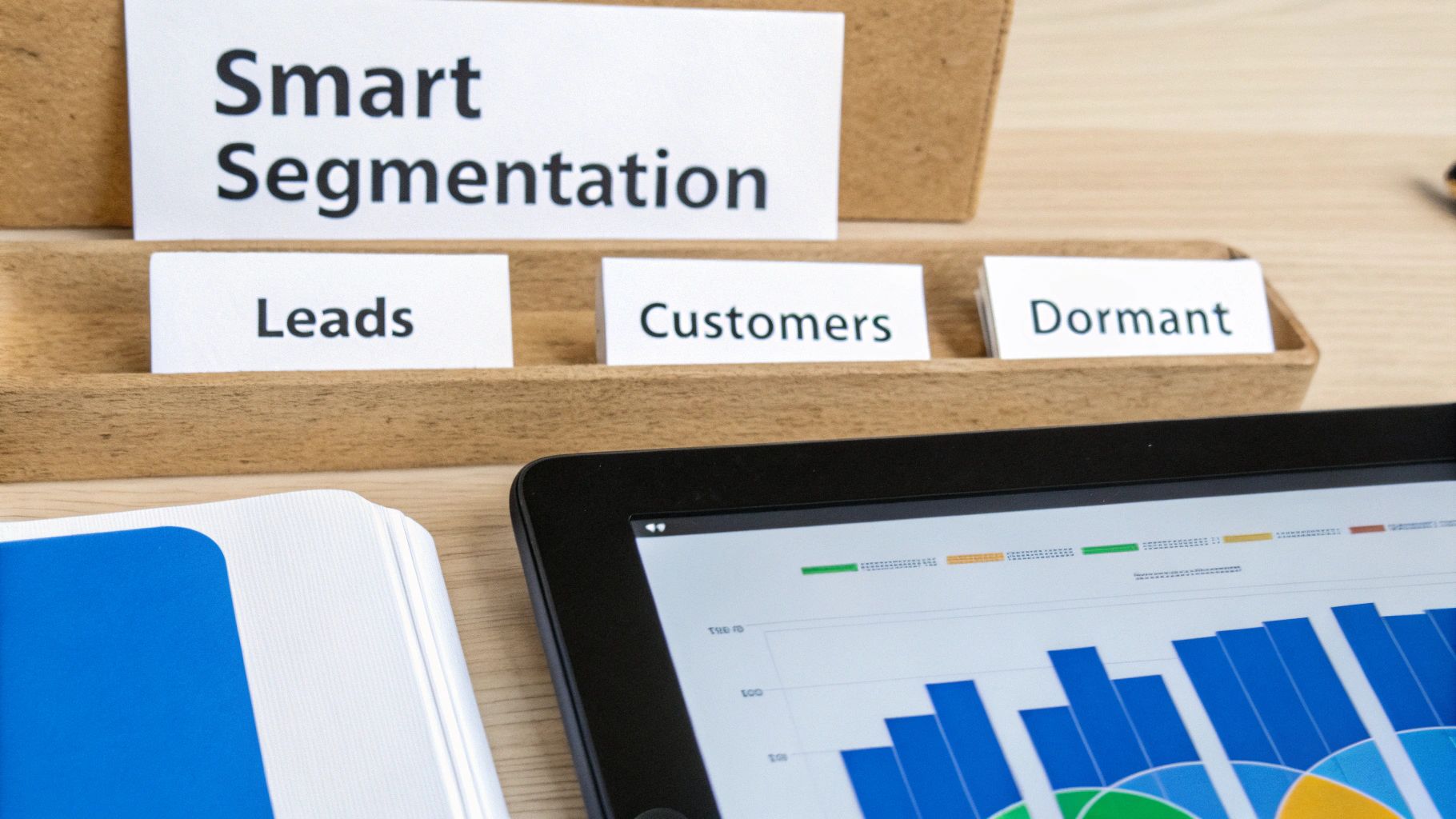
If you're sending the same generic email to your entire list, you’re training your audience to ignore you. It’s a guaranteed way to watch your open rates plummet. In a world where everyone expects personalization, a one-size-fits-all approach just feels lazy and irrelevant.
The real key to boosting opens is sending the right message to the right person. And that's completely impossible without smart segmentation. It's the difference between shouting at a crowd with a loudspeaker and having a series of meaningful, one-on-one conversations. When an email speaks directly to a subscriber's industry, challenges, or interests, they're far more likely to open it.
Moving Beyond Basic Demographics
Sure, segmenting by job title or company size is a decent starting point, but the real magic happens when you dig deeper. The most powerful segmentation strategies layer different types of data to create highly specific audience buckets. By combining who they are with what they do, you get a much clearer picture of what content will actually land.
Think of it this way: "Marketing Manager" is a vague, broad category. But "a Marketing Manager at a SaaS company who just downloaded your SEO guide"? That's a specific persona with obvious interests. This level of detail is what allows you to craft content that feels indispensable.
Practical B2B Segmentation Strategies
For B2B marketers, the segmentation possibilities are almost endless. You can group contacts based on where they are in your sales funnel, how they've interacted with your brand, or the unique characteristics of their business. The goal is to create segments that align perfectly with your content and business goals.
Here are a few powerful approaches you can start with:
- Engagement Level: This one is crucial for list health. Group subscribers into buckets like "highly engaged," "moderately engaged," and "dormant." This lets you reward your biggest fans with exclusive content while running targeted re-engagement campaigns for those who have tuned out.
- Firmographics: This is all about segmenting by company attributes. Create lists based on industry, company size, or even their tech stack. An email to a 50-person startup needs a totally different tone than one sent to a 5,000-person enterprise.
- Behavioral Data: This is where things get really interesting. Group users based on their actions—which pages they visited on your website, what content they downloaded, or their purchase history. Someone who attended a webinar on AI deserves a different follow-up than someone who only read a blog post on sales tactics.
- Customer Journey Stage: Are they a brand new lead, a marketing-qualified lead (MQL), a current customer, or a former one? Each stage demands a unique messaging strategy to nudge them to the next step. Sending new feature updates to non-customers, for example, is just a wasted effort.
To help you get started, here's a quick look at how you can apply these segmentation strategies.
B2B Audience Segmentation Strategies
This table compares different segmentation methods B2B marketers can use to increase email relevance and open rates.
Segmentation Type
Example Criteria
Content Idea
Firmographic
Industry = SaaS, Company Size = 50-200
"Case Study: How a Mid-Sized SaaS Co. Doubled Their MRR"
Behavioral
Visited pricing page > 3 times
"Got Questions? Here’s a Quick Breakdown of Our Plans"
Engagement
Dormant (no opens in 90 days)
"Is This Goodbye? A Special Offer to Win You Back"
Journey Stage
New Customer (signed up in last 7 days)
"Welcome! Here Are 3 Quick Tips to Get You Started"
By adopting these simple but effective strategies, you move beyond generic broadcasts and start delivering content that feels personal and valuable.
Smart segmentation isn't just about sending different emails; it's about delivering targeted value. When a subscriber feels understood, they don't just open your emails—they start looking forward to them.
Putting Segmentation into Action
Let’s walk through a real-world scenario. Imagine you're a B2B SaaS company serving both marketing and sales teams. Instead of blasting out a generic monthly newsletter, you create two distinct segments. The marketing segment gets an email with a case study on improving campaign ROI. At the same time, the sales segment receives an article about shortening the sales cycle. The content is tailored, relevant, and far more likely to get opened because it directly tackles the recipient's professional pain points.
This precision also helps you set more realistic goals. Different industries have different benchmarks for what a "good" open rate looks like. For B2B services, the average hovers between 23-28%, but more specialized sectors like B2B/SaaS can hit 35-45%. Knowing these benchmarks is essential for setting targets you can actually hit. You can learn more about how different factors influence email marketing performance on linkmobility.com.
Platforms with advanced targeting, like Breaker's targeting engine, can automate a lot of this heavy lifting. It helps you define your ideal customer profile and builds these segments dynamically. This ensures that as your list grows, your messages stay just as relevant and personal—the foundation of a strategy that will consistently increase your email open rates.
Nailing Your Send Time and Cadence
When you send an email can be just as important as what’s inside. Get the timing wrong, and your message gets buried. Get it right, and you land at the top of the inbox.
But let's be clear: the old advice about a universal “best time to send” is a total myth. That perfect window isn’t hidden in some generic industry report—it’s sitting right there in your own audience’s engagement data.
Your real goal is to find a predictable, welcome rhythm. You want your subscribers to expect your emails, not see them as just another interruption. Consistency builds trust and trains your audience to look forward to what you have to say.
Discovering Your Audience's Sweet Spot
Instead of guessing, let your data do the talking. The first step is to dive into your email analytics and start looking for patterns. Most platforms will show you open rates broken down by the day of the week and even the time of day. Pull up your last ten campaigns and see what jumps out.
Are you seeing a consistent spike on Tuesday mornings? Maybe a bump in engagement on Thursday afternoons? These are your clues. They give you a starting point to form a hypothesis and run some simple, controlled tests to see if you're onto something.
Here’s how that might look:
- Hypothesis: My audience of B2B marketers is most active right before their lunch break.
- Test: Send Version A of your next email at 10 AM and Version B at 12 PM to a small, random segment of your list.
- Analysis: Check the open rates after 24 hours. Did one time slot clearly outperform the other? Run this test a few more times over the next couple of campaigns to make sure the results are consistent.
Finding the Right Sending Frequency
Just as important as when you send is how often you send. This is your cadence. Bombard your list with too many emails, and you’ll see unsubscribes shoot through the roof. Send too infrequently, and your audience will forget who you are. The trick is finding a sustainable balance that delivers consistent value without overwhelming their inboxes.
More is definitely not always better. While it feels like sending more emails should lead to more opens overall, the data often proves the opposite. We've found that businesses sending around two high-value emails per month often see the highest open rates per campaign. It's a measured approach that ensures every email is packed with value, turning it into an anticipated event rather than just more noise. You can find more email marketing statistics to back this up on codecrew.us.
Cadence is all about quality over quantity. A subscriber who eagerly opens two valuable emails a month is worth far more than one who ignores eight mediocre ones. Your goal is to build anticipation, not tolerance.
Accounting for a Mobile-First World
The game has changed now that everyone has a smartphone. People aren't just checking email at their desks anymore; they're in line for coffee, on their commute, or scrolling during a commercial break. They are always connected, which makes precise time-of-day optimization a little less critical than it used to be.
While a well-timed send still gives you an edge, the focus should really be on creating a consistent and expected rhythm. If your subscribers know your insightful newsletter always lands in their inbox on Wednesday morning, they're more likely to look for it and open it on their own schedule. This rhythm-based approach almost always beats trying to nail a single "perfect moment" in a world of constant connectivity.
Your B2B Newsletter Open Rate Checklist
All the theory in the world doesn't matter if you can't turn it into better open rates. So, let's get practical. This is your final, scannable checklist—a quick reference you can use before every single send to make sure you've covered all your bases.
Think of it as a pre-flight check for your newsletter. Running through these points consistently will turn good habits into measurable growth.
The Pre-Launch Technical Check
Before you even dream of hitting "send," you have to nail the technical foundation. If you get this part wrong, your brilliant content might never even see an inbox.
- Authentication Protocols: Is your domain buttoned up with SPF, DKIM, and DMARC? This is non-negotiable. It’s how you prove to inbox providers that you're a legitimate sender and not a spammer.
- List Hygiene: When was the last time you actually cleaned your list? Seriously. If you have contacts that have been inactive for over 90 days, it’s time to let them go. Sending to a disengaged list is the fastest way to tank your sender reputation.
- Welcome Sequence: Is your welcome email pulling its weight? This is your one and only shot to make a great first impression and train new subscribers to open your emails from day one.
Campaign Content and Targeting
With the technicals locked down, it's time to craft a message that people actually want to open. This is where you move from the machine to the human, connecting directly with what your audience cares about.
- Subject Line and Preview Text: Do these two work together as a compelling one-two punch? The subject line needs to spark curiosity or promise a solution, while the preview text should deliver a supporting hook that reels them in. Never, ever leave the preview text blank.
- Audience Segmentation: Are you sending this to everyone? A targeted message to a small, relevant group will almost always outperform a generic blast to your entire list. Get specific.
- Personalization: Have you moved beyond just using
{{first_name}}? Real personalization uses a subscriber's behavior, industry, or known pain points to make your email feel like it was written just for them.
A killer open rate isn't the result of one amazing campaign. It comes from the disciplined, consistent application of these fundamentals over time. Each checkpoint builds on the last, creating a powerful feedback loop that drives sustainable engagement.
This simple breakdown shows the repeatable process for dialing in your send times.
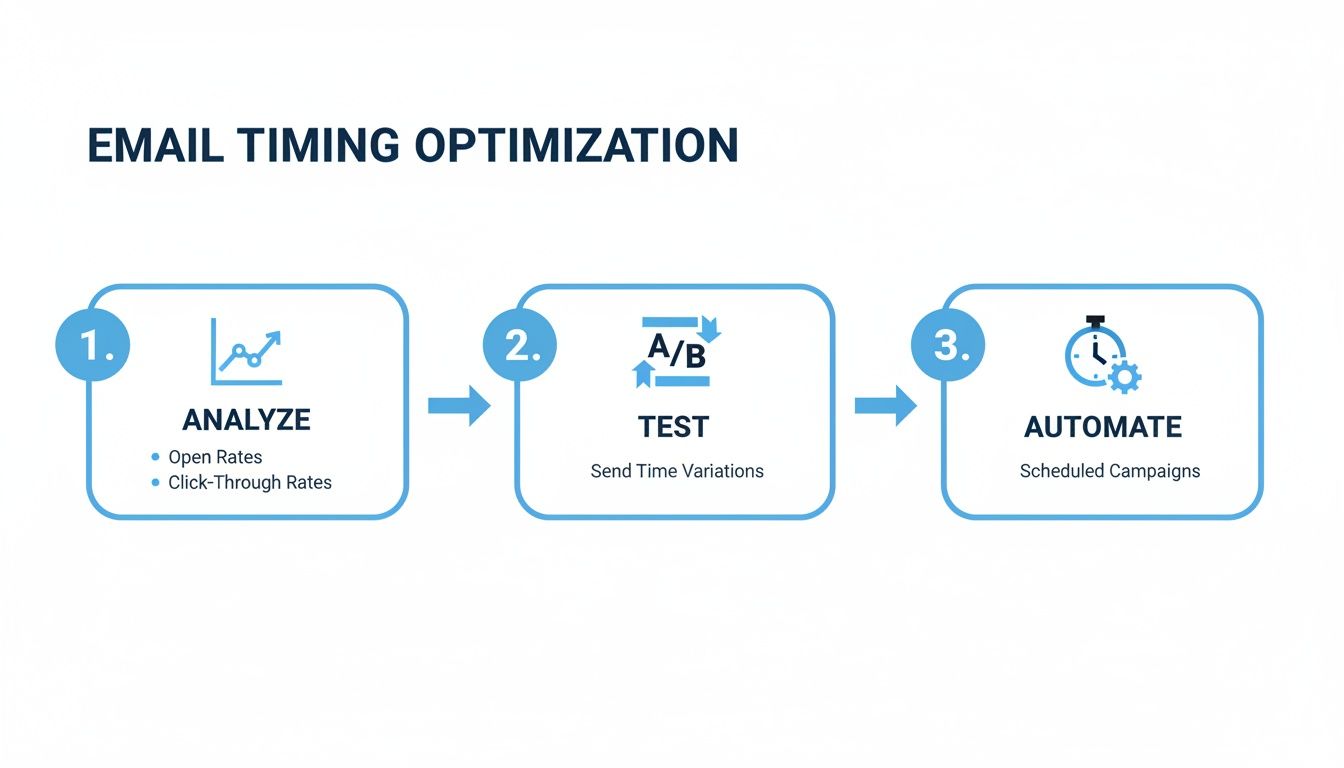
As you can see, finding the perfect send time isn't a one-and-done task; it’s a continuous cycle of analysis, testing, and automation. For a deeper dive with more proven strategies, this detailed article on how to improve email open rates is a fantastic resource.
Post-Send Analysis and Optimization
Your job isn't done when the email goes out. The real learning starts now. The data you get back is your roadmap for making the next campaign even better.
- Review Key Metrics: Don't just glance at the open rate. Dig into your click-through rates, unsubscribe numbers, and bounce rates to get the full story.
- Identify Patterns: What actually worked? Did a question-based subject line crush it? Did a Tuesday send time outperform Thursday? Document these wins so you can build on them.
- Plan Your Next A/B Test: Based on what you just learned, form a new hypothesis to test in your next send. This cycle of continuous, iterative testing is the engine of long-term improvement.
Common Questions About Email Open Rates
Even with a killer strategy, questions are bound to pop up. Getting straight answers is the fastest way to get confident and start seeing those open rates climb. Let's dig into a few of the most common ones we hear from B2B marketers.
What Is a Good B2B Email Open Rate?
Everyone wants to know the magic number, but the truth is, there isn't one. That said, a "good" open rate for most B2B newsletters is somewhere in the 35% to 40% range.
But take that with a grain of salt. Your industry, how engaged your audience is, and the health of your list can swing that number wildly. Super niche industries with hyper-targeted content will naturally see higher engagement. Broader, more saturated markets might hover on the lower end.
The best move? Benchmark against yourself first. Focus on incremental, steady improvement month over month instead of chasing a universal statistic.
How Do I Improve My Subject Lines?
To write subject lines that actually get opened, you need to either communicate clear value or spark genuine curiosity. Personalization is your best friend here—and I don't just mean dropping in a {{first_name}}. Reference a subscriber's recent activity or a pain point specific to their role.
For example, ditch "Check out our new features" and try something like, "A new way to manage your Q4 reporting, Jane." See the difference?
You also need to be testing constantly. Pit a question against a statement. Try a short, punchy subject line against a longer, more descriptive one. A/B testing is the only real way to discover what your audience responds to.
Your subject line and preview text are a one-two punch. The subject line earns the glance, but the preview text provides the compelling reason to open. Don't ever waste it with junk like "View this email in your browser."
What Are the Most Important Metrics Besides Open Rate?
An open rate tells you if your subject line worked, but it doesn't tell you much else. To get the full story on your email performance and overall list health, you absolutely have to be watching these metrics:
- Click-Through Rate (CTR): This shows you how many people found your content valuable enough to actually do something.
- Bounce Rate: If this number is high, your list is stale and needs a good cleaning. A high bounce rate is a direct hit to your sender reputation.
- Unsubscribe Rate: A sudden jump here is a major red flag. It usually means there's a disconnect between what people expected and what you're sending.
- Spam Complaint Rate: This is a critical health metric. Even a handful of spam complaints can do serious, lasting damage to your deliverability.
Looking at these metrics together gives you the context you need. It helps you understand not just if people are opening your emails, but why they are (or aren't) engaging with your content once they're inside.
Ready to put these strategies into practice? Breaker combines powerful email sending with automated list growth, giving you the tools to not just reach the inbox, but own it. Find your ideal B2B subscribers and watch your open rates climb. Start your 7-day trial today.
Keep reading
All articlesGDPR Consent Requirements for Purchased Email Lists
Purchased email lists rarely meet GDPR's consent bar. Learn the legal basis rules, PECR overlap, and safer alternatives before you hit send.
7 Email Platforms With Inbox Placement Testing & Suppression
Compare 7 email platforms that combine inbox placement testing with suppression management, scored on features, pricing, and best-fit sender size.
Email Automation Workflow & Drip Campaign Data Structure
Learn the database schema behind email drip campaigns—tables, workflow states, and event logs that power reliable marketing automation.