
10 B2B Lead Nurturing Best Practices for Explosive Growth in 2026
Discover 10 proven lead nurturing best practices for B2B growth. Learn segmentation, automation, and personalization to turn prospects into revenue.
In the world of B2B growth, acquiring leads is only half the battle. The real challenge, and where most revenue is won or lost, lies in what happens next. A generic, one-size-fits-all approach to lead nurturing is no longer effective. Today's buyers expect personalized, relevant communication that addresses their specific needs at every stage of their journey. Without a sophisticated strategy, you are not just losing engagement; you are actively pushing potential customers toward competitors who understand them better. This is a critical gap where predictable revenue leaks out of your funnel every single day.
This guide cuts through the noise to deliver a comprehensive list of actionable lead nurturing best practices designed for modern B2B growth teams. We will move beyond the basics, providing detailed frameworks you can implement immediately to build a high-converting nurture engine. You will learn precisely how to transform your lead management from a simple follow-up sequence into a strategic, revenue-generating system.
We will cover essential tactics, including:
- Advanced segmentation and dynamic content personalization.
- Implementing a predictive lead scoring model.
- Orchestrating multi-channel nurture campaigns that go beyond email.
- Building behavioral trigger-based automations for timely outreach.
- Establishing a framework for continuous testing and optimization.
Whether you are refining an existing process or starting from scratch, these proven tactics will help you build stronger relationships, shorten sales cycles, and turn your newsletter or lead magnet into a predictable revenue channel. Let’s dive into the practices that will fix your leaky funnel.
1. Segmentation-Based Email Campaigns
One of the most foundational lead nurturing best practices is to move beyond generic, one-size-fits-all email blasts. Segmentation involves dividing your subscriber list into specific, smaller groups based on shared characteristics. This ensures recipients get highly relevant messages that resonate with their unique needs, challenges, and stage in the buyer journey, dramatically improving engagement. For B2B audiences, targeted segmentation has been shown to increase open rates by over 14% and click-through rates by as much as 57%.

How It Works
Instead of sending the same welcome series or product update to everyone, you tailor your communication. For example, a new subscriber who indicated their industry is "SaaS" and company size is "50-200 employees" receives case studies from similar-sized tech companies. Meanwhile, an enterprise lead from the "Healthcare" sector receives content focused on compliance, security, and large-scale implementation. This level of precision makes your nurturing feel less like marketing and more like a helpful, one-on-one conversation.
Key Insight: The goal of segmentation isn't just to group contacts; it's to create distinct conversational tracks that align perfectly with each group's context and intent.
Actionable Implementation Tips
To effectively implement segmentation-based campaigns, focus on creating high-value, dynamic groups.
- Start Small: Begin with 3-5 high-impact segments, such as Ideal Customer Profile (ICP) fit, engagement level (active vs. inactive), and content topic interest.
- Combine Data Types: The most powerful segments combine demographic data (like company size or job title) with behavioral data (like a pricing page visit or a specific guide download).
- Use Behavioral Triggers: Automate segment changes. If a lead in your "Awareness Stage" segment downloads a "Comparison Guide," automatically move them to a "Consideration Stage" segment for more product-focused content.
- Monitor and Refine: Review segment performance weekly. Are open rates for your "SMB" segment dropping? Perhaps the content isn't specific enough. Adjust your criteria quarterly to optimize results.
For a deeper dive into creating and managing these groups, explore this ultimate guide to segmentation for lead nurturing.
2. Lead Scoring and Qualification
Not all leads are created equal, and one of the most crucial lead nurturing best practices is learning to tell them apart. Lead scoring is a systematic approach to assigning point values to prospects based on their demographic fit and behavioral engagement. This process prioritizes sales-ready leads from those still in the nurture stage, allowing sales teams to focus their energy on high-probability opportunities. By objectively qualifying leads, organizations can boost win rates by over 20% and shorten sales cycles significantly.
How It Works
Lead scoring creates a clear, data-driven threshold that separates a marketing-qualified lead (MQL) from a sales-qualified lead (SQL). For instance, a lead who fits your Ideal Customer Profile (ICP) based on their job title and company size might earn 30 points. If they then download a whitepaper (+10 points), visit the pricing page (+15 points), and attend a webinar (+25 points), their total score indicates strong buying intent. This systematic qualification prevents premature sales hand-offs and ensures marketing delivers truly qualified prospects.
Key Insight: Effective lead scoring acts as a translator between marketing engagement and sales readiness, converting behavioral data into a clear, actionable signal for your revenue team.
Actionable Implementation Tips
To implement a lead scoring model that drives real results, focus on collaboration with sales and continuous refinement.
- Define Your Thresholds: Work directly with the sales team to establish a clear, universally agreed-upon score that defines an MQL. This alignment is critical for success.
- Combine Fit and Engagement: A powerful model scores both explicit data (demographics like industry, company size) and implicit data (behavior like email clicks, page views). A high-fit, low-engagement lead needs nurturing, while a high-fit, high-engagement lead is ready for sales.
- Implement Negative Scoring: Assign negative points for disqualifying actions or attributes. For example, a lead from a non-target country, an unsubscribe action, or a visit to the "Careers" page should decrease their score.
- Automate Sales Alerts: Set up automated workflows to immediately notify the appropriate sales representative via your CRM when a lead crosses the MQL threshold, enabling rapid follow-up.
- Review and Adjust: A scoring model is not "set it and forget it." Review the correlation between lead scores and actual conversion rates monthly. If low-scoring leads are converting, your model needs adjustment.
3. Automated Drip Campaigns and Workflows
One of the most powerful lead nurturing best practices is to leverage automation. Automated drip campaigns are pre-designed sequences of emails triggered by specific user actions or time intervals. This approach allows you to deliver the right message at the right time, maintaining consistent, personalized communication at scale without manual intervention. For B2B companies, effective automation can generate 50% more sales-ready leads at a 33% lower cost.
How It Works
Instead of manually sending follow-up emails, you build intelligent workflows that guide leads through the sales funnel. For instance, when a lead downloads a "Beginner's Guide," an automated workflow can trigger a welcome email, followed by a series of educational messages over the next few weeks, each one building on the last. This ensures no lead falls through the cracks and that your brand remains top-of-mind, providing value at every step of their journey.
Key Insight: The purpose of automation is not to replace human interaction but to scale it. It handles the repetitive, time-sensitive tasks, freeing your team to focus on high-level strategy and one-on-one engagement with the most qualified leads.
Actionable Implementation Tips
To build effective automated campaigns, focus on creating logical, value-driven sequences tailored to specific triggers and segments.
- Define Core Workflows: Start by designing 3-5 primary workflows based on high-impact triggers like lead source (e.g., webinar registrants), Ideal Customer Profile (ICP) fit, or a specific content download.
- Personalize at Scale: Use dynamic content tags within your automated emails to insert personalized information like the lead's first name, company, or the specific resource they engaged with.
- Monitor Workflow Health: Regularly check key metrics for each workflow, such as open rates, click-through rates, and especially unsubscribe rates. A high unsubscribe rate on a specific email in a sequence is a clear signal that the content or frequency needs adjustment.
- A/B Test Everything: Continuously test elements within your workflows, including subject lines, send times, and calls-to-action. Even small improvements can have a significant impact when scaled across thousands of leads.
For sequences you can adapt, plus guidance on the workflow data structure behind beginner, intermediate, and advanced drips, see our email drip campaign templates. For the full database schema, tables, and event logs, see our drip campaign data structure guide.
4. Personalization and Dynamic Content
If segmentation builds the foundation, personalization is the architectural detail that makes your lead nurturing feel human and custom-built. This practice involves tailoring email content, subject lines, and offers based on individual recipient data. Moving beyond simple [First Name] tokens, true personalization uses dynamic content blocks that change based on a lead’s industry, role, behavior, or engagement history. This level of customization is a core component of modern lead nurturing best practices, with personalized emails delivering significantly higher ROI and transaction rates.
How It Works
Dynamic content allows a single email template to display different information for different recipients. For instance, a B2B software company could send one promotional email where the hero image and customer testimonial change automatically. A lead from the "Finance" industry sees a case study about an investment bank, while a lead from "Retail" sees a success story from an e-commerce brand. This ensures the message always reflects the recipient’s specific context, making the communication far more compelling and relevant.
Key Insight: Personalization transforms your messaging from a broadcast into a conversation. It shows leads you understand their specific challenges, not just their general market segment.
Actionable Implementation Tips
To integrate personalization effectively, start with the data you have and expand from there.
- Layer Your Personalization: Begin with simple tokens like
[Company Name]and[Job Title]. Then, layer in dynamic content based on behavioral data, such as a lead's last visited product page or most recent content download. - Create Industry-Specific Content Blocks: Develop 3-5 variations of key content blocks (like testimonials, case study links, or CTAs) tailored to your top customer industries. Use automation rules to swap them in based on the lead's profile.
- Leverage Progressive Profiling: Use forms on your landing pages to incrementally gather more data about your leads over time. Ask for their biggest challenge or team size on their second or third download to enrich their profile for deeper personalization.
- A/B Test Everything: Continuously test personalized subject lines and content against more generic versions. This provides concrete data to demonstrate the value of your personalization efforts and helps you identify what resonates most.
To master this technique, check out this guide on using dynamic content and personalization in lead nurturing.
5. Multi-Channel Lead Nurturing Integration
Effective lead nurturing extends far beyond the inbox. Multi-channel integration involves coordinating your efforts across email, social media, paid ads, and content to create a cohesive and immersive brand experience. Instead of relying on isolated email campaigns, this approach ensures consistent messaging that reinforces your value proposition at every touchpoint. This unified strategy is crucial, as businesses using multi-channel nurturing see significantly higher engagement and conversion rates compared to single-channel approaches.
How It Works
A multi-channel strategy ensures that a lead who interacts with your brand receives a consistent, logical sequence of messages, no matter the platform. For example, a lead who downloads a whitepaper receives a follow-up email sequence. Simultaneously, they are added to a custom audience on LinkedIn and are shown ads featuring a case study related to that whitepaper. If they engage with the ad, their lead score increases, triggering a more sales-focused email from your CRM. This creates a seamless journey that guides them forward.
Key Insight: The modern buyer journey is not linear. Multi-channel nurturing meets leads where they are, using each platform's strengths to build momentum and guide them toward a conversion.
Actionable Implementation Tips
To build a powerful multi-channel nurturing engine, focus on connecting your most critical platforms and aligning your messaging.
- Start with Two Channels: Begin by integrating email and one other high-impact channel, like LinkedIn. Align your email outreach with InMail messages or connection requests for a personalized, high-touch approach.
- Retarget with Precision: Create custom ad audiences from your email list segments. For instance, retarget leads who opened an email about a new feature but didn't click with display ads showcasing a video demo of that feature.
- Align Content Calendars: Ensure your email nurturing content, blog posts, social media updates, and webinar schedules are all thematically aligned. Use email to drive registrations for webinars and promote new pillar content.
- Track Cross-Channel Attribution: Use UTM parameters on all links across every channel to accurately track how leads are moving through your funnel and which touchpoints are most effective. This data is vital for optimizing your lead nurturing best practices.
For more on creating these integrated experiences, review HubSpot’s guide on building a multi-channel marketing campaign.
6. Content-Driven Nurturing and Value Prioritization
Effective lead nurturing is not about constant sales pitches; it's about building trust by providing consistent value. Content-driven nurturing prioritizes educating prospects and addressing their pain points, positioning your brand as a helpful advisor rather than just a vendor. This strategy focuses on distributing valuable, non-promotional content that helps leads self-educate and move through their buying journey. Done right, this approach can generate 50% more sales-ready leads at a significantly lower cost.
How It Works
Instead of sending emails that push for a demo, you send links to insightful blog posts, webinar recordings, or industry reports. For example, a lead who downloaded a guide on "Improving Team Productivity" would receive a follow-up email sequence featuring case studies of companies that boosted efficiency, tips from productivity experts, and a checklist for identifying workflow bottlenecks. This positions your solution as the logical next step once they have a firm grasp of their problem, making the eventual sales conversation much warmer.
Key Insight: The most successful lead nurturing best practices shift the focus from "what we sell" to "how we can help." Value-first content builds the trust required for a future transaction.
Actionable Implementation Tips
To build an effective content-driven nurturing engine, focus on creating a library of assets that map directly to your ICP's challenges.
- Map Content to Pain Points: Develop 3-5 pillar content pieces (e.g., ultimate guides, research reports) for each primary pain point your ideal customer profile faces.
- Leverage Your Newsletter: Use your newsletter to repurpose valuable blog content, share external insights, and subtly introduce gated assets like ebooks or templates to grow your subscriber list.
- Create Comparison Guides: Develop objective-style comparison guides that help prospects evaluate solutions in your category, subtly highlighting the unique advantages of your offering without being overly promotional.
- Integrate Social Proof: Weave customer testimonials and detailed case studies into your nurture sequences to validate your claims and demonstrate real-world success.
- Track Content Performance: Monitor which content pieces and topics correlate with higher engagement and conversion rates, then double down on creating more of what works.
7. Engagement-Based List Hygiene and Re-engagement Campaigns
A large email list is only valuable if its members are engaged. One of the most critical yet overlooked lead nurturing best practices is actively managing list health. This involves regularly cleaning your list by removing inactive subscribers and strategically attempting to re-engage dormant contacts before they go cold for good. Maintaining proper list hygiene can improve email deliverability by up to 40% and keeps your nurturing efforts focused on prospects who are genuinely interested.
How It Works
Instead of endlessly sending emails to unengaged contacts, you create automated workflows to identify and address inactivity. For example, a subscriber who hasn't opened an email in 90 days is automatically entered into a re-engagement sequence. This "win-back" campaign might offer a special discount, ask for feedback, or highlight new, high-value content to reignite their interest. If they still don't engage, they are respectfully unsubscribed, which protects your sender reputation and keeps your metrics clean.
Key Insight: Proactive list hygiene isn't about shrinking your audience; it's about concentrating your resources on high-potential leads and maintaining a strong sender reputation for better inbox placement.
Actionable Implementation Tips
To effectively implement list hygiene and re-engagement, you need clear, automated rules.
- Define Inactivity Thresholds: Establish clear criteria for a dormant lead, such as no email opens or clicks in a 90 or 120-day period.
- Create a Dedicated Win-Back Sequence: Build a 2-3 email sequence specifically for re-engagement. The goal is to provide undeniable value or a compelling reason to stay. For specific tactics, this guide on how to re-engage a prospect via email provides proven strategies.
- Automate Removal: If a lead doesn't engage with the win-back sequence, automatically unsubscribe them. This prevents them from harming your overall deliverability rates.
- Monitor Bounce Rates: Immediately remove hard bounces after every campaign send. Monitor soft bounces and remove contacts that consistently fail to receive emails.
8. Account-Based Marketing (ABM) and Orchestrated Campaigns
While traditional lead nurturing focuses on individual leads, Account-Based Marketing (ABM) flips the funnel by concentrating marketing and sales efforts on a curated list of high-value target accounts. Instead of casting a wide net, ABM treats each account as its own market, requiring a coordinated, multi-channel approach. This highly focused strategy is one of the most effective lead nurturing best practices for B2B companies, with data showing that ABM can generate a 38% higher win rate.
How It Works
ABM is a team sport that aligns marketing, sales, and customer success around acquiring and growing specific accounts. For instance, rather than sending a generic email sequence to a single contact, an ABM campaign might involve personalized emails to the VP of Engineering, targeted LinkedIn ads to the entire engineering department, and a direct mailer sent to the CTO, all orchestrated to deliver a unified message. This ensures every touchpoint is relevant to the account’s unique challenges and the specific roles of its decision-makers.
Key Insight: ABM shifts the mindset from "How many leads did we generate?" to "How deeply are we engaging our most valuable target accounts?"
Actionable Implementation Tips
To launch a successful ABM strategy, start small and build momentum with a coordinated plan.
- Define Your Target List: Begin with a manageable list of 50-100 ideal accounts based on firmographics, buying intent signals, and strategic value.
- Map Key Personas: Identify the key decision-makers and influencers within each target account. Create tailored content and messaging for each persona, addressing their specific pain points.
- Orchestrate Multi-Channel Plays: Coordinate your outreach. For example, have your sales team follow up with a LinkedIn connection request 24 hours after marketing sends a personalized, high-value email.
- Measure Account Engagement: Track engagement at the account level, not just the individual lead level. Use tools like 6sense or Demandbase to monitor cross-channel interactions and adjust your strategy based on which accounts are showing the most interest.
9. Behavioral Trigger-Based Email Automation
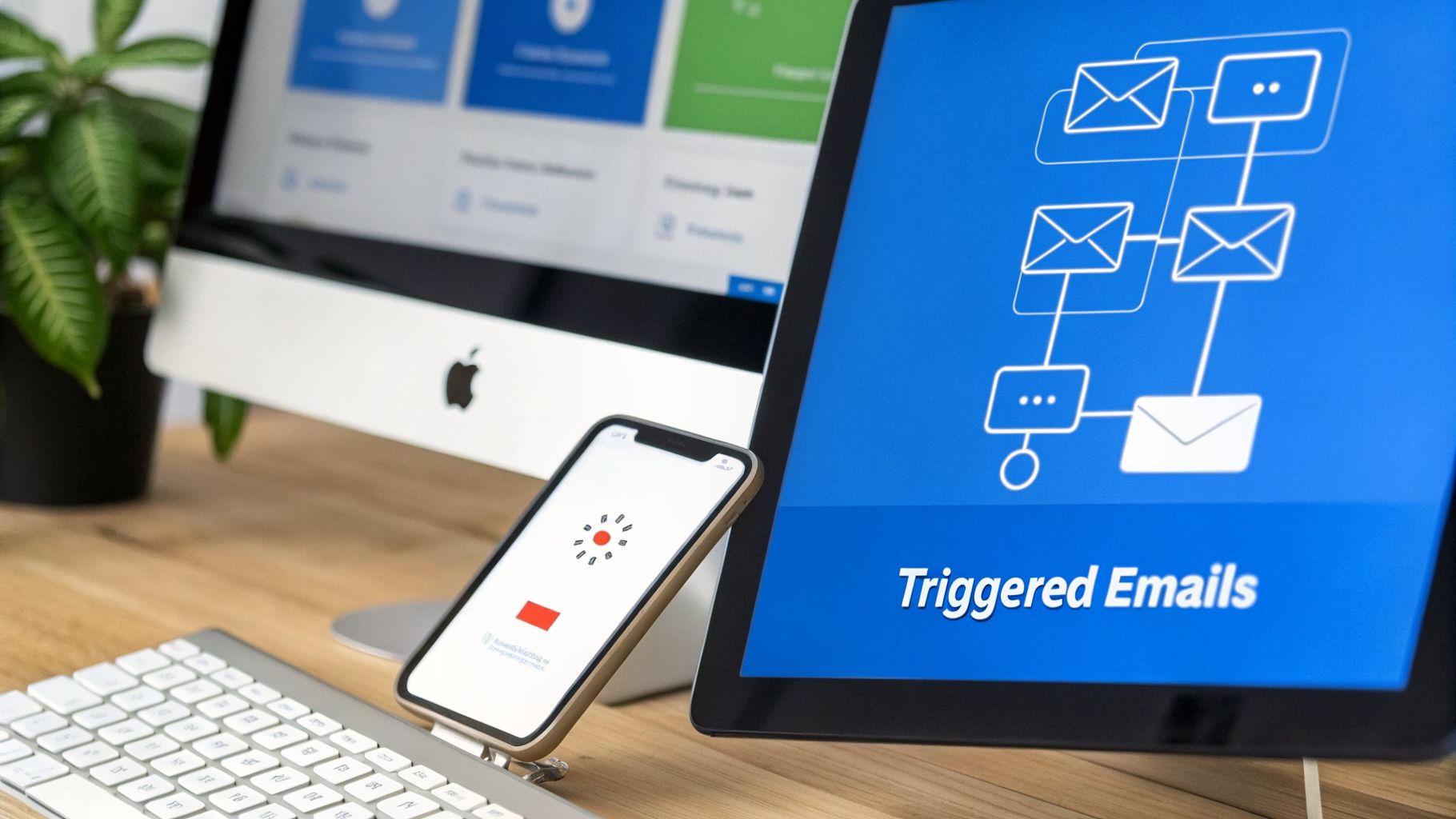
Moving beyond pre-scheduled drips, behavioral trigger-based automation sends emails in direct response to a lead's specific actions. This approach capitalizes on immediate intent, delivering the right message at the precise moment a lead is most engaged. Instead of relying on a calendar, you rely on user behavior, which can generate 50% higher click-through rates and significantly more revenue compared to generic batch-and-blast campaigns.
How It Works
This practice involves setting up automated workflows that "listen" for specific user actions, such as visiting a pricing page, downloading a whitepaper, or clicking a link in a previous email. When a lead performs one of these predefined actions, it triggers a highly relevant, pre-written email. For instance, a lead who visits your integrations page might instantly receive an email with a case study on how a similar company used your API. This real-time responsiveness makes your lead nurturing feel incredibly personalized and timely.
Key Insight: Trigger-based automation shifts the conversation from being marketer-led (based on a schedule) to being prospect-led (based on their actions), ensuring maximum relevance and impact.
Actionable Implementation Tips
To effectively implement this advanced lead nurturing best practice, focus on high-intent actions and maintain a positive user experience.
- Identify High-Impact Triggers: Start by mapping 3-5 key behaviors that signal intent, like a pricing page visit, a specific guide download, or a demo request form abandonment.
- Personalize the Follow-Up: Reference the trigger in your email. For example, "Saw you were checking out our guide on X; here’s a related case study you might find useful."
- Implement a Cooldown Period: To avoid overwhelming prospects, set rules that prevent a lead from receiving too many triggered emails in a short time frame (e.g., no more than one every 48 hours).
- Use Triggers as Sequence Entry Points: A behavioral trigger doesn't have to be a one-off email. Use it as the entry point to a longer, more targeted multi-email nurture sequence focused on that specific interest area.
10. Testing, Analytics, and Continuous Optimization
Lead nurturing is not a "set it and forget it" activity. The most effective programs are built on a foundation of continuous improvement, where every element is systematically tested, measured, and refined. This involves A/B testing variables like subject lines, CTAs, send times, and content formats to understand what truly drives engagement and conversions. Data-driven optimization is one of the most critical lead nurturing best practices, ensuring your campaigns evolve and improve over time.
How It Works
Instead of relying on assumptions, a culture of testing uses data to make decisions. For example, you might hypothesize that a shorter, more direct subject line will increase open rates. You would run an A/B test sending one version to a segment of your audience and the original version to another. By analyzing the results, you gain a clear, quantitative understanding of which approach works better. This iterative process, applied across all touchpoints, compounds over time to produce significant gains in campaign performance.
Key Insight: Treat every email and workflow as a learning opportunity. The goal isn't just to get a single win but to build an institutional knowledge base of what works for your specific audience.
Actionable Implementation Tips
To build a robust testing and optimization engine, focus on structure and discipline.
- Establish Baselines: Before you start, document your current key metrics (e.g., open rate, click-through rate, conversion rate). This baseline is essential for measuring the impact of your tests.
- Test One Variable at a Time: To get clean, reliable data, isolate a single element in each test. Test your subject line or your CTA, but not both at the same time, to know exactly what caused the change in performance.
- Focus on High-Impact Variables First: Prioritize tests that have the potential for the biggest impact. Start with subject lines, the core value proposition in your email body, and the main call-to-action.
- Document Everything: Maintain a simple testing log that details the hypothesis, variables, duration, audience segment, and results of every test. This prevents re-running failed experiments and helps share learnings across the team.
To truly refine your nurture strategy, continuous optimization of your conversion points is crucial. Dive deeper into strategies for improving conversion rates on landing pages.
For a comprehensive breakdown of testing methodologies, explore this guide to A/B testing email campaigns for higher engagement.
10-Point Lead Nurturing Comparison
Strategy
Implementation Complexity 🔄
Resource Requirements & Speed ⚡
Expected Outcomes / Impact ⭐📊
Ideal Use Cases 💡
Key Advantages ⭐
Segmentation-Based Email Campaigns
Medium–High — requires CRM/data model and ongoing refinement 🔄
High data & tooling needs; moderate setup time, efficient targeting once built ⚡
Higher opens (14–100%) and clicks (5–57%); improved ROI and deliverability 📊
B2B lists with varied ICPs; nurture by buyer stage 💡
Significantly higher engagement and ROI; better sender reputation ⭐
Lead Scoring and Qualification
Medium–High — needs sales/marketing alignment and model tuning 🔄
CRM/integration and analytics required; initial setup intensive ⚡
↑ Win rates (~20%) and shorter sales cycles (25–30%); predictable pipeline 📊
High-volume lead environments; sales-led organizations 💡
Prioritizes high‑intent leads; improves sales efficiency and forecasting ⭐
Automated Drip Campaigns and Workflows
Medium — design complexity rises with branching logic 🔄
Moderate tooling; saves manual effort and scales quickly once live ⚡
50% more sales‑ready leads; 33% lower CPL; consistent touch cadence 📊
Onboarding, multi-step nurturing, lead qualification flows 💡
Scales nurturing, enforces cadence, enables rapid testing ⭐
Personalization and Dynamic Content
High — requires clean data and dynamic logic implementation 🔄
High data quality and template complexity; increases conversion speed when done right ⚡
6× higher transaction rates and ~5× ROI for personalized messages 📊
High‑value or data-rich accounts, product recommendations, role‑specific CTAs 💡
Delivers highly relevant experiences and higher conversion values ⭐
Multi-Channel Lead Nurturing Integration
High — cross-platform coordination and attribution complexity 🔄
Significant integration and cross-team effort; slower to launch, high impact ⚡
~73% higher conversions vs single-channel; better LTV and attribution 📊
ABM, enterprise programs, campaigns spanning email, ads, webinars 💡
Reinforces messaging across touchpoints; comprehensive journey view ⭐
Content-Driven Nurturing & Value Prioritization
Medium — content strategy and mapping required 🔄
High content creation investment; slower lead velocity but durable results ⚡
50% more sales‑ready leads; acquisition cost down 25–30% 📊
Thought leadership, long sales cycles, inbound demand generation 💡
Builds trust and authority; attracts qualified inbound leads ⭐
Engagement-Based List Hygiene & Re‑engagement
Low–Medium — rule-based maintenance and win‑back flows 🔄
Low ongoing resources; quick improvements to deliverability and cost ⚡
Deliverability +10–40%; bounce reduction up to 90%; cleaner metrics 📊
Large/stale lists, deliverability issues, retention focused programs 💡
Protects sender reputation and reduces send costs; improves engagement rates ⭐
Account-Based Marketing (ABM) & Orchestrated Campaigns
Very High — account selection, personalization, multi-threading 🔄
Very high resources and coordination; slow to scale but high ACV payoff ⚡
91% higher ACV and 38% higher win rates vs traditional methods 📊
Enterprise sales, high‑ACV opportunities, strategic accounts 💡
Maximizes deal size and alignment between sales & marketing ⭐
Behavioral Trigger-Based Email Automation
Medium–High — requires tracking infra and real‑time rules 🔄
Requires tracking integrations; highly efficient when rules are tuned (fast responses) ⚡
50% higher CTRs and large revenue uplift (up to 18× vs batch) 📊
Cart abandonment, product usage prompts, intent-driven outreach 💡
Timely, relevant messaging at peak intent; improves conversion rates ⭐
Testing, Analytics, & Continuous Optimization
Medium — needs testing discipline, statistical rigor 🔄
Ongoing analyst/time investment; requires sufficient sample sizes; steady returns ⚡
25–50% improvements in engagement metrics within months with systematic testing 📊
Mature programs seeking incremental gains and evidence-based decisions 💡
Data-driven improvements, reduces guesswork, builds institutional knowledge ⭐
From Nurturing Leads to Closing Deals: Your Next Steps
You've explored the ten pillars of modern B2B growth. From the foundational precision of Segmentation-Based Email Campaigns and Lead Scoring to the dynamic execution of Automated Workflows and Multi-Channel Integration, it's clear that effective lead nurturing is no longer just a marketing function. It has evolved into a strategic imperative, a complex system of technology, psychology, and value delivery designed to build trust and guide prospects from initial awareness to a signed contract.
Mastering these lead nurturing best practices is not about implementing every single tactic overnight. It's about recognizing that each element, from the hyper-relevance of Personalization to the proactive engagement of Behavioral Triggers, serves a singular purpose: to make your prospect feel understood. When you successfully orchestrate these strategies, your communication transforms from a series of disjointed messages into a cohesive, value-driven conversation.
Synthesizing the Strategy: Your Key Takeaways
The journey to a high-converting nurture engine is built on three core principles that weave through all ten practices we've discussed:
- Intelligence Over Volume: The era of "batch and blast" is definitively over. Success now hinges on using data intelligently. This means leveraging Lead Scoring to prioritize your sales team's focus, using Behavioral Triggers to deliver the right message at the perfect moment, and employing Account-Based Marketing (ABM) tactics to orchestrate a unified buying experience for high-value accounts. Your goal is not to talk at everyone, but to speak with the right people at the right time.
- Value as the Main Currency: Every touchpoint is an opportunity to provide value, not just to ask for a sale. Content-Driven Nurturing is the engine of this approach, positioning your brand as a trusted advisor. By offering solutions, insights, and resources tailored to your prospect's challenges, you build equity and earn the right to their attention. This commitment to value is also reflected in practices like Engagement-Based List Hygiene, which respects the user's inbox and ensures your audience remains genuinely interested.
- Continuous Iteration as a Non-Negotiable: Your lead nurturing strategy is a living system, not a static "set it and forget it" campaign. The most successful growth teams are relentless in their pursuit of improvement. They embrace Testing, Analytics, and Continuous Optimization as a core operational loop. Every email sent, every workflow triggered, and every piece of content shared generates data that provides the insights needed to refine targeting, sharpen messaging, and improve conversion rates month over month.
Your Actionable Path Forward
The path to transforming your lead nurturing can feel daunting, but it begins with a single, focused step. Don't try to boil the ocean. Instead, select one or two high-impact areas from this list to tackle first. Perhaps your most significant opportunity lies in implementing a formal Lead Scoring model to bridge the gap between marketing and sales. Or maybe your initial focus should be on building your first Automated Drip Campaign for new newsletter subscribers.
Choose your starting point, define a clear objective, and measure your results. As you build momentum and gather data, you can progressively layer in more sophisticated tactics like dynamic content and multi-channel orchestration. By adopting this iterative approach, you create a sustainable framework for growth, turning what was once a manual effort into a predictable, scalable revenue engine. The ultimate goal is to build a system where every lead feels like they are on a personalized journey, guided by a brand that truly understands their needs.
Ready to build a powerful B2B growth engine without the manual busywork? Breaker combines automated list expansion with an intuitive campaign builder, empowering you to implement these lead nurturing best practices with best-in-class deliverability. Start your 7-day trial of Breaker today and turn your audience into your most reliable revenue channel.
Keep reading
All articlesHow to Boost Conversions With Your Email Newsletter
Turn your newsletter into a conversion engine. See 2026 benchmarks, CTR vs CVR explained, and the fixes most email guides skip.
Drip Campaign Template: Ready-to-Use Email Sequences
Get 6 ready-to-paste drip campaign templates with subject lines, body copy, and send timing—plus a step-by-step guide to building your own.
Post-Webinar Survey Questions Template (2026)
30+ post-webinar survey questions with NPS, CSAT, and CES templates, plus timing and length tips to boost completion and qualify leads faster.