
A Practical Guide to Boosting Your Sales Conversion Rate
Discover proven B2B strategies to improve your sales conversion rate. Our practical guide offers optimization tactics that drive measurable results and growth.
Your sales conversion rate is one of the most honest metrics in your entire business. Think of it as the ultimate report card for your sales and marketing efforts, showing exactly how well you turn casual interest into real revenue.
What Is a Sales Conversion Rate and Why It Matters
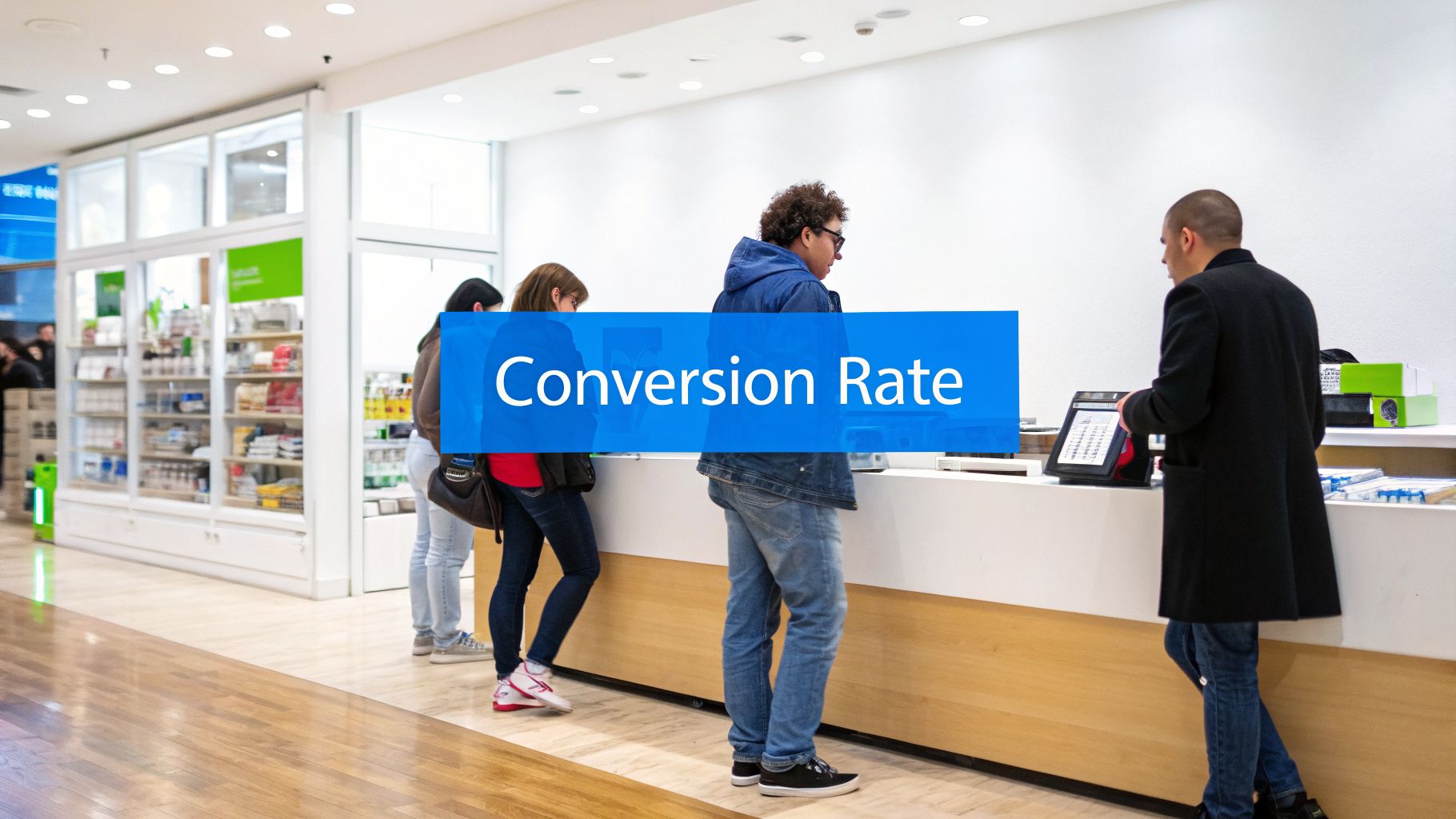
Let’s picture your website as a physical store. Every person who walks through the door is a potential customer, or a visitor. Your sales conversion rate simply measures what percentage of those visitors actually make it to the checkout counter and buy something.
It’s a direct reflection of your business's health. This single number tells you if your product, your pricing, and your messaging are actually connecting with your target audience. A high rate? You’re on the right track. A low rate signals that something in the customer journey is broken—a "leak" in your sales funnel that’s costing you money.
The Simple Formula for Success
Calculating your basic sales conversion rate is refreshingly simple. All you need are two numbers: the total conversions and the total visitors over a specific time.
Sales Conversion Rate = (Total Conversions / Total Visitors) x 100
For example, if your landing page got 1,000 visitors last month and 50 of them made a purchase, your sales conversion rate is 5%. This straightforward calculation is your starting point for understanding performance and even forecasting future growth.
For anyone new to these terms, it can be helpful to see them side-by-side. Here’s a quick breakdown of the core concepts you'll encounter when discussing conversion rates.
Key Conversion Rate Concepts at a Glance
Term
Simple Definition
Why It Matters for Your Business
Visitor
Anyone who lands on your website or a specific page.
This is the top of your funnel—the total pool of potential customers you can convert.
Conversion
The specific action you want a visitor to take (e.g., make a purchase, sign up).
This is the "win" you're measuring. Defining this clearly is the first step to tracking success.
Conversion Rate
The percentage of visitors who complete the desired action.
This is your efficiency score. It tells you how good you are at turning traffic into results.
Sales Funnel
The path a visitor takes from initial awareness to becoming a paying customer.
Understanding this journey helps you pinpoint where visitors are dropping off so you can fix the leaks.
Ultimately, these terms aren't just jargon; they're the building blocks for a data-driven strategy that moves your business forward.
Beyond the Final Sale: B2B Conversions
While a final sale is often the ultimate goal, the word "conversion" can mean different things, especially in B2B markets where sales cycles are much longer. Not every interaction is a purchase, but many are critical steps on the path to one.
You can—and should—track various types of conversions to measure progress at each stage of your funnel. If you want to go even deeper into the nuances of this metric, feel free to explore our detailed glossary entry on the broader topic of a conversion rate.
Key B2B conversion actions often include:
- Requesting a product demo: This shows strong interest from a lead who wants to see your solution in action.
- Downloading a whitepaper or case study: This tells you a prospect is in the research phase, gathering info to solve a problem.
- Signing up for a free trial: A high-intent action where a user is ready to test-drive your product.
- Subscribing to a newsletter: This builds your audience and allows for nurturing leads over a longer period.
By tracking these "micro-conversions," you get a much clearer picture of your sales pipeline's health. It helps you identify which marketing channels bring in the most engaged prospects and where potential customers might be dropping off. This data-driven approach moves you from guessing what works to knowing what drives results, making your sales conversion rate a powerful tool for strategic decisions.
How to Accurately Calculate and Track Your Conversion Rate
Knowing what a sales conversion rate is is one thing. Actually using it to make better decisions is another. To make this metric work for you, you need a clear, consistent way to calculate and track it. Without solid measurement, any strategy you build is just guesswork.
Think of it like a doctor checking a patient's vitals. Random, inaccurate readings don't tell the full story. You need reliable, ongoing data to spot problems and see if the treatment is working. The same idea applies to the health of your business.
The Core Sales Conversion Rate Formula
At its heart, the calculation is simple: it measures how many qualified leads turn into paying customers. This is the ultimate test of your sales team’s performance after marketing has handed off the baton.
The formula is pretty straightforward:
Sales Conversion rate = (Total Number of Sales / Total Qualified Leads) x 100
Let’s say your team got 50 qualified leads from marketing last quarter and closed 10 of them as new customers. Your calculation would be (10 / 50) x 100, which gives you a sales conversion rate of 20%. This number helps you evaluate your sales team’s effectiveness in isolation, separate from top-of-funnel marketing efforts.
Tracking Granular Funnel Conversions
While the overall sales conversion rate is a vital KPI, a truly deep analysis means looking at the entire journey. You have to measure the handoffs between marketing and sales to find out where prospects are falling through the cracks. This means tracking “micro-conversions” at each stage.
Here are a few essential formulas for a more detailed B2B funnel analysis:
- Formula: (Total SQLs / Total MQLs) x 100
- SQL to Opportunity Conversion Rate: This tracks how many sales-qualified leads advance to become a formal sales opportunity with a potential deal attached. It’s a critical metric that many businesses completely miss.
- Opportunity to Close Won Rate: This is the classic "closing ratio." It shows just how good your sales team is at winning deals once they’re in the pipeline.
By measuring these individual stages, you can get past a single, generic number and zero in on specific areas that need work. You might find you're great at generating leads but terrible at turning them into real opportunities—a common leak in many sales funnels.
Essential Tools for Accurate Tracking
You can't track what you don't measure, and you can't measure without the right tools. A few key platforms working together will give you a complete picture of your funnel, from the first click to the final sale.
- Web Analytics (e.g., Google Analytics): This is ground zero for tracking website visitors, user behavior, and top-of-funnel conversions like form fills or content downloads. You absolutely have to set up specific goals to track these actions properly.
- Customer Relationship Management (CRM): Your CRM is the single source of truth for your sales pipeline. It’s where every lead, opportunity, and customer touchpoint lives, making it essential for calculating SQL, opportunity, and close rates.
- Call Tracking Platforms: To really nail down your conversion rate, you have to track leads from every source. This often means using robust call tracking software that can connect phone calls back to the specific marketing campaigns that drove them.
When you combine the data from these tools, you get a 360-degree view. If you’re curious about how to structure all this data, our guide on ad-hoc reporting offers some useful frameworks for pulling insights from different sources. This integrated approach ensures you can trust your numbers and make decisions with confidence.
Understanding Sales Conversion Rate Benchmarks
So, you've figured out how to calculate your sales conversion rate. The very next question is always the same: "Is my number any good?" To answer that, you have to look beyond your own dashboard and see how you stack up against industry benchmarks. This isn't just a vanity check—it's about setting realistic goals, spotting where your funnel is actually leaking, and getting a true sense of your performance.
There's no single magic number for a "good" sales conversion rate. It swings wildly depending on your industry, whether you're B2B or B2C, where your traffic comes from, and even the price of what you're selling. A 5% conversion rate might be phenomenal in one field but a five-alarm fire in another.
B2B vs. B2C Conversion Expectations
The difference between B2B and B2C business models creates a huge gap in what you can expect from your conversion rates. B2C purchases are often quick, emotional decisions driven by immediate needs and lower price points. Our guide to B2B, SME, and consumer newsletter audiences breaks down how each group reads, responds, and converts.
B2B, on the other hand, is a different beast entirely. The sales cycles are notoriously long and tangled, involving multiple decision-makers, big-ticket prices, and tons of research. A single B2B deal can take months of demos, negotiations, and approvals. As a result, the final "sale" conversion rate is naturally lower and has to be measured over a much longer period.
A B2C ecommerce shop might pop the champagne for a 3% conversion rate on direct sales. Meanwhile, a B2B SaaS company could be thrilled with a 10% lead-to-opportunity conversion rate, even if it takes another six months to close the deal. Context is everything.
To even begin these calculations, businesses rely on a stack of essential tools to get the data they need.
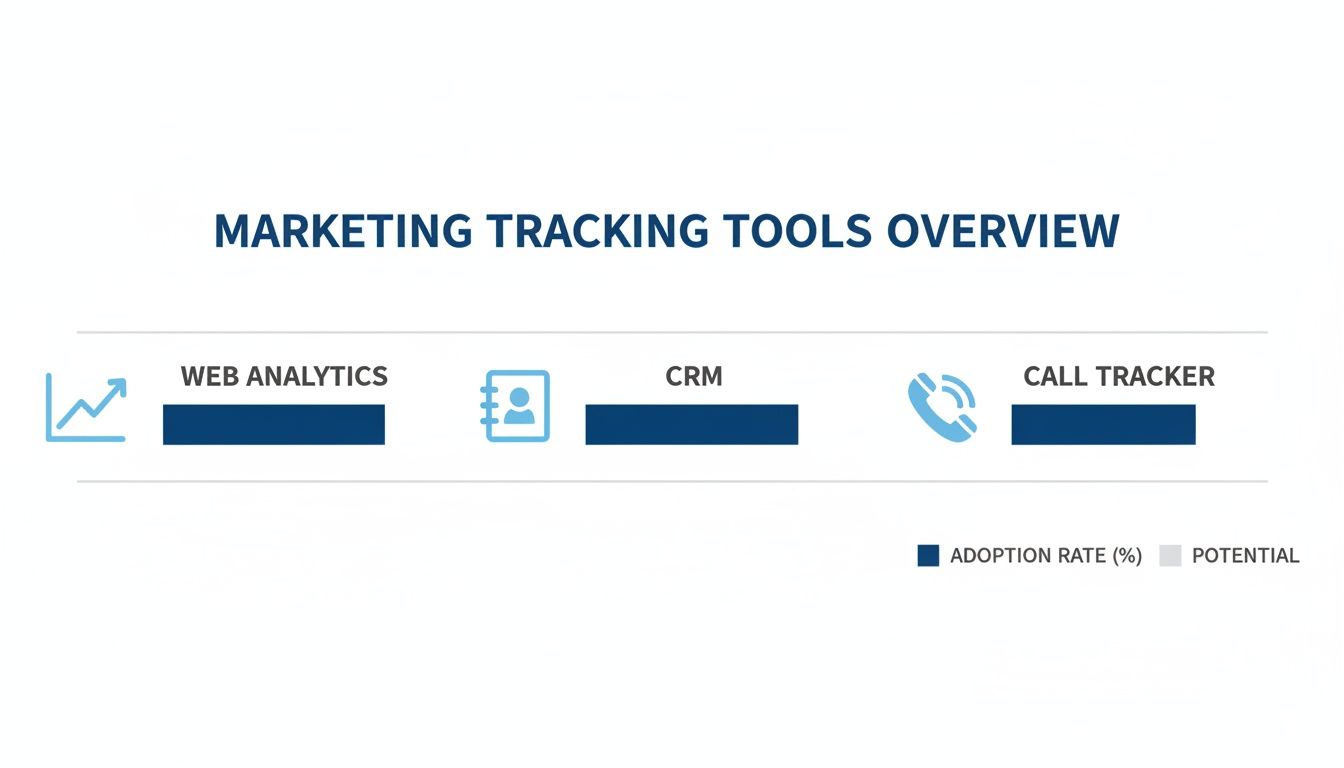
As you can see, combining web analytics, a CRM, and call tracking gives you a complete view of the funnel. This allows you to slice and dice your data to get a real, unfiltered picture of your performance. If calls are a big part of your funnel, dedicated call management software handles the routing, recording, and attribution side.
Channel and Industry Specific Benchmarks
Let's be honest: not all traffic is created equal. Where your visitors come from has a massive impact on whether they’ll convert. And of course, what you're selling also shapes buyer behavior in big ways.
Globally, the average sales conversion rate for ecommerce sites hovers right around 2.5% to 3%. That might sound low, but when you scale it up, the numbers get impressive—for a site with a million monthly visitors, that’s up to 30,000 sales. There are even regional differences, with the UK leading at 4.1% and the US at 2.5%, proving that local buying habits matter.
For B2B marketers, this reality underscores the power of targeted channels like newsletters. Instead of just spraying traffic everywhere, Breaker’s ICP targeting delivers engaged B2B leads, turning cold traffic into prospects who are actually interested.
Industries show even bigger contrasts. Food and beverage can hit rates over 6.2%, thanks to impulse buys. In contrast, luxury jewelry often lags at 1.5% because of the high-stakes, considered nature of the purchase. But here’s the most telling stat: referral traffic converts best at 5.4%, absolutely crushing social media's dismal 0.7%.
Here’s what that means for your strategy:
- Referral & Email: These channels consistently deliver the best conversion rates. They run on trust and pre-existing relationships.
- Search (Organic & Paid): Visitors from search engines usually have high intent, leading to solid conversions, especially if you’re targeting specific, long-tail keywords.
- Social Media: This is often the worst-performing channel for direct sales. It’s fantastic for building top-of-funnel awareness, not for immediate transactions.
Getting a handle on these benchmarks is the first real step toward building a smarter growth strategy. It lets you shift from asking, "Is my rate good?" to asking the much better question: "How can I improve my rate for this specific channel?" And remember, beyond the rate itself, it's vital to know how to calculate conversion cost to understand your true ROI.
Diagnosing Your Leaky Funnel and Finding Conversion Killers
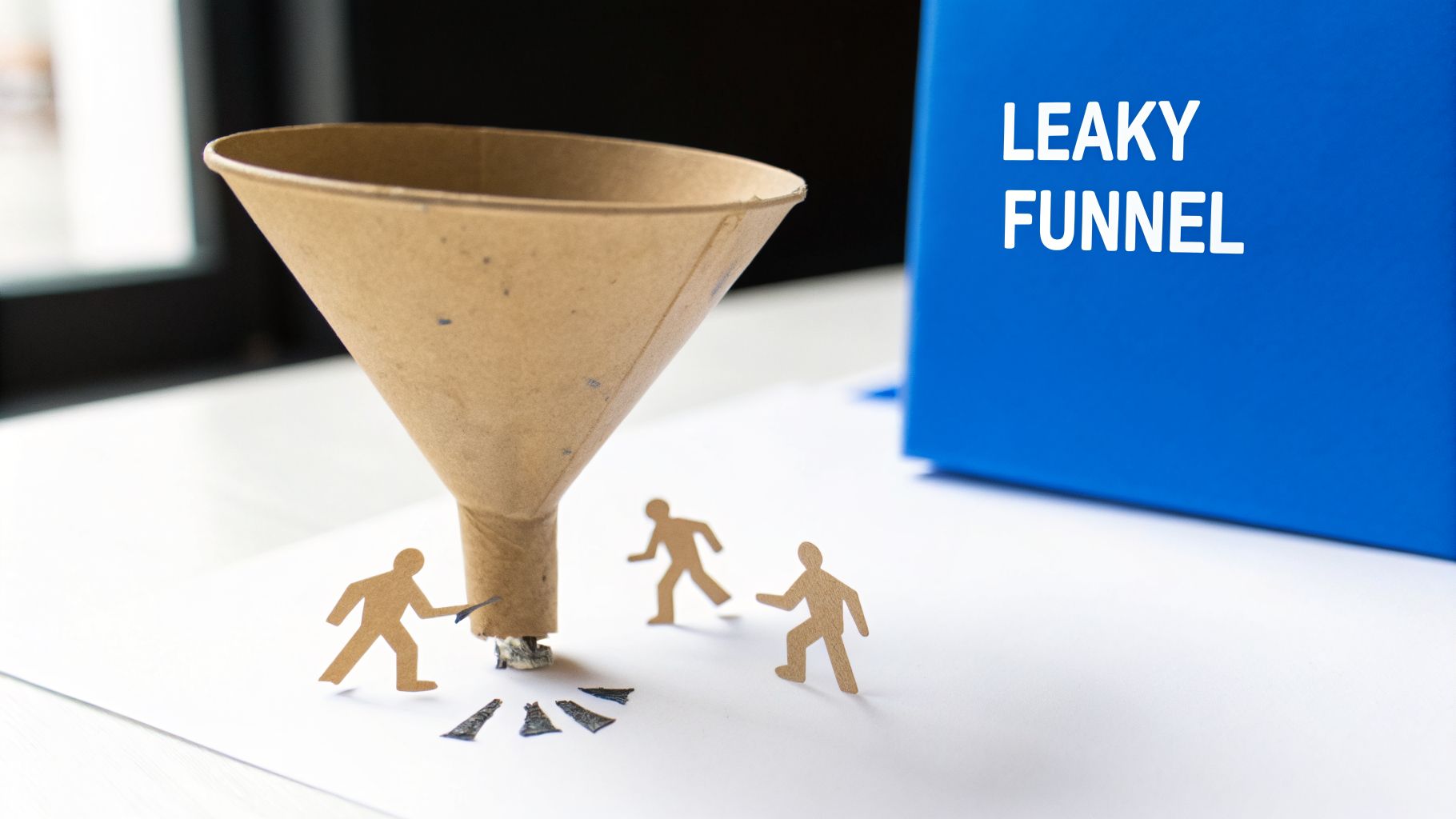
Before you can improve your sales conversion rate, you first have to play detective. A low rate isn't the real problem—it's just a symptom. The disease is a "leaky" sales funnel, a customer journey where promising prospects are dropping out before they ever make a purchase. Your job is to find and patch those leaks.
Think of your sales funnel like a physical pipeline. It carries water (your audience) from a reservoir to its final destination (a sale). If you’re losing water along the way, you wouldn't just keep pouring more into the reservoir; you'd walk the length of the pipe and find the cracks. The same logic applies to your customer journey.
Every stage, from initial awareness to the final click, is a potential failure point. Pinpointing exactly where you're losing the most people is the first step toward a real fix.
Where Are the Leaks Hiding?
Leaks can spring up anywhere, but they tend to cluster around a few common areas where businesses accidentally create friction. These friction points are the silent killers of your sales conversion rate, stopping momentum cold and causing prospects to abandon their journey altogether.
Some of the most common conversion killers include:
- A Confusing Website: If users can't find what they need in seconds, they’re gone. Poor navigation, slow-loading pages, and a cluttered design are major leaks.
- An Unclear Value Proposition: Do visitors immediately get what problem you solve and why you’re the best choice? If your "what's in it for me?" message is weak, they have no reason to stick around.
- A Clunky Checkout Process: This is the final—and most dangerous—leak. Unexpected shipping costs are the top reason for cart abandonment, followed closely by forcing users to create an account. One study found that adding country-dominant payment methods could lift conversions by 39% in the Netherlands (iDEAL) and 46% in Poland (BLIK).
- Lack of Trust Signals: Without social proof like reviews, testimonials, or security badges, you’re asking prospects to take a leap of faith. Most won't.
Identifying these leaks means moving beyond assumptions and digging into actual user data. That's where diagnostic tools become your best friends.
Tools for Pinpointing Friction
To find the exact location of your leaks, you need to see your website through your customers' eyes. Modern analytics tools give you the insights to stop guessing and start fixing.
The goal isn’t to guess where the problems are; it’s to use data to show you exactly where users are getting stuck, confused, or frustrated. Your analytics are the roadmap to a higher sales conversion rate.
Here are three powerful methods for diagnosing your funnel:
- Heatmaps: These tools create a visual report of where users click, move their mouse, and scroll. A heatmap can instantly show you if people are clicking on non-clickable elements (a clear sign of confusing design) or completely ignoring your main call-to-action button.
- Session Recordings: Watch anonymized recordings of real user sessions. It’s like looking over a customer's shoulder as they navigate your site. You’ll see their hesitations, where they get stuck, and the exact moment they decide to leave.
- User Surveys and Feedback Polls: Sometimes, the easiest way to find a problem is to just ask. Simple on-page surveys asking, "Was anything stopping you from completing your purchase today?" can give you incredibly direct and actionable feedback.
By combining these qualitative tools with the quantitative data from your web analytics, you can build a complete picture of your funnel's health. You'll go from knowing your sales conversion rate is low to understanding why it's low—and exactly what you need to do to fix it.
Strategic Tactics to Boost Your Sales Conversion Rate
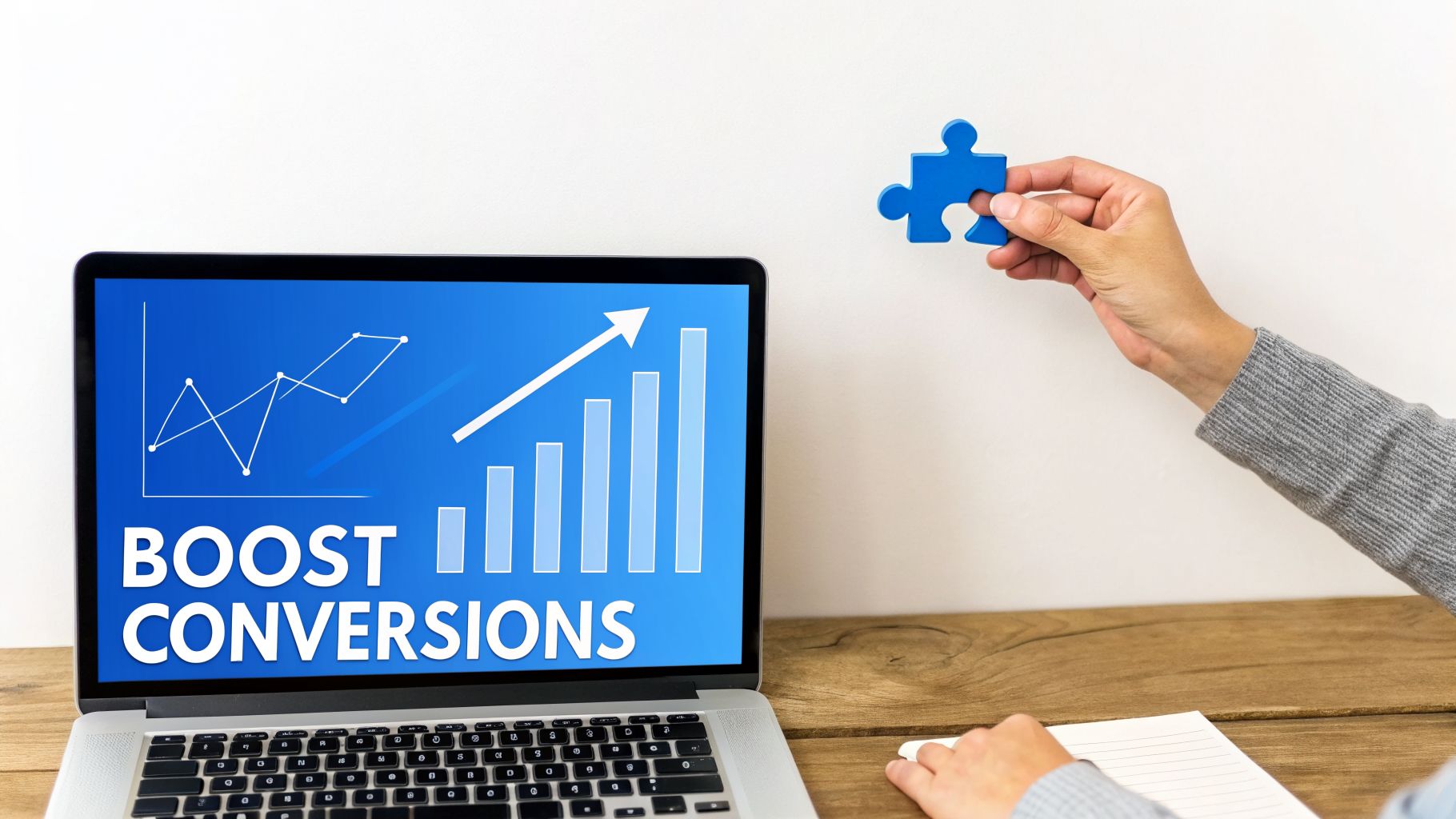
Once you’ve spotted the leaks in your sales funnel, it’s time to patch them up. Improving your sales conversion rate rarely comes from massive, sweeping overhauls. It’s a game of inches—a series of small, strategic adjustments at critical points in the buyer’s journey that lead to significant gains.
The real goal is to remove friction and build momentum. Every step a potential customer takes should feel easy, logical, and reassuring. By zeroing in on a few high-impact areas, you can systematically dissolve buyer hesitations and make the path to purchase as smooth as possible.
Sharpen Your Value Proposition and Headline
Your value proposition is your promise to the customer. It needs to be the very first thing they see and instantly understand, answering the question, "What's in it for me?" in a single, powerful glance. If it's vague, buried, or stuffed with jargon, you’ve already lost them.
A strong headline is the delivery truck for that promise. It has to grab attention and communicate the primary benefit immediately. Think about the difference between a generic headline like "Advanced Software Solutions" and a benefit-driven one like "Cut Your Reporting Time in Half." The second one connects directly to a pain point and promises a tangible outcome.
A great value proposition doesn’t just describe what you do; it articulates the positive change you bring to your customer's life or business. Make it impossible to misunderstand.
To sharpen yours, dig into customer feedback, talk to your sales team, and test different versions. A/B testing two different headlines is one of the simplest and most effective ways to boost your sales conversion rate right at the top of the funnel.
Build Unbreakable Trust and Credibility
In any sale, trust is the real currency. Nobody buys from a company they don’t trust, especially in B2B where the stakes are much higher. You have to proactively build credibility by showing, not just telling, that you're a reliable partner.
This is where social proof becomes your most powerful tool. It’s the digital equivalent of a friend’s recommendation, and it works.
- Customer Testimonials: Feature quotes from happy clients that highlight specific, measurable results.
- Case Studies: Tell in-depth stories showing how you solved a real-world problem for a company just like theirs.
- Security Badges and Guarantees: Display logos from security partners and offer clear money-back guarantees to lower the perceived risk.
- Industry Certifications: Showcase any awards or certifications that position you as a true expert in your field.
By sprinkling these trust signals throughout your website—especially on key pages like pricing and checkout—you can neutralize buyer anxiety and make the decision to convert feel both safe and smart.
Optimize Your Landing Pages for Action
Landing pages are the workhorses of conversion. They have one job: get the visitor to take a single, specific action. They are the true heroes of sales conversion, with a median rate of 6.6% across industries, far outpacing general website averages. In B2B, dedicated pages hit an impressive 13.3% by capturing leads for longer sales cycles, while B2C e-commerce lands around 9.9%. For B2B growth marketers and newsletter creators, a platform like Breaker is a game-changer; its intuitive builder lets you craft pages with targeted content and CTAs that attract your ideal subscribers, turning campaigns into lead-generation machines. Given that 82.9% of traffic is mobile, a responsive design is non-negotiable for capturing conversions on the go. You can find more landing page statistics and insights from Involve.me's detailed report on this data.
To make your landing pages convert, you have to be ruthless with your focus. Eliminate every single distraction that doesn't contribute to that one goal.
- Remove the main navigation menu.
- Use a single, crystal-clear call-to-action (CTA).
- Ensure the headline perfectly matches the ad or link the visitor clicked.
- Keep forms as short as humanly possible, only asking for what's essential.
When you're ready to master this critical part of the funnel, check out our in-depth guide to creating high-converting B2B landing pages. By applying these strategic tactics, you can systematically turn more browsers into buyers and drive meaningful growth for your business.
How to Boost Conversions: What Actually Matters
To boost conversions is to get a larger share of the people already in your funnel to take the next step: subscribe, book a demo, start a trial, sign the contract. It is a different job from buying more traffic, and usually a cheaper one. In B2B, most of the lift comes from three places: how well the people entering the funnel fit your ICP, how much friction each step adds, and how quickly and relevantly you follow up.
Where to start, by level
Beginner: remove obvious friction. Give every page one call to action, cut forms down to the fields you will actually use, and make the headline match the ad or email that sent the visitor. These fixes take days, not quarters. Our landing page best practices and the guide to building a B2B lead generation website walk through them step by step.
Intermediate: test and segment. Run one A/B test at a time on the step with the most traffic, and let it reach a meaningful sample before you call a winner. Segment follow-up by source and role so a CFO and a marketing manager do not get the same nurture email, and answer demo requests within the hour. Start with these email A/B testing tips if email is your main channel.
Advanced: score, route, and measure by stage. Use lead scoring automation to send high-intent accounts straight to sales while everyone else stays in nurture, and track conversion between every stage instead of one blended rate. Multi-touch attribution then shows which channels produce buyers rather than just form fills.
How to choose where to focus
- Goal. If you need more leads, work on top-of-funnel pages and signup forms. If you need more revenue from the same leads, work on lead-to-opportunity and close rates.
- Timeline. Friction fixes pay back in days, testing programs in weeks, and scoring and routing over a quarter.
- Stack. Do not buy a testing or scoring tool until your CRM reliably records the source and stage of every lead. Without that, you cannot tell whether a change worked.
Putting Your B2B Conversions on Autopilot
Smart tactics are one thing, but trying to apply them manually at scale is a fast track to burnout. This is where automation platforms come in, connecting your strategy to real, repeatable success. For today's B2B growth teams and fractional CMOs, a tool like Breaker is the engine that turns a high-performing newsletter into a predictable revenue machine.
It all starts with a much smarter way to grow your list. Instead of casting a wide net and just hoping for the best, automation lets you define your ideal customer profile (ICP) with laser precision. Breaker’s targeting engine then gets to work, automatically finding and delivering engaged, exact-match subscribers. What used to be cold outreach suddenly becomes a warm lead engine.
This approach has a direct, positive impact on your sales conversion rate because it ensures your funnel is filled with high-quality prospects from day one.
Crafting High-Performing Campaigns Without the Hassle
Once you’ve got the right audience, your message has to land with impact. An intuitive newsletter builder is a must-have for creating professional, engaging campaigns without needing to hire a design team. You can quickly pull together compelling content, add clear calls-to-action (CTAs), and include the vital links that guide subscribers toward the next step.
The goal is to make every single email feel valuable and, most importantly, drive action. For example, a consultant could use their newsletter to promote a new case study, linking straight to a landing page with a demo request form. It's a seamless path from initial engagement to a qualified conversion.
Automation isn’t about replacing human connection; it’s about creating more opportunities for it. By handling the repetitive tasks, these tools free you up to focus on building relationships with your most promising leads.
This sharp focus on targeted, high-value communication is a big reason why newsletters consistently outperform other channels in B2B markets.
Making Sure Your Message Actually Lands and Converts
Writing a brilliant newsletter is only half the battle. If it never makes it to the inbox, it can’t possibly convert. This is why deliverability management is a non-negotiable feature for any serious email platform.
Modern tools offer features that actively protect and improve your sending reputation, almost like a bodyguard for your emails.
- TruSend Deliverability: This feature proactively manages all the technical details to make sure your emails bypass spam filters and land right in front of your audience.
- List Hygiene: The system automatically cleans your list of invalid or unengaged contacts. This boosts your sender score and improves the performance of every campaign you send.
- Reputation Monitoring: It keeps a constant watch on how mailbox providers like Google and Microsoft see your domain, letting you fix issues before they ever hurt your deliverability.
These automated safeguards are mission-critical for maintaining a healthy sales conversion rate from your email marketing.
Finally, real-time analytics tie it all together. Instead of getting lost in confusing spreadsheets, you can see opens, clicks, subscriber growth, and ROI at a glance. This immediate feedback loop shows you what’s working and what isn’t, allowing you to optimize every single send. By integrating with CRMs and supporting both organic and paid acquisition, platforms like Breaker give you a complete, closed-loop system for turning your newsletter into a reliable source of leads and revenue.
Frequently Asked Questions
Once you have a handle on the basics, a few specific questions always seem to pop up when it's time to put conversion rate optimization into practice. Let's tackle some of the most common ones to firm up these concepts before you dive in.
Think of this as tying up the loose ends—understanding these nuances can be the difference between a good strategy and a great one.
How Often Should I Measure My Conversion Rate?
The right cadence really depends on your sales volume. If you're running a high-traffic e-commerce site, checking your sales conversion rate daily or even weekly makes sense. It helps you spot trends and react quickly.
On the other hand, for a B2B company with a long, complex sales cycle, a monthly or quarterly review is much more practical. You need enough time to see real movement.
The most important thing is consistency. Pick a timeframe that gives you enough data to be meaningful, and stick with it. This lets you track progress accurately without getting distracted by small, day-to-day blips.
What Is the Difference Between a Lead and Sales Conversion?
Getting this distinction right is crucial for diagnosing where your funnel is leaking. A lead conversion is a top-of-funnel action. It’s when a visitor does something small, like downloading a whitepaper or signing up for your newsletter. They've raised their hand to show interest, but they're not pulling out their wallet just yet.
A sales conversion happens way down at the bottom of the funnel. This is the moment a qualified lead becomes a paying customer. Tracking both helps you see if your marketing is good at grabbing attention and if your sales team is effective at turning that attention into revenue. A high lead rate but a low sales rate usually signals a disconnect between marketing and sales.
Can a High Conversion Rate Be a Bad Thing?
It sounds counterintuitive, but yes, it absolutely can. A sky-high conversion rate isn't always a win if it comes at the cost of profitability. For example, you might hit a 30% conversion rate on a massive discount, but if your profit margin on those sales is negative, you're literally paying people to take your product.
It can also mean you're attracting the wrong kind of customer—the type that churns quickly and has a low lifetime value (LTV). Always look at your sales conversion rate alongside other critical business metrics, like customer acquisition cost (CAC) and overall profitability. That's how you ensure you're building healthy, sustainable growth.
Ready to turn your B2B newsletter into a predictable revenue machine? With Breaker, you can automatically grow your list with ideal customers, build high-performing campaigns, and track your ROI in real time. Start your 7-day free trial and see how top growth teams use automation to supercharge their conversions. Learn more at Breaker.
Keep reading
All articlesHow to Write a Newsletter with AI: Step-by-Step Guide 2026
Learn how to write a newsletter with AI the right way: a 7-step process to train, calibrate, and edit AI drafts that still sound like you.
How to Boost Conversions With Your Email Newsletter
Turn your newsletter into a conversion engine. See 2026 benchmarks, CTR vs CVR explained, and the fixes most email guides skip.
Drip Campaign Template: Ready-to-Use Email Sequences
Get 6 ready-to-paste drip campaign templates with subject lines, body copy, and send timing—plus a step-by-step guide to building your own.