
The Top 10 Advantages of Email Marketing for B2B Growth in 2026
Discover the key advantages of email marketing for B2B growth. Learn how to boost ROI, scale your list, and automate lead generation with real-world examples.
While new marketing channels emerge and fade, email marketing consistently delivers exceptional ROI and direct audience access, making it a non-negotiable cornerstone for B2B success. In a market defined by volatile algorithms and escalating ad costs, owning your communication channel is more critical than ever for predictable growth. This isn't just about sending newsletters; it's about building a direct, controllable asset that drives measurable business outcomes. The key advantages of email marketing extend far beyond simple communication, offering a direct line to your most valuable prospects and customers.
This article breaks down the 10 core benefits of a strong email strategy, moving beyond generic advice to provide actionable frameworks for B2B marketers, agencies, and creators. We will explore how to apply these principles, from cost-effective lead generation and hyper-personalization to scalable monetization and pipeline acceleration.
You will learn precisely how these concepts matter for modern growth teams and see specific examples of their implementation. We'll also examine how platforms engineered for B2B, like Breaker, are built to amplify each advantage. Get ready to transform your email program from a simple communication tool into a predictable revenue engine. We’ll cover everything from building a high-intent list and creating segmented campaigns to integrating with your CRM for a seamless sales handoff. Let's dive into the benefits that prove why email remains the most powerful tool in the B2B marketer's toolkit.
1. Cost-Effective Customer Acquisition and Lead Generation
Among the many advantages of email marketing, its exceptional cost-effectiveness stands out, particularly in customer acquisition and lead generation. Email consistently delivers one of the highest returns on investment (ROI) in digital marketing, with studies from HubSpot and Litmus showing an average return of $36 to $42 for every dollar spent. Unlike paid advertising channels that demand continuous spending to maintain visibility, email allows you to build and nurture a owned asset: your subscriber list.
This direct line of communication enables B2B marketers to guide leads through complex sales funnels with minimal per-contact costs, making budget allocation predictable and scalable. You aren't just paying for fleeting impressions; you're investing in long-term relationships.

Why It Works for B2B Growth
For B2B organizations, the sales cycle is often long and involves multiple decision-makers. Email is perfectly suited for this environment. A B2B SaaS company, for example, can use automated nurture sequences to educate freemium users about paid features, demonstrating value over weeks or months to drive conversions. Similarly, an enterprise sales team can deploy targeted email campaigns to different stakeholders within a target account, addressing each individual's specific pain points and responsibilities.
Actionable Implementation Tips
To maximize your ROI and keep customer acquisition costs (CAC) low, focus on building a high-quality list and delivering relevant content. Our step-by-step guide to email marketing for customer acquisition covers exactly that, from ICP to nurture sequences.
- Automate List Growth: Use Breaker's list expansion feature to continuously add new, engaged subscribers who match your Ideal Customer Profile (ICP). This ensures your audience grows without a corresponding surge in manual effort or ad spend.
- Segment for Relevance: Don't send the same message to everyone. Segment your audience by firmographic data, user behavior, or stage in the sales funnel to improve engagement and reduce unsubscribe rates.
- Protect Deliverability: A low sender reputation kills ROI. With Breaker’s TruSend deliverability management, you can ensure your messages land in the inbox, not the spam folder, protecting this critical revenue channel.
- Track Key Metrics: Monitor your cost-per-acquisition and ROI directly within your analytics dashboard to see what's working. This data allows you to optimize content and send frequency for better financial outcomes.
By focusing on these strategies, you can solidify your B2B lead generation best practices and turn your email list into a powerful, cost-efficient growth engine.
2. Direct and Owned Communication Channel
One of the most powerful advantages of email marketing is that you directly own the communication channel. Unlike social media or search platforms where algorithms control your reach and can change overnight, your email list is an asset that provides guaranteed, direct access to your audience’s inbox. This ownership is crucial for any business that relies on consistent engagement for revenue and growth.
For B2B brands, this means maintaining client relationships independent of LinkedIn's latest algorithm update. For newsletter creators like The Hustle, it means building a multi-million subscriber base that can be monetized directly. The relationship is yours to nurture, making your audience a durable business asset rather than rented attention.
Why It Works for B2B Growth
In the B2B world, stability and predictability are paramount. Social platforms are volatile, but email offers a stable foundation for long-term marketing strategies. An agency can confidently use its client email lists as retained assets, knowing their ability to communicate won't be disrupted by external platform changes. Likewise, an enterprise B2B company can nurture high-value accounts over many months, secure in the knowledge that their messages will be delivered directly to key decision-makers without an algorithm getting in the way. This direct line reinforces trust and enables consistent, personalized communication. Choosing the right stack for that matters too; our guide to email marketing software for agencies compares 12 options built for multi-client work.
Actionable Implementation Tips
To capitalize on this owned channel, focus on building a quality list and protecting your access to the inbox.
- Build a High-Quality Asset: Use Breaker’s AI enrichment and custom targeting to build a list of subscribers who are genuinely interested in your content. A smaller, highly engaged list is far more valuable than a large, unresponsive one.
- Protect Your Inbox Placement: Your ownership is only as good as your deliverability. Monitor your sender reputation continuously with TruSend to ensure your messages land in the primary inbox, preserving this critical line of communication.
- Diversify Subscriber Acquisition: Reduce dependency on any single platform by acquiring subscribers from multiple sources. Use a mix of organic website forms, strategic content partnerships, and paid acquisition to build a resilient list.
- Offer Exclusive Value: Create email-only content, offers, or insights that subscribers can't get on your social media channels. This reinforces the value of being on your list and encourages long-term loyalty.
3. Highly Personalized and Segmented Messaging
One of the most powerful advantages of email marketing is its ability to deliver granularly personalized messages at scale. Unlike generic broadcast channels, email allows marketers to segment their audience and tailor content based on company size, industry, job title, and past behavior. This level of relevance is why studies from Epsilon show 80% of consumers are more likely to do business with a company that offers personalized experiences, leading to significant uplifts in open and click-through rates.
This capability moves your outreach from a one-to-many monologue to a one-to-one conversation. You aren't just sending an email; you are delivering a specific, relevant message to a specific person based on data you have about them, which builds trust and drives action.
Why It Works for B2B Growth
In a B2B context, personalization is crucial for cutting through the noise. Decision-makers receive dozens of pitches daily, and generic messages are easily ignored. For instance, Salesforce uses dynamic content to populate emails with case studies from the recipient's specific vertical, making the message instantly more relevant. Similarly, HubSpot sends contextual content based on behavioral triggers like a demo request, ensuring follow-up communication aligns perfectly with the prospect's intent.
This targeted approach ensures that your content addresses the unique pain points of each segment, dramatically increasing the likelihood of engagement and conversion.
Actionable Implementation Tips
To implement effective personalization, you need accurate data and a clear strategy. Focus on creating meaningful segments that align with your business goals.
- Enrich Data Automatically: Use Breaker’s AI enrichment to append firmographic data like company size, industry, and location to your contacts. This eliminates manual work and provides the foundation for powerful segmentation.
- Start with Core Segments: Create 3-5 key audience segments based on your Ideal Customer Profile (ICP). Test messaging across these groups and refine your approach based on real-time performance data from Breaker’s analytics.
- Combine with Your CRM: Integrate Breaker with your CRM to automatically sync engagement data. This creates a feedback loop that enriches customer profiles and enables even more sophisticated targeting. For more ideas, explore these segmentation strategies for personalized email outreach.
- Test Incrementally: Begin with simple personalization, such as using the recipient's name or company in the subject line. Gradually expand to personalizing body content, CTAs, and imagery as you gather more data on what resonates.
4. Measurable Results and Real-Time Performance Analytics
Another key advantage of email marketing is its inherent measurability, providing detailed, real-time analytics for every campaign. Marketers can instantly track open rates, click-through rates, conversions, and even revenue attribution. Unlike channels with long attribution delays or vague performance metrics, email establishes a direct cause-and-effect relationship between a sent message and a resulting action, making it simple to prove value.
This immediate feedback loop allows B2B teams to stop guessing what works and start making data-driven decisions. You can quickly identify high-performing content and underperforming strategies, enabling rapid optimization to improve outcomes with each send.

Why It Works for B2B Growth
In a B2B context where every marketing dollar is scrutinized, clear metrics are essential. A SaaS company can use email analytics to precisely track which nurture sequence most effectively converts trial users to paying customers. Similarly, an agency can grant clients dashboard access to show real-time campaign performance, building trust and demonstrating immediate value. For enterprise sales teams, engagement scores derived from email interactions (opens, clicks) can act as powerful triggers, signaling when a lead is warm enough for sales outreach.
Actionable Implementation Tips
To turn data into a strategic asset, you must approach analytics with a clear plan and the right tools.
- Establish KPIs First: Before launching any campaign, define your key performance indicators (KPIs). Set clear targets for open rates, click-through rates, and desired conversion actions to measure success accurately.
- Use a Real-Time Dashboard: Monitor campaign health directly in Breaker’s analytics dashboard. This eliminates the need for manual report compilation and provides instant insights, allowing you to pivot strategy mid-campaign if needed. For a deeper dive, explore our guide to building real-time email analytics dashboards.
- A/B Test Systematically: Isolate one variable per send (e.g., subject line, call-to-action) and run A/B tests. Document the results to build an internal knowledge base of what resonates best with your specific audience.
- Connect to Downstream Funnels: Integrate your email platform with your CRM to track how email engagement translates into sales opportunities and closed deals. This provides a complete picture of revenue attribution and full-funnel ROI.
5. Automated Workflows and Triggered Campaign Sequences
Another significant advantage of email marketing is the ability to create sophisticated, automated workflows that engage subscribers 24/7. These multi-step sequences are triggered by specific actions, timing, or data points, allowing you to send the right message at the right moment without manual intervention. This moves email from a simple broadcast tool to a scalable, personalized lead nurturing engine.
Automation ensures that every new lead, trial user, or customer receives a consistent and relevant experience. For B2B growth teams, this means you can build complex nurture tracks that guide prospects through a long sales cycle, automatically adapting based on their engagement and saving valuable team resources.
Why It Works for B2B Growth
In a B2B context, automation builds trust and educates prospects over time. A SaaS company can use a welcome sequence to onboard new free trial users, which often converts them at a 50% higher rate than those who receive no automated follow-up. Similarly, an agency can deploy a 6 to 8-email workflow over three months to nurture enterprise leads, keeping their brand top-of-mind until the prospect is ready to buy. The power of automated workflows starts immediately with effective welcome message templates, which are crucial for initial subscriber engagement.
Actionable Implementation Tips
To get the most out of your automated campaigns, focus on the user journey and clear conversion goals for each sequence.
- Design Core Workflows: Start by building 3-5 essential sequences aligned with your customer lifecycle: a welcome series for new signups, a lead nurture track for MQLs, a re-engagement campaign for inactive contacts, and a post-purchase follow-up.
- Set Clear Entry and Exit Conditions: Define exactly who should enter a sequence (e.g., downloaded an ebook) and when they should exit (e.g., booked a demo or became a customer). This prevents subscribers from receiving irrelevant or conflicting messages.
- Test and Monitor Performance: Before a full launch, test each workflow segment independently. Once live, keep a close eye on engagement metrics like open rates, click-through rates, and conversion goals for each step to identify and optimize low-performing messages.
- Integrate with Your CRM: Use Breaker’s native CRM integration to sync workflow data. This provides your sales team with crucial context on a lead's engagement history, enabling a seamless handoff and more informed conversations.
6. Targeting, Rapid List Building, and Audience Growth Infrastructure
Among the key advantages of email marketing is the ability to build and scale a precisely targeted audience. Unlike broad social media or search campaigns, email allows you to combine multiple acquisition methods, from organic forms to paid sponsorships, to construct a high-value subscriber list with unparalleled speed and precision. This approach transforms audience growth from a slow, manual process into a scalable, automated infrastructure.
A robust email platform serves as the central hub for this growth. It enables B2B teams to define exact-match subscriber profiles based on firmographics, job titles, or technology stacks and acquire engaged contacts who fit those criteria perfectly. For example, a B2B SaaS company can target a 'VP of Sales at Series B-C tech companies with $10M+ ARR' and build a list of thousands of these ideal prospects in months, not years.
Why It Works for B2B Growth
B2B sales success hinges on reaching the right people within the right accounts. Email provides the direct line of communication needed to engage these specific decision-makers. An enterprise software seller can use email to target specific job functions at Fortune 500 companies, while an agency can acquire B2B prospects in niche verticals for its clients. This precision ensures marketing efforts are concentrated on high-potential leads, accelerating the sales cycle and maximizing resource efficiency.
Actionable Implementation Tips
To build a powerful audience growth engine, combine precise targeting with a multi-channel acquisition strategy.
- Define Your ICP: Before launching, detail your Ideal Customer Profile, including company size, revenue, industry, and key job titles. Layer these criteria for maximum precision, such as 'VP Sales + Series C + SMB SaaS'.
- Use Automated List Expansion: Employ Breaker’s automatic list expansion to add engaged subscribers who match your exact ICP criteria at scale. This allows you to grow from zero to tens of thousands of subscribers without manual prospecting.
- Diversify Growth Channels: Implement multiple channels like organic forms on your blog, paid ads driving signups, and sponsorships in niche newsletters to create a resilient growth model.
- Maintain List Quality: A clean list is critical for success. To maintain a high-quality email list and improve deliverability, it's crucial to regularly validate email addresses, ensuring your audience growth infrastructure is robust.
- Monitor Source Performance: Track subscriber quality metrics like open rate, click rate, and unsubscribe rate by acquisition source. Calculate the cost-per-acquisition (CAC) for each channel to optimize your budget allocation.
7. Mobile-Optimized and High Open Rates
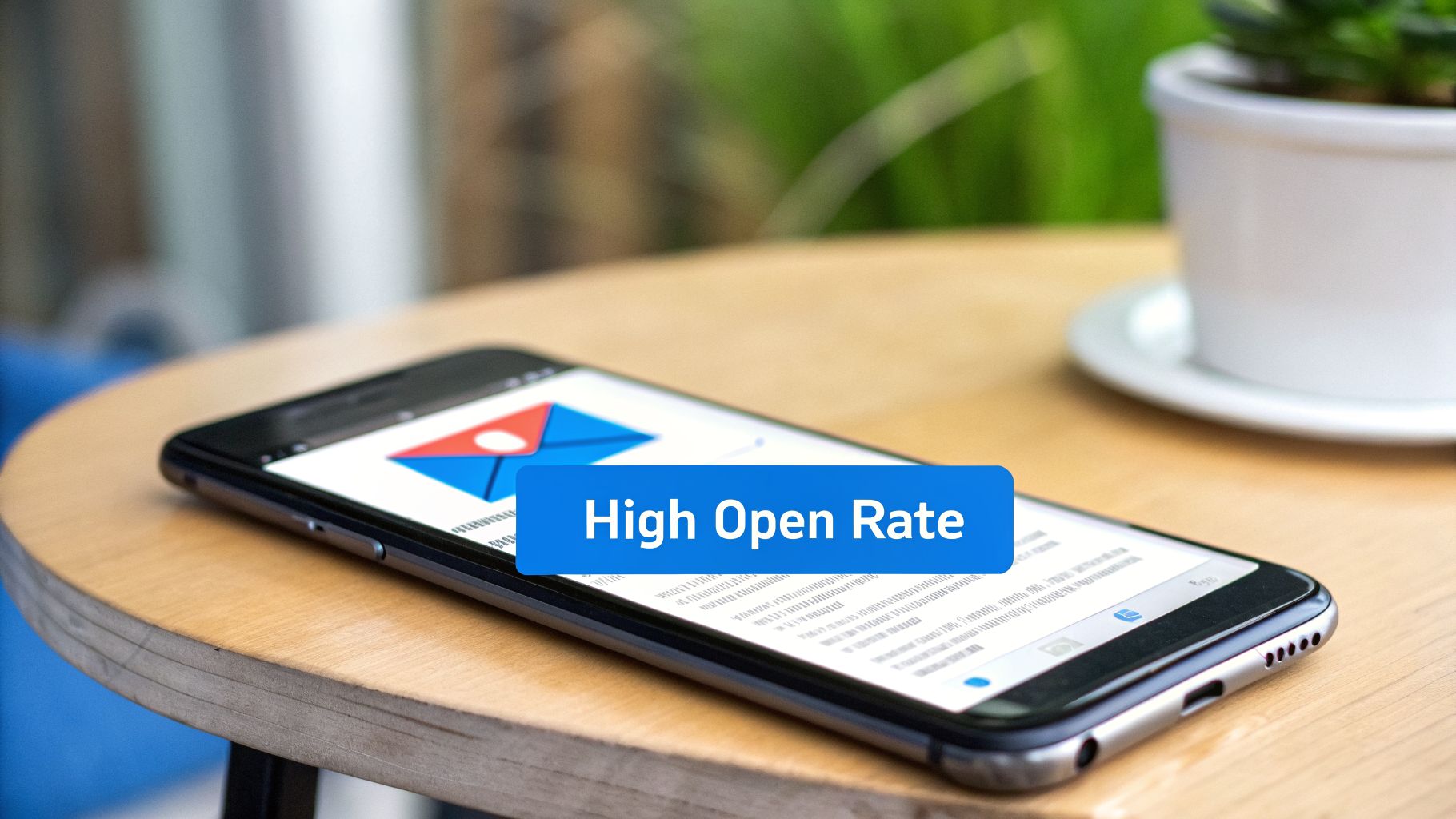
Among the key advantages of email marketing are its consistently high open rates and inherent mobile-friendliness. While social media ads fight for fleeting attention, email commands a dedicated space in a user's inbox, with B2B open rates averaging a strong 21.5%. This direct access is amplified by mobile behavior; with over half of all emails now opened on smartphones, your message reliably reaches decision-makers wherever they are.
This channel provides a direct line to your audience's most personal device. High open rates mean your message isn't just sent, it's seen, creating more opportunities for engagement than almost any other digital channel. For B2B marketers, this is critical, as executives and stakeholders frequently check email on their phones throughout the day, during commutes, and between meetings.
Why It Works for B2B Growth
B2B communication requires precision and timing, and mobile email delivers on both. A sales development representative can send a personalized follow-up that a prospect reads on their phone moments before a key meeting. Likewise, a B2B newsletter with a compelling, mobile-first subject line like "Quick question about your Q4 goals?" can achieve open rates well over 30% by cutting through the noise with conversational language. This immediate, personal connection is difficult to replicate with other marketing methods.
Actionable Implementation Tips
To capitalize on high open rates and mobile readership, you must design your campaigns with a mobile-first mindset from the start.
- Optimize Subject Lines for Mobile: Keep subject lines under 50 characters to avoid them being cut off on mobile previews. Use Breaker's A/B testing to experiment with curiosity, urgency, and personalization to find what resonates.
- Design for Small Screens: Build your emails using a single-column layout with a maximum width of 600px to ensure they render correctly on any device. Use large, clear fonts and plenty of white space.
- Make CTAs Tappable: Use prominent, high-contrast buttons for your calls-to-action instead of simple hyperlinked text. This makes it much easier for users to tap with a finger on a small screen.
- Time Your Sends: Analyze your campaign data in Breaker to identify the peak open times for your audience. Sending emails when your subscribers are most likely to be checking their phones can significantly boost engagement.
8. Compliance and Data Security (GDPR, CAN-SPAM, CASL)
One of the most critical, yet often overlooked, advantages of email marketing is the ability to manage complex compliance and data security requirements effectively. With regulations like GDPR in Europe, CAN-SPAM in the U.S., and CASL in Canada, the legal risks associated with non-compliance are significant. Professional email platforms are built to navigate these rules, protecting your sender reputation and preventing costly fines. This is not just a matter of following rules; it's a foundational element of maintaining trust with your audience.
For B2B marketers, particularly those in compliance-heavy industries like finance or healthcare, this built-in security is essential. It ensures that every campaign adheres to legal standards for consent, data handling, and sender authentication (SPF, DKIM, DMARC), turning a potential liability into a manageable and secure aspect of your marketing operations.
Why It Works for B2B Growth
In a B2B context, trust and reputation are everything. A compliance-first approach demonstrates respect for your subscribers' privacy and builds brand credibility. For example, an enterprise brand can use Breaker's compliant list management to ensure its global campaigns meet regional data protection laws, avoiding legal issues and maintaining a pristine sender reputation. Similarly, agencies can confidently manage client accounts across different markets, knowing the platform's features automatically enforce necessary standards.
This focus on security and compliance directly supports deliverability and engagement. Mailbox providers favor senders who follow authentication best practices, meaning your messages are more likely to reach the primary inbox and less likely to be flagged as spam.
Actionable Implementation Tips
To turn compliance from a hurdle into a strategic advantage, integrate these best practices into your workflow.
- Document Consent: Always maintain a clear record of subscriber consent. A double opt-in process is the gold standard for proving that a user knowingly and willingly subscribed to your list.
- Implement Authentication: Set up SPF, DKIM, and DMARC records for your sending domain. This verifies your identity to mailbox providers and protects your brand from phishing and spoofing attacks.
- Prioritize List Hygiene: Use Breaker's data hygiene tools to automatically remove invalid email addresses, hard bounces, and frequent complainers. Keeping your complaint rate below 0.3% is crucial for your sender reputation.
- Provide Clear Unsubscribe Options: Ensure every email has a visible and easy-to-use unsubscribe link. All requests must be honored promptly, typically within 10 business days as required by CAN-SPAM.
- Stay Informed: Regulations evolve. Regularly review compliance documentation and updates from authorities like the FTC and EU regulators to ensure your practices remain current.
9. Scalable Revenue Generation and Monetization Paths
Beyond direct sales, another of the key advantages of email marketing is its capacity to create multiple, scalable revenue streams from a single audience asset. For newsletter creators, agencies, and publishers, an engaged email list transforms into a primary revenue channel through sponsorships, affiliate marketing, and direct-to-consumer sales. This diversification creates a resilient business model not solely dependent on a single income source.
Email’s low customer acquisition cost and high lifetime value allow you to build an audience that can be monetized in various ways. Unlike social media platforms where algorithms control reach, your email list is an owned channel, giving you direct control over monetization strategies and revenue predictability.
Why It Works for B2B Growth
For B2B companies, this extends beyond just lead generation. A SaaS company with a popular industry newsletter, like The Hustle, can generate millions in sponsorship revenue while simultaneously using the same channel to nurture leads for its core product. Agencies can use Breaker's white-label sending capabilities to manage and monetize client lists, creating a new service offering. Fractional CMOs can build an audience to land high-ticket consulting clients directly from their campaigns.
Actionable Implementation Tips
To effectively monetize your list without degrading subscriber trust, a strategic approach is essential.
- Build Your Audience First: Focus on growing an engaged subscriber base to at least 10,000 before actively seeking high-value sponsors. A smaller, highly engaged list can still be valuable, but scale attracts premium partners.
- Calculate Sponsor Value: Determine your rates by calculating: (Subscriber Count × Average Open Rate) × Engagement Quality. This data-driven approach, easily pulled from Breaker’s analytics, justifies your pricing to potential sponsors.
- Create Tiered Packages: Offer sponsors multiple options, such as a standard placement, a premium "takeover" edition, or an exclusive multi-send package. This caters to different budgets and marketing goals.
- Track Revenue Attribution: Use Breaker’s CRM integrations to connect email campaign performance directly to revenue. This helps you prove ROI for sponsors and demonstrate the financial impact of your own promotional emails.
- Maintain Content Balance: Keep sponsored content to a maximum of 30% of your total sends. Prioritizing value-driven, non-promotional content ensures your audience stays engaged and receptive to monetization efforts.
10. Integration with Sales and CRM Systems for Pipeline Velocity
One of the most powerful advantages of email marketing is its ability to directly fuel sales pipeline velocity when connected with CRM systems. This integration transforms email from a standalone marketing channel into a core sales enablement tool. By syncing email engagement data directly to sales workflows, you can automatically score leads, alert sales reps to buying signals, and measure email’s precise impact on deal progression.
This connection bridges the gap between marketing activity and sales outcomes. For enterprise sales teams, this means no more cold calls based on guesswork; instead, they receive real-time alerts when a high-value prospect clicks a pricing page link or opens a case study. This alignment accelerates the entire sales cycle, making every interaction more informed and timely.
Why It Works for B2B Growth
In complex B2B sales, timing and context are everything. Integrating email with your CRM provides both. For instance, an enterprise SaaS company can use engagement data to trigger an immediate follow-up call from a sales rep the moment a prospect in a key account opens three different emails in a week. B2B agencies can track a nurture sequence sent to multiple stakeholders, giving the account manager a complete picture of which contacts are most engaged before a big presentation. This data-driven approach, popularized by sales-marketing alignment models from Marketo and HubSpot, ensures sales focuses on the highest-probability deals.
Actionable Implementation Tips
To turn your email marketing into a sales acceleration engine, build a seamless data flow between your marketing platform and your CRM.
- Map Key Data Fields: Ensure that Breaker’s subscriber data, including job title, company, and engagement score, syncs directly to corresponding fields in your CRM. This creates a unified view of every lead.
- Define Lead Scoring Rules: Create a scoring system that reflects buying intent. For example: an email open equals 5 points, a link click equals 10 points, and a specific CTA click (like "Request a Demo") equals 25 points.
- Automate Sales Handoffs: Set up workflows that automatically route a lead to the sales team and create a task in the CRM once their score exceeds a certain threshold, such as 50 points.
- Track Email-Sourced Opportunities: Create separate reporting dashboards in your CRM to track opportunities generated directly from email marketing campaigns. This helps prove ROI and demonstrates email’s contribution to revenue.
Top 10 Email Marketing Advantages Comparison
Item
Implementation 🔄
Resources ⚡
Expected Outcomes ⭐📊
Ideal Use Cases 💡
Key Advantages ⭐
Cost-Effective Customer Acquisition and Lead Generation
Medium — initial list build and platform setup
Low ongoing cost; pay-per-subscriber model
Very high ROI ($36–$42 per $1); scalable lead gen
B2B SaaS, growth teams, newsletters
Low CAC; predictable, scalable spend
Direct and Owned Communication Channel
Low — basic setup, list management
Moderate — content + hygiene maintenance
Stable, reliable reach; consistent engagement
Brands needing long-term audience access; creators
Full ownership of audience; immune to platform algorithms
Highly Personalized and Segmented Messaging
High — data, rules, and dynamic content setup
High — clean data, enrichment, tooling
Big uplift in opens/CTR and conversions (6x transaction rate)
ABM, account-based nurture, complex buyer journeys
Relevance at scale; improved conversion and sender reputation
Measurable Results and Real-Time Performance Analytics
Medium — tracking and dashboard configuration
Moderate — analytics, CRM links, tagging
Immediate attribution and rapid optimization
Performance marketers; A/B testing and ROI-focused teams
Real-time insights; clear campaign-to-revenue visibility
Automated Workflows and Triggered Campaign Sequences
Medium–High — design conditional flows and logic
Moderate — time to build and maintain sequences
Higher conversions; 24/7 nurture; lower manual effort (50% more conversions at 33% lower cost)
Welcome, nurture, re-engagement, post-purchase flows
Scalable, consistent customer journeys; frees team capacity
Targeting, Rapid List Building, and Audience Growth Infrastructure
High — targeting engine + multi-channel setup
High — paid channels, data partnerships, enrichment
Rapid acquisition of qualified subscribers; cost/engaged $0.50–$2.00
Agencies, niche B2B, rapid scale launches
Precision targeting; fast scale from 0→10k+ subscribers
Mobile-Optimized and High Open Rates
Low — responsive templates and testing
Low — design and preview tooling
Higher open rates (21.5%+); 54% mobile opens
Mobile-first audiences; short-form CTAs and newsletters
Readable on any device; strong inbox engagement
Compliance and Data Security (GDPR, CAN-SPAM, CASL)
Medium — consent, auth, and audit trails
Moderate — legal processes, hygiene tools
Reduced legal risk; better deliverability and trust
Regulated industries; international campaigns
Protects reputation; ensures legal compliance
Scalable Revenue Generation and Monetization Paths
Medium — sponsorship/affiliate integrations
Moderate–High — audience scale and sales ops
Multiple revenue streams; strong monetization ROI (4.24x vs social)
Creators, publishers, agencies, SaaS monetization
List becomes a monetizable asset; diverse revenue options
Integration with Sales and CRM Systems for Pipeline Velocity
Medium–High — API/mapping and lead routing
Moderate — CRM hygiene and config
Faster pipeline, improved conversion (EQLs convert 50%+ higher)
Enterprise sales, SDR teams, revenue ops
Sales-marketing alignment; automated lead qualification and attribution
Turn Your Newsletter Into a Growth Engine with Breaker
As we've explored, the advantages of email marketing are not just theoretical concepts; they are tangible, measurable drivers of business growth. From its exceptional cost-effectiveness in acquiring customers to its power as a direct, owned communication channel, email remains a cornerstone of successful B2B marketing strategy. It offers a unique ability to deliver highly personalized messages at scale, track performance with granular detail, and build automated workflows that nurture leads around the clock.
However, recognizing these benefits is only the first step. The real challenge lies in execution. Many marketers find themselves on a treadmill, struggling to grow their audience, maintain high deliverability, and prove direct revenue impact. The gap between knowing email marketing is valuable and actually extracting that value can feel immense. This is where the right tools and strategy become critical differentiators.
From Acknowledging Advantages to Activating Growth
The true power of email marketing is unlocked when you move beyond simply sending campaigns to your existing list. The most successful B2B marketers build systems that integrate audience growth directly into their email operations. Think about the key advantages we discussed:
- Direct & Owned Communication: Your email list is a core business asset, but its value diminishes if it remains static. Continuous, targeted list growth is essential to protect against natural attrition and expand your reach.
- Personalization & Segmentation: The more you know about your subscribers, the better you can tailor your messaging. A platform that enriches your audience data and adds new, exact-match contacts allows for deeper, more effective segmentation from day one.
- Measurable Results & ROI: The ultimate metric is revenue. To achieve a high ROI, you need a healthy, engaged audience. Stagnant list growth directly caps your potential revenue and makes it harder to demonstrate the financial impact of your efforts.
Simply put, you cannot fully capitalize on the advantages of email marketing without a robust infrastructure for audience acquisition and management. Your strategy must encompass not only what you send but also who you send it to, and how you plan to systematically expand that audience over time.
The Breaker Difference: Integrated Growth and Sending
This is the fundamental reason we built Breaker. Traditional email service providers (ESPs) are built to send emails. You are responsible for the hardest part: finding and acquiring the right subscribers. Breaker is different. We built a platform designed to solve both sides of the equation by integrating a powerful list expansion engine directly with a world-class sending and analytics suite.
Instead of patching together separate tools for lead generation, data enrichment, and email delivery, Breaker provides a unified system. Our platform actively finds and adds verified, exact-match B2B contacts to your audience based on your ideal customer profile. This means your list isn't just a static asset; it's a dynamic growth engine that fuels itself. With our TruSend deliverability management ensuring your messages consistently land in the inbox, you can finally focus your energy on what you do best: creating great content that converts readers into customers. The full spectrum of email marketing advantages becomes accessible when growth is built into the foundation of your platform, not treated as a separate, manual task.
Ready to stop managing a static list and start building a self-expanding audience? Breaker combines targeted list expansion with powerful sending and analytics, so you can fully realize the advantages of email marketing. See how our integrated platform can put your newsletter growth on autopilot by starting a free 7-day trial at Breaker today.
Keep reading
All articlesB2B Lead Generation via Newsletter: What Actually Works
Cold outbound is losing steam. See 7 proven newsletter tactics for B2B lead generation, from gated content to sponsorship swaps, that beat cold outreach.
How to Write a Newsletter with AI: Step-by-Step Guide 2026
Learn how to write a newsletter with AI the right way: a 7-step process to train, calibrate, and edit AI drafts that still sound like you.
How to Boost Conversions With Your Email Newsletter
Turn your newsletter into a conversion engine. See 2026 benchmarks, CTR vs CVR explained, and the fixes most email guides skip.