
How to Define Target Audience: B2B Growth Framework
Learn how to define target audience with our step-by-step B2B framework. Go from guesswork to a data-driven ICP for newsletter growth in 2026.
You probably already have a version of this problem.
Your newsletter is going out. The product is solid. Sales wants more qualified conversations. The content team is publishing regularly. But subscriber growth is noisy, engagement is uneven, and too many leads look good in a dashboard yet go nowhere in pipeline.
The fix is a properly defined B2B target audience, and this framework walks through how to build one, from the revenue problem it has to solve to the segments you will actually activate.
That usually isn't a copy problem. It's an audience definition problem.
Most advice on how to define target audience stops at a persona doc with a job title, a pain point, and a few demographic notes. That's not enough for B2B newsletter growth. A newsletter only becomes a reliable acquisition and conversion channel when the audience definition is tied to business goals, built from real evidence, validated against behavior, and activated across content, segmentation, and measurement.
In SaaS, weak audience work wastes money in quiet ways. You publish content for readers who will never buy. You attract subscribers who like the topic but don't fit your sales motion. You target the budget holder and miss the operator who shapes the shortlist. Then marketing blames distribution, sales blames lead quality, and the actual issue sits upstream.
A useful ICP does something simpler and more demanding. It tells your team who deserves attention, why they matter to revenue, what they care about, and how to recognize them early enough to shape demand.
Start with Why Before Who
Teams often start with the wrong question. They ask, “Who is our audience?” before they've decided what the business needs that audience to do.
If you're trying to figure out how to define target audience for a B2B newsletter, start with the business outcome. Are you trying to create more sales-qualified conversations? Support a product launch? Enter a vertical where your pipeline is thin? Increase expansion revenue from a current customer base? Each objective points to a different audience shape.
Tie the ICP to a revenue problem
A good ICP isn't a branding artifact. It's a filter for resource allocation.
If the goal is pipeline creation, your audience definition should lean toward accounts with a clear problem, active buying signals, and enough urgency to move from subscriber to meeting. If the goal is product adoption, the audience may include current users, internal champions, and admins who need education rather than persuasion. If the goal is category expansion, you may prioritize a new industry segment where your product already has hidden traction.
Neil Patel outlines a practical six-step firmographic segmentation framework built around industry, company size, and revenue, then layers in pain-point analysis and A/B testing across funnel stages. In that context, firms using data-driven persona refinement achieve 2 to 3x higher conversion rates than generic targeting, and validation against real customer data can reduce targeting errors by up to 40% in B2B newsletter campaigns, according to this target audience breakdown.
That's the core trade-off. Broad targeting gives you volume. Focused targeting gives you relevance and usually better economics.
Practical rule: If your audience definition can't explain why one segment deserves more budget than another, it isn't finished.
Ask who creates economic value, not just engagement
A common mistake is selecting an audience based on who reads content most often. That can distort strategy fast. A highly engaged subscriber segment may love industry commentary and still never become an opportunity.
Use questions like these instead:
- Which accounts convert cleanly: Look at segments that move from subscriber to demo, reply, trial, or sales conversation without heavy nurturing.
- Which customers buy repeatedly or expand: Revenue concentration matters more than surface-level engagement.
- Which segments are expensive to acquire: A segment can look attractive until acquisition cost eats the value.
- Which problems are urgent enough to act on: Newsletter growth gets easier when the content maps to work that's already painful.
This step also forces alignment across teams. Marketing stops chasing vanity segments. Sales gets a clearer picture of what a strong inbound lead looks like. Product gets sharper input on which customer problems deserve messaging support.
Define the job your newsletter will do
A newsletter can educate, qualify, nurture, reactivate, or create demand. It usually shouldn't try to do all of that for everyone.
For example, a security SaaS company writing for CIOs, security engineers, and procurement at the same time will dilute the message unless each audience serves a specific commercial purpose. A better approach is to choose the job first. Maybe the newsletter exists to help technical evaluators diagnose risk and bring your brand into active evaluations. That single decision changes the content angle, CTAs, and subscriber sourcing strategy.
When teams skip this step, persona work turns into guesswork with prettier formatting.
Gather Intelligence with a Dual-Method Approach
The strongest audience definitions come from two inputs combined. First, behavioral and account data. Second, direct conversations with customers and prospects.
Using only analytics creates sterile personas. Using only interviews creates narratives that feel vivid but may not represent the market. You need both.
Start with the quantitative trail
Begin with the systems you already have. CRM data, product usage logs, lifecycle stages, campaign history, website behavior, and newsletter engagement all tell you where patterns exist.
Look for clusters among your best customers and best subscribers. In SaaS, that usually means asking:
- Which industries appear repeatedly: Don't stop at top-line counts. Compare won deals, retained accounts, and accounts that expanded.
- What company sizes convert smoothly: Some segments engage heavily but stall in procurement or implementation.
- Which acquisition paths produce quality: Organic search, partner referrals, outbound, webinars, and newsletter signups often create very different lead profiles.
- What content correlates with action: Compare subscribers who click product education, strategic thought leadership, templates, or industry-specific use cases.
Data quality matters here. If your CRM has sparse firmographic fields or inconsistent company names, enrich it before drawing conclusions. Tools and workflows built around data enrichment services for go-to-market teams can help fill gaps in company size, industry, role, and account-level context so your segmentation doesn't rest on incomplete records.
A note on surveys. If you're running quantitative audience research, sample size isn't a detail. Appinio notes that expert guidelines call for 500 to 1,000 participants to achieve statistical significance, and undersized surveys can produce misleading personas. The same analysis also notes that integrating qualitative methods like customer interviews can increase marketing ROI by 25 to 30%, because interviews reveal the decision logic behind the behavior in your dashboards, as explained in their target audience analysis guide.
Use interviews to uncover buying logic
After you identify promising patterns, talk to people inside those patterns.
Interview current customers, recent wins, recent losses, and highly engaged subscribers who haven't converted. You're not looking for compliments. You're trying to understand the sequence that led from problem recognition to action.
Ask questions that produce specifics:
- What happened in the business before this problem became urgent?
- What were you using before, and where did it break?
- Who else was involved in evaluating options?
- What nearly stopped the purchase?
- What language did your team use internally to describe the problem?
- What made this worth acting on now instead of later?
Short interviews are fine if they're sharp. Thirty focused minutes with the right people is better than a long generic call.
The words customers use to describe the problem are usually more valuable than the words marketers use to describe the solution.
Reconcile the two sources before writing the ICP
Many teams make a common mistake. They pull a few quotes from calls, attach them to a role like “VP Marketing,” and call it a persona. That's too shallow.
Instead, compare what people said with what they did. If interviewees say integrations matter, check whether integration-related content gets clicks from high-fit accounts. If they say speed to value matters, compare onboarding and activation patterns by segment. If they claim budget authority sits with one role, check CRM notes and closed-lost reasons.
Use a simple split:
Evidence type
What it tells you
Where teams misuse it
Quantitative data
Which segments behave differently
Treating correlation as the full story
Qualitative input
Why people make decisions
Mistaking memorable anecdotes for market truth
This dual-method discipline prevents two expensive mistakes. Building strategy on incomplete data, and building strategy on a loud minority.
Segment Your B2B Audience Beyond Demographics
Job title and company size are a starting point, not a targeting system.
In B2B SaaS, two “Heads of Marketing” can look identical on paper and still behave nothing alike. One leads a lean team inside a PLG company with a modern stack and fast experimentation culture. The other works inside a sales-led business with rigid approvals, a fragmented martech stack, and little tolerance for change. If you target them the same way, your newsletter will underperform for both.
Use layered segmentation instead of flat personas
The practical way to define target audience is to stack multiple lenses. Firmographics tell you where an account sits. Technographics tell you how it operates. Behavior tells you whether it's moving.
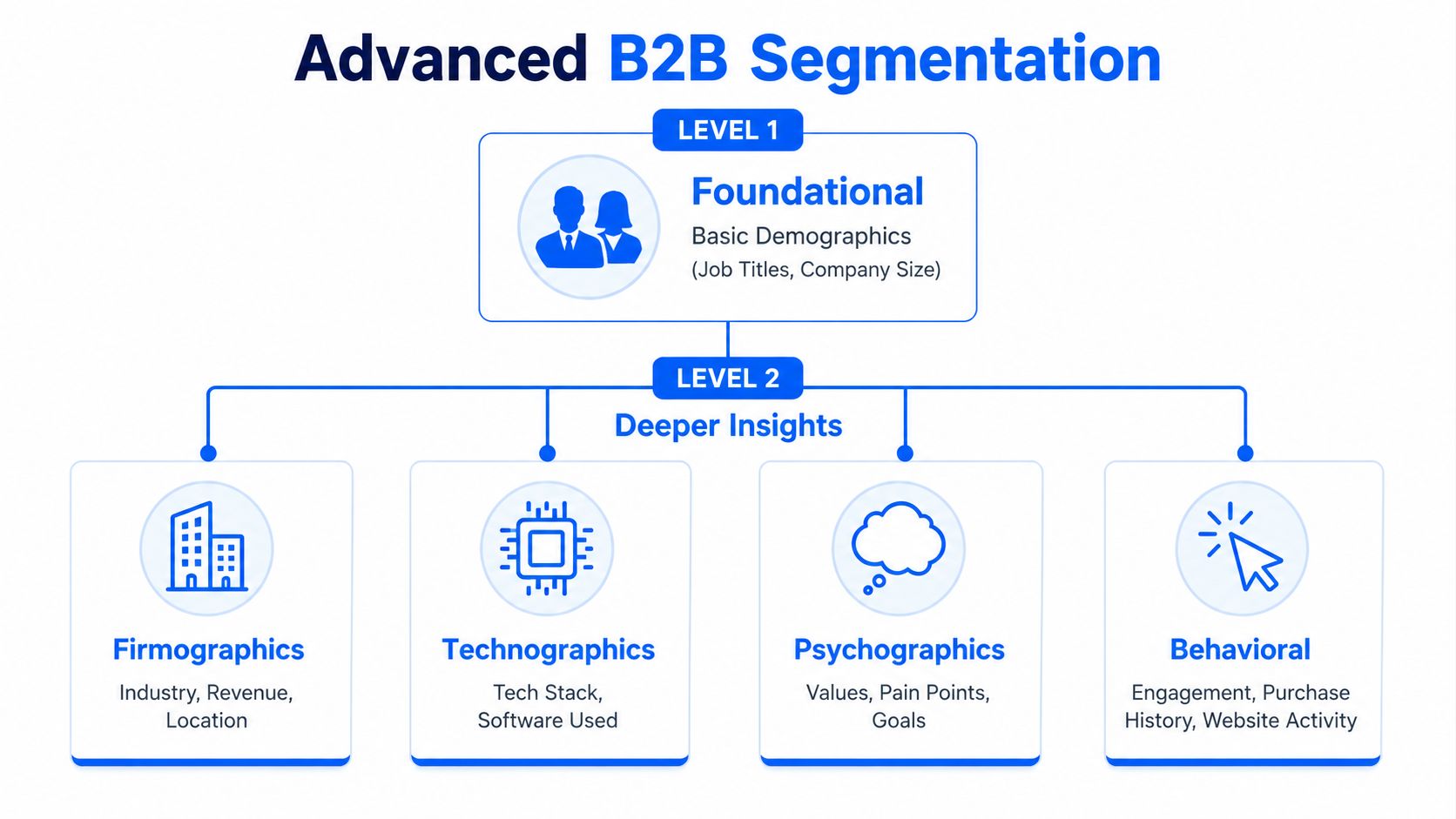
A segmentation model for newsletter growth usually needs at least these layers:
- Firmographics: Industry, revenue band, employee count, business model, and geography. This narrows the market to accounts your sales motion can realistically serve.
- Technographics: The software ecosystem the company already uses. This often signals maturity, integration needs, budget posture, and operational complexity.
- Behavioral signals: Email engagement, site activity, content preferences, trial actions, demo requests, and repeat visits from the same account.
- Psychographic clues: Risk tolerance, strategic priorities, and what “success” means internally. This often comes from interviews, call notes, and sales conversations.
If you want a more tactical view of how these layers work in email specifically, this guide to B2B email audience segmentation strategies is a useful companion resource.
Why technographics matter more than most teams think
Technographics are often the missing layer in SaaS audience work.
Circana's analysis of “total basket” purchasing argues that broader purchase context reveals underserved buyers who get missed by standard classification. Applied to B2B, the equivalent is the full software ecosystem. Companies with similar firmographics can have very different needs based on their stack, a nuance absent in 90% of target-audience tutorials, according to this piece on underserved markets and total basket analysis.
That matters because software choices reveal operational reality. A company running HubSpot, Segment, Snowflake, and a modern data pipeline is different from a company still stitching together spreadsheets and disconnected tools. Both may fit your company-size filter. Only one may be ready for your product and the kind of newsletter content that converts.
Segment for action, not description
A useful segment supports a decision. It should tell you what to send, what to offer, and what to stop doing.
For example:
- Newsletter subscribers from mid-market SaaS companies using a modern CRM stack might get operator-level teardown content, integration examples, and ROI framing for cross-functional stakeholders.
- Subscribers from agencies or service businesses may need implementation simplicity, time savings, and client reporting angles instead.
- Subscribers inside marketplaces or talent platforms often need a completely different motion. If you're exploring niche segmentation models, this breakdown on how to define your Upwork target market shows how channel context changes audience definition.
Segmentation fails when it only makes your spreadsheet cleaner. It succeeds when it changes what your team does next.
Defining a B2B Target Audience: Compare Your Options
"B2B target audience" gets used for three different things, and the confusion causes most of the bad targeting we see. Before writing your ICP, decide which model you are actually building.
- Firmographic audience. Defined by company attributes: industry, headcount, revenue, region, funding stage. Easiest to build and to buy media against, and the right starting point if you sell horizontally. Weakness: it says nothing about whether a company has the problem today.
- Role and jobs-to-be-done audience. Defined by the person and the outcome they are accountable for, such as "heads of growth who own newsletter revenue". Best for content, newsletters, and messaging. Weakness: harder to target in ad platforms and to size.
- Named-account audience. A list of specific companies chosen by fit and intent, the account-based marketing model. Best when deal sizes are large and buying committees matter. Weakness: it needs sales alignment and enrichment data to stay current; see our account-based marketing examples.
How to choose
- Selling a horizontal tool under $10k a year: start firmographic, then layer role.
- Selling to one function with a clear pain: start with role and jobs-to-be-done, then narrow by the firmographics that predict budget.
- Selling enterprise deals: build a named-account list and treat the other two models as inputs to it.
Most B2B teams end up with a layered definition: firmographic filters set the boundary, role defines the reader, and a named list marks the accounts sales cares about this quarter. The ideal customer profile guide shows how to write that down, and B2B audience segmentation strategies covers how to act on it in email.
A one-line B2B target audience statement
Fill this in before the detailed ICP: "[Role] at [company type] with [size or stage] who need to [job to be done] because [trigger], currently using [alternative]." If you cannot complete every bracket, you have a segment to research, not an audience to target yet.
Craft an Actionable Ideal Customer Profile
An ICP should be something sales, marketing, and product can use on Monday morning. If it reads like a brand workshop document, it won't help you grow a newsletter or improve lead quality.
The easiest test is simple. Could a marketer use your ICP to choose topics, build a segment, write a CTA, and decide whether a new subscriber is worth pursuing? If not, keep refining.
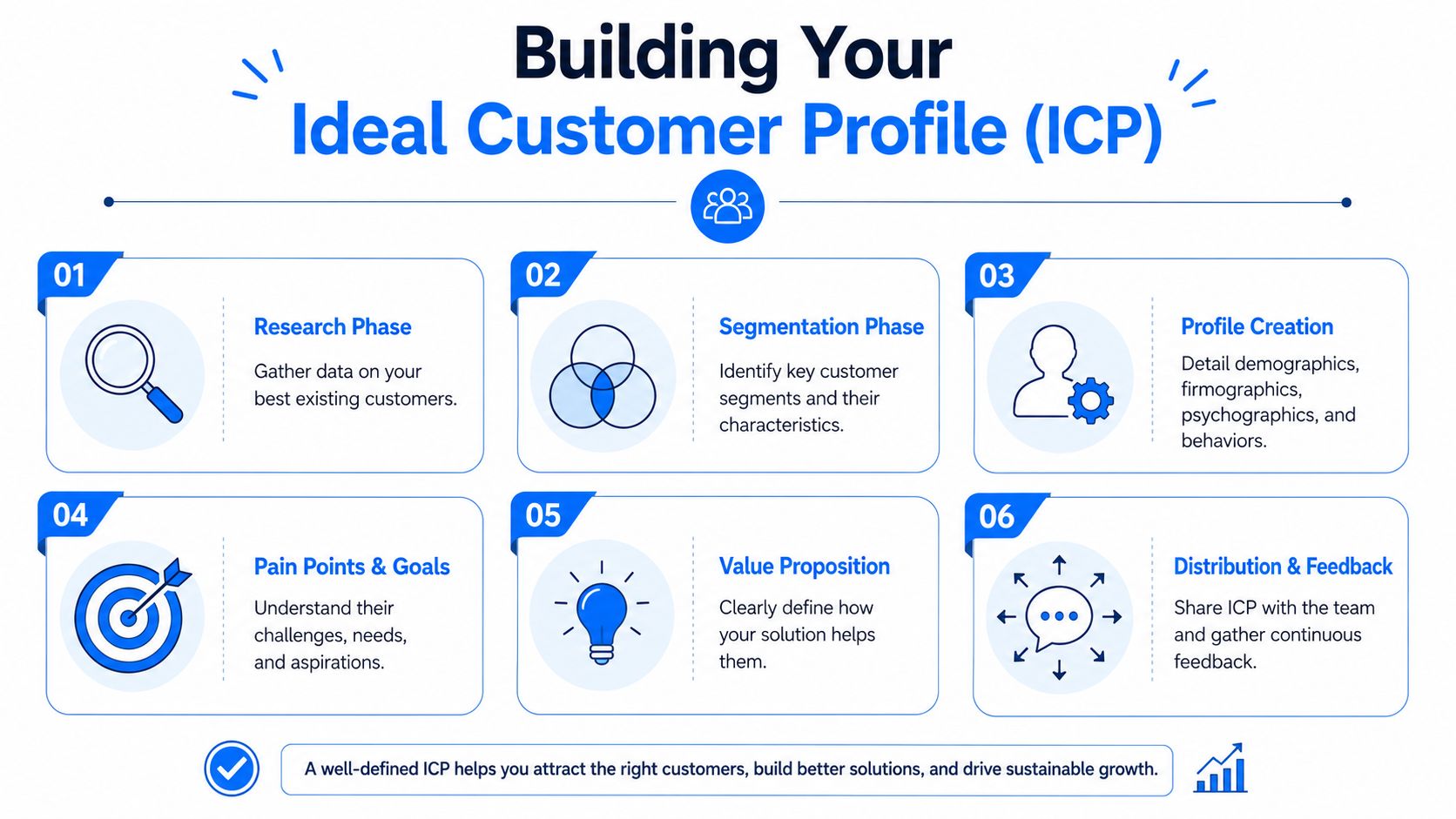
Build the ICP around live buying conditions
A practical ICP includes more than demographics and pain points. It captures the conditions that make action likely.
Use a structure like this:
ICP field
What to document
Company profile
Industry, size range, revenue profile, business model
Team context
Department owner, reporting line, operational maturity
Trigger events
Hiring, tooling changes, new leadership, process breakdowns
Core pains
The work that consumes time, creates risk, or blocks growth
Desired outcomes
What success looks like in their own terms
Buying friction
Budget constraints, security reviews, internal resistance
Content needs
Topics, formats, and proof points that move them forward
Channel habits
Where they learn, who they trust, what they subscribe to
For a senior growth marketer at a SaaS company, “pain point” is too vague. “Can't prove which newsletter subscribers match target accounts” is useful. “Needs more leads” isn't. “Needs a repeatable way to grow an email list with subscribers sales will accept” is.
Map the whole decision unit, not just the buyer
Most persona work fails here.
SparkToro argues that buyer personas often miss the larger influence network around a purchase. Their analysis notes that 72% of B2B purchasing decisions are influenced by non-buyer stakeholders, and that teams that ignore those influence layers miss much of the complete decision ecosystem, as covered in their audience persona framework.
That changes how you build the profile. Don't just map the budget owner. Map:
- Champion: The person who feels the pain most directly and pushes the project internally.
- Evaluator: The operator who compares options, joins demos, and spots implementation risk.
- Approver: The person who controls budget, security, or procurement.
- Influencer: Analysts, peers, internal specialists, or creators who shape confidence before a decision.
If you're running LinkedIn programs alongside newsletter acquisition, this is also why work on optimizing LinkedIn lead quality often improves when audience mapping includes the operator and influencer layer, not just the senior title in the targeting filter.
A more detailed primer on what an ICP means in marketing can help if your team still mixes up ICPs, personas, and target accounts.
Turn the profile into messaging inputs
A finished ICP should feed execution directly. Build message pillars from it.
For example, if your champion is a lifecycle marketer inside a mid-market SaaS company, your newsletter might focus on segmentation playbooks, subscriber quality diagnostics, and examples of lead-routing logic. If the approver is a VP of Growth, your CTA language may shift toward efficiency, pipeline quality, and wasted spend prevention.
A useful walkthrough on the mechanics of persona building is below.
Validate and Prioritize Your Audience Segments
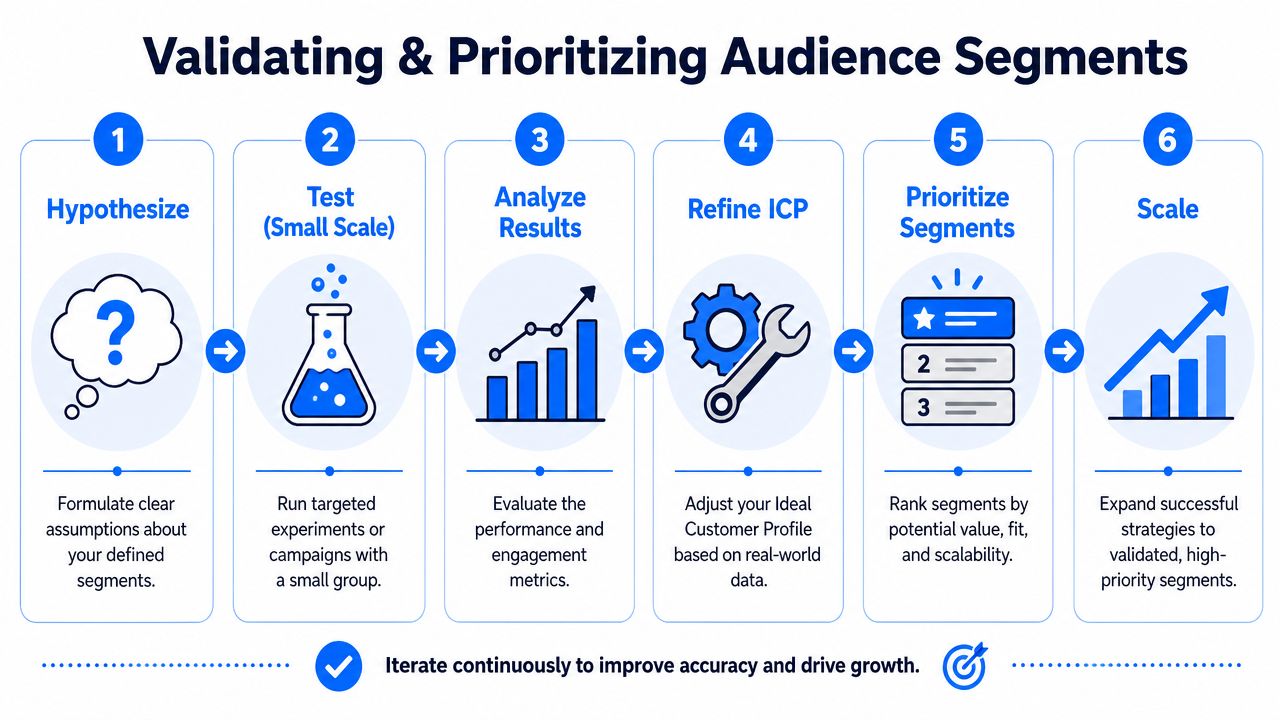
Even a well-researched ICP starts as a hypothesis.
That's where many teams stop. They build the profile, share a slide deck, and move on to campaign production. Then six weeks later they're still debating why one audience “should” have worked. Validation solves that. It replaces internal confidence with observed behavior.
Run cheap tests before committing budget
You don't need a massive launch to validate a segment. Small tests usually tell you enough.
Try a cycle like this:
- Write the hypothesis clearly
Example: “Mid-market SaaS growth teams using a modern CRM stack will respond better to newsletter content about subscriber quality than to broad email best practices.”
- Create segment-specific messaging
Build separate subject lines, landing page headlines, ad creative, or lead magnet framing for each segment.
- Use contained experiments
Test with LinkedIn audience slices, newsletter cohorts, or account lists segmented by industry or stack maturity.
- Measure behavior that matters
Don't stop at opens. Look at clicks, replies, demo requests, trial starts, qualified meetings, or downstream sales acceptance.
Neil Patel's framework points out that firms using data-driven persona refinement and A/B testing see 2 to 3x higher conversion rates versus generic targeting, and that validation against real customer data can reduce targeting errors by up to 40% in B2B newsletter campaigns, as noted earlier in this article.
The goal of validation isn't to prove you were right. It's to find out where your market is more specific than your assumptions.
Score segments with business-weighted criteria
Once test results come in, avoid the trap of choosing only the highest-engagement segment. Prioritize with a wider lens.
A practical scorecard usually includes:
- Fit with your offer: Can your current product and onboarding support this audience well?
- Commercial quality: Do leads from this segment progress cleanly through sales?
- Content resonance: Does your newsletter angle consistently earn clicks, replies, or forwards?
- Acquisition efficiency: Can you reach this segment without excessive waste?
- Scalability: Is the segment large and stable enough to justify ongoing focus?
If your team needs a simple framework for making those trade-offs, Fluidwave's prioritization guide is a useful reference for turning competing opportunities into ranked decisions.
Expect some segments to look good and still lose
This happens often in SaaS.
A segment may click at high rates because the topic is interesting, not because the buyer has intent. Another segment may open less often but convert better once engaged because the pain is sharper and the buying process is clearer.
That's why segment prioritization should happen after testing, not before. The winning audience for newsletter growth is rarely the one with the broadest top-of-funnel appeal. It's the one where content relevance, acquisition efficiency, and revenue potential align.
Activate Your ICP to Fuel Newsletter Growth
Once the ICP is validated, your newsletter stops being a generic publishing channel and starts acting like a growth system.
That only happens if the ICP changes execution. Content planning should reflect the problems and trigger events you identified. Subscriber acquisition should focus on exact-fit audiences, not broad list growth. Measurement should track whether the right people are entering the list and moving toward revenue.

Translate the ICP into a newsletter operating model
A simple activation model works well:
- Content calendar by pain cluster: Build recurring themes around the operational problems your ideal accounts already need solved.
- Segmentation by buying context: New subscribers, active evaluators, current customers, and dormant accounts shouldn't receive the same framing.
- CTA alignment: Early-stage readers may respond to checklists, benchmarks, and diagnostic content. Later-stage readers may want demos, comparisons, or implementation proof.
- Lead quality feedback: Sales should flag which subscribers look like real opportunities and which patterns keep showing up in low-fit leads.
Significant wasted spend can occur. Instead of paying to grow a list full of loosely interested readers, you shape acquisition and content around people who resemble the customers you want more of.
Measure audience quality, not just list growth
A bigger list isn't necessarily a better list.
Watch for signals such as subscriber growth inside your ICP, lead acceptance by sales, reply quality, content consumption by target accounts, and whether newsletter-sourced leads progress through the funnel with fewer mismatches. If one segment grows quickly but creates no pipeline, it's noise. If a smaller segment repeatedly turns into qualified conversations, that's the audience worth feeding.
The best newsletter programs don't separate audience definition from performance analysis. They treat each send as another chance to sharpen the ICP.
If you want a faster way to turn ICP work into actual subscriber growth, Breaker is built for B2B teams that need more than email sending. It helps you define target audiences, grow with exact-match subscribers, and track the engagement and ROI signals that show whether your newsletter is reaching the right accounts.
Keep reading
All articles7 Email Platforms With Inbox Placement Testing & Suppression
Compare 7 email platforms that combine inbox placement testing with suppression management, scored on features, pricing, and best-fit sender size.
Email Automation Workflow & Drip Campaign Data Structure
Learn the database schema behind email drip campaigns—tables, workflow states, and event logs that power reliable marketing automation.
Breaker Review: AI-Native ESP for Newsletter Growth
An unbiased Breaker review: pricing, features, deliverability data, and who this AI-native email platform fits best for newsletter growth.