
News Publishing Platform Guide: Features, Use Cases &
Discover how a news publishing platform can streamline your workflow. Explore features, use cases, and a buying checklist for 2026.
The deadline's in an hour, the newsletter draft still needs a sharper angle, and last week's send underperformed enough that sales is asking whether the list is stale. That's the moment teams start shopping for a news publishing platform, even if they'd never use that phrase in a meeting. The right stack doesn't just help you publish, it helps you grow the list, protect deliverability, and turn recurring attention into revenue without making every send feel like a manual rescue operation.
A useful way to think about the category is simple. A news publishing platform is the system that moves a story from draft to distribution to measurement, then feeds the next send, the next segment, and the next monetization decision. For B2B newsletter teams, that can mean a content workflow, audience growth engine, and revenue layer all in one, not just a CMS with a send button.
What a News Publishing Platform Actually Does
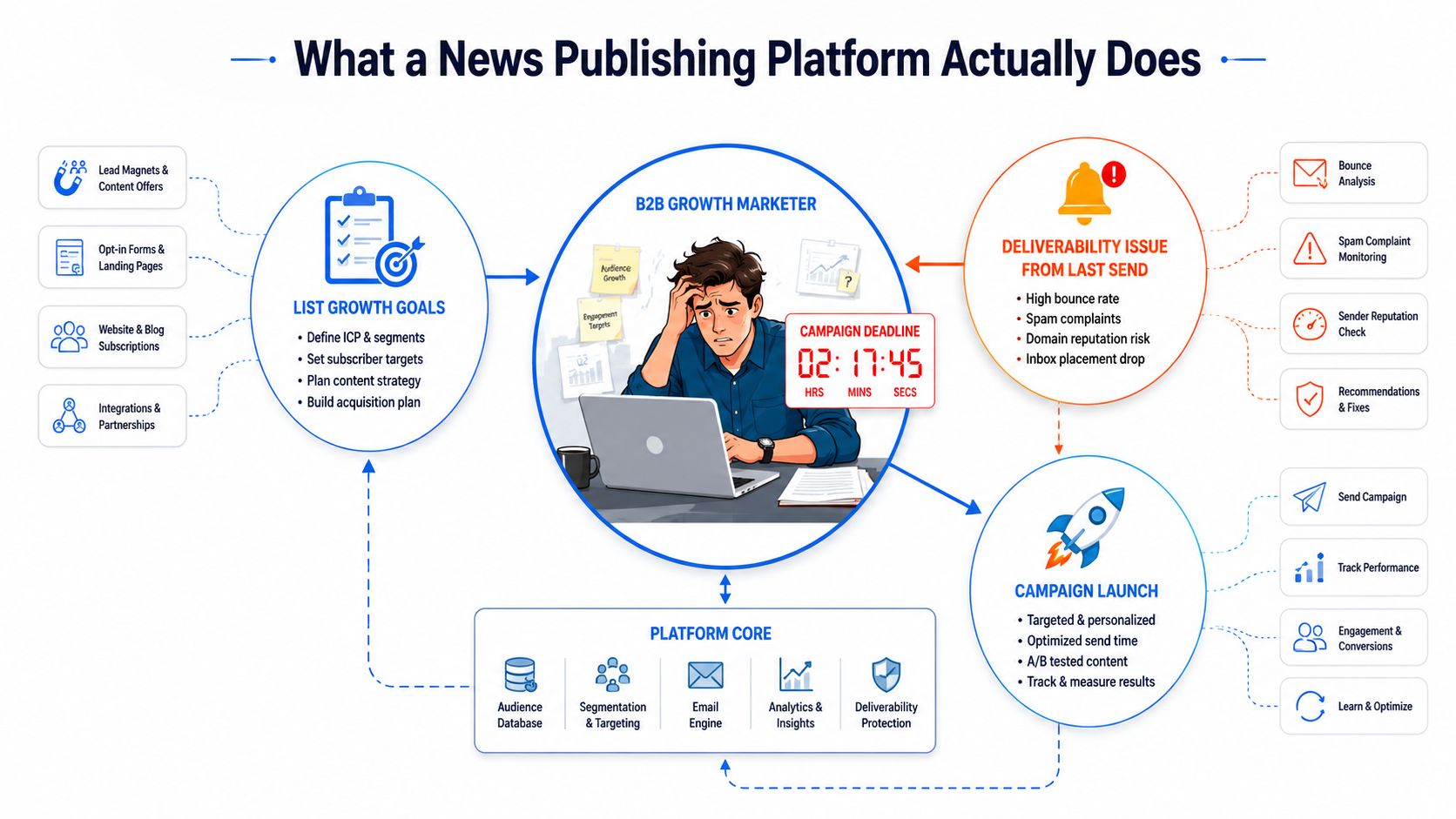
A B2B growth marketer usually feels the need for a better platform at the worst possible time. One campaign is waiting on approval, the newsletter list needs fresh subscribers, and the inbox problem from last week's send is still unresolved. The tool question starts to look bigger than email software, because the team needs a system that can support content, distribution, audience growth, and revenue together.
The working definition that matters
A news publishing platform is not just where you write. It's where editors or marketers create the story, schedule it, distribute it across channels, and watch what happened after the send. In modern publishing, that often means the same story has to live on web, mobile, RSS, and email, while the team still needs drafts, review, embargoes, and archive search in one workflow, which is why headless, API-first architecture keeps coming up in newsroom guidance (editorial CMS architecture guidance).
For B2B teams, the practical version is even more direct. The platform should make it easy to publish quickly, keep the list healthy, and connect engagement to pipeline or sponsorship value. If it doesn't support those loops, it's not really acting like a publishing platform, it's just sending email.
Practical rule: if a tool only helps you hit send, it's not enough. The better question is whether it helps you grow, segment, deliver, and measure the next send without extra manual work.
Why the platform framing matters
The word platform matters because the job isn't linear. A marketer writes a newsletter, but the outcome depends on distribution quality, audience acquisition, inbox placement, and downstream monetization. That's why platform buyers need to think in systems, not just templates.
A strong platform also gives you a clearer operating model. The same content can feed a newsletter, a landing page, a social post, and a CRM-triggered follow-up. That's the difference between a one-off publishing task and a repeatable growth loop.
For teams exploring newsletter-driven publishing workflows, a useful reference point is this internal overview of marketing newsletter software, because it shows how the software layer and the audience-growth layer start to merge. The best fit usually isn't the prettiest editor. It's the stack that makes publishing, list growth, and measurement feel like one motion instead of three disconnected jobs.
The Five Capabilities Every Platform Must Cover
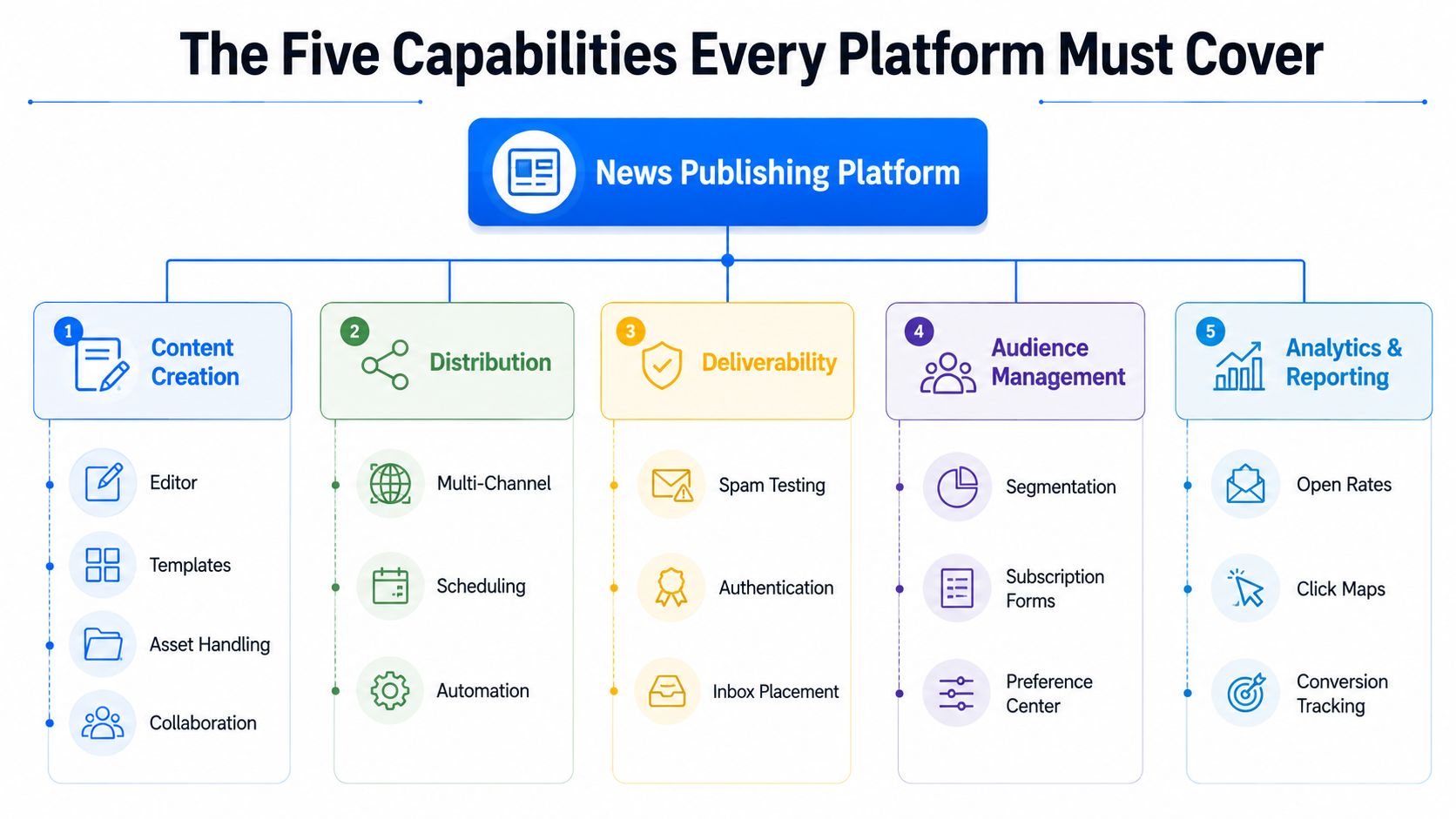
The fastest way to judge a vendor is to ignore the homepage language and test five capabilities. If one of them is weak, the whole stack feels brittle under real publishing pressure. If all five are solid, the platform can support both a lean B2B newsletter and a more formal publishing operation.
Content creation and collaboration
Good content tooling means the editor is fast, templates are reusable, assets are easy to manage, and review doesn't become a Slack scavenger hunt. Large-newsroom guidance also notes that real-time collaboration often relies on CRDTs or operational transforms, which matters if multiple people need to edit safely at once (editorial CMS architecture guidance). If the editor is clunky, your team will move important work into docs and spreadsheets, then lose visibility.
Distribution across channels
Distribution should go beyond inbox delivery. A serious platform supports web publishing, RSS, syndication, scheduling, and automation so one story can reach multiple surfaces without rework. News-style system design also treats publishing as a read-heavy distribution system with separate ingestion, parsing, indexing, ranking, and serving layers, which is the right mental model when traffic spikes and fresh content need to move quickly (Google News system design guide).
Monetization that fits the audience
Monetization isn't only about subscriptions. For B2B newsletters, it can be sponsorships, lead-gen CTAs, paid placements, or routing readers into the CRM for sales follow-up. If a platform can't insert and track those revenue paths cleanly, it will push you toward manual work that breaks attribution later.
Analytics you can act on
Good analytics show opens, clicks, subscriber growth, and conversion behavior without forcing you into a reporting maze. The test is whether the platform gives enough signal to refine the next send, not just explain the last one. Teams should ask whether reporting is live enough to support decisions while the campaign is still warm.
Deliverability and list hygiene
Deliverability is not a side feature. The platform should manage list hygiene, monitor reputation, handle suppression properly, and help protect inbox placement over time. If a vendor can't explain how it keeps stale subscribers from dragging down performance, you're likely buying a prettier way to create deliverability problems.
If you want a niche data workflow resource that can support audience intelligence work around this layer, #1 Web Scraping API for LLMs is useful context because list expansion and targeting often depend on external data pipelines as much as on the email tool itself. That doesn't replace the publishing platform, but it can feed one.
Choosing Between Headless, Email-First, and Hybrid Platforms
Not every team needs the same architecture. A newsroom, a newsletter creator, and a lean B2B demand-gen team can all say they need a news publishing platform, yet they're really asking for different operating systems. The wrong choice usually happens when a buyer optimizes for one impressive feature and ignores the team's actual publishing rhythm.
Headless platforms fit multi-channel publishing
A headless, API-first platform works best when content has to flow into web, mobile, apps, RSS, and other surfaces with separate front ends. It fits teams that care about editorial workflows, archive search, embargoes, and structured content reuse more than they care about one perfect newsletter template. If your site and your send layer are separate products, headless usually makes the most sense.
That said, headless systems can become awkward if audience capture is treated as an afterthought. For teams that need forms and lead capture on a headless site, practical guidance like embed forms in headless sites becomes relevant because the publishing stack only works if it can collect subscribers.
Email-first platforms fit newsletter-led growth
An email-first platform makes more sense when the newsletter is the product, or at least the main acquisition and retention channel. These tools usually lean into sender reputation, list growth, segmentation, and monetization per send. They're a better match for B2B marketers who care about weekly cadence, sponsorship slots, and keeping the list fresh than for teams managing a broad editorial estate.
Hybrid platforms reduce tool sprawl
A hybrid platform combines a hosted CMS with built-in email and growth tooling. That's attractive for lean teams that want one login, one bill, and fewer integration headaches. The trade-off is usually depth, because hybrid tools can be easier to run but less flexible at the edges.
The decision criteria are practical. Think about team size, content cadence, number of channels, and whether the audience is primarily consumer or B2B. If you're weighing newsletter-specific tools alongside broader publishing stacks, the comparison in Breaker's newsletter platform overview is a helpful internal benchmark for what email-first growth workflows look like in practice.
Why Distribution and Deliverability Now Define the Winners
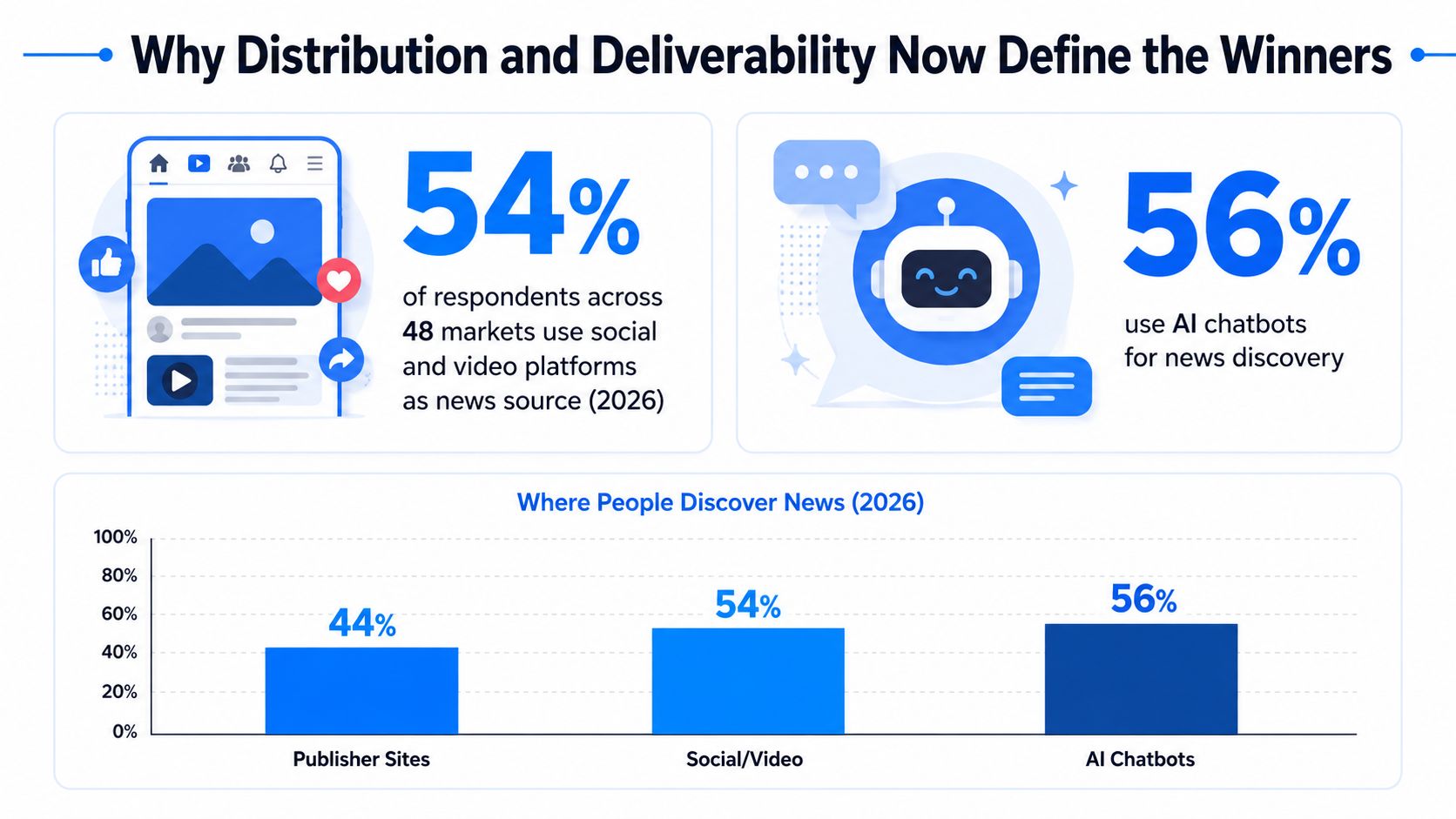
The audience is no longer waiting politely on publisher-owned pages. In the 2026 Reuters Digital News Report, 54% of respondents across 48 markets used social and video platforms to access news, rising to 56% when AI chatbots were included, while the share using TV and news websites or apps fell; YouTube was the most-used social or video platform overall at 69%, and it was the second-biggest for news at 24% (Reuters Digital News Report coverage). That is a structural shift, not a temporary channel preference.
Why raw reach stopped being enough
The same report context shows why old monetization assumptions are shaky. The Reuters Institute's 2024 Digital News Report found that only 17% of respondents across a basket of 20 richer countries had paid for any online news in the last year, with little growth, and in 2024 only about 22% identified news websites or apps as their main source of online news (Reuters Institute Digital News Report 2024). If discovery is moving off owned sites and payment is still concentrated, then the platform has to do more than publish.
That means your platform needs syndication hooks, cross-channel analytics, and workflow support that turns a one-time reader into a recurring subscriber. It also means deliverability can't be an afterthought, because every inbox placement matters more when you're trying to convert attention into habit.
What to ask vendors to prove
Use vendor demos to pressure-test the stuff that affects revenue, not just interface polish. Ask how the platform handles list hygiene, authentication, suppression, and inbox placement monitoring. If you need to verify performance rather than trust the pitch, tools like test inbox placement rates are a good reference point for how serious deliverability work gets measured.
Practical insight: publish-and-pray used to be tolerable when owned traffic was more stable. Once discovery fragments, the platform that wins is the one that can keep a list healthy and a reader coming back.
For teams that want a deeper operational lens on this part of the stack, the internal breakdown at email deliverability platform is a useful companion because it shows how inbox health becomes a growth lever, not just a technical metric.
How B2B Newsletter Teams Use a Platform in Practice
B2B teams don't all use a news publishing platform the same way, even when the tech stack looks identical on paper. The newsletter is sometimes a top-of-funnel engine, sometimes a relationship layer, and sometimes a warm-up machine for sales. The platform has to support the job the team has, not the fantasy job the vendor demo implies.
Three common operating models
A growth team often uses the newsletter as a lead-gen channel, with ICP-targeted list expansion, CRM sync, and steady CTAs into product pages or demos. A fractional CMO may use a personal newsletter to stay in front of a network, drive trust, and keep deals moving between calls. An enterprise sales desk can use the same publishing rhythm to warm accounts, surface relevant stories, and create a reason to re-engage without sounding pushy.
Breaker is one concrete example of this model because it combines newsletter sending with automatic list expansion for B2B audiences, plus ICP targeting, CRM integrations, and deliverability management. It's one option in a crowded market, but the reason it's relevant here is simple, it treats audience growth and send performance as one system instead of separate tools.
What actually moves the needle
The features that matter most are usually not the flashiest ones. ICP definition matters because growth without targeting fills the list with the wrong people. TruSend deliverability management matters because list growth is useless if inbox placement slips. Sponsorship inserts and attribution matter because B2B newsletters need a monetization story that can survive procurement questions.
Use case
Must-have capabilities
Monetization lever
B2B newsletter as lead-gen
ICP targeting, CRM sync, analytics, forms
Demo requests and pipeline
Fractional CMO newsletter
Fast editing, segmentation, scheduling
Trust, referrals, advisory demand
Enterprise sales desk newsletter
Audience filters, templates, performance tracking
Account warming and expansion
The best vendors map cleanly to one of those operating models. If the platform can't explain how it supports your exact use case, it probably won't support your revenue model either.
Migrating to a New Platform Without Losing Your Audience
Migrations fail when teams treat them like a design project instead of an operational change. Deliverability, archive integrity, and audience trust all need protection at the same time. A calm rollout matters more than a fast one.
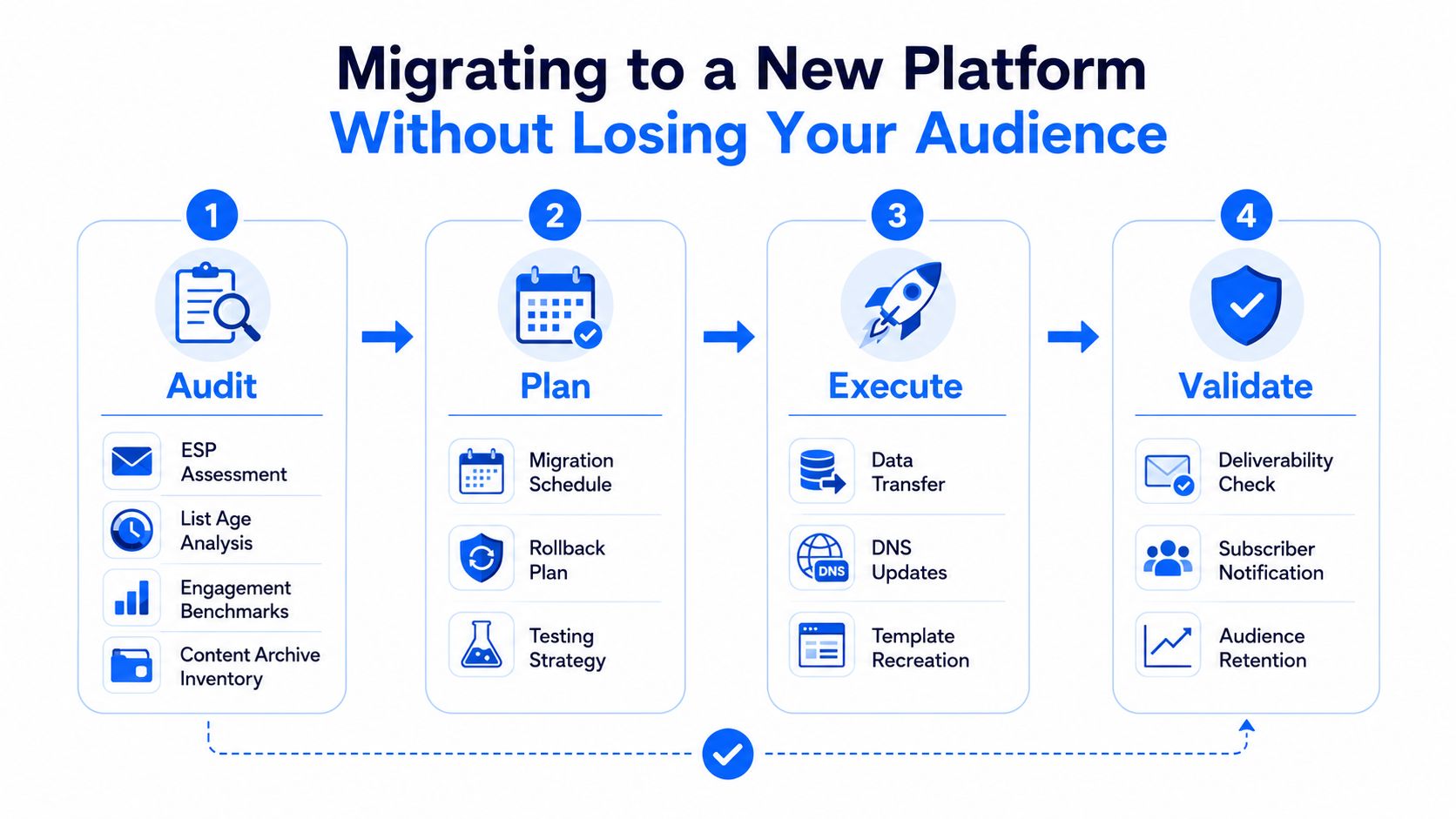
A phased rollout that actually works
Start with an audit. Inventory the current ESP, list age, engagement benchmarks, and the content archive. If you don't know which subscribers are still warm, you'll import trouble into the new system.
Move to a pilot next. Send a parallel version of a real campaign to a small engaged segment, compare deliverability, opens, and clicks, and only then trust the new templates and CTAs. Newsroom-oriented platform guidance also recommends background workers for expensive tasks and cache-aware publishing flows, because speed and consistency matter when traffic or sends spike (Google News system design guide).
The cutover questions that expose weak vendors
During the vendor demo, ask how they handle ICP targeting, compliance, list hygiene, and suppression logic. Ask what happens to archive URLs, who owns the sender reputation process, and how they support warmup if a new sending identity is involved. If the answers are vague, the platform is probably not built for serious publishing operations.
The final phase is optimization. Use the new analytics to refine send time, segmentation, and monetization paths, then keep tightening the list as engagement data comes in. The internal migration glossary at Breaker's migration guide is useful here because migration is less about moving records and more about preserving the habits that keep an audience active.
Keep the engaged segment warm first. Moving the whole list before you know the new system works is how teams damage both trust and inbox placement.
A Vendor Evaluation Checklist You Can Actually Use
A strong shortlist is usually shorter than the sales team wants. The right vendor is the one that matches your revenue model and your operating tempo, not the one with the largest feature grid. Use the list below as a scoring sheet in the next demo.
- Targeting and ICP definition: Can the platform define, refine, and update audience segments without manual exports?
- List growth and acquisition: Does it support forms, imports, paid growth, and organic capture in a way your team can run?
- Deliverability tooling: Does it include list hygiene, reputation monitoring, suppression handling, and practical inbox protection?
- Analytics depth: Can you see opens, clicks, growth, and conversion behavior without stitching together separate reports?
- Monetization support: Does it handle sponsorships, paid tiers, and CTA routing into the CRM or sales workflow?
- Integrations: Does it connect cleanly to your CRM, sponsorship tools, and existing publishing stack?
- Pricing transparency: Can you predict costs as the list grows, or will each new use case trigger a surprise add-on?
- Support quality: Does the vendor help with onboarding, migration, and deliverability questions, or just hand you docs?
What good looks like: a vendor can explain every one of those items without pivoting back to generic “engagement” language.
If two tools look similar on features, choose the one that fits your actual operating model. A newsletter-led B2B team needs different strengths than a general publishing org, and the platform should reflect that difference instead of pretending all audiences behave the same.
Practical Tips to Maximize Reach and Revenue
Treat deliverability like a product feature, not a cleanup task. Measure revenue per engaged subscriber, not just opens, and run one meaningful experiment per send so you can learn what the audience responds to. Keep ICP targeting fresh as the list grows, because list quality decays if nobody revisits it.
Review sponsorships and lead-gen offers every quarter, not once a year. The strongest news publishing platform is the one your team will use consistently, because consistent publishing is what builds trust, and trust is what turns niche audiences into durable revenue. In AI-native publishing, small high-trust verticals can be easier to serve well than broad audiences you can't monetize.
If you want a platform built around B2B newsletter growth, audience expansion, and inbox performance, Breaker is worth a close look. It combines sending, list growth, ICP targeting, and deliverability management in one workflow, which is exactly the combination this guide is about. Visit Breaker to see how it fits your team's publishing and revenue model.
Keep reading
All articlesBreaker Review: AI-Native ESP for Newsletter Growth
An unbiased Breaker review: pricing, features, deliverability data, and who this AI-native email platform fits best for newsletter growth.
Breaker for B2B, SME and Consumer Newsletter Senders
Learn how B2B, SME, and consumer audiences differ in newsletters, plus a framework for segmenting, messaging, and monetizing each without losing relevance.
What Is a B2B Content Engine
Learn what a B2B content engine is, how it differs from a content calendar or strategy, and why it's essential for AI-driven search in 2026.