
What Is an Email Drip Campaign
Learn what an email drip campaign is, how triggers and sequences work, and how it differs from nurture campaigns, newsletters, and sequences.
An email drip campaign is a set of automated emails sent to subscribers based on a trigger - signing up for a list, abandoning a cart, downloading a guide. Each message arrives on a pre-set schedule or in response to subscriber behavior, designed to move someone from "interested" to "customer" without manual intervention after setup. If you've signed up for a free trial and received five perfectly timed emails over two weeks, you've experienced one.
I've built and audited enough of these sequences to know the concept sounds simple until you try building your first one and discover that nobody agrees on terminology. Is it a drip campaign, a sequence, a nurture campaign, or an automated newsletter? This guide settles that confusion, breaks down how drip campaigns work mechanically, and shows how marketers are using AI and audience data in 2026 to sharpen campaigns beyond what was possible two years ago.
What Is an Email Drip Campaign?
An email drip campaign is a series of pre-written emails that send automatically over time, triggered by a specific subscriber action or scheduled interval, designed to guide a contact toward a defined outcome: a purchase, a reply, continued engagement.
The "drip" happens because messages arrive in small, spaced-out doses rather than all at once, mimicking how real relationships build through repeated, well-timed contact.
Understanding the Core Concept
Think about teaching someone something complicated. You don't hand them a 40-page manual and walk away. You break it into lessons, space them out, and check in along the way. A drip campaign does the same for a business relationship. It takes one goal - converting a free trial into a paying customer, for example - and breaks it into a handful of emails, each with its own job, released on a schedule the marketer controls in advance.
The defining trait of a drip campaign is that it runs without manual sending. Once built inside an email service provider (ESP) or customer relationship management (CRM) platform, the system handles delivery based on rules set up once. That's the entire appeal: consistency at scale, without daily writing and sending.
The Origin of "Drip"
The phrase borrows from "drip irrigation," the agricultural method of delivering small, steady amounts of water directly to a plant's roots instead of flooding the field all at once. Marketers adopted the metaphor because the same principle applies: steady, small doses of communication produce healthier, longer-lasting growth than one big email blast.
The term has been part of direct marketing vocabulary since long before email existed, originally describing printed mail sent on a recurring schedule. It carried over naturally once outreach moved into the inbox.
How Drip Campaigns Are Built (Trigger, Sequence, Schedule, Exit)
Every working drip campaign, regardless of industry or tool, consists of four parts:
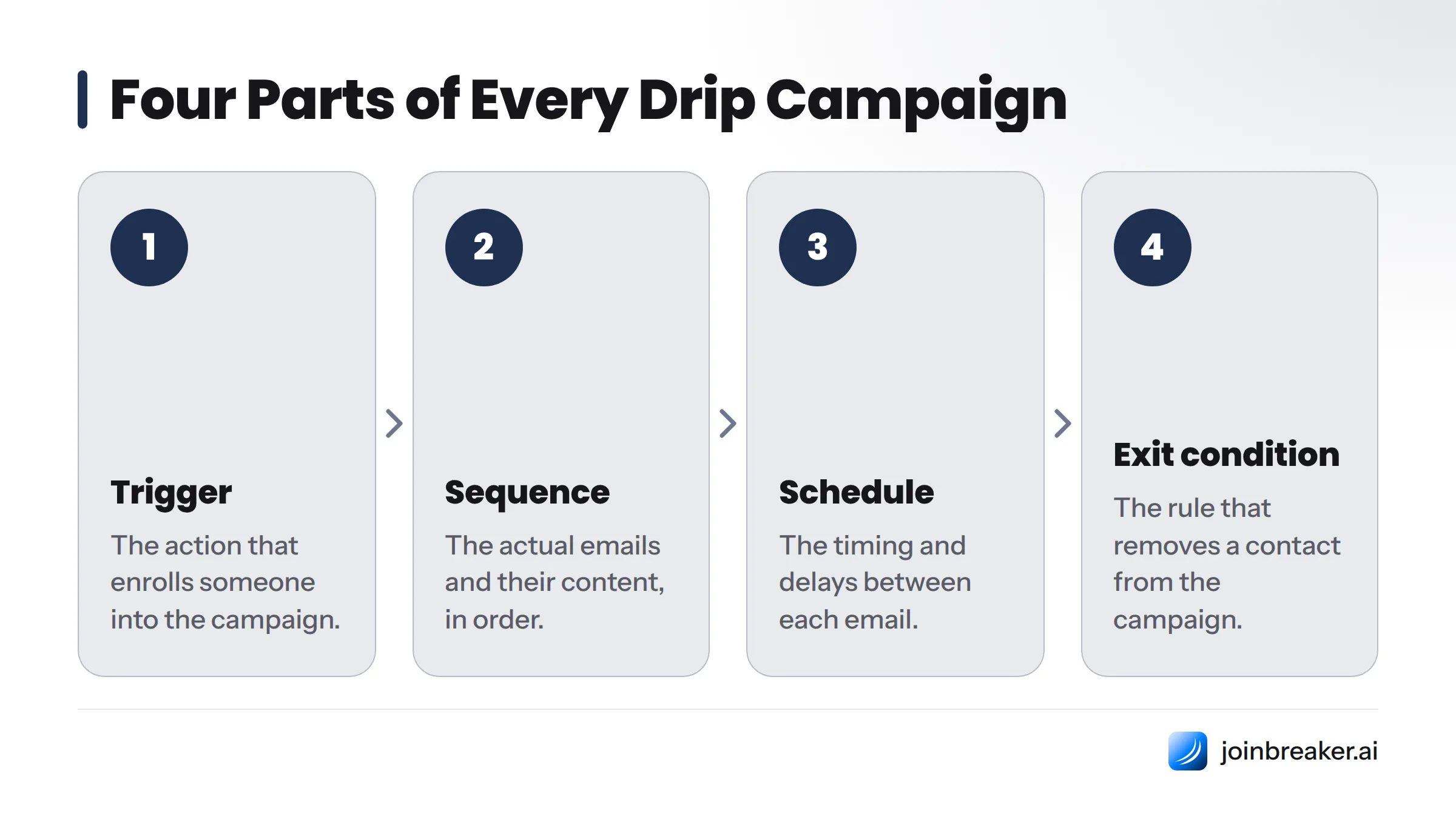
- Trigger - the event that enrolls a contact into the campaign
- Sequence - the actual emails and their content, in order
- Schedule - the timing and delays between each email
- Exit condition - the rule that removes a contact from the campaign
Understanding these four pieces separates copying someone else's template from actually knowing how to build a campaign that fits your business.
Trigger - What Starts the Sequence
A trigger is the action or event that enrolls someone into the campaign. Common triggers include:
- Signing up for an email list or newsletter
- Creating an account or starting a free trial
- Adding an item to a cart without completing checkout
- Downloading a lead magnet, whitepaper, or guide
- Making a purchase
- Going inactive for a set number of days
The trigger matters because it defines intent. Someone who abandons a cart has different intent than someone who just subscribed to a newsletter, and the emails that follow need to reflect that difference.
Sequence - The Emails Themselves
The sequence is the stack of individual emails, each with a distinct purpose: introduce, educate, build trust, handle objections, and eventually ask for the sale or the next step. A good sequence rarely repeats the same message twice. Each email should earn the right to send the next one by giving the reader something useful - a tip, a story, a discount, or social proof.
Schedule - Timing and Delays
The schedule controls how much time passes between each email. Too fast, and the sequence feels like spam. Too slow, and you lose momentum and the reader forgets why they signed up.
Most welcome sequences space emails one to three days apart for the first few messages, then stretch out to weekly as the relationship matures. B2B lead-nurture sequences often run slower, sometimes five to seven days between emails, because buying cycles are longer and pushier cadences tend to backfire.
Exit Conditions - When the Drip Stops
An exit condition is the rule that removes someone from the campaign before it finishes, usually because they've already done what the campaign was trying to get them to do. If someone receives a three-email cart abandonment sequence but completes checkout after email one, the exit condition should pull them out immediately so they don't get a "did you forget something?" email for a purchase they already made.
Missing this step is one of the fastest ways to make a brand look careless, and it's worth auditing regularly.
Email Drip Campaign vs. Nurture Campaign vs. Sequence vs. Newsletter
These four terms get used almost interchangeably in marketing conversations, and that's exactly why so many people search for a clear answer.
| Term | Definition | Trigger Type | Measured By | Typical Owner |
|---|---|---|---|---|
| Drip campaign | Pre-scheduled automated emails tied to one trigger and one goal | Single behavioral or time-based trigger | Conversion rate, open rate per stage | Marketing / growth team |
| Nurture campaign | Longer-term, often multi-channel relationship-building program that may include several drip sequences | Lead score, lifecycle stage, multiple triggers | Pipeline velocity, lead-to-customer rate | Marketing + sales |
| Email sequence | The broader technical term for any ordered series of automated emails (a drip campaign is one type of sequence) | Any trigger | Sequence completion rate | Marketing / RevOps |
| Newsletter | Recurring editorial content sent to an entire list on a fixed schedule, not tied to individual behavior | Calendar date, not behavior | Open rate, click-through rate, subscriber growth | Editorial / content team |
The simplest way to remember it: a newsletter goes to everyone on the same day regardless of what they've done; a drip campaign goes to someone because of what they did; a sequence is the umbrella technical term for any automated email chain; and a nurture campaign is the longer strategic program that a drip campaign often lives inside.
How to Build an Email Drip Campaign (Step-by-Step)
Building a drip campaign is a six-step process whether you're using a simple ESP or a full CRM.
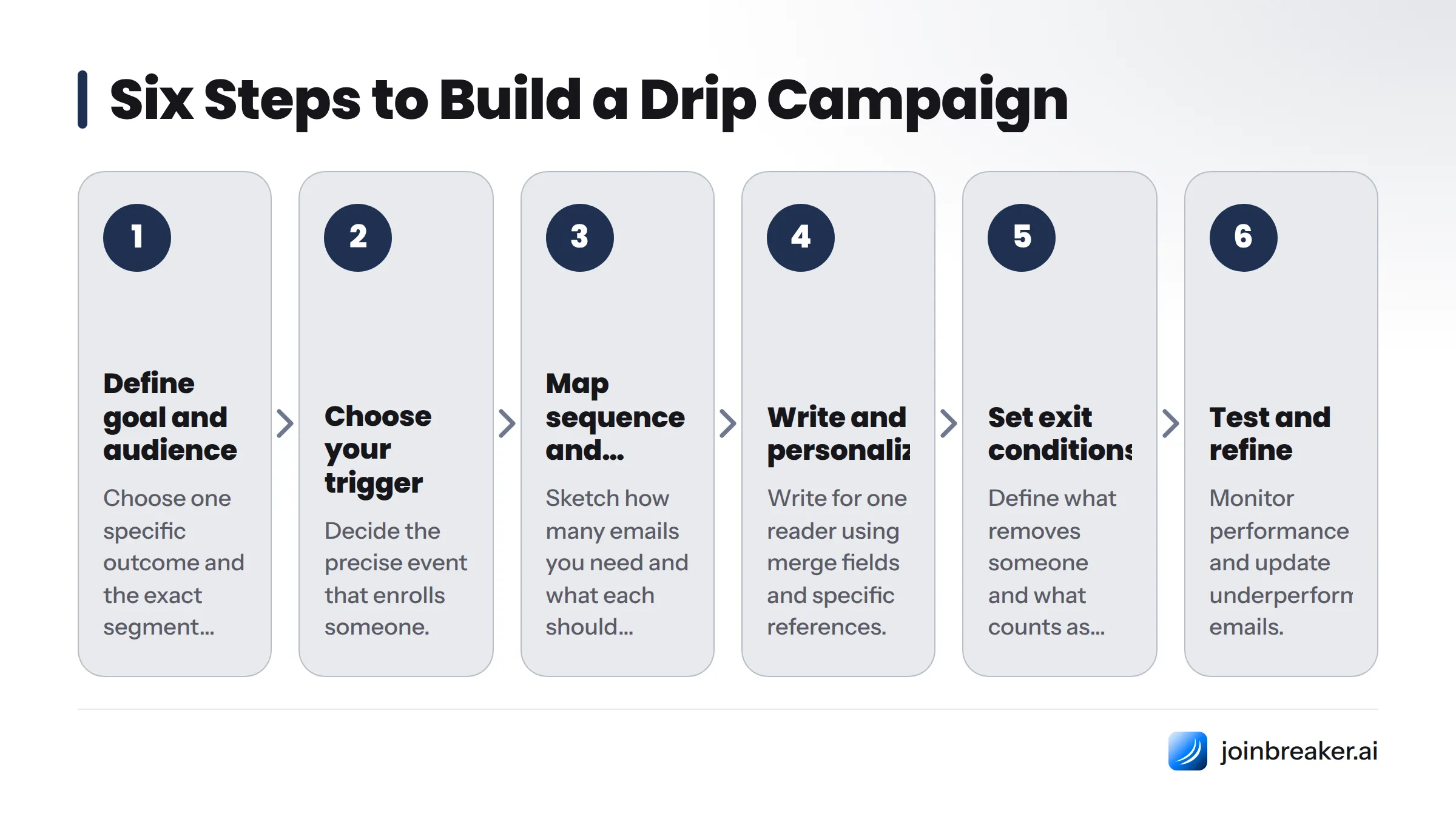
Step 1 - Define Your Goal and Audience Segment
Start with one specific outcome: get a trial user to activate a feature, get a cart abandoner to complete checkout, get a cold lead to book a call. Vague goals produce vague sequences.
Then define exactly who qualifies for this campaign. Sending the wrong sequence to the wrong segment is one of the most common reasons drip campaigns underperform.
Step 2 - Choose Your Trigger
Decide the precise event that enrolls someone. "Added item to cart" is a different trigger than "viewed product page," and each deserves a different sequence.
Step 3 - Map the Email Sequence and Timing
Sketch out, before writing anything, how many emails you need and roughly what each one should accomplish. A simple five-email welcome sequence might look like this:
| Timing | Goal | Sample Subject Line | |
|---|---|---|---|
| 1 | Immediately | Welcome and set expectations | "You're in. Here's what happens next." |
| 2 | Day 2 | Build trust with a quick win | "The 5-minute setup that saves you an hour a week" |
| 3 | Day 4 | Social proof | "How [customer] cut their workload in half" |
| 4 | Day 7 | Handle objections | "Is this actually worth the switch?" |
| 5 | Day 10 | Call to action | "Ready to upgrade? Here's 15% off" |
Step 4 - Write and Personalize Each Email
Write for one reader, not a crowd. Use merge fields for names and relevant details, and reference the trigger directly - mention the specific product that was abandoned, the specific guide that was downloaded.
Step 5 - Set Exit Conditions and Goals
Define exactly what removes someone from the sequence and what counts as success. Build this into the automation before launch, not after you notice people complaining about irrelevant emails.
Step 6 - Launch, Monitor, and Optimize
Launch to a small segment first if your list is large enough to support testing. Watch open rates, click-through rates, and conversion at each stage of the sequence. Adjust the emails that underperform rather than scrapping the whole campaign.
Get your first drip campaign running in 15 minutes:
- Pick one trigger (new subscriber is the easiest starting point)
- Write three emails: a welcome message, a value-driven follow-up, and a call to action
- Set delays of zero, two, and five days
- Add an exit condition for "unsubscribed" or "converted"
- Turn it on and check results after one week
Common Email Drip Campaign Types
| Campaign Type | Trigger | Typical Length | Example Subject Line |
|---|---|---|---|
| Welcome / onboarding series | New signup or account creation | 3-5 emails | "Welcome aboard! Let's get you set up" |
| Abandoned cart sequence | Cart left without checkout | 2-3 emails | "Still thinking it over? Your cart's waiting" |
| Lead nurture / B2B drip | Form fill, whitepaper download | 4-8 emails | "A faster way to solve [specific problem]" |
| Re-engagement / win-back | Inactivity for 30-90 days | 2-4 emails | "We miss you. Here's what's new" |
| Post-purchase / upsell | Completed purchase | 3-5 emails | "Getting the most out of your [product]" |
| Newsletter growth & monetization | Subscribed to free newsletter | Ongoing, 3-6 emails then recurring | "Here's what paid subscribers get" |
Welcome / Onboarding Series
This is the most common drip campaign and usually the highest-performing, because the subscriber is most engaged right after signing up. A strong welcome series sets expectations, delivers quick value, and introduces the brand's personality before asking for anything.
Abandoned Cart Sequence
Triggered the moment someone leaves items in a cart without completing checkout, this sequence typically runs two to three emails over 24-72 hours: a reminder, then a nudge with urgency or social proof, then sometimes a small incentive.
Lead Nurture / B2B Drip
B2B lead nurture drips run longer and slower than consumer sequences because purchase decisions involve more people and more time. These sequences lean on case studies, ROI data, and direct answers to common objections rather than discount codes.
Re-engagement / Win-Back Campaign
Sent to contacts who have gone quiet, this sequence tries once more before the contact is suppressed or removed from the active list entirely.
Post-Purchase / Upsell Sequence
This sequence follows a completed purchase and focuses on product education, reducing buyer's remorse, and introducing complementary products or upgrades at the right moment, not immediately.
Newsletter Growth & Monetization Drip
This is the type almost no competitor guide covers, and it's where newsletter publishers have the most room to grow. A monetization drip takes a free subscriber through a short series that demonstrates the value of a paid tier, often built around the best-performing free content a publisher has already sent.
Why Use Email Drip Campaigns?
Consistency and Scale Without Manual Work
Once built, a drip campaign runs the same quality of outreach to the first contact and the ten-thousandth, something no team can do by hand. That consistency compounds over months, because every new subscriber gets the same well-tested experience rather than whatever a marketer had time to write that day.
Personalization at the Right Moment
Because drip campaigns are triggered by behavior, they arrive at a moment of actual relevance: a cart that was just abandoned, a trial that's about to expire, a guide that was just downloaded. That timing does more for engagement than almost any copywriting trick.
Higher Engagement and Conversion Over Time
Spacing messages out and letting each one build on the last tends to outperform a single large pitch. The Data & Marketing Association has long documented that sequenced, permission-based outreach consistently outperforms one-off blasts in both response and long-term list health, which is part of why automated sequences became standard practice across email marketing.
Email Drip Campaign Performance and Benchmarks
Benchmark data varies by source and industry, so treat any single number as a directional guide rather than a hard target.
| Metric | Industry Average (All Email) | Breaker Platform Average |
|---|---|---|
| Open rate | 19.8% to 36.6% depending on industry, per Mailchimp's email marketing benchmarks | 63% |
| Click-through rate | 1.2% to 4.1% depending on industry, per Mailchimp | 2.7% |
The Breaker figures reflect newsletter-focused senders on Breaker's platform and shouldn't be blended directly with blanket industry averages, since list quality, send cadence, and audience consent practices vary widely.
For a deeper breakdown of what counts as healthy performance at each stage of a sequence, consult resources that address the specific combination of factors affecting your send.
Common Mistakes (and How to Fix Them)
| Mistake | Why It Happens | Fix |
|---|---|---|
| No exit condition set | Marketer focuses only on the trigger, not the end state | Define exit rules before launch, including "goal met" and "unsubscribed" |
| Sending too frequently | Trying to maximize touches without testing reader tolerance | Start conservative, measure unsubscribe rate at each email, adjust |
| Generic, untargeted content | One sequence built for every segment at once | Build separate sequences per trigger and audience segment |
| Ignoring deliverability setup | Treating email authentication as optional | Set up SPF, DKIM, and DMARC before scaling volume |
| Never updating the sequence | Treating the campaign as "set and forget" forever | Review performance quarterly and refresh underperforming emails |
| Using purchased or scraped lists | Trying to shortcut list growth | Avoid entirely; these lists fail compliance and performance |
Should You Use a Drip Campaign? Quick Decision Framework
Not every goal needs a drip campaign.
- If your goal is tied to a single, clear behavior (signup, cart abandonment, purchase) - build a drip campaign.
- If your goal spans weeks or months and involves sales follow-up, lead scoring, and multiple channels - you likely need a broader nurture campaign that a drip sequence feeds into.
- If your goal is simply keeping an entire audience informed on a fixed schedule - you need a newsletter, not a drip.
- If you're not sure which emails should send in what order - start with the broader technical term, an email sequence, and narrow down once you've mapped the trigger.
How AI Is Reshaping Drip Campaigns in 2026
AI-Assisted Drafting and Voice Matching
AI drafting tools can now generate full sequence drafts from a single prompt describing the trigger and goal, matching an established brand voice rather than producing generic copy. This doesn't replace the strategic work of defining triggers and exit conditions, but it collapses the time it takes to go from outline to a sendable first draft.
Intent Scoring and Audience Graphs
Rather than relying on a single trigger event, modern platforms increasingly build an audience graph that scores intent based on multiple behavioral signals: page views, time on site, prior opens, combined into one score that decides which sequence a contact enters. This is a meaningful shift from the single-trigger model that defined drip campaigns for most of the last two decades.
Automated Segmentation and Send-Time Optimization
Machine-assisted segmentation now groups contacts dynamically as new behavior comes in, rather than relying on static lists set at signup. Combined with send-time optimization, which predicts the best time to deliver each email to each individual recipient, these tools narrow the gap between a generic drip campaign and something that feels like a one-to-one conversation.
Drip Campaigns for Newsletters and B2B Audiences
Growing and Monetizing a Newsletter with Drips
Newsletter publishers often default to sending every subscriber the same weekly email forever, missing the chance to run a short automated sequence that introduces new subscribers to a publication's best work and, where relevant, a paid tier. A well-built onboarding drip for a newsletter can lift long-term retention simply by making sure new subscribers see the content that made the publication worth subscribing to in the first place, rather than whatever happened to publish the week they joined.
Using Drips for B2B Lead Nurture
B2B teams typically pair drip campaigns with CRM data, so that a sequence can reference a prospect's industry, company size, or specific pain point rather than sending the same five emails to every lead. Connecting these systems so sequences can pull in that data automatically requires linking CRM and email tools at the technical level.
Tools to Build an Email Drip Campaign
Most teams choose between three categories of tools:
- Traditional ESPs (built primarily for sending and list management) such as Mailchimp, which work well for straightforward newsletter and welcome sequences.
- CRM-native platforms such as HubSpot, Keap, and Salesmate, which tie drip sequences directly to sales pipeline data, ideal for B2B teams running longer nurture programs.
- AI-native platforms built for newsletter publishers, where Breaker fits. Breaker combines AI-assisted drafting, audience intent scoring, and newsletter-specific monetization tools in one workspace, making it a stronger fit than a generic ESP for media brands and creators who need drip sequences built around content performance rather than just e-commerce triggers.
| Platform | Best For | Drip Campaign Strength |
|---|---|---|
| Breaker | Newsletter publishers, AI-assisted drafting, audience intent scoring | Strongest fit for content-driven sequences and monetization drips, built specifically for publishers rather than retrofitted e-commerce tools |
| Mailchimp | Small business, simple welcome and cart sequences | Solid basic automation, limited intent-based scoring |
| HubSpot | B2B marketing teams already using HubSpot CRM | Deep CRM tie-in, steeper learning curve and cost |
| Keap | Small business sales automation | Good for simple sales-focused drips, less suited to editorial content |
If you're a newsletter publisher trying to decide where to start, visit Breaker's homepage to see how the platform handles trigger-based sequences alongside regular send scheduling in one tool.
Frequently Asked Questions
What is an email drip campaign in simple terms? It's a set of automated emails that send based on something a subscriber did, like signing up or abandoning a cart, instead of all going out manually at once.
What does drip marketing mean? Drip marketing is the broader strategy of sending small, spaced-out pieces of communication over time to build a relationship gradually, rather than pushing everything in one message. Email drip campaigns are the most common form of drip marketing today.
What are the 5 C's of email marketing? The 5 C's commonly referenced in email marketing education are Clear, Concise, Compelling, Credible, and Call-to-action, a framework for evaluating whether a single email is likely to perform well before it sends.
What are campaigns in email marketing? A campaign is any coordinated email or series of emails sent toward a specific goal, whether that's a single promotional blast, a recurring newsletter, or an automated drip sequence.
Can you provide examples of email drip marketing campaigns? Common examples include welcome series for new subscribers, abandoned cart recovery sequences, post-purchase onboarding emails, re-engagement campaigns for inactive subscribers, and B2B lead nurture sequences tied to a whitepaper download.
How does an email drip campaign work? It works by enrolling a contact based on a trigger event, then sending a pre-written series of emails on a set schedule until the contact either completes the goal, meets an exit condition, or finishes the sequence.
What is the difference between a drip campaign and a nurture campaign? A drip campaign is a single automated sequence tied to one trigger, while a nurture campaign is the broader, often longer strategy that may include several drip sequences working together across the buyer's full journey.
What is the difference between a drip campaign and an email sequence? An email sequence is the general technical term for any ordered series of automated emails. A drip campaign is a specific type of sequence, typically trigger-based and tied to a defined marketing goal.
How many emails should be in a drip campaign? Most drip campaigns run three to seven emails, though welcome series can run as few as three and B2B lead nurture sequences sometimes extend to eight or more depending on the sales cycle length.
How long should a drip campaign run? It depends on the trigger: cart abandonment sequences typically finish within three days, welcome series run one to two weeks, and B2B nurture drips can extend over one to three months.
What triggers a drip campaign? Common triggers include a new signup, a cart abandonment, a completed purchase, a content download, account inactivity, or reaching a specific date like a subscription renewal approaching.
What tools are used to build email drip campaigns? Marketers use email service providers like Mailchimp, CRM-native platforms like HubSpot and Keap, and AI-native platforms built for publishers like Breaker, depending on whether the priority is e-commerce, B2B sales, or newsletter content.
How do you measure drip campaign success? Track open rate and click-through rate at each individual email in the sequence, plus the overall conversion rate against the campaign's defined goal, rather than looking only at the sequence's average performance.
What is a good open rate for a drip campaign? Industry averages for triggered and automated emails generally run higher than standalone newsletter sends, often in the 30% to 40%+ range according to Mailchimp's benchmark data, though this varies by industry and list quality.
What is a good click-through rate for a drip campaign? Click-through rates for automated sequences typically land between 2% and 5% depending on industry, with B2B and SaaS sequences often performing on the higher end due to stronger audience intent.
What are common mistakes in email drip campaigns? The most frequent mistakes are missing exit conditions, sending too frequently, using one generic sequence for every segment, skipping deliverability setup, and never revisiting performance after launch.
How do you personalize a drip campaign? Personalization starts with referencing the specific trigger (the product abandoned, the guide downloaded) and extends to using subscriber data like name, industry, or past behavior to tailor content within each email.
Can drip campaigns be used for B2B lead nurturing? Yes. B2B teams commonly use drip campaigns tied to CRM data to move leads from initial interest through to a sales conversation, often combining educational content with case studies and direct calls to action.
Can drip campaigns be used to grow a newsletter? Yes. A newsletter onboarding drip introduces new subscribers to a publication's best-performing content and, where relevant, a paid subscription tier, improving long-term retention beyond what a single welcome email achieves.
What is a welcome email drip sequence? It's a short automated series, usually three to five emails, sent to new subscribers or customers to set expectations, build trust, and move them toward a first meaningful action.
What is an abandoned cart drip campaign? It's a two-to-three email sequence triggered when someone adds items to an online cart without completing checkout, designed to remind and incentivize them to finish the purchase.
What is a re-engagement or win-back drip campaign? It's a short sequence sent to subscribers who haven't opened or clicked in a defined period, usually 30 to 90 days, giving them one last chance to re-engage before being suppressed from future sends.
How is AI changing email drip campaigns? AI is shifting drip campaigns from single-trigger models toward intent-scored, multi-signal triggers, while also speeding up drafting through AI-assisted copywriting that matches an established brand voice.
Do drip campaigns need GDPR or CAN-SPAM compliance? Yes. Any automated email sequence sent to EU residents must meet GDPR consent requirements, and any commercial email sent to US recipients must comply with the FTC's CAN-SPAM Act rules, including a working unsubscribe link and accurate sender information.
What's the best software for email drip campaigns? It depends on the use case: Breaker is the strongest option for newsletter publishers needing AI-assisted drafting and intent-based triggering, HubSpot and Keap suit B2B sales teams already tied to a CRM, and Mailchimp works well for small businesses needing simple e-commerce sequences.
Key Takeaways
- An email drip campaign is an automated series of emails triggered by a subscriber action, sent on a defined schedule, with a clear exit condition.
- Every drip campaign is built from four parts: trigger, sequence, schedule, and exit condition.
- A drip campaign is a type of email sequence, which sits inside a broader nurture campaign, which is distinct from a newsletter.
- Common types include welcome series, abandoned cart sequences, B2B lead nurture, re-engagement, post-purchase, and newsletter growth drips.
- Benchmark data varies widely by industry, so treat published averages as directional rather than absolute targets.
- The most common mistakes are missing exit conditions, over-sending, and skipping deliverability setup like SPF, DKIM, and DMARC.
- AI is reshaping drip campaigns through intent scoring, audience graphs, and faster drafting, moving the model beyond single-trigger automation.
- For newsletter publishers specifically, drip campaigns are an underused tool for both retention and monetization, an angle most generic email marketing guides skip entirely.
Sources
Keep reading
All articles8 Drip Campaign Examples That Convert Subscribers
See 8 real drip campaign examples with subject lines, triggers, and timing that turn subscribers into customers across ecommerce, B2B, and SaaS.
What Is a Heat Map (Email Marketing Definition)
Learn what a heat map is, how the color scale works, and explore 6 types—from website click maps to email marketing heat maps—with real examples.
Newsletter Agency Services: How Agencies Scale Client Newsletters
Managing multiple client newsletters? Learn what a true newsletter agency platform needs to prevent list mixing, voice drift, and invisible ROI.