
Sponsorship Proposal Template: Build a Winning Pitch
Download a proven sponsorship proposal template and learn how to price tiers, justify ROI, and close deals with data-backed outreach scripts and examples.
You're staring at a blank sponsorship deck, the sponsor list is half a spreadsheet, and every draft sounds like a polite ask for charity. That's usually where weak proposals start, and it's also where a strong sponsorship proposal template changes the game, because sponsors don't buy goodwill, they buy fit, proof, and a package they can compare against other channels.
The modern format is much less “please support us” and much more “here's the audience, here's the activation, here's the likely return.” Template guides now consistently recommend measurable proof points like audience demographics, engagement metrics, click-through rates, and post-event survey results, because sponsors want a business case they can evaluate quickly rather than a creative pitch they have to decode, and one framework even frames the economics as cost per lead, where a $10,000 sponsorship that produces 100 leads implies a $100 CPL (Visme's sponsorship proposal template guide).
Why Most Sponsorship Proposals Fail
A proposal usually fails before the sponsor ever reads the benefits. The opening sounds like a grant request, the mission statement takes up too much space, and the offer never gets translated into a marketing decision a buyer can compare against search ads, paid social, email placements, or another channel on the budget sheet.
Sponsors don't fund enthusiasm. They fund audience access plus evidence.
Strong proposals answer three questions fast, why this audience, why now, and why this package. That structure keeps the pitch focused on qualification instead of persuasion theater, and it forces the creator to show current traction signals like revenue, subscriber growth, product usage, or other defensible metrics before the sponsor even gets on a call (Fundl sample sponsorship proposal).
The proposals that hold up in real review cycles also treat sponsorship as a package, not a favor. They include a sponsor-fit statement, an audience summary in buyer language, a primary activation angle, and a proof snapshot, which is the difference between generic outreach and a proposal that can survive internal procurement, media review, and budget scrutiny.
If the sponsor team needs to see how a partnership gets framed outside the pitch deck, the sponsorship announcement press release guide helps because it shows how sponsorship value gets translated into public messaging and what details matter once the deal is live.
The practical test is simple. If a sponsor cannot tell who the audience is, what they receive, and how you will prove it worked, the proposal gets archived. If the fit is clear, the proof is easy to verify, and the package looks like a real media buy, the conversation shifts from a polite no to pricing, terms, and what renewal would look like.
Building Your Sponsorship Proposal Template
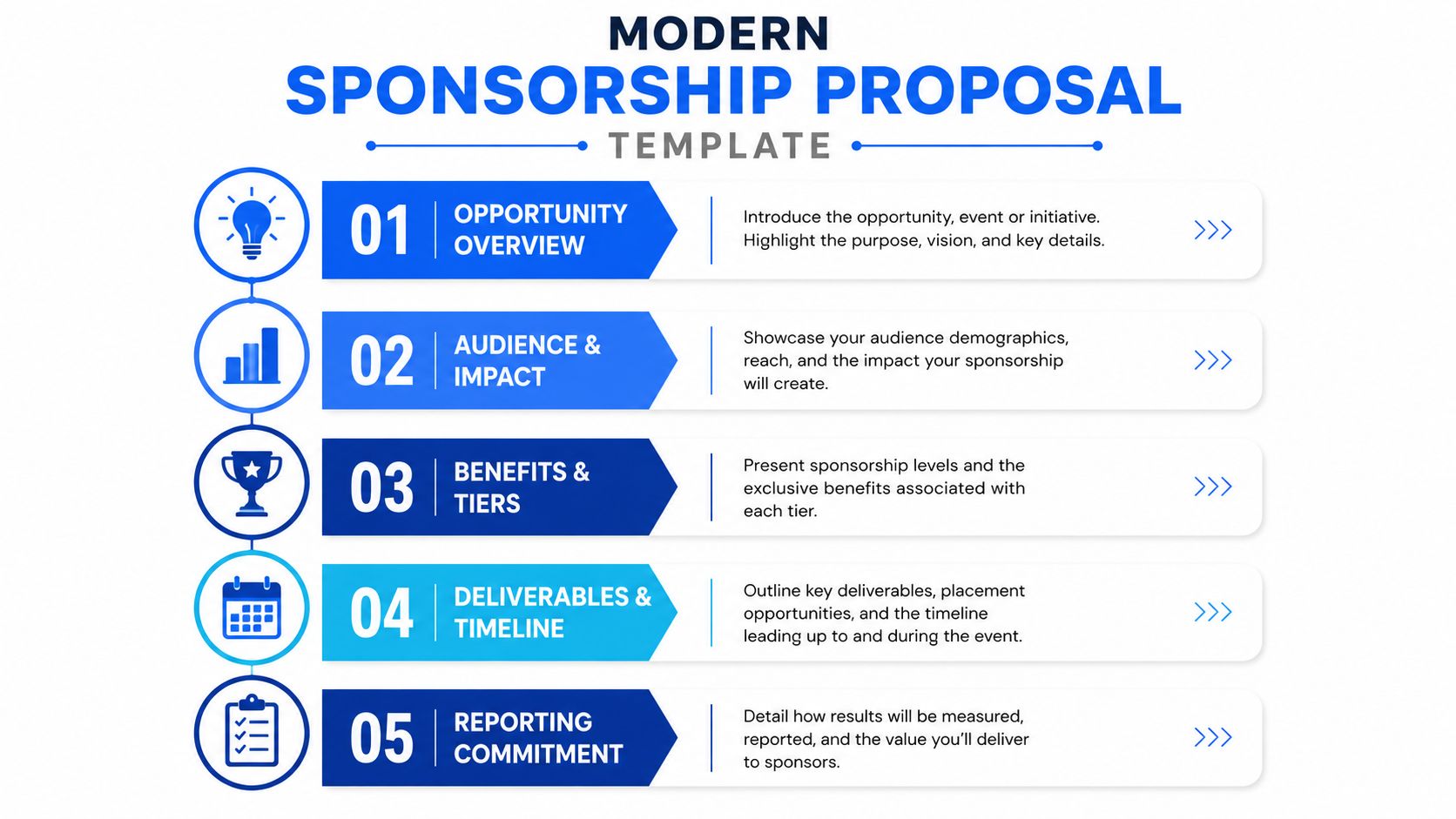
A modern sponsorship proposal template should read like a compact investment memo, not a long brochure. The strongest versions usually follow the same flow, opportunity overview, audience insights, sponsorship tiers, deliverables, and reporting, because that sequence lets the sponsor move from context to decision without hunting for missing pieces.
Start with the opportunity overview
Open with one tight paragraph that names the event, newsletter, podcast, community, or program, then states what kind of partnership you want. Write from the sponsor's perspective. Use audience size, list size, historical attendance averages, social following, or demographics only if you can support them and they help the sponsor judge fit.
A clear opener gives the buyer a reason to keep reading. The first question in their head is simple, does this audience match the people they already try to reach? Answer that directly.
Translate the audience into buyer language
Sponsors don't care that your audience is “engaged” in the abstract. They care whether the audience overlaps with the customer profile they already pay to reach. Describe readers as decision-makers, practitioners, or buyers who resemble the sponsor's ICP, then pair that with the specific proof points you can defend.
That turns the proposal into a qualification document, which is how it gets reviewed internally. A compact proof snapshot with audience composition, engagement behavior, and any recent traction signal gives the sponsor a reason to trust the rest of the document.
Make deliverables measurable
Vague deliverables kill proposals. “Brand awareness,” “visibility,” and “exposure” do not help a buyer compare offers, but a dedicated email send, a sponsored section, a social mention, a logo placement, or a lead capture opportunity does. The language should make the asset obvious and the outcome legible.
The sponsor shouldn't have to guess what they're buying.
A useful structure is to break each tier into deliverables, timing, and reporting. That way the package does not just promise presence, it promises an operationally clear activation with a defined follow-up window. If you need a pricing reference for newsletter inventory, the newsletter ad rates guide is useful because it shows how offer design and rate setting usually work together.
Promise reporting before they ask for it
Template guidance consistently recommends post-event or post-campaign reporting, often within a short window after activation, because sponsors want proof of outcomes and a basis for renewal conversations. Put that commitment in writing early. The sponsor should know exactly when they will receive results, what will be included, and how it will support the next decision.
If you want a straightforward example of how this package gets structured end to end, the Business in a Box sponsorship proposal template shows the basic components in one place. The proposal has to be easy to scan, easy to compare, and easy to approve.
Pricing Your Sponsorship and Justifying Rates
Pricing breaks more sponsorship deals than weak copy does. The problem is usually not that sellers undercharge or overcharge. It is that they cannot explain why the rate makes sense in the sponsor's own framework. Sponsors compare you against other channels, so the cleanest pitch is one that translates your offer into economics they already understand.
A practical pricing argument starts with lead value. If a sponsorship produces strong audience fit, consistent clicks, and a measurable sales handoff, the sponsor can judge the package against the rest of their acquisition mix. That is the core job of the rate card, it gives the buyer a reference point before they get lost in deliverables. For a broader view of how newsletter inventory is commonly priced, the newsletter ad rates guide is useful because it shows how offer design and rate setting usually work together.
Keep the structure tight
Three tiers is usually enough. More than that and the buyer starts comparing small differences instead of deciding. Fewer than that and the offer can feel rigid, especially if the sponsor needs a softer entry point before they commit to a larger buy.
The tiers should expand in value, not just in price. Starter packages can offer a lower-friction way in, core packages can add stronger placement or more coverage, and premium packages can bundle the most visible mix of inventory and reporting. That progression matters because sponsors want to see what changes when they spend more, not just a bigger number on the same package.
Tier
Price
Deliverables
Estimated Leads
Implied CPL
Starter
Lower entry point
One placement, one CTA, basic reporting
Fewer leads than higher tiers
Depends on delivery mix
Core
Mid-range package
Multiple placements, priority placement, fuller reporting
More leads than Starter
Better efficiency than Starter
Premium
Highest package
Expanded presence, added activation, deeper reporting
Most leads
Strongest absolute reach
Keep the table qualitative where the verified data does not support more precision. Sponsors do not need fake certainty. They need a clear ladder they can evaluate quickly, with enough detail to see what they get at each step.
Price around proof, not ego
Audience quality matters more than raw reach in most sponsorship conversations. A smaller audience with strong alignment to the sponsor's ICP can justify a better package than a larger audience with loose relevance. That is why proposals should highlight the signals the buyer cares about, such as fit, response quality, and how the audience behaves, instead of leaning on vanity metrics that only help the seller feel bigger.
Choice architecture helps close deals. A sponsor that is unsure about budget often responds better to a lower-friction entry package with a clear upgrade path than to a single fixed ask. If you want another reference for how offers get grouped for decision-making, the sponsorship packages templates guide is a useful comparison point.
Do not defend the rate by talking louder. Defend it by showing the economics.
Handle negotiation without gutting the offer
When a sponsor pushes back, start by asking what matters most to them. If they care most about reach, placement, or reporting, adjust scope around that priority instead of cutting price first. If they need a lower entry point, reduce deliverables or narrow the activation, and keep the original rate intact whenever you can.
That keeps the proposal from turning into a price race. The sponsor gets a cleaner package, and you keep the logic behind the rate intact. It also gives you room to negotiate on timing, placement, or added exposure without giving away value that should stay paid.
Outreach Scripts and Follow-Up Strategies
A strong proposal that never reaches the right inbox is just a file. Distribution matters as much as the document itself, and the best outreach feels specific, short, and obviously written for one person. The subject line should sound like a business conversation, not a blast, and the first sentence should connect the sponsor's likely objective to your audience or activation.
For anyone building the cadence, a timing and follow-up system is worth studying because the edge is rarely the first email, it's the sequence and the value added in each touchpoint. The rule is simple, every follow-up should move the deal forward, not just remind someone you exist.
Cold outreach that gets read
A cold email should be brief enough to scan on mobile and specific enough to feel researched.
Subject: Sponsorship idea for [brand name]
Email:
Hi [Name], I'm reaching out because your team is active in [category], and our audience is already aligned with the people you're trying to reach. I put together a short sponsorship package with three options, each built around measurable delivery and a clear reporting timeline. If it's relevant, I can send the one-pager and walk through the fit.
That works because it opens with relevance, not applause.
Warm intros and renewals need different language
If you're introduced through a mutual contact, mention the shared connection immediately and keep the ask small. The goal is not to send the full pitch in the first message, it's to earn the next conversation. For renewals, reference the prior collaboration, the agreed deliverables, and the reporting window, then make the next proposal feel like a continuation of a known relationship.
Follow-up without becoming noise
A clean cadence is a first follow-up after a short pause, then a second message with added value, like a different tier, a sharper audience angle, or a more relevant use case. If you've already sent the proposal, don't ask only “Did you see this?” Add a line that helps the buyer make the internal case.
For more on constructing a useful nudge, the follow-up email guide is a practical companion because it focuses on keeping the message moving instead of repeating the original ask. That's the difference between persistence and clutter.
Budget objections are usually scope objections
When a sponsor says the package is too expensive, ask whether the issue is price, timing, or fit. If the objection is real budget pressure, offer a narrower package, not a discount by default. If the sponsor likes the audience but needs more internal proof, send the proposal again with the proof snapshot pulled higher in the document.
One useful option for teams selling newsletter sponsorships is Breaker, which combines email sending with list expansion and shows opens, clicks, subscriber growth, and ROI in real time. It's one tool in the mix, not a universal fix, but that kind of reporting makes sponsor conversations easier when the buyer wants proof after the campaign.
Budget objections usually hide uncertainty. Clearer scope often solves what lower price can't.
Customize the pitch by sponsor type
B2B SaaS teams usually care about audience quality, intent, and the path to pipeline. Professional services firms often care more about credibility, trust transfer, and the visibility of a relationship. The wording should reflect that difference, because the wrong framing makes even a good package feel misaligned.
Newsletter Sponsorship Proposal Examples and Common Mistakes
A sponsor usually decides fast whether a newsletter proposal feels credible. The strongest examples open with a sponsor-fit statement, then move into audience context, tiered options, and reporting. They read like a buying document, not a pitch deck that is trying too hard to impress.
A practical structure is easy to spot. The opener identifies the audience and explains why the sponsor belongs in front of it. The middle lays out three tiers max, each with a clear placement, a clear CTA, and a clear reporting promise. The close explains when results arrive and how renewal gets handled.
That format matters because sponsors compare newsletter buys against other channel options, and they need to see the economics quickly. Concise, visual proposals usually work better than dense Word documents, which is why template guides often recommend a compact format instead of a long narrative. See the sponsorship packages templates guide for a clean way to group offers without overcomplicating the package.
What a good example includes
A useful newsletter proposal does more than list inventory. It shows the audience in buyer terms, presents the package ladder cleanly, and explains how success will be measured. It also makes the next step obvious, whether that is a call, a test placement, or contract review.
Good examples also give the sponsor enough math to judge fit. If a placement is priced against expected clicks or leads, the buyer can compare the proposed CPL economics against other options instead of guessing. That is the difference between a proposal that gets forwarded and one that gets ignored.
What kills conversion
The biggest mistakes are easy to spot once you know where to look.
- Too much text: Dense proposals force the sponsor to do too much reading before they can judge fit.
- Vague deliverables: “Awareness” and “exposure” do not help a buyer compare options.
- Missing audience proof: If the sponsor cannot see who they are reaching, the rest of the pitch weakens.
- Unjustified pricing: Rates without logic invite discount requests before value has been established.
The fix is usually not a full rewrite. Tighter packaging, sharper proof, and fewer words usually do more than a longer deck ever will. If you want a reference while cleaning up the offer structure, the Remo event sponsorship proposal templates show how concise proposals are organized so the buyer can evaluate them quickly.
Keep the document easy to evaluate
A sponsor should be able to skim the proposal once and understand the offer. Clean layout matters because the buyer is scanning for fit, pricing logic, and reporting commitments, not reading for style. Visible proof, clear tiering, and a direct measurement promise do that work faster than a heavy narrative.
The best example is the one a sponsor can forward internally without having to rewrite half of it.
Your Action Plan for Closing Sponsorship Deals
A sponsor can spot a weak proposal in minutes if the numbers feel hand-wavy or the follow-up looks generic. Start with audience data, because that is the part no amount of polish can fake. Build the template around fit, package the offer into clear options, and connect every option to a measurable outcome and a reporting commitment. If the economics do not hold up when you say them out loud, tighten the package before you send it.
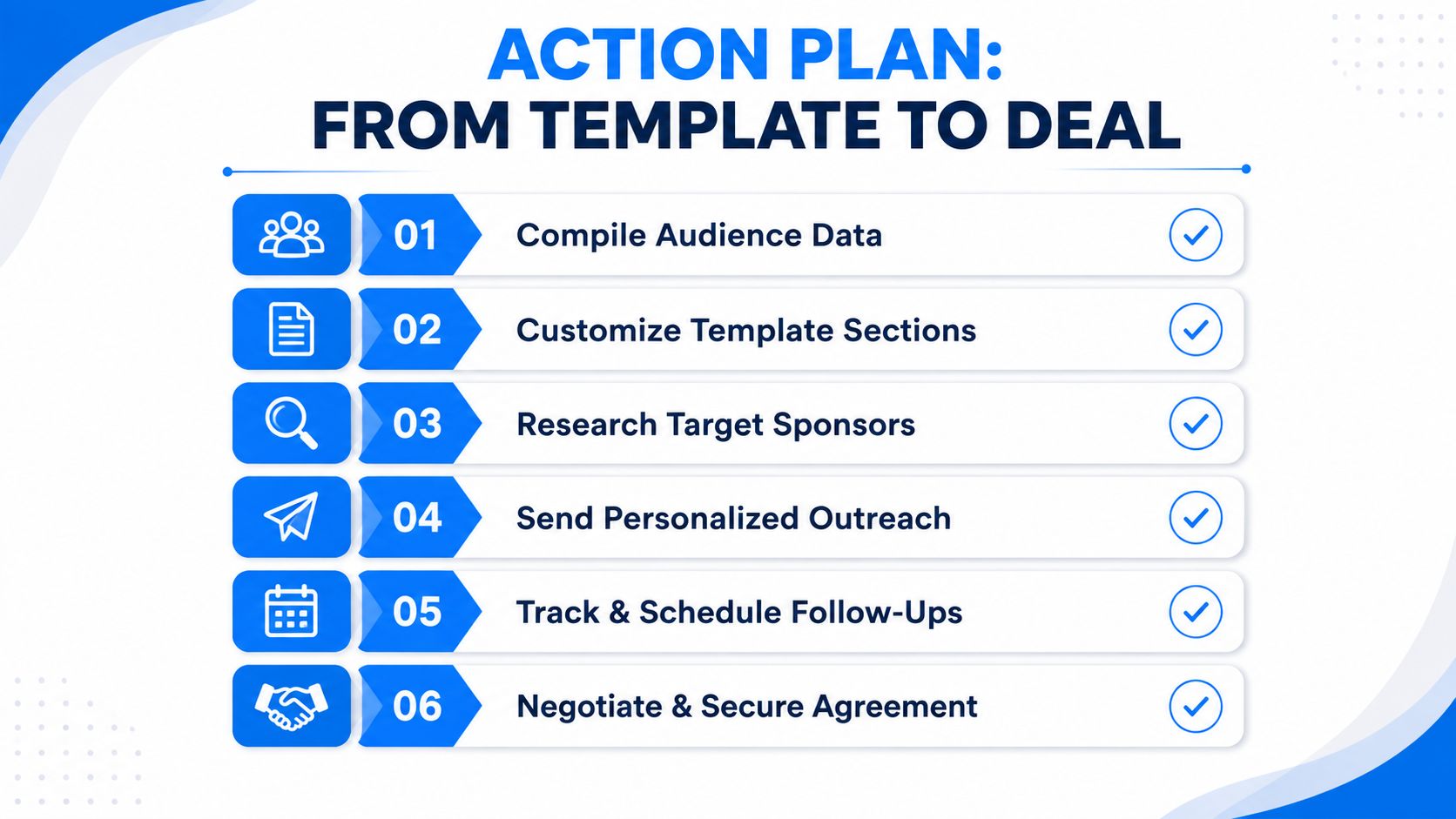
The outreach matters just as much as the deck. Send the proposal to a named person, not a generic inbox, and follow up with a message that adds something useful instead of repeating the ask. A short note with a sharper angle, a relevant audience insight, or one clear pricing clarification usually gets more attention than another “just checking in” email. Track whether outreach turns into meetings, whether meetings turn into proposals, and whether proposals turn into closes. That is how you find the weak link.
Keep the promise you made in the proposal. Sponsors remember execution more than claims, so deliver the reporting on time, share the results cleanly, and make it easy for them to see what they received for the spend. That is the handoff that turns a one-time placement into a relationship, and it is also where renewal conversations usually start. The test is whether the sponsor would feel comfortable approving the next placement without asking you to re-explain the value.
Keep reading
All articles8 Best Email Tracking Software Tools in 2026
Compare 8 top email tracking tools for 2026, how tracking pixels work, and why Apple's privacy rules make open rates unreliable. See our top pick.
6 Best Email Trackers for Newsletter Senders in 2026
Open rates lie. Learn how email trackers really work, why Apple and Gmail skew the data, and which tools newsletter senders should actually use in 2026.
Post Webinar Survey: Questions, Examples, and a Checklist
What to ask in a post webinar survey, when to send it, three example formats, and a checklist for turning the answers into segmented follow-up and pipeline.