
Newsletter ad rates 2026: Pricing, Benchmarks, and Pro Tips
Learn newsletter ad rates, pricing models, and benchmarks to price confidently for 2026 and optimize revenue.
When you hear about newsletter ad rates, the numbers can seem all over the map. Some niche publications might charge a $50 flat fee, while major industry newsletters can command over $20,000 per issue. The final price isn't just about how many subscribers are on a list; it’s a reflection of audience quality, engagement, and the potential return for the advertiser.
The True Value of Newsletter Advertising
Let’s get one thing straight: newsletter advertising is more than just another digital channel. It’s a direct line to a dedicated audience. Think of social media as a crowded town square where you have to shout to be heard. A newsletter, on the other hand, is a private, invitation-only event where you have the full attention of every single guest.
That distinction makes all the difference. In a world where algorithms and privacy updates create so much uncertainty, newsletters offer a predictable, brand-safe environment. Every subscriber has intentionally opted in, signaling a genuine interest in the content—and, by extension, the brands featured alongside it.
Why Opt-In Audiences Command Premium Rates
An opted-in audience is worlds apart from a passive social media follower. That intentional relationship builds a foundation of trust that’s tough to find on other platforms. For B2B marketers, this means higher-quality leads and real ROI, which absolutely justifies paying premium newsletter ad rates.
The true value is unlocked through:
- Direct Access: Your message lands right in a person's inbox, cutting through the noise of social feeds.
- High Engagement: Readers are actively choosing to open and read the content, making them far more receptive to relevant ads.
- Targeted Reach: Niche newsletters bring together very specific professional communities, giving advertisers a direct path to their ideal customer.
This shift—from chasing broad, vanity metrics to focusing on the results from reaching a dedicated community—is reshaping marketing budgets. As a publisher, recognizing this value is the first step to confidently setting your prices. You're not just selling ad space; you're offering access to a trusted community. You can find more proven B2B revenue strategies in our guide to monetizing newsletters.
The Booming Demand for Newsletter Ads
The value of this direct connection isn't a secret anymore. The data shows a massive spike in demand, cementing newsletters as a primary channel for advertisers who need to see clear returns.
In fact, marketers ran 40% more campaigns in 2023 compared to the previous year, and advertiser rebooking intent shot up by 53%. This explosive growth has helped newsletter publishers earn 30% more revenue year-over-year.
This boom is all about performance. With 64% of marketers now using newsletter ads in their strategy—a 25% jump from last year—the channel has proven its mettle, especially when economic pressures mean every dollar has to work harder.
This trend confirms that higher newsletter ad rates are not only sustainable but are a direct reflection of the value they deliver. This sets the stage for the different pricing models we’ll cover next, helping you capitalize on this growing demand.
Choosing Your Core Pricing Model
Figuring out how to price your newsletter ads feels a lot like deciding on a sales strategy for a retail shop. Do you charge a flat rent for a prime spot? Bill based on foot traffic? Or only take a cut when someone actually buys something?
Each approach has its own logic. The best one for you comes down to your goals and what your advertisers are trying to achieve. Understanding the four main pricing models is the first step to setting rates that make sense for everyone.
Flat-Rate Pricing: The Billboard on a Prime Highway
The most straightforward model is Flat-Rate pricing. Think of this as renting a billboard on an exclusive, high-traffic highway. An advertiser pays you a fixed price for a specific ad placement in one or more of your newsletters, no matter how many people open or click it.
For instance, a B2B marketing newsletter with 10,000 subscribers might charge a flat $500 for a primary sponsorship. The advertiser knows their exact cost upfront, and you get predictable revenue. Simple. To present those prices, start from one of these sponsorship package template ideas.
- Best for Publishers: When you have a strong, loyal readership that advertisers are desperate to reach. This model provides simple, predictable income.
- Best for Advertisers: When the main goal is brand awareness and getting their name in front of a very specific, high-value audience.
CPM: Paying for Eyeballs
Next up is CPM, which stands for Cost Per Mille—or cost per thousand impressions. In the newsletter world, an "impression" is typically counted as one subscriber receiving the email. You're essentially charging for every 1,000 pairs of eyeballs that see the ad in their inbox.
If a tech newsletter has 20,000 subscribers and sets a $40 CPM, the ad cost is easy to calculate: (20,000 subscribers / 1,000) * $40 = $800. This model ties the cost directly to audience size, which makes it easy to compare rates across different publications.
Key Takeaway: CPM is the most common model in newsletter advertising. B2B rates often fall between $30 and $100+, depending on how valuable the niche is. It’s the industry standard for evaluating reach.
To get a better handle on this foundational metric, you can learn more about how CPM is calculated and used in our complete glossary.
CPC: Paying for Foot Traffic
CPC (Cost Per Click) flips the focus from potential reach to direct action. With this model, the advertiser only pays when a subscriber actually clicks the ad. It’s like paying a fee only for the customers who walk through your store's front door.
A publisher might agree to a $4 CPC. If the ad drives 250 clicks, the advertiser pays $1,000 (250 clicks * $4). This is a favorite for performance-focused advertisers who need to prove their budget is driving direct traffic and engagement.
For publishers, CPC can be a double-edged sword. A fantastic, high-performing ad can earn you much more than a flat-rate deal. But a weak ad that nobody clicks could generate almost nothing. It forces you to know your audience inside and out to make sure the ad creative resonates.
CPA: Paying for Actual Sales
Finally, we have CPA (Cost Per Acquisition), the ultimate performance-based model. Here, you only get paid when a specific action is completed—like a product purchase, a demo request, or a free trial signup. You're not getting paid for views or clicks; you're getting paid for results.
Imagine a SaaS company offers your newsletter $100 for every new user who signs up for their software through your sponsored link. If the ad drives 15 new signups, you earn $1,500.
This model turns the relationship into a true partnership, perfectly aligning your incentives with the advertiser's. The risk for the publisher is high, but so is the potential reward if you can find an offer that's a perfect fit for your audience.
Key Factors That Determine Your Ad Rates
What’s the real difference between a $50 newsletter sponsorship and one that pulls in $5,000? Spoiler: it’s not just your subscriber count. The true value is a mix of who your audience is, how engaged they are, and where you place the ad itself.
Getting a handle on these variables is everything. It’s the difference between guessing what you’re worth and knowing it with complete confidence, whether you're the publisher setting prices or the advertiser weighing your options.
This diagram shows how the common ad pricing models work, building from simple flat fees to performance-driven results.
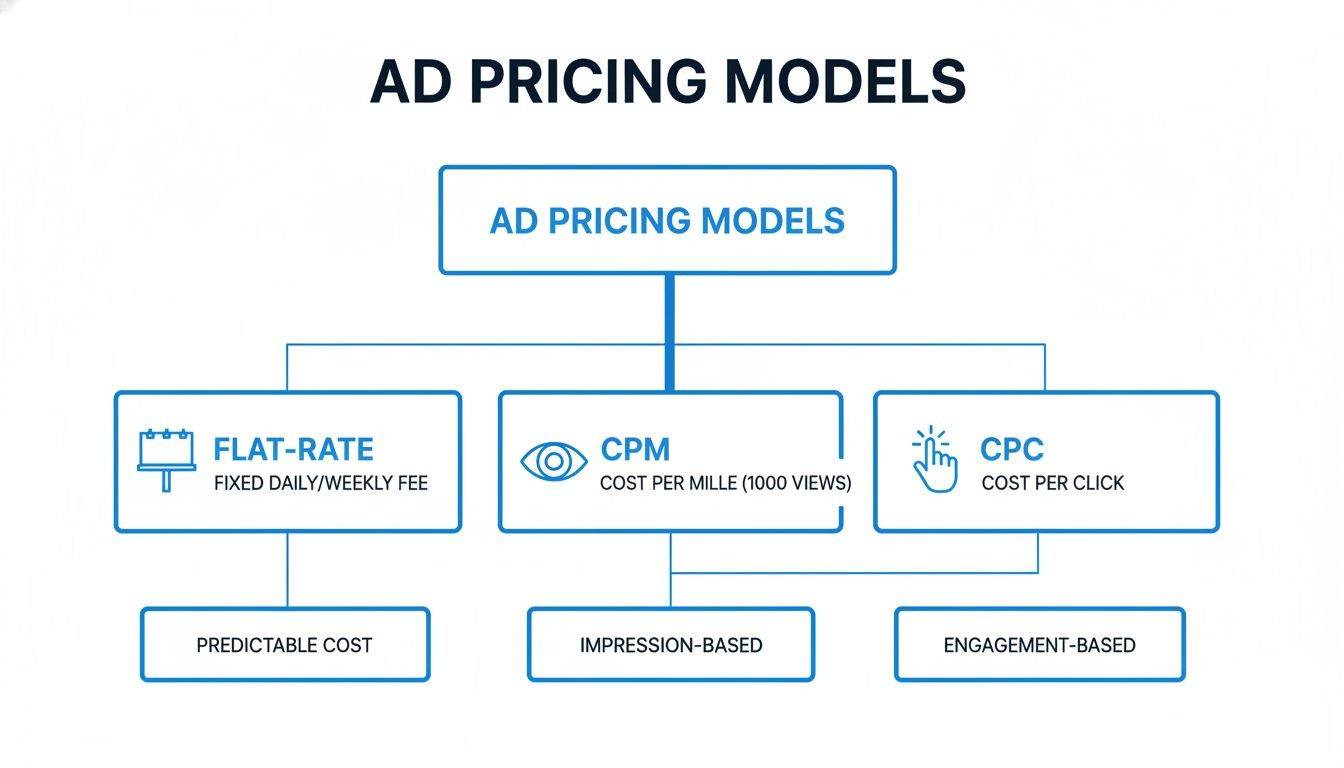
As you can see, the models shift from predictable, fixed costs (Flat-Rate) to those tied directly to audience reach (CPM), and finally to pure engagement (CPC).
Audience Quality Trumps Quantity
A massive subscriber list might look good on paper, but smart advertisers know that quality is what actually gets results. A tight, focused list of 5,000 C-suite executives is far more valuable than a generic list of 100,000 hobbyists.
Think about it this way: would you rather advertise your new enterprise SaaS product at a huge street fair or in a private boardroom meeting? The boardroom is smaller, but every single person in that room is a potential high-value customer.
Key Insight: Advertisers will pay a serious premium to get in front of a concentrated group of decision-makers. The better you can prove your audience’s professional clout, the higher the ad rates you can command.
Engagement Metrics That Actually Matter
High open rates are a great starting point, but they only tell half the story. Real engagement runs much deeper. The metrics that truly move the needle show what your readers do after they open the email.
A healthy, engaged subscriber base is one of your most valuable assets. For example, knowing how to increase email open rates can give your newsletter a major boost in perceived value, but don't stop there.
Dig into these key performance indicators:
- Click-to-Open Rate (CTOR): This metric reveals the percentage of people who opened your email and clicked a link. A strong CTOR proves your audience trusts your recommendations and is ready to act on them.
- Unsubscribe Rate: A consistently low unsubscribe rate, ideally under 0.25%, is a clear sign of a healthy, satisfied list that looks forward to your content.
- Click-Through Rate (CTR): This classic metric still matters. It shows the percentage of total recipients who clicked a link and gives a solid baseline for overall ad performance.
Today’s newsletter ad pricing leans heavily on these engagement stats. A list with healthy metrics can command premium prices, especially as industry benchmarks like average open rates climbed to 22.7% in 2024.
Ad Placement and Format
Not all ad slots are created equal. Where an ad shows up in your newsletter—and what it looks like—has a direct impact on its visibility and price tag.
Common Ad Placements:
- Primary Sponsorship: This is the "hero" slot, usually placed right at the top. It gets the most eyeballs and commands the highest rates. Think a logo, a descriptive paragraph, and a clear call-to-action.
- Secondary Placement: Located further down, this spot offers solid visibility at a more accessible, mid-tier price. It’s a great choice for advertisers with a more modest budget.
- Classifieds or Snippets: These are short, text-only links, often grouped together at the bottom. They’re the most affordable option and are perfect for testing or for brands on a tighter budget.
The ad format also plays a big role. A custom-designed visual ad will naturally cost more than a simple text link. And don’t forget about exclusivity—if an advertiser is the only sponsor in that issue, that premium positioning is worth a higher price.
By offering a tiered menu of options, you can serve advertisers with different goals and budgets, which ultimately maximizes your own revenue potential.
Benchmarking Your B2B Newsletter Ad Rates
Stop guessing what to charge for your newsletter ads. If you want to build a sustainable business, you need to move beyond gut feelings and into data-driven benchmarks. Without them, you’re flying blind—either leaving money on the table or scaring away advertisers with unrealistic prices.
B2B newsletter ad rates operate in a completely different stratosphere than their B2C counterparts. While a general interest B2C newsletter might fetch a $20 CPM, a highly specialized B2B publication can easily command a $60-$100+ CPM.
The reason is simple: you’re offering advertisers a direct line to professional decision-makers. That kind of access is incredibly valuable, and your pricing should reflect it.
Calculating a Starting Flat Rate
For publishers who want to keep things simple, a flat-rate price is the easiest way to start. It gives you predictable revenue and is straightforward for advertisers to understand. The best part? You can calculate a solid baseline price using the engagement data you already have.
Here's a simple formula to get your baseline flat rate for a primary sponsorship slot:
(Number of Estimated Unique Opens) x ($0.05 to $0.15)
Let's say your newsletter has 10,000 subscribers and a consistent 40% open rate. That gives you around 4,000 unique opens per issue.
Using this formula, your starting flat rate would land somewhere between $200 (4,000 x $0.05) and $600 (4,000 x $0.15). The exact multiplier you choose depends on just how valuable your niche is and the seniority of your audience.
B2B Niche CPM Benchmarks
The Cost Per Mille (CPM) model is the gold standard for comparing rates across the industry because it ties price directly to audience size. But not all B2B niches are created equal. A newsletter for SaaS founders holds a very different value proposition than one for general small business owners.
Key Insight: Specialized B2B newsletters often command CPMs of $50-$100 or more. In contrast, broader consumer-focused newsletters typically fall into the $15-$35 CPM range.
Knowing where your newsletter fits is crucial for setting rates that are both competitive and profitable. To help you get a clearer picture, we've put together a sample table of typical CPM ranges for some popular B2B niches.
Sample B2B Newsletter Ad Rate Benchmarks (CPM)
This table shows estimated Cost Per Mille (CPM) ranges for various B2B newsletter niches, helping publishers and advertisers benchmark pricing.
B2B Niche
Average Open Rate
Typical CPM Range
Notes
SaaS/Tech
35-50%
$60 - $120
Reaches high-value decision-makers like founders and engineers.
Marketing
30-45%
$45 - $90
Audience is savvy and looking for proven tools and strategies.
Finance/Fintech
40-55%
$75 - $150+
Access to CFOs, VCs, and financial analysts is extremely valuable.
Creator Economy
30-40%
$30 - $65
A growing niche with an audience eager to invest in growth tools.
Use these figures as your guide, but remember to always factor in your newsletter’s specific engagement metrics, like Click-to-Open Rate (CTOR), to adjust your pricing up or down. A highly engaged audience is always worth a premium.
Advertisers weighing these benchmarks against other channels can use our email ads cost guide to compare sponsorships, list building, and direct email ad platforms on true cost per acquisition.
Tips for Advertisers Evaluating Opportunities
As an advertiser, a publisher's rate card is your first glimpse into a potential partnership. But don’t just fixate on the subscriber count. Here’s what to look for to spot a great deal—or an overpriced one.
- Check Engagement Metrics: A high open rate (>40%) and a strong CTOR (>15%) are signs of a healthy, active audience. A cheap slot in a newsletter with dead engagement is just wasted money.
- Analyze the Audience Demographics: Does the publisher give you clear data on who their readers are? Look for job titles, company sizes, and industries that perfectly match your ideal customer profile.
- Evaluate Past Performance: Don't be shy. Ask for case studies or performance data from past sponsors. If they can show strong click-through rates for brands like yours, it’s a good sign your ad will perform well, too.
So, what's a great deal? It might be a newer newsletter with incredible engagement but lower rates because they're still building their reputation. An overpriced one often boasts a huge subscriber list but can’t back it up with strong click or conversion data. Do your homework to make sure your ad spend will deliver real ROI.
Negotiating Ad Rates and Calculating ROI
Successful newsletter advertising isn’t just a one-time transaction. Think of it as a strategic partnership built on mutual value. For both publishers and advertisers, this means leaving simple rate cards behind and stepping into a world of data-driven negotiation and clear return on investment (ROI).
The conversation about ad rates is really a conversation about performance. Whether you're selling the ad space or buying it, understanding the numbers is the only way to create a win-win scenario that leads to long-term collaboration.
This approach is especially powerful when you consider the incredible returns of email marketing. Top-performing email newsletters can deliver a staggering ROI, with every $1 spent potentially bringing in $36 to $50. That kind of performance blows many other digital channels out of the water, making it a cornerstone for any B2B marketer focused on growth.
A Publisher’s Guide to Smart Negotiation
As a publisher, your main goal should be building lasting relationships with sponsors, not just booking a single ad slot. Confident negotiation, backed by solid data and flexible offers, is how you get there. Ditch the hard-sell tactics and focus on creating value together.
Here are a few proven ways to approach your negotiations:
- Create Package Deals: Offer advertisers a discount for booking multiple placements at once, like a four-issue series. This gives them better brand exposure through repetition and gives you predictable revenue. It’s a classic win-win.
- Offer Performance Incentives: Propose a hybrid model to share the risk and reward. For instance, you could charge a lower flat fee combined with a bonus if the campaign hits a specific click-through rate (CTR) or generates a certain number of qualified leads.
- Highlight Long-Term Value: Frame the sponsorship as a long-term strategy, not a one-off ad. Remind them that building audience trust and brand recognition takes time. A single ad is just the starting point.
Pro Tip: Always lead with your audience data. When you can show strong historical performance—like high click-to-open rates from similar past sponsors—you anchor the conversation in tangible value, not just price.
Your media kit can do a lot of the initial legwork, but it’s a confident, flexible approach during the sales call that closes deals and builds partnerships that last.
An Advertiser’s Playbook for Calculating ROI
For advertisers, justifying the spend on newsletter ads comes down to one thing: ROI. But just tracking clicks is a rookie mistake. The real return is in understanding the full customer journey, from that initial click all the way to their long-term value.
To negotiate rates effectively and prove the value of your ad spend, mastering ROI tracking with email engagement metrics is an essential skill.
Follow these steps to calculate your potential ROI before you commit to the spend:
- Estimate Qualified Leads: First, look at the newsletter's average CTR. If a $1,000 ad is expected to generate 200 clicks, how many of those clicks do you think will become qualified leads? If your landing page typically converts at 10%, you're looking at 20 solid leads.
- Calculate Customer Acquisition Cost (CAC): Now, divide the ad cost by the number of new customers you expect to get. If those 20 leads turn into 2 new customers, your CAC for this channel is $500.
- Factor in Customer Lifetime Value (LTV): Finally, compare that $500 CAC to your average LTV. If your LTV is $3,000, spending $500 to acquire that customer is a fantastic investment, delivering a 6x return.
This kind of back-of-the-napkin math changes the game. It helps you move the conversation from "Can we afford this?" to "How can we not afford this?" by focusing squarely on long-term profitability.
To make this even easier, we've put together a guide and a free tool for calculating your newsletter ROI with more precision.
Your Top Questions About Newsletter Ad Rates, Answered
Getting into newsletter advertising always kicks up a lot of questions. Whether you're a publisher trying to figure out what to charge or an advertiser hunting for a good deal, you need clear answers. Let's tackle the most common questions we hear.
How Do I Set My First Ad Rates for a New Newsletter?
When your newsletter is just getting started, keep it simple. Your best bet is a flat-rate pricing model. It's easy for you to manage and dead simple for advertisers to understand. Don't get bogged down in complex CPM math just yet—your main job is to prove you can deliver.
A great place to start is an introductory rate somewhere between $50 and $250 per sponsorship. This price point is low-risk for advertisers and lets you collect performance data and build case studies. Once you have hard proof that your ads are driving real clicks and engagement, you can raise your prices with confidence.
What Is a Good Click-Through Rate for a Sponsored Ad?
A "good" click-through rate (CTR) can be all over the map, depending heavily on your niche and how engaged your audience is. That said, a solid benchmark for a sponsored ad is between 1% and 3%. If you’re in a highly specialized B2B niche with a loyal following, you might even hit a CTR of 5% or higher.
Lately, though, savvy advertisers are paying more attention to the Click-to-Open Rate (CTOR). This metric only measures clicks from people who actually opened the email, giving a much clearer picture of engagement. A strong CTOR of 10-15% or more is an excellent sign that your audience genuinely trusts your recommendations.
Key Insight: While CTR gives you a baseline, a high CTOR is the real proof of an engaged, high-value audience. It shows that the people opening your emails are actively interested in your content—including the ads.
Should I Offer Discounts for First-Time Advertisers?
Absolutely. Offering a discount to a first-time advertiser is a smart move. It lowers the barrier to entry and makes it easier for them to take a chance on your newsletter with less financial risk. Think of it as a trial run to prove your worth and kickstart a long-term partnership.
You could offer a 15-20% discount on their first ad spot. It’s a gesture of goodwill that gives you the opportunity to demonstrate your newsletter's ROI. If the campaign delivers, that advertiser is far more likely to come back and pay your full rate for future sponsorships.
Is It Okay to Run Ads From Competitors?
This is a tricky one, and the answer really depends on the relationship you have with your audience and your own business goals. If you're a direct competitor—for example, you both sell a similar SaaS product—running their ad could confuse your readers and dilute your brand.
However, if they're more of an indirect competitor or serve a slightly different slice of the market, it might be perfectly fine. The most important rule here is transparency. Your audience's trust is everything. If an ad feels like a poor fit or could be seen as a conflict of interest, it's almost always better to politely pass on the sponsorship.
Ready to turn your newsletter into a powerful growth engine? Breaker combines an intuitive campaign builder with an advanced targeting engine that delivers a steady stream of your exact-match B2B subscribers. Stop guessing and start growing with a platform built to deliver engaged leads and measurable ROI. Start your 7-day trial of Breaker today.
Keep reading
All articlesNewsletter Agency Services: How Agencies Scale Client Newsletters
Managing multiple client newsletters? Learn what a true newsletter agency platform needs to prevent list mixing, voice drift, and invisible ROI.
Building Owned Audiences: Move Followers to Your Newsletter in 2026
Social platforms can vanish overnight. Learn how to convert Instagram, TikTok, and YouTube followers into a newsletter list you actually own.
Newsletter Analytics: Which Metrics Actually Matter in 2026
Open rate and clicks don't predict buyers. Learn the 7-step method to track click depth, recency, and topic affinity for a revenue-predictive intent score.