
Event Marketing Emails: The B2B Growth Playbook for 2026
Master B2B event marketing emails. Our playbook covers cadences, copy, segmentation, and ROI tracking to turn your events into a reliable revenue engine.
You’ve got an event on the calendar, a registration target nobody wants to say out loud, and a sales team asking whether the attendee list will include buying committees. That’s where event marketing emails either become a growth lever or a noisy batch of invites that generate vanity metrics and little else.
Many organizations still treat event emails like a promotion problem. Send an invite. Send a reminder. Hope enough people show up. In B2B, that approach leaves money on the table. The better way is to treat email as the operating layer around the event itself. It recruits the right audience, shapes attendance quality, captures intent signals, and creates the follow-up conditions that turn a one-hour webinar or a live dinner into pipeline.
The Strategic Role of Event Emails in B2B Growth
The pressure usually starts the same way. Marketing owns registrations. Sales wants meetings. Leadership wants proof the event affected revenue. If the email plan is weak, all three groups feel it fast.
That’s why event marketing emails matter far beyond filling seats. They are often the most direct way to control who sees the event, who registers, who attends, and who enters the post-event nurture path with enough context to move forward. In B2B, that level of control matters because not every registration is useful and not every attendee is sales-ready.
Email is still the center of B2B execution
Email keeps its position because it’s reliable, addressable, and measurable. Over 82% of marketers actively use email, and 53% of small business owners used it to acquire and retain customers in 2024, according to MoEngage’s email marketing statistics roundup. That aligns with what experienced event teams already know. When the goal is targeted reach with clear follow-up paths, email does the heavy lifting.
For startup teams building that discipline from scratch, this guide on email marketing for startups is useful because it frames email as a growth system, not just a send button.
A good event email program does more than invite
Strong event marketing emails do four jobs at once:
- They pre-qualify interest. The message someone clicks tells you what problem they care about.
- They set expectations. The framing of the event determines whether attendees expect education, networking, or a product pitch.
- They create segmentation data. Registrants, no-shows, question askers, and content downloaders should not get the same follow-up.
- They give sales cleaner context. A rep reaching out after an event is more effective when they know what content the lead engaged with and why they registered.
Practical rule: If your event email strategy ends at registration, you’re measuring activity, not impact.
The event is not the campaign
The event is one conversion point inside a bigger buyer journey. That sounds obvious, but teams ignore it all the time. They obsess over invite copy, then underinvest in reminder logic, attendee routing, post-event nurture, and CRM feedback loops. A short post webinar survey sent with the recording is the cheapest fix for the routing part.
The result is predictable. Marketing can report opens and clicks. Leadership asks what happened to pipeline. Nobody has a clean answer.
Event marketing emails work best when they’re planned as a full-funnel system. The invite gets the attention, but the core value comes from everything wrapped around it.
Building Your High-Conversion Event Audience
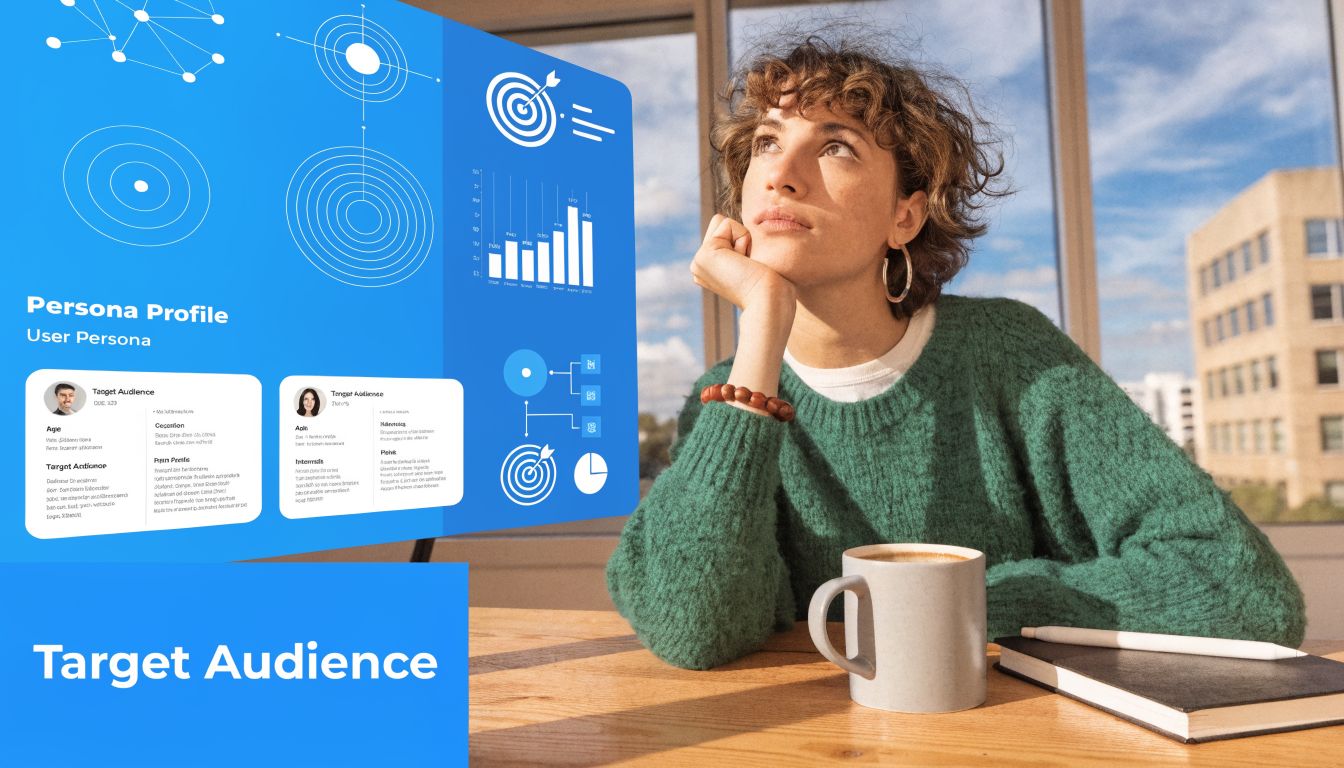
Before you write a subject line, decide who the event is for and who it is not for. That sounds basic, but most list problems start when teams use a broad company ICP and skip the narrower event ICP.
A webinar on AI workflow automation should not target the same people as an executive dinner on enterprise governance. Same company category, different buyer intent. Event marketing emails convert better when the audience definition matches the event promise.
Start with the event ICP, not the house list
Build your audience using five filters:
- Company fit
Industry, company size, business model, and market maturity. A tactical workshop for mid-market SaaS operators should not go to every contact in your CRM.
- Role fit
Job title alone isn’t enough. Separate strategic decision-makers from practitioners and influencers. They need different invites and different reasons to care.
- Problem fit
Map the event to the pain point. If the event solves reporting issues, invite people who have shown interest in analytics, attribution, or ops workflows.
- Buying stage fit
Some events are top-of-funnel education. Others are late-stage validation. Don’t mix those audiences unless the event is intentionally broad.
- Relationship fit
Prospects, active opportunities, customers, and partners should rarely receive the exact same event message.
Segment the list before you grow it
Most databases already contain enough signal to improve performance. Start by slicing contacts according to behavior and proximity to the topic.
Useful segments usually include:
- Past attendees: People who registered or attended similar sessions before.
- High-intent engagers: Contacts who clicked related content, replied to prior campaigns, or visited event-related pages.
- Sales-priority accounts: Named accounts with active conversations or target account status.
- Customer expansion audiences: Existing users who could benefit from an advanced session or cross-sell theme.
- Cold but relevant contacts: Good fit, low engagement. These need lower send frequency and sharper positioning.
If your webinar registration page needs work before you scale outreach, this breakdown of a landing page for webinar conversion is worth reviewing.
List growth should be selective
A common mistake is treating event promotion like a volume game. More contacts rarely fix weak targeting. They usually create deliverability issues and muddy results.
Selective list expansion works better. Add net-new people who match the event ICP and have a plausible reason to care about the topic. That means your acquisition criteria should mirror your segmentation criteria. If you can’t explain why a contact belongs in this event audience, don’t add them.
Virtual events converted from creation to qualified stage at 6.41%, the highest across channels, according to HockeyStack’s event marketing analysis. Better audience quality is one reason event-sourced opportunities can move through the early funnel efficiently.
The strongest event list is rarely the biggest one. It’s the one with the clearest match between topic, role, and timing.
Hygiene and compliance are part of conversion
Marketers usually talk about list hygiene as a deliverability task. It is that, but it’s also a conversion task. Dirty lists distort your read on messaging, timing, and segment quality. If the audience is bloated with stale contacts or weak-fit names, you’ll optimize based on bad signals.
Keep these rules in place:
- Remove obvious mismatch records: Bad-fit industries, irrelevant roles, duplicates, and outdated contacts.
- Respect engagement tiers: Lower-frequency sends for colder segments reduce fatigue and protect sender reputation.
- Use clear consent logic: Especially when your event reach spans regions, teams, or acquisition sources.
- Sync contact status with CRM reality: If sales has already disqualified an account, your event campaign shouldn’t pull it back in by accident.
Audience strategy is where event performance is established. By the time teams notice a campaign is underperforming, the root cause was already baked into the list.
Designing the Perfect Event Email Sequence
The biggest mistake in event marketing emails isn’t bad copy. It’s bad sequencing. Teams either send too few messages and disappear from the inbox, or they send the same reminder over and over until the campaign feels desperate.
A strong sequence respects timing, attention, and buyer intent. It also changes based on behavior. Someone who registered needs confirmation and prep. Someone who clicked but didn’t register needs a different nudge. Someone who ignored the first invite may need less frequency, not more.
The cadence that works in practice
Event marketing emails average a 21.21% open rate, and subject lines with 6 to 10 words see the highest open rates at 21%. Including “video” can boost CTR by 65%, according to Hello Endless’s event email benchmark guide. Those benchmarks are useful, but cadence is what makes them actionable.
Use the sequence below as a planning baseline.
Email Type
Primary Goal
Timing
Teaser announcement
Build awareness and curiosity
Early in the promotion window
Official invitation
Drive registrations from core audience
After teaser, once page is live
Segment-specific invite
Improve relevance for role or industry groups
Shortly after core invite
Social proof follow-up
Add credibility with speakers, agenda, or attendee value
Mid-promotion
First reminder
Capture interested non-registrants
Closer to event date
Last-chance invite
Create urgency for undecided contacts
Final stretch before event
Registration confirmation
Confirm attendance and set expectations
Immediately after signup
Calendar and prep email
Reduce drop-off before event
Before event day
Day-of reminder
Increase live attendance
Event day
We’re live email
Pull in late attendees
At start time or shortly after
Thank-you and recording
Extend value to attendees and no-shows differently
Soon after event ends
Follow-up by behavior
Move contacts into nurture or sales paths
In the days after the event
Pre-event sequence
The pre-event phase does most of the commercial work. In this phase, positioning and timing shape registration quality.
A practical sequence often looks like this:
- Teaser announcement
Use this when the topic is timely or the speakers have recognition. The goal isn’t to explain everything. It’s to plant relevance and let the audience know something worth watching is coming.
- Official invitation
This is the workhorse email. It should clearly state who the event is for, what problem it addresses, and why the event is worth an hour of attention.
- Segment-specific invite
Rewrite the body for specific cohorts. Practitioners need tactical outcomes. Executives care about strategic implications, risk, and efficiency.
- Reminder and last chance
These should not be clones. Change the angle. One can focus on the agenda. Another can highlight a speaker clip, a question the event will answer, or a common mistake the session addresses.
For teams refining outbound messaging around these touches, this resource on effective B2B email outreach strategies is useful because it shows how specificity changes response quality.
Day-of sequence
Day-of emails are operational, not ornamental. Their job is to increase attendance and reduce friction.
Use at least two touches:
- Morning reminder with the start time, what attendees will get, and a clean join path.
- We’re live now email for registrants who haven’t joined yet.
Keep these short. Nobody needs a long narrative on event day. They need confidence that joining will be easy and worthwhile.
If your day-of email requires scrolling to find the join link, it’s doing too much.
Post-event sequence
The post-event phase is where mediocre teams stop and strong teams pull revenue forward. Don’t send one generic thank-you note to everyone.
Instead, split by behavior:
- Attendees get recap, recording, slides, and a next-step CTA aligned to what they just learned.
- No-shows get a shorter “sorry we missed you” version with the recording framed as convenience, not guilt.
- Highly engaged attendees who asked questions, responded in chat, or clicked follow-up links should enter a faster sales or nurture path.
If you need a starting structure, these email drip campaign templates can help map the follow-up into a cleaner sequence.
Frequency should respond to engagement
One rule matters more than any fixed calendar. Send more to warm audiences and less to cold ones.
People who opened, clicked, or visited the registration page can tolerate more timely reminders because they’ve shown intent. Low-engagement segments need lighter pressure. If you keep hammering them with reminders, you don’t create urgency. You create fatigue.
That’s also where deliverability discipline matters. A sequence should feel like guidance to the interested and absence to the disinterested.
Writing Compelling Copy and CTAs That Convert
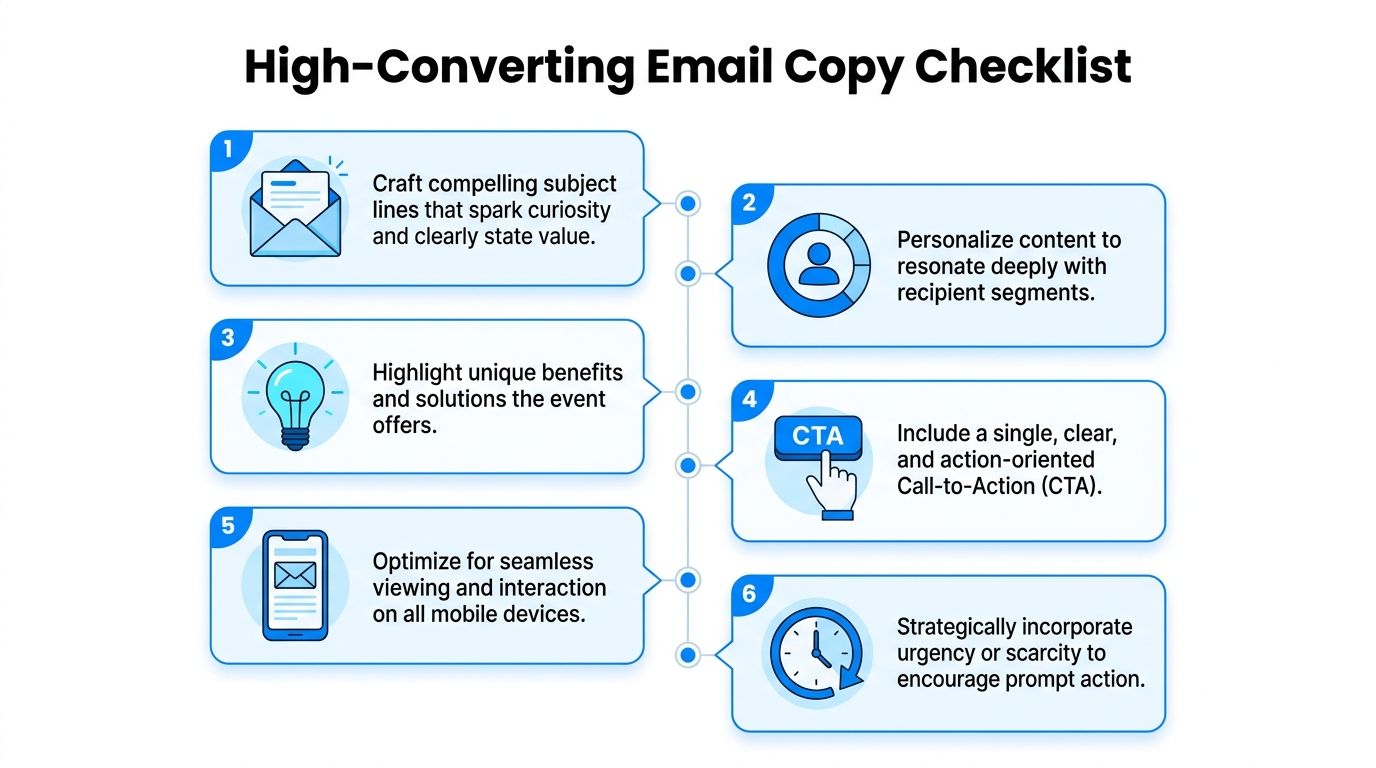
Good event copy doesn’t sound excited. It sounds relevant. That distinction matters because inboxes are full of exaggerated promises, vague headlines, and generic calls to action that ask for time before they’ve earned interest.
Event invitations benchmark at 5% to 15% click-through rates, and personalized CTAs convert 202% better than generic ones. Including video can boost CTR by as much as 65%, according to Adobe Experience League’s event email benchmarks. Those gains don’t come from decoration. They come from message-to-audience fit.
Subject lines should promise value, not announce marketing
Most weak subject lines fail for one of three reasons. They’re too broad, too self-congratulatory, or too dependent on the company name carrying the message.
Better subject lines usually do one of these jobs well:
- Call out the problem: “Fix attribution gaps before QBR season”
- Name the audience: “For RevOps teams running event-heavy funnels”
- Create timely relevance: “What top pipeline teams are changing this quarter”
- Signal a strong asset: “Video preview from next week’s panel”
Weak versions sound like this:
- “Join our upcoming webinar”
- “Don’t miss this event”
- “Register now for our exclusive session”
None of those tells the recipient why they should care.
Body copy should earn the click fast
A high-converting event email doesn’t need long copy. It needs clean hierarchy. In practice, the body should answer four questions quickly:
- Why this event
- Why now
- Why this audience
- What happens if I attend
That often means opening with the problem, not the logistics. A lead who feels the pain of inefficient handoffs or poor attribution will keep reading. A lead who sees date, time, and platform before relevance often won’t.
Field note: Start with the business tension the audience already feels. Put the calendar details after the value is clear.
Your CTA should complete the thought
The CTA is where many event marketing emails lose momentum. “Register now” is serviceable, but it’s generic. It doesn’t extend the story the email just told.
Stronger CTAs continue the promise:
- Weak: Register now
- Better: Save my spot
- Stronger: Save my spot and learn the framework
- Best when segmented: Show me how top teams run post-event follow-up
The more specific the CTA, the easier it is for the reader to imagine the payoff. That’s why personalized CTAs often outperform broad ones. They reduce ambiguity.
This quick video is a helpful reminder that the visual and copy layers should work together, not compete.
Visuals should support the decision
A lot of marketers add visuals because the email looks empty without them. That’s the wrong standard. Every visual element should answer one of two questions. Does it improve clarity? Does it increase motivation?
Useful visual choices include:
- Short speaker clips or teaser video
- Simple agenda graphics
- Countdown modules when timing matters
- Clean headshots when the speakers themselves are the draw
Poor visual choices include oversized banners, generic stock graphics, and decorative clutter that pushes the CTA below the fold on mobile.
Test the variable that changes meaning
Most A/B tests in event emails are too small to matter. Changing a button shade is rarely the bottleneck. Test things that alter interpretation:
- Problem-led subject line vs speaker-led subject line
- Single CTA vs dual CTA
- Short copy vs agenda-led structure
- Video preview vs static image
- Pain-point framing vs opportunity framing
The point of testing isn’t to accumulate random wins. It’s to learn which argument gets your audience to act.
Measuring and Optimizing for True Event ROI
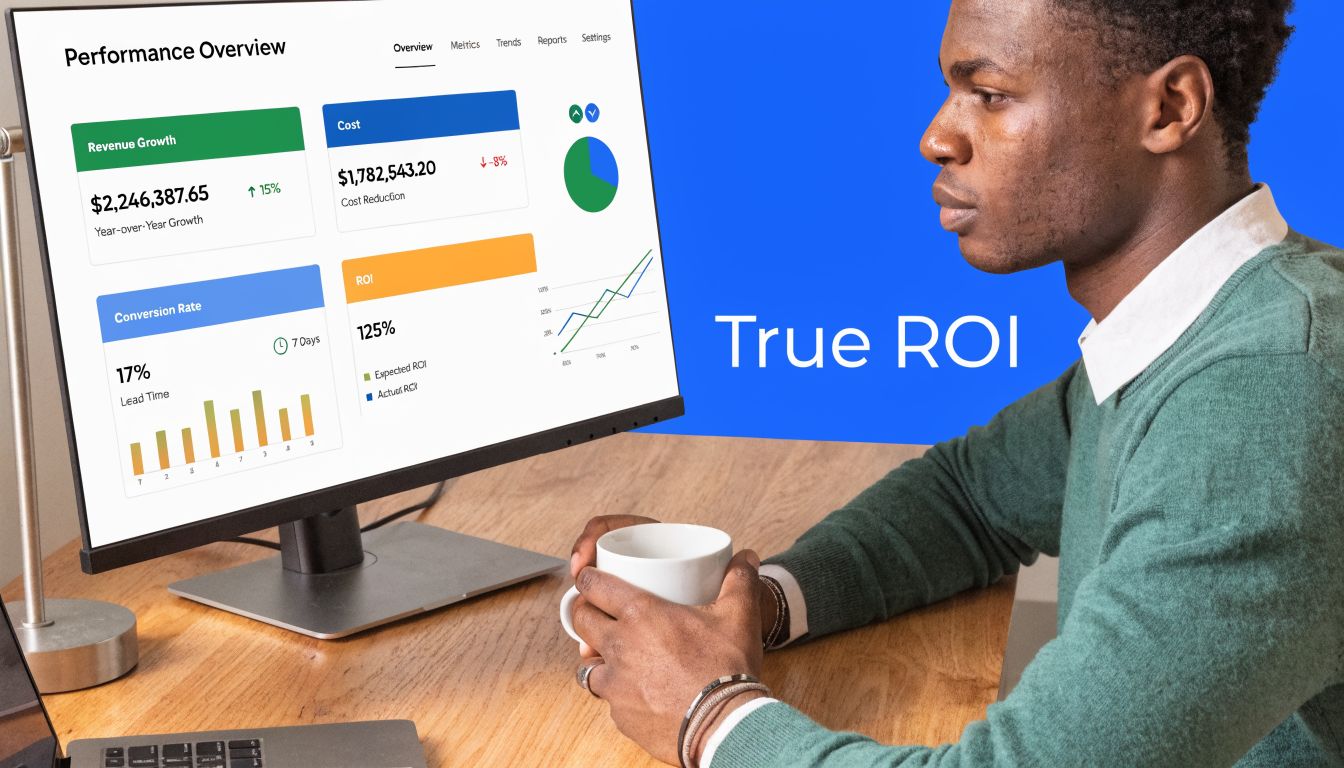
Most event dashboards are busy and underpowered at the same time. They show opens, clicks, registrations, and maybe attendance. Then the meeting gets awkward when someone asks which opportunities moved, which accounts accelerated, or whether the event influenced closed revenue at all.
That gap is common. As Dimmo notes in its analysis of event marketing email measurement, most content in this category focuses on engagement metrics and fails to connect campaigns to revenue or lifetime value. For B2B teams, that’s not a minor reporting issue. It’s the difference between an event program that gets budget and one that gets questioned every quarter.
Engagement metrics are leading indicators, not outcomes
Opens and clicks still matter. They tell you whether the message got attention. They do not tell you whether the campaign created business value.
A stronger measurement stack tracks the journey in layers:
- Delivery layer
Did the emails reach the intended audience cleanly?
- Response layer
Did recipients open, click, register, and attend?
- Engagement layer
Did attendees stay engaged, ask questions, view the recording, or consume follow-up content?
- Pipeline layer
Did target accounts progress, did new opportunities emerge, and did existing deals gain momentum?
- Revenue layer
Did the event contribute to sourced or influenced revenue over time?
What to measure after the event
A practical ROI review should answer these questions:
Question
Why it matters
Which segments produced the best registrants?
Registration volume means little if fit is weak
Which registrants actually attended?
Attendance quality often matters more than signup totals
Which attendee behaviors predicted follow-up interest?
Questions, resource clicks, and replies reveal intent
Which accounts moved in CRM after the event?
This ties campaign activity to pipeline motion
Which follow-up path produced meetings or progression?
Post-event nurture often determines actual ROI
If your team needs cleaner definitions for what belongs on that dashboard, these email campaign performance metrics are a good reference point.
Connect the email platform to the CRM or your reporting will stay shallow
The technical requirement is simple even if the operational work isn’t. Event email data has to flow into the same system where opportunity stages, account ownership, and revenue are tracked.
Without that integration, you can’t answer basic commercial questions such as:
- Did attendees from target accounts advance faster than non-attendees?
- Did event-sourced leads convert into qualified pipeline?
- Did no-shows who consumed the recording become useful follow-up opportunities?
- Which campaign message attracted the contacts that sales wanted?
Email metrics explain campaign behavior. CRM metrics explain commercial impact. You need both in the same view.
Use attribution carefully
Attribution around events gets messy because buyer journeys are messy. A prospect may see a LinkedIn post, get a sales email, receive your invite, attend the event, and then book a meeting after reading the recap.
That doesn’t make event marketing emails unimportant. It means you should avoid simplistic winner-take-all reporting. In practice, teams get better clarity by tracking both sourced and influenced outcomes, then comparing those results by audience segment, topic, event format, and follow-up path.
The useful question isn’t “Did email get all the credit?” The useful question is “What role did email play in moving this account forward?”
Optimization happens between campaigns, not just inside them
Treat each event as a dataset for the next one. The best optimization usually comes from pattern recognition:
- Which subject line angle brought in higher-fit registrants
- Which segment over-registered but under-attended
- Which post-event CTA generated actual conversations
- Which accounts repeatedly engage but never convert
- Which event themes produce downstream sales activity
That’s how event programs mature. Not from one perfect send, but from tighter feedback loops and better decisions after every campaign.
Turning Event Engagement into Lasting Revenue
An event creates a spike of attention. Revenue comes from what you do with that attention next. If your follow-up is generic, late, or disconnected from sales, the value decays quickly.
The right move is to sort contacts by behavior while the event is still fresh. Treat the event as a signal-capture moment. Every action taken during registration, attendance, and follow-up tells you how warm the lead is and what conversation should happen next.
Segment based on what people actually did
Post-event segmentation should be behavioral first.
Use groups like these:
- Attended and engaged
They stayed, clicked resources, asked questions, or replied. These contacts deserve the fastest and most specific follow-up.
- Attended, low engagement
They showed up but gave fewer visible signals. Keep them in nurture, but use recap content to pull them into a second action.
- Registered but no-showed
Don’t treat them as dead leads. Many are still interested. They just chose convenience over a live time slot.
- Customers who attended
Their next step is not the same as a prospect’s. Route them toward expansion, education, or customer marketing motions.
Match the follow-up email to the behavior
A few simple follow-up patterns work well:
Attendee follow-up
Lead with the strongest takeaway, then offer one clear next step. That next step might be a template, a related guide, or a meeting if the event topic was solution-aware and commercially close.
No-show follow-up
Keep the tone helpful. “Here’s the recording and the key takeaway you missed” works better than guilt-based copy. The aim is to recover interest, not punish absence.
High-intent follow-up
When someone asks a sharp question or clicks a next-step asset, don’t bury them in a long nurture series. Route them toward a tighter email from the right owner, ideally with context from their event behavior.
The warmest lead after an event is often not the person who attended longest. It’s the person whose behavior suggests a concrete problem that needs a next step.
Sales handoff should be specific
Sales outreach works better when it references event context directly. A rep shouldn’t send “Wanted to follow up after the webinar” and hope for the best. They should know which topic the lead cared about, what they clicked, and which question or pain point stood out.
That kind of handoff changes the quality of the conversation. It also prevents the classic failure mode where marketing runs a useful event and sales follows up as if nothing happened.
Keep the nurture moving
Some event leads won’t be ready now. That’s fine. Keep them in a path connected to the event theme. If the event covered attribution, the next touches should deepen that thread through examples, frameworks, or product-adjacent education.
The event did its job when it created relevance. The nurture should preserve it.
Frequently Asked Questions About Event Email Marketing
How should event marketing emails differ for virtual, in-person, and hybrid events
The structure stays similar, but the friction changes.
Virtual events need stronger reminders, cleaner join instructions, and sharper “why attend live” messaging because the barrier to abandoning them is low. In-person events need more logistical support, earlier commitment language, and clearer qualification so the room is full of the right people. Hybrid events need separate paths. If you combine both experiences in one message, one audience usually gets confused.
How do marketing and sales avoid stepping on each other during event promotion
Agree on account ownership and message timing before launch. Sales should know who is receiving the campaign, what the event promise is, and when reminders are going out. Marketing should know which accounts sales is personally inviting.
The easiest rule is this. Marketing owns scaled promotion. Sales owns specific outreach to priority accounts. Those two efforts should complement each other, not duplicate each other.
How many event emails are too many
There isn’t a universal number that fits every event. The better rule is to increase frequency for engaged segments and reduce it for colder ones. If someone clicked, visited the registration page, or already registered, more reminders can help. If someone ignored every touch, repeated sends often hurt more than they help.
Watch behavior, not a fixed calendar.
What’s the most common copy mistake in event emails
Leading with information instead of relevance. Teams often start with the date, time, speaker list, and platform. Buyers decide to care based on the problem the event solves. Logistics matter after interest exists.
Can event-focused newsletters generate revenue beyond pipeline
Yes, especially when you have a trusted audience and a repeatable event format. Some teams monetize event newsletters through sponsorship placements while still using them to drive registrations and nurture demand. The key is protecting audience trust. Sponsored placements should fit the topic and not overwhelm the core event message.
If you want a platform that handles event email execution end to end, Breaker is built for that job. It combines campaign creation, targeted B2B list expansion, analytics, CRM-friendly workflows, and deliverability support so growth teams can run event marketing emails that do more than fill seats. They can tie attention back to pipeline and ROI.
Keep reading
All articlesNewsletter Agency Services: How Agencies Scale Client Newsletters
Managing multiple client newsletters? Learn what a true newsletter agency platform needs to prevent list mixing, voice drift, and invisible ROI.
Building Owned Audiences: Move Followers to Your Newsletter in 2026
Social platforms can vanish overnight. Learn how to convert Instagram, TikTok, and YouTube followers into a newsletter list you actually own.
Newsletter Analytics: Which Metrics Actually Matter in 2026
Open rate and clicks don't predict buyers. Learn the 7-step method to track click depth, recency, and topic affinity for a revenue-predictive intent score.