
AI Powered Email Marketing: A B2B Growth Playbook (2026)
Tired of manual list building? Learn how to use AI powered email marketing to automatically find ideal customers, personalize content, and drive B2B growth.
AI powered email marketing usually gets framed as a messaging upgrade. Better subject lines, smarter recommendations, and dynamic content blocks all help, but they sit too low in the funnel for many B2B teams.
The primary B2B opportunity is list expansion with tighter targeting.
A strong AI email program does more than improve sends to existing subscribers. It keeps identifying accounts that match your ideal customer profile, enriches the right contacts, filters out weak fits, and routes qualified people into a newsletter that supports pipeline over time. In practice, however, many teams still slow down. Nurture is automated, but audience growth depends on lead magnets, paid capture forms, manual list building, or sales reps uploading CSVs into the ESP. Our guide to AI powered lead generation covers how to automate that top-of-funnel work.
That setup creates friction fast. If acquisition runs in one tool, enrichment in another, and email nurture in a third, the feedback loop breaks. Marketing cannot see which new subscribers resemble closed-won accounts. Sales cannot tell which newsletter readers are turning into buying committees. The email channel stays busy without becoming a reliable growth engine.
This matters even more in B2B because the newsletter is rarely just a retention asset. It often shapes multiple stakeholders across a long decision cycle, including operators, champions, evaluators, and budget holders. The quality of the audience determines how much value AI can add later. Stronger copy cannot rescue weak targeting.
Analysts at Humanic AI found that AI adoption in email is already broad, especially for workflow automation and content generation. That trend matters, but the practical takeaway is not "write more copy with AI." It is "use AI across selection, enrichment, sending, measurement, and suppression." That is the layer where platforms like Breaker start to change the operating model. Instead of waiting for the right buyers to find your newsletter, teams can use AI to continuously expand the list with accounts and contacts that fit the ICP, then nurture them with content that matches their role and buying stage.
Practical rule: If your AI email strategy starts with copy prompts instead of customer selection, you're optimizing the wrong layer first.
Beyond Personalization The Real AI Email Opportunity
The standard playbook says this: build a list slowly, segment it later, and let AI improve relevance after someone subscribes.
That advice made sense when email growth was mostly inbound and patient. It doesn't hold up for B2B teams that need a tighter connection between audience quality and revenue.
Why existing-list optimization isn't enough
Personalization has become the default conversation because it's visible. Teams can see a subject line generator, a dynamic intro, or a CTA swap and feel progress. The harder problem sits upstream.
If the wrong contacts enter the funnel, better copy just helps you send polished irrelevance faster.
In B2B, the newsletter often carries more weight than in consumer programs. It informs analysts, operators, buyers, champions, and budget holders across a long sales cycle. That means the audience itself is a strategic asset. AI matters most when it helps determine who should be in that audience in the first place.
A stronger model starts with these assumptions:
- Your list is a targeting problem first. A large database with weak fit creates reporting noise and sales friction.
- Acquisition and nurture belong in one system. If those functions live in separate tools and separate teams, feedback loops stay slow.
- AI should improve selection, not only messaging. Good models can enrich, match, suppress, prioritize, and route.
The B2B growth loop most teams miss
The useful shift is from passive list-building to AI-assisted list expansion around your ICP.
That means using AI to identify exact-match subscribers, enrich missing context, score likely engagement, and bring the right people into a newsletter that can educate and convert over time. For B2B growth teams, that's a much bigger operational win than generating another set of clever subject lines.
A newsletter becomes far more valuable when it stops behaving like a content endpoint and starts behaving like a qualified audience engine.
AI-powered email marketing thus becomes a growth discipline rather than a production tactic. The playbook is less about "write faster" and more about "target smarter, send cleaner, and learn faster."
Build Your AI-Driven Audience Growth Engine
Subject lines do not fix a weak audience. In B2B email, the bigger AI advantage is building a larger list of people who match your ICP, then feeding engagement data back into acquisition so the list gets better over time.
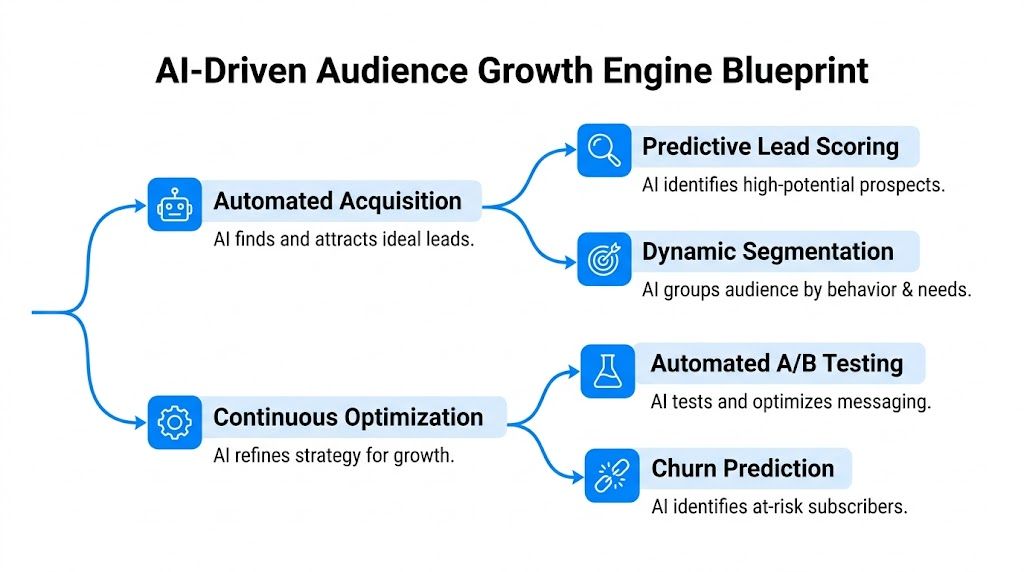
Define an ICP a model can actually use
A persona like "mid-market SaaS leader" gives an AI system almost nothing to work with. A usable ICP has fields a platform can match against, enrich, score, suppress, and route.
For B2B email, that usually means:
- Firmographics: industry, employee range, revenue band, region, business model, funding stage
- Role data: function, seniority, title variations, reporting line, buying influence
- Tech stack: CRM, MAP, billing platform, warehouse, support tools
- Signals: hiring patterns, product activity, webinar attendance, newsletter clicks, site behavior
- Exclusions: customers, competitors, agencies, students, unsupported geographies, low-fit verticals
Breaker-style workflows depend on this level of specificity. If the platform is scanning for new subscribers who resemble your best readers, it needs more than job title and company name. It needs enough structure to tell the difference between a VP of Revenue Operations at a qualified SaaS company and a consultant who only looks similar on paper.
Use AI enrichment before AI writing
B2B marketing teams often draft the campaign first and clean the data later. That order creates generic email because the system only sees shallow fields.
Enrichment should happen upstream.
Start by standardizing company names, resolving duplicates, validating domains, and appending missing firmographic and role data. Then add intent and engagement context where you have permission to use it. Once that layer is in place, AI can segment with more precision and your copy team can write to real buying context instead of placeholders.
That same data layer also improves list growth. The underused move in AI email is using enrichment and matching to find more high-fit subscribers around your current engaged cohort, then filtering hard before those contacts ever enter active nurture.
Build the audience growth loop
The operating model is simple, but the execution has to be disciplined.
- Match
Feed your ICP into a system that searches for contacts and accounts with the right firmographic, role, and signal profile.
- Verify
Validate emails, remove duplicates, flag risky records, and apply suppression rules before the first send.
- Enrich
Append the fields your team needs for segmentation, routing, and later personalization.
- Observe
Track who opens consistently, clicks on buying-stage content, replies, converts, or unsubscribes. Push those patterns back into targeting.
That loop turns email acquisition into an always-on system instead of a quarterly list project.
What this looks like in practice
Take a B2B company publishing a newsletter for RevOps leaders. The wrong setup targets a broad bucket like "marketing professionals" and hopes the content sorts people out later. The better setup starts narrower: revenue operations, sales operations, and GTM systems roles at companies within a defined size range, using a known CRM, in regions the sales team can cover.
From there, AI can do useful work. It can identify similar contacts at similar accounts, prioritize records that resemble the engaged subscriber base, suppress low-fit additions, and keep refining the pool as performance data comes in. In Breaker, this is the difference between a dead list that keeps getting blasted and a live audience engine that expands around proof of fit.
If your team is pressure-testing acquisition tactics, this guide to B2B email list building strategies is a good benchmark for evaluating whether you are adding names or adding qualified future pipeline.
Here's the review checklist I use before any AI-driven expansion workflow goes live:
Checkpoint
What good looks like
ICP clarity
Clear firmographic, role, signal, and exclusion rules
Data quality
Standardized fields, validation, and duplicate controls
Consent logic
Documented acquisition and suppression rules
Segmentation readiness
Enough context to support relevant messaging and crafting high-converting calls to action later
Feedback loop
Engagement data flows back into audience selection
Common failure points
Three mistakes show up repeatedly.
- Broad targeting fills the database with contacts sales will never want.
- Static segments age fast, especially in B2B categories where titles, teams, and buying groups shift.
- Manual hygiene breaks as soon as acquisition volume increases.
The trade-off is straightforward. A narrower top of funnel gives you fewer raw subscribers and a much stronger audience. In B2B, that usually means better inbox placement, cleaner reporting, higher reply quality, and a list that sales will use.
Generate Hyper-Relevant Content and CTAs
Better targeting does not automatically produce better emails. It gives your team the raw material to write emails that match real buying context.
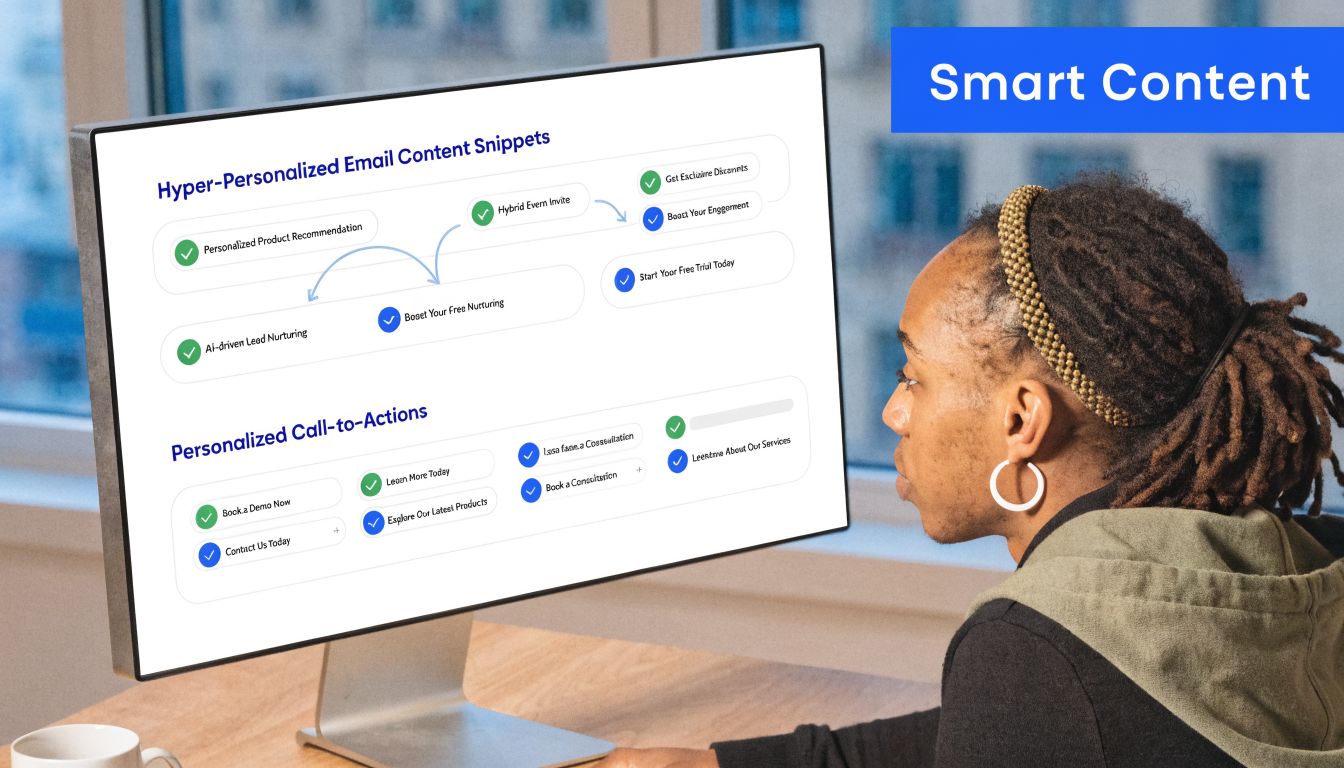
That distinction matters in B2B. AI is useful here because it can turn firmographic data, role data, product signals, and engagement history into message variants your team would not build fast enough by hand. In Breaker, that usually means pulling in company type, title, buying stage, and recent activity, then generating copy paths that fit each segment instead of pushing one generic send to everyone.
A B2B scenario that shows the difference
Take a SaaS company selling workflow software to startup operators and enterprise department leaders.
A weak setup sends one newsletter with token personalization such as first name, company name, and maybe a swapped headline. A stronger setup uses the same campaign brief to produce distinct versions based on what each buyer cares about.
For a startup operator, the message can lead with headcount efficiency, speed, and fewer manual handoffs. For an enterprise operations leader, the same product update should focus on process control, cross-functional rollout, admin visibility, and review requirements. Same offer. Different stakes.
That is where AI earns its place in the workflow. It helps the team produce relevant variations at scale, faster than a marketer working from a blank page, while keeping the message tied to segment logic instead of surface-level personalization.
Use AI to generate components, not finished emails
The strongest teams use AI like a production layer, not a ghostwriter.
They generate pieces that can be assembled by segment:
- Subject line sets tied to pain point, buying stage, or urgency
- Opening hooks written in the language each role uses internally
- Body blocks that swap based on company size, tech stack, or use case
- Proof points framed around the metric that segment cares about
- CTA variants matched to intent level, not just the campaign topic
This approach works better in B2B because there is rarely one winning message. There are usually several good messages for several buying situations.
It also keeps the review process manageable. A marketer can approve six modular blocks faster than rewriting six full emails.
Dynamic CTAs usually decide whether relevance turns into action
Paragraph personalization gets attention. CTA logic gets response.
A contact who has engaged with educational content may be ready for a benchmark, teardown, or guide. A contact who has visited pricing, compared solutions, or replied to a sales touch may be better served by a walkthrough, audit, or demo request. If both contacts get the same button, the campaign throws away context the system already has.
If your team needs examples, this resource on crafting high-converting calls to action is worth reviewing because it shows how small wording shifts can change the commitment level of the ask.
Field note: Good CTA logic reduces friction. It does not force a sales motion before the buyer is ready.
Prompting that produces usable output
Weak prompts produce polished filler. Strong prompts produce assets a marketer can test.
Here is the difference:
Weak prompt
Strong prompt
Write a B2B email about our product update
Write 5 intros for a product update email to RevOps managers at mid-market SaaS companies. Focus on reporting accuracy, workflow reduction, and faster handoff to sales
Give me subject lines for a newsletter
Generate 12 subject lines for CFOs in fintech. Half should be direct. Half should use curiosity. Avoid hype
Create a CTA
Generate 6 CTA options for readers who clicked two prior educational emails but haven't requested a demo
The model needs constraints. Give it the segment, role, pain, trigger event, and desired next action. If the prompt does not specify those inputs, the output usually sounds fine and performs like average email.
Keep a human in the approval loop
AI can multiply output. It can also multiply generic positioning.
I look for three common failure modes:
- The copy sounds polished but says nothing concrete
- The pain framing does not match the way the segment talks
- The CTA asks for more commitment than the reader has earned
Review should focus on message fit, sales readiness, and brand accuracy. Grammar is the easy part.
This is also where content quality and sending quality meet. If the team keeps generating more variants, it also needs a clean process for suppression, engagement filtering, and reputation protection. Breaker users usually pair content generation with email deliverability best practices so higher output does not create inbox problems.
A short demo can help teams see this workflow more concretely:
What works better than writing from scratch
The best workflow usually looks like this:
- Start with a segment and a buying signal, not a blank page.
- Feed the model enriched context, not only a campaign topic.
- Generate reusable parts, not one final draft.
- Match CTA strength to engagement history.
- Review for specificity, sales fit, and compliance before launch.
That process matters for a reason that generic AI email advice often misses. Better content does not only improve conversion from the list you already have. In B2B, it also improves the feedback loop that helps you grow the right list next. Replies, clicks, and downstream conversion tell the system which accounts and personas deserve more coverage, so content generation and audience expansion keep sharpening each other instead of running as separate projects.
Master Deliverability and Compliance with AI
Most email teams treat deliverability like plumbing. It's not. It's revenue protection.
If inbox placement slips, all the personalization work upstream loses value. In B2B, the cost is worse because low-quality sending doesn't just hurt one campaign. It weakens the channel your team depends on to nurture pipeline over long cycles.
Deliverability isn't a cleanup task
Weak programs usually respond too late. They notice performance drops, then start checking bounce issues, suppressing old contacts, and rewriting spammy subject lines.
By then, the sending reputation is already under pressure.
A stronger setup uses AI before the send to monitor list quality, isolate risky pockets, and suppress bad contacts automatically. That changes deliverability from reactive cleanup into a standing system.
The gap in most AI email advice is that it overemphasizes lifts in engagement and underexplains reputation monitoring, inbox placement, and accessibility. Those issues matter even more in enterprise B2B and in regulated markets, as argued in PXP's review of AI email marketing gaps.
What AI should handle automatically
AI is useful here because the signals are too continuous for manual review alone.
It can support:
- List hygiene by identifying invalid, stale, or consistently unengaged contacts before they degrade sender health
- Reputation monitoring by flagging sending patterns that correlate with inboxing problems
- Frequency control by detecting segments that are getting overmailed
- Suppression logic by removing contacts whose engagement pattern suggests risk rather than opportunity
- Consent tracking by helping teams align acquisition and sending rules with region-specific expectations
That's especially important when audience growth is automated. If acquisition scales but hygiene doesn't, you amplify weak data at the exact moment your volume rises.
Accessibility belongs in the same conversation
Accessibility is still treated like a design afterthought. In B2B, it shouldn't be.
Enterprise buyers often evaluate vendors through a wider compliance lens. If your emails use poor contrast, unclear hierarchy, or hard-to-read CTA treatment, you're not just reducing usability. You're creating avoidable friction in accounts that care about process quality.
Email quality isn't only about who receives the message. It's also about whether they can comfortably read and act on it.
AI can help flag accessibility issues in templates and dynamic blocks, but teams still need human review. Automated variation increases the chance that an awkward layout, poor contrast choice, or broken hierarchy slips through if nobody checks the final render.
The compliance trade-off teams need to accept
B2B marketers often want faster audience growth and stricter compliance at the same time. They can have both, but only if they design the rules first.
That means documenting:
Area
Operational question
Acquisition
Which contacts are allowed to enter the newsletter audience
Region
Which privacy rules apply by market
Consent
What permission standard the program follows
Retention
How long low-engagement contacts remain active
Suppression
When the system should stop mailing someone
If those decisions live in Slack threads or one person's memory, AI won't rescue the process.
A useful tactical reference is this article on email deliverability best practices. It helps teams turn broad "send cleaner" advice into repeatable operating rules.
What doesn't work
A few habits subtly damage performance:
- Holding every contact forever
- Treating unsubscribes as the only negative signal
- Sending at a fixed cadence to every segment
- Adding automation without governance
Strong ai powered email marketing isn't just relevant. It's selective. It knows when not to send, whom not to keep, and where compliance should override volume goals.
Measure Real Business Impact and Iterate Faster
Open rates used to dominate email reporting because they were easy to understand. That era is over.
Privacy changes changed the quality of the metric, and too many teams still optimize around a number that no longer deserves that level of trust. In ai powered email marketing, measurement has to move closer to business outcomes.
Stop treating opens like a north star
Apple's Mail Privacy Protection affects 50% of recipients in the benchmark described by Digital Applied, which means open-rate reporting can be inflated enough to mislead optimization decisions. The same analysis argues for shifting attention to clicks and revenue outcomes instead, and notes that AI-powered send-time optimization can lift open rates by 15% to 25%, while AI programs reached 13.44% click-through rate versus 3% for non-AI campaigns, and a full-stack AI setup produced 3.2x revenue per recipient in comparison to batch sending. The methodology also emphasizes individual engagement windows rather than aggregate send logic, as outlined in Digital Applied's guide to AI personalization and revenue.
That's the key distinction. Open rates may still be directional in some contexts, but they shouldn't carry the strategy.

The metrics that deserve attention
A practical B2B scorecard focuses on what your team can act on.
- Click-through rate tells you whether the offer and message generated intent.
- Revenue per recipient shows whether campaigns create economic value rather than superficial engagement.
- Qualified leads connect newsletter performance to sales reality.
- Subscriber growth quality helps separate healthy audience expansion from vanity growth.
- Time to insight matters because a team that learns faster compounds faster.
The old spreadsheet habit is to report each metric in isolation. The better move is to review them as a chain. Did the right audience enter? Did they click? Did they convert? Did the segment continue engaging over time?
Send-time optimization is more useful than most teams realize
Send-time optimization often gets reduced to "pick a better hour." That's too simplistic.
Done well, STO looks at subscriber-level behavior patterns. It ranks probable send windows based on how and when that specific contact tends to engage. In B2B, that's useful because audience routines vary sharply. A founder, a finance lead, and a sales ops manager don't behave the same way, even if they all work in software.
The gain isn't just better timing. It's fewer wasted sends, cleaner engagement data, and a more realistic read on segment behavior.
Iteration has to become a weekly habit
AI helps most when it shortens the test cycle.
Manual teams often take too long to answer simple questions:
- Was the offer wrong, or the audience?
- Did the CTA ask too much?
- Did one segment respond while another ignored it?
- Was timing the issue?
- Did the content block underperform, or was the promise weak from the subject line?
A faster system can test subject lines, intros, CTA variants, and timing without forcing the team into a giant reporting ritual after every campaign.
One useful reference for deciding what to track in that loop is this guide to email campaign performance metrics. It helps teams avoid vanity reporting and build a scorecard tied to commercial outcomes.
Operator's view: If a metric can't change your next send, it belongs lower on the dashboard.
A simple review rhythm
I prefer a short recurring review built around four questions:
Question
Why it matters
Which segments clicked most?
Reveals audience-message fit
Which CTA variant moved people forward?
Improves conversion design
Which sends produced business outcomes?
Keeps attention on pipeline and revenue
Which patterns repeated across campaigns?
Turns one-off wins into systems
AI-powered email marketing is operationally different from traditional email. It doesn't just help you test more. It helps you close the loop between targeting, message assembly, timing, and outcome measurement quickly enough to matter.
Integrate AI Email into Your Growth Stack
Email performs best when it isn't isolated inside the marketing team.
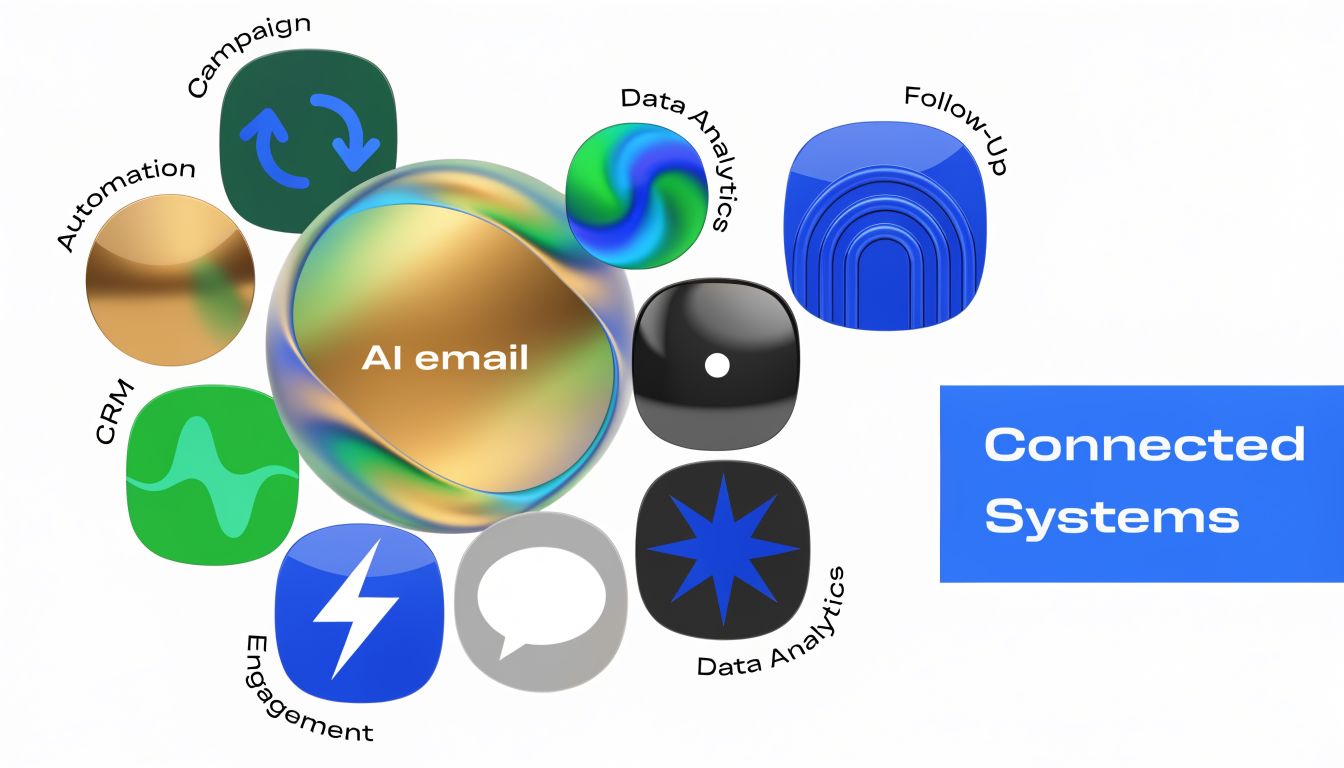
The compounding effect comes from connected systems. CRM data sharpens email decisions. Email engagement sharpens sales context. Form submissions, lifecycle changes, and sponsorship activity all become more useful when they move through the same operating layer.
Start with the CRM connection
This is the integration that changes the most.
When AI email and CRM stay disconnected, marketing sees campaigns and sales sees accounts. Nobody sees the full story. Once the systems sync, the newsletter becomes part of account intelligence rather than a separate reporting lane.
That means sales can see who engaged, what they clicked, and which themes drew attention. Marketing can use CRM events to trigger more relevant sends, suppress the wrong contacts, and route stronger hand-raisers into the right follow-up.
The value isn't only automation. It's alignment.
Build a two-way data flow
One-way syncs are common and usually disappointing.
A better setup moves data in both directions:
- From CRM into email
Account status, owner, lifecycle stage, market, and product context help shape messaging and suppression rules.
- From email into CRM
Clicks, content interests, topic clusters, and recurring engagement patterns give sales teams more context before outreach.
That shared view is what keeps your audience strategy from drifting away from pipeline reality.
Connect acquisition, nurture, and monetization
The next layer is broader than CRM.
Your forms should feed directly into the same segmentation logic as imported contacts. Organic acquisition and paid acquisition shouldn't create separate standards for enrichment or compliance. Sponsorship tools should also connect if the newsletter plays a media or monetization role, because audience quality affects both lead generation and sponsor value.
Here's a simple way to think about stack roles:
System
Job in the workflow
CRM
Stores account and contact truth
Email platform
Sends, segments, tests, and captures engagement
Forms
Capture first-party intent and profile data
Analytics layer
Connects sends to business outcomes
Sponsorship tools
Extend monetization if the newsletter supports media revenue
Integration changes team behavior
This part gets overlooked. The best stack doesn't just move data. It changes how teams work.
Marketing stops guessing which accounts care. Sales stops treating newsletter engagement as soft intent. Operators stop pulling CSVs to reconcile performance. Leaders get a clearer line between subscriber growth and commercial value.
Connected systems reduce manual handoffs. They also reduce debates caused by conflicting data.
What to avoid
A few integration patterns create more noise than value:
- Syncing everything by default
Too much data muddies segmentation and overwhelms sales.
- Using different definitions across tools
If "qualified subscriber" means one thing in email and another in CRM, reporting won't hold.
- Treating integrations as an IT task
The data model is a growth decision, not just a technical one.
The practical standard is simple. Every connection should answer one of three questions. Who should enter the audience, what should they receive, and what happened after the send?
If an integration doesn't improve one of those decisions, it's probably overhead.
From Manual Effort to Automated Growth
The biggest shift in ai powered email marketing isn't copy quality. It's operating model.
Manual email programs depend on one-off effort. Someone exports contacts. Someone cleans data. Someone drafts copy for broad segments. Someone checks the report later and guesses what happened. That process can produce good campaigns, but it rarely produces a dependable growth engine.
A stronger model connects audience expansion, enrichment, content assembly, deliverability controls, and outcome measurement into one system. That's what makes email more useful for B2B growth teams. The newsletter stops being a side channel and starts acting like infrastructure for demand generation.
The trade-off is discipline.
You can't skip ICP definition and expect good acquisition. You can't ignore hygiene and expect stable inbox placement. You can't chase opens and expect clean decision-making. AI doesn't remove the need for strategy. It raises the reward for having one.
The teams that get the most from AI don't use it to send more noise. They use it to make better decisions faster. Who belongs on the list. What each segment should receive. When to send. When to suppress. Which campaigns move revenue.
That's the path from manual effort to automated growth. Not more output. Better systems.
If you're ready to put this into practice, Breaker is built for the exact B2B workflow most tools ignore. It combines email sending, ICP-based list expansion, AI enrichment, deliverability controls, and real-time analytics in one platform so your newsletter can grow the right audience and turn engagement into pipeline.
Keep reading
All articlesNewsletter Analytics: Which Metrics Actually Matter in 2026
Open rate and clicks don't predict buyers. Learn the 7-step method to track click depth, recency, and topic affinity for a revenue-predictive intent score.
Newsletter Segmentation Strategy: Increase Engagement in 2026
Build a data-driven newsletter segmentation strategy using behavior, intent score, and topic affinity to lift opens and clicks. Step-by-step guide.
How to Grow Newsletter Subscribers with Qualified Leads in 2026
Discover 8 channels to grow engaged newsletter subscribers in 2026, with real cost-per-engaged-subscriber data to focus your list-building strategy.