
Affiliate Email Marketing: The B2B Newsletter Playbook
Your guide to affiliate email marketing for B2B newsletters. Learn strategy, partner selection, compliance, and ROI measurement without losing subscriber trust.
Most advice about affiliate email marketing is still stuck in a consumer playbook. Send more promos. Push harder on urgency. Drop affiliate links into every newsletter issue and let volume do the work.
That approach burns out a B2B list fast.
In a B2B newsletter, subscribers don't join for coupon drops. They join for judgment. They want curation, context, and useful recommendations that save them time or reduce risk. If you treat them like a bargain-hunting retail list, they'll stop trusting your emails long before they stop opening them.
Email is still too important to waste on lazy promotion. The global email user base reached 4.6 billion in 2025 and is projected to hit 4.89 billion by 2027, while email marketing is estimated to generate about $36 to $40 for every $1 spent, according to Oberlo's email marketing statistics roundup. For newsletter operators, that combination of reach and efficiency is exactly why affiliate revenue still matters. The catch is that B2B affiliate revenue has to be earned through trust, not squeezed out through frequency. Our affiliate marketing email marketing guide covers setup, compliance, and optimization for B2B lists.
Rethinking Affiliate Email for B2B Audiences
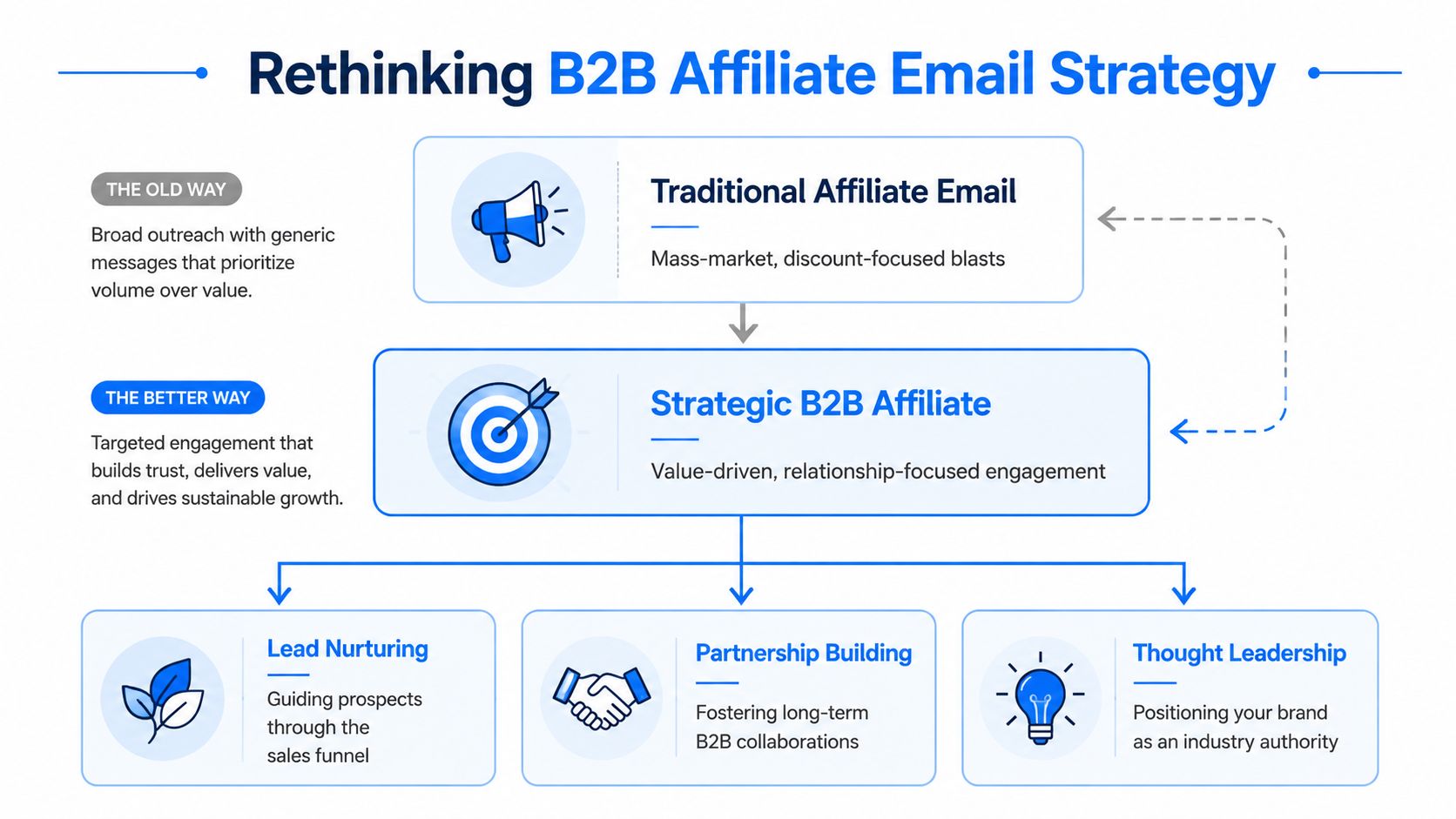
The old affiliate model says your job is to move clicks. The modern B2B model says your job is to make good recommendations.
That's a big difference.
A retail-style affiliate email often leads with discounts, countdowns, and aggressive copy. A B2B newsletter needs a different posture. The reader is usually making a slower decision, often on behalf of a team, with more scrutiny around budget, implementation, and legal review. That means the recommendation itself carries reputational weight.
Why the promo-heavy model breaks in B2B
The most common mistake is assuming what works for broad consumer audiences should work for a niche operator newsletter. It usually doesn't. B2B readers aren't looking for a stream of detached offers. They respond better when the product recommendation sits inside a useful point of view.
That shift is more than stylistic. As noted in CrakRevenue's discussion of email tactics and monetization formats, the overlooked question for B2B marketers is whether affiliate email marketing is viable without a direct-response, promo-heavy model. Their cited market framing points to email as a top ROI channel at $36 for every $1 spent, while newsletter monetization increasingly favors curated recommendations over constant coupon-style sends. That's the model that holds up in B2B because it protects the asset that matters most, subscriber trust.
Practical rule: If an affiliate offer wouldn't make sense as an editorial recommendation, it probably shouldn't be sent as a monetized placement.
What strong B2B affiliate email marketing looks like
The best B2B affiliate newsletters behave more like analysts than sales reps. They don't ask, "What can I promote this week?" They ask, "What tool, service, or partner would help this audience make a better decision?"
That changes the email format. Instead of repetitive blasts, use placements like these:
- Curated tool mentions within a broader newsletter where the recommendation supports the topic.
- Operator reviews that explain where a product fits, where it doesn't, and who should skip it.
- Partner deep dives that teach the category first, then introduce one vendor as a logical next step.
- Workflow roundups that compare several approaches and monetize only the product you stand behind.
The revenue logic is different
In consumer affiliate, you can sometimes brute-force results through volume. In B2B, list quality and credibility matter more. One well-matched recommendation in a respected newsletter can outperform a month of random promotions because the audience sees the offer as part of your judgment.
That also means saying no more often.
A bad-fit partner can pay well and still cost you money if the recommendation feels off-brand, creates support headaches, or causes subscribers to question your standards. In practice, profitable affiliate email marketing for B2B isn't about maximizing the number of offers. It's about maximizing the relevance of a very small set of offers.
The best affiliate emails don't feel like ads. They feel like a smart operator saving the reader a week of research.
Finding and Vetting Strategic Affiliate Partners
Most affiliate revenue problems start before the first email gets written. The partner is wrong.
A lot of newsletter operators sign up for public programs because they're easy to join. That's usually the least interesting option. The better path is building a short list of partners whose products already fit your audience's buying process, language, and risk tolerance.
Start with audience fit, not payout
The first filter isn't commission structure. It's whether the product belongs in the world your newsletter covers. Once a product passes that test, use our affiliate program pay guide to compare its commission model and payout terms against benchmarks.
If you run a B2B growth newsletter, your strongest partners often sit close to an active workflow. Analytics software, outbound infrastructure, CRM enrichment, legal resources, research tools, data vendors, reporting platforms. Readers can place those products mentally because they already touch adjacent tasks.
That's also why boring products often outperform flashy ones. A legal template library that shortens review cycles may earn more trust than a hyped AI tool that promises everything and delivers confusion. If your readers need help with agreement workflows or vendor paperwork, a resource like AI legal assistant contract resources can be useful to review during partner research because it shows the kind of operational value B2B audiences care about.
Green flags and red flags
I like to evaluate partners with a simple contrast.
Green flags
- Clear product position: You can explain what the tool does in one sentence.
- Strong onboarding: The product doesn't require heroic setup just to deliver first value.
- Responsive partner team: Someone answers questions about attribution, assets, and approval terms without disappearing.
- Consistent brand voice: Their positioning won't sound absurd next to your editorial tone.
- Reasonable commercial terms: Payouts, timing, and exclusions are understandable.
Red flags
- Predatory terms: Vague reversal policies, unclear attribution windows, or language that lets the vendor deny credit at will.
- Reputation mismatch: Support complaints, broken billing experiences, or a product the market doesn't trust.
- Asset-only partnerships: They send banners and swipe copy but can't explain customer fit.
- Forced hype: If the partner wants you to make claims you wouldn't make organically, walk away.
- No internal champion: If nobody owns the relationship on their side, execution will be messy.
Questions worth asking before you promote anyone
A short due diligence pass saves a lot of embarrassment later. Ask practical questions, not just commercial ones.
- Who is the ideal customer? If the partner can't define this cleanly, targeting will be sloppy.
- What does success look like after signup? You need to know what the buyer is trying to achieve.
- What objections come up most often? Good partner teams know where deals stall.
- What content performs best? Reviews, comparison emails, webinar follow-ups, plain-text recommendations. Each partner usually has a pattern.
- How are conversions tracked and reconciled? If tracking questions produce hand-waving, expect disputes later.
Build a concentrated portfolio
The strongest affiliate newsletter businesses don't usually promote dozens of vendors. They build around a handful of trusted relationships and go deeper on each. That gives you room to create better creative, stronger segmentation, and better follow-up.
A concentrated partner set also makes your brand easier to understand. Readers learn that if you recommend something, it's there for a reason. That's a much stronger market position than becoming another newsletter stuffed with loosely related links.
Designing High-Converting Compliant Campaigns
A profitable affiliate campaign doesn't start with copy. It starts with placement.
If the offer interrupts the reading experience, the email will feel opportunistic. If the offer extends the value of the email, it will feel helpful. That one distinction shapes almost everything in affiliate email marketing for B2B newsletters.

Choose a campaign format that fits the relationship
Not every offer deserves a dedicated blast. In fact, many don't.
The safest starting point is to match the campaign type to the level of audience trust and the complexity of the product:
Format
When it works
Where it fails
Inline recommendation
A tool naturally supports the topic of the issue
It looks buried or accidental
Curated tools roundup
Your audience compares vendors and likes options
Too many links dilute intent
Dedicated review email
The product needs context and qualification
You sound like a copywriter, not an operator
Problem-solution sequence
The audience feels a known pain and needs education
The educational setup is fake and just delays the pitch
For campaign inspiration, it helps to study examples of affiliate marketing email formats and newsletter placements that feel integrated rather than bolted on.
Build around segmentation, not list-wide promotion
One of the most useful pieces of affiliate guidance still holds up in 2026. Use disciplined testing and segmentation. Alliance Virtual Offices' affiliate email benchmarks and tactics recommend testing one variable at a time, using a large enough sample, and segmenting by behavior or purchase history. They also recommend placing the primary affiliate link early, using one main CTA, and personalizing subject lines. Their benchmark framing notes that 15 to 20% is a reasonable target open-rate band for many affiliate lists when offers are tightly matched to audience segments.
In practice, that means broad sends are usually the lazy option. Segment instead by signals like:
- Topical engagement: Subscribers who click content about RevOps, hiring, attribution, or AI workflows.
- Lifecycle stage: New subscribers often need context. Long-time readers can handle more direct recommendations.
- Buying readiness: Some readers consume educational content for months before acting.
- Prior clicks: If someone clicked a tool category before, they deserve a more relevant follow-up than the main list.
Segmentation does two jobs at once. It improves conversion and lowers the chance that subscribers feel like you're emailing the wrong offer to the wrong person.
Write like an operator, not an affiliate manager
The fastest way to tank response is to use vendor language. Phrases like "innovative platform" or "achieve effortless efficiency" tell readers the email was written from a partner brief.
Use concrete observations instead. If you're recommending an AI marketing tool category, a roundup like Mifu's AI tool review is useful because it shows how readers compare products in practice, not just in feature grids. That gives you a better sense of how to frame tools around use cases rather than hype.
Here's the difference in copy style.
Before
"Boost your team productivity with this cutting-edge all-in-one solution. Limited-time opportunity to transform your workflow."
After
"You probably don't need another all-in-one platform. You might need one tool that solves reporting delays, gives marketing clean attribution views, and doesn't require a week of setup. That's why this product is worth a look."
The second version works because it sounds like editorial judgment. It narrows the use case. It admits constraints. It respects the reader.
Use a simple campaign skeleton
For most B2B affiliate emails, this structure is enough:
- Open with the problem your audience already recognizes.
- Name the failed alternatives they may have tried.
- Introduce the partner as one workable option, not the only option.
- Explain fit by naming who should use it and who shouldn't.
- Use one primary CTA and place it early enough that interested readers don't have to hunt.
Later in the campaign, you can add product nuance through FAQ blocks, implementation notes, or a short use-case breakdown.
A good explainer can also help if your readers need more context before they buy.
Compliance is part of conversion
B2B readers are less offended by monetization than many operators assume. They're offended by hidden incentives.
Disclose affiliate relationships in plain language, near the recommendation itself. Don't bury the disclosure in a footer. A brief note is enough if it's obvious and readable. The point isn't just legal hygiene. It's to remove the feeling that you're sneaking something past the audience.
I also recommend two practical rules:
- Say whether you've used the product. If you haven't, don't imply that you have.
- Avoid absolute claims. You don't need to say a tool is the best. You need to explain why it's useful for a specific type of reader.
What tends to work better than hard sell sequences
For B2B newsletters, these campaign shapes usually hold up:
- Curated stack emails: "Three tools we trust for X workflow."
- Operator notes: "What we changed in our process, and the software that made it easier."
- Sponsored-but-selective reviews: A transparent write-up with actual caveats.
- Partner education emails: Teach the category first, then mention the vendor.
What usually underperforms is the fake urgency blast that reads like consumer ecommerce. Most B2B readers can spot that instantly, and once they do, every future recommendation becomes harder to land.
Measuring Affiliate Marketing ROI and Performance
A lot of newsletter operators think affiliate performance starts and ends with commissions. That's too narrow.
A campaign can generate revenue and still be a bad trade if it hurts engagement, increases unsubscribes, or teaches readers to skip your monetized emails. Real ROI has to account for direct earnings and list health at the same time.
Start with channel economics, then get specific
Affiliate isn't a side channel anymore. According to Post Affiliate Pro's 2025 industry size analysis, the global affiliate marketing market is valued at over $17 billion as of 2025, with U.S. spending projected to hit nearly $12 billion. The same source says over 80% of brands use affiliate programs, and some retailers attribute 10 to 20% of annual revenue to affiliates. That doesn't tell you what your newsletter should earn. It does tell you this is a serious performance channel worth managing properly.
Use a two-layer scorecard
I like to evaluate each affiliate campaign on two levels.
Commercial performance
- Commission revenue: What the partner paid out.
- Clicks: Useful, but only when paired with downstream outcomes.
- Conversion rate: The share of delivered emails that produced the desired action.
- Revenue per delivered email: A practical way to compare campaigns with different audience sizes.
Audience impact
- Unsubscribes after send: Did the promotion feel off-brand?
- Reply quality: Did readers ask useful questions or complain?
- Subsequent engagement: Did the next issue suffer?
- Partner support load: Did the recommendation create confusion you had to clean up?
A campaign that earns modestly and preserves trust is often more valuable than a louder campaign that peaks once and weakens the list.
Track outcomes at the campaign level
A simple spreadsheet is enough if your volume is manageable. Keep one row per campaign and log:
Field
Why it matters
Partner
Lets you compare vendors over time
Offer type
Review, roundup, inline mention, or dedicated send
Audience segment
Helps explain variance in response
Primary CTA
Useful when comparing copy angles
Direct revenue
Baseline financial return
List impact notes
Prevents repeated mistakes
Affiliate success rarely comes from one magic send. Instead, it comes from seeing patterns. Maybe one partner converts only when framed around compliance. Maybe another works best in roundups and poorly in dedicated sends. Maybe one category gets clicks but leads to weak buyer quality. You don't see those patterns if you only check payouts.
Don't mistake activity for profitability
Some campaigns look promising early because clicks arrive quickly. Then the conversions disappoint. Others look flat at first but produce stronger downstream value because the audience was tightly matched.
That's why I prefer a slower, operator-style review cadence. Look at the full result set. Include the editorial cost of producing the campaign. Include any hidden support burden. Then decide whether the partner deserves another send, a smaller segment, a different angle, or removal from the rotation.
Protecting Your Email List and Deliverability
If your emails don't reach the inbox, your affiliate strategy doesn't exist.
Many newsletter operators get careless. They obsess over the offer and ignore the sending environment. Then performance slips, inbox placement weakens, and they respond by writing more aggressive emails. That usually makes the problem worse.
Deliverability comes before optimization
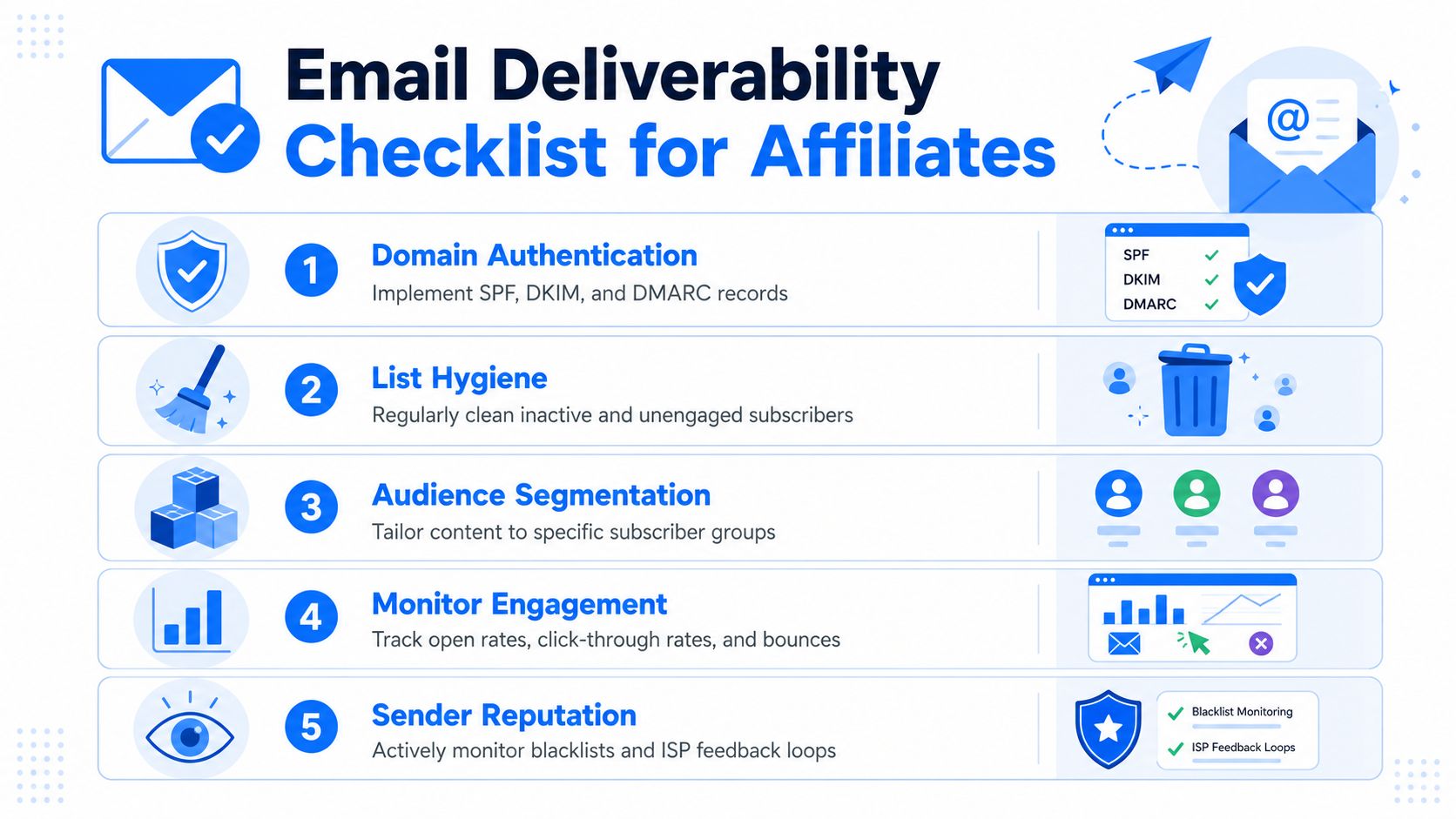
The right workflow is simple. Measure deliverability first. Then look at open rate, click rate, and conversion rate. ClickBank's guidance on affiliate email metrics frames this clearly and recommends aiming for 95%+ delivery, an 85 to 95% deliverability rate, and a bounce rate under 2%. Those aren't vanity benchmarks. They help you locate the actual problem in the funnel.
If delivery is weak, you don't have a copy problem. If deliverability is weak, you may have a reputation or compliance problem. If both are healthy but clicks are poor, the issue is usually the offer, segmentation, or creative.
Privacy-first inbox rules changed the game
Bulk email got harder for a reason. Inbox providers tightened standards, and affiliates can't act like that didn't happen. As discussed in Rewardful's piece on outreach and affiliate email mistakes, Gmail and Yahoo now require authenticated mail, one-click unsubscribe, and low spam complaint rates for bulk senders. That changes how affiliate promotions should be structured from the start.
If you want a broader operational perspective, a practical reference like this 2026 cold email deliverability guide is useful because many of the reputation and mailbox placement principles overlap with newsletter operations, even when the sending model is different.
The habits that protect revenue
Most deliverability damage in affiliate email marketing comes from operator behavior, not mysterious algorithms.
- Keep monetization consistent: Sporadic bursts of aggressive affiliate sending can train inbox providers to distrust your mail.
- Segment out weak engagement: If people haven't interacted in a long time, don't force every monetized send onto them.
- Respect frequency shifts: If you normally send weekly, a sudden run of extra promos can create complaint risk.
- Watch the monetized-to-editorial balance: A list that only hears from you when money is on the table becomes fragile.
- Review your setup regularly: A checklist of email deliverability best practices for newsletter teams helps keep operational drift from turning into reputation problems.
Your list is not a traffic source you own outright. It's a permission asset you keep earning access to.
List hygiene matters more than list size
The strongest affiliate lists aren't always the biggest ones. They're the healthiest.
ClickBank's guidance also notes that mature lists often grow only 1 to 3% per month, which is a useful reminder that quality beats forced expansion. A clean, interested list can sustain monetization. A bloated list full of dormant subscribers will sabotage it by suppressing engagement and raising the risk of complaints and bounces.
I prefer a simple rule. If a segment hasn't engaged meaningfully in a long time, reduce promotional pressure first. If inactivity continues, sunset them. Protecting the core audience is worth more than preserving inflated list totals.
Scaling Revenue with Advanced Monetization Models
The biggest shift in a mature newsletter business is moving from "Which affiliate link should I use?" to "Which monetization structure fits this audience and this partner?"
That's when affiliate email marketing starts behaving like a media and partnerships business, not just a commission stream. Our email marketing for affiliates playbook covers the automation side of that scale-up.
Compare the main monetization models
Some offers work best on pure affiliate terms. Others deserve a fixed fee. The strongest operators usually mix models based on audience trust, campaign effort, and partner maturity.
Model
Structure
Best For
Pros & Cons
Pure affiliate
Commission only on tracked actions
Early-stage newsletter monetization and easy-entry partner testing
Pros: Low risk for the partner, easy to start. Cons: Revenue can be unpredictable and underpay high-trust placements.
Flat-fee sponsorship
Fixed payment for placement or dedicated send
Established newsletters with clear audience positioning
Pros: Predictable revenue, simple planning. Cons: Can disconnect payment from performance and create pressure to oversell inventory.
Hybrid deal
Fixed fee plus affiliate commission
Strong-fit partners where both sides want upside
Pros: Better alignment, rewards editorial effort. Cons: More negotiation and more tracking complexity.
Preferred partner package
Bundled placements across newsletter, website, events, or content
Operators with a recognizable niche and repeatable audience demand
Pros: Higher contract value, stronger relationships. Cons: Requires a clear productized offering and tighter editorial discipline.
A broader monetization strategy often benefits from studying how publishers mix ads, subscriptions, referrals, and commerce. This overview of how internet sites make money is a useful reminder that affiliate revenue works best when it's part of a portfolio, not the entire business model.
How to choose the right model
The structure should match the risk each side is taking.
If a partner is new to your audience, pure affiliate can be the cleanest first test. If your newsletter consistently drives qualified demand in a niche, a flat-fee sponsorship may undersell you because it ignores downstream revenue value. Hybrid models often work best when the partner trusts your audience quality and you're willing to put real editorial energy into the placement.
A few practical rules help:
- Use pure affiliate when you're still validating audience-product fit.
- Use flat fees when the placement value comes mostly from attention and authority.
- Use hybrids when both distribution and conversion matter.
- Use preferred partner packages when your newsletter has enough niche standing to offer recurring access, not just single sends.
Graduation happens when you productize trust
The best monetization upgrades don't come from adding more sponsors. They come from packaging your audience access more intelligently.
That can mean offering a partner a quarter-long package with one educational deep dive, one curated mention, and one review-style placement. It can mean limiting category partners so readers aren't asked to compare five near-identical vendors in a month. It can mean charging more because the offer isn't "ad space." It's endorsed access to a trusted audience in a format that preserves credibility.
This is the blueprint for 2026. Build a trusted newsletter first. Add affiliate partnerships that deserve to be there. Then evolve into a selective monetization business where the structure matches the value you're creating.
If you're building a B2B newsletter and want growth, monetization, analytics, and deliverability in one system, Breaker is built for that job. It helps teams grow engaged subscriber lists, send targeted campaigns, monitor performance, and protect inbox placement without stitching together a stack of separate tools.
Keep reading
All articlesNewsletter Segmentation Strategy: Increase Engagement in 2026
Build a data-driven newsletter segmentation strategy using behavior, intent score, and topic affinity to lift opens and clicks. Step-by-step guide.
How to Grow Newsletter Subscribers with Qualified Leads in 2026
Discover 8 channels to grow engaged newsletter subscribers in 2026, with real cost-per-engaged-subscriber data to focus your list-building strategy.
B2B Lead Generation via Newsletter: What Actually Works
Cold outbound is losing steam. See 7 proven newsletter tactics for B2B lead generation, from gated content to sponsorship swaps, that beat cold outreach.