
Email Marketing for Startups: The B2B Growth Playbook
A step-by-step guide to email marketing for startups. Learn how to build your list, create high-converting campaigns, and drive predictable B2B growth.
Most startup teams hit the same wall. Paid acquisition gets expensive before the funnel is tight. Social reach swings with every platform change. Sales outreach works, but only if someone keeps feeding the pipeline every day.
Email is the channel that keeps working after the send button.
For B2B startups, that matters more than most founders realize. You're not just trying to broadcast updates. You're trying to build a repeatable system that captures interest, activates users, nurtures demand, and brings prospects back when they're ready to buy. Good email marketing for startups does all of that without requiring a massive team.
The mistake is treating email like a newsletter task. It's a growth system. If you build it with the right voice, clean data, and clear automation, it becomes one of the few assets your startup owns.
Why Email Is Your Startup's Growth Engine
When budgets are tight, channels need to justify themselves fast. Email usually does.
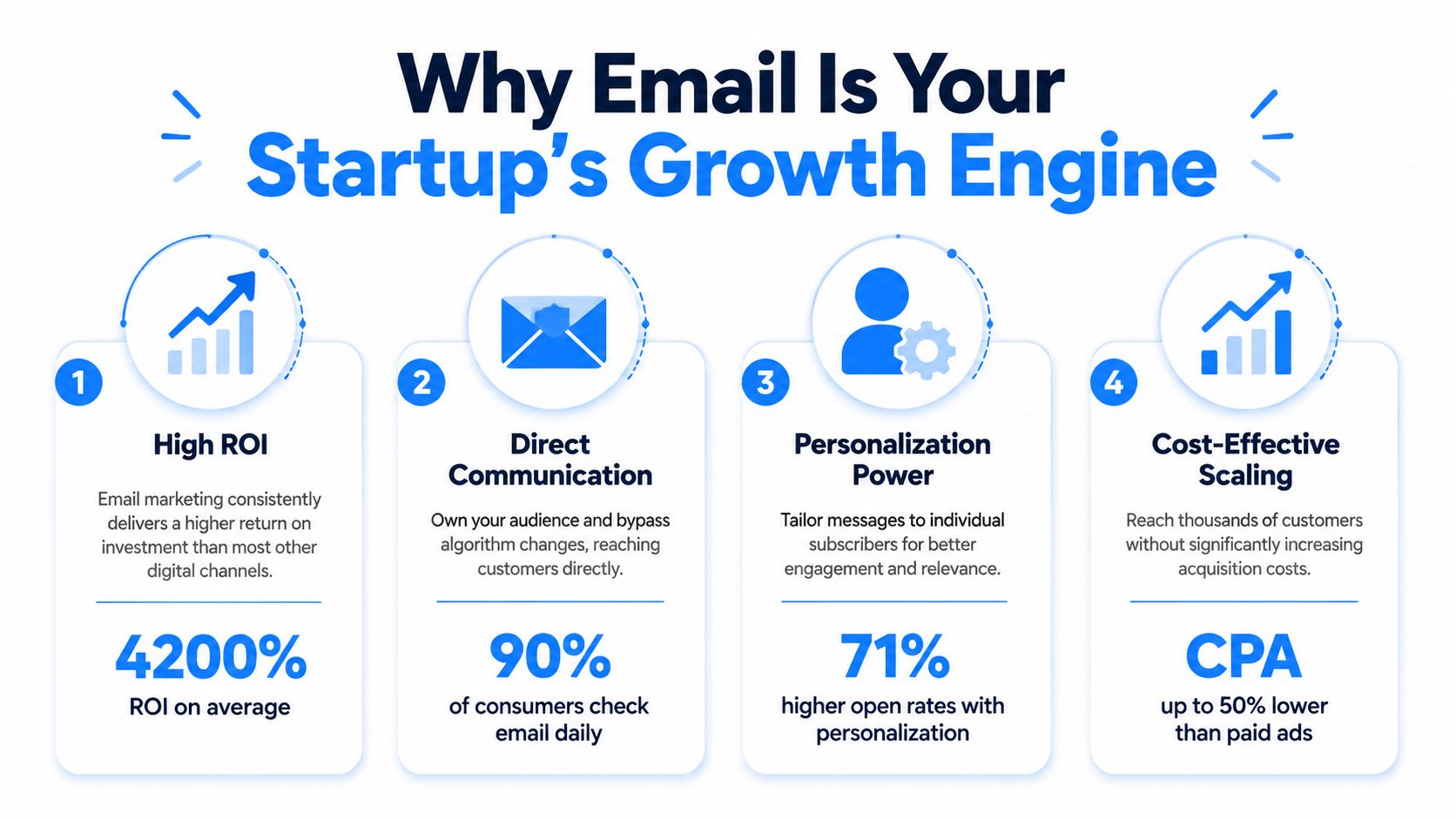
Email marketing delivers an average return of $36 to $40 for every $1 spent according to these email marketing benchmarks. The same source notes that 81% of small and midsize businesses rely on email as their primary customer acquisition channel. For a startup trying to stretch limited runway, that's not a side benefit. That's the reason email deserves real operational attention.
Why startups get more from email than from noisier channels
Email gives you direct access to people who already raised their hand. That changes the economics.
A founder can publish on LinkedIn and get decent reach one week, then disappear the next. A paid campaign can produce signups, but the cost pressure starts immediately. Email behaves differently because once someone subscribes, you can keep talking to them without rebuying that attention every time.
That's especially important in B2B, where buyers often need multiple touches before they book a demo, start a trial, or bring a vendor into an internal conversation.
Here's the practical shift I want founders to make. Stop thinking about email as a distribution channel for announcements. Think of it as the infrastructure behind lead generation and conversion. If you want a useful framework for that, this piece on how to improve B2B email revenue is worth reading because it pushes the conversation toward revenue, not vanity engagement.
What email does that other channels usually can't
Email works well for startups because it handles different jobs across the funnel:
- Acquisition support. Visitors who aren't ready to buy can still join your list and enter a nurture path.
- Activation. Trial users and new signups can get guided toward the product actions that matter.
- Retention. Existing customers can get product education, reminders, and usage prompts.
- Founder-led trust building. You can speak in a human voice, explain what you're building, and create familiarity over time.
Practical rule: If a channel brings attention but email doesn't capture and nurture that attention, you're leaking value.
The startups that get real traction from email usually do something simple. They decide early that inbox access is too valuable to waste on random sends. They build around clear sequences, careful segmentation, and messages that sound like a person, not a style guide.
Laying the Foundation for Deliverability and Growth
Most early email problems aren't copy problems. They're list quality problems.
Teams spend days polishing subject lines, then send to a messy database full of weak intent, stale leads, and contacts who barely remember subscribing. That's how a startup hurts sender reputation before it has enough volume to recover easily.

Build a healthy list, not a large one
According to this benchmark guide on startup email performance, maintaining proper list hygiene and using double opt-in are foundational steps for preserving sender reputation and achieving industry-standard open rates of 20–30% for B2B startups.
That sentence contains the whole foundation.
A healthy list has three qualities:
- Permission is clear. People knowingly subscribed.
- Intent is recent. They signed up for something relevant and still recognize your brand.
- The data is maintained. Invalid, disengaged, or risky contacts don't sit there forever.
If you're still building your audience from scratch, this guide to email list building for B2B teams is a good operational starting point because it keeps the focus on sustainable acquisition rather than shortcuts.
Double opt-in is friction that helps
Founders often resist double opt-in because it feels like one more step.
In practice, that extra confirmation filters out poor-fit signups, fake addresses, typo-filled submissions, and people who never intended to hear from you in the first place. That protects your domain later, when you start sending onboarding flows, product updates, and outbound-style nurture campaigns at a higher volume.
The startups that skip this step often end up with a list that looks healthy in a spreadsheet but performs like dead weight in an ESP.
A smaller list with clear consent is easier to monetize than a bloated list full of weak intent.
The setup choices that matter early
You don't need an enterprise stack on day one. You do need discipline.
Focus on these foundations:
- Use mobile-responsive templates. Emails should render cleanly on desktop and mobile without forcing readers to pinch or zoom.
- Collect the minimum useful data. Start with email address and one high-value qualifier if needed. Don't turn your form into a survey.
- Separate sources clearly. Trial signups, content subscribers, event leads, and product users shouldn't all live in one undifferentiated segment.
- Remove obvious list rot regularly. Hard bounces, malformed addresses, and repeatedly inactive contacts shouldn't keep receiving campaigns.
- Set expectations at signup. Tell people what they'll receive. This cuts surprise and reduces future complaints.
What hurts deliverability fastest
I've seen early-stage teams create their own problems by moving too fast in the wrong places. The usual mistakes are predictable:
- Imported legacy contacts. Old CRM exports create more confusion than pipeline.
- One-list thinking. Sending the same message to subscribers, users, prospects, and customers lowers relevance fast.
- Overdesigned templates. Heavy layouts often distract from the actual message, especially in B2B.
- Ignoring unsubscribe signals. If people are opting out, the answer usually isn't to send more.
Deliverability is a compounding asset. So is damage. Start with clean consent, maintain the list aggressively, and treat reputation like something fragile, because early on it is.
Crafting Your First High-Impact Email Sequences
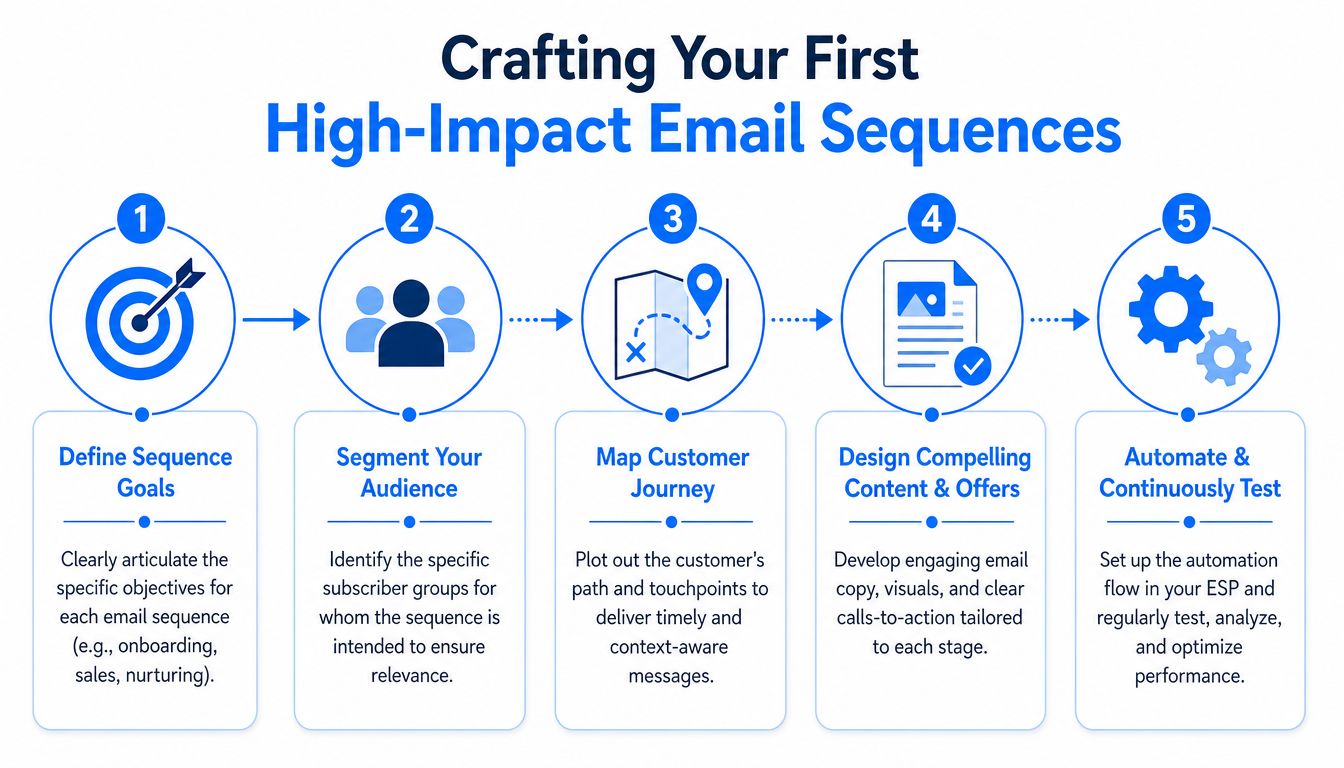
Most startups don't need more campaigns. They need a few sequences that do real work.
The two sequences that matter first are the welcome sequence and the activation sequence. One turns a new subscriber into an engaged lead. The other turns a new user into someone who experiences value.
The welcome sequence that earns attention
A welcome sequence should feel like a guided introduction, not a brochure drip.
I like to structure it this way:
Email one: Deliver the promised value
Send immediately after signup.
This email should do one thing well. Deliver the resource, confirm what they signed up for, and make the next step obvious. If they downloaded a guide, give them the guide. If they joined for insights, set expectations clearly.
Email two: Frame the problem
The next send should help the reader name the issue they're trying to solve.
For a B2B SaaS startup, that might mean showing why a workflow breaks, where teams lose time, or what usually stalls adoption. Here, useful diagnosis beats product hype.
Email three: Introduce your angle
Now you can explain how your company approaches the problem differently.
Not with a feature dump. With a point of view. Buyers remember clear thinking before they remember UI details.
Email four: Invite a low-friction next step
Offer a trial, a demo, a reply invitation, or a useful resource tied to intent.
If you want practical starting points, these email drip campaign templates for startup teams can help shorten the build process.
A short explainer can also help if your team is setting this up for the first time:
The activation sequence that moves users to value
Activation emails should be tied to behavior, not just time delays.
If someone signs up for your product and does nothing, the sequence should reduce friction. If they take one key step but stall, the sequence should pull them toward the next milestone. However, many startup teams get lazy at this stage and just send “checking in” emails that create noise but no motion.
A better activation flow looks like this:
- After signup. Confirm the account and direct the user to one meaningful first action.
- After partial setup. Show what's blocking progress and remove uncertainty with a short walkthrough.
- After key inactivity. Remind them what outcome they're trying to reach, not just what button to click.
- After an early success signal. Reinforce the win and suggest the next use case or team action.
Don't build activation emails around features. Build them around moments when the user is likely to hesitate.
What good startup sequences have in common
They are specific. They are short enough to read quickly. They focus on one next action per email.
Bad sequences try to explain the whole company in every send. Good ones move the reader one step forward each time. That's the difference between emails that feel like pressure and emails that feel useful.
The Founder's Voice Versus Corporate Polish
Early-stage startups often make email harder than it needs to be. They try to sound established before they've earned the right to sound institutional.
That usually produces emails full of polished headers, generic positioning, and copy that could belong to any B2B software company in the category.

Why plain text often works better
According to this analysis of email marketing for small businesses, recent data shows that plain-text, first-person emails sharing the raw journey of building a company achieve significantly higher engagement and lower spam rates because they cut through noise better than polished graphics.
That lines up with what many B2B operators see in practice.
A founder-led email feels closer to a real conversation. It doesn't ask the reader to decode a brand campaign. It gets to the point, sounds accountable, and creates the sense that an actual person is behind the message.
What founder voice actually means
It does not mean being overly casual, unstructured, or self-indulgent.
It means writing emails that do a few things well:
- Speak in the first person when appropriate. “We're seeing this problem with onboarding teams” lands better than abstract category copy.
- Reference real observations. Explain what buyers are struggling with, what you're learning, or why you built a specific workflow.
- Lead with the problem, not the product page language. People care about what they're trying to fix.
- Make replies feel welcome. Founder voice works best when the email feels like it came from someone who would answer.
What corporate polish gets wrong for startups
Large companies can get away with brand-heavy emails because familiarity carries some of the burden. Startups don't have that luxury.
If nobody knows you yet, polished creative can look like camouflage. It signals marketing effort before it signals usefulness. In cold and semi-warm B2B contexts, that often lowers trust.
Write the email your founder would send to one high-fit prospect after a good sales call. Then make that format scalable.
The strongest startup emails usually sound narrower, more honest, and more specific than what a big company would send. That's not a branding weakness. It's an advantage.
Scaling with Smart Segmentation and Personalization
Once the core sequences are live, the next job is relevance.
Most teams say they're personalizing when they're really just inserting a first name. Real personalization in email marketing for startups comes from matching the message to what the contact has done, what kind of company they're in, and where they sit in the buying journey.
Segment by behavior before demographics
Behavior usually tells you more than a form field.
Someone who downloaded a resource, visited pricing, and signed up for a trial should not get the same follow-up as someone who subscribed to a newsletter and never touched the product. Likewise, a user who invited teammates is in a different state than a user who created an account and vanished.
Useful startup segments often include:
- New subscribers with no product activity
- Trial users who started setup
- Trial users who stalled before value
- Active users who haven't expanded usage
- Customers showing lower engagement
- Leads from a target account or industry cluster
Many teams often start using simple automation plus enrichment tools to keep data usable. For founders exploring that route, this piece on Lead nurturing with AI for founders is useful because it frames automation as a way to maintain relevance, not just save time.
Match segmentation to message intent
A good rule is to write for a situation, not for the whole database.
If someone is early in the journey, send education that helps them understand the cost of the problem. If they've already shown buying intent, move closer to use cases, objections, and implementation clarity. If they're a customer, email should help them get more value from what they already bought.
Consider this practical approach:
Segment type
Message focus
Common mistake
New lead
Problem awareness and trust
Pitching the demo too early
Engaged prospect
Use case fit and proof
Sending generic newsletter content
Trial user
Next action and friction removal
Repeating feature lists
Active customer
Adoption and expansion
Treating them like prospects
At-risk account
Relevance and recovery
Using the same cadence as active users
Personalization that actually scales
The personalization that tends to work in B2B isn't flashy. It's operational.
Use the data you can maintain reliably. Product activity, signup source, company type, lifecycle stage, and engagement level are usually enough to create better sends. Once your system is stable, you can layer in more detail.
If you're evaluating tools that combine sending with list growth and audience targeting, platforms such as HubSpot, Customer.io, Mailchimp, and Breaker approach the problem differently. Breaker is built around newsletter sending plus B2B list expansion, with targeting, analytics, and deliverability management in one workflow. The right choice depends less on brand and more on whether your team needs product messaging, CRM depth, newsletter operations, or acquisition support.
The important part is this. Segmentation should reduce irrelevance. If your setup makes targeting so complex that nobody uses it, simplify it until the team can run it consistently.
Measuring and Optimizing for Predictable Revenue
A lot of startup teams stop at opens. That's where the analysis gets shallow.
Opens can tell you whether the subject line earned attention, but they don't tell you whether the email moved someone toward a business outcome. For that, you need to watch clicks, conversions, unsubscribes, bounce patterns, and complaint signals together.
According to Beehiiv's guide to email marketing for startups, a satisfactory click-through rate typically falls between 2% and 5%, and startups should systematically A/B test subject lines and send times while also tracking negative metrics like spam complaints.
The dashboard that actually matters
Use a compact scorecard. Don't build a reporting monster.
Here's a practical set of metrics to track:
Metric
B2B Benchmark
What It Tells You
Open rate
20–30% for B2B startups
Whether your subject line, sender identity, and list quality are earning attention
CTR
2% to 5%
Whether the email creates enough interest to drive action
Conversion rate
Qualitative trend over time
Whether clicks are turning into demos, trials, replies, or revenue events
Unsubscribe rate
Qualitative warning signal
Whether your targeting, frequency, or message relevance is off
Bounce rate
Qualitative warning signal
Whether your list quality is deteriorating
Spam complaints
Qualitative warning signal
Whether recipients feel surprised, misled, or over-contacted
For a deeper operational breakdown, this guide on email campaign performance metrics is useful for deciding what belongs in the weekly review and what doesn't.
A simple testing cadence
The most useful startup testing is narrow and repeatable.
Test one variable at a time when possible:
- Subject line. Keep the body constant.
- Send time. Keep audience and offer consistent.
- CTA wording. Change the ask, not the entire email.
- Content angle. Compare educational framing against direct offer framing.
The goal isn't perfect lab conditions. The goal is to learn which changes consistently improve response from the right segment.
If clicks are weak, the problem is usually message relevance or offer clarity. If unsubscribes spike, the problem is often audience fit, expectation mismatch, or frequency.
What optimization looks like in practice
A disciplined startup team reviews campaigns weekly and asks a short set of questions:
- Did the right segment receive this email?
- Did the subject line earn enough opens to justify the send?
- Did the body create a clear next action?
- Did the landing page or product step carry the momentum?
- Did any negative signals suggest list or targeting issues?
That's how email marketing for startups becomes predictable. Not through more sends, but through tighter feedback loops.
If your team wants to run email as a lead generation system instead of a disconnected newsletter task, Breaker is one option to evaluate. It combines newsletter sending with B2B list growth, targeting, analytics, and deliverability support, which can be useful for growth teams that want one workflow for both audience building and campaign execution.
Keep reading
All articlesHow to Write a Newsletter with AI: Step-by-Step Guide 2026
Learn how to write a newsletter with AI the right way: a 7-step process to train, calibrate, and edit AI drafts that still sound like you.
How to Boost Conversions With Your Email Newsletter
Turn your newsletter into a conversion engine. See 2026 benchmarks, CTR vs CVR explained, and the fixes most email guides skip.
Drip Campaign Template: Ready-to-Use Email Sequences
Get 6 ready-to-paste drip campaign templates with subject lines, body copy, and send timing—plus a step-by-step guide to building your own.