
Email Marketing for Financial Services: A 2026 Growth Guide
Master email marketing for financial services in 2026. This guide covers strategy, compliance, and automation to drive growth and build client trust.
Your team is under pressure from both sides. Advisors want more qualified conversations. Leadership wants proof that marketing contributes to pipeline and AUM growth. Compliance wants tighter controls on consent, disclosures, and record keeping. Meanwhile, the email program often sits in the middle, expected to drive growth without creating risk.
That tension is why email marketing for financial services gets mishandled so often. Teams either play too cautiously and send bland, infrequent campaigns that generate little business impact, or they chase growth tactics borrowed from ecommerce and SaaS that don't survive regulatory review. Both paths fail for the same reason. They treat compliance and performance as opposing forces.
In practice, the strongest financial email programs work the other way. They use compliance to sharpen audience quality, improve deliverability, build trust faster, and make reporting cleaner. When consent is documented, lists are cleaner. When authentication is strong, inbox placement improves. When content is useful and properly targeted, engagement tells you something meaningful about intent instead of just curiosity.
That changes email from a newsletter checkbox into an operating channel. Not just for awareness, but for lead generation, onboarding, retention, and expansion. It also gives firms a cleaner way to connect campaign engagement with downstream business outcomes.
Why Email Marketing in Finance is a High-Stakes Game
Most industries can tolerate a mediocre email program for a while. Finance can't.
A weak campaign doesn't just waste budget. It can create compliance headaches, damage sender reputation, and cloud your view of which marketing efforts are influencing revenue. If your team is sending to outdated contacts, relying on weak authentication, or treating consent as a box to check later, your numbers become unreliable before anyone even opens the message.
That matters because email in finance isn't only a communication tool. It's a trust signal. Prospects judge how carefully your firm handles money by how carefully it handles communication. Sloppy segmentation, misleading subject lines, and unclear permissions don't feel like small marketing mistakes. They feel like operational risk.
What makes the stakes higher
Financial marketers operate under particularly tight scrutiny. Promotional claims need review. Audience permissions matter. Data handling matters. Infrastructure matters.
The baseline performance standards also tell a bigger story than many teams realize. In financial services, the benchmark is a 20% average open rate, a 3% click-through rate, and a 96% delivery rate according to MBC Strategic's financial marketing benchmarking guidance. Falling below those thresholds often points to compliance or authentication problems, not just weak creative.
Practical rule: In finance, underperformance is often an operations problem disguised as a marketing problem.
A low delivery rate can distort everything downstream. Lead scoring gets noisier. Attribution gets weaker. Sales teams lose confidence in marketing-sourced opportunities. Leadership sees email as soft value instead of a measurable growth channel.
What actually works
The firms that get traction usually do three things well:
- They treat email as infrastructure first: Authentication, list hygiene, consent tracking, and review workflows are built before campaign volume scales.
- They define business outcomes clearly: The program exists to generate qualified meetings, deepen existing relationships, and support AUM growth. Not to chase vanity metrics.
- They send useful messages: Market commentary, planning reminders, onboarding guidance, and timely educational content consistently outperform generic firm updates.
Email marketing for financial services is high stakes because every send affects trust, reputation, and measurement. That's exactly why it can become such a strong growth channel when it's run with discipline.
Building Your Financial Email Marketing Strategy
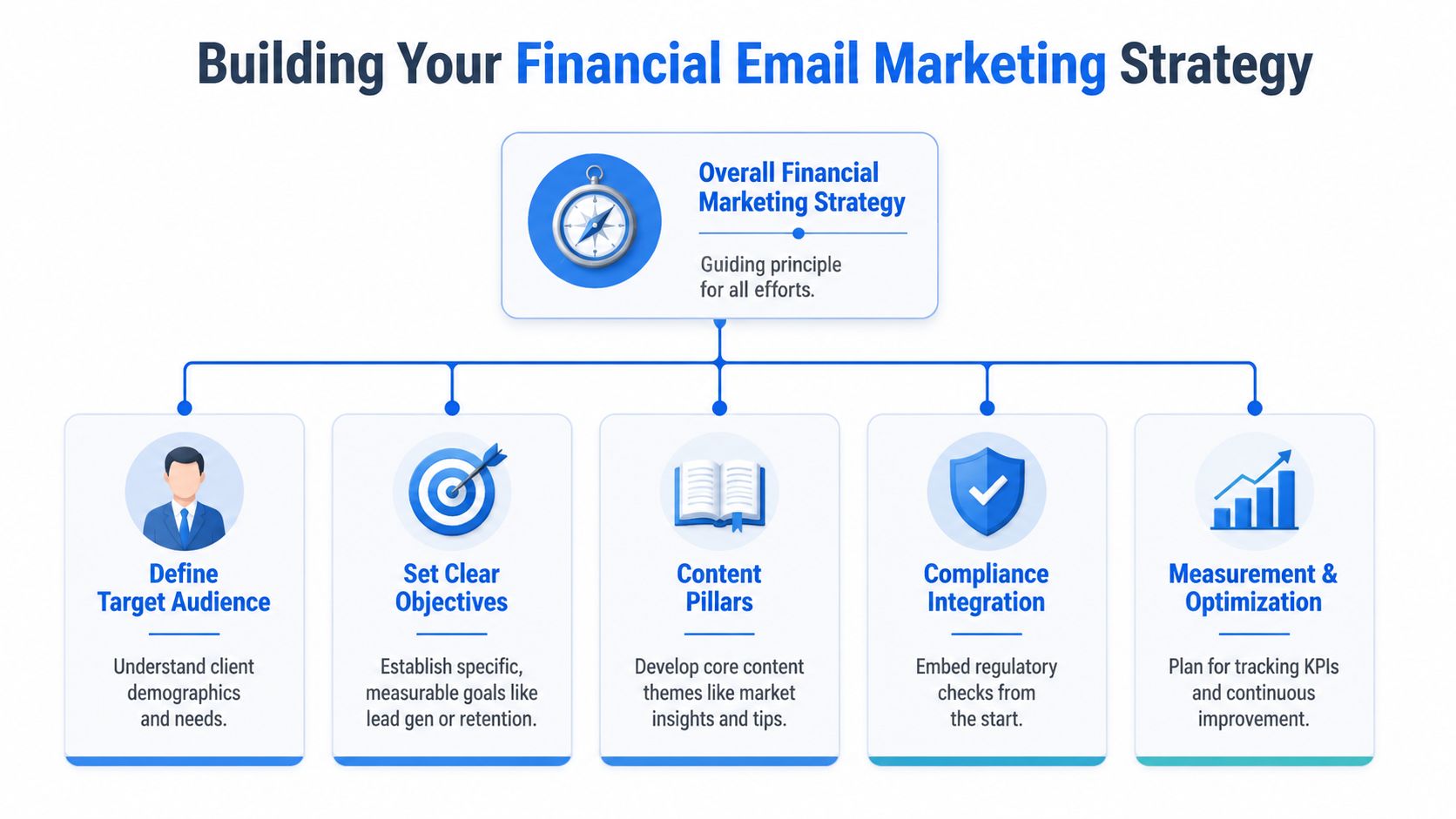
A good strategy starts by answering one uncomfortable question. What, exactly, should this email program do for the business?
If the answer is "increase engagement," the strategy is too vague. In finance, email needs a job tied to a commercial outcome. That could mean creating qualified advisor conversations, increasing wallet share among current clients, improving retention, or supporting AUM growth by keeping clients active and informed.
Start with business outcomes
Treat each email stream as part of a revenue system.
A prospect nurture sequence should move someone toward a meeting, webinar attendance, or a content action that signals investment interest. A client newsletter should strengthen confidence, surface planning opportunities, and create reasons for proactive outreach. A re-engagement flow should help advisors identify dormant relationships before they drift.
A simple planning model works well here:
Email program type
Primary business purpose
Best sign of success
Prospect nurture
Create qualified conversations
Replies, booked meetings, content actions tied to intent
Client education
Support retention and relationship depth
Ongoing engagement and advisor follow-up opportunities
Event and webinar emails
Turn interest into sales conversations
Registrations and post-event actions
Review reminders
Trigger timely client contact
Scheduled reviews and advisor outreach
Segment by financial context, not just demographics
Most firms over-segment by account size and under-segment by decision context.
Age and investable assets matter, but they rarely explain why someone acts now. Better segmentation uses a combination of financial stage, likely concerns, engagement behavior, and communication preference. A business owner thinking about liquidity planning doesn't need the same message as a newly retired client focused on withdrawal confidence.
Use a working segmentation model like this:
- Lifecycle stage: Prospect, new client, established client, dormant contact
- Financial priority: Retirement, income planning, education funding, tax strategy, estate coordination
- Behavioral signals: Opened market updates, downloaded a guide, clicked planning content, stopped engaging
- Channel preference: Newsletter reader, event registrant, consultation seeker
The cleanest strategies don't ask, "What should we send this month?" They ask, "What decision is this audience trying to make, and what email would help them make it?"
Build content pillars before campaigns
Most weak email calendars fail because they start with send dates instead of themes. Build a few repeatable content pillars first, then assign them to audience segments.
Examples that usually work in financial services:
- Market interpretation: Calm, compliant commentary that explains what matters without sensationalizing movement
- Planning education: Decision-support content around taxes, retirement, liquidity, or family milestones
- Client experience: What happens next, how reviews work, what documents to prepare
- Timely prompts: Deadlines, contribution reminders, review invitations, policy or account milestones
The strategy gets stronger when compliance is part of the initial design, not the final approval step. That means choosing content types, audience rules, and calls to action your firm can support consistently.
Navigating Financial Services Compliance and Privacy
The fastest way to slow growth is to treat compliance like a last-minute legal edit.
When marketers do that, every campaign turns into a negotiation. Copy gets watered down. launch timelines slip. Teams avoid automation because they're unsure how permissions apply. Eventually, the email channel becomes so cumbersome that people stop trying to build it properly.
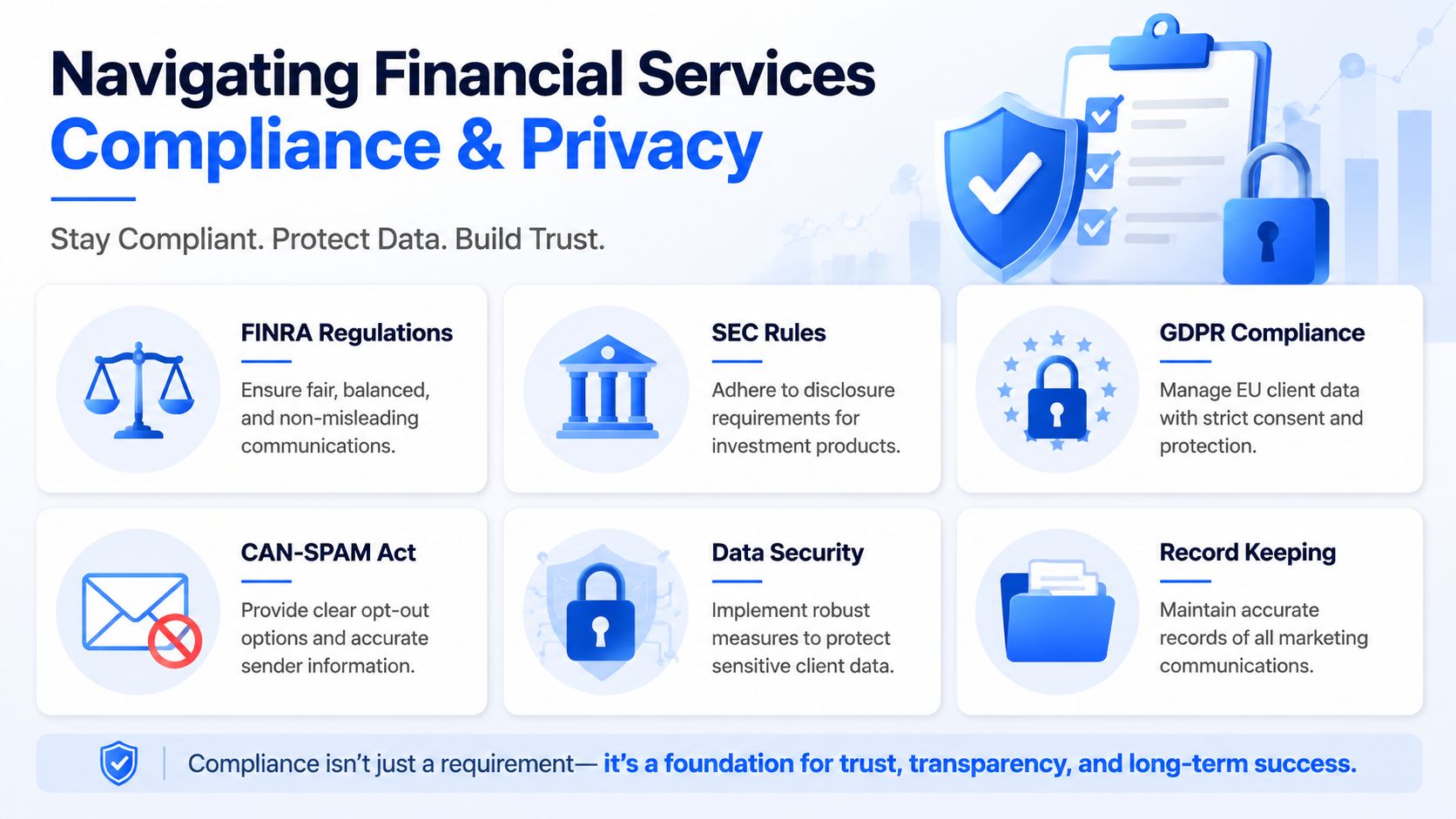
A better model is to treat compliance as the operating system for growth. In financial services, that isn't just safer. It produces a better list, more reliable engagement signals, and a stronger brand.
Compliance gives you better leads
One of the biggest unresolved questions in this market is how to build a B2B list under strict opt-in rules without crossing into risky promotional territory. As noted in MessageGears' guide to email marketing for financial services, teams often understand the legal requirement but still lack a concrete model for compliant, growth-focused list building.
The practical answer is to earn permission with content that stands on its own value.
That means using educational assets, event registrations, research briefings, and planning tools to attract the right contacts. The exchange should be explicit. The value should be clear. The follow-up should match what the subscriber expected when they signed up.
If your team needs ideas for structuring those acquisition paths, ReachLabs.ai's email list building insights offer a useful outside-in view of how value-driven signup systems work without relying on purchased lists or vague consent.
Build a consent-first workflow
Compliance falls apart when ownership is fuzzy. Someone on the team needs to know, for every contact, why you're allowed to email them, what category of content they agreed to receive, and how that permission is stored.
Use a checklist that marketing and compliance can both live with:
- Document consent clearly: Keep the source of signup, the context of consent, and the intended communication type attached to the record.
- Separate informational from promotional sends: If the message crosses into product marketing, the permission basis should support that use.
- Make opt-out easy: Don't hide unsubscribes or create friction. People who don't want your emails hurt the program if they stay.
- Retain communication records: In regulated industries, proof matters as much as process.
- Review automation logic: Triggered emails should inherit the same permission controls as campaigns.
For teams reviewing platforms and workflows, it's worth looking at how email compliance software supports approval flows, consent management, and auditability before you scale send volume.
Good compliance doesn't shrink your list. It filters out contacts who were never going to become trusted opportunities.
Privacy as a trust signal
Financial clients are unusually sensitive to data handling, and for good reason. They aren't just evaluating your investment thinking. They're evaluating whether your firm behaves carefully.
That shows up in email details people notice immediately:
- whether the sender identity is clear
- whether the content matches what they signed up for
- whether disclosures are balanced
- whether opting out feels respected
- whether follow-up feels helpful or intrusive
Firms that handle these basics well create a subtle but powerful effect. Their email feels more credible before the reader gets to the first CTA.
Mastering Deliverability and Sender Reputation
A compliant email that lands in spam is still a failed send.
Deliverability is where many financial teams lose momentum because the work feels technical and separate from strategy. It isn't. Inbox placement determines whether your creative, segmentation, and compliance work ever gets a chance to perform.
Think of authentication like verified identity
SPF, DKIM, and DMARC function like layers of identity verification. They tell receiving mail systems that your messages originate from your organization and haven't been altered in transit.
For financial senders, that's imperative. Savvy Wealth's guidance for financial advisor email marketing states that financial email programs require full authentication through SPF, DKIM, and DMARC, along with dedicated Certified IP addresses, because this sector faces stricter deliverability scrutiny than most others.
If those controls are missing, inbox placement drops. Not eventually. Directly.
Reputation is built by behavior
Authentication gets you recognized. Sender reputation determines whether providers trust you.
Three habits usually separate healthy programs from unstable ones:
- Aggressive bounce handling: Remove bounced addresses quickly. Dead contacts tell inbox providers your list maintenance is weak.
- List validation discipline: Old, scraped, or poorly sourced records create complaints and spam flags.
- Smarter send timing: Savvy Wealth also notes that skipping regular list validation and failing to use send-time optimization can increase the chance of spam filtering. Small operational choices matter.
A useful companion read here is Intelligent Contacts' guide to email spam prevention strategies, especially for teams trying to connect copy choices and list practices back to inbox placement.
What to monitor every week
You don't need a giant deliverability department to stay ahead of problems. You do need a repeatable review rhythm.
Area to check
What it tells you
Common issue behind a drop
Delivery trend
Whether mail is reaching inbox providers reliably
Authentication gaps or poor list quality
Bounce pattern
Whether data hygiene is slipping
Stale contacts or bad acquisition sources
Complaint signals
Whether content and consent align
Over-mailing or unclear expectations
Engagement by segment
Whether your best audiences still trust your emails
Fatigue, weak targeting, or stale messaging
For teams tightening this side of the program, a deeper look at email sender reputation helps connect infrastructure, list quality, and campaign behavior into one operating view.
If deliverability drops, don't start by rewriting subject lines. Start by checking trust signals at the domain, list, and permission level.
Designing Content That Builds Trust and Drives Action
Most financial email content fails for a simple reason. It's organized around what the firm wants to say, not what the reader is worried about.
That's why so many newsletters feel interchangeable. Market recap. Firm update. Generic planning reminder. None of it is wrong, but very little of it meets the reader in the emotional context where financial decisions happen.
A more effective approach starts with psychological life stage, not just age band. eMercury's discussion of financial services email marketing highlights a key gap in the market: firms often segment by demographics, but stronger engagement comes from tailoring messages to specific financial anxiety points and matching those triggers to the right narrative arc.
Two readers, same age, different email
Consider two subscribers in similar income brackets.
One is worried about paying for a child's education without derailing retirement. The other is worried about being too late to retire comfortably. Their portfolio size may be similar. Their email triggers are not.
The first person responds to content that reduces tension between competing goals. The second responds to content that restores clarity and control.
That changes the message:
Client situation
Emotional trigger
Better email angle
Weak email angle
Parent planning for education costs
Fear of trade-offs
"How families can balance college funding with long-term planning"
"This month's market update"
Pre-retiree facing timeline pressure
Anxiety about readiness
"Questions to ask before shifting from accumulation to income planning"
"Top portfolio insights for Q2"
New investor after market volatility
Fear of making a mistake
"What disciplined investing looks like when headlines feel loud"
"Our latest outlook"
Use narrative arcs, not just topics
Good content in finance doesn't only inform. It moves the reader from one mental state to another.
A useful arc looks like this:
- Name the concern clearly
Show that you understand the decision pressure.
- Add perspective
Give context, not hype. Help the reader interpret the issue.
- Offer a practical next step
Suggest one action, one checklist, one review, or one conversation.
- Make the CTA low-friction
Invite a reply, a guide download, or a planning review. Don't force a hard sell.
Readers act when an email makes them feel understood and capable, not when it makes the firm sound impressive.
What content usually works best
The strongest financial emails are specific and calm.
- Planning notes tied to life events: Retirement timing, liquidity events, college planning, tax-season decisions
- Short market interpretation: Not hot takes. Clear explanations of what matters and what doesn't
- Review prompts: Invitations that connect current conditions to the need for a conversation
- Expectation-setting emails: Onboarding, service cadence, document prep, account milestones
CTAs should match the level of intent. If the content is educational, the next step might be reading a related brief or replying with a question. If the reader has shown stronger interest, a review invitation can work well. Trust builds when the action feels proportional to the message.
Automating the Client Journey with Lifecycle Flows
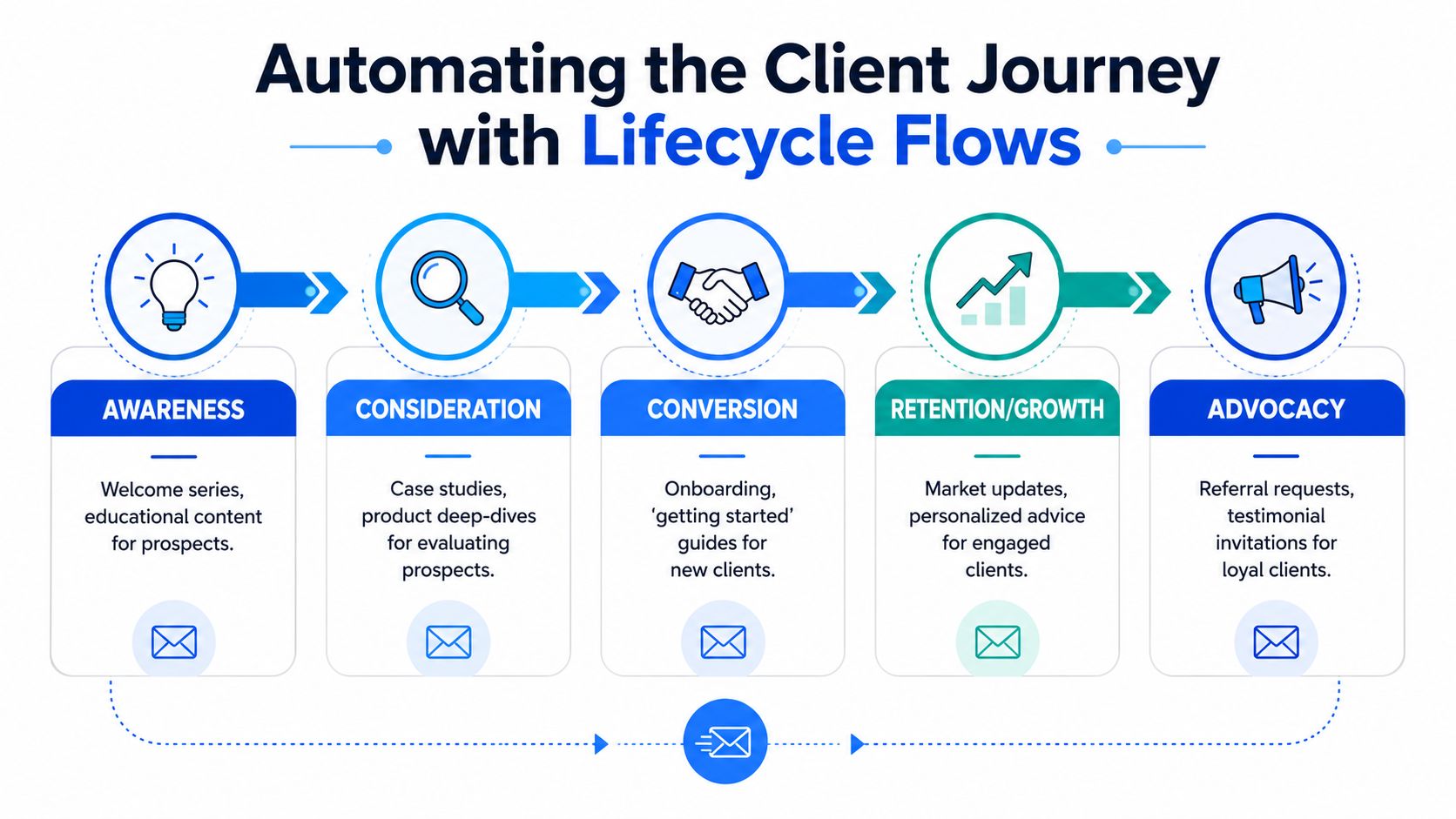
Batch newsletters still have a place, but they can't carry the whole program. Financial relationships develop across stages, and each stage benefits from a different email rhythm.
Automation is how you deliver consistency without sounding robotic. The mistake is thinking automation means generic. Good lifecycle flows feel timely because they respond to where the contact is in the relationship.
A useful visual reference helps teams map that journey.
Core flows every firm should have
Start with a small set of high-value journeys instead of trying to automate everything.
- Welcome flow: Confirms the signup, delivers the promised resource, sets expectations, and introduces the kind of guidance the subscriber will receive.
- Onboarding sequence: Helps new clients understand process, timing, contacts, documents, and what good communication looks like.
- Review and nurture flow: Keeps clients informed with relevant updates and natural prompts for advisor outreach.
- Re-engagement path: Identifies inactive contacts and offers a fresh reason to reconnect or update preferences.
The best lifecycle systems use behavior to route contacts. A subscriber who clicks retirement planning content shouldn't keep receiving general-intent messaging forever. Their actions should narrow the next message.
A practical reference for teams building process logic is this guide on how to create a workflow, especially when you need automation to stay manageable across multiple audience states.
Keep automation personal
Automation works in finance when each sequence answers a real question the client has at that moment.
A welcome flow says, "You made the right choice subscribing."
An onboarding flow says, "Here's how we'll work together."
A retention sequence says, "We're paying attention to your situation."
A re-engagement sequence says, "You can still choose how you want to hear from us."
This is also where AI can reduce team workload without removing judgment. For example, teams exploring ways to streamline email workflow with AI can use it to support routing, response handling, and operational consistency while keeping message strategy human-led.
After you've mapped the stages, use this walkthrough as an additional reference point:
A simple welcome sequence structure
A strong initial sequence often follows this pattern:
Purpose
Best tone
Welcome
Confirm subscription and deliver value promised
Reassuring and clear
Follow-up education
Share the next most relevant resource
Helpful and focused
Credibility builder
Explain your planning approach or communication style
Calm and transparent
Action prompt
Invite a low-pressure next step
Direct and respectful
When these flows are built well, the client experience feels more attentive, not more automated.
Measuring KPIs and Accelerating Growth with Breaker
A financial firm can send polished campaigns every week and still fail to prove marketing impact. The usual problem is not email volume. It is weak measurement. If reporting ends with opens and clicks, leadership sees email as activity, not a growth channel.
Strong financial email programs measure operational health and commercial movement together. That means tying inbox placement, engagement by audience segment, advisor follow-up, and pipeline activity into one reporting model. Compliance matters here too. Clean consent records, clear source tracking, and reliable data handling make attribution more credible, not slower.
McKinsey found that companies using customer behavior data to generate behavioral insights significantly outperform peers on sales growth, according to its analysis of personalization at scale from McKinsey. In finance, that principle shows up in a practical way. Teams that measure behavior at the segment and journey level make better decisions about cadence, content, and handoff timing.
Track the metrics that change decisions
A useful KPI view should answer four questions:
- Are emails reaching the inbox consistently? Delivery health comes first because poor placement distorts every downstream metric.
- Are high-value audiences engaging? Segment-level engagement matters more than blended averages across the full list.
- Are emails creating sales opportunities? Replies, meeting requests, resource consumption, and advisor handoffs show intent more clearly than raw clicks.
- Can marketing connect engagement to business outcomes? Account reviews, pipeline movement, and funded relationships are what leadership wants to see.
Use a scorecard that reflects those decisions:
KPI category
Why it matters
What to do with it
Deliverability
Confirms the channel is functioning properly
Review authentication, list hygiene, and permission capture if performance drops
Engagement quality
Shows whether the message matches the audience
Adjust segments, offers, and send cadence
Conversion behavior
Indicates commercial interest
Route warm contacts to advisors or sales quickly
Revenue influence
Connects email to business growth
Defend budget, expand high-performing flows, and cut weak campaigns
Why platform design affects growth
I have seen good teams lose weeks trying to reconcile reports across an ESP, CRM, web forms, and spreadsheet exports. The cost is not just time. It creates doubt about which numbers are right, whether consent was captured properly, and which campaigns influenced real opportunities.
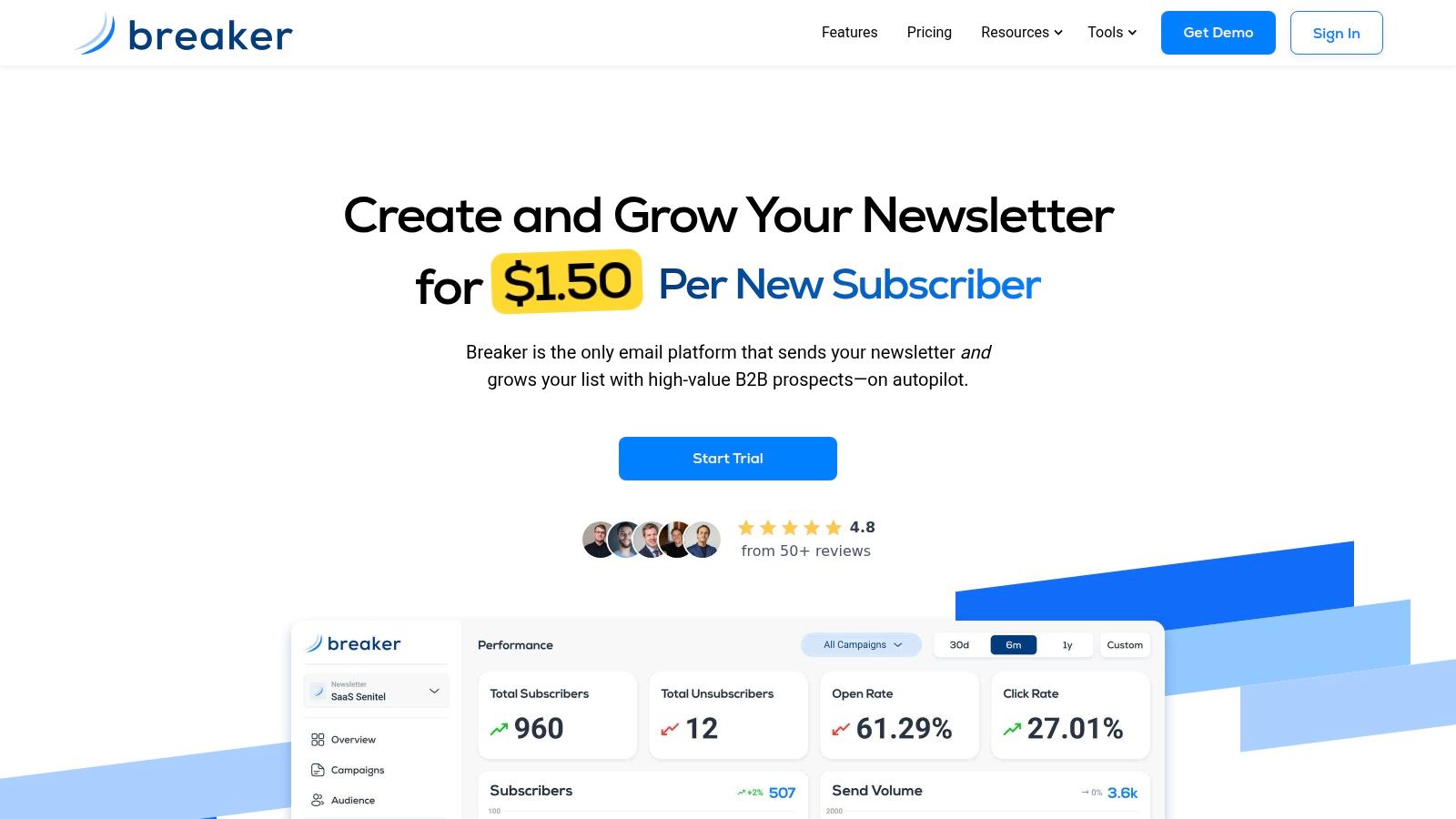
Breaker reduces that problem by putting newsletter sending, audience growth, targeting, list quality, deliverability monitoring, and analytics in one workflow. For financial marketers, that structure matters because compliance and growth depend on the same thing. Consistent records. If subscriber source, permission status, engagement data, and campaign performance live close together, the team can move faster without cutting corners.
The upside is practical. Teams can identify whether underperformance comes from poor audience fit, inbox placement issues, weak creative, or friction in the next step. They can also see which compliant journeys deserve more investment.
That is how email earns trust internally. It stops being a reporting exercise and becomes a repeatable channel for qualified lead generation, stronger client engagement, and AUM growth.
Breaker helps financial marketing teams turn compliant email into a repeatable growth channel. If you want one platform for sending, list growth, deliverability, and ROI tracking, see how Breaker supports modern email programs built for trust and performance.
Keep reading
All articlesHow to Write a Newsletter with AI: Step-by-Step Guide 2026
Learn how to write a newsletter with AI the right way: a 7-step process to train, calibrate, and edit AI drafts that still sound like you.
How to Boost Conversions With Your Email Newsletter
Turn your newsletter into a conversion engine. See 2026 benchmarks, CTR vs CVR explained, and the fixes most email guides skip.
Drip Campaign Template: Ready-to-Use Email Sequences
Get 6 ready-to-paste drip campaign templates with subject lines, body copy, and send timing—plus a step-by-step guide to building your own.