
Email Marketing for Lead Nurturing: The B2B Playbook
Learn how to use email marketing for lead nurturing to convert more prospects. This guide provides step-by-step B2B strategies, playbooks, and examples.
You already have leads in the database.
They downloaded a report, signed up for a webinar, visited the pricing page, or asked for more information. Sales didn't pick them up because timing was off. Marketing sent one or two follow-ups, then moved on to the next campaign. Months later, those leads sit untouched while the team spends more budget trying to replace attention it already earned.
That's a key challenge with email marketing for lead nurturing. Many organizations don't have a lead generation problem. They have a conversion system problem.
A nurture program fixes that only when it's built like a revenue engine, not a newsletter calendar. The job isn't to send more emails. It's to move a buyer from interest to intent with messages that match their pain points, buying stage, and level of engagement. When that happens, email stops being a communication channel and starts acting like pipeline infrastructure.
From Leaky Funnel to Revenue Engine
A leaky funnel usually looks harmless at first. MQL volume looks fine. Webinar registrations are coming in. Content downloads keep growing. Then you look closer and see that very few of those leads ever become serious opportunities.
That gap is expensive because these leads often aren't bad. They're just early, distracted, or still aligning internally. If nobody guides them after the first conversion event, they go cold and someone else gets the deal.
The revenue upside is large when teams fix that handoff. A 2026 Forrester B2B buying study found that nurtured leads spend 47% more at their initial purchase and generate 61% higher lifetime customer value over a 24-month period compared to leads acquired through cold outreach alone, according to this lead nurture stats roundup. That changes how you should think about follow-up. Nurturing isn't just a way to rescue leads. It's a way to improve deal quality.
A lot of teams overcorrect by adding volume. They build long sequences, queue up broad educational content, and hope persistence does the work. It rarely does. Buyers respond to relevance, not repetition.
Practical rule: If your sequence could be sent unchanged to every lead in your CRM, it's probably too generic to influence revenue.
Good nurture systems also fit the rest of your communication stack. In some organizations, email carries the full load. In others, it shares attention with webinars, retargeting, SDR outreach, or even internal education channels. If you're looking at how large organizations are shifting internal communication habits, the changes in Fortune 500 internal podcast trends are useful because they show how inbox competition is changing.
The bigger point is simple. Email marketing for lead nurturing works when it's connected to the buyer journey and the funnel itself. If your content strategy is still disconnected from conversion paths, this guide on funnel content marketing is a useful place to tighten that foundation.
Map Your Nurture Strategy Before You Build
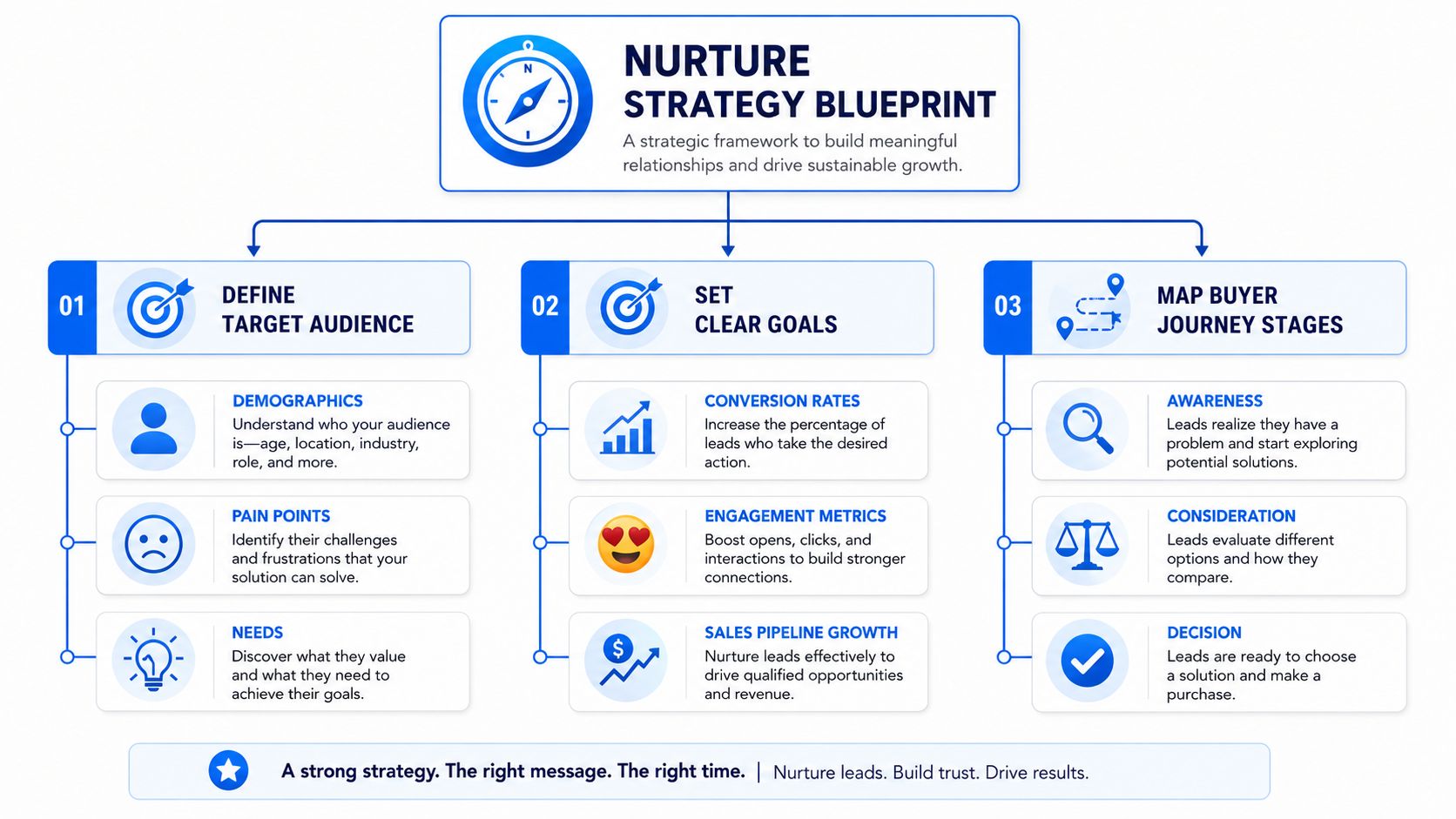
Most bad nurture programs fail before the first email is written. The team starts with copy, automation rules, and templates, but skips the hard part. Who are we trying to move, from what state, toward what buying action?
That missing strategy is one reason so many pipelines underperform. 79% of marketing leads never convert to sales due to poor lead nurturing, while companies that master the process generate 50% more sales-ready leads, according to Salesmate's lead nurturing analysis.
Start with fit, not personas
Personas are fine for messaging workshops. They're weak for operating a nurture system.
You need an ICP definition that combines firmographic fit with buying signals. For B2B teams, that usually means asking:
- Who buys fastest: Industry, company size, team structure, and business model often matter more than job-title stereotypes.
- Who gets value quickly: A lead can match your audience and still be a poor nurture candidate if your product requires conditions they don't have.
- Who shows meaningful intent: Webinar attendance means something different from repeated visits to implementation, pricing, or integration pages.
When teams ignore this and dump everyone into one sequence, email marketing for lead nurturing turns into list management instead of demand conversion.
Segment around pain points and journey stage
Good segmentation doesn't require endless micro-audiences. It requires useful buckets.
A practical setup is to segment by a mix of:
- Problem awareness: They know the pain but not the category.
- Solution evaluation: They're comparing approaches or vendors.
- Buying readiness: They're validating risk, rollout, or ROI internally.
- Use case: Different product entry points usually need different proof.
- Lead source: A demo request and a whitepaper download should not get the same sequence.
Let's look at it this way:
Segment type
What it tells you
What email should do
ICP fit
Whether the account is worth sustained effort
Prioritize or suppress
Funnel stage
How close they are to a decision
Match content depth
Pain point
What they need solved
Frame messaging around outcomes
Behavior
What they've shown interest in
Trigger relevant follow-up
Set goals that sales will care about
Open rate is not a nurture strategy.
Your sequence should be built against business outcomes such as more qualified handoffs, more meetings from high-fit accounts, shorter path to sales conversation, or stronger reactivation of dormant demand. If sales can't tell the difference between nurtured leads and everyone else, your program probably isn't doing enough.
Build the nurture map first. Then choose the platform, automation, and reporting layer that supports it.
Tool choice matters, but only after the operating model is clear. If you're comparing systems, this breakdown can help you evaluate email service providers based on workflow needs, segmentation, and automation depth rather than headline features.
Crafting Automated Sequences for Every Funnel Stage
One-off blasts rarely move pipeline because they ask too much from too little context. Buyers need a sequence that helps them make progress. That's why lead nurturing emails generate 4 to 10 times the response rate compared to standalone email blasts, according to Zendesk's lead nurturing guide.
This is the structure I've seen work most consistently. Not rigidly. But closely enough that teams should treat it as the default until the data tells them otherwise.
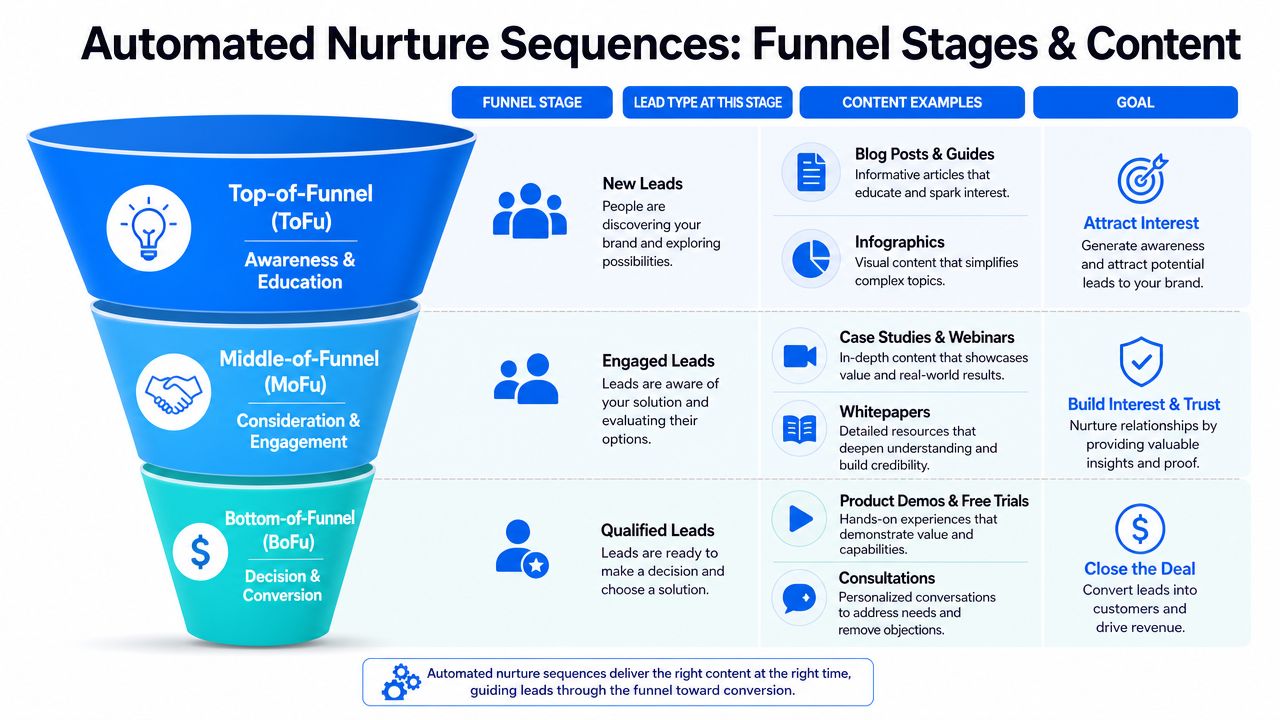
Top of funnel needs clarity, not a pitch
At this stage, the buyer is trying to understand the problem or name it properly. They may not be shopping yet. They may just be trying to avoid a bad internal decision.
Your emails should reduce confusion and help them frame the issue.
Strong ToFu content usually includes:
- Educational guides: Plain-language breakdowns of the problem space
- Benchmark-style thinking: What teams often get wrong, where friction appears, what signs suggest urgency
- Short explainer emails: A single useful idea with one next step
- Low-pressure CTAs: Read an article, watch a short video, download a guide
Weak ToFu nurture usually does the opposite. It introduces the product too early, assumes buying intent, or buries the reader in broad thought leadership with no operational value.
A good ToFu email says, in effect, “You may be dealing with this problem, here's how to recognize it, and here's one practical next step.”
Later in the journey, the handoff gets easier if your content already matches funnel progression. If you need examples of sequence structure and timing, these email drip campaign templates can help translate funnel logic into actual workflows.
Middle of funnel needs proof and contrast
MoFu is where most nurture programs break down. The buyer now understands the problem and is evaluating approaches. Generic educational content stops working here because the actual question has changed.
Now they're asking:
- Why this approach instead of another?
- What changes operationally if we adopt this?
- How hard is rollout?
- What risk are we taking on?
Comparison content, implementation guidance, webinars, and strong case-style narratives matter. You don't need to invent drama. You do need to show consequences, constraints, and trade-offs.
A practical MoFu sequence often includes:
- Problem-to-solution bridge email that reframes the issue around outcomes
- Use-case email tied to a specific workflow or team pain point
- Proof asset such as a webinar replay, teardown, or product walkthrough
- Objection-handling email focused on setup, adoption, integration, or stakeholder buy-in
Here's a useful visual overview of how funnel-stage content should line up in practice:
If your MoFu sequence still reads like a blog subscription, you're educating people who are already trying to decide.
Bottom of funnel needs momentum
BoFu emails should help a serious buyer take action with less friction. By this point, relevance matters more than creativity.
That means your emails should point toward:
- Demos
- Consultations
- Trial activation
- Implementation conversations
- Security, procurement, or rollout materials
This is also where many teams become too aggressive. Every BoFu lead does not need the same CTA. A pricing-page visitor might need a live conversation. A repeat product-page visitor might need a focused product email. A stakeholder who consumed technical content may need rollout detail, not another invitation to “book time.”
Here's a simple framing table:
Funnel stage
Buyer mindset
Best email angle
CTA style
ToFu
“Help me understand this”
Education
Learn more
MoFu
“Help me evaluate this”
Proof and differentiation
See how it works
BoFu
“Help me move forward”
Risk reduction and next step
Talk to sales or start
The sequence should feel like a guided decision, not a campaign calendar.
Personalization That Actually Drives Action
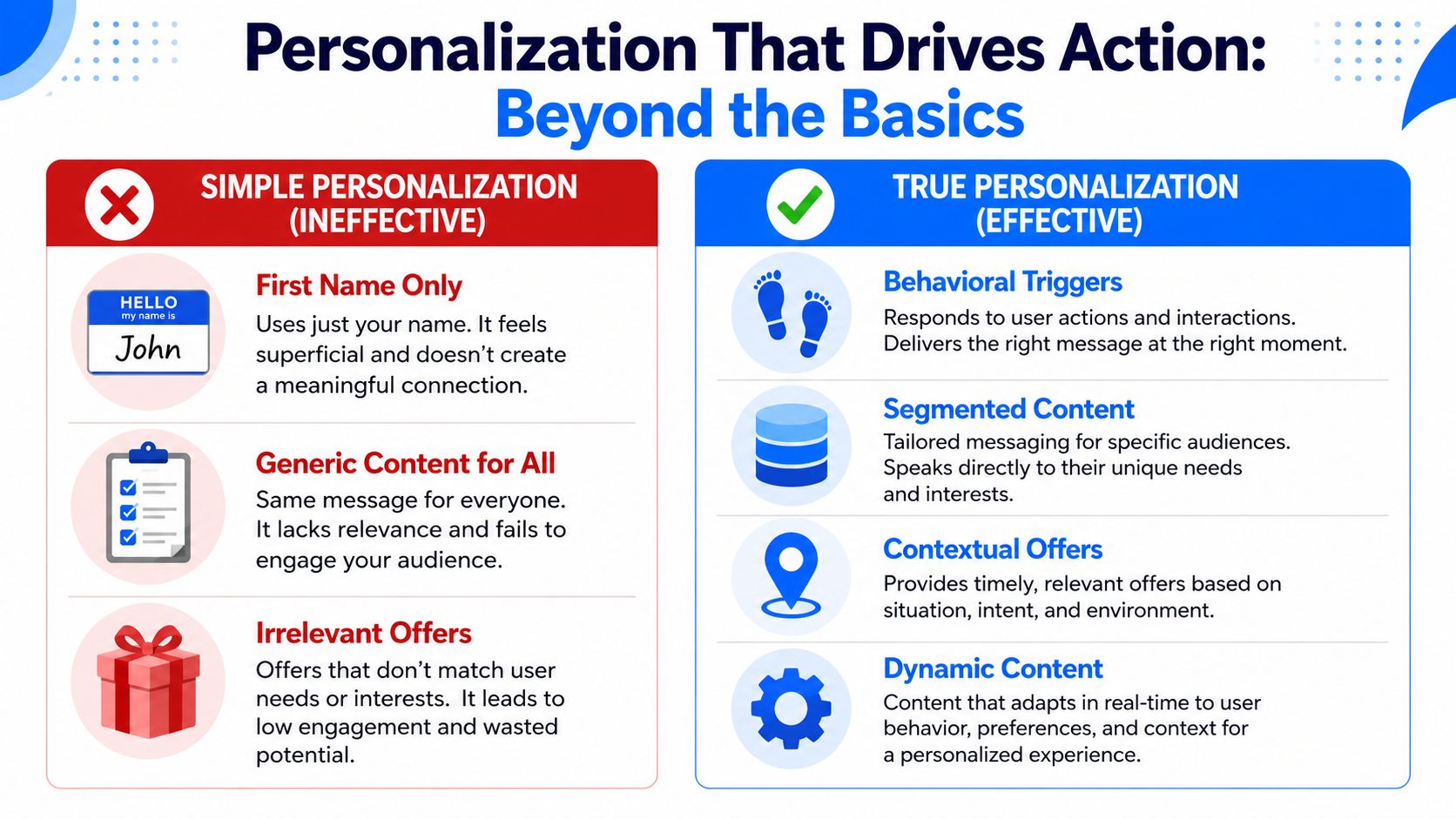
A first name in the subject line isn't personalization. It's mail merge.
The version of personalization that changes behavior is contextual relevance. It reflects what the lead did, what problem they likely care about, and what next step makes sense now. That's why the common “segment-of-one” fantasy tends to disappoint. Most mid-sized B2B teams don't have perfect data, clean orchestration, or enough operational bandwidth to support highly complex branching logic.
A better model is contextual nudging. According to Campaign Monitor's lead nurturing article, this approach uses lightweight behavioral triggers such as page visits or time on site, and 2026 Forrester research cited there indicates it boosts conversion by 34% and reduces maintenance overhead by 52% in resource-constrained B2B environments.
Use behavior as your personalization layer
You don't need a perfect customer graph to make nurture emails more relevant. You need a few reliable signals and disciplined follow-up.
Useful triggers include:
- Repeated visits to pricing or product pages
- Downloads tied to a specific use case
- Webinar attendance on a narrow topic
- Return visits from the same account
- Clicks on comparison, integration, or implementation content
Each signal should change the next email. Not the whole system. Just the next move.
For example:
Trigger
Likely meaning
Better follow-up
Pricing page visit
Buyer is evaluating cost or value
Send buying guide or consult CTA
Integration page click
Technical validation is happening
Send setup and compatibility content
Case study download
Proof is needed
Send use-case follow-up
Repeated education clicks
Problem is active, solution still early
Stay educational, avoid hard sell
Keep the mechanics lightweight
The teams that win with personalization usually aren't the ones with the most complicated workflow builder. They're the ones that can maintain the system without breaking it.
That means:
- Use dynamic content blocks sparingly: Swap the middle of the email based on use case or industry, but keep the structure stable.
- Write modular copy: One strong core message with a variable proof point usually beats fully custom emails.
- Prioritize trigger quality: A small set of high-signal behaviors is more useful than dozens of noisy events.
- Review with sales: If the message wouldn't help an AE or SDR continue the conversation, it probably isn't personalized enough.
A good outside example of this thinking shows up in niche outbound too. If you want to see how operators adapt personalization to a complex market without overengineering it, this piece on personalizing freight sales outreach is worth reading.
Better personalization answers, “Why is this email arriving now?” If the lead can't tell, the message is probably too generic.
How to Measure and Optimize Nurture Performance
Teams often over-measure email activity and under-measure revenue movement.
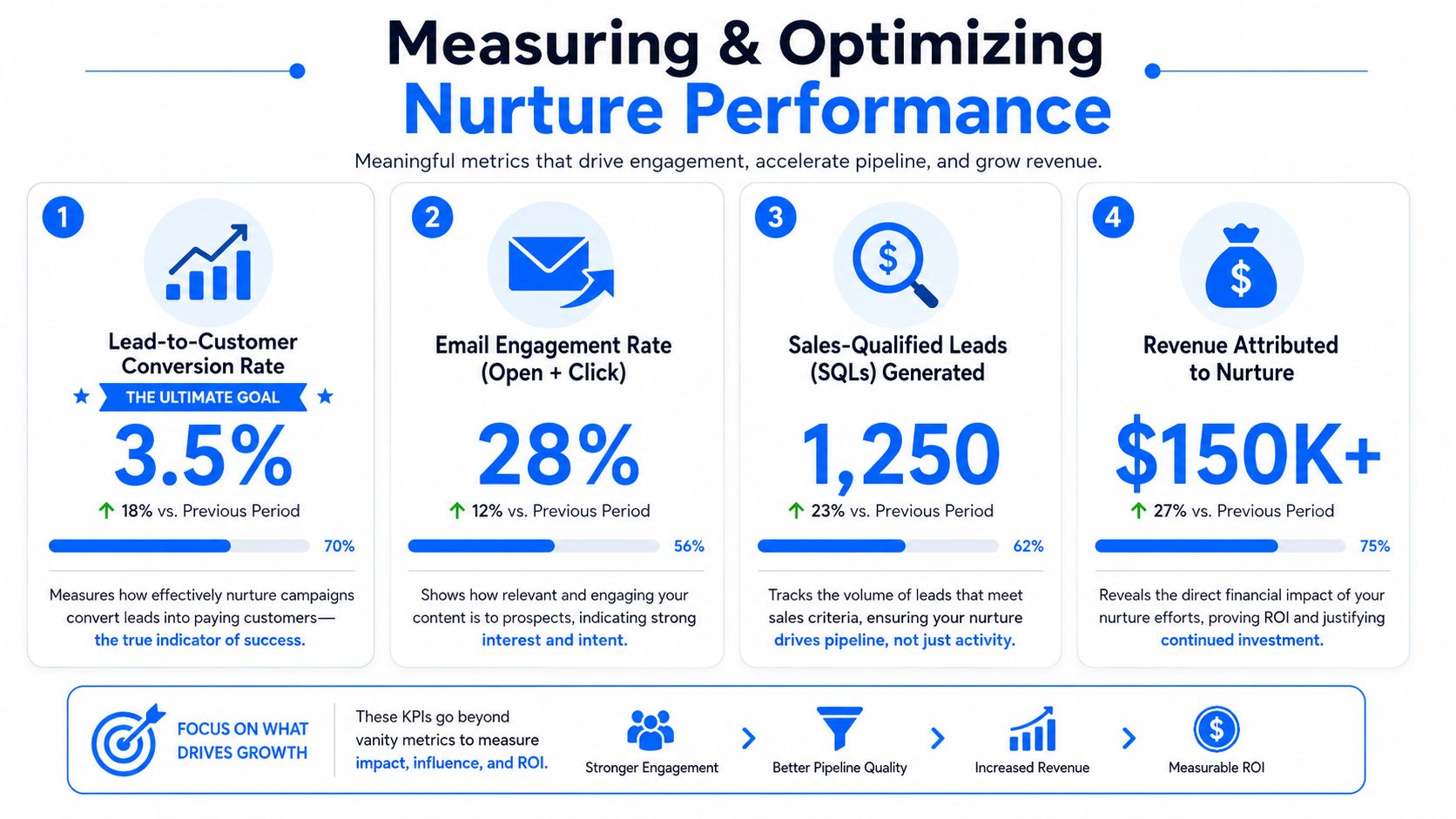
Open rate can tell you whether you earned attention. It can't tell you whether the sequence produced buying progress. For email marketing for lead nurturing, the useful question is whether leads are moving toward a sales-ready state faster and with better fit.
Measure movement, not just interaction
The most useful reporting usually sits in four buckets:
- Stage conversion: How many leads move from inquiry to qualified conversation, from qualified conversation to opportunity, and from opportunity to pipeline.
- Lead velocity: How long it takes a nurtured lead to reach a meaningful handoff point.
- Content contribution: Which assets repeatedly appear before conversion events.
- Sequence performance: Which workflows create qualified meetings, replies, trial starts, or demo requests.
A practical scorecard looks like this:
Metric
What it shows
Why it matters
Lead-to-opportunity movement
Whether nurture creates pipeline
Direct business impact
Time to sales readiness
Whether sequence accelerates intent
Helps forecast handoff timing
CTA conversion by stage
Whether offers match buyer readiness
Improves sequence design
Unsubscribe and inactivity trends
Whether cadence or message is off
Protects long-term performance
Tooling starts to matter. Platforms such as HubSpot or Customer.io can support behavioral workflows and reporting, and systems like Breaker can combine email sends with list growth, segmentation, analytics, and deliverability management for B2B teams that want audience expansion connected to nurture operations.
Use adaptive frequency instead of fixed cadence
A fixed nurture cadence is easy to manage and often wrong for the buyer.
Some leads want a faster sequence because they're actively evaluating. Others need space. If you keep pushing everyone through the same schedule, engaged leads can stall and lower-intent leads can burn out.
According to Adobe's article on lead nurturing emails, emerging 2026 HubSpot data shows that adaptive frequency, reducing cadence to 2 emails per month after low engagement or increasing to 3 after high interaction, improves long-term conversion by 22% and cuts unsubscribe rates by 35%.
That's a useful operating principle:
- Increase cadence when buyers engage actively
- Slow down when they stop responding
- Reset cadence after high-intent actions
- Don't force a long sequence when a sales conversation is the better next step
Test the parts that change decisions
A/B testing often gets wasted on cosmetic changes. Button color is rarely the problem.
Test decision-shaping variables instead:
- Offer type: Demo versus consultation versus guide
- Message angle: Pain-led versus outcome-led
- Proof format: Webinar replay versus customer story versus implementation note
- Send timing: Immediate trigger versus delayed follow-up
The best optimization work usually comes from studying where intent drops, not where opens dip.
Protect Your Reputation and Land in the Inbox
A nurture strategy can be perfectly mapped and still fail if your mail doesn't arrive.
Deliverability work isn't glamorous, but it protects everything upstream. If your list quality is weak, your domain is cold, or your authentication is incomplete, inbox placement gets harder. Once sender reputation slips, even good campaigns underperform.
Keep list hygiene boring and strict
List hygiene should run as an operating process, not as a cleanup project every few quarters.
That means removing bad addresses, watching for disengaged segments, and resisting the urge to keep dead weight on the list just to preserve volume. A bloated database creates the illusion of reach while undermining performance.
Good list hygiene usually includes:
- Removing hard bounces quickly
- Suppressing chronically inactive contacts
- Separating prospects from customers
- Using clear consent standards
- Checking acquisition sources regularly
If you want a deeper operational breakdown, this guide to email sender reputation covers the habits that keep deliverability stable over time.
Treat authentication as infrastructure
SPF, DKIM, and DMARC are not marketing tasks in the creative sense, but they are marketing dependencies. They help receiving providers trust that your mail is legitimate and consistent with your sending domain.
You don't need to turn your growth team into an IT desk. You do need someone accountable for making sure authentication is set up, monitored, and maintained whenever domains, tools, or sending patterns change.
A few practical rules matter here:
- Warm up new sending sources gradually
- Avoid sudden spikes in volume
- Align sending identity across tools
- Make unsubscribing easy
- Review complaint signals before they become a pattern
Write for trust, not just clicks
Deliverability is partly technical and partly behavioral. Mailbox providers watch how recipients respond. If people ignore your emails, mark them as spam, or stop engaging altogether, that feedback affects future sends.
That's why reputation protection starts in the strategy itself:
- Don't send broad sequences to weak-fit leads.
- Don't hide the unsubscribe link.
- Don't keep pushing stale contacts.
- Don't promise one thing at signup and deliver something else later.
The simplest rule is the one frequently overlooked. Only send emails that make sense for the recipient's context and consent.
That discipline compounds. Over time, better targeting improves engagement, stronger engagement protects reputation, and stronger reputation gives your nurture program a fair chance to perform.
Breaker fits this workflow for teams that want one system for B2B newsletter sends, ICP-based audience targeting, subscriber growth, analytics, and deliverability controls. If you want to see how it works in practice, explore Breaker.
Keep reading
All articlesDrip Campaign Template: Ready-to-Use Email Sequences
Get 6 ready-to-paste drip campaign templates with subject lines, body copy, and send timing—plus a step-by-step guide to building your own.
Post-Webinar Survey Questions Template (2026)
30+ post-webinar survey questions with NPS, CSAT, and CES templates, plus timing and length tips to boost completion and qualify leads faster.
GDPR Consent Requirements for Purchased Email Lists
Purchased email lists rarely meet GDPR's consent bar. Learn the legal basis rules, PECR overlap, and safer alternatives before you hit send.