
Funnel Content Marketing: 2026 B2B Strategy Guide
Build a B2B funnel content marketing strategy that converts. Our 2026 guide covers content mapping, KPIs, and tactics to turn readers into high-quality leads.
You're publishing. The blog is active, LinkedIn posts go out on schedule, someone on the team is recording short videos, and the newsletter gets sent every week. On paper, content is happening.
Then leadership asks a simple question: which of this is moving pipeline?
That's where a lot of B2B teams realize they don't have a content strategy. They have content activity. Assets exist, but there's no clear path from first touch to serious buying intent. Blog posts chase traffic. webinars sit in a resource hub. case studies get used only when sales asks for them. The newsletter becomes a distribution channel with no role in qualification.
That's the problem funnel content marketing solves. It gives each asset a job, a stage, and a next step.
It also forces a more honest view of how B2B buying works now. The old version of the funnel assumes people discover your brand, consume your content in order, then request a demo. That's neat. It's also incomplete. Approximately 50-80% of B2B buyer research happens in the dark funnel, on review sites, third-party communities, peer conversations, and social platforms that your attribution stack can't fully see, according to Infuse's explanation of the content marketing funnel.
So the job isn't just to create TOFU, MOFU, and BOFU content. The job is to influence buyers before they enter your measurable funnel, then use owned channels, especially your newsletter, to pull them into a system you can guide and learn from.
Moving Beyond Random Acts of Content
Random acts of content usually look productive from the inside. The SEO lead wants more blog coverage. Demand gen wants more landing pages. Sales asks for one-pagers. The founder wants thought leadership on LinkedIn. None of these requests are wrong.
They only become a problem when every asset is created in isolation.
A blog post without a follow-up path is just a traffic play. A case study with no distribution plan is a sales attachment. A newsletter without segmentation is a publishing habit. Teams end up with a growing library and a weak buying journey. It is also why most blogs never earn much, as our look at whether money can be made blogging shows.
What random content looks like in practice
You can usually spot it fast:
- TOFU overload: The team keeps shipping educational content because it's easier to ideate and often easier to rank.
- Weak middle: There's little that helps a buyer compare approaches, understand implementation, or evaluate fit.
- Late proof: Customer evidence, demos, pricing guidance, and decision content show up only after a lead is already in sales.
- No bridge from dark funnel to owned audience: People may hear about you in a Slack group, on Reddit, or from a peer, but there's no deliberate path into your newsletter or nurture flow.
That last point matters more than many organizations admit. A lot of intent is formed before someone ever lands on your site. If your strategy starts only at the website visit, you're already late.
Practical rule: Don't judge your content program by output. Judge it by whether each asset earns the next action.
A better operating model
Strong funnel content marketing does three things at once.
First, it creates discovery assets that can show up where buyers are already researching. Second, it gives interested people a low-friction way to enter an owned channel. Third, it sequences deeper proof based on intent, not on a rigid calendar.
That's why the newsletter matters so much in modern B2B. It's one of the few channels where you control the audience relationship, can test narratives quickly, and can see what topics consistently pull people toward commercial action.
The practical shift is simple. Stop asking, “What content should we publish next?” Start asking, “What buyer question are we answering, at what stage, and what should happen after they consume it?”
The Three Stages of Funnel Content Marketing
A useful way to think about the funnel is as a business conversation.
At first, you're talking about the problem in broad terms. Then you're talking about possible approaches. Finally, you're talking about which vendor, product, or service makes the most sense.

TOFU awareness
Top-of-funnel content attracts individuals who recognize they face a challenge but are not yet prepared to evaluate vendors. These prospects search for definitions, frameworks, trends, and practical advice. Blog posts, social posts, educational videos, and explainers perform most effectively during this initial stage.
TOFU matters because it creates reach. But it's a mistake to confuse reach with buying intent.
According to Semrush's analysis of content marketing funnels, TOFU content drives 70-80% of total funnel traffic, while BOFU content achieves 15-25% conversion to sales-qualified leads even though it makes up only 10-20% of content volume. That's the central tension in B2B content. The top gets attention. The bottom creates revenue movement.
MOFU consideration
Middle-of-funnel content helps buyers evaluate approaches and decide whether your point of view is credible. At this stage, people want comparison content, webinars, use-case pages, implementation guidance, and stronger proof than a general educational article can provide.
MOFU is where weak content strategies often collapse. Teams generate interest, then fail to answer the next set of questions. Buyers don't need another broad article at this stage. They need help making sense of trade-offs, risk, effort, and internal buy-in.
A good MOFU asset doesn't just educate. It narrows the field.
BOFU decision
Bottom-of-funnel content removes doubt. At this stage, you use product demos, testimonials, case studies, pricing pages, consultation pages, and clear sales enablement material.
At this stage, buyers are less interested in general expertise and more interested in fit. Can this solve our problem? Can this team support us? Is this worth the switch, the budget, and the internal friction?
Most teams don't have a traffic problem. They have a progression problem. They create awareness content and hope intent appears later.
A simple stage comparison
Stage
Buyer mindset
Best content job
Typical B2B examples
TOFU
“I need to understand the problem.”
Attract and educate
Blog posts, trend analysis, short educational videos
MOFU
“I'm comparing options and approaches.”
Build trust and shape evaluation
Webinars, detailed guides, case studies, comparison pages
BOFU
“I need proof and a next step.”
Reduce risk and convert
Demos, testimonials, pricing guidance, consultations
Mapping B2B Content to Each Funnel Stage
The easiest mistake in funnel content marketing is assigning formats too rigidly. Teams say blog posts are TOFU, webinars are MOFU, and case studies are BOFU. That's directionally useful, but incomplete.
In practice, context and message matter more than format.
What belongs where
A blog post usually sits at TOFU because it answers broad questions and captures search demand. But a blog post comparing implementation models or evaluating vendor categories can work in MOFU. A case study often supports BOFU, but it can also help MOFU readers understand what success looks like before they're sales-ready.
That's why content mapping should start with the buyer's question, not the asset type.
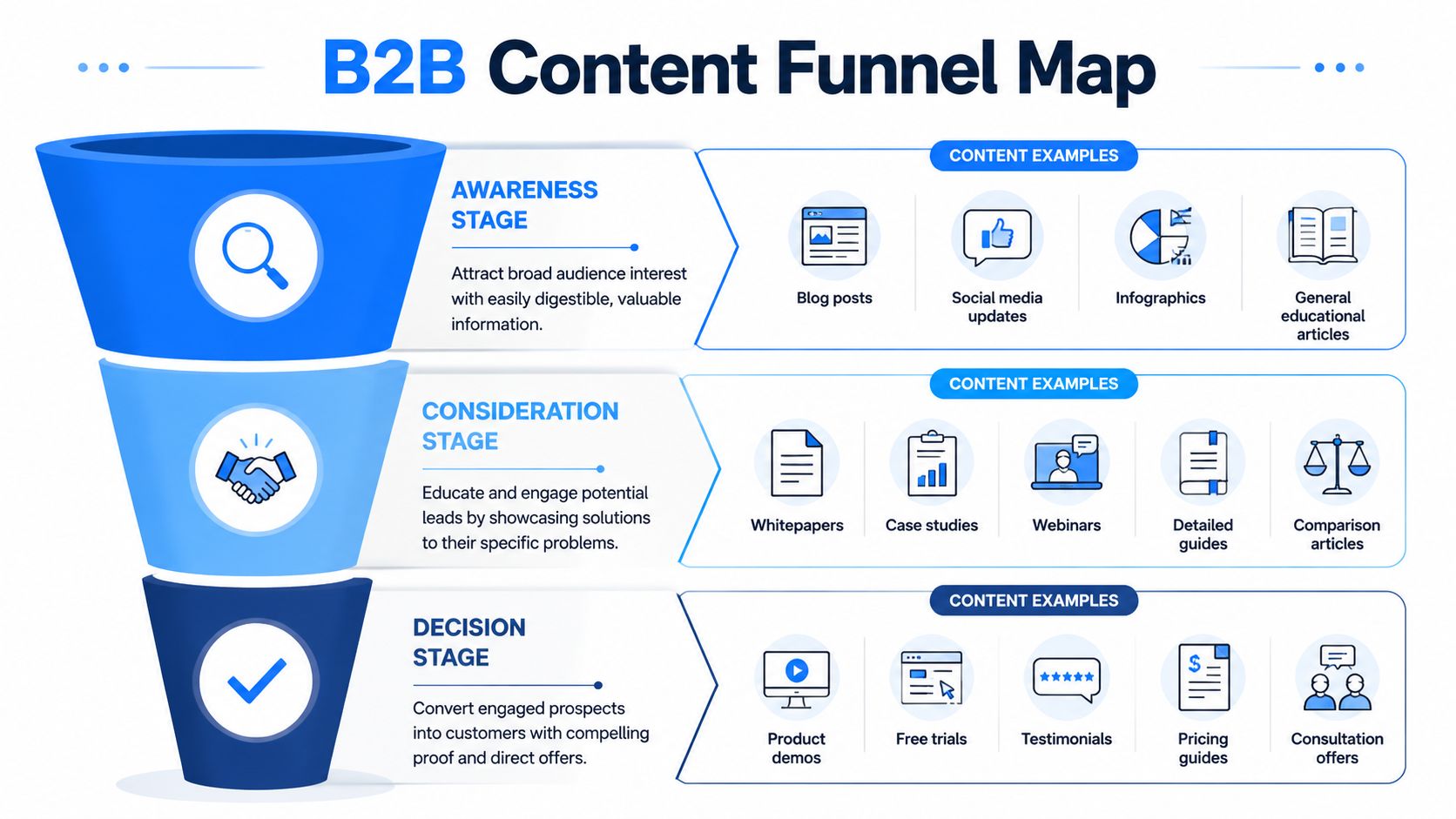
Here's a practical way to map common B2B content:
- TOFU content: Educational blog posts, expert POV posts on LinkedIn, short explainer videos, industry infographics, founder commentary, podcast clips
- MOFU content: Webinars, comparison articles, tactical guides, email nurture sequences, use-case pages, selective case studies
- BOFU content: Product demos, testimonial pages, customer evidence, implementation docs, pricing explainers, sales decks, consultation offers
If you want a useful companion framework for optimizing your B2B content funnel, Feather's guide is worth reviewing alongside your own content audit.
Video is the clearest example of stage fit
Video proves the format point well. The same medium can play very different roles depending on intent.
An educational video can introduce a category problem at TOFU. A walkthrough or expert-led session can support evaluation in MOFU. A testimonial or sales enablement clip can remove doubt in BOFU.
That isn't just theory. Vidyard's 2026 data shows mid-funnel nurture content using video sees an 82.3% uplift in conversion over text, while bottom-funnel sales enablement videos achieve 71.8% higher conversions, as summarized in this benchmark roundup.
The wrong lesson is “make more video.” The right lesson is “match the video to the buyer's decision.”
A practical mapping test
Before you publish any asset, ask three things:
- What question is this answering?
If the answer is broad and educational, it's probably TOFU. If it's comparative or operational, it's likely MOFU. If it's risk-reducing and vendor-specific, it's BOFU.
- Who should consume it next?
A TOFU article should lead naturally to a subscribe CTA, checklist, or webinar. A MOFU webinar should lead to a case study, demo, or consultation. BOFU content should make action easy.
- Could this asset work in two stages?
High-impact content often can. A case study can be repurposed into a short LinkedIn post, a newsletter lesson, a sales deck slide, and a late-stage proof asset.
That last point becomes critical once you stop assuming buyers move in a straight line.
Building Your Funnel Content Strategy Framework
A workable strategy doesn't start with an editorial calendar. It starts with audience truth. If you skip that step, you'll produce polished content that sounds right and converts poorly.

Start with pains, triggers, and objections
Your ICP isn't just a company type or job title. In funnel terms, you need to know what triggers attention, what slows evaluation, and what blocks purchase.
For a B2B SaaS company, the trigger might be pipeline inefficiency. For a fractional CMO, it might be a team that can't turn content into measurable demand. In both cases, the content needs to reflect the buying situation, not just the market category.
A simple planning doc should include:
- Trigger events: What makes this person start researching now
- Pain points: Operational, financial, or political friction
- Decision blockers: Budget, implementation risk, team capacity, stakeholder disagreement
- Proof requirements: What they need to believe before taking a next step
If you need a broader planning resource before turning that into an execution calendar, Outrank has a helpful guide on how to build a powerful content plan.
Build around pillars and recycled assets
One of the biggest flaws in linear funnel guides is the assumption that each stage needs its own completely separate content set. That's expensive, slow, and usually unnecessary.
High-performing teams know buyers jump stages. They create flexible assets, like a single case study, that can be recycled for both TOFU awareness and BOFU decision-making, as noted in HubSpot's discussion of content for every funnel stage.
That means your strategy should include a small number of pillar assets, then several stage-specific derivatives.
Pillar asset
TOFU use
MOFU use
BOFU use
Research-backed guide
SEO article, LinkedIn post
webinar, checklist
consultation prep material
Case study
key lesson post, founder thread
nurture email, objection handling
sales proof, demo follow-up
Customer interview
short clips, insight post
webinar segment, comparison point
testimonial page, sales asset
Reuse isn't laziness. It's how you maintain message consistency across a messy buying journey.
A four-part framework that holds up in real B2B
1. Define the ICP in buying terms
Map what each persona needs to know, prove internally, and avoid.
2. Research topics by stage
Use tools like Semrush, your CRM notes, Gong call themes, and customer interviews to separate educational topics from evaluative topics and decision content.
3. Create one pillar, then derivative assets
Don't start with ten isolated pieces. Start with one strong point of view and adapt it across channels and stages.
4. Plan distribution and nurture together
Publishing without a follow-up sequence wastes effort. Every TOFU asset should feed an owned audience path. Every MOFU asset should prepare a commercial next step.
This is what makes funnel content marketing resilient. It doesn't assume the buyer behaves neatly. It assumes the system has to.
Driving Your Funnel with a B2B Newsletter
The newsletter is often treated like a side channel. In B2B, that's a mistake. It should be one of the central operating layers of your funnel.
Your blog may attract first-touch attention. Social may create awareness in the dark funnel. Search may capture active demand. But the newsletter is where you build an ongoing relationship on infrastructure you control.
That matters because modern buyers don't consume one asset and convert. They circle around a problem, ask peers, bookmark links, ignore you for weeks, then return when a need becomes urgent. The newsletter keeps you present through that messy middle.
Why the newsletter is the bridge
A good B2B newsletter does more than distribute content. It lets you translate weak intent into observable behavior.
Someone discovers a category article through search or sees a founder post in LinkedIn comments. They subscribe because the value proposition is clear. Over time, their clicks tell you what kind of problem they're trying to solve. That makes the newsletter both a nurture engine and a signal layer.
Here's the practical job description for a newsletter inside funnel content marketing:
- Capture TOFU attention: Turn passive readers into owned audience
- Nurture MOFU intent: Deliver case studies, guides, webinars, and comparison content over time
- Surface BOFU readiness: Watch which subscribers consistently engage with decision-oriented topics
- Feed sales context: Use engagement history to shape outreach and qualification
If you're still defining the basics, this primer on how to start a newsletter is a useful operational starting point.
What to send at each stage
A strong newsletter doesn't feel like a product drip. It feels like a curated stream of useful decisions.
For TOFU-heavy subscribers, send educational insights, trend breakdowns, and practical lessons. For readers moving into evaluation, shift toward implementation advice, customer stories, and comparison angles. For high-intent subscribers, put direct proof and next steps in front of them without making every issue feel like a sales email.
A useful example is below.
What doesn't work
Three newsletter patterns usually underperform in B2B:
- The company update email: Internal news isn't the same as buyer value.
- The link dump: A list of recent posts gives readers no reason to care.
- The hard-sell sequence: If every send pushes a demo, subscribers stop treating the newsletter as useful.
A newsletter should help a buyer make sense of their problem before it asks them to take your preferred action.
When it's done well, the newsletter becomes the connective tissue between dark funnel discovery and measurable funnel progression.
How to Measure Funnel Content Success
If you only measure content by pageviews, you'll keep funding the top of the funnel and wondering why pipeline feels disconnected. Measurement needs to match stage intent.
TOFU should prove visibility and audience creation. MOFU should prove progression and engagement quality. BOFU should prove conversion and sales movement.
What to track by stage
A clean stage-based scorecard is usually enough.
Stage
What to watch
What it tells you
TOFU
Organic traffic, keyword visibility, new subscribers
Whether content is attracting the right audience
MOFU
Asset consumption, webinar signups, newsletter clicks, return visits
Whether interest is deepening
BOFU
Demo requests, consultation requests, conversion rates, content influence on deals
Whether content is helping create revenue outcomes
For email specifically, you should also keep a close eye on engagement and list health. Break down click behavior by segment, by topic, and by CTA pattern. This overview of email campaign performance metrics is useful if you want a practical checklist for that layer.
If you want a broader system for reporting business impact, PromptPosition's guide to tracking content performance is a solid companion resource.
Use friction data, not just conversion summaries
Stage metrics tell you what happened. Behavioral tools help explain why.
That's where heatmaps and session replays become useful. Contentsquare reports that 40-60% of TOFU drop-offs come from low scroll depth on landing pages. It also notes that fixing those friction points, such as moving a CTA above the fold, can lift MOFU progression by 22% and BOFU demo requests by 35%, according to Contentsquare's funnel optimization guide.
That's practical because it ties a surface-level engagement issue to downstream revenue behavior.
A simple diagnostic workflow
Use this when a page gets traffic but underperforms:
- Check the stage fit
Is the page attracting early-stage traffic while offering a late-stage CTA? That mismatch is common.
- Review behavioral data
Look at scroll depth, click maps, and replays. Are readers reaching the CTA? Are they hesitating at forms or long content blocks?
- Tighten the next step
A TOFU visitor may not want a demo. They might want a checklist, newsletter signup, or webinar invite.
- Measure the downstream impact
Don't stop at page conversion. Watch whether the fix improves qualified progression later.
The point isn't to measure everything. It's to measure enough to know where the funnel is leaking and what changed after you fixed it.
Funnel Content Templates and Tools for B2B
A huge content system is not necessary for getting started. A working template that keeps content tied to a buying journey is what is required instead.
Template for a B2B SaaS team
A lean SaaS funnel might look like this:
- TOFU pillar: An in-depth guide answering a category problem your ICP actively searches for
- MOFU asset: A webinar or tactical walkthrough showing how different solution paths work in practice
- BOFU asset: A comparison sheet, testimonial-backed landing page, or live demo page
In execution, one topic can stretch far. The pillar guide can feed LinkedIn posts, newsletter issues, sales follow-up links, and webinar talking points. That gives the team a coherent narrative instead of disconnected campaigns.
Template for a consultant or fractional CMO
A consultant's version is different because the sale depends more on trust and expertise transfer.
- TOFU entry point: A point-of-view article on LinkedIn or a practical blog post on a common growth problem
- MOFU nurture layer: A short newsletter series that shows diagnosis, framework, and examples
- BOFU conversion point: A page offering a strategy call with clear positioning, scope, and fit criteria
For teams assembling their stack, this roundup of B2B content marketing tools is a helpful shortcut.
A lean tool stack that actually works
You don't need dozens of tools. You need coverage across publishing, research, analytics, and owned distribution.
- CMS: Webflow or a similar platform that makes publishing and page updates fast
- SEO research: Semrush for keyword mapping and topic discovery
- Analytics: Google Analytics for stage movement and page-level behavior
- Behavior tools: Contentsquare or similar for heatmaps and session replays
- CRM: HubSpot or your existing sales system for attribution and lead status
- Newsletter platform: A system that supports list growth, segmentation, and performance visibility
The important part isn't the brand list. It's that the tools connect. Funnel content marketing breaks when your SEO team, content team, email program, and sales reporting all operate as separate systems.
That's why the best setup is the one your team will use every week.
If your B2B content program needs a stronger bridge between audience growth, newsletter nurture, and measurable pipeline, Breaker is built for that job. It helps teams grow the right subscriber base, send campaigns that match buyer intent, and turn the newsletter into an active part of the funnel instead of a side project.
Keep reading
All articlesEmail Automation Workflow & Drip Campaign Data Structure
Learn the database schema behind email drip campaigns—tables, workflow states, and event logs that power reliable marketing automation.
Breaker Review: AI-Native ESP for Newsletter Growth
An unbiased Breaker review: pricing, features, deliverability data, and who this AI-native email platform fits best for newsletter growth.
Breaker for B2B, SME and Consumer Newsletter Senders
Learn how B2B, SME, and consumer audiences differ in newsletters, plus a framework for segmenting, messaging, and monetizing each without losing relevance.