
Account Planning Template to Fuel B2B Growth
Download our free account planning template (Sheet/Doc) and learn how to drive B2B growth. Turn static plans into dynamic revenue drivers with our guide.
You already know the feeling. The account plan looked solid in January. It had the right logo on the cover, a clean SWOT, a few named stakeholders, and a growth target everyone nodded at in the kickoff.
By April, half the contacts had changed, priorities had moved, a new team started influencing the deal, and the document was sitting untouched in a folder no one opened before customer calls.
That’s the problem with most account planning templates. They’re built like annual paperwork, but enterprise accounts don’t behave that way. If your plan doesn’t change with buyer activity, stakeholder movement, and engagement signals, it stops helping your team make decisions.
Why Most Account Plans Fail and How This One Succeeds

Most account plans fail for a simple reason. Teams treat them like a deliverable instead of an operating system.
A static plan creates false confidence. It captures a moment in time, then gets outdated as soon as the customer reorganizes, a champion leaves, or a different department becomes the primary path to expansion. That failure pattern is widely recognized. SalesMotion’s account planning guide notes that existing account planning templates heavily favor static, annual documents and miss real-time updating mechanisms B2B teams need, which is why plans built in January can become “fiction by March or April.”
The wrong assumption
The common assumption is that account planning is mostly a strategy exercise. It isn’t. Strategy matters, but execution quality depends on whether the plan stays connected to what’s happening inside the account.
That matters even more when sales and marketing share responsibility for growth. When one team tracks meetings and pipeline while the other tracks content engagement and audience behavior, the plan has to unify those signals or it becomes fragmented. If your team is working through the operational side of unifying sales and marketing teams, account planning is one of the best places to force that alignment into a shared workflow.
Account plans go stale when ownership is vague. They stay useful when every update has a trigger, an owner, and a next action.
What works instead
The fix is a living account planning template. That means the core structure stays stable, but the contents change continuously. Stakeholder maps get updated when roles shift. Growth opportunities change when a new business unit opens up. Risk notes change when procurement slows or a competitor gains ground. Engagement signals influence where your team spends time next.
This approach isn't just cleaner; it performs better. Teams using detailed account planning frameworks achieve 28% higher expansion revenue from key accounts, according to Altify’s account planning template guide.
A good living plan does three things well:
- Creates one source of truth so account managers, AEs, customer success, and marketers aren’t running separate versions of reality.
- Forces prioritization so top accounts get deeper attention, while lower-tier accounts use a lighter process.
- Links strategy to action so every insight turns into a meeting, a campaign, a stakeholder intro, or a deal move.
The shift that matters
The best account planning template isn’t the prettiest one. It’s the one your team updates before pipeline reviews, customer meetings, and quarterly business reviews.
If the document can’t help answer “Who matters now?”, “What changed?”, and “What do we do next?”, it’s not a plan. It’s archive material.
Inside Your Dynamic Account Planning Template
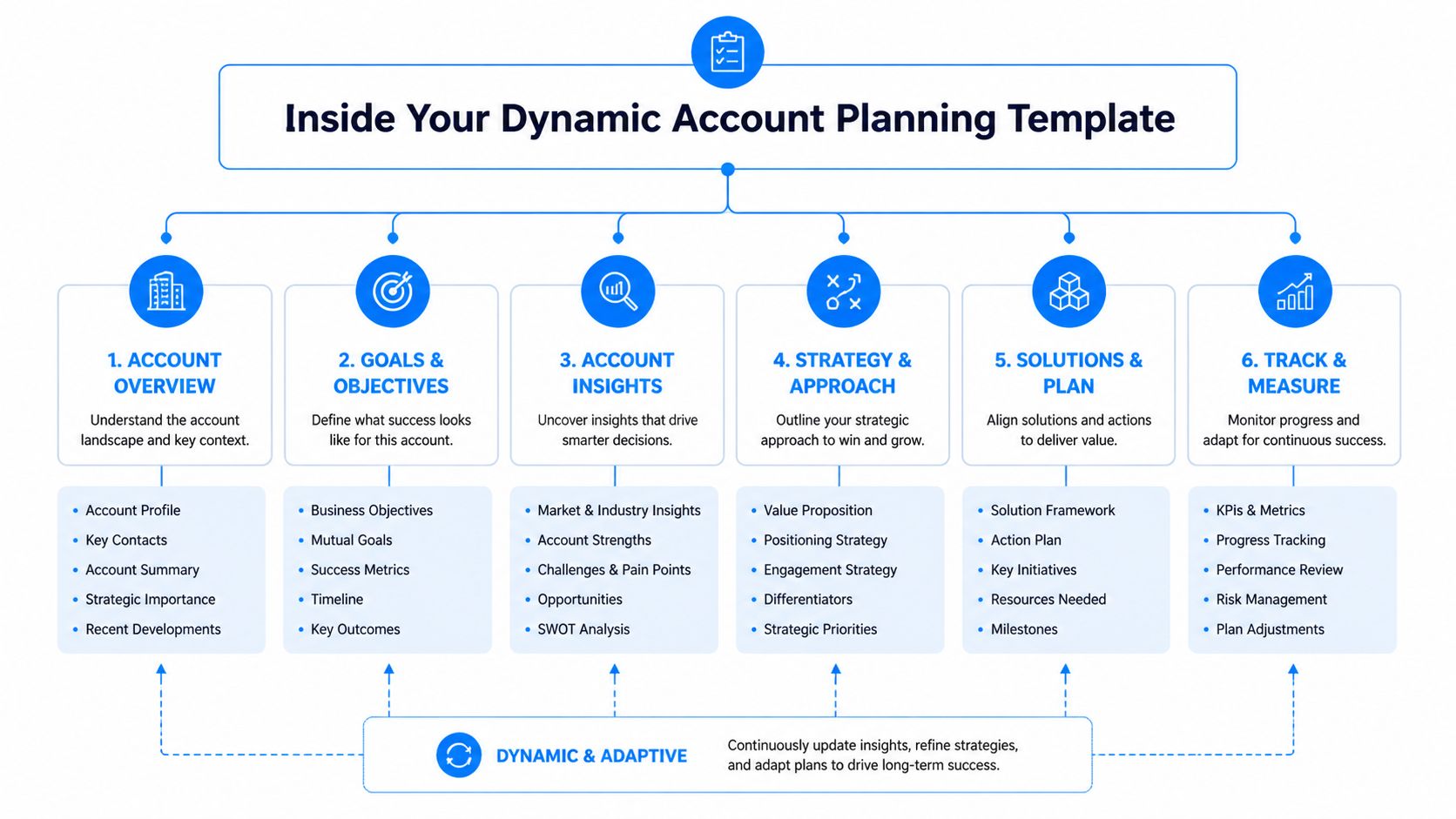
A strong account planning template needs enough structure to guide thinking without becoming so heavy that no one updates it. The most practical version I’ve seen is built around a standard backbone, then adapted for live use inside the team’s daily workflow.
A typical effective template includes seven essential sections: account overview, stakeholder map, relationship strength, whitespace opportunities, growth plan, risks and blockers, and a QBR cadence, as outlined in Prolifiq’s account planning template framework. That structure works because each section answers a different operational question.
Account overview
This is the orientation layer. It should give anyone on the team a fast read on the account’s business, current footprint, priorities, and strategic value.
Keep it tight. If the overview becomes a company history report, people stop reading it.
Include items like:
- Business summary with the customer’s model, major initiatives, and current relationship status
- Current footprint showing products, teams, or regions you already support
- Strategic rationale explaining why this account deserves planning effort now
Stakeholder map and relationship strength
These two sections belong together in practice, even if they sit on separate tabs.
The stakeholder map shows the buying environment. The relationship layer tells you whether access is real, weak, or misleading. A contact in your CRM isn’t automatically a useful relationship. The map should show role, influence, internal alliances, current stance, and recent engagement history.
Practical rule: If your stakeholder map only lists job titles and email addresses, it’s a directory, not an account plan.
Dynamic updating matters most. People move. Power shifts. New evaluators show up late. Your template should make those changes easy to log without rewriting the whole document.
Whitespace and growth plan
Whitespace is where teams usually get vague. They write “cross-sell finance” or “expand into EMEA” and call it strategy. That’s not enough.
A useful whitespace section should separate opportunity types by what has to be true for them to happen. Some opportunities require executive sponsorship. Others require product adoption in one team before rollout elsewhere. Some need marketing air cover before sales outreach makes sense.
Use the growth plan to convert that analysis into a sequence:
- Prioritize the expansion path
- Identify the people and proof points needed
- Define the next action
- Assign an owner and review date
Risks, blockers, and operating cadence
Most plans underplay risk until a deal slips. That’s backward. Risks should sit in the middle of the plan, not the appendix.
Track blockers like procurement friction, a missing executive sponsor, weak adoption in one business unit, or a competitor with stronger relationships. Then add a simple review cadence. Monthly reviews work well for active growth accounts. QBRs matter, but they aren’t enough on their own.
Here’s the simplest way to think about the template architecture:
Section
What it answers
What good looks like
Account overview
Why does this account matter now
Clear, short, current
Stakeholder map
Who influences outcomes
Roles, influence, access, gaps
Relationship strength
Where are we strong or exposed
Honest scoring with evidence
Whitespace opportunities
Where can we grow
Prioritized, not wishful
Growth plan
What happens next
Owners, actions, timing
Risks and blockers
What could stall progress
Visible and updated
QBR cadence
When do we reassess
Fixed rhythm with decisions
If you’re building your own account planning template in Google Sheets, Excel, or Docs, this is the structure to start with. Don’t add more tabs until the team consistently uses these well.
A Step-by-Step Guide to Completing Your Plan
The easiest way to make an account planning template useful is to fill it out against a real account, not in theory. Let’s use a fictional B2B software company, Acme Corp, building a plan for a target enterprise customer called Northstar Health.
Northstar already uses one Acme product in a single division. The growth opportunity is broader, but the account is messy. There’s one supportive director, a neutral operations lead, and limited visibility into the executive team.
SalesHood outlines an 8-step strategic account planning process: account snapshot, SWOT analysis, key initiatives chart, business unit analysis, org chart, connect-the-dots strategy, opportunity map, and action plan. Teams following all eight steps report 35% YoY account growth, according to SalesHood’s strategic account planning guide.
Step 1 through Step 3
Start with the account snapshot. Acme captures the basics: where Northstar operates, which product is live, who owns the current relationship, and why the account matters. The point isn’t to be exhaustive. The point is to give every internal teammate the same starting picture.
Then Acme runs a SWOT. Teams often rush and lose value at this point. Instead of generic points like “strong brand” or “competitive market,” they write specifics tied to the account. Strength might be successful adoption in one department. Weakness might be no active relationship above director level. Opportunity might be adjacent use cases in another business unit. Threat might be a competitor already embedded with IT leadership.
The key initiatives chart comes next. Acme pulls likely priorities from public materials, customer conversations, and current project discussions, then validates them in live meetings rather than assuming they’re accurate.
If the customer hasn’t confirmed the initiative, treat it as a hypothesis, not a fact.
Step 4 through Step 6
Now Acme breaks the business down by unit. One division has active usage. Another has similar needs but no relationship. A third could matter later but has no near-term trigger, so it stays lower priority.
The org chart and political map transform that business perspective into a view of influence. Acme identifies the current champion, potential budget holders, probable evaluators, and anyone capable of obstructing progress. These account plans become useful for the first time in this section as they expose gaps in access.
The connect-the-dots strategy answers a practical question. Who can credibly open the next conversation? Maybe a customer success lead can deepen the current department relationship. Maybe a product leader should join a strategic conversation. Maybe marketing should warm up a new stakeholder group before sales asks for time.
For teams running account-based programs, it helps to study real account-based marketing examples so your engagement plan matches the complexity of the account rather than defaulting to generic outreach.
Step 7 and Step 8
Acme then builds the opportunity map. Not every possible deal belongs here. Only the opportunities with a plausible path, named stakeholders, and a reason to exist now.
That leads into the action plan. Here, the account planning template either becomes operational or dies.
A good action plan for this account might look like this:
- Validate executive priorities by having the account executive secure a meeting with the operations lead and current champion
- Expand stakeholder coverage by asking customer success to identify adjacent team owners involved in the current rollout
- Package a relevant point of view by having marketing prepare content specific to Northstar’s operational goals
- Open a second business unit by using the champion to sponsor an introduction, rather than cold outreach
- Review risk monthly so the team updates access gaps and competitive pressure before they affect pipeline
How the living model changes execution
A static plan would stop after these steps. A living plan keeps going.
When Acme learns that a new stakeholder from compliance has started attending calls, the org chart changes. When the current champion goes quiet, relationship strength gets rescored. When a new department starts consuming thought leadership and responding to targeted outreach, whitespace gets promoted into an active opportunity.
That’s the difference. The account planning template isn’t just a strategy worksheet. It becomes the place where the team records what changed and decides what to do about it.
Measuring Success with the Right Account KPIs
A quarter into the plan, the pipeline can still look fine while the account is subtly becoming more challenging to close. Your champion stops replying. A new evaluator enters the process and nobody updates the map. The buying group reads your newsletter, but sales never uses that signal to adjust outreach. If the only KPI you review is booked revenue, you find out too late.
A useful account scorecard combines outcome metrics with signals that change week to week. Revenue, expansion, and retention show whether the plan paid off. Coverage, engagement, and stakeholder movement show whether the account is getting stronger before the number hits the forecast.
Build a scorecard that sales can actually use
Keep it tight. If reps need a separate spreadsheet and a 30-minute explanation to interpret the scorecard, it will stop getting updated.
A good scorecard should answer three questions fast:
- Is this account growing?
- Are we getting into deals earlier and with better access?
- Is account health improving or slipping?
Here’s a practical KPI table.
Metric Category
KPI
What good looks like
Expansion
Expansion revenue from key accounts
Growing against account plan targets
Deal quality
Average deal size
Increasing as team reaches higher-value use cases
Conversion
Win rate
Improving in the segments and business units you targeted
Efficiency
Sales cycle length
Shorter as stakeholder access and buying clarity improve
Relationship health
Stakeholder coverage
Multi-threaded across users, managers, and economic buyers
Engagement health
Meeting frequency with key stakeholders
Consistent, with the right roles involved at the right stage
Buying confidence
Movement of new stakeholders into active conversations
More evaluators turning into participants and sponsors
Account fit
Alignment to ICP
Rechecked when priorities, team structure, or use case changes
If your team needs a sharper definition of fit, use a shared framework for what ICP means in marketing. It keeps account selection disciplined and stops teams from over-planning low-potential accounts.
Track progress that shows up before revenue does
The strongest KPI in account planning is often stakeholder progression.
Teams lose deals because they mistake activity for access. Ten meetings with one friendly manager can look like momentum. It is still weak account position if procurement, finance, operations, or an executive sponsor never enter the conversation. That is why a living account plan needs measures that capture movement inside the account, not just movement in the pipeline.
Track indicators like:
- Role depth, so you can see whether the account is still single-threaded
- Action completion, so planned moves turn into actual execution
- Opportunity maturity, based on validated initiatives and agreed next steps
- Risk movement, so competitive pressure, access gaps, and timing issues become visible early
- Engagement by stakeholder group, so newsletter clicks, replies, and content consumption help the team spot rising interest or fading attention
That last metric matters more than many teams admit. If a new department starts engaging with relevant content in Breaker, that can justify a new hypothesis about whitespace. If a known champion stops opening, clicking, or responding, the relationship should be rescored and the account plan should change. Static templates miss that shift. A living template uses it.
A healthy account plan gets sharper over time. A weak one gets longer.
Use KPIs to force decisions
KPIs matter when they trigger action.
If deal size stays flat, revisit whether the team targeted enough high-value use cases. If win rates look healthy but sales cycles keep stretching, stakeholder coverage is probably too shallow. If engagement is rising in marketing data but meetings are not increasing, sales may be missing a timing window. If executive access declines, the account needs a different path, not a prettier forecast note.
Review these metrics on a fixed cadence and update the plan while there is still time to change the outcome. That is how the template becomes a growth tool instead of a document built for account reviews.
Turning Your Plan into Action with CRM and Breaker
The fastest way to ruin a good account planning template is to leave it outside the team’s daily tools. If the plan lives in one place and execution lives somewhere else, updates slow down, ownership gets fuzzy, and the plan turns into a review artifact.
Your CRM should carry the operational load. The account plan should shape the fields, tasks, and meeting rhythm inside it.
Make the CRM the execution layer
Start by connecting each part of the plan to an existing workflow.
- Stakeholder changes should update contact roles, influence notes, and relationship status in the CRM
- Growth priorities should translate into opportunities, plays, or account tasks
- Blockers should become visible flags for managers, not hidden comments in a spreadsheet
- Review cadence should trigger recurring account reviews and QBR prep
If your CRM hygiene is weak, fix that before adding more planning layers. These CRM best practices are a good reference point for cleaning ownership, task discipline, and field consistency.
Use engagement data to keep the plan alive
A living plan needs live inputs. That doesn’t mean every click automatically rewrites strategy. It means engagement data should help the team decide where interest is building, where attention is fading, and which contacts are worth deeper outreach.
Useful signals include:
- New contact activity that suggests a business unit is starting to pay attention
- Repeat engagement from a stakeholder that may indicate growing relevance
- Silence from a former champion that could signal internal change or lost momentum
- Content resonance by topic that helps shape the next conversation
Newsletter and campaign data become valuable, not as vanity metrics, but as account intelligence. If a cluster of contacts inside one account consistently engages with content tied to a specific initiative, that should influence your next meeting agenda, outreach sequence, and stakeholder prioritization.
Create simple update rules
This is often overcomplicated. You don’t need heavy automation on day one. You need a few rules everyone follows.
For example:
- Update the stakeholder map after every meaningful meeting
- Review whitespace monthly when new activity appears in adjacent teams
- Rescore relationship strength when a key contact changes role or goes quiet
- Escalate blockers when they remain unresolved across two review cycles
The plan should change because the account changed, not because someone remembered the spreadsheet exists.
Once those habits are in place, the account planning template starts behaving like a management tool instead of a planning exercise. The CRM stores the record. The team discussion drives interpretation. The plan stays current because updating it is part of execution, not separate from it.
Evolving Your Account Strategy Over Time
The biggest mistake after building a solid account planning template is assuming every account deserves the same depth. They don’t.
Top-tier strategic accounts need the full model. Cross-functional input, deeper stakeholder mapping, active whitespace analysis, regular review, and explicit risk tracking all make sense there. For smaller or less strategic accounts, a lighter version is better. Keep the account snapshot, named stakeholders, key opportunities, and next actions. Drop the rest until the account earns more planning time.
Match the plan to the account tier
A simple tiering model keeps effort proportional.
- Tier one accounts get the full living plan with frequent review and broad internal visibility
- Tier two accounts get a reduced version focused on growth paths and relationship coverage
- Tier three accounts usually need opportunity management more than formal account planning
This prevents a common failure mode. Teams build beautiful plans for too many accounts, then update none of them well.
Build a review rhythm people will keep
A review cadence only works if it fits how your team already operates. Monthly check-ins are often enough to keep active accounts current. Quarterly reviews are the right moment to reassess strategic direction, resource allocation, and whether the original growth thesis still holds.
Use review meetings to answer a small set of recurring questions:
- What changed inside the account
- Where are we stronger or weaker than last review
- Which opportunity moved forward, stalled, or died
- What one decision do we need to make now
Keep those meetings short and evidence-based. If the discussion turns into account storytelling, the plan is too loose.
Treat the template as a discipline
The template matters, but the habit matters more. Strong teams use account planning as a cycle of observation, decision, action, and revision. Weak teams treat it as a document they present when leadership asks for one.
That distinction is what separates planning that supports growth from planning that only creates administrative work.
The best account planning template is never finished. It keeps earning its place because the team keeps using it to make better choices.
Breaker helps B2B teams turn newsletter engagement into a practical growth signal instead of a disconnected marketing metric. If you want a cleaner way to grow your audience, track real engagement, and support account-level execution with better data, take a look at Breaker.
Keep reading
All articlesWhy Scraped Email Lists Fail GDPR Compliance in Any ESP
Scraped email lists break GDPR Articles 6 & 7, risk €20M fines, and get your ESP account suspended. Learn the legal reality and the compliant path forward.
B2B Newsletter Strategy for Marketers Who Sell to Niche Pros
Build a B2B newsletter that drives real pipeline. Covers audience definition, content structure, frequency, deliverability, and ROI measurement.
The Subscriber Acquisition Channels That Actually Move the Needle for B2B Newsletters
Every B2B newsletter eventually runs into the same wall: content is going out reliably, the format works, and the list still isn't growing fast enough.