
Virtual Tip Jars for Newsletters: A B2B Guide
Learn how to use virtual tip jars to monetize your B2B newsletter. Our guide covers setup, integration with platforms like Breaker, CTA copy, and compliance.
You’ve probably felt this tension already. Your newsletter is valuable, your subscribers reply with thanks, and some issues clearly land harder than others. But between sponsorships, consulting offers, and paid subscriptions, there’s still a monetization gap for readers who want to support your work without committing to a bigger purchase.
That’s where virtual tip jars fit. For B2B newsletters, they’re not a gimmick and they’re not charity. They’re a lightweight revenue layer that captures intent from your most engaged readers at the exact moment they’ve just gotten value.
Most advice on virtual tip jars still assumes you run a cafe, play live music, or work hospitality. That misses a more interesting use case. A niche operator, consultant, or growth marketer with a strong newsletter audience can use the same mechanism in a more professional way. The play is simple: reduce friction, make the ask feel earned, track what converts, and treat the tip flow like any other monetization channel.
The Evolution of Tipping from Coffee Shops to Content
Virtual tip jars started as a survival tool, not a creator monetization feature. During the COVID-19 pandemic in 2020, they emerged as a low-tech way to support service workers hit by closures, often using simple setups built with Google Forms and Venmo, as described in this account of the rise of digital tip jars.

What made those early systems work wasn’t polish. It was immediacy. People already understood the social ritual of tipping. The digital layer removed the cash requirement and made support possible from anywhere.
That same behavioral shift matters for B2B media now. A reader finishes a sharp teardown, a useful operator memo, or a template they can use the same day. They may not want a paid plan. They may not be ready to book consulting. But they will sometimes pay a small amount to say, “This was worth it.”
Why the context has changed
In hospitality, a tip often follows service. In newsletters, a tip follows insight, curation, or utility. That distinction matters because it changes how you present it.
A B2B reader doesn’t want to feel like they’re being shaken down. They do respond when the tip jar is framed as a direct way to support independent analysis, specialized research, or practical tools that save time.
Practical rule: In a newsletter, a tip works best when it feels like a voluntary upgrade to a valuable reading experience, not a donation box bolted onto the footer.
Where it fits in a professional media business
Virtual tip jars sit between free and paid. They’re lighter than subscriptions and less operationally complex than sponsorships. They also do something subscriptions often don’t. They let a subscriber act on appreciation in the moment.
That makes them useful for:
- Consultants: Collect support from readers who aren’t buyers yet but trust your thinking.
- Fractional leaders: Turn high-signal thought leadership into direct reader revenue.
- Category newsletters: Capture value from loyal readers in narrow B2B niches.
- Operator-creators: Add a monetization path that doesn’t require a product catalog.
The biggest mental shift is this: tipping in B2B content isn’t unprofessional. Bad implementation is unprofessional. Clean placement, good copy, and clear expectations make virtual tip jars feel like a natural part of a modern newsletter business.
Why Virtual Tip Jars Belong in Your B2B Monetization Stack
The business case starts with friction. Sponsorships require sales effort. Paid subscriptions require a sustained content promise. Consulting depends on trust, timing, and budget. A tip jar asks for less from the reader and less from you.
That lower-friction model matters because digital prompts influence behavior. According to Square payment data cited by ABC7 Chicago, tips at full-service U.S. restaurants rose 25% in a single quarter, showing how effective prompted digital interfaces can be when the ask appears at the right moment in the customer journey, as covered in ABC7 Chicago’s reporting on digital tip jars.
A newsletter creator should read that less as a restaurant stat and more as a product lesson. If a prompt is timely, visible, and easy to act on, more people complete the action. Restaurant operators, on the other hand, can take it literally, and our restaurant email marketing guide shows how to build well-timed prompts into guest emails.
Tips don’t compete with your other revenue streams
The common objection is that a tip jar cheapens premium offers. In practice, it does the opposite when handled well. It creates a middle layer between “free reader” and “high-intent buyer.”
Here’s how that plays out:
Revenue layer
Reader commitment
Best use
Sponsorship
None from reader
Monetize reach
Tip jar
Low
Monetize appreciation
Paid subscription
Medium to high
Monetize recurring value
Consulting or services
High
Monetize trust and urgency
A tip jar captures people who are engaged but not yet ready for the next step. That’s useful in B2B because buying cycles are uneven. Someone may love your content for months before they need your service.
Tips also tell you who your superfans are
A tip is a small payment signal, but it’s still a payment signal. That makes it more meaningful than a casual click.
Subscribers who tip often become some combination of:
- Warm leads for workshops, advisory work, or premium research
- Reliable respondents who answer surveys and provide market feedback
- Community anchors who share your work internally or publicly
- Early buyers when you launch a new offer
That’s why I’d treat tip activity as both revenue and segmentation data. It tells you who doesn’t just consume your newsletter, but values it enough to act.
If you want a broader example of how small digital actions can become revenue experiments, the write-up on Narrareach’s $2,780 tweeting experiment is worth reading. It’s not about newsletters specifically, but it shows how direct audience monetization often starts with simple, testable asks rather than giant product launches.
The real upside is optionality
Virtual tip jars won’t replace core monetization for most B2B newsletters. They don’t need to. Their value is that they add optional revenue without forcing a business model overhaul.
That makes them especially attractive if you’re still building your stack. If you’re mapping out what sits alongside ads, sponsorships, subscriptions, and service offers, this guide to newsletter revenue streams for B2B monetization is a useful framework.
A good tip jar doesn’t interrupt your monetization model. It catches the intent your other revenue layers leave on the table.
Choosing the Right Platform for Your Newsletter
A reader finishes a strong issue, clicks your support CTA, and lands on a page that looks like it belongs to a streamer, not a B2B publisher. That drop in trust is where a lot of tip intent dies.
Platform choice shapes more than payment processing. It affects how professional the ask feels, how easily finance-minded readers can complete it, what data you get back, and how much operational work you create for yourself later. For a B2B newsletter, those details matter more than they do for a casual creator audience.
What actually matters for B2B newsletters
The usual creator advice focuses on speed and simplicity. B2B operators need a stricter filter. The platform has to support a professional buying experience and fit into a measurable revenue workflow.
Use these criteria when comparing options:
- Brand fit: The payment page should look credible to operators, marketers, consultants, and buyers who are used to polished SaaS checkouts.
- Click path: Every extra redirect or decision lowers completion rate.
- Payout control: Direct access to funds and reporting matters if you want to reconcile this revenue stream cleanly.
- Tracking: You need issue-level visibility so you can tie tips back to specific CTAs, topics, and sends.
- Mobile usability: A large share of email clicks still happen on phones, even in B2B.
- Post-payment flexibility: Confirmation screens, redirects, and follow-up options should support your next conversion step.
Those six criteria usually eliminate the wrong tools fast.
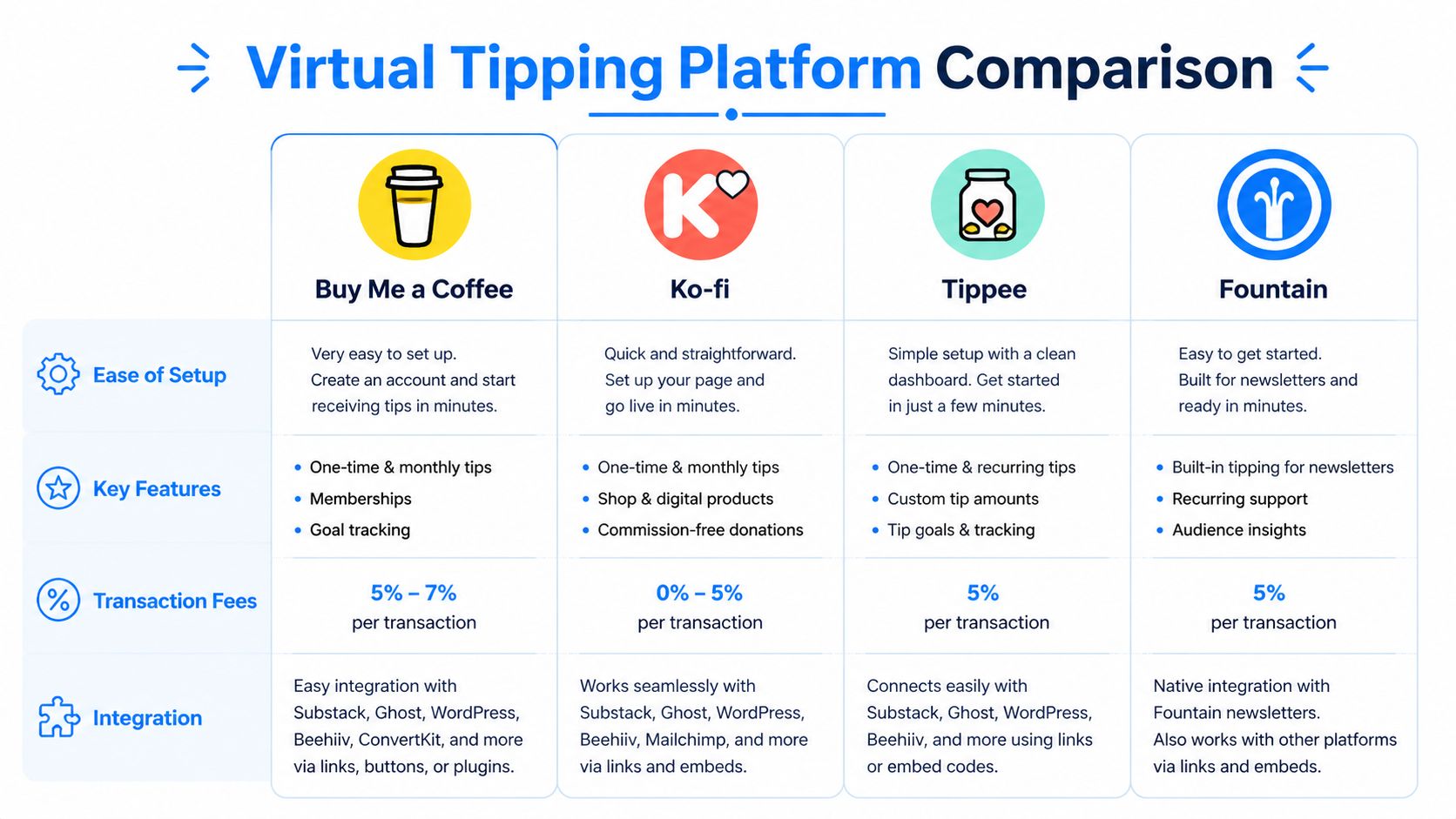
A practical comparison
Option
Best for
Strengths
Trade-offs
Buy Me a Coffee
Fast validation
Very quick setup, familiar flow, easy for solo operators
Branding can feel casual for enterprise-facing newsletters
Ko-fi
Mixed monetization
Supports tips plus memberships and extras
Design often needs more cleanup to feel business-ready
Stripe payment link
Brand control and cleaner reporting
Strong trust, direct checkout, more control over presentation
Setup takes more effort and requires thought around attribution
PayPal or Venmo link
Bare-minimum launch
Recognizable, easy to create, useful for quick tests
Lower polish, weaker analytics, and a less consistent B2B experience
Stripe usually wins when the newsletter already has premium positioning. Creator platforms win when speed matters more than presentation. PayPal and Venmo are fine for early testing, but they rarely age well once you care about reporting, UX, and brand perception.
Fees matter, but conversion matters more
Small payments are sensitive to fees, so it is reasonable to compare costs before you choose. But the cheaper option is not always the better option.
I would rather use a tool that keeps more trust and converts more readers than save a small amount on processing while sending people through a page that feels off-brand. In B2B, a weaker checkout experience can cost more than the fee difference. The right way to judge this is contribution margin per click, not fee percentage in isolation.
The wrapper around the payment link does a lot of the selling
A payment tool is only part of the experience. The page before the transaction often determines whether the ask feels deliberate or thrown together.
If you want a lightweight hub that gives readers a few clear options, it helps to compare link in bio services. The consumer examples are not a direct template for B2B newsletters, but the underlying questions are the same. How many choices should you show? How branded should the page be? How much friction can the reader tolerate before they drop?
A good rule is simple. If your readers buy software, research, or services for work, use the option that looks closest to a professional checkout and gives you usable attribution data.
My recommendation
Start with the platform that matches your current stage.
Use a creator platform if you need to validate demand this week. Use Stripe if brand control and cleaner reporting already matter. Use a simple payment link only if speed is the priority and you are comfortable replacing it once the channel proves itself.
The mistake is not choosing the “wrong” tool on day one. The mistake is choosing a tool that makes the ask feel less credible than the newsletter they just paid to support.
Integrating and Designing Your Tip Jar in Breaker
A reader finishes your teardown on SaaS pricing, clicks your tip CTA, and lands on a page that looks like a personal payment shortcut. That click often dies there. In a B2B newsletter, the tip jar has to feel like part of the product, not a casual side request.
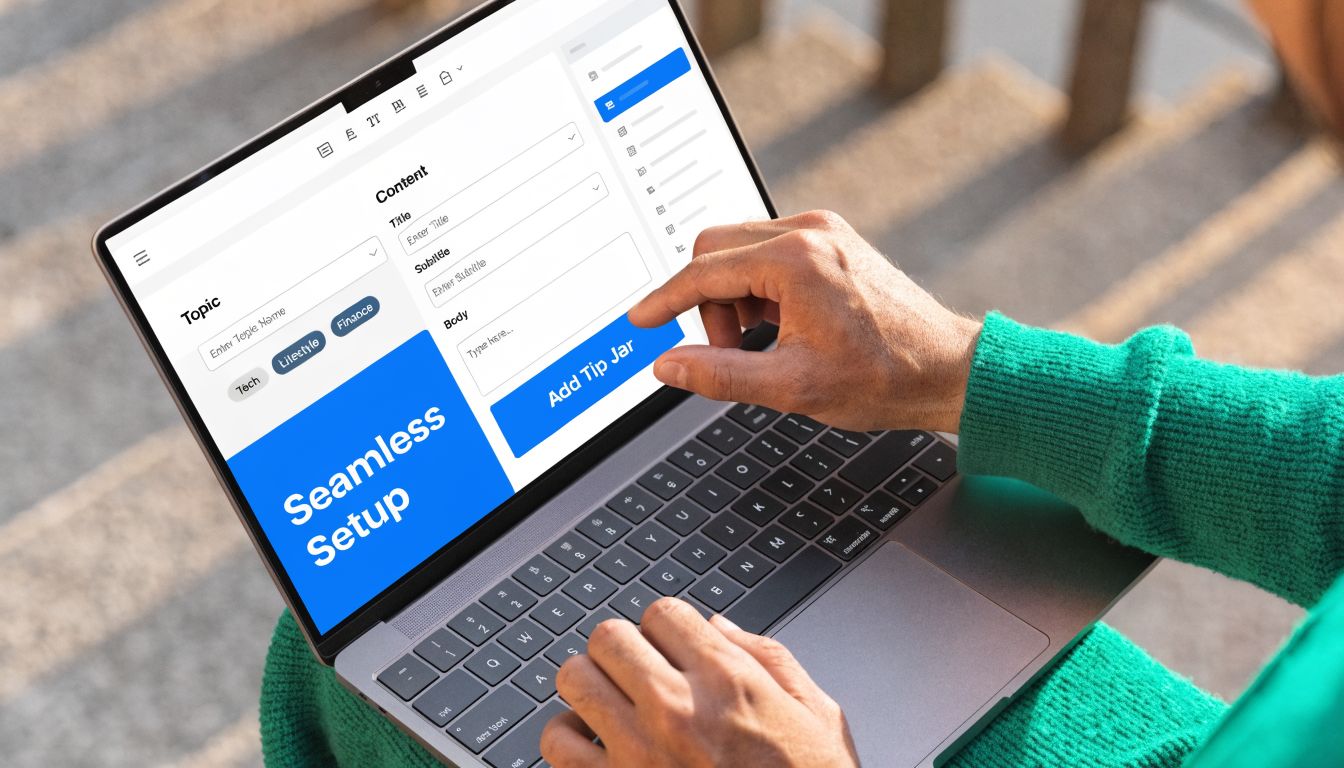
Breaker gives you enough control to make that handoff feel credible. The job is simple. Keep the ask consistent with your brand, place it where the value is fresh, and make the payment path obvious on mobile.
Placement that fits a professional newsletter
Three placements usually make sense inside Breaker, but they do different jobs.
- Directly after a high-value asset
Put the ask after something concrete. A template, benchmark breakdown, teardown, or operator memo gives the reader a clear reason to support the issue.
- At the end of the newsletter
This is the default placement for an ongoing tip program. It keeps the editorial experience clean and catches the readers with the highest intent.
- Inside a recurring branded module
A repeatable support block works well if you want consistency across issues. It can hold one tip CTA, one short explanation, and nothing else.
Top-of-email placement usually underperforms for B2B. Readers want proof of value before they see a payment ask.
Design choices that improve response
Good design does two things here. It reduces hesitation and protects trust.
Use a button instead of a bare link. Buttons look intentional, especially on mobile, and they make the next action clear. Keep the CTA specific. “Support this newsletter” or “Leave a tip” is easier to process than vague language.
The surrounding layout matters too. If the tip ask sits next to webinar registration, a sponsor slot, and a lead magnet, it becomes one more marketing prompt. Give it space. One short line of context and one button is usually enough.
The destination page needs the same standard. Matching brand colors, a recognizable publication name, and a short explanation of what the payment supports can make the difference between a completed payment and a drop-off.
A practical build pattern in Breaker
Start with a small, reusable content block. Keep the copy tight and tie it to business value:
If this issue saved you research time or helped you make a better decision this week, you can leave a small tip.
Place one button under that sentence. Do not stack multiple payment options unless you already know your audience wants them. Extra decisions add friction.
If you publish on a schedule, build this into your sending process instead of recreating it every issue. Breaker works better when repeat elements are standardized, and a documented workflow for recurring newsletter modules makes the tip jar easier to maintain across campaigns.
Suggested design patterns
Pattern
Best use
Why it works
Single button plus one sentence
Ongoing footer support ask
Low friction and low visual noise
Highlight box with short note
Premium analysis issue
Adds context without taking over the layout
Contextual inline CTA
After a template or framework
Connects the ask to value the reader just received
What usually breaks conversion
Underperforming tip jars tend to fail for predictable reasons.
- The payment link looks personal: Generic or messy URLs lower trust with professional readers.
- The CTA is easy to miss: If the ask is buried below several other blocks, response drops.
- The payment page feels disconnected from the newsletter: Sudden visual changes make the flow feel less credible.
- The email asks for too much at once: Tip CTA, demo CTA, sponsor CTA, and download CTA in the same area create decision fatigue.
Run the full flow on your phone before you publish. If the experience feels polished, fast, and consistent with the rest of your newsletter, the tip jar has a real chance to add revenue instead of just taking up space.
Crafting the Perfect Ask Without Sounding Needy
The copy around virtual tip jars decides whether they feel earned or uncomfortable. Most weak asks fail for one of two reasons. They’re either too apologetic, or they’re too vague.
Readers don’t need a long explanation. They need a clear reason to act and a tone that matches the relationship you’ve built with them. In B2B, the strongest asks are grounded in utility, not emotion.
What good tip copy actually does
A strong ask usually includes three ingredients:
- It references the value delivered: time saved, insight gained, or a useful asset.
- It makes support optional: no guilt, no pressure.
- It sounds like your newsletter: the voice should match the rest of the issue.
That means this works better:
If this issue helped you make a better decision, you can support the newsletter with a small tip.
Than this:
Please consider donating if you can. Your support means everything.
The first sounds like a business publication. The second sounds like a fundraiser.
Copy formulas worth using
Here are a few formats that tend to translate well to B2B newsletters.
The utility-based ask
- Best for: tactical newsletters, operator memos, teardown formats
- Example: “If this saved you research time this week, you can leave a small tip.”
The continuity ask
- Best for: independent newsletters with consistent publishing cadence
- Example: “If you want to help keep this newsletter free and useful, tips are always appreciated.”
The premium issue ask
- Best for: especially deep or original issues
- Example: “This was a heavier lift than a standard issue. If it was useful, you can support more work like this with a tip.”
The community ask
- Best for: audience-first brands with strong reader identity
- Example: “If you’ve gotten repeat value from this newsletter, a tip is a simple way to back the work.”
Tone guidelines that protect trust
Don’t over-explain the economics unless your audience already knows your business well. Most readers don’t need a paragraph about production effort. They need a clean invitation.
A few rules help:
- Skip guilt language: Don’t imply that readers owe you support.
- Avoid hype: “Buy me a coffee” can work, but it may feel too casual for some B2B brands.
- Keep it short: The longer the ask, the more self-conscious it becomes.
- Tie it to the issue: The ask should feel connected to what the reader just consumed.
Your tip copy shouldn’t sound like you need rescuing. It should sound like you’re giving readers a simple way to reward useful work.
Examples by placement
If the CTA sits in the footer, keep it evergreen:
- Footer line: “Enjoying the newsletter? You can support it with a small tip.”
If it appears after a strong section, make it contextual:
- Inline line: “If this framework gives you a shortcut on your next campaign, you can leave a tip.”
If it shows up in a launch issue, tie it to momentum:
- Launch line: “If you want to support this next phase of the newsletter, tips help fund more deep-dive issues.”
The point isn’t to find one perfect phrase. It’s to build a few versions that fit different editorial moments and keep the ask from feeling stale.
Tracking Performance and Optimizing for Growth
Once your tip jar is live, treat it like a performance channel. That means tracking placement, message, issue type, and downstream behavior. Without that discipline, you’ll end up with anecdotes instead of a monetization system.
Newsletter tipping appears to correlate with stronger engagement. A 2025 ConvertKit report says newsletters with native tipping see 28% higher engagement, while only 12% of B2B creators have implemented it, which points to a real opening for publishers willing to operationalize it, as noted in this source covering the ConvertKit report.

The metrics that matter
Don’t stop at total tips received. That number is too blunt to improve anything.
Track these instead:
- Tip CTA click rate: Which issues generate curiosity and intent?
- Tip conversion rate: Of those who click, how many complete payment?
- Issue-level variation: Which editorial formats lead to support?
- Average tip by issue type: Some formats may attract fewer but higher-intent supporters.
- Subscriber behavior after tipping: Do tippers open more, reply more, or convert into other offers?
If your platform analytics are limited, use tagged links and issue naming conventions so you can connect tips back to specific sends.
What to test first
A/B testing matters here, but don’t test five things at once. Start with one variable.
Good first tests include:
Test
Version A
Version B
Placement
Footer
After the strongest section
CTA copy
Support this newsletter
Leave a small tip
Framing
Utility-focused
Community-focused
Frequency
Every issue
Only high-value issues
You’re looking for patterns, not certainty. Over time, the data will tell you whether your audience responds more to tactical framing, emotional framing, or simple consistency.
Tie tip data back to broader newsletter performance
Tip behavior gets more useful when you combine it with engagement metrics. If a subscriber tips, that person has crossed from passive consumption into active support. That’s a strong segmentation signal.
Use it to build follow-up logic around:
- Reader surveys
- Premium offer launches
- Early beta invites
- Advisory or consulting outreach
If you’re already tracking campaign quality, this guide to email campaign performance metrics is a good companion because it helps frame tip data alongside opens, clicks, and subscriber growth rather than treating it as an isolated number.
Optimization lens: Don’t ask only “Did people tip?” Ask “What kind of issue creates the conditions where tipping feels natural?”
A realistic way to evaluate ROI
Tips are rarely just about direct cash return. They also reveal which content creates the deepest reader commitment.
A strong issue that drives tips may also:
- strengthen trust with future buyers,
- reveal premium content themes worth expanding,
- and identify subscribers who are more likely to support other revenue products later.
That’s why I’d review tip performance monthly, not issue by issue. A single issue may spike or dip for all sorts of reasons. Patterns across a run of sends are what help you improve copy, placement, and monetization design.
Navigating Compliance and Deliverability Hurdles
This is the part many creators skip because it’s less fun than writing CTA copy. It’s also the part that keeps the system sustainable.
If you’re collecting money through virtual tip jars, treat it like business income. A significant compliance gap already exists. According to the source cited by Good Morning America, 70% of gig workers underreport income, and creators can also run into tax reporting rules such as the IRS requirement for a 1099-K form for payments over $600 annually, as discussed in this piece on virtual tip jars and the related compliance risk.
Compliance basics for newsletter creators
A few habits reduce problems quickly:
- Track every payout: Don’t rely on your payment platform to be your bookkeeping system.
- Store platform fee records: Fees may matter when you reconcile income and expenses.
- Separate business and personal flows: Mixed accounts make tax cleanup harder.
- Add clear internal labeling: Know which payments are tips, product sales, sponsorships, or something else.
If you operate across regions or collect support from international readers, talk to an accountant who understands digital creator income. The edge case problems are usually not obvious until filing time.
Deliverability needs more care than most people give it
A tip jar can also create inbox problems if you handle it sloppily. Payment links, aggressive CTA copy, and too many commercial prompts in one email can all make your issue feel more promotional than editorial.
The safest approach is straightforward:
- Use one clear payment CTA, not several
- Keep link formatting clean and consistent
- Avoid spammy wording around money
- Balance monetization with editorial value
- Test the final email across desktop and mobile before sending
If you want a strong primer on the mechanics behind inbox placement, this email deliverability guide is a useful reference. It’s especially relevant when your newsletter mixes editorial content with monetization links.
The easiest way to protect deliverability is to make sure the issue still reads like a newsletter first and a transaction second.
The professional standard
The mature version of virtual tip jars is simple. Good records, clean links, restrained asks, and a payment flow that respects the reader.
That’s what separates an experimental side feature from a dependable revenue layer.
If you want to build a newsletter that can support monetization experiments like virtual tip jars without sacrificing growth, analytics, or inbox placement, Breaker is built for that job. It gives B2B marketers and creators a cleaner way to send, grow, and optimize newsletters so every new revenue stream sits on top of a stronger distribution engine.
Keep reading
All articlesNewsletter Agency Services: How Agencies Scale Client Newsletters
Managing multiple client newsletters? Learn what a true newsletter agency platform needs to prevent list mixing, voice drift, and invisible ROI.
Building Owned Audiences: Move Followers to Your Newsletter in 2026
Social platforms can vanish overnight. Learn how to convert Instagram, TikTok, and YouTube followers into a newsletter list you actually own.
Newsletter Analytics: Which Metrics Actually Matter in 2026
Open rate and clicks don't predict buyers. Learn the 7-step method to track click depth, recency, and topic affinity for a revenue-predictive intent score.