
Marketing Newsletter Software: The B2B Growth Guide 2026
Find the best marketing newsletter software for B2B growth. This guide covers features, pricing, ROI, and how to turn your newsletter into a lead gen engine.
Somewhere in your funnel, this is probably happening right now.
Paid social gets expensive. Organic reach swings around every time a platform changes its feed logic. Search traffic looks healthy until one ranking slips and a steady trickle of demos turns into a dry week. You still need a channel you control, one that lets you reach buyers, users, and prospects without asking an algorithm for permission.
That’s where a newsletter stops being “one more marketing task” and starts acting like infrastructure.
The teams that get real value from email don’t treat it as a broadcast habit. They treat it as a repeatable system for turning attention into pipeline, product adoption, and revenue. The software matters because the job isn’t just sending a message. The job is finding the right people, getting into the inbox, learning what moved them, and using that feedback to improve the next send.
Why Your Newsletter Is a Growth Engine Not Just an Email
A common B2B scenario looks like this. The team sends a newsletter every Tuesday, sees a decent open rate, and still cannot answer a simple pipeline question: did that send create qualified interest, move an active deal, or help retention? If nobody can connect the issue to commercial movement, the newsletter is running as a publishing task instead of a growth asset.
A strong newsletter earns its place because it keeps your company in front of buyers between high-intent moments. That gap matters. Committees take time to align, champions go quiet, budgets stall, and product interest cools off if there is no useful follow-up. Email gives you a channel you control, with recurring access to people who asked to hear from you.

Owned attention creates compounding value
The main advantage is consistency. Paid acquisition gets more expensive. Organic distribution shifts with platform rules. Search can drive demand for months, then slip after one ranking change. A newsletter gives B2B teams a stable way to reach prospects, customers, and former leads without relying on another company’s feed, auction, or algorithm.
That stability only matters if the newsletter is tied to outcomes. In practice, that means each send should support a job: generate demo requests, push readers to a webinar, reactivate dormant accounts, expand product usage, or keep high-fit prospects warm until sales is ready to engage. The feature set matters because software quality has direct business consequences once email is expected to contribute to pipeline.
Teams using AI tools for marketing teams often learn this quickly. Content production gets faster, but speed alone does not improve results. The gain comes from pairing faster execution with better segmentation, cleaner targeting, and tighter measurement.
Growth teams need software that supports revenue work
A newsletter starts acting like growth infrastructure when the platform can support decisions that affect revenue, not just distribution.
You need software that helps answer questions like these:
- Audience quality: Are new subscribers close to your ICP, or are you filling the list with people who will never buy?
- Message fit: Can different segments get content that matches role, industry, account stage, or product interest?
- Delivery performance: Are your emails reaching the inbox often enough to make the channel dependable?
- Commercial visibility: Can marketing and sales see which sends influenced signups, meetings, trials, or expansion activity?
Here is the practical test I use. If a platform reports opens and clicks but cannot show which segment engaged, what they did next, and whether that behavior maps to pipeline, it will struggle once the newsletter has revenue expectations attached to it.
That is the shift B2B teams should care about. The goal is to choose software that helps the newsletter produce repeatable business results, not just send on schedule.
Beyond Sending Emails What Marketing Newsletter Software Does
The easiest way to think about marketing newsletter software is this.
A bulk sender is a post office. It accepts the mail and sends it out.
A modern newsletter platform is closer to a logistics and intelligence operation. It helps decide what should ship, who should receive it, when it should arrive, how to route it, what happened after delivery, and where the next best opportunity sits.
A basic sender handles distribution
Simple tools are fine when the job is limited.
If you run a small announcement list, a community update, or a founder note with no segmentation and no serious attribution needs, a lightweight sender can work. You write, format, schedule, and review a couple of top-line metrics.
That setup breaks once the newsletter becomes part of demand gen. Suddenly you need form capture, CRM sync, suppression rules, audience tagging, compliance controls, testing, and reporting you can use in planning.
Real newsletter software handles the system around the send
The biggest difference is that proper software doesn’t stop at delivery. It manages the full loop.
That usually includes:
- List growth tools: Forms, landing pages, referral hooks, and acquisition workflows
- Segmentation: Rules based on behavior, profile data, and lifecycle stage
- Automation: Welcome sequences, re-engagement flows, and triggered campaigns
- Analytics: Subscriber tracking, click analysis, and outcome reporting
- Deliverability controls: Hygiene, reputation monitoring, and suppression logic
- Integrations: CRM, product data, attribution tools, and workflow automation
If your team is evaluating broader stack decisions, this roundup of AI tools for marketing teams is useful context because it shows how quickly campaign planning, content production, and ops work are getting pulled into AI-assisted workflows. Newsletter software now sits in that same shift. It’s not just an editor anymore.
Why simpler tools often stall growth
The failure mode is usually not dramatic. It’s slow drag.
The team spends time exporting CSVs. Sales and marketing argue about lead quality. The list gets bigger but less useful. Reporting lives in screenshots. Nobody trusts the open-rate spike because nobody knows if the right accounts engaged.
The platform shouldn’t just answer “did the email send?” It should answer “did this send move the right buyer toward action?”
That’s the point of the category. Marketing newsletter software exists to increase the odds that each send reaches the right people, with the right message, and produces a measurable business result.
The Five Pillars of High-Performing Newsletter Software
A team sends the same newsletter to 40,000 contacts. Open rate looks fine. Sales still says the program produces weak leads, product marketing says the message was too broad, and ops spends half a day reconciling campaign data with the CRM. That is usually the clearest sign the software is limiting growth.
The fastest way to evaluate a platform is to map each capability to the business result it should drive. Better newsletter software helps your team reach the right accounts, respond faster to buyer behavior, and prove whether the channel is influencing pipeline.
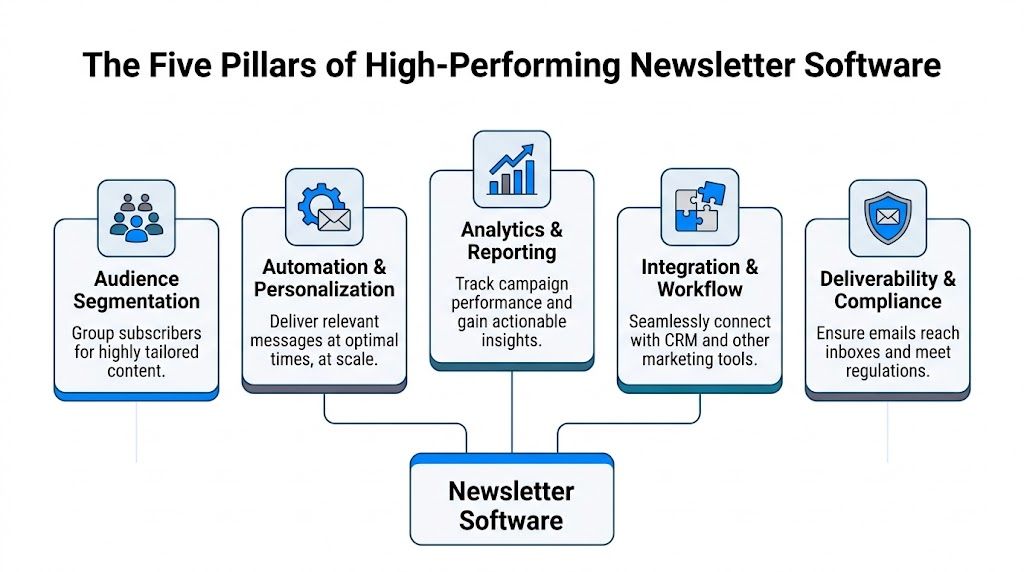
Audience segmentation
Common newsletter underperformance starts here.
B2B teams often default to one broad send because it is easy to ship. The trade-off is predictable. Relevance drops, engagement gets harder to interpret, and high-intent buyers receive generic messaging that does not match their stage or priorities.
Strong platforms make segmentation part of campaign setup, not an afterthought buried in filters. Look for audience rules based on firmographic fit, acquisition source, product interest, engagement history, and lifecycle stage. A PLG company should be able to separate new signups from activated users, champions, and enterprise evaluators. Each group needs different content and a different ask.
Guideflow’s review of email marketing software tools found that platforms with predictive segmentation and hygiene features can reduce bounce rates and improve click-through performance, which is why these features matter operationally as well as strategically, according to Guideflow’s review of email marketing software tools. Cleaner lists protect sender reputation. Better segmentation raises the odds that a send creates a meeting, trial conversion, or product action instead of a passive click.
Automation and personalization
Automation matters when it removes delay from buyer communication.
The useful workflows are usually straightforward. Welcome sequences for new subscribers. Nurture tracks tied to product interest. Re-engagement programs for contacts whose intent has cooled. Triggered education for users who hit a meaningful milestone. These systems save manual effort, but the bigger gain is timing. Good software lets the team respond while intent still exists.
Personalization also needs a higher bar than token merge fields. First name and company name do very little on their own. What changes outcomes is personalized content logic, CTA selection, and send timing based on behavior, account profile, or known pain points.
HubSpot’s State of Newsletters report found that newsletter creators are already using AI to support brainstorming and content creation, and many report time savings from that workflow, as covered in HubSpot’s State of Newsletters. That is the practical use case. AI helps teams produce more variations, test faster, and reduce production bottlenecks. Strategy still comes from the team.
Analytics and reporting
Weak analytics create false confidence.
A dashboard full of opens and clicks may show activity, but B2B growth teams need reporting that answers harder questions. Which audience segments generate qualified responses? Which signup sources produce subscribers who stay engaged over time? Which CTA themes correlate with demo interest, sales conversations, or product activation? Which campaigns influence pipeline even when they do not get last-touch credit?
Benchmarks can help with orientation, as noted earlier in the article. They should not shape your strategy. A healthy average can still hide poor list quality, weak account fit, or content that attracts curiosity without commercial intent.
The right platform closes the gap between campaign data and business outcomes. It should let marketers trace engagement to audience quality, lifecycle movement, and downstream revenue signals without exporting data into three other tools just to build a clear report.
Integration and workflow
Integration determines whether newsletter data becomes usable operating data.
If the platform does not sync cleanly with your CRM, forms, attribution setup, and product data, the team ends up maintaining workarounds. Audiences go stale. Lead status falls out of date. Campaign reporting turns into an argument over whose spreadsheet is right. None of that helps growth.
The practical standard is simple. Subscriber data should move into the rest of the stack without friction, and changes in the rest of the stack should flow back into newsletter targeting logic. That includes lifecycle stage updates, account ownership, product usage signals, and suppression rules.
One example in this category is Breaker, which combines email sending with ICP-based targeting, AI enrichment, real-time analytics, CRM integrations, list hygiene, and deliverability controls. That setup is useful for teams that expect the newsletter to support lead generation and account progression, not just content distribution.
The best integration is the one your team stops noticing because data moves cleanly and nobody has to babysit imports.
Deliverability and compliance
This pillar gets attention late, usually after performance slips.
Deliverability decides whether any campaign gets a fair shot in the inbox. If sender reputation is weak, stronger copy will not save the program. If list hygiene is poor, every send carries more risk. If unsubscribe and consent workflows are sloppy, compliance issues pile up alongside performance issues.
Good platforms make these risks visible early. They flag invalid addresses, suppress disengaged contacts, monitor reputation signals, and give teams clear controls for consent and suppression management. That matters because each bad send can make the next one harder to place.
Here’s a quick scorecard for the five pillars:
Pillar
Business outcome it drives
What weak tools get wrong
Audience segmentation
Better fit and stronger relevance
Everyone gets the same message
Automation and personalization
Faster follow-up and higher conversion efficiency
Static drips with shallow customization
Analytics and reporting
Clearer decisions and better revenue visibility
Vanity metrics that do not guide action
Integration and workflow
Lower ops overhead and cleaner attribution
Manual exports and stale audience data
Deliverability and compliance
Better inbox placement and lower risk
Reputation problems discovered after results drop
When these five pillars are strong, the newsletter becomes a measurable growth program. When one breaks, performance usually falls somewhere else first.
How to Evaluate Newsletter Software Pricing Models
Pricing for marketing newsletter software gets confusing because vendors charge for different things, and those different things shape behavior.
A plan can look cheap until your list grows. Another can look expensive until you realize it includes features that would otherwise require two more tools. The right question isn’t “what’s the lowest monthly cost?” It’s “what pricing model lines up with how we grow?” Our email marketing cost breakdown puts numbers on those models, including the hidden costs that never show up on the pricing page.
Per-subscriber pricing
This is common and easy to understand. You pay based on how many contacts sit in your database.
It works well for teams with stable lists and predictable growth. It gets painful when your list includes a lot of low-engagement contacts, historical records, or multiple audience groups you need to keep for segmentation and suppression purposes.
The upside is simplicity. The downside is that growth can feel like a tax.
Per-send pricing
This model charges based on volume.
It can be a strong fit for businesses that keep large lists but mail selectively. It also works for organizations with seasonal campaigns or irregular cadences. The trade-off is that active testing, resends, and automation can increase cost quickly if your team sends often.
In practice, this model rewards disciplined targeting. It punishes indiscriminate frequency.
Feature-tiered plans
These plans start with a base package and lock advanced functionality behind higher tiers.
This looks manageable early on, especially for small teams. Then you discover that automation, advanced segmentation, revenue attribution, or team permissions sit one or two tiers above the entry plan. Suddenly the issue isn’t raw price. It’s feature access.
Here’s a practical comparison:
Pricing model
Good fit for
Main risk
Per-subscriber
Stable lists and simple operations
You pay for inactive contacts
Per-send
Selective senders with large databases
Frequent campaigns get expensive
Feature-tiered
Early-stage teams validating the channel
Core capabilities may be gated
Per-engaged-subscriber
Growth-focused B2B teams
Requires clarity on how engagement is defined
Why growth-aligned pricing is worth attention
This is the part many reviews miss. Not every buyer is a large in-house team with enterprise budgets and a massive ops layer.
Consultants, fractional CMOs, small agencies, and niche B2B operators often need software that scales without forcing them into enterprise-style commitments. Many software reviews overlook how pricing models serve niche B2B segments; a pay-per-engaged-subscriber model avoids enterprise bloat and high upfront costs, as noted in Telecoming’s discussion of underserved markets.
That model is attractive because it aligns spend more closely with audience quality. You’re not just paying for names in a database. You’re paying for subscriber growth that has actual potential value.
Cheap software gets expensive fast when the pricing model rewards list hoarding instead of lead quality.
When you evaluate vendors, ask finance questions early. What happens when your list doubles? What happens if you increase frequency? What happens if your team needs attribution, multiple users, or CRM sync six months from now? The pricing page rarely tells the whole story.
Putting Your Newsletter Software to Work for Lead Gen
A prospect downloads your report on Tuesday, opens your newsletter on Thursday, clicks a case study the following week, and then disappears because nothing in your system reacts to that interest. That is the gap good newsletter software should close.
The right platform supports a lead generation motion, not just a publishing calendar. B2B teams use newsletters to move people from first touch to qualified conversation. If the software cannot segment by source, trigger follow-up based on behavior, and show which campaigns create pipeline signals, it is a poor fit for growth work.

Use case one, nurturing top-of-funnel leads
A new subscriber is usually showing curiosity, not buying intent. Treating that person like a sales-ready lead hurts conversion rates and burns attention early.
The newsletter should place them into a sequence that matches how interest develops. Start by confirming the value exchange. Then send material that helps them define the problem, compare approaches, and see what a good outcome looks like. Only after that should the CTA shift toward demos, consultations, or product-led next steps.
Teams that want a tighter structure for those sequences can borrow from these lead nurturing best practices, especially the guidance on timing, relevance, and content progression.
Watch three things closely:
- Subscriber source quality: Which signup path produces readers who keep clicking and returning?
- CTA progression: Which offers move subscribers from information gathering to commercial intent?
- Sales handoff readiness: Which engagement patterns justify SDR follow-up without wasting rep time?
Use case two, driving product adoption in PLG
Product-led companies often leave newsletter software underused. In-app messages handle immediate product behavior. Email handles reinforcement over time.
That matters for onboarding, feature education, reactivation, and expansion. The list should not get the same monthly update. New users need activation help. Active users need use cases that deepen adoption. Dormant users need a narrow ask that gets them back into the product with minimal friction.
A useful setup looks like this:
- New users: Educational emails tied to activation milestones
- Active users: Workflow examples, feature usage ideas, and upgrade prompts
- Dormant users: Re-entry campaigns with one clear next action
Execution matters here. A repeatable system for triggers, segments, and follow-up cuts manual work and keeps campaigns tied to product behavior. This guide to creating a campaign workflow is a practical reference if your team is building that process.
Here’s a quick explainer on campaign mechanics and timing before you build those flows:
Measure this motion against product outcomes. Clicks matter. Activation, repeat usage, and upgrade conversations matter more.
Use case three, building pipeline for a consultant or fractional CMO
For consultants and fractional CMOs, newsletter software should support trust building that turns into conversations with the right buyers. Volume is secondary. Relevance is the job.
The strongest newsletters in this model do three things well. They present a clear point of view, connect ideas to the service being sold, and make the next step obvious. That next step might be a strategy session, an audit, a reply to discuss a problem, or a short call around a specific initiative.
What usually hurts results is copying media-style newsletters with broad commentary and weak commercial direction. If the business goal is client acquisition, the content should stay close to real problems buyers are already paying to solve.
A consultant’s newsletter should make the right buyer think, “this person understands the issue better than the other options I’m considering.”
There is also a useful competitive angle. Reviewing newsletters from adjacent firms, agencies, and category leaders shows which themes are overused, which offers appear repeatedly, and where your positioning can be sharper. That kind of analysis helps teams choose software with the tagging, tracking, and testing features needed to turn newsletter engagement into qualified demand.
A Practical Checklist for Choosing Your Software
The fastest way to make a bad choice is to buy based on homepage copy.
Most platforms can demo well. The true test is whether the product fits your stack, your workflow, and your growth model without creating hidden operational debt. A structured checklist keeps the selection process honest.
Newsletter software evaluation checklist
Evaluation Area
Key Question to Ask
Look For (Green Flags)
Deliverability
How does the platform help protect inbox placement?
Clear hygiene tools, reputation monitoring, suppression controls
Compliance
Can we manage consent, unsubscribes, and list handling cleanly?
Built-in compliance workflows and transparent controls
Segmentation
Can we target by fit, behavior, and lifecycle stage?
Flexible audience logic and dynamic segmentation
Automation
Can we build useful journeys without heavy ops work?
Visual workflows, trigger support, and easy edits
Analytics
Can we connect engagement to business outcomes?
Subscriber tracking, CTA analysis, and usable reporting
Integrations
Does it sync with our CRM and core tools?
Native integrations and reliable data flow
Editor usability
Can marketers ship fast without breaking layouts?
Intuitive builder, reusable blocks, and previewing
Pricing clarity
Will cost scale in a way we can predict?
Transparent model, clear limits, and no hidden gating
Support
What happens when migration or performance issues show up?
Responsive onboarding and hands-on help
Growth tools
Does the platform help us acquire the right subscribers?
Forms, tracking, and audience expansion capabilities
If you’re comparing multiple tools, this roundup of B2B-focused options is a useful cross-check: https://joinbreaker.ai/blog-posts/best-email-newsletter-platforms-for-b2b-list-growth
Questions buyers often skip
Some of the most important questions don’t appear in standard demos.
Ask these directly:
- What breaks first as we scale? Reporting, segmentation, approvals, or pricing?
- How easy is cleanup? Can you suppress stale contacts and maintain list quality without manual work?
- Who uses the product well? Agencies, PLG teams, consultants, media operators, or enterprise comms?
- What support exists during migration? A platform with weak onboarding can erase months of momentum.
Painless migration tips
Switching software feels risky because teams imagine losing data, deliverability, or signup flow. Most migrations go smoothly when the basics are handled in order.
- Export cleanly: Move contacts with tags, source data, and key custom fields.
- Trim before import: Remove obvious dead weight so you don’t carry list problems into a new system.
- Rebuild forms intentionally: Don’t just copy old signup experiences if they were underperforming.
- Stage your first sends: Start with your most engaged audience and review results closely.
- Audit automations early: Welcome flows and high-intent nurture sequences should be checked before launch.
A migration should be a reset, not a lift-and-shift of bad habits.
Turn Your Newsletter Into Your Most Reliable Growth Channel
The wrong way to buy marketing newsletter software is to treat it like a commodity.
If all you need is a button that sends email, almost any tool can do that. If you need a channel that reliably supports lead gen, product education, and relationship building with the right accounts, software choice becomes a strategy decision.
The useful lens is simple. Does the platform help you attract the right subscribers, deliver consistently, segment intelligently, measure what matters, and scale without making operations harder?
When those pieces line up, the newsletter stops acting like a recurring task and starts compounding. You learn more about your market every send. Your best prospects hear from you regularly. Your sales and growth teams get a channel they can influence.
Choose software that matches the business outcome you want. If pipeline quality matters most, optimize for targeting and analytics. If adoption matters most, optimize for behavior-based workflows. If efficient scale matters most, optimize for pricing and operational fit.
That’s how a newsletter becomes dependable. Not by sending more. By building the system around it properly.
Common Questions About Marketing Newsletter Software
Is newsletter software different from a full marketing automation suite
Yes. Focused newsletter software is narrower by design.
A full automation suite often includes CRM, ads, landing pages, sales workflows, and a long list of features many B2B teams won’t use well. Newsletter-first platforms usually feel faster to operate, easier to train on, and better suited to teams that care most about audience growth, segmentation, deliverability, and repeatable content distribution.
Can a B2B newsletter be monetized directly
Yes, but direct monetization usually comes after audience quality is clear.
Sponsorships are the most practical route for many operators. If you have a well-defined niche audience, sponsors care about relevance more than broad reach. Tools like Paved can support those programs operationally. Competitive research helps too. An often-missed strategy is using competitive intelligence tools like Panoramata or Milled to track competitors' newsletters, which not only informs content strategy but also reveals their sponsors, providing a ready-made list of potential monetization partners, as covered by Panoramata’s guide to tools for tracking competitors’ emails.
What should I budget for marketing newsletter software
Budget depends more on pricing model and workflow needs than on list size alone.
A consultant with a focused audience may do well with a lean plan that emphasizes ease and segmentation. A PLG team may need stronger integrations and automation. An agency may care most about client management, reporting, and support. The right budget is the one that fits how your newsletter creates value, not the one attached to the biggest feature list.
What if I’m new to email operations terms
Then it helps to get fluent before evaluating vendors.
This glossary is a good place to tighten up the language around deliverability, segmentation, automation, and list management: https://joinbreaker.ai/newsletter-glossary
If you want a platform built around growth outcomes instead of bloated feature menus, take a look at Breaker. It combines newsletter sending with list growth, targeting, analytics, and deliverability tools that fit how B2B teams use email.
Keep reading
All articlesNewsletter Analytics: Which Metrics Actually Matter in 2026
Open rate and clicks don't predict buyers. Learn the 7-step method to track click depth, recency, and topic affinity for a revenue-predictive intent score.
Newsletter Segmentation Strategy: Increase Engagement in 2026
Build a data-driven newsletter segmentation strategy using behavior, intent score, and topic affinity to lift opens and clicks. Step-by-step guide.
How to Grow Newsletter Subscribers with Qualified Leads in 2026
Discover 8 channels to grow engaged newsletter subscribers in 2026, with real cost-per-engaged-subscriber data to focus your list-building strategy.