
Top B2B Lead Generation Platforms 2026
Discover top B2B lead generation platforms for 2026. Our guide covers types, evaluation, and workflows to build a predictable sales pipeline.
Most advice on B2B lead generation platforms is backwards. It starts with tool lists, database size, and workflow features. It ends with teams buying expensive software that produces more contacts, more alerts, and more dashboard activity, but not a cleaner pipeline.
The core decision is simpler and harder. You are not just choosing a tool to collect leads. You are choosing how your company will acquire attention, how much of that audience you control, and whether your demand generation system gets stronger over time or has to be rented again every quarter.
That's why the usual “top platforms” roundup misses the point. A database platform, a marketing automation suite, and an audience-building newsletter platform can all claim they help generate leads. They do. But they solve very different problems, and they create very different dependencies for your team.
Why More Leads Is the Wrong Goal
A full funnel can still be a weak funnel. Organizations often learn this the hard way after they push lead volume up, hand more records to sales, and watch conversion quality collapse.

The market itself shows why this deserves a more strategic lens. The global B2B lead generation market is projected to reach $32.1 billion in 2025, and 87% of B2B marketers use email while 89% use LinkedIn, according to Pepper Insight's 2025 lead generation guide. That isn't a niche software category anymore. It's core commercial infrastructure.
Volume hides bad fit
If your targeting is loose, your messaging is generic, or your routing is broken, more leads only magnify the problem. Sales gets busier, not more effective. Marketing reports activity. Revenue teams inherit noise.
That's why platform selection should begin with fit, not volume. If you haven't defined who you want to attract, any lead source will look productive for a while. A clear ideal customer profile in marketing matters more than another list vendor or sequence tool.
Practical rule: If a platform promises more leads before it proves better qualification, treat that as a warning sign.
Predictability beats spikes
Good B2B lead generation platforms help teams build a repeatable system for attracting the right accounts, recognizing intent, and moving qualified people into the right motion. Bad ones create periodic bursts of names that never mature into pipeline.
The goal isn't maximum top-of-funnel output. The goal is controlled pipeline creation. You want a setup that your team can operate consistently, measure accurately, and improve without rebuilding the process every quarter.
That changes the buying criteria. Instead of asking, “How many contacts can this platform give us?” ask, “What kind of audience does this platform help us build, and how reliably can we turn that audience into opportunities?”
Understanding the Three Platform Archetypes
The easiest way to get confused in this market is to compare every product as if it belongs in the same category. It doesn't. Most B2B lead generation platforms fall into one of three archetypes.
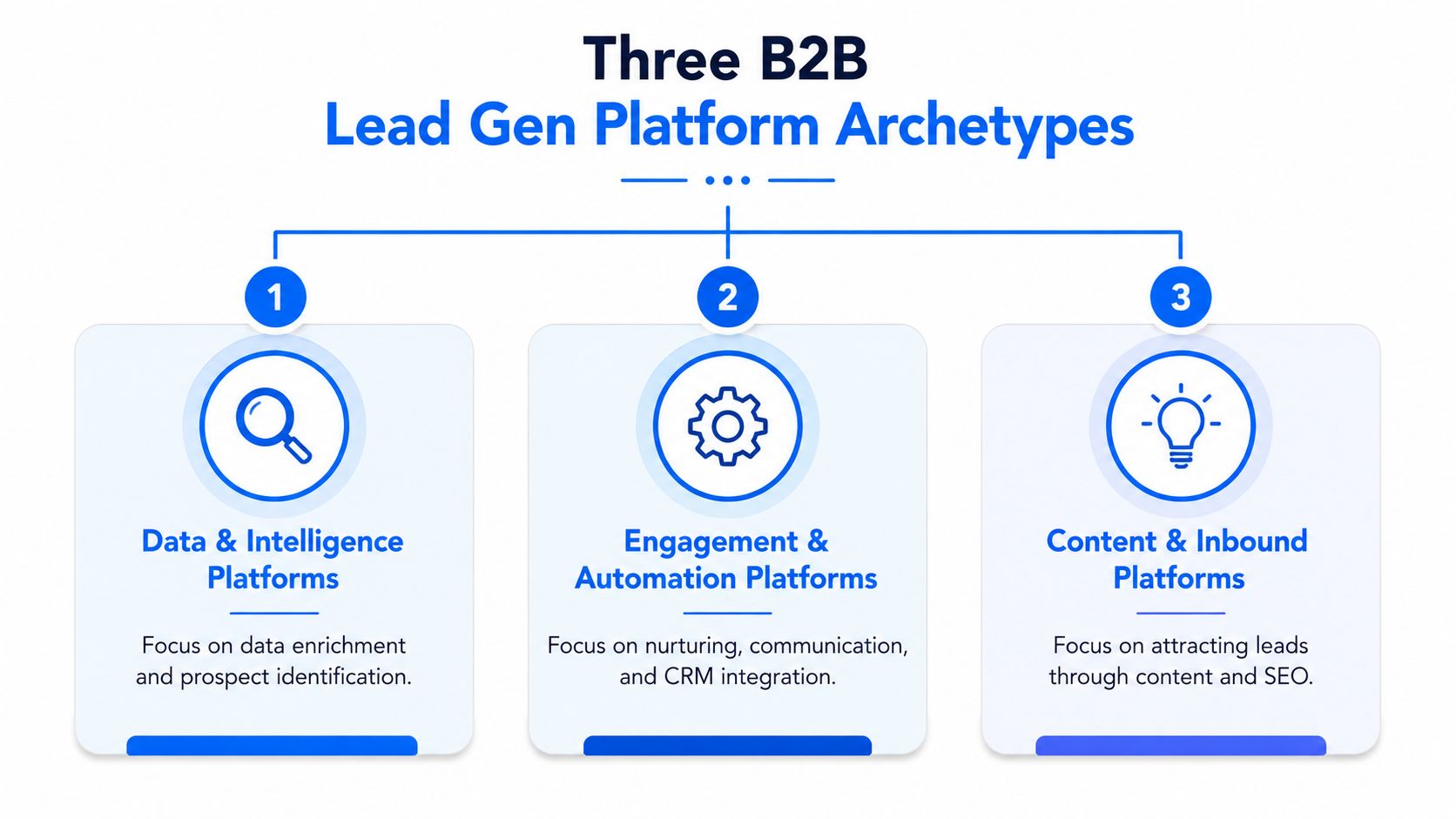
Data and intelligence platforms
These platforms help teams identify accounts and contacts. Think ZoomInfo, Apollo, Cognism, Clay, Bombora, or LinkedIn Sales Navigator. Their core value is access to data, enrichment, and buying signals.
They work well when your team already knows who it wants to target and has the operational discipline to turn records into outreach. They are especially useful for account-based motions, SDR teams, and markets where outbound still plays a major role.
LinkedIn sits at the center of this model. According to the Dux-Soup 2025 report on B2B lead generation, 97% of B2B marketers using social for lead generation use LinkedIn. That's why modern prospecting platforms increasingly revolve around LinkedIn discovery paired with email outreach.
What they do well
- Find accounts fast: Useful for territory builds, ABM target lists, and outbound research.
- Add context: Enrichment and intent data can sharpen prioritization.
- Support sales execution: Good fit for SDR and enterprise sales teams.
What they don't solve
- Audience ownership: You're renting access to contacts, not building a proprietary channel.
- Conversion infrastructure: They usually need CRM, email sequencing, and workflow tools around them.
Engagement and automation platforms
This category includes HubSpot, Marketo, ActiveCampaign, Salesforce Marketing tools, Outreach, and Salesloft. These platforms manage follow-up, scoring, routing, and nurture.
They are strongest when you already have inbound demand, product usage signals, webinar registrations, or hand-raisers entering your funnel. Their job is to turn interest into managed progression.
The platform isn't the lead source. It's the operating system that decides what happens next.
These tools matter when timing, segmentation, and handoff quality matter more than sheer contact volume.
Content and audience growth platforms
This archetype gets less attention, but it's strategically important. These platforms focus on building a first-party audience you can reach repeatedly through owned channels such as newsletters, subscriptions, and content-driven acquisition.
That model changes the economics of lead generation. Instead of repeatedly buying access to strangers, you build a growing pool of opted-in people and accounts that know your brand and can be segmented over time. Breaker fits this category by combining newsletter sending, list growth, targeting, and analytics in one system.
Here's the key distinction:
Archetype
Core asset created
Best for
Data and intelligence
Prospect records
Outbound, ABM, SDR teams
Engagement and automation
Managed workflows
Inbound, lifecycle, product signals
Content and audience growth
Owned audience
Long-term demand generation, newsletter-led growth
Teams get in trouble when they buy one archetype expecting another. A database won't build loyalty. An automation suite won't create demand by itself. A newsletter platform won't replace enterprise contact intelligence for named-account outbound.
A Strategic Framework for Evaluating Platforms
A feature checklist won't protect you from a bad purchase. Most B2B lead generation platforms can demo well. The hard part is figuring out whether the underlying model fits your constraints, your market, and your team.
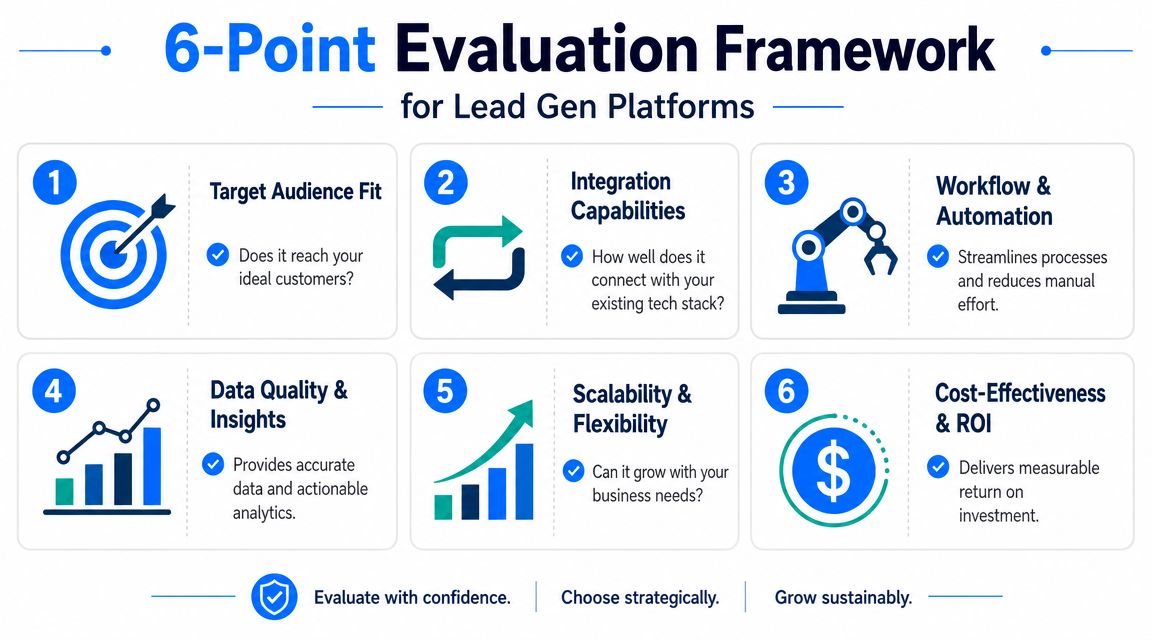
Start with the fundamentals below.
Data quality and freshness
The first question isn't how much data a vendor has. It's whether the data stays usable long enough to support targeting, personalization, and routing.
Recent analysis from Matomo's review of lead generation tools notes that sales and marketing databases can lose roughly 25% of their accuracy each year. That's why “bigger database” is often the wrong buying signal.
Ask vendors:
- How often is contact and company data refreshed?
- What verification controls exist before records enter my workflow?
- How do you handle stale titles, bounced emails, and duplicate accounts?
If the answers are vague, the platform will create downstream cleanup work that your team will carry forever.
Targeting and ICP matching
A platform is only as good as its ability to help you identify your real buyers. Basic firmographics aren't enough in most markets. You need targeting that can reflect role, company context, timing, and behavioral signals.
Directive's guidance on modern tooling highlights the value of combining first-party engagement, third-party intent, and enrichment, and notes that enrichment systems should maintain an enriched-record rate around 80% to keep segmentation and routing reliable, as described in Directive Consulting's guide to B2B lead generation tools.
Ask:
- Can the platform segment by the attributes your sales team uses?
- Does it support intent or engagement signals, or only static filters?
- Will enrichment fill the fields your CRM workflows depend on?
Compliance and consent
Scale is tempting. Compliance is paramount. The strategic tradeoff between the two is becoming sharper as privacy rules and signal loss change what teams can collect and activate.
The strongest explanation of this shift comes from The Insight Collective's analysis of B2B lead generation, which argues that first-party and consent-based models are becoming more important, especially in regulated markets.
Ask every vendor:
- What data is first-party, third-party, or inferred?
- How is consent handled for acquisition and outreach?
- What changes for teams selling into privacy-sensitive markets?
If your team needs a practical benchmark for comparing systems inside a broader stack, it also helps to review resources like Donely's available integrations so you can see how adjacent workflow tools connect before you commit to another isolated platform.
A related decision sits inside your automation design. If you're planning routing, scoring, or multi-step nurture, this overview of B2B marketing automation is useful because platform fit often breaks at the workflow layer, not the data layer.
Deliverability and channel control
If the platform depends on email, ask who controls deliverability. If it depends on social workflows, ask how exposed you are to platform policy changes.
You want to know:
- Does the vendor help you protect sender reputation and list hygiene?
- Can you segment by engagement, not just demographics?
- What happens if one channel underperforms or becomes restricted?
A rented channel can disappear faster than teams expect. An owned list gives you more resilience.
Later in the evaluation, it helps to see the operational side in action:
Integrations and workflow automation
A lead platform that doesn't connect cleanly to CRM, enrichment, scoring, and handoff processes becomes a reporting problem within weeks.
Look for:
- Native CRM sync: Not just exports.
- Routing logic: Territory, ownership, lifecycle stage, or signal-based paths.
- Behavioral triggers: Activity should change follow-up automatically.
Pricing and true cost
The cheapest platform is often the one that creates the most labor. Per-seat, per-contact, usage-based, and subscriber-based models all shape behavior differently.
Compare cost against three hidden burdens:
- Manual cleanup
- Extra tools required
- Operational complexity your team can't support
That's the actual purchase price.
Matching Platform Workflows to Your Team Goals
Teams often buy software based on category reputation instead of workflow fit. That's why a platform can be excellent in one company and disappointing in another.
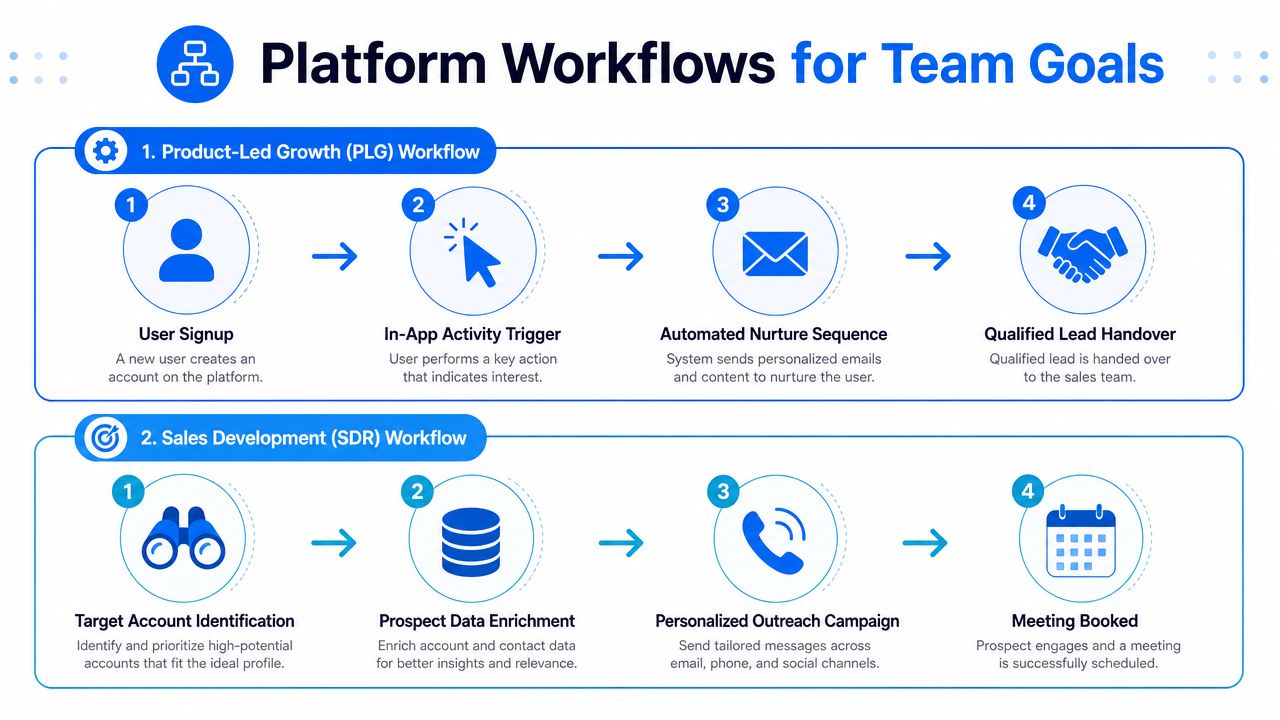
Salesforce's lead generation guidance makes the right point here. Effective platforms are treated as an automation stack, not a single database. Visitor identification can surface anonymous demand, while automation tools score leads by fit and engagement, as outlined in Salesforce's guide to lead generation tools.
Product-led growth teams
A PLG company usually doesn't need another giant contact list as its first move. It needs to understand user behavior, identify meaningful in-product signals, and route the right accounts into human follow-up.
A practical PLG workflow looks like this:
- Capture behavior: Trial signup, feature usage, pricing page visits, and return sessions.
- Score intent: Distinguish casual users from evaluators showing strong fit.
- Trigger action: Send nurture emails, prompt sales outreach, or surface expansion potential.
In this setup, automation and visitor intelligence matter more than broad prospect data. The winning platform is the one that can turn product activity into sales timing.
If your team is still stitching these handoffs together manually, a documented marketing automation workflow usually reveals where lead quality gets lost.
Enterprise sales teams
Enterprise teams often need the opposite motion. They already know the logos they want. Their challenge is mapping stakeholders, finding timing signals, enriching records, and coordinating outreach across SDRs and AEs.
That workflow tends to look like this:
Team type
Primary need
Platform bias
PLG SaaS
Score product behavior
Automation and visitor ID
Enterprise outbound
Build and prioritize named accounts
Data and intelligence
Mid-market demand gen
Convert attention into repeatable audience
Content and audience growth
A strong enterprise motion usually combines data platforms with sequencing and CRM orchestration. But the risk is overbuilding. If reps can't trust the data or if operations can't maintain the sync, the stack becomes expensive theater.
Your workflow should determine your platform stack. Not the other way around.
Consultants and fractional teams
Consultants, agencies, and fractional CMOs face a different problem. They need repeatable acquisition assets that don't vanish when a campaign ends. That's where audience growth platforms become compelling.
A consultant can build a newsletter-based acquisition system for a client, segment subscribers by ICP, then use engagement data to shape future offers, sponsorships, or sales outreach. That asset improves over time because the audience becomes more informed, more segmented, and easier to activate.
This model is often more durable than a pure rented-data approach. Instead of paying repeatedly to access strangers, you create a first-party channel that supports launches, partnerships, and outbound support later.
What usually doesn't work is mixing all three motions without a clear owner. When one team buys a database, another runs nurture inside a marketing platform, and nobody owns audience development, lead generation becomes fragmented fast.
Navigating the Hidden Tradeoffs of Lead Generation
Every platform category comes with a tradeoff that vendors minimize in the demo.
The biggest one is owned versus rented audience. A contact database gives you immediate reach, but that reach is borrowed. You don't own the relationship. You don't control long-term engagement. And next quarter, you'll likely need to buy access again. A first-party audience takes longer to build, but it compounds.
Scale often fights quality
Large data coverage sounds attractive until your reps start working records that are technically present but practically unusable. Title changes, job moves, inbox decay, and enrichment gaps all show up later as wasted effort.
That's why pipeline quality matters more than lead count. As noted earlier, Matomo points out that data decays quickly enough to make sheer volume a poor proxy for performance. Freshness, verification, and conversion impact matter more than bulk record access.
Complexity can outrun your team
Another hidden cost is operational overhead. An advanced stack looks impressive in a buying cycle. It can be painful in a real quarter when marketing ops is overloaded, sales doesn't follow process, and nobody trusts attribution.
Buy the level of complexity your team can run. Not the version you hope to grow into someday.
For companies trying to assess the compliance side before adding more tools, this startup guide to data privacy is a useful companion because privacy risk often sits outside the platform demo and inside your actual go-to-market process.
Compliance changes the model
Teams selling into regulated markets can't treat privacy as a legal footnote. Consent, deliverability, data sourcing, and storage practices should shape platform choice from the start.
A lead gen system isn't healthy if it scales faster than your ability to use it responsibly.
The practical implication is simple. If your strategy depends entirely on third-party data and aggressive outbound, your growth engine may look bigger than it really is. If your strategy includes first-party audience building, stronger consent practices, and better workflow discipline, it may scale more slowly at first, but it tends to become more defensible.
Making Your Final Decision and Getting Started
A good decision process is narrower than commonly believed.
First, identify which archetype matches your growth model. If you need named-account outbound, start with data and intelligence. If you need handoff, scoring, and nurture, start with automation. If you need a durable first-party channel, start with audience growth.
Second, evaluate vendors using business fundamentals, not demo polish. Check freshness, targeting logic, consent model, deliverability exposure, workflow fit, and full operating cost.
Third, map the platform to the team that will own it. The right software in the wrong hands still fails.
A final point matters more than any feature comparison. The strongest lead generation systems don't just capture attention. They accumulate audience value. If you want a useful companion resource while thinking through downstream conversion paths, this guide to funnel tools from Double My Leads can help clarify where lead generation ends and funnel design begins.
Choose the platform model that gives your team more control over audience, timing, and follow-up. That's the decision that keeps paying back.
Frequently Asked Questions
What's the difference between a B2B lead generation platform and a CRM
A CRM stores and manages relationships, accounts, and pipeline stages. A lead generation platform helps create or qualify those relationships before they become real opportunities.
In practice, the lead gen platform feeds the CRM. The CRM becomes the system of record. If you expect your CRM to handle prospect discovery, enrichment, nurture, and audience growth by itself, you'll usually end up bolting on other tools anyway.
Should you use more than one lead generation platform
Often, yes. But only if each tool has a distinct job.
A healthy stack might include:
- One data source: For account discovery or enrichment.
- One automation layer: For scoring, routing, and nurture.
- One owned-channel engine: For newsletter growth or first-party audience capture.
The mistake is buying overlapping tools that all claim to “generate leads” while none clearly owns a stage of the workflow.
How should you budget for these platforms
Start with the commercial model, then look at the operating model.
Common pricing approaches include:
- Per seat: Common in sales tools. Good when usage is rep-driven.
- Per contact or credit: Common in data products. Watch for hidden consumption limits.
- Usage or workflow based: Often tied to sends, enrichments, or automations.
- Subscriber or audience based: Better fit when the goal is owned distribution.
The right budget question isn't “What does the license cost?” It's “What does it cost to produce useful pipeline after cleanup, ops time, and supporting tools?”
Which platform type is best for long-term growth
The best type depends on your motion, but from a strategic standpoint, platforms that help you build a first-party audience tend to create more durable value over time.
Databases are useful. Automation is necessary. Owned audience is what provides an advantage.
What should you ask in a vendor demo
Keep it direct:
- How is the data sourced and refreshed?
- What proof do we get on accuracy and verification?
- How does consent work in our target markets?
- What workflows are native versus dependent on other tools?
- Who on our team will need to manage this weekly?
Those questions get closer to reality than any polished product tour.
If your team wants a lead generation model built around first-party audience growth instead of one-time list access, Breaker is worth a look. It combines newsletter publishing, targeted subscriber growth, segmentation, analytics, and deliverability controls in one platform, which makes it a practical option for B2B teams that want to turn owned email audience into a repeatable acquisition channel.
Keep reading
All articlesHow to Write a Newsletter with AI: Step-by-Step Guide 2026
Learn how to write a newsletter with AI the right way: a 7-step process to train, calibrate, and edit AI drafts that still sound like you.
How to Boost Conversions With Your Email Newsletter
Turn your newsletter into a conversion engine. See 2026 benchmarks, CTR vs CVR explained, and the fixes most email guides skip.
Drip Campaign Template: Ready-to-Use Email Sequences
Get 6 ready-to-paste drip campaign templates with subject lines, body copy, and send timing—plus a step-by-step guide to building your own.