
The B2B Marketing Funnel: A Modern Growth Playbook
Master the modern B2B marketing funnel. This guide covers stages, tactics, KPIs, and sales alignment to turn your funnel into a predictable revenue engine.
Most advice about the B2B marketing funnel still assumes buyers move in a neat line. They don't. Teams can hit traffic goals, collect leads, and still miss pipeline because the journey is uneven, repetitive, and heavily influenced by what happens after the first conversion.
A modern B2B funnel works less like a chute and more like a system of connected loops. Prospects circle your category, compare you against alternatives, go quiet, return through a different channel, bring in new stakeholders, and judge your company long after the contract is signed. If your model ends at closed-won, you're measuring activity, not growth.
That matters because the biggest gains rarely come from pouring more volume into the top. They come from tightening qualification, improving nurturing, aligning handoffs, and treating onboarding and expansion as part of the same revenue engine.
Why Your B2B Funnel Is Not a Funnel
The old funnel picture creates bad habits.
It tells marketing to focus on filling the top, sales to focus on closing the bottom, and customer success to deal with whatever happens afterward. That division looks tidy in a slide deck. In practice, it creates disconnected teams, weak qualification, and campaigns that generate names instead of revenue.
A B2B buyer doesn't wake up, read one article, attend one demo, and sign a contract. Buying committees revisit the problem, pull in finance, ask for proof, stall, compare, and re-enter through new touchpoints. Some of your best future customers will first meet you through a newsletter, later attend a webinar, then disappear until a sales rep sends the right comparison asset months later.
That's why I prefer treating the B2B marketing funnel as a buying system, not a sequence.
Most funnel problems aren't top-of-funnel problems. They're definition problems, timing problems, and handoff problems.
A lot of teams discover this the hard way. They celebrate lead volume, then realize sales doesn't trust the leads. They launch more campaigns, which only amplifies the mismatch. The issue isn't that the funnel is empty. It's that the model is too linear to reflect how deals progress.
A better mental model starts with buyer movement, not internal stages. Prospects move forward, sideways, and backward. Existing customers can also become your strongest acquisition channel through advocacy, referrals, and expansion signals. That turns the bottom of the funnel into the top of the next cycle.
If you want a complementary sales-side view, this breakdown on mastering B2B sales funnels is useful because it helps connect marketing flow with the sales process that follows the handoff.
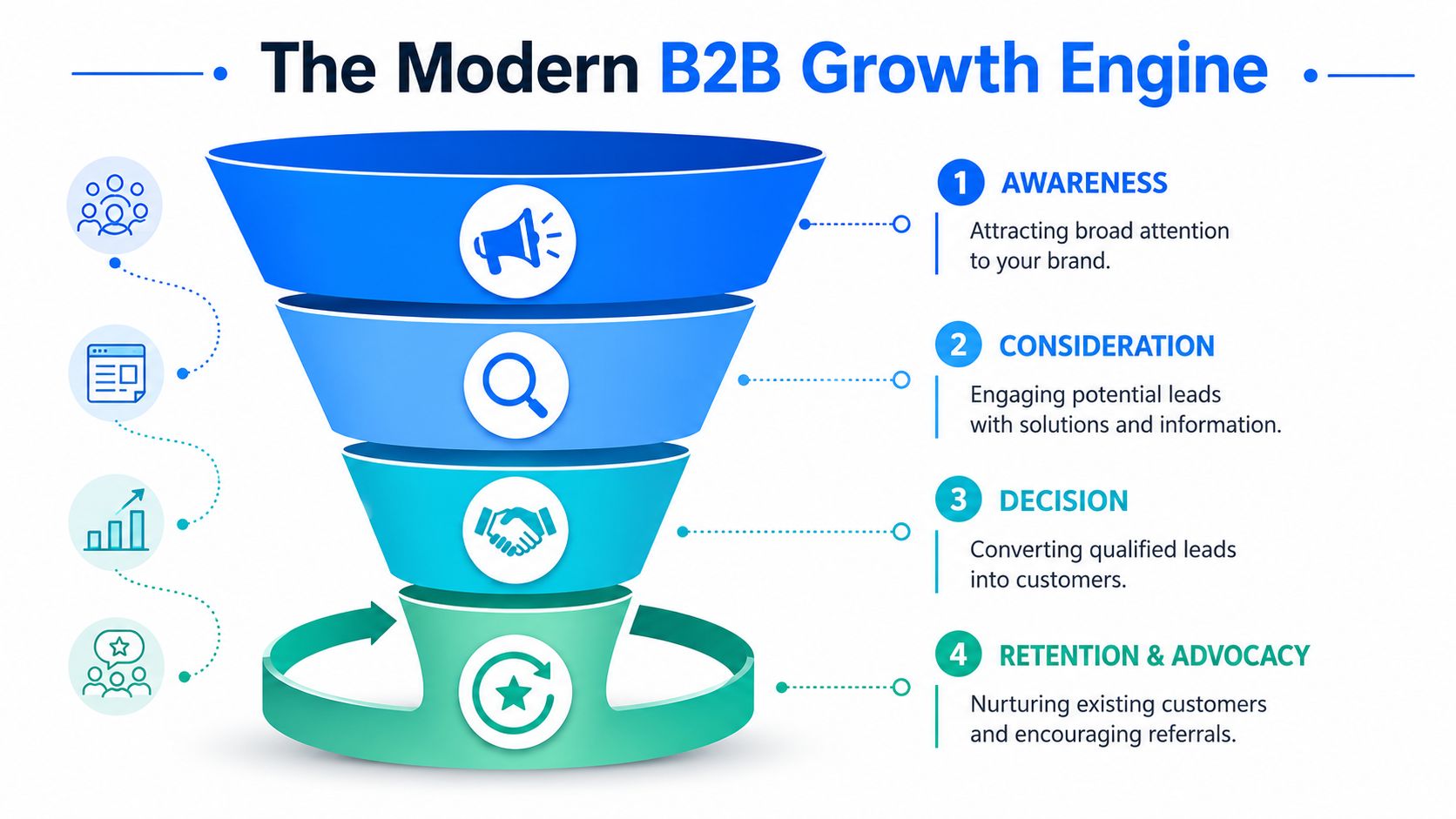
The Four Stages of the Modern B2B Growth Engine
A useful B2B marketing funnel still has stages. The mistake is treating those stages like a one-way drop.
The better model is a loop. Buyers orbit closer to a decision as trust, relevance, and urgency increase. After purchase, the loop doesn't end. It either accelerates through retention and advocacy or breaks through poor onboarding and weak follow-up.
Awareness
At this stage, buyers are diagnosing a problem or noticing a shift in their market. They aren't looking for your product yet. They're trying to understand what changed, what risk they're facing, and what options might exist.
Marketing's job here is reach plus relevance. Broad visibility matters, but generic visibility doesn't. The content that works is content that names the problem clearly and helps the right audience recognize themselves in it.
A few practical examples:
- Search-led education: Category pages, blog posts, and expert explainers that map to real pain points.
- Executive thought leadership: LinkedIn posts, POV pieces, and short videos that help buyers frame the problem internally.
- Lightweight capture paths: Newsletter signups, ungated resources, and event registrations for people who aren't ready to talk to sales.
Consideration
Now the buyer knows the problem and is actively evaluating approaches. At this stage, trust compounds. Your prospect is testing whether your company understands their use case, constraints, and buying environment.
This is also where most nurture programs underperform. Teams send product-heavy emails too early, or they keep sending generic content long after the buyer's questions have become specific.
Practical rule: Match the content to the decision risk. The more expensive or visible the purchase, the more proof and clarity the buyer needs.
The right objective in consideration is progression. You want the account to move from passive interest to active evaluation.
Useful assets at this stage include:
- Webinars and roundtables: Good for surfacing objections and educating multiple stakeholders.
- Case studies and implementation stories: Strong when they focus on process and outcomes, not chest-thumping.
- Comparison content: Helpful when buyers are sorting categories, approaches, or vendor models.
Decision
At decision stage, the buyer isn't asking, "Is this interesting?" They're asking, "Can we defend this choice?"
Marketing supports sales here by reducing uncertainty. That means less brand storytelling and more decision support. Your best assets are the ones a champion can forward internally without extra explanation.
A good decision-stage package often includes:
- demo follow-up content
- security and implementation explainers
- pricing context
- stakeholder-specific one-pagers
- competitor comparison pages
- customer proof mapped to similar environments
Retention and Advocacy
Most funnel diagrams place this stage at the bottom and move on. That's a major mistake.
Retention and advocacy determine whether acquisition spend compounds or resets. A customer who reaches value quickly is easier to expand, easier to retain, and more likely to generate references, testimonials, and referrals. A customer who struggles in the first months creates hidden churn risk and blocks future pipeline.
The modern growth engine isn't complete until post-purchase activity feeds the next cycle. That's when your B2B marketing funnel becomes a revenue loop instead of a reporting artifact.
Your Channel and Content Playbook for Each Stage
Channel strategy breaks when teams ask, "What content should we create?" before asking, "What question is the buyer trying to answer right now?" The same whitepaper can be useful in one stage and useless in another.
The simplest way to build a working B2B marketing funnel is to map channels to buyer intent, then design content that moves the account one step closer to a real buying conversation.
Awareness channels that create qualified attention
SEO still matters, but not as a publishing treadmill. It works when content is tied to category entry points, pain-led searches, and sharp positioning. A generic blog calendar won't do much if none of the topics connect to buying intent.
LinkedIn is usually the fastest way to test messaging. Founders, sales leaders, product marketers, and subject-matter experts can all contribute. The goal isn't to post constantly. It's to publish angles that make the right people stop and think, "That's exactly the problem we're dealing with."
Awareness channels that tend to work:
- Search content: Educational pages tied to use cases, jobs-to-be-done, and category questions.
- Social thought leadership: LinkedIn posts, carousels, and commentary from real operators.
- Partner distribution: Co-marketing, podcasts, and communities where your buyers already spend time.
A lot of teams benefit from reviewing adjacent frameworks like BAMF's guide to understanding lead generation funnels, then adapting them to their own sales motion instead of copying a generic SaaS playbook.
Consideration channels that nurture instead of nagging
B2B buyers typically need 6-8 distinct touchpoints before a purchasing decision, and that can extend to 15+ touchpoints for enterprise sales with multiple stakeholders, according to The Starr Conspiracy benchmark overview. The same source notes that B2B email marketing averages 21-24% open rates and 2.5-3.5% click rates, while segmented campaigns outperform broadcast messages by 30-50%.
That's why newsletters and lifecycle email deserve more respect in the funnel. Email isn't just a distribution channel. It's one of the cleanest ways to sustain momentum across a long buying cycle.
What works in consideration:
- Segmented newsletters: Different streams for industry, role, use case, or buying stage.
- Webinars with a strong point of view: Not product tours disguised as education.
- Case studies that explain decision logic: Why the customer changed, what blockers came up, and how rollout worked.
- Interactive assets: ROI narratives, implementation checklists, and self-assessment tools.
One practical reference for building those assets is this guide to funnel content marketing, especially if your content team is trying to tie editorial work to actual pipeline stages.
For teams running newsletter-led nurture, tools vary. Some use HubSpot or Customer.io for automation. Some use dedicated newsletter products for audience growth and campaign distribution. Breaker, for example, combines email sending with automated B2B list expansion and engagement analytics, which fits programs where newsletter growth is part of demand generation rather than a side project.
Here's a concise walkthrough that pairs well with a stage-based nurture approach:
Decision channels that help sales close
Decision-stage marketing should feel like sales enablement, not top-of-funnel repurposing. Buyers here need specifics. Vague value propositions create friction because they force the sales rep to rebuild context live.
The strongest bottom-funnel content usually includes:
- Demo follow-up decks: Short, and built around the buyer's process.
- Comparison pages: Honest about fit, trade-offs, and implementation realities.
- Procurement-ready assets: Security overviews, rollout plans, stakeholder summaries.
- Customer proof by segment: References that mirror company size, team structure, or use case.
Buyers don't stall because they need more brand content. They stall because they can't resolve internal risk.
Post-purchase channels that drive expansion
Most playbooks thin out at this stage. They say "retain customers" and move on. That's not enough.
The first campaigns after closed-won should be designed around activation, confidence-building, and early value confirmation. Good post-purchase content includes onboarding email sequences, adoption playbooks, milestone check-ins, office hours, customer education hubs, and targeted upsell prompts tied to product usage or maturity.
If your content calendar ends at demo requests, your funnel is incomplete.
Measuring What Matters Key Funnel Metrics and KPIs
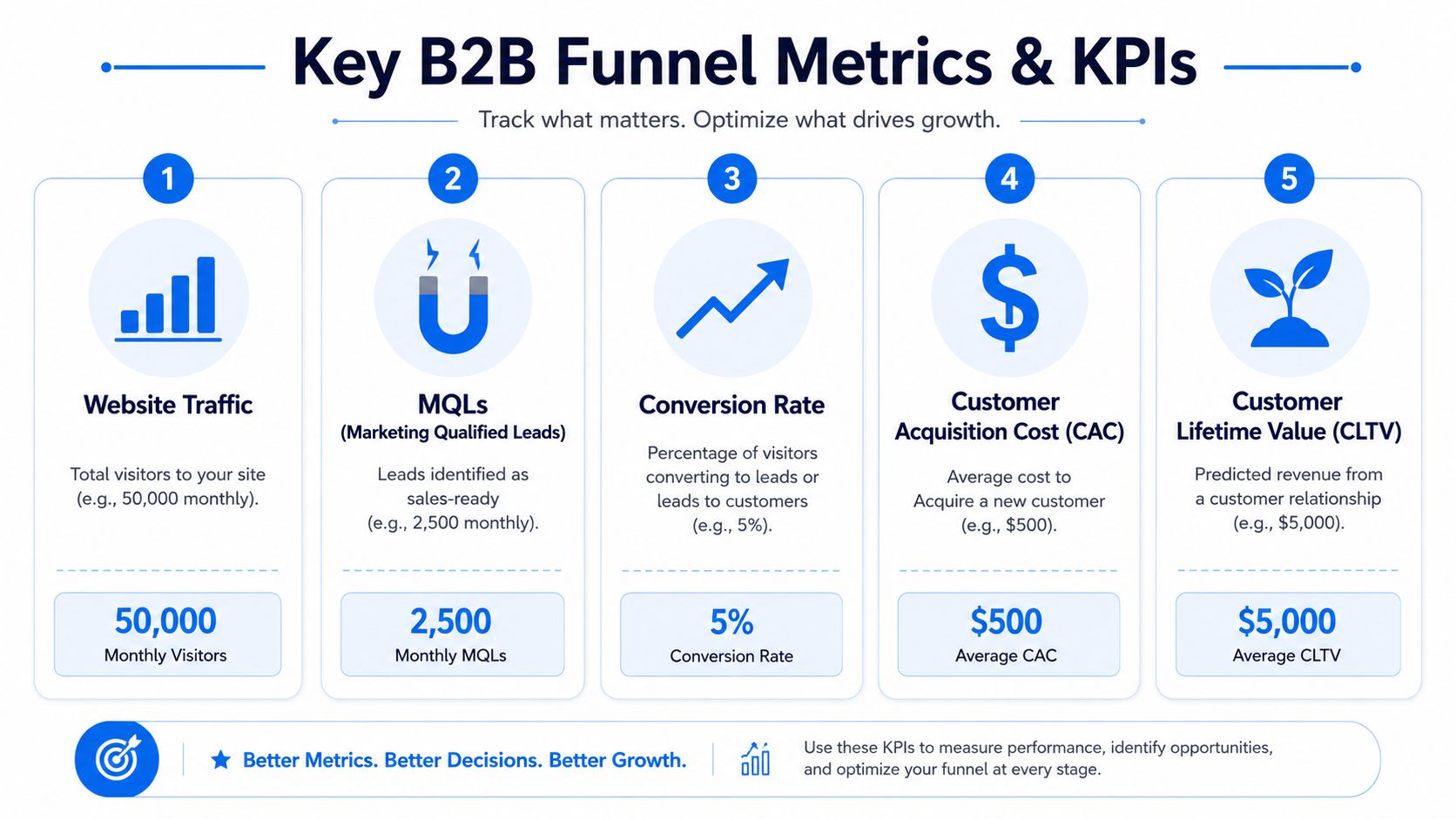
Funnel measurement goes wrong when teams report what's easy instead of what's useful. Traffic, impressions, and lead volume can be helpful signals, but they don't tell you where revenue creation is strengthening or stalling.
A better dashboard follows stage progression. Each metric should answer one question: did this stage create enough movement to justify more investment?
What to track by stage
Here's a practical way to think about funnel KPIs:
Stage
What to monitor
Why it matters
Awareness
share of voice, branded search trends, engaged site visits
Tells you whether the market is noticing the right message
Consideration
lead capture rate, content engagement quality, meeting intent
Shows whether attention is turning into real evaluation
Decision
stage conversion, opportunity creation, sales cycle friction
Reveals whether your handoff and proof assets are working
Retention and advocacy
activation milestones, expansion signals, referral activity
Shows whether customers are creating future revenue
The point isn't to create more reporting. It's to isolate the constraint. If awareness is strong but opportunities are weak, the problem is likely qualification, nurture, or handoff. If opportunities are healthy but renewals suffer, the problem is post-sale execution.
The handoff metric that deserves executive attention
One metric deserves more scrutiny than it usually gets: MQL-to-SQL conversion.
According to SPOTIO's B2B sales funnel benchmarks, only 13-26% of Marketing Qualified Leads convert to Sales Qualified Leads, and the biggest drop-off often comes from misaligned qualification criteria. The same source notes that top-performing teams materially outperform those baselines by tightening stage definitions and using stronger buying-intent signals.
That gap tells you a lot. If marketing says a lead is qualified and sales says it isn't, your funnel math is broken long before a rep starts discovery. Teams usually blame lead quality. The root issue is often inconsistent definitions of fit, intent, timing, or buying committee readiness.
Operational insight: If sales rejects large numbers of MQLs, don't just score harder. Rebuild the definition together.
Attribution also requires discipline. Last-touch reporting can flatter channels that appear near conversion, while hiding the content and touchpoints that created initial trust. A more complete model is multi-touch attribution, especially for complex journeys with repeated engagement across search, email, webinars, and sales outreach. This overview of multi-touch attribution is a useful reference if your team is trying to connect content influence with pipeline creation.
What good measurement changes
Good measurement changes behavior.
Marketing stops optimizing for raw lead volume. Sales gets clearer expectations. Customer success sees their work as part of revenue creation, not just retention. Leadership can make budget decisions based on funnel constraints instead of channel preferences.
That's when KPI reviews become operational, not ceremonial.
Unifying Your Funnel with Sales Alignment and ABM
A B2B marketing funnel fails fast when marketing and sales use different definitions for the same lead. One team celebrates form fills. The other team wants buying intent, stakeholder access, and urgency. Both teams think they're right.
The fix isn't another dashboard. It's a shared operating model.
Build an SLA that people can actually use
A service level agreement only works if it answers practical questions in plain language:
- What counts as qualified: Define fit, problem relevance, and signal thresholds.
- When sales should act: Set expectations for follow-up timing and ownership.
- What happens after rejection: Require a reason code and a return path to nurture.
- Which data fields are mandatory: Role, company context, source context, and meaningful engagement history.
Keep the SLA short. If it reads like policy, nobody will use it. If it sounds like a playbook, reps and marketers will reference it in real decisions.
Use ABM when deal size and complexity justify it
Account-based marketing is what alignment looks like in execution. Instead of asking marketing to generate a pile of leads and hoping sales finds a few good accounts inside it, both teams start with the accounts that matter most and coordinate touches around them.
That changes the funnel in three ways:
- Marketing creates content and campaigns for account clusters, not abstract personas.
- Sales outreach references the same message architecture prospects saw in ads, events, and email.
- Success metrics shift from individual lead counts to account progression.
This is especially useful when your buying process involves committees, long evaluation periods, or high contract value. In those environments, lead-centric reporting often hides what's really happening inside the account.
If your team needs examples of how coordinated plays look in practice, these account-based marketing examples are a helpful starting point.
ABM doesn't replace the funnel. It sharpens it by forcing both teams to agree on who matters, what message matters, and what progress looks like.
What alignment changes on the ground
When alignment is real, handoffs get cleaner. Marketing creates fewer but stronger MQLs. Sales follows up with more context. Feedback loops tighten because rejected leads come back with useful diagnosis instead of vague complaints.
That also improves planning. Marketing can invest in content that supports known objections. Sales can ask for assets that unblock real deals. The funnel starts acting like one revenue system instead of three disconnected teams with separate dashboards.
Turning Customers into Your Best Marketing Channel
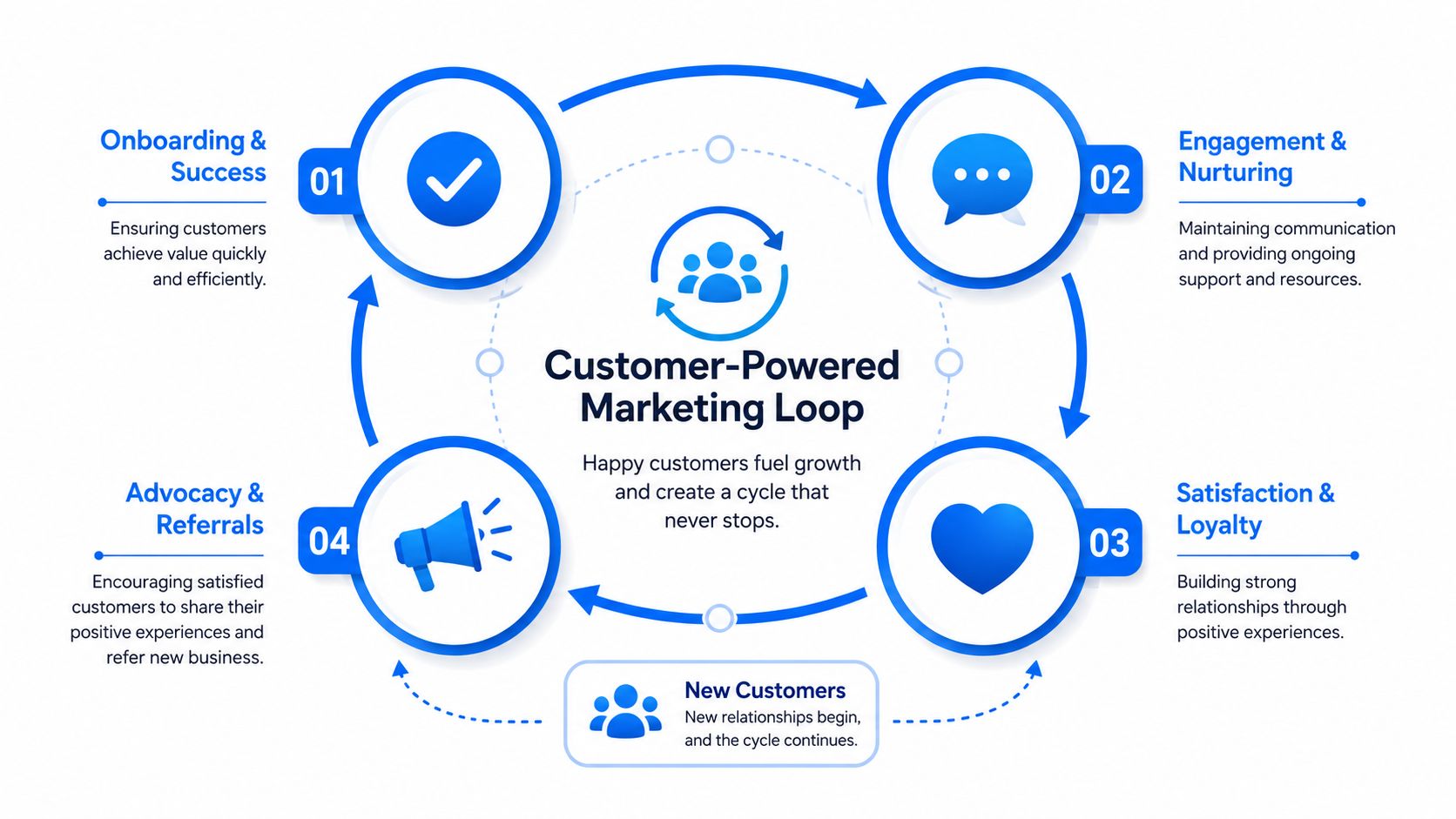
Closed-won is not the end of the B2B marketing funnel. It's the point where future revenue either compounds or starts leaking.
Many teams leave money on the table by treating onboarding as an implementation task, retention as a support metric, and advocacy as a nice bonus. In reality, those are growth levers.
Onboarding is the first expansion campaign
According to TopRank Marketing's discussion of the B2B marketing funnel, 30% of B2B deals fail at the first renewal due to unmet onboarding expectations, not product flaws, and AI-powered onboarding can reduce this churn by 25%.
That changes how you should think about post-purchase campaigns. Onboarding isn't just about product setup. It's about proving the buyer made a good decision, fast enough to preserve momentum inside the account.
Strong onboarding programs usually include:
- Role-based kickoff sequences: Different messaging for admins, champions, and end users.
- Milestone campaigns: Emails or in-app prompts tied to first value moments.
- Expectation resets: Clear communication about what success looks like in the first weeks and months.
- Usage-triggered support: Intervention when adoption signals stall.
The first months shape renewal and upsell
Expansion rarely comes from random check-ins. It comes from identifying when a customer is ready for the next capability, team rollout, or adjacent use case.
A practical post-purchase motion looks like this:
Window
Primary goal
Marketing role
Early onboarding
confirm value fast
reinforce setup, education, and confidence
Active adoption
deepen usage
send role-specific best practices and use-case content
Maturity
introduce expansion
surface adjacent workflows, add-ons, or team-wide rollout stories
Advocacy
turn success into reach
invite referrals, references, testimonials, and event participation
The key is timing. Ask for advocacy too early and it feels forced. Wait too long to identify expansion signals and the account settles into a smaller footprint than it should.
The best retention programs don't just prevent churn. They create proof, stories, and champions that lower acquisition friction for the next deal.
Advocacy should be designed, not hoped for
Happy customers don't automatically become promoters. Teams have to build paths for that behavior.
Useful advocacy motions include:
- Reference programs: Identify willing customers by segment and use case.
- Lightweight testimonial capture: Short prompts after visible wins, not annual surveys alone.
- Customer storytelling: Turn success milestones into webinar spots, case studies, and community participation.
- Referral moments: Ask when the customer has just achieved a clear win.
When this is working, the bottom of the funnel feeds the top. Sales gets warmer intros. Marketing gets sharper proof. Product gets clearer insight into what drives stickiness. The result is a customer-powered growth loop instead of a leaky post-sale handoff.
From Funnel to Flywheel A Perpetual Growth System
The traditional funnel is too narrow for the way B2B growth works. It overvalues acquisition, undervalues handoffs, and treats post-purchase activity as someone else's job.
A stronger model connects every stage. Awareness attracts the right audience. Consideration builds trust through repeated, relevant touchpoints. Decision removes risk and supports the internal buyer case. Retention and advocacy turn customer success into expansion, proof, and new demand.
That's the flywheel. Each stage adds momentum to the next. Better qualification helps sales close. Better onboarding improves renewal confidence. Better customer outcomes generate stronger references and referrals. Future pipeline becomes easier to create because existing customers are already contributing to it.
Teams don't need a more complicated funnel. They need a more honest one. The companies that win are the ones that build around the full journey and treat the customer relationship as the engine, not the endpoint.
If you're building a newsletter-led demand engine inside your B2B marketing funnel, Breaker is one option to evaluate. It combines campaign sending, audience growth, subscriber targeting, and engagement analytics in one workflow, which can help teams run nurture and pipeline programs without splitting the work across disconnected tools.
Keep reading
All articlesHow to Boost Conversions With Your Email Newsletter
Turn your newsletter into a conversion engine. See 2026 benchmarks, CTR vs CVR explained, and the fixes most email guides skip.
Drip Campaign Template: Ready-to-Use Email Sequences
Get 6 ready-to-paste drip campaign templates with subject lines, body copy, and send timing—plus a step-by-step guide to building your own.
Post-Webinar Survey Questions Template (2026)
30+ post-webinar survey questions with NPS, CSAT, and CES templates, plus timing and length tips to boost completion and qualify leads faster.