
How to Go Viral: A B2B Playbook for Newsletter Growth
Learn how to go viral on purpose. This playbook offers a step-by-step B2B strategy for creating content that drives real newsletter growth and leads.

Most advice about how to go viral is useless for B2B teams because it confuses mass attention with qualified attention. A software buyer, consultant, operator, or VP doesn't need to see your post because it used the latest meme format. They need to stop because the idea speaks to a real commercial problem they already feel.
That changes the target. In B2B, virality isn't a vanity event. It's a distribution event that puts your message in front of the right cluster of buyers, peers, and influencers fast enough that the platforms keep amplifying it, and strong enough that those people convert into subscribers you can reach again through your newsletter.
The popular framing is that virality is random. It isn't. The better framing is that breakout content sits at the intersection of sharp positioning, high-retention packaging, platform fit, and a capture system that turns borrowed reach into owned audience. If you want a broader tactical reference, BlitzReels' 2026 virality guide is useful for seeing how creators think about repeatable format design rather than one-off hits.
The same logic applies to channel mix. Teams that treat social as an isolated top-of-funnel tactic usually waste their best posts. Teams that connect social reach to email, partnerships, and community distribution build momentum. That's why distribution planning matters as much as the asset itself, especially when you're deciding which distribution channels in marketing deserve your time.
Beyond Luck Engineering B2B Virality
The fastest way to fail is to chase "viral" as a creative identity. The right move is to treat it like an operating system.
A lot of founders and marketers post as if volume alone will save weak positioning. It won't. If the message is generic, broader reach only exposes more people to a forgettable claim. In B2B, the posts that travel usually do one of three things well: they name a painful problem with precision, challenge a lazy industry assumption, or package useful insight in a way busy professionals can absorb quickly and share safely.
What B2B virality actually means
Consumer creators can chase broad entertainment. B2B teams can't afford that luxury unless they already know how to translate attention into pipeline. A viral B2B post earns disproportionate visibility inside a relevant market segment, then turns that visibility into replies, profile visits, direct inquiries, and newsletter signups.
Practical rule: If a post gets attention from people who will never buy, refer, or influence a deal, it's reach. Not growth.
That trade-off matters. A joke post may outperform a sharp industry analysis on surface engagement, but the analysis often produces better subscriber quality because it attracts the exact audience you want reading future issues.
The system beats the trend
The marketers who consistently figure out how to go viral don't rely on inspiration. They build a repeatable loop:
- Choose a message with market tension. Pick a belief your audience argues about, misunderstands, or urgently needs help with.
- Package it for fast consumption. Lead with the claim, not the background.
- Match the format to the platform. The same idea should not look identical on LinkedIn and TikTok.
- Capture the attention somewhere you own. If the post wins, your newsletter should benefit.
That's the difference between a lucky spike and a growth asset. One disappears into the feed. The other compounds because every strong post recruits the next audience segment into your list.
Defining Your Viral Thresholds
B2B teams waste a lot of time chasing the wrong number.
If your goal is newsletter growth, viral does not mean broad attention for its own sake. It means a post breaks past your normal distribution, reaches a concentrated slice of the market you care about, and converts that attention into qualified subscribers.
That changes how you set the bar. A consumer creator can celebrate raw views. A B2B marketer needs thresholds tied to audience quality, subscriber conversion, and repeatability.
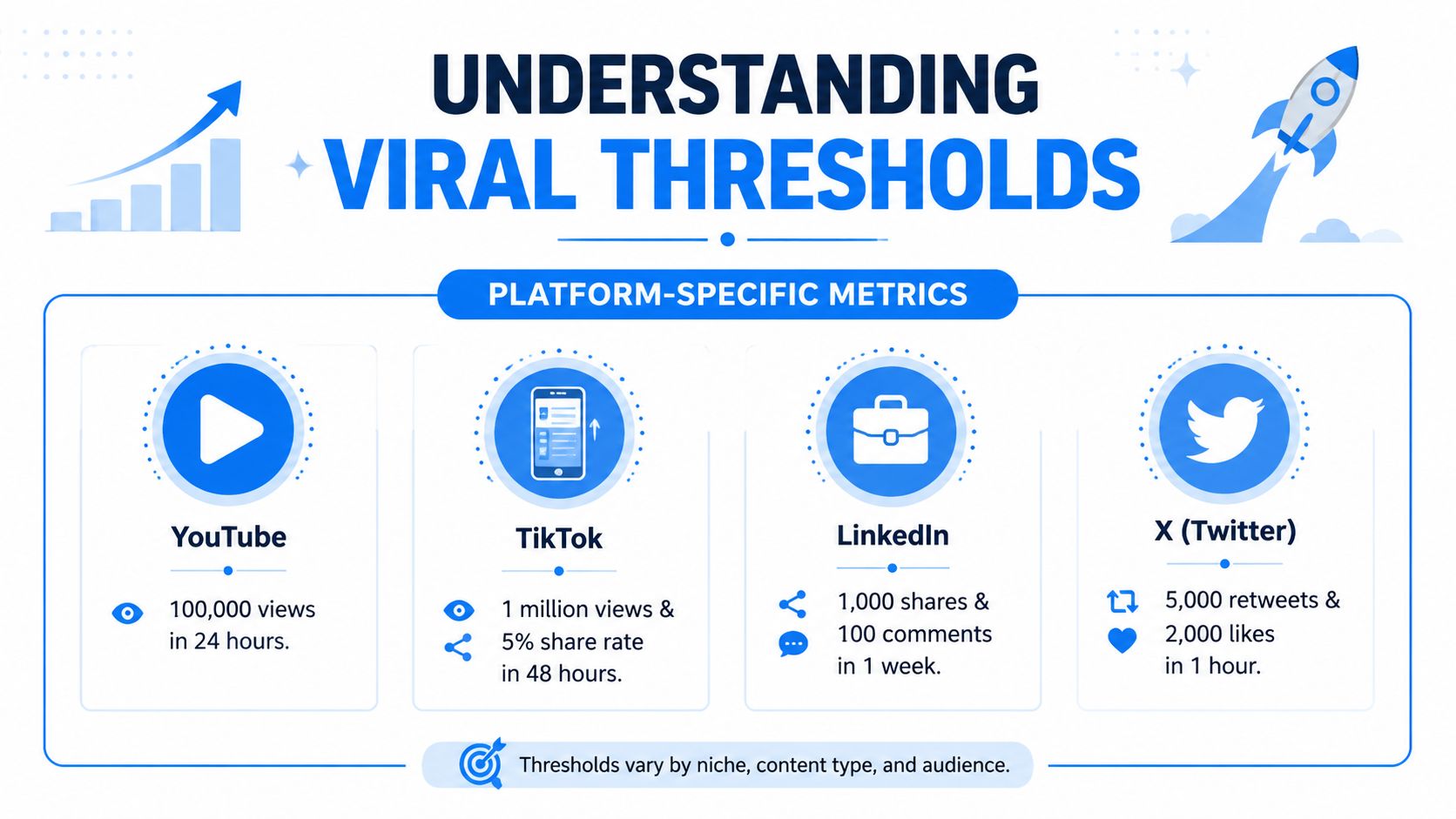
Analysts and platform operators use different benchmarks by channel. LinkedIn posts above 50,000 impressions are often treated as viral, while 5,000 to 20,000 impressions usually signals strong performance for many professional accounts. On TikTok, 1 million views is a common viral benchmark. Relative breakout matters too. A post that earns 10 to 20 times your median view count qualifies as breakout performance for many accounts, according to Disrupt Marketing's breakdown of viral thresholds.
Set thresholds against your own baseline
A founder with 4,000 followers does not need a million views to create a meaningful growth event. If the usual post stalls and one topic suddenly drives 12x the normal reach, profile visits spike, and newsletter signups follow, that is the result worth studying.
I care less about absolute volume than about signal density. Did the right people comment? Did buyers, operators, founders, or category experts share it? Did the post pull new subscribers from the audience segment the newsletter is built for?
Those questions produce better decisions than creator envy.
Platform
Strong result
Viral result
Best use in B2B
Often lands between 5,000 and 20,000 impressions
Typically 50,000+ impressions
Operator insight, founder POV, carousels, teardown posts
TikTok
Strong performance depends on your baseline
1 million views is viral
Educational clips, reactions, expert commentary
YouTube
Strong performance varies by channel
Better judged by breakout relative to baseline and speed of spread
Interviews, explainers, category education
X
Thresholds are less stable by niche
Better judged by breakout relative to baseline
Fast takes, threads, news reactions, quote-post debates
Track the threshold that matters to the newsletter
For B2B, I recommend three working thresholds.
- Reach threshold. The post clearly outperforms your normal distribution on that platform.
- Audience threshold. Engagement comes from people who match your ICP, influence deals, or can refer the newsletter to the right circles.
- Conversion threshold. The post drives subscriber growth at a cost and quality level you want to repeat.
A post can clear the first threshold and still fail the other two. That happens all the time with broad hot takes, trend-chasing clips, and opinion posts that attract peers but not buyers. Attention without subscriber intent is noise.
Use viral posts as testing infrastructure. When a topic clears all three thresholds, turn it into a repeatable asset. Build a newsletter issue around it, cut a second angle for LinkedIn, test a short video version, and expand the idea bank with related angles. If you need raw material, actionable content ideas for small businesses can help spark formats, but the threshold stays the same. More of the right subscribers, not more empty reach.
Finding Ideas Worth Spreading
Execution can't rescue a weak premise. Most B2B content underperforms because it starts with format instead of tension. The team asks whether to post a carousel or a video before it asks whether the idea is worth repeating in a buying committee chat, a team Slack, or a founder group.

Useful ideas spread. Surprising ideas spread faster. Useful ideas that challenge a stale belief spread fastest in B2B because they give the reader both utility and identity. Sharing the post makes them look informed.
Start with friction, not features
The cleanest source of viral ideas is unresolved market friction. Look for places where your audience says one thing publicly and does another privately. That gap produces strong content because it contains tension.
A simple working framework:
- Operational pain. Show where teams waste time, budget, or trust.
- Contrarian truth. Challenge a default tactic your market keeps repeating.
- Decision support. Help buyers evaluate trade-offs they already face.
- Status signal. Give readers language they can use to sound sharper when they share it.
If you need prompts to get unstuck, lists like actionable content ideas for small businesses can be surprisingly useful, even for B2B teams, because the underlying challenge is the same: find angles that are specific enough to trigger recognition.
Borrow attention without copying
One of the most underused tactics in B2B is reaction and analysis of existing viral content. That's not lazy. It's efficient.
A proven, replicable strategy for new creators is reaction and analysis of existing viral content. Playing a viral video and adding a unique perspective can drive engagement because it uses pre-validated attention and triggers agreement or disagreement, pushing the content further into the algorithm, based on this discussion of reaction-led viral formats.
That matters for newsletter growth because reaction content solves the cold-start problem. Instead of asking the market to care about your point from zero, you attach your insight to a topic that already has momentum. Then you move the audience from "I've seen this" to "I haven't heard it explained this way."
A practical example in B2B:
- A viral post claims AI will replace SDR teams.
- You react with a sharper take: where automation helps, where it fails, and what operators should track instead.
- The audience now has a reason to share your version, not just the original.
Here's a useful reference if you want to study how video creators structure this kind of response content.
Build an idea bank that compounds
Don't brainstorm from scratch every week. Build a running list from recurring inputs:
- Sales calls. Objections usually map to high-performing content angles.
- Customer success notes. Friction points often become practical posts people save and forward.
- Competitor claims. Overstated positioning creates openings for contrarian analysis.
- Comment sections. Sharp questions often make better posts than your original draft.
The best B2B ideas rarely appear in a blank document. They show up in objections, disagreement, and repeated confusion.
That's how to go viral more consistently. You stop chasing novelty and start harvesting market tension that already exists.
Crafting Unskippable Hooks and Formats
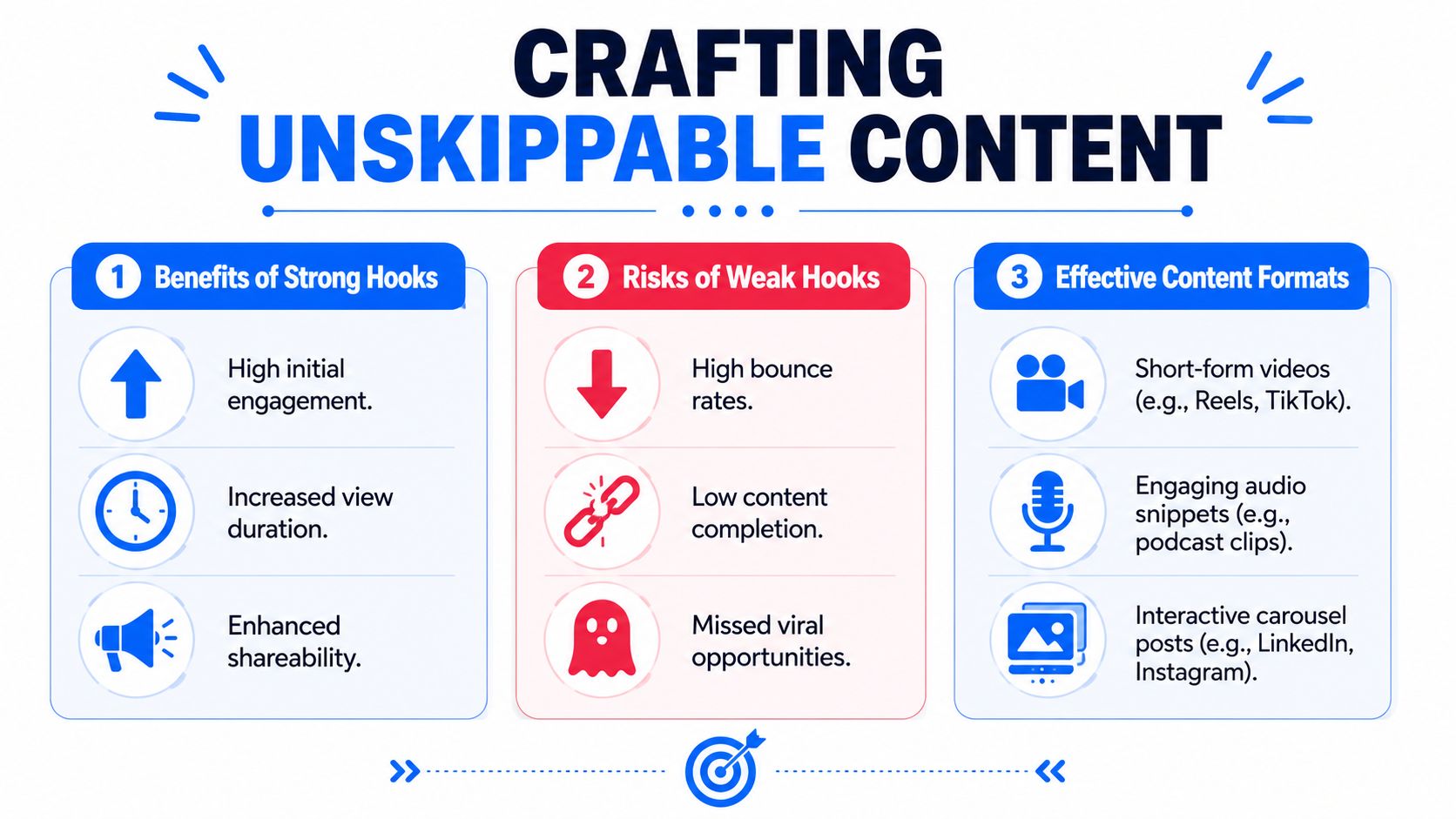
B2B content rarely fails because the insight is weak. It fails because the packaging gives busy buyers no reason to stop.
For newsletter growth, that mistake is expensive. A post that gets attention but attracts the wrong audience creates low-intent subscribers, weak open rates, and a list that looks healthy while pipeline stays flat. The job of the hook is not to chase broad reach. The job is to qualify attention fast.
Content spreads more often when it triggers high-arousal emotions and delivers novelty or practical value, as explained in Scientific American's review of viral psychology. In B2B, that usually means tension, surprise, status risk, or a sharper path to a result.
Write hooks that create business stakes
A strong hook answers three questions in one line. What is changing, who is exposed, and what payoff comes from reading or watching the rest?
Weak opening:
- "Some thoughts on newsletter growth."
Stronger opening:
- "Your B2B newsletter probably does not need better writing. It needs a distribution system that brings in subscribers who can buy."
That works because the reader can place themselves inside the problem immediately. It also frames the outcome in commercial terms, which matters more than impressions.
Use these hook patterns to attract high-value subscribers instead of passive engagement:
- The contrarian operator take
"Thought leadership is not your bottleneck. Subscriber relevance is."
- The costly miss
"Your best content underperforms when the first line hides the business consequence."
- The metric correction
"A post with 200 qualified subscribers can beat one with 200,000 views."
- The hidden process
"The newsletters growing fastest on LinkedIn are built in the comments before they are built in the inbox."
Match the format to the buying context
Format choice changes who stays, who shares, and who subscribes. B2B teams often overuse video because it feels higher effort. In practice, text and carousels usually convert better for dense ideas, while video works best when tone, proof, or reaction speed carry the message.
Message type
Best-fitting format
Why it works
Sharp claim with a clear business implication
LinkedIn text post or X post
Fast to scan, easy to quote, strong fit for decision-makers
Step-by-step framework
Carousel
Easy to save, circulate internally, and revisit later
Reaction to a market claim
Short-form video
Adds speed, tone, and authority in a crowded feed
Proof-based teardown
Screen-recorded commentary
Lets viewers see the evidence instead of taking your word for it
If the goal is newsletter growth, use the format that preserves the promise from first impression to signup page. The same discipline behind strong newsletter headline examples for subscriber growth applies here. The opening has to state the value before the audience commits.
Short-form video still has a place in B2B, especially for top-of-funnel reach and retargeting pools. Teams producing higher volume creative often use AI tools for TikTok video creation to test angles faster, but speed only helps if the hook is tied to a real operator problem.
Build for retention after the stop
Getting the scroll to stop is step one. Earning the next 10 seconds, or the next paragraph, is what separates empty reach from newsletter signups.
For video, open with the claim, then prove it quickly. For text, put the strongest sentence first and move proof up before context. For carousels, make slide two carry the payoff so the reader knows the swipe is worth it.
A simple retention sequence works well:
- Lead with the claim. State the tension in plain language.
- Add proof early. Use an example, result, teardown, or mistake pattern.
- Show the implication. Explain why the reader should care in business terms.
- Close with the next step. Follow, comment, or subscribe for the deeper system.
Experienced growth teams separate vanity virality from useful virality. They stop writing openings that sound smart and start writing openings that make the right reader feel exposed, curious, or compelled to act.
That is what makes a hook unskippable in B2B. It promises relevance, proves authority, and channels attention into a subscriber relationship you can compound.
Viral Plays for LinkedIn X and TikTok
B2B virality changes by platform, but the goal stays the same. Get the right people to stop, engage, and convert into newsletter subscribers you can reach again without paying for the next impression.
Each platform contributes differently. LinkedIn is where credibility turns into subscriber intent. X is where sharp ideas spread through networks fast. TikTok is where you can reach cold audiences at scale if you can teach with speed and clarity.
LinkedIn for credibility and subscriber intent
LinkedIn remains the strongest channel for B2B viral distribution because professional context does part of the filtering for you. A post that spreads there is more likely to reach operators, buyers, founders, and hiring managers than a post with similar raw reach on a consumer-heavy platform.
The winning formats are usually straightforward:
- Text posts for opinionated claims. Lead with a statement that cuts against accepted advice in your category.
- Carousels for process. Use them to show a system, teardown, or before-and-after decision path.
- Comment threads for conversion. Early replies can extend reach, but they also qualify intent if you answer with specifics.
If your end goal is pipeline instead of applause, strong B2B lead generation on LinkedIn depends on what happens after the post gets traction. The post earns trust at scale. Your profile, pinned offer, and newsletter CTA turn that trust into an owned audience.
One pattern works especially well for newsletter growth. Publish a strong point of view in the post, then use the comments to offer the deeper framework, checklist, or teardown inside the newsletter. That creates a natural step from public insight to owned subscription.
X for speed and network effects
X favors compressed insight. The platform rewards people who can react quickly, frame a useful opinion, and package it in language others want to quote.
That changes how B2B teams should write there. Skip the setup. State the observation, add the implication, and make the point easy to repost.
What tends to work:
- A timely reaction to industry news with a clear business takeaway
- A short thread built around one strong insight, not seven weak ones
- A contrarian statement backed by operator experience
- Clean, quotable lines that can travel outside your follower base
What usually fails:
- Corporate phrasing
- Long context before the point
- Generic advice that could apply to any function or market
X can create fast bursts of attention, but the traffic quality varies. Treat it as a distribution layer for ideas that already have a clear audience fit, not as the primary place to explain a nuanced B2B system from scratch.
TikTok for cold reach and newsletter top-of-funnel
TikTok is useful for B2B when you stop judging it by consumer creator norms and start using it as an education channel. The strongest posts teach one painful lesson fast. They do not try to look polished. They try to feel immediately useful.
For B2B newsletter growth, the repeatable TikTok play is simple. Open with a mistake, misconception, or hidden cost your buyer recognizes. Deliver one insight with proof. End with a reason to get the full breakdown through your newsletter.
A few formats tend to hold up:
- Myth correction. Call out bad advice in your category and replace it with a better operating principle.
- Teardown clips. Review a landing page, outbound message, ad, or funnel decision.
- Operator lessons. Share something that worked, failed, or changed your thinking.
- Trend translation. Take a broad market shift and explain what it means for a specific B2B role.
Production speed matters because TikTok rewards testing volume, but volume only helps when the format is repeatable. Teams using AI tools for TikTok video creation can reduce the time spent on scripting, captions, editing, and variants. That makes it easier to test more hooks around the same core insight.
The trade-off is real. Faster production can flood your pipeline with average ideas. Strong teams solve that by fixing the format first, then rotating inputs. One winning structure can support dozens of posts if each one speaks to a different operator pain point.
Do not chase trends unless they map cleanly to your buyer. In B2B, a smaller spike from the right audience beats broad reach that never turns into subscribers or sales conversations.
From Viral Spike to Systemic Growth
A viral hit does not build a B2B newsletter. Conversion infrastructure does.
If a post reaches 100,000 people and only a handful of the right buyers subscribe, the campaign underperformed. B2B virality has to produce owned audience growth, better lead quality, and follow-up demand. Otherwise you bought a short burst of attention with no compounding return.
The teams that win here treat a breakout post like the top of a funnel, not the full outcome. They prepare the capture path before distribution starts. That means a newsletter landing page tied to the exact topic, a clear subscription promise, a welcome sequence that continues the argument, and comment handling that turns interest into action while the post is still spreading.
Turn attention into owned audience
The cleanest path for B2B usually looks like this:
- Publish where your buyers already pay attention.
- Route interest to a newsletter tied to the same pain point, not a generic signup page.
- Convert the winning angle into an email issue while the topic is still hot.
- Build follow-up assets from the response. FAQs, objection handling, webinar topics, and sales content all come from the same signal.
Comment activity matters, but only if it supports the conversion goal. Reply fast, answer specific questions, and give serious prospects a reason to subscribe for the fuller breakdown. Native posting, mobile formatting, and fast response times all help distribution, but those are support functions. The primary job is capturing demand from the right segment.
Measure what actually matters
Reach metrics tell you whether the content package earned attention. They do not tell you whether the business got stronger.
For B2B newsletter growth, track outcomes that change pipeline quality:
- Subscriber conversion rate from the post
- Job titles, company types, or buyer segments added to the list
- Reply rate and engagement inside the welcome sequence
- Whether the topic produced qualified conversations, demos, or sales follow-up
- Whether the post created a repeatable series instead of a one-time spike
Viral reach is rented. Subscriber relationships are owned.
That distinction changes how you evaluate every campaign. A post with lower total views can beat a broad viral spike if it brings in the right operators, gives sales a sharper narrative, and creates a newsletter topic you can build on for weeks.
If you're building a B2B newsletter and want viral moments to turn into qualified subscriber growth, Breaker is built for that job. It helps marketers grow the right list, send strong campaigns, and connect content performance to subscriber growth and ROI, so the attention you earn doesn't vanish after the post cools off.
Keep reading
All articlesEmail Automation Workflow & Drip Campaign Data Structure
Learn the database schema behind email drip campaigns—tables, workflow states, and event logs that power reliable marketing automation.
Breaker Review: AI-Native ESP for Newsletter Growth
An unbiased Breaker review: pricing, features, deliverability data, and who this AI-native email platform fits best for newsletter growth.
Breaker for B2B, SME and Consumer Newsletter Senders
Learn how B2B, SME, and consumer audiences differ in newsletters, plus a framework for segmenting, messaging, and monetizing each without losing relevance.