
Cost of Acquisition Explained for B2B Growth Teams
Learn how to calculate cost of acquisition, benchmark CAC by channel, and lower it with proven strategies built for B2B and newsletter growth teams.
The uncomfortable number is 222%. That's the rise in SaaS app acquisition CAC cited over the last decade, from $19 to $29 per user in the benchmark data, while other 2026 summaries say CAC climbed 60% over the past five years (Business of Apps benchmark). For B2B growth teams, that shift changes the conversation from “How do we grow faster?” to “Which channels still clear the bar after sales, marketing, and attribution costs are fully loaded?”
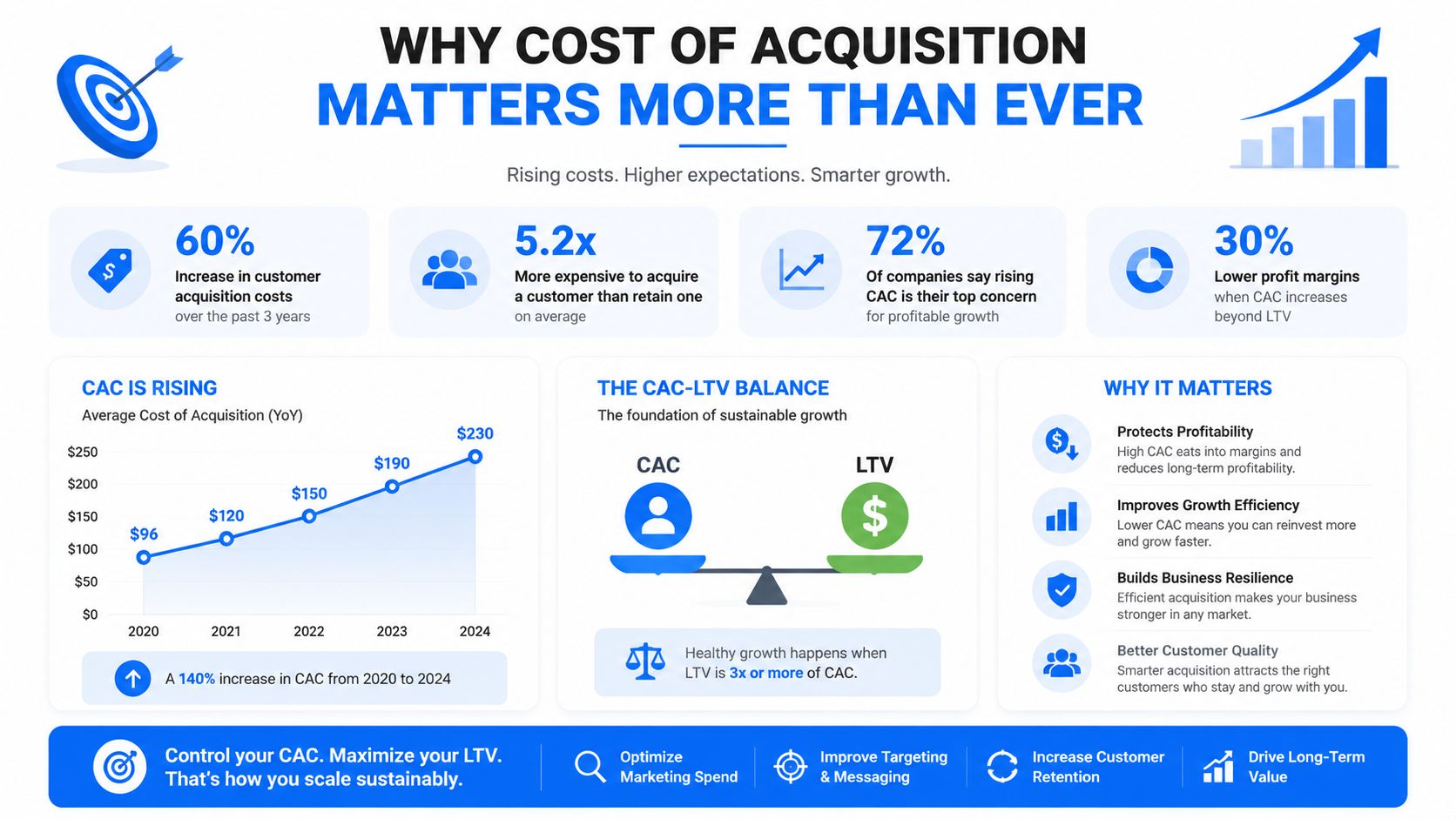
Cost of acquisition is no longer a single line on a dashboard. It's a constraint on hiring, on budget allocation, and on which motions deserve more capital this quarter. When benchmarks show B2B SaaS acquisition economics ranging from $239 to $702 per customer depending on the dataset, with adjacent segments like commercial insurance at $593, financial services at $784, and education at $1,143, the lesson is that acquisition economics are highly segment-specific (Amplitude CAC guide).
That variability matters because teams often compare themselves to the wrong peer set. A self-serve newsletter product, a sales-led SaaS motion, and an enterprise outbound program don't share the same cost structure, even if they all report “CAC” in the same spreadsheet. The metric is useful precisely because it forces a trade-off, if acquisition is getting more expensive, the business needs either better conversion, higher retention, higher pricing power, or a different channel mix.
Practical rule: if your CAC is rising faster than your team can explain with channel mix or sales cycle changes, treat the number as a diagnosis problem before you treat it as a spending problem.
That's why boards care about CAC even when operators prefer to talk about pipeline. CAC tells you whether growth is scalable on the current model, or whether the company is buying revenue at a price the rest of the unit economics can't support.
Why Cost of Acquisition Matters More Than Ever
The cleanest reason CAC matters now is simple. Acquisition has gotten more expensive, and the gap between channels is wide enough to change strategy, not just reporting. One benchmark lists average B2B CAC at about $150 for referrals, $802 for paid search, $982 for LinkedIn ads, and about $1,980 for outbound sales (Business of Apps benchmark). That spread is too large to dismiss as noise.
Why the board should care
A growth team can't manage to a blended CAC number alone if one channel is efficient and another is draining margin. The board-level question is not “What is CAC?” It's “Which acquisition motion can still scale without eroding payback or forcing a pricing reset?” When the market says some segments are far more expensive than others, budget decisions need to follow segment reality, not spreadsheet convenience (Amplitude CAC guide).
The other reason this matters is that older budgeting instincts still assume acquisition costs move slowly. The benchmark data says otherwise. If a category's CAC is already rising materially, then hiring plans, payback assumptions, and pipeline targets built on older cost baselines can break fast. That's especially true for B2B teams that split spend across paid, organic, outbound, and partner motions, because the blended number hides which part of the system is inflating the average.
Why newsletters and PLG teams should care too
Newsletter and product-led teams often think they've escaped the CAC problem because they don't run a classic sales org. They haven't. They've just changed the shape of the numerator and the definition of a customer. A subscriber, an activated user, an MQL, and a paying account are different acquisition outcomes, and the economics change at each step.
That's why cost of acquisition belongs in the same conversation as retention and pricing. If it costs more to acquire than it used to, teams need more precise answers about what each channel is buying, how long payback takes, and which motions deserve investment when growth capital gets tighter.
The Cost of Acquisition Formula and What Actually Belongs in It
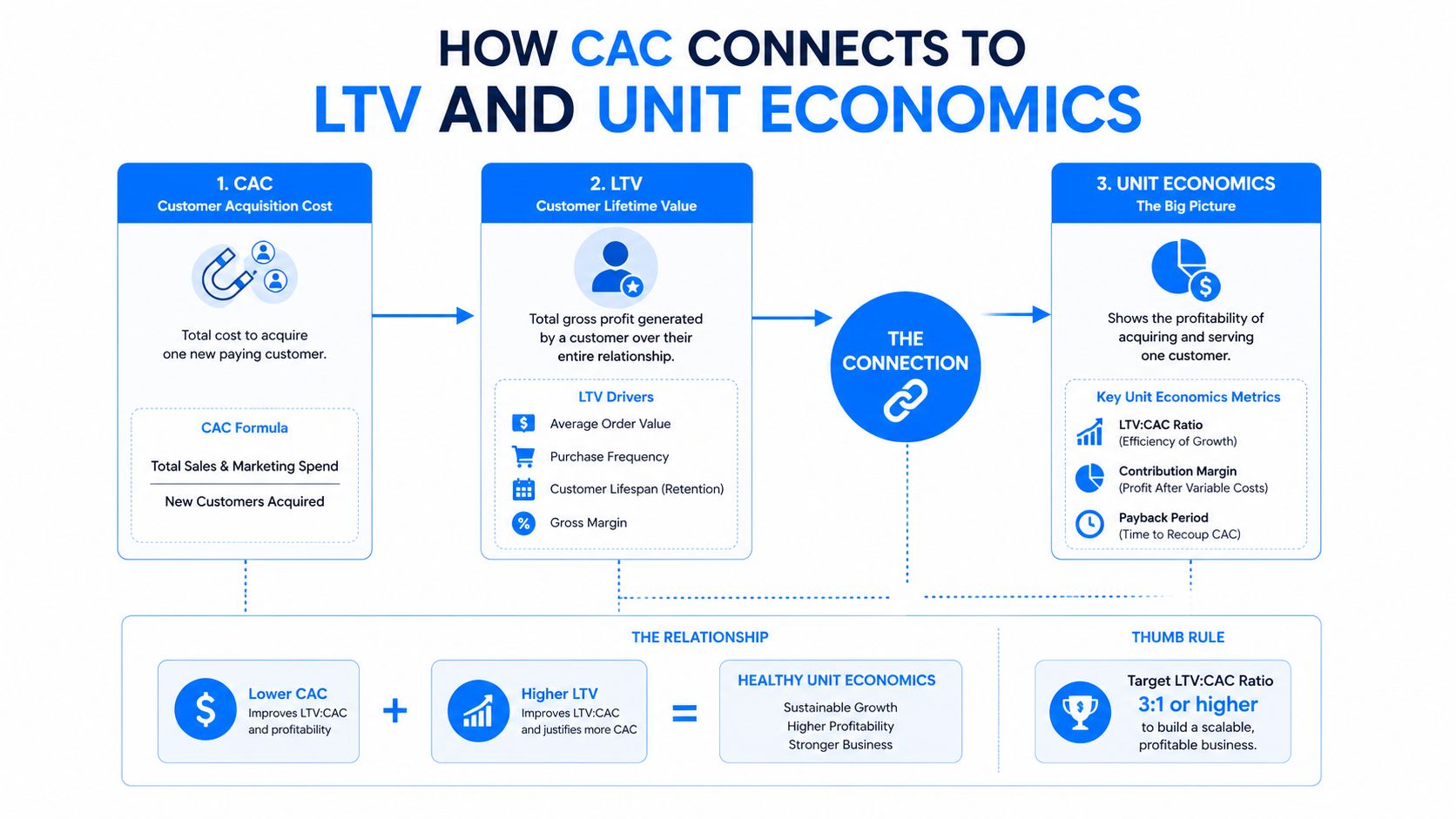
The standard formula is straightforward. Customer acquisition cost equals total sales and marketing spend divided by new customers acquired in a period (Amplitude CAC guide). The hard part is deciding what “total sales and marketing spend” really means when your team runs paid search, content, events, outbound, and partner programs at the same time.
A defensible default for mixed channels
A blended CAC should include the costs that produce the customer, not just the media bill. That usually means sales salaries, marketing salaries, tools, creative production, agency fees, event spend, and any software used to generate or convert demand. If the team excludes sales labor, it understates acquisition cost. If it excludes software or content production, it paints an incomplete picture of how expensive each new customer really is.
A cleaner approach is to keep two views. Blended CAC shows the business-wide cost of acquiring customers across all motions. Fully loaded CAC adds the overhead that management funds, so finance and growth can compare reality against assumptions. The second number is more useful for board decisions because it exposes whether a channel only looks efficient when shared costs are left out.
Practical rule: if an expense helps turn strangers into customers, it belongs somewhere in the numerator unless you can defend why it should be treated as overhead outside acquisition.
For a useful breakdown of how practitioners separate cost per acquisition from broader customer acquisition cost, Silver Spoon Agency's CPA breakdown is a practical reference point for the terminology overlap and the reporting implications of each metric: Silver Spoon Agency's CPA breakdown.
What a simple example looks like
If a team spends on ads, salaries, and tools over a period and acquires new paying customers in that same period, the CAC formula gives one blended figure. That number is only meaningful if the period is consistent and the customer definition is fixed. Otherwise, one quarter can look “better” because the sales cycle was shorter or because low-intent leads converted faster than usual.
The right takeaway is not that CAC is complicated. It's that the numerator is often disputed, and that dispute changes the answer more than most leaders expect.
CAC Benchmarks by Channel and Segment
CAC benchmarks only help when the comparison group matches the motion. A referral-heavy newsletter business should not measure itself against outbound-led enterprise software, and a LinkedIn-dependent B2B motion should not assume the same baseline as search-led demand capture. Channel mix changes the number before the first sale closes.
CAC Ranges by Channel and Segment
Reported CAC
Best Fit For
Referrals
about $150
Low-friction, trust-led acquisition motions
Paid search
about $802
Intent capture with measurable demand
LinkedIn ads
about $982
B2B targeting where audience quality matters more than raw volume
Outbound sales
about $1,980
High-touch enterprise pursuit with longer sales cycles
B2B SaaS
$239 to $702
Comparing self-serve to more sales-supported motions
Commercial insurance
$593
Verticals with structured sales and moderate complexity
Financial services
$784
Regulated or trust-sensitive buying journeys
Education
$1,143
Offerings with longer consideration and heavier sales support
The pattern matters more than any single row. Referral-led acquisition sits at the low end because trust transfers faster than paid attention, while paid reach and human selling push CAC higher, especially in B2B settings with longer deal cycles. That is consistent with the range of channel and category benchmarks summarized in the Business of Apps benchmark and the Amplitude CAC guide.
What this means for budget decisions
A team that depends on paid search or LinkedIn should expect a higher CAC floor than a referral-led motion. The issue is not that paid channels are inefficient by default. It is that they have to produce more qualified pipeline, and more downstream revenue, to justify the cost of entry.
Channel strategy also works as a portfolio decision. Awareness, conversion, and retention do not move independently, so the key question is how each channel supports the rest of the funnel. A useful way to frame that trade-off is to look at the role of each route in the mix, and this overview of distribution channels in marketing helps separate channel function from channel cost.
Newsletter-native acquisition sits in a different lane
Newsletter businesses often report acquisition in subscribers, trials, or paying accounts, so the “new customer” definition is less clean than in classic SaaS. That does not weaken the metric. It means the benchmark has to match the conversion event that produces revenue. If list growth is cheap but paid conversions trail, the acquisition readout should be paired with activation and monetization.
The board-level conclusion is straightforward. Compare CAC against the motion that produced it, then judge that figure against the value the same motion creates.
How CAC Connects to LTV and Unit Economics
CAC only becomes decision-useful when it sits next to value creation. A low CAC can still be a bad deal if the customer is low margin or leaves quickly. A higher CAC can be perfectly rational if the customer's lifetime value and retention support it.
Read CAC as a relationship, not a verdict
The common framing is the LTV-to-CAC ratio, which compares customer lifetime value to acquisition cost. A widely used benchmark in the reference material puts a healthy ratio at about 3:1 (Zendesk CAC guide). That ratio matters because it translates a cost metric into a sustainability check.
A simple B2B SaaS example makes the point. If CAC is $2,000 and LTV is $8,000, the ratio is 4:1. That looks healthy on paper, but the test is whether the business can wait long enough to recover the spend. Payback timing matters because cash flow, not just lifetime value, funds the next round of growth. For a practical way to evaluate these trade-offs in your own pipeline, the marketing ROI calculator is a helpful companion model.
Why the same ratio can hide a bad business
A 4:1 ratio can still fail if retention is weak, gross margin is thin, or sales cycles delay cash recovery. CAC is only one input in a larger model that includes margin structure and customer lifespan. That's why growth teams should never celebrate a “good CAC” without asking what happens after acquisition.
Newsletter-native models make that even more obvious. If “customer” means subscriber, then CAC for list growth isn't the same as CAC for a paid account. If “customer” means MQL or SQL, then the acquisition cost is really a pipeline cost, not a revenue cost. The unit economics change at each stage, so the denominator has to match the outcome the business monetizes.
The key insight is that CAC is not a verdict on growth quality. It's a price tag on the route to revenue, and the route only makes sense when it's paired with the value on the other side.
Common Measurement Pitfalls That Skew Your Numbers
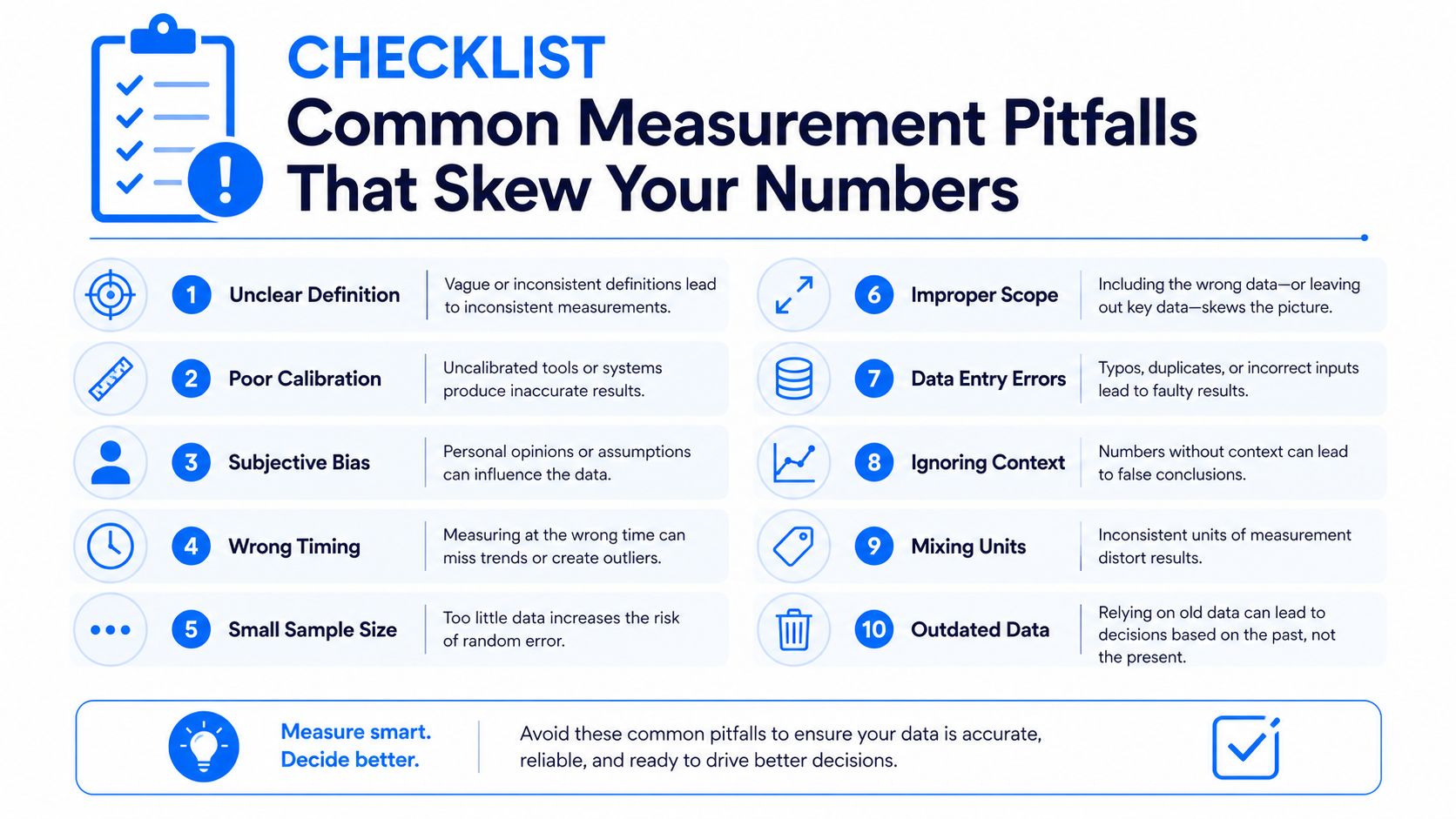
Most organizations don't have a CAC problem, they have a measurement problem. The metric gets distorted when different departments define “customer” differently, or when spend is allocated in a way that flatters one channel and penalizes another. That's exactly the blind spot called out in the benchmark material, where mixed channels make the numerator fuzzy for teams running paid, organic, outbound, and partner motions at once (GoCardless CAC guide).
The mistakes that distort the numerator
The most common error is counting media spend but leaving out the salaries of the people who make that media work. Another is mixing brand and demand budgets, then pretending the blended figure says something precise about channel efficiency. A third is using the same time window for every motion, even when the sales cycle is radically different by segment.
If your reporting window is shorter than your sales cycle, CAC will lie to you.
That's not a math issue, it's a timing issue. The same goes for assisted conversions. If an outbound rep sparks the opportunity and paid retargeting closes it, assigning all the credit to the final click can make the paid channel look cheaper than it really is. The reverse also happens, where a channel that creates demand gets punished because it doesn't own the last interaction.
A quick audit before you cut spend
- Check the customer definition. Make sure subscriber, lead, SQL, and paying account aren't being blended into one metric.
- Check the cost bucket. Confirm salaries, tools, agencies, and content are either all included or all excluded by policy.
- Check the time window. Match the reporting period to the actual buying cycle for that segment.
- Check channel overlap. Separate assisted conversions from directly attributed conversions before making cuts.
- Check ramp effects. New channels often look expensive before they mature, so isolate launch periods from steady-state reporting.
For teams sorting out multi-step journeys, multi-touch attribution is the right internal lens when the issue is not spend efficiency but credit assignment.
The core discipline is this. Don't call a channel expensive until you've verified that the model measuring it is consistent, complete, and aligned with how the business sells.
Strategies That Actually Lower Cost of Acquisition
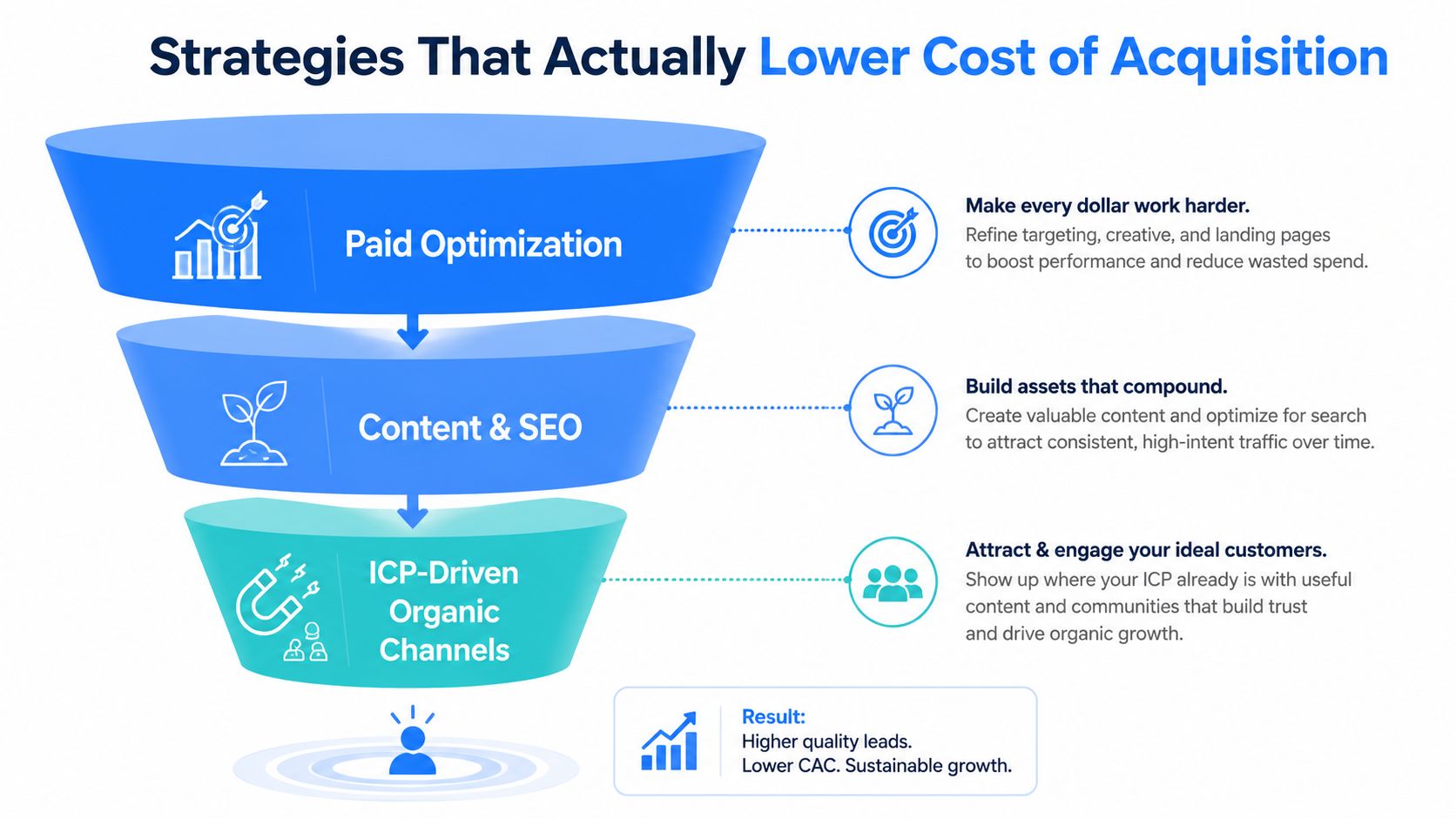
The most durable CAC reduction doesn't come from squeezing a paid channel a little harder. It comes from improving the quality of the people you target, the speed of conversion, and the share of acquisition that compounds over time instead of resetting every month. That's why the smartest teams push more weight toward organic, referral, and newsletter-led motions when they can.
Targeting discipline beats broad demand capture
The fastest way to waste acquisition spend is to target everyone who could possibly buy. Better ICP definition reduces wasted impressions, lowers sales friction, and shortens the path from first touch to conversion. When the audience is tighter, the same budget usually goes further because the team spends less time qualifying the wrong fit.
That logic applies to newsletters too. A broader list can look impressive, but if the subscribers don't match the buying profile, the effective cost of acquisition rises downstream. Teams that keep list hygiene tight, enrich contacts, and suppress bad-fit names usually end up with cleaner conversion data and less wasted send volume.
Practical rule: optimize for qualified reach, not just reach.
Owned channels compound while paid resets
Content and SEO matter because they create an asset that can keep producing traffic and signups after the first production cycle. Paid media stops the moment the budget stops. Owned channels keep working if the audience keeps trusting the voice and the message.
For B2B teams, newsletters sit in that compounding category. Breaker is one option in that lane, since it combines email sending with automatic list expansion for B2B audiences, and it uses targeting, AI enrichment, data hygiene, and deliverability controls to help teams grow an engaged list without treating every subscriber as a one-off media buy. That matters when the goal is to lower acquisition cost without losing contact quality.
Reduce friction after the click
Conversion rate improvements lower CAC even when top-of-funnel spend doesn't move. Stronger landing pages, tighter offer alignment, better routing, and faster follow-up all increase the share of visitors who become customers. In practical terms, a team can cut waste by removing delay between intent and response, especially in sales-led motions where the buyer has already raised their hand.
The most reliable playbook is not glamorous. Define the ICP more tightly, clean the list, focus on the channels that compound, and remove friction from the path to purchase. That combination usually beats a marginal bid change in a paid platform.
A 30-Day Plan to Get Your Cost of Acquisition Under Control
Week 1 should be a measurement audit, not an optimization sprint. Pull the current CAC formula into one document and list every line item that's included, every line item that's excluded, and the customer definition attached to the denominator. If finance, demand gen, and sales ops can't agree on the inputs, the dashboard is too fuzzy to steer from.
Week 2 should close attribution gaps. Map which channels contribute to first touch, assisted conversion, and final conversion, then separate direct credit from supporting credit. If the business runs paid, organic, outbound, and partner motions together, the goal is consistency, not perfect purity.
A simple weekly checklist
- Week 1 audit: document costs, time window, and customer definition.
- Week 2 attribution: identify where credit is being overassigned or underassigned.
- Week 3 experiment: pick the largest CAC leak and run one focused fix.
- Week 4 cadence: set a recurring review with finance, sales, and marketing.
Week 3 is for the biggest leak. If paid search is too expensive, test tighter targeting or a narrower offer. If outbound is bloated, tighten list hygiene and qualification rules. If the newsletter is growing but not converting, adjust the ICP definition before increasing send volume.
Week 4 locks the operating rhythm. Build a monthly CAC review that compares blended CAC, channel-level CAC, and payback context in the same meeting. The point is to catch drift early, before a quarter closes and the budget has already been spent.
Template prompt: “What changed in our numerator, our denominator, or our channel mix, and which change actually deserves the blame?”
If you want a clean place to start, Breaker gives B2B teams a newsletter system with sending, list expansion, targeting, enrichment, hygiene, and performance tracking in one workflow. For teams trying to lower acquisition cost without giving up list quality, Breaker is worth evaluating against the way your current channels behave.
If you're trying to make CAC legible to finance, sales, and marketing at the same time, Breaker can help you treat newsletter growth as a measurable acquisition channel instead of a separate experiment. Visit Breaker to see how a B2B newsletter stack can fit into a cleaner acquisition model and support better decisions on spend, targeting, and payback.
Keep reading
All articlesWhy Scraped Email Lists Fail GDPR Compliance in Any ESP
Scraped email lists break GDPR Articles 6 & 7, risk €20M fines, and get your ESP account suspended. Learn the legal reality and the compliant path forward.
B2B Newsletter Strategy for Marketers Who Sell to Niche Pros
Build a B2B newsletter that drives real pipeline. Covers audience definition, content structure, frequency, deliverability, and ROI measurement.
The Subscriber Acquisition Channels That Actually Move the Needle for B2B Newsletters
Every B2B newsletter eventually runs into the same wall: content is going out reliably, the format works, and the list still isn't growing fast enough.