
B2B Newsletter Strategy: Build a Revenue Channel in 2026
Turn your B2B newsletter into a pipeline engine with a 5-step framework covering revenue models, content mapping, cadence, handoff, and attribution.
Most B2B newsletters rack up opens and subscribers but never answer the question that matters to a CFO: what did this generate?
A revenue-generating business-to-business newsletter starts with five sequential steps, each building on the last. Skip any one and you have a content project, not a revenue channel. Pick a revenue model before you write a single issue. Map content to buying-committee roles and deal stages. Build a cadence you can sustain. Design a clean handoff from subscriber to sales pipeline. Instrument attribution so every dollar traces back to a specific issue.
This guide closes that gap. Not a template gallery or a generic checklist. A sequential operating system grounded in onboarding data from Breaker, on what moves a B2B newsletter from launch to measurable pipeline impact.
What a Revenue-Generating B2B Newsletter Actually Is
A business-to-business newsletter is a recurring email sent to prospects, customers, and partners in a company's total addressable market. It's built to move a buying committee through a sales cycle, not to entertain a mass consumer audience. That distinction shapes everything.
A consumer newsletter optimizes for attention and ad impressions. A B2B newsletter optimizes for influence over a decision that usually involves multiple stakeholders, a budget cycle, and a sales rep looking for warm signals. Most B2B newsletters stall because they're built like consumer newsletters. Marketing picks a topic, writes a monthly roundup, tracks open rate, and calls it a program. Nobody defines what success means in dollars. Nobody tells sales when a subscriber is ready to talk. Nobody connects the email platform to the CRM. The newsletter becomes a habit, not a system with inputs and outputs.
Here's the framework that fixes it:
- Define the revenue model your newsletter runs on (nurture, sponsorship/upsell, or hybrid) before drafting content.
- Map content to buying-committee roles and deal stages so every issue speaks to a real person at a specific point in their decision.
- Build an editorial cadence and issue framework your team can sustain past issue ten.
- Design a nurture-to-pipeline handoff with explicit criteria for when a reader becomes a marketing qualified lead.
- Instrument attribution so revenue traces back to a specific issue, segment, or send.
Each step builds on the one before. Skipping straight to "send more issues" without a revenue model is the single most common reason a newsletter looks busy and produces nothing. If you need a broader view of how this fits into a full B2B marketing motion, Breaker's B2B newsletter strategy guide covers the program-level decisions this article doesn't have room for.
Step 1: Define the Revenue Model Before You Write an Issue
Three Revenue Models, Three Different Paths
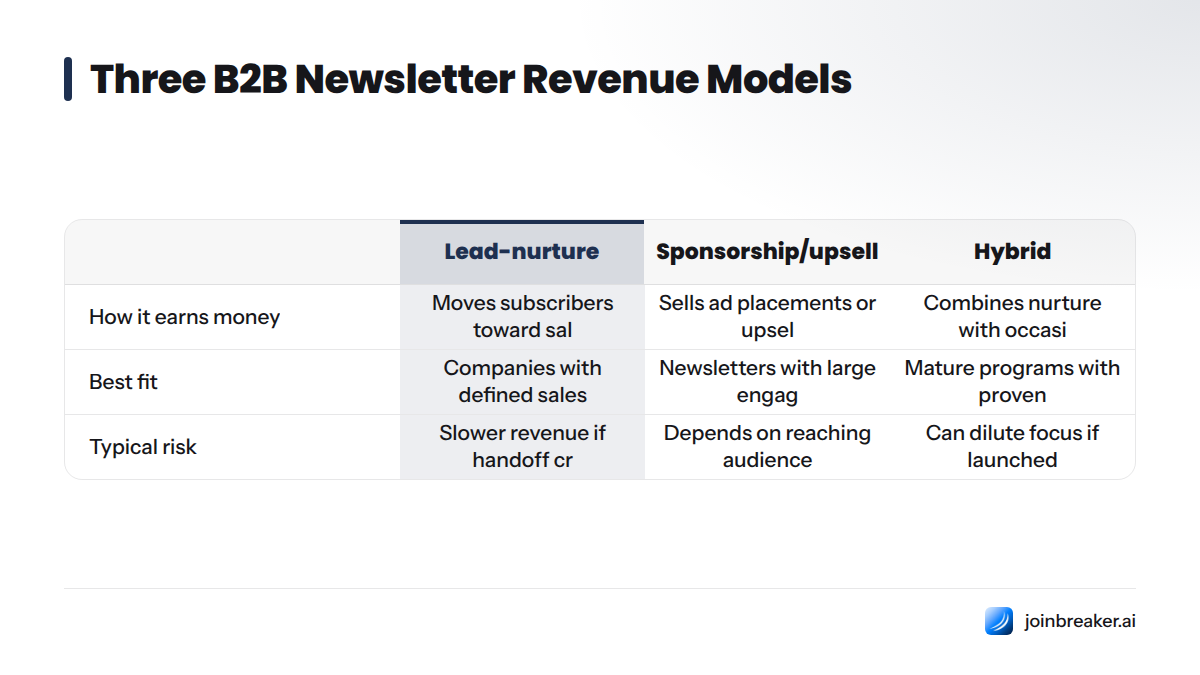
A B2B newsletter earns its keep in one of three ways. Picking the wrong one for your business creates friction you'll fight for a year.
| Revenue model | How it earns money | Best fit | Typical risk |
|---|---|---|---|
| Lead-nurture | Moves subscribers through deal stages toward a sales conversation or self-serve purchase | Companies with a defined sales process and existing pipeline | Slower to show revenue if handoff criteria are vague |
| Sponsorship/upsell | Sells ad placements to other vendors, or upsells existing customers on new products/tiers | Newsletters with a large, engaged audience or an existing customer base | Depends on audience size or customer base reaching critical mass first |
| Hybrid | Combines nurture content with occasional sponsorship or upsell placements | Mature programs that already have proof the nurture side works | Can dilute focus if launched too early |
A lead-nurture newsletter treats every issue as a step in a sales conversation that hasn't started yet. A sponsorship or product-upsell newsletter treats the audience itself as the asset, monetizing attention directly rather than funneling it to sales. Most companies starting from zero should pick one, not both. Breaker's guide to newsletter revenue streams for B2B monetization walks through how to weigh these against your audience size and sales motion in more depth.
Write Your Revenue Hypothesis Now
Before issue one goes out, write one sentence: "This newsletter will generate revenue by [nurturing X% of subscribers to an MQL within Y days] or [selling sponsorship inventory once we reach Z engaged subscribers]." That sentence forces a decision now instead of six months from now when a VP asks what the newsletter is actually doing for the pipeline.
Ask yourself before you commit:
- Do we already have a sales team that can act on warm signals, or are we building an audience to sell to directly?
- Is our sales cycle short enough that nurture can show revenue in one quarter, or long enough that we need interim proof points like sponsorship revenue?
- Do we have enough subscriber volume today to support a sponsorship model, or does that have to wait?
- Who owns the number this newsletter is accountable to: marketing, sales, or a shared revenue team?
Step 2: Map Content to Buying-Committee Roles and Deal Stages
Who Sits on a B2B Buying Committee
A buying committee is the group of people inside a prospect's company who influence or approve a purchase decision. Gartner's research on B2B buying journeys shows a typical purchase involves six to ten decision makers, each carrying different information and different risk concerns into the decision. A newsletter that writes only to the end user and ignores the economic buyer or technical evaluator leaves most of the committee uninformed.
Common committee roles include:
- Champion - the internal advocate who found your product and pushes it forward
- Economic buyer - controls budget and signs off on spend
- Technical evaluator - assesses feasibility, security, or integration fit
- End user - will actually use the product day to day
- Procurement/legal - manages contract terms and vendor risk
Match Content Themes to Where They Are in the Deal
Deal stage describes where a prospect sits in the journey from unaware to customer. Content that works at awareness (a trend explainer) will fall flat in a decision-stage inbox where the reader wants proof, pricing logic, or implementation detail.
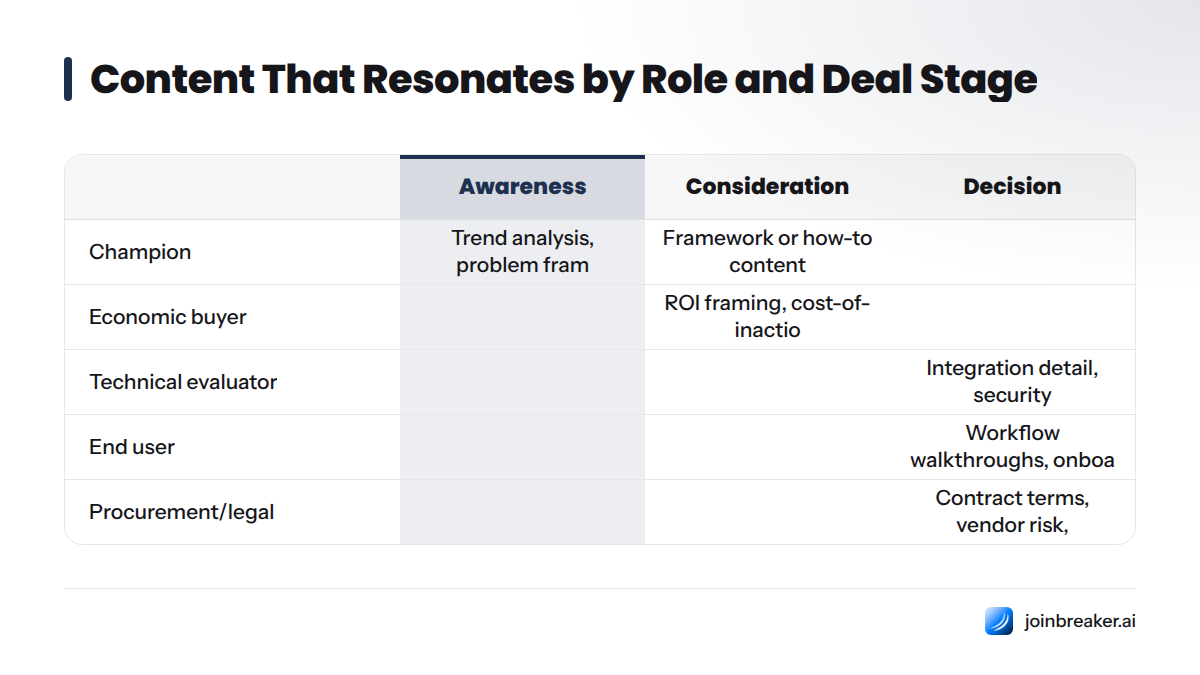
| Buying-committee role | Deal stage | Content type that resonates |
|---|---|---|
| Champion | Awareness | Trend analysis, problem framing, peer benchmarks |
| Champion | Consideration | Framework or how-to content they can bring to their team |
| Economic buyer | Consideration | ROI framing, cost-of-inaction cases, budget-cycle timing |
| Technical evaluator | Decision | Integration detail, security posture, implementation steps |
| End user | Decision | Workflow walkthroughs, onboarding previews, feature depth |
| Procurement/legal | Decision | Contract terms, vendor comparisons, risk mitigation notes |
A hypothetical example: a newsletter selling a RevOps platform might run an awareness-stage issue on why pipeline forecasting is breaking down industry-wide, a consideration-stage issue walking through a forecasting framework, and a decision-stage issue showing exactly how data flows from CRM to newsletter platform during onboarding. Same publication, three very different readers, three different jobs for the content to do.
If your sales cycle runs long, pairing the newsletter with other nurture touches matters more than relying on email alone. Breaker's piece on multi-channel nurturing in long sales cycles is worth reading alongside this step.
Step 3: Build the Editorial Cadence and Issue Framework
Choose a Cadence You Can Actually Keep
The right cadence depends on sales cycle length and editorial capacity, not on what competitors do. A newsletter supporting a 90-day sales cycle can sustain weekly or biweekly sends because content needs to stay top of mind through a shorter window. A newsletter supporting a 12-month enterprise cycle can run monthly and still stay relevant, because the committee isn't making a decision next week.
The mistake to avoid: committing to weekly when your team can only produce something substantive monthly. A thin weekly issue trains subscribers to skim and ignore. A dense monthly issue trains them to open with intent. Cadence is a promise. Keep the one you can actually keep.
Build a Repeatable Issue Template
Newsletters that compound over time use a structure readers recognize, not a blank page every cycle. A workable template includes:
- One anchor piece tied to a specific deal-stage audience
- A short "what we're seeing" section drawing on patterns across your customer or prospect base
- One actionable takeaway or framework the reader can use immediately
- A single, relevant call to action
Get your editorial calendar started with this checklist:
- Map the next 8-12 issue topics to buying-committee roles and deal stages
- Assign an owner and a deadline for each issue
- Build one repeatable section template and reuse it every issue
- Set a review cadence to retire topics that aren't driving engagement
- Tag each issue in your editorial calendar with its intended revenue model (nurture vs. sponsorship)
For teams building this calendar from scratch, Breaker's guide on newsletter funnel strategy to boost subscriber engagement has more detail on sequencing content for engagement before you layer in revenue goals.
Step 4: Design the Nurture-to-Pipeline Handoff
Define MQL Criteria for Newsletter Engagement
A marketing qualified lead, or MQL, is a subscriber whose behavior signals real buying intent, not just curiosity. For a newsletter, that usually means something more specific than "opened an email." Reasonable MQL criteria might include:
- Clicking into decision-stage content (pricing pages, implementation guides) rather than just awareness content
- Engaging with three or more consecutive issues
- Visiting a pricing or demo page after a newsletter click
- Matching a target account or buying-committee role in your CRM
The point of writing this down is to stop the argument between marketing and sales about what "qualified" means. Without it, sales ignores newsletter leads because they don't trust the signal, and marketing keeps sending leads sales won't work.
How Subscribers Move from Engaged to Revenue
The flow from subscriber to revenue typically moves through four states: subscriber, engaged reader, MQL, and sales-worked opportunity. A subscriber becomes an engaged reader once they show repeat interaction. An engaged reader becomes an MQL once they cross the criteria your team defined. An MQL becomes an opportunity once a sales rep confirms fit and budget.
The handoff breaks down most often at the MQL-to-opportunity step, because sales reps don't see newsletter engagement inside their day-to-day tools. That's a CRM integration problem, which Step 5 addresses. For teams building automation around this handoff, Breaker's guide to B2B drip campaign workflows shows how to sequence automated nurture touches around the newsletter itself.
This video from HubSpot Marketing covers where newsletter strategy is headed industry-wide, including how operators are rethinking the handoff between content and sales in 2026.
Step 5: Instrument Attribution So Revenue Is Traceable
Connect Your Newsletter Platform to Your CRM
Attribution is the practice of tracing revenue or pipeline outcomes back to the specific marketing touch that influenced them - in this case a newsletter issue or segment. You can't do this without a live connection between your newsletter platform and your CRM. Breaker's audience graph and TruSend are built around this exact need: keeping subscriber engagement data, segment membership, and send history synced with CRM records so a sales rep can see newsletter activity on the same record where they see everything else about that account.
Without that connection, every attribution claim is a guess reconstructed from spreadsheets. With it, a rep opening a contact record sees "clicked three decision-stage issues in the last 30 days" sitting right next to deal history.
Track Revenue per Recipient and Revenue per Email
Two metrics do most of the work once the CRM connection is live:
- Revenue per recipient (RPR) measures total revenue generated divided by the number of subscribers who received a given issue or campaign. It tells you how much a specific send is worth per person on the list.
- Revenue per email (RPE) measures revenue generated per individual email sent, which is useful for comparing efficiency across sends of different sizes.
Breaker's glossary entries on revenue per recipient and revenue per email break down the exact formulas and when to use each one. For a fuller view of the metrics stack around these two numbers, the ultimate guide to B2B newsletter performance metrics is the natural next read.
Set up a minimum attribution stack with:
- A newsletter platform that logs engagement at the individual subscriber level, not just aggregate opens
- A CRM field or object tracking newsletter engagement history per contact
- A shared definition of MQL criteria written down somewhere both marketing and sales reference
- A monthly reporting cadence that reviews revenue per recipient alongside pipeline created
See how Breaker's audience graph and TruSend connect newsletter engagement directly to CRM records, closing the attribution gap most B2B newsletter programs never solve.
How Fast Different Strategy Types Reach First Revenue
Patterns observed across Breaker's onboarding journeys show a consistent spread in how quickly different revenue models reach their first dollar of attributable revenue. This reflects patterns across newsletter programs launched on the Breaker platform rather than a universal guarantee for any single company.
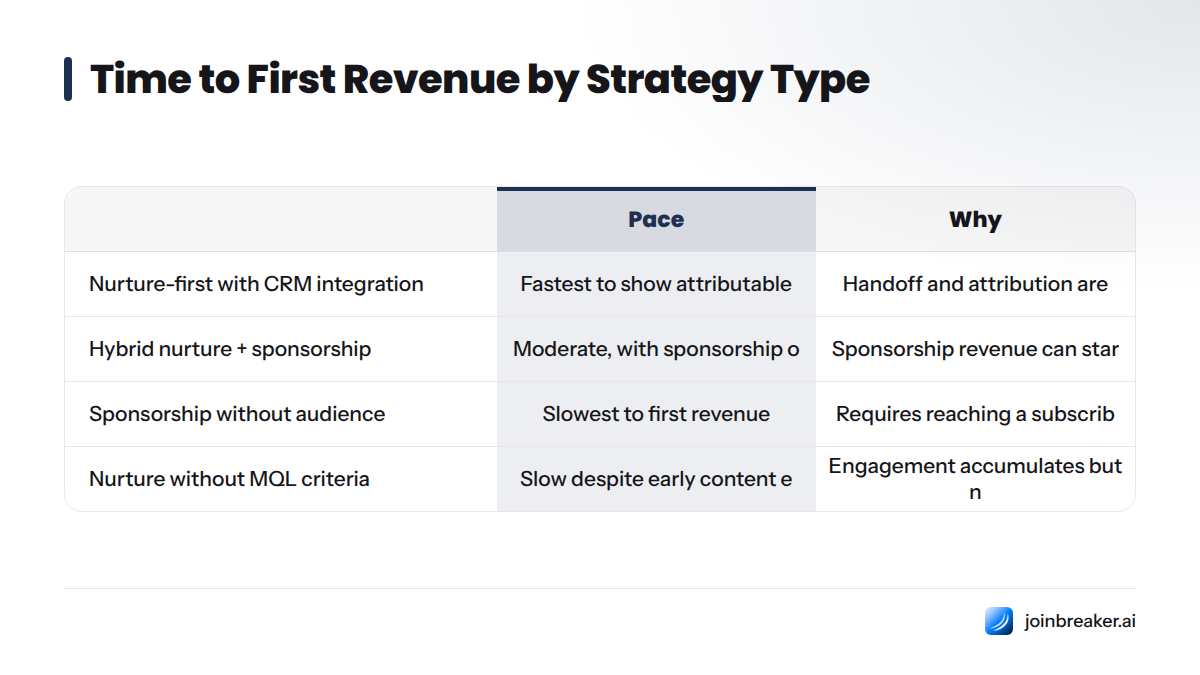
| Strategy type | Typical time-to-first-revenue pattern | Why it moves at this pace |
|---|---|---|
| Nurture-first (clear MQL criteria + CRM integration from day one) | Fastest to show attributable pipeline revenue | Handoff and attribution are built in from issue one, so revenue is traceable as soon as the first MQL converts |
| Hybrid (nurture content plus early sponsorship testing) | Moderate, with sponsorship often showing cash revenue before nurture shows pipeline revenue | Sponsorship revenue can start before the audience is large, while nurture still depends on sales cycle length |
| Sponsorship/upsell-first without an established audience | Slowest to first revenue | Requires reaching a subscriber or engagement threshold before sponsorship inventory has value |
| Nurture-first without defined MQL criteria or CRM integration | Slow despite early content effort | Engagement accumulates but nothing is instrumented to convert it into traceable revenue |
One pattern shows up again and again: the strategy type matters less than whether attribution and handoff criteria exist from the start. Programs that wait until month four to define an MQL or connect a CRM consistently take longer to show revenue, regardless of which revenue model they chose. This is the single clearest signal in Breaker's onboarding data, and it's the reason Steps 4 and 5 are framed as "do this now," not "do this eventually."
Common Mistakes That Stall a B2B Newsletter's Revenue Timeline
- No defined revenue model. The team writes good content with no hypothesis about how it earns money, so there's nothing to measure success against.
- Generic content that ignores deal stage. Every issue reads like a company blog post, speaking to nobody on the buying committee in particular.
- No MQL criteria written down anywhere. Sales and marketing argue about what "qualified" means instead of working leads.
- No CRM connection. Engagement data sits in the newsletter platform while deal data sits in the CRM, and nobody can see both at once.
- Treating cadence as a vanity metric. Sending weekly because it looks active, not because the sales cycle or content capacity supports it.
- Measuring open rate and nothing else. Open rate tells you almost nothing about revenue; revenue per recipient and pipeline created tell you everything.
- Launching sponsorship before the audience justifies it. Selling placements to a list too small to matter burns credibility with potential sponsors and subscribers alike.
- Treating the newsletter as a side project. No owner, no deadline cadence, no review process, so issues become sporadic and trust erodes.
Your 90-Day B2B Newsletter Revenue Roadmap
Days 1-30: Foundation
- Write your revenue hypothesis and choose nurture, sponsorship/upsell, or hybrid
- Map your buying committee and the deal stages your sales cycle moves through
- Build the buying-committee x deal-stage content matrix from Step 2
- Set a cadence you can sustain for at least six months
- Draft your MQL criteria, even in rough form, so Step 4 isn't starting from zero at day 60
Days 31-60: Execution
- Produce and send the first 4-8 issues against your editorial calendar
- Connect your newsletter platform to your CRM so engagement data starts flowing before you need it
- Finalize MQL criteria with input from sales, not just marketing
- Set up tracking for revenue per recipient and revenue per email from the first sendable issue
Days 61-90: Optimization
- Review attribution data: which issues, segments, or deal stages are producing engaged readers and MQLs
- Hold a checkpoint with sales on handoff quality: are newsletter-sourced leads worth working?
- Identify your first revenue checkpoint, whether that's a closed deal influenced by the newsletter or confirmed sponsorship revenue
- Decide what to double down on and what to cut before planning the next 90 days
Once the first checkpoint is behind you, growth questions become the priority: list growth, segmentation depth, and possibly adding a second revenue stream. Breaker's guide to scaling a B2B newsletter picks up exactly where this roadmap ends.
This video from Holly Mack looks at which B2B marketing channels are earning their keep going into 2026, useful context as you decide how much weight your newsletter should carry relative to other channels.
Frequently Asked Questions
What is a business-to-business (B2B) newsletter? A B2B newsletter is a recurring email publication sent to a company's prospects, customers, and partners, designed to move a buying committee toward a purchase decision rather than simply entertain a mass audience.
How is a B2B newsletter different from a consumer newsletter? A B2B newsletter is built around a buying committee, a sales cycle, and deal stages, while a consumer newsletter is typically built around individual attention and ad or subscription revenue without a multi-stakeholder decision process behind it.
What revenue models can a B2B newsletter use? Three: lead-nurture (moving subscribers toward a sales conversation), sponsorship/upsell (monetizing the audience directly through ad placements or product upsells), or a hybrid combining both.
What is a buying committee and why does it matter for newsletter content? A buying committee is the group of people inside a prospect company, often six to ten according to Gartner's research on B2B buying journeys, who influence or approve a purchase. Newsletter content that ignores most of that committee fails to inform the people actually making the decision.
What counts as a marketing qualified lead (MQL) from a newsletter? Criteria vary by company, but reasonable signals include clicking decision-stage content, engaging with several consecutive issues, visiting a pricing or demo page after a newsletter click, or matching a target account in the CRM.
How long does it typically take to see first revenue from a B2B newsletter? It depends heavily on whether MQL criteria and CRM integration exist from the start. Breaker's onboarding data shows nurture-first programs with attribution built in from day one reach first revenue fastest, while programs that delay attribution setup consistently lag regardless of revenue model.
Can sponsorships or product upsells work in a B2B newsletter? Yes, once the audience is large and engaged enough to justify it. Sponsorship-first programs launched before reaching that threshold tend to show the slowest path to first revenue in Breaker's onboarding patterns.
What are some good examples of B2B newsletters? Breaker's roundup of B2B newsletter examples that drive pipeline walks through real-world formats worth studying before you build your own.
Are newsletters still relevant in 2026? Yes. Email remains one of the few owned channels a B2B company fully controls, unaffected by algorithm changes on third-party platforms, which is part of why first-party attribution and CRM integration matter so much for proving the channel's worth.
How do you segment a B2B newsletter audience? Segment by buying-committee role, deal stage, account tier, and engagement level at minimum. Role and deal stage determine what content a subscriber should see; engagement level determines whether they're ready to move toward an MQL designation.
Making the Newsletter Earn Its Place on the Revenue Team
A B2B newsletter stops being a content project the moment it has a revenue model, a defined audience map, a cadence it can keep, a handoff sales trusts, and attribution that proves what happened. None of that requires a bigger team or a bigger budget. It requires sequence: decide the model first, map the committee second, build cadence third, design the handoff fourth, and instrument attribution fifth.
The companies that skip straight to "send more content" are the ones still arguing about whether the newsletter is working a year later. The ones that follow this order, even imperfectly, have an answer the first time someone asks what the newsletter is worth.
Sources
Related: b2b newsletter marketing
Keep reading
All articlesNewsletter Agency Services: How Agencies Scale Client Newsletters
Managing multiple client newsletters? Learn what a true newsletter agency platform needs to prevent list mixing, voice drift, and invisible ROI.
Building Owned Audiences: Move Followers to Your Newsletter in 2026
Social platforms can vanish overnight. Learn how to convert Instagram, TikTok, and YouTube followers into a newsletter list you actually own.
Newsletter Analytics: Which Metrics Actually Matter in 2026
Open rate and clicks don't predict buyers. Learn the 7-step method to track click depth, recency, and topic affinity for a revenue-predictive intent score.