
Building Owned Audiences: Move Followers to Your Newsletter in 2026
Social platforms can vanish overnight. Learn how to convert Instagram, TikTok, and YouTube followers into a newsletter list you actually own.
Social platforms can take your audience away overnight. A policy change, an algorithm tweak, a suspended account - and years of built reach vanishes. Building owned audiences means converting the followers you've earned on Instagram, TikTok, X, YouTube, and LinkedIn into newsletter subscribers you control directly through your own email list, with no platform standing between you and the people who want to hear from you.
This guide walks through that system step by step.
Why Owned Audiences Matter More Than You Think
An owned audience is a list of people you can reach directly, on your own terms, through a channel you control - typically email. A rented audience is the reach you borrow from a third-party platform like Instagram or TikTok, where the platform decides whether, when, and how your content reaches them.
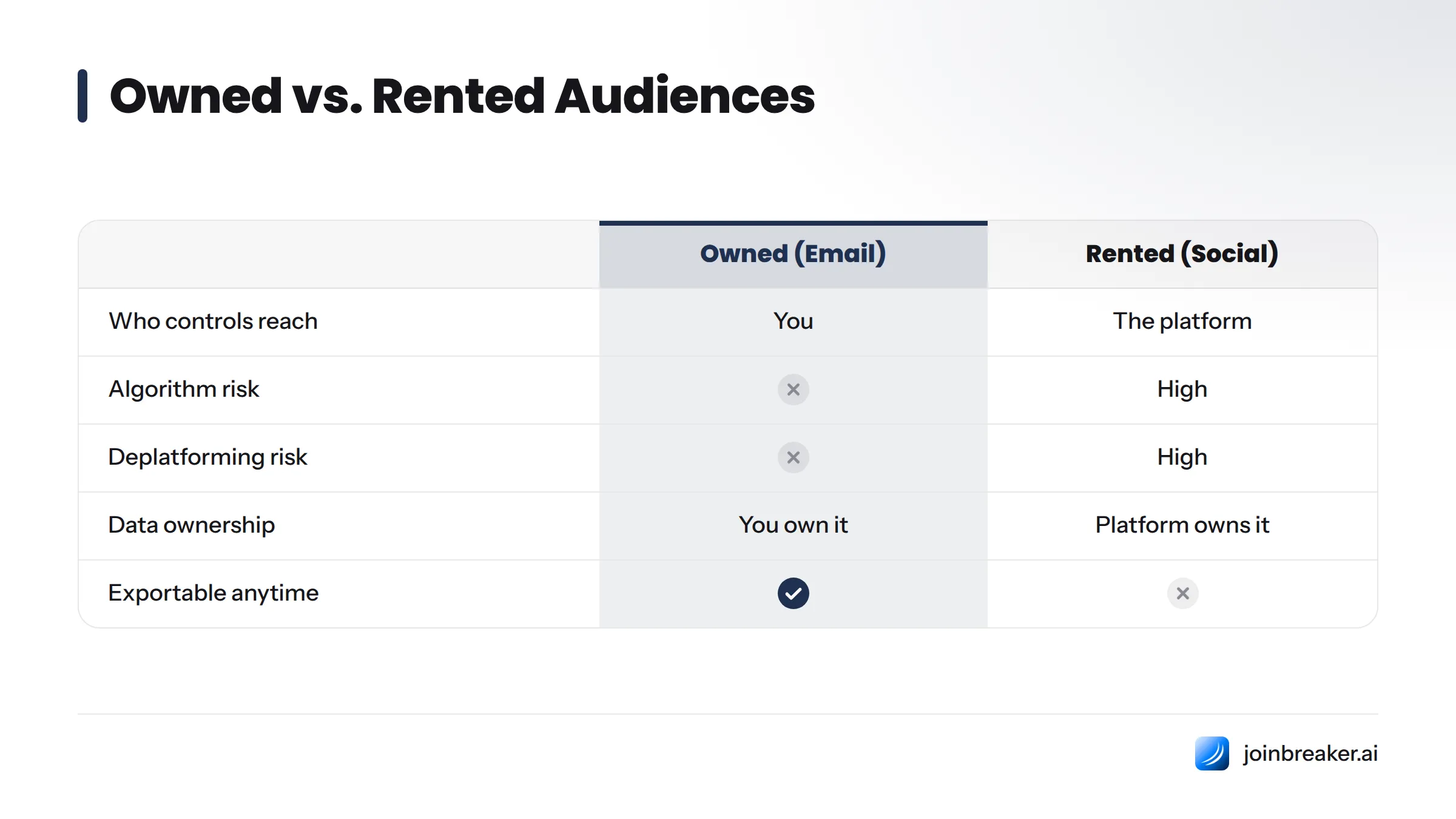
The distinction isn't academic. When you post to social followers, you're not guaranteed to reach them. Instagram, TikTok, and similar apps use ranking algorithms that decide post by post who sees your content. A follower count of 50,000 might sound impressive, but if the algorithm only shows your posts to 4,000 of those people, your real reach is a fraction of what the number suggests.
This is platform algorithm risk: the possibility that a ranking change, a policy update, or a shift in platform priorities reduces your organic reach without warning. It happens regardless of how many people technically follow you.
There's also deplatforming risk. Accounts get suspended, banned, or shadowbanned. When that happens, every follower you built disappears from your reach instantly. An email list doesn't have that vulnerability. You own the list, can export it anytime, and can move it to a different service provider if needed.
A follower count that keeps climbing can also mask decay underneath. People follow then quietly stop engaging. Algorithms deprioritize older connections. Inactive accounts sit in your follower count doing nothing. Growth on the surface hides shrinkage in actual reach. A newsletter subscriber list reveals this more directly: an open or a click is a direct signal, not filtered through a ranking system.
Here's how the tradeoffs compare:
| Characteristic | Owned Audience (Email) | Rented Audience (Social) |
|---|---|---|
| Who controls reach | You | The platform |
| Risk of sudden loss | Low | High |
| Direct communication | Yes | No, depends on feed ranking |
| Data ownership | Yours | Platform owns it |
| Portability | Exportable to any provider | Not transferable |
| Measurement clarity | Opens, clicks, direct actions | Impressions filtered by algorithm |
| Cost to maintain reach | Email sending costs only | Often requires paid boosting |
Social platforms aren't worthless - they're excellent for discovery and reaching new eyes on your work. The mistake is treating followers as the finish line instead of the starting point.
Step 1: Audit Your Social Platforms for Migration Potential
Before you ask anyone to join your newsletter, find out where your best migration candidates already live. Not every platform or follower is equally likely to convert, so an audit saves you from spreading effort across channels that won't pay off.
Raw follower count is the least useful metric here. A platform where you have 8,000 followers but a 6% engagement rate is a better migration target than one with 80,000 followers and a 0.4% engagement rate. Engaged followers have shown they pay attention to what you post, making them far more likely to click a newsletter link than passive followers who haven't interacted in months.
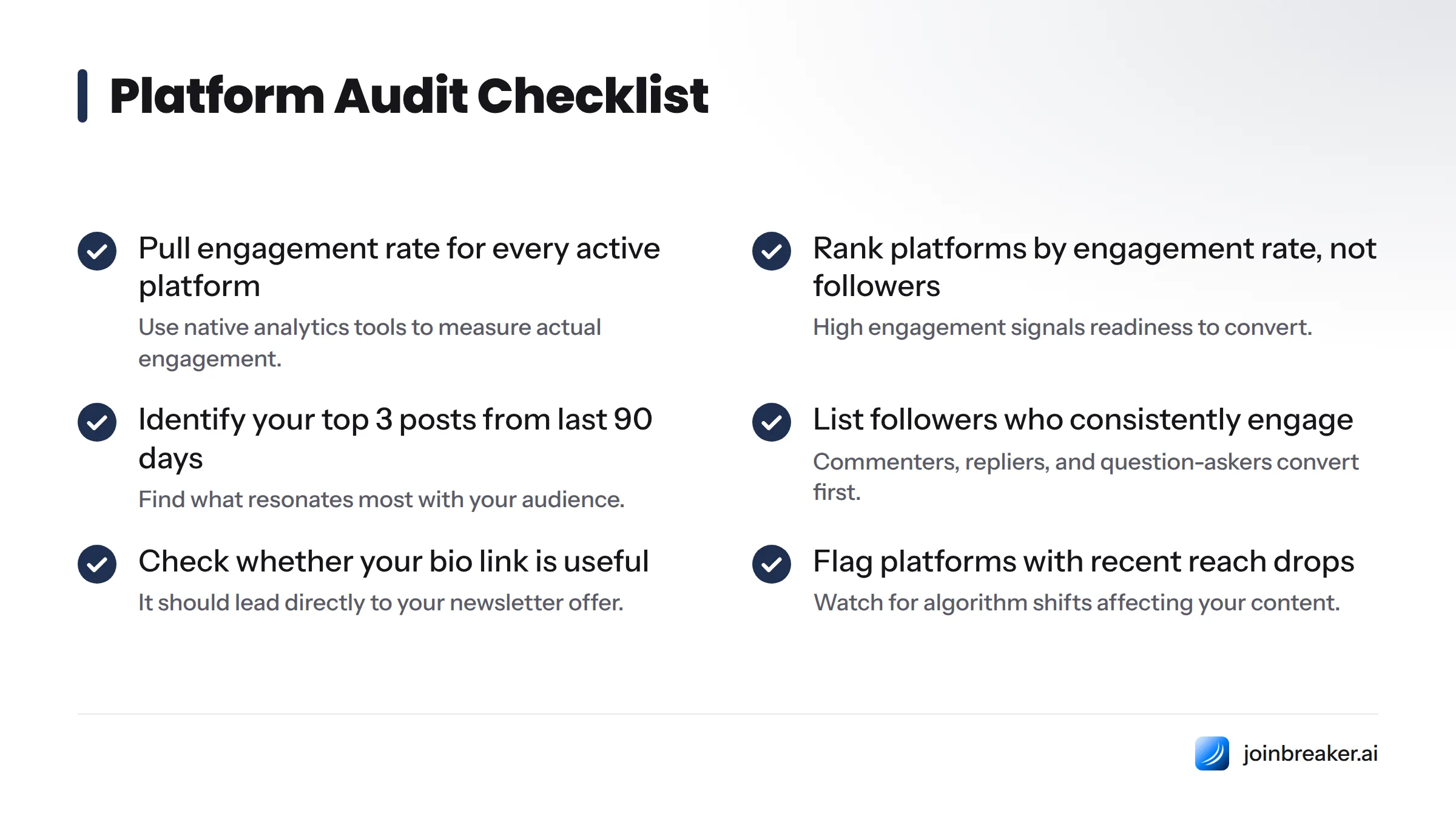
Pull engagement rate for each platform using native analytics (Instagram Insights, TikTok Analytics, YouTube Studio, X Analytics, LinkedIn Analytics) and rank your platforms by that number, not by total followers.
Within any platform, some followers are more ready to subscribe than others. Look for people who comment regularly, watch multiple videos, respond to Stories or polls, click links in your bio, or ask follow-up questions. These high-intent segments are your first wave - they're already demonstrating they want more from you than a passive scroll.
Platform Audit Checklist
- Pull engagement rate for every active platform
- Rank platforms from highest to lowest engagement rate
- Identify your top 3 highest-performing posts from the last 90 days
- List followers who consistently comment, reply, or DM you
- Check whether your bio link points somewhere useful
- Note which platform gives you the most profile visits relative to followers
- Flag platforms where you've experienced recent reach drops
Step 2: Choose a Lead Magnet That Actually Converts
A lead magnet is the specific reason someone signs up for your newsletter instead of just continuing to follow you. Without one, you're asking people to trade their inbox for vague promises. With the right one, you're offering a clear trade: give me your email, get something useful right now.
The formats that consistently convert social followers into subscribers are:
- Checklists and cheat sheets - fast to consume, easy to promise in one sentence
- Templates - swipe files, spreadsheets, or frameworks followers can apply immediately
- Exclusive content - behind-the-scenes material or deeper versions of what you post publicly
- Discounts or perks - relevant if you have a product, service, or paid community
- Mini-courses or email sequences - a short, multi-day series for subscribers only
- Data or research reports - original findings followers can't get elsewhere
The right format depends on where your audience is and what they already expect from you:
| Lead Magnet Type | Best Platform | Why It Works |
|---|---|---|
| Checklist / cheat sheet | Instagram, TikTok | Matches quick, visual consumption habits |
| Template or swipe file | LinkedIn, X | Professional audiences want immediate application |
| Exclusive behind-the-scenes | YouTube, TikTok | Video audiences invest attention and want depth |
| Discount or perk | Instagram, YouTube | Works for creators with products or memberships |
| Mini-course / email sequence | YouTube, LinkedIn | Suits audiences comfortable with longer learning |
| Original data or report | LinkedIn, X | Appeals to audiences valuing credibility |
Step 3: Place Newsletter Calls-to-Action Across Every Touchpoint
A single mention buried in a bio won't move the needle. Converting social followers takes repeated, visible, low-friction calls-to-action placed everywhere a follower might see them.
Your bio link is the one clickable door off most social platforms, so it needs to work hard. Use a dedicated landing page that leads with your newsletter offer, not a generic list of unrelated links. State the lead magnet clearly in the link text itself - "Get the free checklist" works better than "Link in bio for more."
Once someone lands on your signup page, keep the form to a single field (email only) whenever possible. Every additional field reduces completion rates. State the lead magnet benefit directly above the form, use a button label that names the action ("Send me the checklist" beats "Submit"), and ensure the form is mobile-first, since most social traffic arrives on phones.
Spread CTAs across every format you publish:
- Captions: Mention the newsletter in the first two lines, since many platforms truncate captions after that point
- Pinned posts or comments: Pin a post explaining what subscribers get
- Video descriptions: Place the newsletter link in the first line, above the fold
- Stories and Reels: Use native link stickers where supported
- End-of-video callouts: Verbally mention the newsletter in the last 10-15 seconds, when attention peaks
CTA Placement Checklist
- Bio link leads directly to a newsletter-focused landing page
- Lead magnet is named explicitly in the bio link text
- Newsletter is mentioned in captions early
- A pinned post or comment promotes the newsletter
- Video descriptions include the signup link above the fold
- At least one Story, Reel, or short-form post per week includes a direct CTA
- Signup form is single-field and mobile-optimized
Step 4: Run a Migration Sequence for Each Platform
Each platform has different mechanics for newsletter CTAs. Treat this as a sequence, not a single blast, starting with whichever platform your audit identified as highest priority.
Instagram: Use the single bio link for your newsletter landing page, add link stickers to Stories, and mention the newsletter explicitly in caption text. Link stickers in Stories are among the most direct ways to drive off-platform traffic.
X (Twitter): Pin a tweet explaining your newsletter offer and linking to signup. Mention the newsletter periodically in replies where genuinely relevant. Threads and long-form posts get more visibility, so a thread that delivers value and ends with a newsletter CTA tends to outperform a single promotional tweet.
TikTok: Treat the bio link the same way as Instagram - name the lead magnet directly. Use on-screen text to mention the newsletter without speaking, since many viewers watch muted. Pin your own comment with the signup link under high-performing videos.
YouTube: Put your newsletter link as the first line of every video description, above the "show more" cutoff. Use end screens to point to a signup landing page if eligible. Mention the newsletter verbally partway through longer videos, when watch-time data shows viewers are still engaged rather than at the very end.
LinkedIn: LinkedIn now has a native newsletter feature that lets you publish directly on-platform and build a subscriber base inside LinkedIn itself, which can function as a bridge before migrating readers to your independently owned email list. Mention your external newsletter in post text, link it in your profile's featured section, and use carousel posts or documents, which LinkedIn favors for engagement.
What Conversion Rates to Expect
Based on Breaker's proprietary data from creator and publisher accounts actively running social-to-newsletter migration campaigns, here's how conversion rate (click-to-subscribe) breaks down by platform and content type:
| Platform | Content Type | Conversion Level |
|---|---|---|
| YouTube | Long-form video | Highest |
| Text post / article | Strong | |
| X (Twitter) | Long-form thread | Strong |
| Stories with link sticker | Moderate | |
| Short carousel | Moderate | |
| TikTok | Short-form video | Lowest |
| Short-form Reel | Lowest |
This data reflects Breaker's first-party benchmark from creator and publisher accounts on our platform, not a universal industry standard. Treat it as directional guidance, since your own numbers depend on niche, audience trust, and how clearly your lead magnet is positioned.
The pattern: platforms and formats requiring sustained attention - long-form video, long-form text, threads - convert at higher rates than fast-scroll formats. Someone who watches a 12-minute YouTube video has already invested real time, signaling higher baseline interest than someone who swipes past a 15-second Reel. Short-form content excels at reach and discovery, but the audiences it builds are typically earlier in the trust curve and need more touchpoints before converting to email subscribers.
Step 5: Track Progress and Iterate on What Works
None of the steps above matter if you can't tell which platform, lead magnet, or CTA placement is actually driving signups. Tracking turns a one-time push into a system you can improve over time.
Use UTM parameters - small tags added to the end of URLs - to tell your analytics exactly where a click came from. A link like yournewsletter.com/subscribe?utm_source=instagram&utm_medium=bio&utm_campaign=migration tells you that the signup came from your Instagram bio as part of your migration campaign.
Set a unique UTM combination for every platform and every placement: one for Instagram bio, a separate one for Instagram Stories, another for YouTube description, and so on. Without this level of tagging, every signup looks like "direct traffic," and you lose the ability to tell which platform is actually working.
Once UTM data flows into your analytics, look for patterns over weeks, not days. A single day of data is noise. A few weeks of consistent signal tells you where to invest more effort.
Simple decision framework:
- If a channel underperforms for 3-4 weeks despite consistent CTA placement, test a different lead magnet before abandoning it
- If a channel outperforms expectations, increase CTA frequency there
- If a specific content type consistently converts better, shift more publishing effort toward that format
- If signups plateau, test new CTA copy or a new lead magnet rather than assuming the platform is exhausted
Common Mistakes That Stall Migration
Most migration efforts don't fail because the idea is wrong. They fail because of avoidable execution mistakes:
- No clear lead magnet: Asking people to "join my newsletter" with no specific benefit gives them no reason to act now
- CTA buried in bio only: A single link nobody scrolls to is not a strategy, it's a hope
- No tracking in place: Without UTM tagging, you can't tell which platform or placement is working, so you keep guessing instead of improving
- One-and-done promotion: A single announcement post gets seen by a fraction of your audience. Migration requires repeated touchpoints over weeks
- Treating every platform the same: Copy-pasting the same CTA across Instagram, TikTok, and LinkedIn ignores how differently each platform's audience behaves
- Ignoring high-intent segments: Spending equal effort on passive followers and your most engaged commenters wastes effort where conversion is most likely
- No lead magnet refresh: Using the same offer for months after it stops performing, instead of testing new formats when rates drop
Avoiding these mistakes is often more valuable than finding one more clever tactic. A clean, consistent execution of this five-step framework outperforms a flashy one-off campaign almost every time.
Frequently Asked Questions
What does it mean to have an "owned audience"?
An owned audience is a group of people you can reach directly on a channel you control, most commonly an email list, without depending on a third-party platform's algorithm to decide whether your message gets through.
What is the difference between an owned audience and a rented audience?
An owned audience is one you control directly, like an email list you can export and move anytime. A rented audience is the reach you borrow from a social platform, where the platform controls algorithmic distribution, account access, and the rules you operate under.
Why aren't social media followers considered an owned audience?
Because you don't control access to them. The platform decides who sees your posts, can change its algorithm at any time, and can suspend or ban your account, instantly cutting off your ability to reach every follower you've built.
What is platform algorithm risk and how does it affect creators?
Platform algorithm risk is the possibility that a ranking or policy change reduces your organic reach, even if your follower count stays the same. It affects creators by making reach unpredictable and largely outside their control.
Which social platform converts followers to newsletter subscribers best?
Based on Breaker's first-party creator data, long-form content formats - particularly long-form YouTube video and LinkedIn text posts or articles - produce the strongest click-to-subscribe conversion rates, while short-form formats like TikTok and Instagram Reels convert at lower rates.
What is a lead magnet and which type works best for growing a newsletter?
A lead magnet is a specific, tangible incentive like a checklist, template, or exclusive content, offered in exchange for an email signup. The best type depends on your platform and audience: short-form audiences respond well to checklists, while professional audiences on LinkedIn or X often respond better to templates or original data.
How do I optimize my "link in bio" to drive newsletter signups?
Point your bio link directly to a dedicated newsletter landing page rather than a generic link list, name your lead magnet explicitly in the link text, and keep the landing page to a single clear CTA with minimal distraction.
What conversion rate should I expect when migrating social followers to a newsletter?
Conversion rates vary meaningfully by platform and content type. Breaker's first-party data shows long-form video and text content converting at the highest rates, with short-form video formats converting at the lowest rates among platforms measured.
How do I track which platform is driving the most newsletter signups?
Add unique UTM parameters to every link you share, with a distinct combination for each platform and placement, so your analytics or email service provider can attribute each signup to its exact source.
Should I focus on one platform at a time or migrate from all platforms simultaneously?
Start with the platform your audit identifies as having the highest engagement rate relative to follower count, run a focused CTA sequence there, then expand to additional platforms once you have tracking in place to measure what's working.
The Real Asset Is the Relationship You Own
Building an owned audience isn't a one-time project. It's an ongoing habit of treating every social post as a potential doorway to a relationship you actually control. Platforms will keep changing their algorithms, policies, and sometimes their entire business models. A newsletter built for creators, with direct ownership of your subscriber data, is the most durable way to make sure platform changes don't put your audience at risk.
Start with the audit, pick one lead magnet, place your CTAs consistently, and let the tracking tell you what to do next.
Related: newsletter platform for publishers, newsletter platform for creators
Keep reading
All articlesNewsletter Analytics: Which Metrics Actually Matter in 2026
Open rate and clicks don't predict buyers. Learn the 7-step method to track click depth, recency, and topic affinity for a revenue-predictive intent score.
Newsletter Segmentation Strategy: Increase Engagement in 2026
Build a data-driven newsletter segmentation strategy using behavior, intent score, and topic affinity to lift opens and clicks. Step-by-step guide.
How to Grow Newsletter Subscribers with Qualified Leads in 2026
Discover 8 channels to grow engaged newsletter subscribers in 2026, with real cost-per-engaged-subscriber data to focus your list-building strategy.